

EN 15595:2018+A1:2023
(Main + Amendment)Railway applications - Braking - Wheel slide protection
- Abstract
This document specifies the criteria for system acceptance and type approval of a wheel slide protection (WSP) system. It also specifies criteria for the implementation of WSP to specific vehicle applications and specific operating conditions, as well as requirements for wheel rotation monitoring (WRM). This includes the design, testing and quality assessment of the WSP and WRM systems and their components.
This European Standard does not apply to vehicles on rubber tyred wheels or vehicles equipped with hydraulic brakes.
- Status
- Published
- Publication Date
- 10-Oct-2023
- Technical Committee
- CEN/TC 256 - Railway applications
- Drafting Committee
- CEN/TC 256/SC 3/WG 47 - Braking
- Current Stage
- 6060 - Definitive text made available (DAV) - Publishing
- Start Date
- 11-Oct-2023
- Due Date
- 07-May-2024
- Completion Date
- 11-Oct-2023

Overview
EN 15595:2018+A1:2023 is the CEN European Standard for railway braking - wheel slide protection (WSP) and associated wheel rotation monitoring (WRM). It defines system acceptance and type‑approval criteria, plus requirements for implementing WSP/WRM on specific vehicles and operating conditions. The standard covers design, testing, performance, installation, documentation and quality assessment of WSP and WRM systems and components. Note: it does not apply to rubber‑tyred vehicles or systems with hydraulic brakes.
Key topics and technical requirements
- Functional requirements - objectives of WSP, brake‑force control strategies, safety watchdogs, air supply and compensation for wheel diameter differences.
- Wheel Rotation Monitoring (WRM) - sensor/axle speed acquisition, monitoring criteria and tests to detect wheel rotation faults.
- Design requirements - environmental specification, fire behaviour, mechanical construction, power management, RAMS (reliability, availability, maintainability, safety) and software lifecycle expectations.
- Actuators & I/O - requirements for brake‑force modification devices and control unit inputs/outputs.
- Performance requirements - stopping distance, adhesion improvement, wheelset slide limits, track damage limits, maximum deceleration and air consumption limits.
- Testing & type approval - comprehensive range of tests: type tests, vehicle implementation tests, simulator and bench tests, re‑testing rules, and test evaluation methodology. Annexes give test‑to‑requirement mappings and minimum WSP simulator requirements.
- Installation, documentation & marking - recommendations for air, electrical systems, routine inspections, test documentation and product identification.
Practical applications
EN 15595 is used to:
- Approve and certifiy WSP/WRM systems for passenger and freight vehicles.
- Guide WSP system design and component selection to meet European acceptance criteria.
- Define test programs (track, bench, simulator) for type approval and vehicle implementation.
- Set performance targets for stopping distance, wheel/track protection and safety watchdogs.
- Provide installation and maintenance requirements to ensure operational reliability.
Who should use this standard
- Railway vehicle manufacturers and braking system suppliers
- WSP/WRM system designers and integrators
- Certification bodies, testing laboratories and assessors
- Railway operators, maintenance engineers and safety managers
- Systems engineers responsible for RAMS, software and braking performance
Related standards
Refer to other CEN/CENELEC EN standards covering railway braking, vehicle safety, RAMS, signalling and software verification for complementary requirements when implementing WSP/WRM solutions.
Relations
- Effective Date
- 28-Aug-2024
- Merged From
EN 15595:2018+AC:2021/FprA1:2023 - Railway applications - Braking - Wheel slide protection - Effective Date
- 05-Jul-2023
- Effective Date
- 05-Jul-2023
- Refers
EN IEC 61373:2026 - Railway applications - Rolling stock equipment - Shock and vibration tests - Effective Date
- 15-Sep-2026
- Effective Date
- 19-May-2026
- Effective Date
- 12-May-2026
- Effective Date
- 01-Apr-2026
- Effective Date
- 09-Feb-2026
- Effective Date
- 09-Feb-2026
- Effective Date
- 09-Feb-2026
- Effective Date
- 09-Feb-2026
- Effective Date
- 09-Feb-2026
- Effective Date
- 09-Feb-2026
- Effective Date
- 09-Feb-2026
- Effective Date
- 09-Feb-2026
Get Certified
Connect with accredited certification bodies for this standard

IRIS Certification (UNIFE)
International Railway Industry Standard certification.

TÜV SÜD Rail GmbH
TÜV SÜD railway certification services.

Bureau Veritas Railway Certification
Railway and transportation certification.
Sponsored listings
Frequently Asked Questions
EN 15595:2018+A1:2023 is a standard published by the European Committee for Standardization (CEN). Its full title is "Railway applications - Braking - Wheel slide protection". This standard covers: This document specifies the criteria for system acceptance and type approval of a wheel slide protection (WSP) system. It also specifies criteria for the implementation of WSP to specific vehicle applications and specific operating conditions, as well as requirements for wheel rotation monitoring (WRM). This includes the design, testing and quality assessment of the WSP and WRM systems and their components. This European Standard does not apply to vehicles on rubber tyred wheels or vehicles equipped with hydraulic brakes.
This document specifies the criteria for system acceptance and type approval of a wheel slide protection (WSP) system. It also specifies criteria for the implementation of WSP to specific vehicle applications and specific operating conditions, as well as requirements for wheel rotation monitoring (WRM). This includes the design, testing and quality assessment of the WSP and WRM systems and their components. This European Standard does not apply to vehicles on rubber tyred wheels or vehicles equipped with hydraulic brakes.
EN 15595:2018+A1:2023 is classified under the following ICS (International Classification for Standards) categories: 45.040 - Materials and components for railway engineering. The ICS classification helps identify the subject area and facilitates finding related standards.
EN 15595:2018+A1:2023 has the following relationships with other standards: It is inter standard links to EN 15595:2018/AC:2021, EN 15595:2018+AC:2021/FprA1:2023, EN 15595:2018, EN IEC 61373:2026, EN 50129:2026, EN 50155:2026, EN 45545-6:2024+A1:2026, EN 50129:2018, EN 61373:2010, ISO 8573-1:2010, EN 50125-1:2014, EN 60529:1991, EN 50155:2021, EN 50155:1995, EN 50121-3-2:2016. Understanding these relationships helps ensure you are using the most current and applicable version of the standard.
EN 15595:2018+A1:2023 is associated with the following European legislation: EU Directives/Regulations: 2016/797/EU; Standardization Mandates: M/483, M/591. When a standard is cited in the Official Journal of the European Union, products manufactured in conformity with it benefit from a presumption of conformity with the essential requirements of the corresponding EU directive or regulation.
EN 15595:2018+A1:2023 is available in PDF format for immediate download after purchase. The document can be added to your cart and obtained through the secure checkout process. Digital delivery ensures instant access to the complete standard document.
Standards Content (Sample)
SLOVENSKI STANDARD
01-december-2023
Nadomešča:
SIST EN 15595:2019
Železniške naprave - Zavore - Preprečevanje zdrsa koles (vključuje dopolnilo A1)
Railway applications - Braking - Wheel slide protection
Bahnanwendungen - Bremse - Gleitschutz
Applications ferroviaires - Freinage - Anti-enrayeur
Ta slovenski standard je istoveten z: EN 15595:2018+A1:2023
ICS:
45.040 Materiali in deli za železniško Materials and components
tehniko for railway engineering
2003-01.Slovenski inštitut za standardizacijo. Razmnoževanje celote ali delov tega standarda ni dovoljeno.
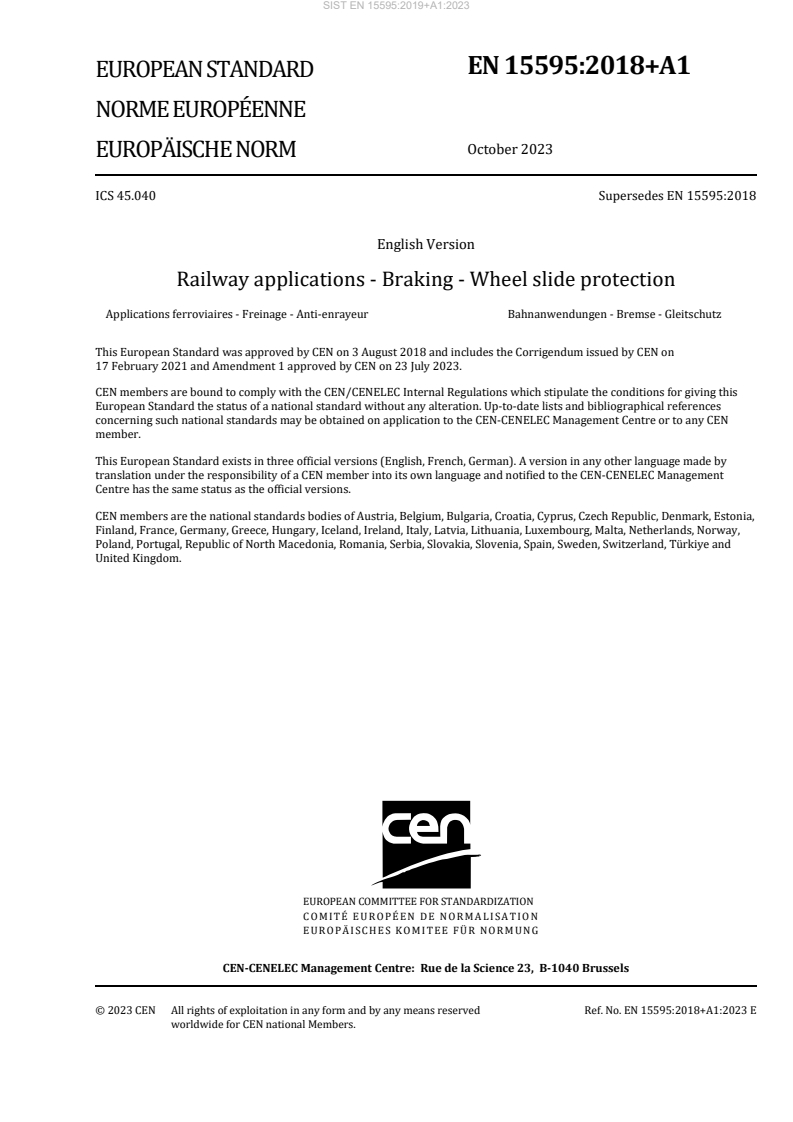
EN 15595:2018+A1
EUROPEAN STANDARD
NORME EUROPÉENNE
October 2023
EUROPÄISCHE NORM
ICS 45.040 Supersedes EN 15595:2018
English Version
Railway applications - Braking - Wheel slide protection
Applications ferroviaires - Freinage - Anti-enrayeur Bahnanwendungen - Bremse - Gleitschutz
This European Standard was approved by CEN on 3 August 2018 and includes the Corrigendum issued by CEN on
17 February 2021 and Amendment 1 approved by CEN on 23 July 2023.
CEN members are bound to comply with the CEN/CENELEC Internal Regulations which stipulate the conditions for giving this
European Standard the status of a national standard without any alteration. Up-to-date lists and bibliographical references
concerning such national standards may be obtained on application to the CEN-CENELEC Management Centre or to any CEN
member.
This European Standard exists in three official versions (English, French, German). A version in any other language made by
translation under the responsibility of a CEN member into its own language and notified to the CEN-CENELEC Management
Centre has the same status as the official versions.
CEN members are the national standards bodies of Austria, Belgium, Bulgaria, Croatia, Cyprus, Czech Republic, Denmark, Estonia,
Finland, France, Germany, Greece, Hungary, Iceland, Ireland, Italy, Latvia, Lithuania, Luxembourg, Malta, Netherlands, Norway,
Poland, Portugal, Republic of North Macedonia, Romania, Serbia, Slovakia, Slovenia, Spain, Sweden, Switzerland, Türkiye and
United Kingdom.
EUROPEAN COMMITTEE FOR STANDARDIZATION
C OMITÉ EUROPÉEN DE NORMALISATIO N
EUROPÄISCHES KOMITEE FÜR NORMUN G
CEN-CENELEC Management Centre: Rue de la Science 23, B-1040 Brussels
© 2023 CEN All rights of exploitation in any form and by any means reserved Ref. No. EN 15595:2018+A1:2023 E
worldwide for CEN national Members.
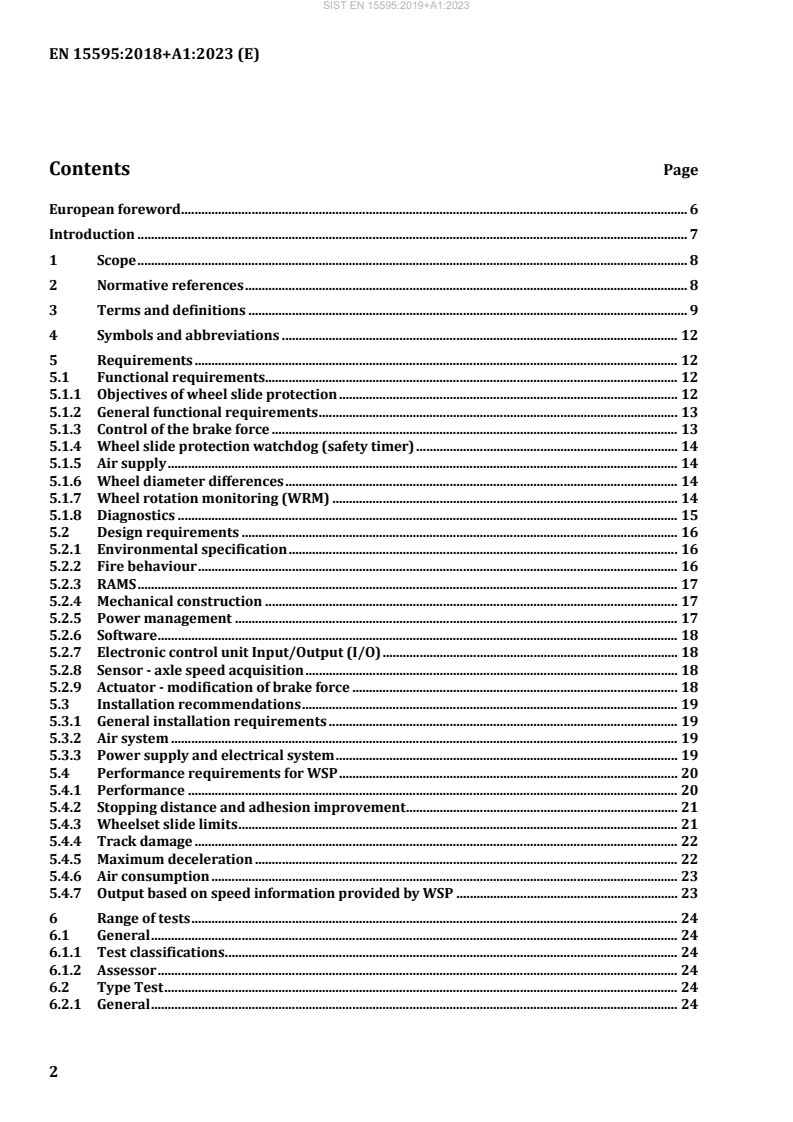
Contents Page
European foreword . 6
Introduction . 7
1 Scope . 8
2 Normative references . 8
3 Terms and definitions . 9
4 Symbols and abbreviations . 12
5 Requirements . 12
5.1 Functional requirements. 12
5.1.1 Objectives of wheel slide protection . 12
5.1.2 General functional requirements . 13
5.1.3 Control of the brake force . 13
5.1.4 Wheel slide protection watchdog (safety timer) . 14
5.1.5 Air supply . 14
5.1.6 Wheel diameter differences . 14
5.1.7 Wheel rotation monitoring (WRM) . 14
5.1.8 Diagnostics . 15
5.2 Design requirements . 16
5.2.1 Environmental specification . 16
5.2.2 Fire behaviour . 16
5.2.3 RAMS . 17
5.2.4 Mechanical construction . 17
5.2.5 Power management . 17
5.2.6 Software . 18
5.2.7 Electronic control unit Input/Output (I/O) . 18
5.2.8 Sensor - axle speed acquisition . 18
5.2.9 Actuator - modification of brake force . 18
5.3 Installation recommendations . 19
5.3.1 General installation requirements . 19
5.3.2 Air system . 19
5.3.3 Power supply and electrical system . 19
5.4 Performance requirements for WSP . 20
5.4.1 Performance . 20
5.4.2 Stopping distance and adhesion improvement . 21
5.4.3 Wheelset slide limits . 21
5.4.4 Track damage . 22
5.4.5 Maximum deceleration . 22
5.4.6 Air consumption . 23
5.4.7 Output based on speed information provided by WSP . 23
6 Range of tests . 24
6.1 General . 24
6.1.1 Test classifications . 24
6.1.2 Assessor . 24
6.2 Type Test . 24
6.2.1 General . 24
6.2.2 Test requirements . 24
6.2.3 Individual component Type Test . 25
6.3 Vehicle Implementation Test . 25
6.3.1 General . 25
6.3.2 Test requirements . 26
6.3.3 Conformity of previous vehicle tests . 26
6.4 List of tests . 26
6.4.1 Standard tests . 26
6.4.2 Drag tests . 27
6.4.3 Test methods for speeds from 160 up to 200 km/h . 27
6.4.4 Test methods for speeds > 200 km/h . 27
6.4.5 Supplementary higher deceleration tests . 27
6.4.6 Supplementary approval tests for WSP acting in vehicles with brakes that are
independent of adhesion . 27
6.4.7 Supplementary approval tests involving tractive units and trainsets having dynamic
brakes . 27
6.4.8 Testing of wheel rotation monitoring (WRM) . 28
6.5 Re-testing . 34
6.5.1 General . 34
6.5.2 Hardware . 34
6.5.3 Software . 35
7 Test methods . 35
7.1 General . 35
7.2 Measurement . 36
7.3 Tests on vehicle . 37
7.3.1 General . 37
7.3.2 Generation of degraded adhesion . 38
7.3.3 Environmental conditions . 38
7.4 Test in simulation environment . 39
7.4.1 General . 39
7.4.2 Tests on simulation rig . 39
7.4.3 Additional specific simulator tests . 40
7.4.4 Optional tests . 40
8 Evaluation of test . 40
8.1 Correcting the stopping distances . 40
8.2 Number and validity of dry tests . 40
8.3 Evaluation of slide test . 40
8.3.1 General . 40
8.3.2 Evaluation of stopping performance . 41
8.3.3 Evaluation of test validity . 42
8.3.4 Evaluation of relative air consumption . 51
9 Documentation of tests . 52
9.1 Test Specification . 52
9.2 Test report . 53
10 Routine test and inspection . 54
11 Designation, identification and marking . 54
Annex A (normative) Tables linking the WSP / WRM Requirements to Tests and Test
Criteria . 55
Annex B (normative) Minimum requirements for a WSP simulator . 75
B.1 General . 75
B.1.1 General . 75
B.1.2 Use of the simulator model . 75
B.2 Adhesion model . 80
B.2.1 General . 80
B.2.2 Constant adhesion condition . 80
B.2.3 Variable adhesion condition . 80
B.2.4 Adhesion conditioning factors . 81
B.3 Test and performance model . 81
B.3.1 General . 81
B.3.2 Simulator performance . 81
B.3.3 Test requirements . 81
B.3.4 Stopping performance . 81
B.3.5 Wheel damage . 82
B.3.6 Air system . 82
B.3.7 Pass/fail limits . 82
B.3.8 Fault conditions . 82
B.3.9 WSP outputs . 83
B.4 Vehicle performance model . 83
B.4.1 General . 83
B.4.2 Friction material. 83
B.4.3 Pneumatic actuator/brake demand . 83
B.4.4 Body/Bogie/wheel dynamics . 83
B.5 Vehicle functional model . 84
B.5.1 General . 84
B.5.2 Functional inputs . 84
B.6 Simulator validation . 84
B.6.1 General . 84
B.6.2 Validation of test benches . 84
B.6.3 Management . 87
Annex C (informative) Example of customer specific simulator tests . 88
C.1 Naturally occurring variable adhesion tests . 88
C.1.1 General . 88
C.1.2 Sequence . 88
C.1.3 Measurement and pass/fail criteria . 90
C.2 Sustained low adhesion track condition (SLAC) Tests . 91
C.2.1 Sequence . 91
C.2.2 Measurement/pass fail criteria . 92
C.2.3 WSP speed reference (v ) . 92
ref
C.3 Operating speeds above 160 km/h . 92
C.3.1 Criteria . 92
C.3.2 Sequence . 93
C.3.3 Measurement and pass/fail criteria . 93
Annex D (informative) Optional tests . 94
D.1 Sander system tests — Criteria . 94
D.2 Dynamic braking system tests — Criteria . 95
D.3 Peripheral output tests — Criteria . 95
Annex E (informative) Typical diagram of a real WSP test . 97
Annex F (informative) In-service monitoring . 99
Annex G (informative) Braking configurations . 100
G.1 Per bogie control . 100
G.2 Per wagon control . 100
Annex H (informative) Changes between Revision 1 and Revision 2 of EN 15595 . 101
Bibliography . 103
European foreword
This document (EN 15595:2018+A1:2023) has been prepared by Technical Committee CEN/TC 256
“Railway applications”, the secretariat of which is held by DIN.
This European Standard shall be given the status of a national standard, either by publication of an
identical text or by endorsement, at the latest by April 2024, and conflicting national standards shall be
withdrawn at the latest by April 2024.
Attention is drawn to the possibility that some of the elements of this document may be the subject of
patent rights. CEN shall not be held responsible for identifying any or all such patent rights.
This document supersedes !EN 15595:2018 and EN 15595:2018/AC:2021".
This document includes the corrigendum EN 15595:2018/AC:2021 which corrects the wording of the
st nd nd
1 sentence of 8.3.3.3.1, the 2 sentence of 8.3.3.3.2 and the 2 sentence of 8.3.3.3.3.
The start and finish of text introduced or altered by corrigendum is indicated in the text by tags ˜™.
This document includes Amendment 1 approved by CEN on 23 July 2023.
The start and finish of text introduced or altered by amendment is indicated in the text by tags !".
!deleted text"
The rationale behind the changes between Revision 1 and this Revision of this standard is given in
Annex H.
Any feedback and questions on this document should be directed to the users’ national standards body.
A complete listing of these bodies can be found on the CEN website.
According to the CEN-CENELEC Internal Regulations, the national standards organisations of the
following countries are bound to implement this European Standard: Austria, Belgium, Bulgaria,
Croatia, Cyprus, Czech Republic, Denmark, Estonia, Finland, France, Germany, Greece, Hungary, Iceland,
Ireland, Italy, Latvia, Lithuania, Luxembourg, Malta, Netherlands, Norway, Poland, Portugal, Republic of
North Macedonia, Romania, Serbia, Slovakia, Slovenia, Spain, Sweden, Switzerland, Türkiye and the
United Kingdom.
Introduction
A Wheel Slide Protection (WSP) system is designed to make the best use of available adhesion and to
improve adhesion by a controlled reduction and restoration of the brake force to prevent wheel sets
from locking and uncontrolled sliding due to low adhesion. Thus the braking performance is optimized
and the occurrence of wheelset damage is minimized.
The Wheel Rotation Monitoring (WRM) system is designed to detect locked wheels and to give
immediate information in this case.
Trains fitted with WSP systems may consist of single vehicles, locomotive and trailing vehicles or may
be high speed trains, multiple units, commuter trains, Light Rail Vehicles (LRV) and Tram Trains of any
track gauge, etc.
Such trains will be equipped with friction brakes and may also be equipped with additional braking
systems, e.g. dynamic brakes, wheel/rail adhesion independent brakes, and may also be fitted with
adhesion improving systems, e.g. sanding.
This European Standard is not intended to be used to determine the stopping performance of a WSP
equipped train under all environmental conditions.
1 Scope
This document specifies the criteria for system acceptance and type approval of a wheel slide
protection (WSP) system. It also specifies criteria for the implementation of WSP to specific vehicle
applications and specific operating conditions, as well as requirements for wheel rotation monitoring
(WRM). This includes the design, testing and quality assessment of the WSP and WRM systems and
their components.
This European Standard does not apply to vehicles on rubber tyred wheels or vehicles equipped with
hydraulic brakes.
2 Normative references
The following documents are referred to in the text in such a way that some or all of their content
constitutes requirements of this document. For dated references, only the edition cited applies. For
undated references, the latest edition of the referenced document (including any amendments) applies.
EN 14478:2017, Railway applications — Braking — Generic vocabulary
EN 15663, Railway applications — Vehicle reference masses
!EN 16834:2019, Railway applications — Braking — Brake performance"
EN 45545 (all parts), Railway applications — Fire protection on railway vehicles
EN 50121-3-2, Railway applications — Electromagnetic compatibility — Part 3-2: Rolling stock —
Apparatus
EN 50125-1, Railway applications — Environmental conditions for equipment — Part 1: Rolling stock and
on-board equipment
EN 50126-1, Railway Applications — The Specification and Demonstration of Reliability, Availability,
Maintainability and Safety (RAMS) — Part 1: Generic RAMS Process
EN 50128, Railway applications — Communication, signalling and processing systems — Software for
railway control and protection systems
EN 50129, Railway applications — Communication, signalling and processing systems — Safety related
electronic systems for signalling
EN 50155, Railway applications — Rolling stock — Electronic equipment
EN 60529, Degrees of protection provided by enclosures (IP Code) (IEC 60529)
EN 61373, Railway applications — Rolling stock equipment — Shock and vibration tests (IEC 61373)
EN ISO 228-2, Pipe threads where pressure-tight joints are not made on the threads — Part 2: Verification
by means of limit gauges (ISO 228-2)
EN ISO/IEC 17025, General requirements for the competence of testing and calibration laboratories
(ISO/IEC 17025)
ISO 8573-1, Compressed air — Part 1: Contaminants and purity classes
3 Terms and definitions
For the purposes of this document, the terms and definitions given in EN 14478:2017 and the following
apply.
ISO and IEC maintain terminological databases for use in standardization at the following addresses:
• IEC Electropedia: available at https://www.electropedia.org/
• ISO Online browsing platform: available at https://www.iso.org/obp
3.1
adhesion profile
predefined set of data representing the adhesion characteristics of a section of running line
3.2
relative air consumption
ratio of the total volume of air consumed during a braking stop with WSP activity against that which
would be consumed during a stop with no WSP activity
3.3
supplementary reservoir
pressure reservoir used for determination of relative air consumption during WSP testing
3.4
crush laden
vehicle load condition based on the design mass under exceptional payload in accordance with
EN 15663
3.5
dry rail
conditions where 100 % of the brake force of the vehicle can be applied with no axle sliding more
than 2 %
3.6
dry rail stopping distance
actual measured stopping distance in dry rail conditions
3.7
low adhesion
conditions where the wheel/rail adhesion is in the range 0,08 to 0,05
3.8
very low adhesion
conditions where the wheel/rail adhesion is in the range 0,05 to 0,03
3.9
extremely low adhesion
conditions where the wheel/rail adhesion is below 0,03
3.10
reference speed
signal generated and generally used by the WSP or WRM to determine an approximation to the true
train speed
3.11
nominal initial train speed
specified speed at start of braking during brake tests
Note 1 to entry: True train speed can slightly differ.
Note 2 to entry: This may be known as target speed.
3.12
uncoupled test
method of brake testing where the vehicle (or single unit) under test is uncoupled from the rear of the
test train and brakes separately, also referred to as a slip test
3.13
brake to stop test
brake test starting from a nominal initial speed going to a stop, performed with either an individual
vehicle (locomotive, coach) or a train set as the tested unit
3.14
absolute wheel slide
difference between true train speed and circumferential speed
3.15
relative wheel slide
absolute wheel slide divided by true train speed
3.16
undesired brake force reduction
reduction in brake force not justified by behaviour of wheelsets
3.17
brake blending curve
curve describing the characteristics of blending of dynamic and pneumatic brakes as function of speed
3.18
WSP controller
device having the electronic hardware and software to receive the signals from the speed sensors and
provide the outputs to the WSP brake control elements, for example dump valves, enabling the
modulation of the brake force
3.19
WSP actuator
device used by the WSP controller to control the brake force
3.20
WSP dump valve
WSP actuator to control the brake cylinder pressure
3.21
speed sensor
device used to generate an individual wheelset or wheel speed signal to a WSP controller
3.22
service interface
access point for diagnostic information and maintenance test
3.23
validation
process of analysis followed by a judgment based on evidence to determine whether an item
(e.g. process, documentation, software or application) fits the user needs, in particular with respect to
safety and quality and with emphasis on the suitability of its operation in accordance to its purpose in
its intended environment
3.24
verification
process of examination followed by a judgment based on evidence that output items (process,
documentation, software or application) of a specific development phase fulfils the requirements of that
phase with respect to completeness, correctness and consistency
Note 1 to entry: Verification is mostly based on document reviews (design, implementation, test documents,
etc.).
3.25
designed deceleration
maximum deceleration which is provided by the brake system of the vehicle, in a normal manner on
level track and which is defined by calculation
3.26
slide test
test performed under degraded adhesion conditions
3.27
dry rail test
test performed where the adhesion conditions will support the maximum brake force
3.28
drag test
test to simulate braking on a falling gradient, performed with an auxiliary tractive unit to achieve a
constant speed with a constant brake application
3.29
brake test
test where the brakes are applied to achieve a deceleration
3.30
tare laden
vehicle load condition based on the design mass in working order in accordance with EN 15663
Note 1 to entry: This can have to include additional test equipment and personnel.
4 Symbols and abbreviations
For the purposes of this document, the following symbols and abbreviations apply.
g 2
acceleration due to gravity, in m/s
v nominal initial train speed, in km/h
nom
v WSP vehicle reference speed, in km/h
ref
v true train speed, in km/h
t
μ adhesion coefficient
ρ coefficient of inertia of rotating masses
τ initial adhesion coefficient
AR auxiliary reservoir
BP brake pipe
BSR brake supply reservoir; may also be referred to as an auxiliary reservoir
EB emergency brake
ER (fr: événement redouté) anticipated event – used in safety analysis
MMI Man Machine Interface
MTB magnetic track brake
Nl normal litre
RAMS reliability, availability, maintainability and safety
VIT Vehicle Implementation Test
WRM wheel rotation monitoring system (sometimes called DNRA, detection of non-rotating axle)
WSP wheel slide protection
5 Requirements
5.1 Functional requirements
5.1.1 Objectives of wheel slide protection
The objectives of fitting WSP systems to trains are to assist in achieving the following:
— minimum extension in stopping distance compared to stopping on clean dry rails (i.e. good
adhesion conditions);
— minimum level of wheelset damage due to wheel slide or wheel lock;
— minimum level of track damage;
— for pneumatic brake systems, minimum increase in air consumption compared to a dry rail stop
with no WSP activity.
The particular priority of these objectives may vary for different classes of applications or even for a
particular application.
The objectives are deemed to be fulfilled, if the requirements of this standard are met.
5.1.2 General functional requirements
One independent WSP/WRM system shall control no more than eight axles.
In the case of tractive units that are capable of running alone, any single fault of the WSP system shall
not result in a loss of brake force on more than 50 % of the braked axles. This may be achieved by
multiple WSP systems or an independent braking system that cannot be influenced by WSP.
The circumferential speed of the wheelsets is calculated on the basis of information provided by
sensors, and monitored by regulators or automatic control systems (WSP controller).
The WSP controller may use additional information (e.g. signals from pressure sensors) about the
status of the train for WSP control.
The WSP controller transmits commands to the WSP actuators (e.g. WSP dump valves) to reduce, hold
or restore brake force, either totally or partially.
The WSP shall not reduce the brake force below a low speed threshold. This threshold shall not be
higher than 5 km/h and not lower than 0,5 km/h. If the brake force is already reduced when the train
speed falls below this threshold, the WSP system shall restore the brake force to the demanded value.
When starting the train the WSP shall be available for operation before the speed achieves 6 km/h. For
freight applications where power supply is not provided at low speed, this threshold may be increased
up to 15 km/h.
The WSP system shall remain operative whilst there is brake force present (i.e. until the brakes are fully
released).
The WSP shall not be capable of increasing the brake force above that demanded by the braking system.
The WSP shall not alter the demanded brake force at standstill except during system test.
All speed thresholds defined in this standard shall be related to nominal mean wheel diameter if the
true wheel diameter is not known.
5.1.3 Control of the brake force
5.1.3.1 Requirements for pneumatic actuation of the friction brake
WSP-actuators (e.g. WSP dump valves or other pneumatic control devices - integrated brake valve) are
used to modify brake force.
The WSP-system shall not allow a direct connection between supply and exhaust.
5.1.3.2 Dynamic brake
Dynamic brakes shall have either WSP control in accordance with this standard or means to switch
them off in the event of sliding.
If the dynamic brake is used for emergency brake applications a WSP control of the dynamic brake shall
be provided.
If the dynamic brake is commanded by an independent control command, separate from the regular
train wide control command, the maximum slide criteria, as defined in 5.4.3.1, shall at least be met.
The dynamic brake may be equipped with its own WSP. As long as the friction brake is not activated the
slide can be controlled by the WSP of the dynamic brake alone.
A WSP strategy shall be adopted for the two systems if dynamic brake and friction brake are
coordinated by a blending function or operated independently to fulfil the requirements of this
standard.
5.1.4 Wheel slide protection watchdog (safety timer)
For safety reasons, a monitoring function is provided to avoid an excessive reduction of braking effort.
This WSP watchdog function shall be provided for WSP systems capable of acting during emergency
braking, and shall be independent from the WSP control algorithm and processor.
A continuous brake effort release demanded by the WSP shall not exceed 10 s. After this time, the WSP
watchdog shall inhibit WSP intervention.
The WSP watchdog shall inhibit WSP intervention in the case where the brake effort is maintained
constant or continuously reduced below the demanded level with no rise in brake effort for a period
which shall not exceed 15 s. The watchdog function shall remain permanently active including during
WSP tests, in order to restore the demanded brake force if sustained release or reduction of this brake
force occurs because of WSP operation. Activation of this function other than during a test shall be
indicated and recorded.
If the watchdog function is activated, it shall be reset only after the WSP controller stops demanding a
reduction in brake force.
5.1.5 Air supply
As an option, the WSP should have the capability of being inhibited if the BSR pressure falls below a
defined value.
For single-pipe systems, the WSP system shall ensure that WSP activity is inhibited if the auxiliary
reservoir pressure is less than 300 mbar above the highest brake application pressure.
WSP shall be automatically re-enabled when the inhibit signal is removed.
5.1.6 Wheel diameter differences
When evaluating speeds on a given vehicle, the WSP and WRM system shall tolerate permitted
differences of the wheel diameters, within the range from new to worn wheels, so as not to cause WSP
or WRM activity because of these differences.
5.1.7 Wheel rotation monitoring (WRM)
5.1.7.1 General
These characteristics are additional to those in 5.1.1 to 5.1.6 for WSP equipment designed for high
speeds. Where fitted, WRM supplements the WSP device with a “rotation monitor function” to
continuously monitor wheelset rotation and to indicate rotation anomalies.
5.1.7.2 Functional characteristics
If a wheelset locks when the train starts up a “rotation monitor function” shall output a locked axle
indication no later than 10 s after a train speed of 50 km/h has been attained.
During a run the “rotation monitor function” shall output a signal on detecting an abnormal difference
in the speeds of the wheelsets for a period longer than 10 s. A difference is considered abnormal if it is
at least X km/h + Y · v . X and Y parameters being defined case by case, but not exceeding
ref
50 km/h + 0,3 · v .
ref
5.1.7.3 System requirements
The “rotation monit
...