

EN 12697-23:2026
(Main)Bituminous mixtures - Test methods - Part 23: Determination of the indirect tensile strength of bituminous specimens
- Abstract
This document specifies a test method for determining the (splitting) indirect tensile strength of cylindrical specimens of bituminous mixtures.
- Status
- Published
- Publication Date
- 15-Sep-2026
- Technical Committee
- CEN/TC 227 - Road materials
- Drafting Committee
- CEN/TC 227/WG 1 - Bituminous mixtures
- Current Stage
- 6060 - Definitive text made available (DAV) - Publishing
- Start Date
- 16-Sep-2026
- Due Date
- 01-Jun-2026
- Completion Date
- 16-Sep-2026

EN 12697-23:2026 is a CEN standard for testing bituminous mixtures. It specifies a laboratory method for determining the indirect tensile strength (ITS) of cylindrical bituminous specimens by loading them diametrically until break. Engineers, laboratories, and quality teams use it to measure mixture behavior, compare results, and report how the specimen failed.
What does EN 12697-23:2026 specify?
EN 12697-23:2026 specifies a test method for the indirect tensile strength of cylindrical specimens of bituminous mixtures. The method covers the full workflow from specimen preparation and conditioning to calculation, reporting, and precision.
The document is organized into clauses on scope, normative references, terms and definitions, principle, apparatus, sample preparation, conditioning, test temperature, test procedure, calculation, test report, and precision. In practice, that means the standard tells you what to test, how to prepare the specimen, how to run the machine, and how to record the result.
What are the key requirements of EN 12697-23:2026?
Principle and loading method
EN 12697-23:2026 measures ITS by placing a cylindrical specimen between loading strips and loading it diametrically at a constant speed until it breaks. The result is calculated from the peak load and the specimen dimensions.
This matters because the test is sensitive to load direction, loading rate, and specimen size. If any of those are inconsistent, the reported strength is harder to compare between laboratories or projects.
Apparatus and control of test conditions
EN 12697-23:2026 calls for a compression testing machine, preferably Marshall-type or similar, with a recommended minimum capacity of 28 kN and a deformation rate of (50 ± 2) mm/min after a short transitory period. It also requires a testing head with loading strips matched to the specimen diameter, a load measuring device, and either a thermostatically controlled water bath or air chamber.
The load measurement must be to the nearest 0,1 kN with a maximum permissible error of 0,2 kN. The temperature around the specimen must be held within ±1 °C of the test temperature, because temperature strongly affects the fracture response.
Specimens and preparation
EN 12697-23:2026 requires at least three specimens for each sample and condition tested. It allows cylindrical specimens with diameters of 80, 100, 120, 150, or 160 mm, with specimen height between 35 mm and 75 mm.
The specimen size must suit the aggregate size of the mixture, and the specimen may be laboratory-made or cored from a slab or layer. The specimen is also checked visually for symmetry, measured for diameter and height, and stored before testing for between 48 hours and 42 days at not more than 25 °C.
Conditioning and test temperature
EN 12697-23:2026 requires the specimen to be brought to the selected test temperature with a maximum permissible error of 1 °C. Conditioning time depends on size: at least 2 h for specimens below 150 mm diameter and at least 4 h for specimens 150 mm or larger.
The test temperature is selected between +5 °C and +25 °C. That gives laboratories a way to test the mixture at temperatures that are relevant to the expected service or research condition.
Test procedure, calculation, and reporting
EN 12697-23:2026 requires the specimen to be loaded continuously and without shock until peak load is reached and the specimen breaks. The tester records the failure type - clear tensile break, deformation, or combination - and checks whether the broken aggregates are cracked or intact.
The ITS is then calculated in kilopascals and rounded to the nearest kPa. The test report must identify the standard used, the sample, specimen type, dimensions, test temperature, storage history, average ITS, failure type, and any deviations or unusual observations.
What terms does EN 12697-23:2026 define?
- Indirect tensile strength (ITS) - the maximum tensile stress calculated from the peak load applied to a cylindrical specimen loaded diametrically until break.
- Cylindrical specimen - a laboratory-made cylindrical moulded specimen or a core taken from a bituminous layer or slab.
- Peak load - the highest load recorded during the diametral compression test and used in the ITS calculation.
- Loading strips - the hardened steel contact strips in the testing head that apply the diametral load to the specimen.
- Test temperature - the selected temperature at which the specimen is conditioned and tested, between +5 °C and +25 °C.
- Failure type - the observed break pattern, reported as clear tensile break, deformation, or combination.
Who uses EN 12697-23:2026?
EN 12697-23:2026 is used by asphalt and road-materials laboratories, mix producers, and quality control teams. It is also used by engineers, quality managers, and buyers who need a repeatable strength result for acceptance checks, product comparison, or investigation of cored material from site.
It is most useful when a team needs to compare laboratory-prepared specimens with cores from pavements or slabs and document how the material fails under diametral loading.
What changed in EN 12697-23:2026 from the previous edition?
EN 12697-23:2026 supersedes EN 12697-23:2017. The foreword states these significant technical changes:
- Clause 5.3 updates load measurement wording to “nearest 0,1 kN with a maximum permissible error of 0,2 kN”.
- Clause 5.4 broadens the conditioning equipment wording to include an air chamber and keeps the ±1 °C control around the specimen.
- Clause 7 merges the former subclauses and adds the requirement to bring the specimen to the selected test temperature with a maximum permissible error of 1 °C.
- Clause 8 changes the test temperature selection to between +5 °C and +25 °C.
- Clause 9.1 removes the room-temperature requirement for the testing machine.
- Clause 10 changes ITS rounding to the nearest kPa.
Which standards are used with EN 12697-23:2026?
| Standard | What it contributes |
|---|---|
| EN 12697-27 | Sampling of bituminous layers for cores |
| EN 12697-29 | Measurement of specimen dimensions |
| EN 12697-30 | Specimen preparation by impact compactor |
| EN 12697-31 | Specimen preparation by gyratory compactor |
| EN 12697-32 | Specimen preparation by vibratory compactor |
| EN 12697-33 | Specimen preparation by roller compactor |
| EN 12697-34 | Marshall test and the referenced testing machine type |
What does the EN 12697-23:2026 document contain?
EN 12697-23:2026 contains the method principle, apparatus requirements, specimen preparation rules, conditioning and temperature control, the test procedure, the ITS calculation, reporting items, and a precision requirement. It also includes a table for loading strip dimensions by specimen diameter and figures for the testing head and failure types.
The document gives the practical details a laboratory needs to set up the test consistently, including the load rate, temperature tolerance, specimen sizes, and observation of fracture mode. It also states what to record so the result can be compared across samples and projects.
Relations
- Effective Date
- 21-Feb-2024
- Effective Date
- 17-Sep-2026
- Effective Date
- 17-Sep-2026
- Effective Date
- 17-Sep-2026
- Effective Date
- 17-Sep-2026
- Effective Date
- 17-Sep-2026
Get Certified
Connect with accredited certification bodies for this standard

Zavod za gradbeništvo Slovenije (ZAG) - Inšpekcija
ZAG inspection body for construction products, structures, and materials.
Sponsored listings
Frequently Asked Questions
EN 12697-23:2026 is a draft published by the European Committee for Standardization (CEN). Its full title is "Bituminous mixtures - Test methods - Part 23: Determination of the indirect tensile strength of bituminous specimens". This standard covers: This document specifies a test method for determining the (splitting) indirect tensile strength of cylindrical specimens of bituminous mixtures.
This document specifies a test method for determining the (splitting) indirect tensile strength of cylindrical specimens of bituminous mixtures.
EN 12697-23:2026 is classified under the following ICS (International Classification for Standards) categories: 93.080.20 - Road construction materials. The ICS classification helps identify the subject area and facilitates finding related standards.
EN 12697-23:2026 has the following relationships with other standards: It is inter standard links to EN 12697-23:2017, EN 12697-12:2018, EN 13108-31:2019, EN 13108-7:2016, EN 12697-12:2008, EN 13108-9:2016. Understanding these relationships helps ensure you are using the most current and applicable version of the standard.
EN 12697-23:2026 is available in PDF format for immediate download after purchase. The document can be added to your cart and obtained through the secure checkout process. Digital delivery ensures instant access to the complete standard document.
Standards Content (Sample)
SLOVENSKI STANDARD
oSIST prEN 12697-23:2025
01-maj-2025
Bitumenske zmesi - Preskusne metode - 23. del: Ugotavljanje posredne natezne
trdnosti bitumenskih preskušancev
Bituminous mixtures - Test methods - Part 23: Determination of the indirect tensile
strength of bituminous specimens
Asphalt - Prüfverfahren - Teil 23: Bestimmung der indirekten Zugfestigkeit von Asphalt-
Probekörpern
Mélanges bitumineux - Méthode d'essais - Partie 23 : Détermination de la résistance à la
traction indirecte des éprouvettes bitumineuses
Ta slovenski standard je istoveten z: prEN 12697-23
ICS:
93.080.20 Materiali za gradnjo cest Road construction materials
oSIST prEN 12697-23:2025 en,fr,de
2003-01.Slovenski inštitut za standardizacijo. Razmnoževanje celote ali delov tega standarda ni dovoljeno.
oSIST prEN 12697-23:2025
oSIST prEN 12697-23:2025
DRAFT
EUROPEAN STANDARD
prEN 12697-23
NORME EUROPÉENNE
EUROPÄISCHE NORM
March 2025
ICS 93.080.20 Will supersede EN 12697-23:2017
English Version
Bituminous mixtures - Test methods - Part 23:
Determination of the indirect tensile strength of
bituminous specimens
Mélanges bitumineux - Méthode d'essais - Partie 23 : Asphalt - Prüfverfahren - Teil 23: Bestimmung der
Détermination de la résistance à la traction indirecte indirekten Zugfestigkeit von Asphalt-Probekörpern
des éprouvettes bitumineuses
This draft European Standard is submitted to CEN members for enquiry. It has been drawn up by the Technical Committee
CEN/TC 227.
If this draft becomes a European Standard, CEN members are bound to comply with the CEN/CENELEC Internal Regulations
which stipulate the conditions for giving this European Standard the status of a national standard without any alteration.
This draft European Standard was established by CEN in three official versions (English, French, German). A version in any other
language made by translation under the responsibility of a CEN member into its own language and notified to the CEN-CENELEC
Management Centre has the same status as the official versions.
CEN members are the national standards bodies of Austria, Belgium, Bulgaria, Croatia, Cyprus, Czech Republic, Denmark, Estonia,
Finland, France, Germany, Greece, Hungary, Iceland, Ireland, Italy, Latvia, Lithuania, Luxembourg, Malta, Netherlands, Norway,
Poland, Portugal, Republic of North Macedonia, Romania, Serbia, Slovakia, Slovenia, Spain, Sweden, Switzerland, Türkiye and
United Kingdom.
Recipients of this draft are invited to submit, with their comments, notification of any relevant patent rights of which they are
aware and to provide supporting documentation.
Warning : This document is not a European Standard. It is distributed for review and comments. It is subject to change without
notice and shall not be referred to as a European Standard.
EUROPEAN COMMITTEE FOR STANDARDIZATION
COMITÉ EUROPÉEN DE NORMALISATION
EUROPÄISCHES KOMITEE FÜR NORMUNG
CEN-CENELEC Management Centre: Rue de la Science 23, B-1040 Brussels
© 2025 CEN All rights of exploitation in any form and by any means reserved Ref. No. prEN 12697-23:2025 E
worldwide for CEN national Members.
oSIST prEN 12697-23:2025
prEN 12697-23:2025 (E)
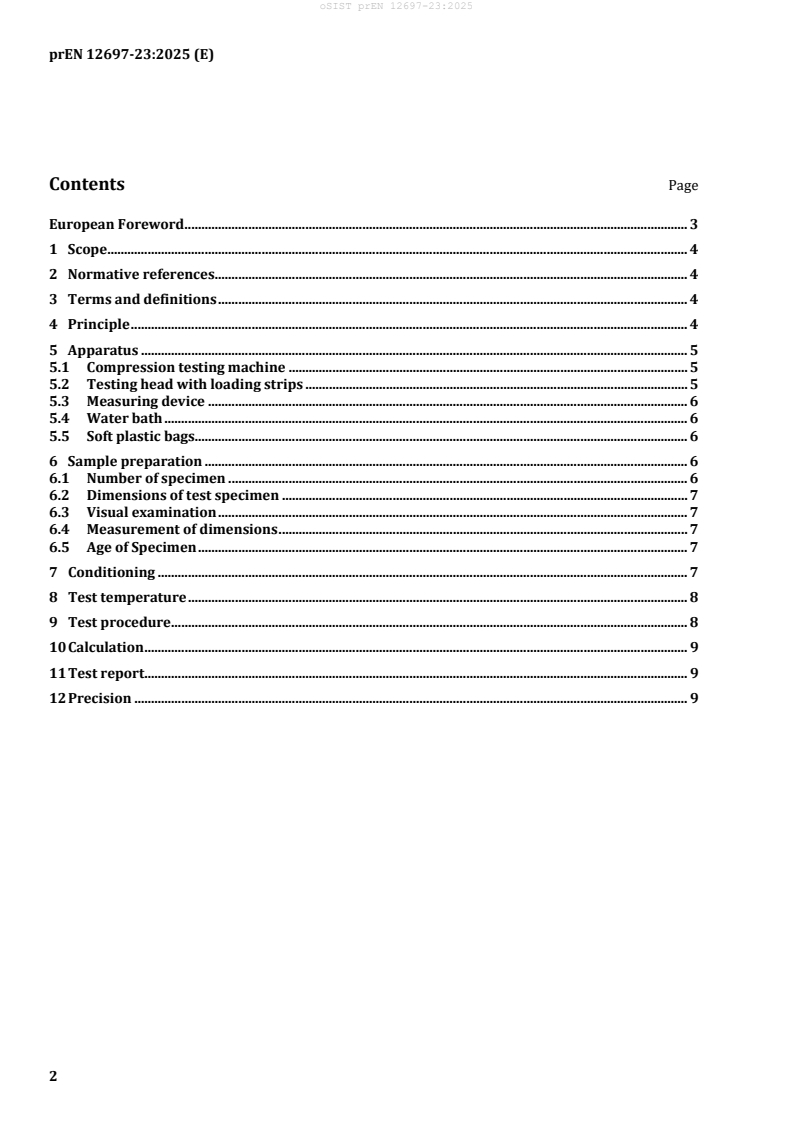
Contents Page
European Foreword . 3
1 Scope . 4
2 Normative references . 4
3 Terms and definitions . 4
4 Principle . 4
5 Apparatus . 5
5.1 Compression testing machine . 5
5.2 Testing head with loading strips . 5
5.3 Measuring device . 6
5.4 Water bath . 6
5.5 Soft plastic bags. 6
6 Sample preparation . 6
6.1 Number of specimen . 6
6.2 Dimensions of test specimen . 7
6.3 Visual examination . 7
6.4 Measurement of dimensions . 7
6.5 Age of Specimen . 7
7 Conditioning . 7
8 Test temperature . 8
9 Test procedure . 8
10 Calculation . 9
11 Test report . 9
12 Precision . 9
oSIST prEN 12697-23:2025
pEN 12697-23:2025 (E)
European Foreword
This document (prEN 12697-23:2025) has been prepared by Technical Committee CEN/TC 227 “Road
materials”, the secretariat of which is held by BSI.
This document is currently submitted to the CEN Enquiry.
This document will supersede EN 12697-23:2017.
prEN 12697-23:2025 includes the following significant technical changes with respect to
EN 12697-23:2017:
— [Clause 5.3] the wording, “accuracy of ± 0,2 kN”, amended to read “nearest 0,1 kN with a maximum
permissible error of 0,2 kN”;
— [Clause 5.4] amended to read: “Water bath, thermostatically controlled, or air chamber, capable of
maintaining the temperature in the vicinity of the specimen within ± 1 °C from the test temperature.”
— [Clause 7]. Subclause 7.1 and 7.2 deleted and merged under Clause 7. Completion with following
paragraph: “Bring the test specimen to the selected test temperature selected according to Clause 8
with a maximum permissible error of 1 °C. “;
— [Clause 8] deletion of 1st paragraph: “Unless defined elsewhere, the test temperature shall be (10 ±
2) °C. Replaced by: “The test temperature shall be selected between +5 °C to +25 °C”;
— [Clause 8], 2nd paragraph. Last two sentences deleted. 1st sentence reworded to NOTE;
— [Clause 9.1] Deletion of paragraph: “The testing machine shall be placed in a room with temperature
between 15 °C and 25 °C.;
— [Clause 10] Rounding of ITS changed to the nearest kPa instead of three significant figures.
oSIST prEN 12697-23:2025
prEN 12697-23:2025 (E)
1 Scope
This document specifies a test method for determining the (splitting) indirect tensile strength of
cylindrical specimens of bituminous mixtures.
2 Normative references
The following documents are referred to in the text in such a way that some or all of their content
constitutes requirements of this document. For dated references, only the edition cited applies. For
undated references, the latest edition of the referenced document (including any amendments) applies.
EN 12697-27, Bituminous mixtures - Test methods - Part 27: Sampling
EN 12697-29, Bituminous mixtures - Test methods - Part 29: Determination of the dimensions of a
bituminous specimen
EN 12697-30, Bituminous mixtures - Test methods - Part 30: Specimen preparation by impact compactor
EN 12697-31, Bituminous mixtures - Test methods - Part 31: Specimen preparation by gyratory compactor
EN 12697-32, Bituminous mixtures - Test methods - Part 32: Specimen preparation by vibratory compactor
EN 12697-33, Bituminous mixtures — Test methods — Part 33: Specimen prepared by roller compactor
EN 12697-34, Bituminous mixtures - Test methods - Part 34: Marshall test
3 Terms and definitions
For the purposes of this document, the following terms an
...