


FprEN 18322
(Main)Inorganic fertilizers - Determination of the organic carbon content by dry combustion
General Information
- Abstract
This document specifies a method for the determination of total organic carbon content by elemental analysis using dry combustion. The method is applicable to inorganic fertilizers containing more than 0,1 % carbon expressed on dry mass.
NOTE This method can also be applied to other types of fertilizers, provided the user has verified the applicability.
This document is applicable to the fertilizing products blends where a blend is a mix of at least two of the following components: inorganic fertilizers, organic fertilizers, organo-mineral fertilizers, liming materials, soil improvers, growing media, inhibitors, plant biostimulants and where the following category: inorganic fertilizer is the highest % in the blend by mass or volume, or in the case of liquid form by dry mass. If inorganic fertilizer is not the highest % in the blend, the European Standard for the highest % of the blend applies. In case a fertilizing product blend is composed of components in equal quantity, the user decides which standard to apply. Variations in analytical methods for fertilizing product blends can lead to differing results as some components or matrix interactions can affect the outcome. Validation procedures have shown that developed standard methods are robust and reliable across diverse product compositions, but possible interferences and unexpected results when analysing fertilizing product blends are possible.
- Status
- Not Published
- Publication Date
- 13-Jan-2027
- Technical Committee
- CEN/TC 260 - Fertilizers and liming materials
- Drafting Committee
- CEN/TC 260/WG 7 - Chemical analysis
- Current Stage
- 4599 - Dispatch of FV draft to CMC - Finalization for Vote
- Start Date
- 29-Jul-2026
- Due Date
- 31-Aug-2027
- Completion Date
- 29-Jul-2026

Overview
FprEN 18322: Inorganic fertilizers - Determination of the organic carbon content by dry combustion is a draft European Standard developed by CEN/TC 260. This standard outlines a validated, robust method for determining the total organic carbon (TOC) content in inorganic fertilizers using elemental analysis by dry combustion. It applies to fertilizers containing more than 0.1% carbon (on a dry mass basis) and can be extended to other fertilizer types and blends, provided suitability is verified.
The standard is essential for regulatory compliance within the EU, product quality control, and ensuring consistent analytical results. It addresses the growing need for accurate organic carbon content measurements in agricultural sectors and supports harmonization of testing across Europe.
Key Topics
- Applicability: Primarily for inorganic fertilizers, but users may apply the method to organic, organo-mineral fertilizers, liming materials, soil improvers, growing media, inhibitors, and plant biostimulants if inorganic fertilizer is the dominant blend ingredient.
- Analytical Principle:
- Method A (Indirect): Calculates TOC by subtracting total inorganic carbon (TIC) from total carbon (TC) using combustion and acid treatment.
- Method B (Direct): Removes TIC by acid treatment first, then directly measures TOC by combusting the residue.
- Sample Preparation: Requires representative sampling and detailed preparation steps to avoid contamination and ensure accurate carbon quantification.
- Interferences: Outlines potential issues, such as the presence of urea or other carbon-containing compounds, and guidance for appropriate corrective actions.
- Precision and Validation: Details inter-laboratory study results, providing clear repeatability and reproducibility limits to support confidence in method reliability.
- Reporting: Specifies clear reporting requirements for laboratories, including test method, sample identification, method used, and any deviations from the procedure.
Applications
This standard is critical for:
- Fertilizer Producers: Ensuring products meet regulatory requirements for organic carbon content and supporting claims regarding product composition.
- Quality Control Laboratories: Enabling consistent, accurate TOC measurements for a wide range of inorganic fertilizer products and blends.
- Regulatory Compliance: Harmonizing organic carbon testing methods across the EU in accordance with Regulation (EU) 2019/1009 and supporting market access.
- Research & Development: Providing a validated framework for the analysis of fertilizer blends and supporting development of new fertilizing products.
Special consideration is needed for blends: when inorganic fertilizers are not the dominant component by mass or volume, users must apply the standard relevant to the major constituent. For equal blend compositions, the user selects the applicable standard.
Related Standards
To ensure comprehensive compliance and accuracy, the following related standards are referenced or complementary to FprEN 18322:
- EN 1482-1 and EN 1482-2: Guidelines for sampling and sample preparation of fertilizers, liming materials, and inhibitors
- EN 12944-1 and EN 12944-2: Vocabulary for fertilizers and related products
- EN 15705: Methods for analyzing methylen-urea oligomers in inorganic fertilizers
- ISO 5725-2 and ISO 5725-3: Procedures for determining the repeatability and reproducibility of measurement methods
- ISO 8466-1: Approach to calibration and evaluation of analytical methods
These standards work together to support accurate fertilizer testing and quality assurance throughout the agricultural supply chain.
Keywords: inorganic fertilizers, organic carbon, dry combustion, total organic carbon (TOC), fertilizer analysis, CEN standard, fertilizer blends, quality control, EU Regulation 2019/1009, elemental analysis, agricultural standardization.
Get Certified
Connect with accredited certification bodies for this standard

Control Union Certifications
Global certification for agriculture and sustainability.

ECOCERT
Organic and sustainability certification.

FSC International
Forest Stewardship Council certification.
Sponsored listings
Frequently Asked Questions
FprEN 18322 is a draft published by the European Committee for Standardization (CEN). Its full title is "Inorganic fertilizers - Determination of the organic carbon content by dry combustion". This standard covers: This document specifies a method for the determination of total organic carbon content by elemental analysis using dry combustion. The method is applicable to inorganic fertilizers containing more than 0,1 % carbon expressed on dry mass. NOTE This method can also be applied to other types of fertilizers, provided the user has verified the applicability. This document is applicable to the fertilizing products blends where a blend is a mix of at least two of the following components: inorganic fertilizers, organic fertilizers, organo-mineral fertilizers, liming materials, soil improvers, growing media, inhibitors, plant biostimulants and where the following category: inorganic fertilizer is the highest % in the blend by mass or volume, or in the case of liquid form by dry mass. If inorganic fertilizer is not the highest % in the blend, the European Standard for the highest % of the blend applies. In case a fertilizing product blend is composed of components in equal quantity, the user decides which standard to apply. Variations in analytical methods for fertilizing product blends can lead to differing results as some components or matrix interactions can affect the outcome. Validation procedures have shown that developed standard methods are robust and reliable across diverse product compositions, but possible interferences and unexpected results when analysing fertilizing product blends are possible.
This document specifies a method for the determination of total organic carbon content by elemental analysis using dry combustion. The method is applicable to inorganic fertilizers containing more than 0,1 % carbon expressed on dry mass. NOTE This method can also be applied to other types of fertilizers, provided the user has verified the applicability. This document is applicable to the fertilizing products blends where a blend is a mix of at least two of the following components: inorganic fertilizers, organic fertilizers, organo-mineral fertilizers, liming materials, soil improvers, growing media, inhibitors, plant biostimulants and where the following category: inorganic fertilizer is the highest % in the blend by mass or volume, or in the case of liquid form by dry mass. If inorganic fertilizer is not the highest % in the blend, the European Standard for the highest % of the blend applies. In case a fertilizing product blend is composed of components in equal quantity, the user decides which standard to apply. Variations in analytical methods for fertilizing product blends can lead to differing results as some components or matrix interactions can affect the outcome. Validation procedures have shown that developed standard methods are robust and reliable across diverse product compositions, but possible interferences and unexpected results when analysing fertilizing product blends are possible.
FprEN 18322 is classified under the following ICS (International Classification for Standards) categories: 65.080 - Fertilizers. The ICS classification helps identify the subject area and facilitates finding related standards.
FprEN 18322 is associated with the following European legislation: EU Directives/Regulations: 2019/1009; Standardization Mandates: M/564, M/564 AMD 1, M/564 AMD 2. When a standard is cited in the Official Journal of the European Union, products manufactured in conformity with it benefit from a presumption of conformity with the essential requirements of the corresponding EU directive or regulation.
FprEN 18322 is available in PDF format for immediate download after purchase. The document can be added to your cart and obtained through the secure checkout process. Digital delivery ensures instant access to the complete standard document.
Standards Content (Sample)
SLOVENSKI STANDARD
01-april-2026
Anorganska gnojila - Določanje organskega ogljika s suhim sežigom
Inorganic fertilizers - Determination of the organic carbon content by dry combustion
Anorganische Düngemittel - Bestimmung des Gehalts an organischem Kohlenstoff durch
trockene Verbrennung
Ta slovenski standard je istoveten z: prEN 18322
ICS:
65.080 Gnojila Fertilizers
2003-01.Slovenski inštitut za standardizacijo. Razmnoževanje celote ali delov tega standarda ni dovoljeno.
DRAFT
EUROPEAN STANDARD
prEN 18322
NORME EUROPÉENNE
EUROPÄISCHE NORM
March 2026
ICS 65.080
English Version
Inorganic fertilizers - Determination of the organic carbon
content by dry combustion
Anorganische Düngemittel - Bestimmung des Gehalts
an organischem Kohlenstoff durch trockene
Verbrennung
This draft European Standard is submitted to CEN members for enquiry. It has been drawn up by the Technical Committee
CEN/TC 260.
If this draft becomes a European Standard, CEN members are bound to comply with the CEN/CENELEC Internal Regulations
which stipulate the conditions for giving this European Standard the status of a national standard without any alteration.
This draft European Standard was established by CEN in three official versions (English, French, German). A version in any other
language made by translation under the responsibility of a CEN member into its own language and notified to the CEN-CENELEC
Management Centre has the same status as the official versions.
CEN members are the national standards bodies of Austria, Belgium, Bulgaria, Croatia, Cyprus, Czech Republic, Denmark, Estonia,
Finland, France, Germany, Greece, Hungary, Iceland, Ireland, Italy, Latvia, Lithuania, Luxembourg, Malta, Netherlands, Norway,
Poland, Portugal, Republic of North Macedonia, Romania, Serbia, Slovakia, Slovenia, Spain, Sweden, Switzerland, Türkiye and
United Kingdom.
Recipients of this draft are invited to submit, with their comments, notification of any relevant patent rights of which they are
aware and to provide supporting documentation.
Warning : This document is not a European Standard. It is distributed for review and comments. It is subject to change without
notice and shall not be referred to as a European Standard.
EUROPEAN COMMITTEE FOR STANDARDIZATION
COMITÉ EUROPÉEN DE NORMALISATION
EUROPÄISCHES KOMITEE FÜR NORMUNG
CEN-CENELEC Management Centre: Rue de la Science 23, B-1040 Brussels
© 2026 CEN All rights of exploitation in any form and by any means reserved Ref. No. prEN 18322:2026 E
worldwide for CEN national Members.
prEN 18322:2026 (E)
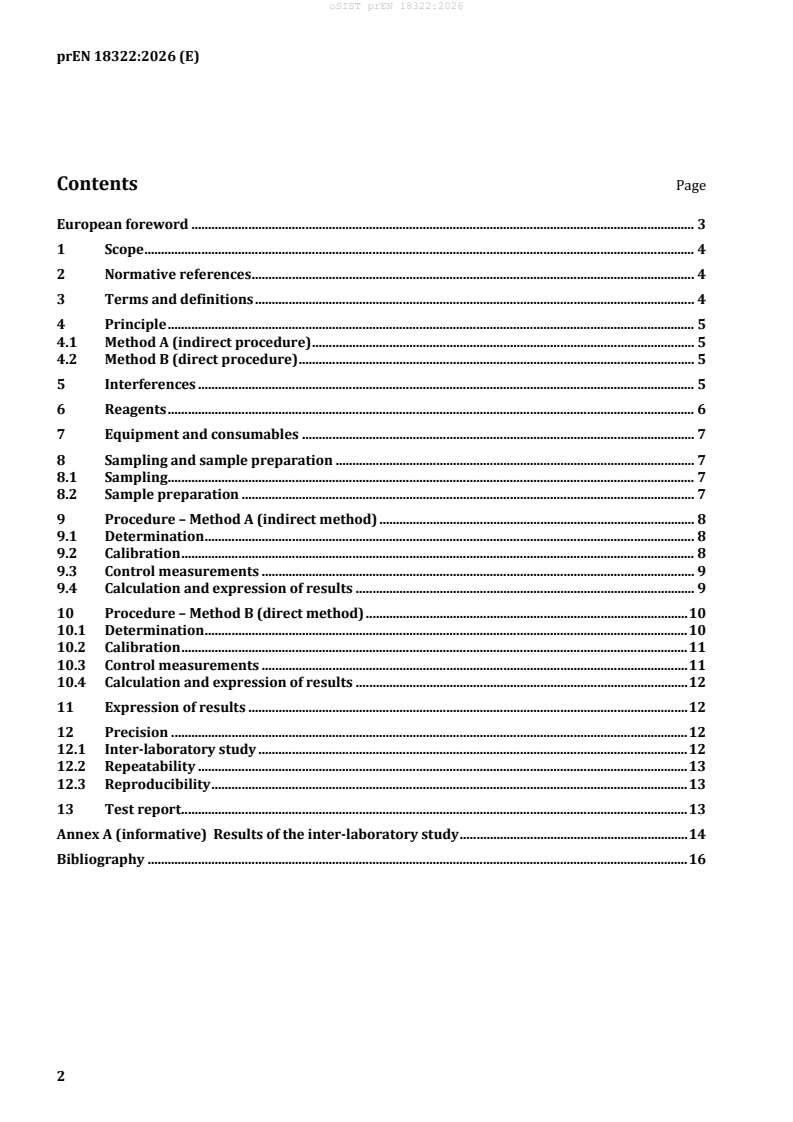
Contents Page
European foreword . 3
1 Scope . 4
2 Normative references . 4
3 Terms and definitions . 4
4 Principle . 5
4.1 Method A (indirect procedure) . 5
4.2 Method B (direct procedure) . 5
5 Interferences . 5
6 Reagents . 6
7 Equipment and consumables . 7
8 Sampling and sample preparation . 7
8.1 Sampling . 7
8.2 Sample preparation . 7
9 Procedure – Method A (indirect method) . 8
9.1 Determination . 8
9.2 Calibration . 8
9.3 Control measurements . 9
9.4 Calculation and expression of results . 9
10 Procedure – Method B (direct method) . 10
10.1 Determination . 10
10.2 Calibration . 11
10.3 Control measurements . 11
10.4 Calculation and expression of results . 12
11 Expression of results . 12
12 Precision . 12
12.1 Inter-laboratory study . 12
12.2 Repeatability . 13
12.3 Reproducibility . 13
13 Test report . 13
Annex A (informative) Results of the inter-laboratory study . 14
Bibliography . 16
prEN 18322:2026 (E)
European foreword
This document (prEN 18322:2026) has been prepared by Technical Committee CEN/TC 260 “Fertilizers
and liming materials”, the secretariat of which is held by DIN.
This document is currently submitted to CEN Enquiry.
This document has been prepared under a standardization request addressed to CEN by the European
Commission. The Standing Committee of the EFTA States subsequently approves these requests for its
Member States.
prEN 18322:2026 (E)
1 Scope
This document specifies a method for the determination of total organic carbon content by elemental
analysis using dry combustion. The method is applicable to inorganic fertilizers containing more than
0,1 % carbon expressed on dry mass.
NOTE This method can also be applied to other types of fertilizers, provided the user has verified the
applicability.
This document is applicable to the fertilizing products blends where a blend is a mix of at least two of the
following components: inorganic fertilizers, organic fertilizers, organo-mineral fertilizers, liming
materials, soil improvers, growing media, inhibitors, plant biostimulants and where the following
category: inorganic fertilizer is the highest % in the blend by mass or volume, or in the case of liquid form
by dry mass. If inorganic fertilizer is not the highest % in the blend, the European Standard for the highest
% of the blend applies. In case a fertilizing product blend is composed of components in equal quantity,
the user decides which standard to apply. Variations in analytical methods for fertilizing product blends
can lead to differing results as some components or matrix interactions can affect the outcome. Validation
procedures have shown that developed standard methods are robust and reliable across diverse product
compositions, but possible interferences and unexpected results when analysing fertilizing product
blends are possible.
2 Normative references
The following documents are referred to in the text in such a way that some or all of their content
constitutes requirements of this document. For dated references, only the edition cited applies. For
undated references, the latest edition of the referenced document (including any amendments) applies.
EN 1482-2, Fertilizers, liming materials and inhibitors — Sampling and sample preparation — Part 2:
General sample preparation provisions
EN 12944-1, Fertilizers, liming materials and inhibitors — Vocabulary — Part 1: General terms
EN 12944-2, Fertilizers, liming materials and inhibitors — Vocabulary — Part 2: Terms relating to
fertilizers
3 Terms and definitions
For the purposes of this document, the terms and definitions given in EN 12944-1 and EN 12944-2 and
the following shall be applied.
ISO and IEC maintain terminology databases for use in standardization at the following addresses:
— ISO Online browsing platform: available at https://www.iso.org/obp
— IEC Electropedia: available at https://www.electropedia.org/
3.1
total organic carbon
TOC
quantity of carbon that is converted into carbon dioxide by combustion and not released as carbon
dioxide by treatment with acid
Note 1 to entry: In agreement with Regulation (EU) 2019/1009 [1], carbon derived from urea and polymers
containing urea are not considered as organic in this document.
prEN 18322:2026 (E)
3.2
total inorganic carbon
TIC
quantity of carbon that is released as carbon dioxide by acid treatment
Note 1 to entry: Typically, the TIC represents the carbonates present in a sample.
3.3
total carbon
TC
quantity of carbon present in the sample in the form of organic, inorganic and elemental carbon
4 Principle
4.1 Method A (indirect procedure)
In this procedure, the total organic carbon (TOC) content is obtained by the difference between the
results of the measurements of TC and TIC.
The total carbon (TC) present in the sample is converted into carbon dioxide by combustion in an oxygen-
containing gas flow free of carbon dioxide. To ensure complete combustion, catalysts and/or modifiers
can be used.
The total inorganic carbon (TIC) is determined separately from another sub-sample by means of
acidification and purging of the released carbon dioxide.
The released amount of carbon dioxide is measured e.g. by infrared spectrometry, thermal conductivity
detection, or other suitable techniques.
4.2 Method B (direct procedure)
In this procedure, the TIC present in the sample is previously removed by treating the sample with acid.
The carbon dioxide released by the following combustion step is measured by one of the techniques
mentioned in 4.1 and indicates the TOC directly.
NOTE The quality of results of Method B is dependent on experience and practice, especially regarding the
steps before the determination of TOC. Using automatic dispensing units regarding removal of TIC prior to
determination of TOC improve the performance of Method B.
5 Interferences
In the case of experience with samples containing high amounts of carbonates, the operator shall take
care to correctly eliminate all the carbonates to make sure to produce reliable TOC results.
When present, carbon from urea is determined as organic carbon using the method described in this
document. An interpretation of the measured value can therefore be problematic in cases where the
sample contains relevant levels of urea. If needed, carbon from urea shall be determined separately by
means of a suitable validated method (see EN 15705 [2]) and shall be subtracted and reported by the
laboratory.
Depending on the detection method used, different interferences occur, for instance:
— the presence of cyanide interferes with the coulometric detection of TIC by modifying the pH value
(dissolution of hydrogen cyanide (HCN));
— high content of halogenated compounds leads to an overestimation of TOC when coulometric
detection is used; in some cases, the classical silver or copper trap is insufficient to absorb all halides.
prEN 18322:2026 (E)
Method B leads to incorrect results in the following cases:
— volatile organic substances are lost during sample preparation, especially during the acidification. If
necessary, the carbon content resulting from volatile organic substances shall be determined
separately;
— side reactions between the sample and the acid take place (e.g. decarboxylation, volatile reaction
products).
When present, elemental carbon, carbides, cyanides, cyanates, isocyanates, isothiocyanates and
thiocyanates are determined as organic carbon using the methods described in this document. An
interpretation of the measured value is therefore problematic in cases where the sample contains
relevant levels of the above-mentioned components. If needed, these components shall be determined
separately by means of a suitable validated method and shall be subtracted and reported by the
laboratory.
6 Reagents
Use only reagents of recognized analytical grade, unless otherwise specified and distilled water or
ultrapure water, with a specific conductivity not higher than 0,2 mS/m at 25 °C, free from the elements
to be determined.
Hygroscopic substances shall be stored in a desiccator.
.
6.1 Calcium carbonate, CaCO3
6.2 Sodium carbonate, NaCO anhydrous.
6.3 Tetrasodium ethylenediamine tetraacetate-tetra-hydrate, Na EDTA⋅4H O
4 2
(C H N O Na⋅4H O), heated at 80 °C ± 1 °C for 2 h.
10 12 2 8 4 2
Other forms of Na -EDTA hydrates may be used if the water content is exactly known. In these cases, the
composition of the control mixtures shall be recalculated accordingly (see also 6.10 and 6.11).
6.4 Potassium hydrogen phthalate, C H O K.
8 5 4
6.5 Acetanilide, C H NO.
8 9
6.6 Atropine, C H NO
17 23 3.
6.7 Spectrographic graphite powder, C.
H O Na.
6.8 Sodium salicylate, C7 5 3
6.9 Aluminium oxide, Al O , neutral, granular size < 200 μm, annealed at 600 °C ± 5 °C.
2 3
6.10 Control mixture A, prepared from sodium carbonate (6.2), Na -EDTA⋅4H O (6.3) and aluminium
4 2
oxide (6.9) in a mass ratio of 2,34:1,00:7,28
The mixture shall be homogenized. It shall contain 2,5 % TIC and 2,5 % TOC (e.g. 22,06 g of sodium
carbonate; 9,41 g Na -EDTA⋅4H O; 68,53 g of aluminium oxide).
4 2
6.11 Control mixture B, prepared from sodium salicylate (6.8), calcium carbonate (6.1),
Na -EDTA·4 H O (6.3) and aluminium oxide (6.9) in a mass ratio of 1,00:4,36:1,97:8,39
4 2
prEN 18322:2026 (E)
The mixture shall be homogenized. It shall contain 3,3 % TIC and 6,6 % TOC (e.g. 6,36 g of sodium
salicylate; 27,78 g of calcium carbonate; 12,50 g of Na -EDTA·4H O; 53,36 g of aluminium oxide).
4 2
6.12 Inert absorbent material for determination on fluid samples.
6.13 Non-oxidizing mineral acid, used for carbon dioxide expulsion, e.g. phosphoric acid H PO
3 4
(w = 85 % [as a mass fraction]).
NOTE Due to potential corrosion by hydrochloric acid, phosphoric acid is preferred for TIC determination in
Method A (9.1.3). Due to potential formation of P4O10 during combustion, hydrochloric acid HCl (w = 37 %) is
preferred for removal of inorganic carbon in Method B (10.1.2).
6.14 Carrier gas, e.g. synthetic air, nitrogen, oxygen, helium or argon, free of carbon dioxide and organic
impurities in accordance with the manufacturer's instructions.
7 Equipment and consumables
Disposable equipment is acceptable in the same way as reusable glassware if the specifications are
similar. Ordinary laboratory equipment, and particularly the following.
7.1 Analytical scale, capable of weighing to the nearest 0,000 1 g.
7.2 Equipment for determination of carbon in solid and liquid, with relevant accessories.
7.3 Purging unit for TIC determination, for Method A only.
7.4 Vessels or crucibles, made of e.g. ceramic, silica, quartz, silver or platinum.
NOTE Tin and nickel vessels are not acid resistant. Tin vessels are suitable only for Method A.
7.5 Pasteur pipettes.
7.6 Drying system, thermostatically controlled and capable of maintaining temperature of
(105 ± 2)°C.
7.7 Desiccator, with an active drying agent such as silica gel.
7.8 Muffle furnace, thermostatically controlled.
8 Sampling and sample preparation
8.1 Sampling
Sampling is not part of the method specified in this document. Recommended sampling method are given
in EN 1482-1 [6] and EN 1482-3 [7].
It is important that the laboratory receives a sample that is representative of both the product under
consideration and the given analysis. The sample should not
...