

EN 1622:2006
(Main)Water quality - Determination of the threshold odour number (TON) and threshold flavour number (TFN)
- Abstract
This European Standard specifies quantitative methods for determining the TON and TFN of waters and also a qualitative method for determining any abnormal odour and/or flavour. It is essential that the safety remarks in Clause 5 are taken into account.
Two quantitative methods are described:
a short method applicable when either a sample has no odour and flavour or when the odour and flavour are to be compared with a specified threshold number;
a full method applicable when the threshold number for the sample is to be determined.
For both quantitative methods, two different methodologies are described:
unforced choice in the standard;
forced choice in Annex B.
Both methods are applicable for quantifying the odour and flavour of drinking water and/or migration waters from materials in contact with waters.
NOTE The choice of the quantitative or qualitative method is depending on the national regulations, and on the type of water to be assessed (raw water, distribution water, migration water ….)
- Status
- Published
- Publication Date
- 08-Aug-2006
- Technical Committee
- CEN/TC 230 - Water analysis
- Drafting Committee
- CEN/TC 230 - Water analysis
- Current Stage
- 9093 - Decision to confirm - Review Enquiry
- Start Date
- 12-Jul-2022
- Completion Date
- 21-Oct-2026


Overview
EN 1622:2006 (CEN) - "Water quality - Determination of the threshold odour number (TON) and threshold flavour number (TFN)" - defines standard sensory methods to quantify and screen odour and flavour in waters. The standard provides two quantitative approaches (a short method and a full method) and a qualitative screening option, plus guidance on test environment, panel selection and safety. The methods measure the dilution ratio at which a water sample no longer has a perceptible odour (TON) or flavour (TFN).
Key topics and requirements
- Scope: Quantitative determination of TON and TFN and a qualitative method for abnormal odour/flavour. Applicable to drinking water, distribution water, raw water and migration waters from materials in contact with water.
- Principle: Compare sample (or serial dilutions) with a reference water using selected sensory assessors; TON/TFN is the dilution ratio beyond which no perceptible odour/flavour remains.
- Methods:
- Short method - for samples with no detectable odour/flavour or for comparison against a specified threshold number.
- Full method - for determining an absolute threshold number for the sample.
- Two decision modes - unforced choice (main body) and forced choice (described in Annex B).
- Qualitative simplified procedure - Annex C for rapid screening by one assessor or a panel.
- Test environment & controls: Odour-free, temperature-controlled room (recommended 23 ± 2 °C); dedicated, cleaned glassware and tasting glasses; no air fresheners in the testing room.
- Panel and assessors: Selection and screening guidance provided (Annex E). Tests rely on trained, selected assessors and standard sensory test formats (triangle tests, paired tests).
- Safety: Clause 5 mandates assessment of biological/toxic risks; do not swallow samples; decontaminate or avoid testing suspicious samples.
- Supporting annexes: Dechlorination procedures (Annex A), reference water preparation (D), dilution preparation (F), interlaboratory testing guidance (G).
Practical applications and users
EN 1622:2006 is used to:
- Verify drinking water organoleptic quality and consumer acceptability
- Assess migration waters from materials in contact with potable water (e.g., fittings, coatings)
- Support regulatory compliance, quality control and supplier qualification
- Conduct interlaboratory comparisons and routine monitoring by accredited labs
Typical users:
- Water utilities and distribution system operators
- Accredited sensory and water testing laboratories
- Material manufacturers and product compliance teams
- Environmental consultancies and public health authorities
Related standards
- ISO 7393-2 (chlorine colorimetric testing) - referenced for dechlorination context
- ISO 8589 (sensory test facilities) - room design guidance
- ISO 3591 (tasting glass specifications) - recommended glassware
EN 1622:2006 provides a structured, reproducible sensory framework to quantify odour and flavour in water, supporting regulatory monitoring and product/material assessments while emphasising assessor training and safety.
Relations
- Effective Date
- 22-Dec-2008
- Effective Date
- 25-Aug-2026
- Effective Date
- 28-Jan-2026
- Effective Date
- 24-Jun-2026
- Effective Date
- 28-Jan-2026
- Effective Date
- 28-Jan-2026
- Effective Date
- 28-Jan-2026
- Effective Date
- 28-Jan-2026
- Effective Date
- 28-Jan-2026
Get Certified
Connect with accredited certification bodies for this standard

CIS Institut d.o.o.
Personal Protective Equipment (PPE) certification body. Notified Body NB-2890 for EU Regulation 2016/425 PPE.

Kiwa BDA Testing
Building and construction product certification.
Kmetijski inštitut Slovenije
Agricultural Institute of Slovenia. Soil testing, plant health, agricultural product analysis.
Sponsored listings
Frequently Asked Questions
EN 1622:2006 is a standard published by the European Committee for Standardization (CEN). Its full title is "Water quality - Determination of the threshold odour number (TON) and threshold flavour number (TFN)". This standard covers: This European Standard specifies quantitative methods for determining the TON and TFN of waters and also a qualitative method for determining any abnormal odour and/or flavour. It is essential that the safety remarks in Clause 5 are taken into account. Two quantitative methods are described: a short method applicable when either a sample has no odour and flavour or when the odour and flavour are to be compared with a specified threshold number; a full method applicable when the threshold number for the sample is to be determined. For both quantitative methods, two different methodologies are described: unforced choice in the standard; forced choice in Annex B. Both methods are applicable for quantifying the odour and flavour of drinking water and/or migration waters from materials in contact with waters. NOTE The choice of the quantitative or qualitative method is depending on the national regulations, and on the type of water to be assessed (raw water, distribution water, migration water ….)
This European Standard specifies quantitative methods for determining the TON and TFN of waters and also a qualitative method for determining any abnormal odour and/or flavour. It is essential that the safety remarks in Clause 5 are taken into account. Two quantitative methods are described: a short method applicable when either a sample has no odour and flavour or when the odour and flavour are to be compared with a specified threshold number; a full method applicable when the threshold number for the sample is to be determined. For both quantitative methods, two different methodologies are described: unforced choice in the standard; forced choice in Annex B. Both methods are applicable for quantifying the odour and flavour of drinking water and/or migration waters from materials in contact with waters. NOTE The choice of the quantitative or qualitative method is depending on the national regulations, and on the type of water to be assessed (raw water, distribution water, migration water ….)
EN 1622:2006 is classified under the following ICS (International Classification for Standards) categories: 13.060.60 - Examination of physical properties of water. The ICS classification helps identify the subject area and facilitates finding related standards.
EN 1622:2006 has the following relationships with other standards: It is inter standard links to EN 1622:1997, ISO 7393-2:1985, EN 1532:1997, EN 1420:2026, EN 1420:2016, EN 14944-1:2023, EN 14944-2:2025, EN ISO 15175:2011, CEN/TR 16950:2016. Understanding these relationships helps ensure you are using the most current and applicable version of the standard.
EN 1622:2006 is available in PDF format for immediate download after purchase. The document can be added to your cart and obtained through the secure checkout process. Digital delivery ensures instant access to the complete standard document.
Standards Content (Sample)
2003-01.Slovenski inštitut za standardizacijo. Razmnoževanje celote ali delov tega standarda ni dovoljeno.Wasserbeschaffenheit - Bestimmung des Geruchsschwellenwerts (TON) und des Geschmacksschwellenwerts (TFN)Qualité de l'eau - Détermination du seuil d'odeur (TON) et du seuil de flaveur (TFN)Water quality - Determination of the threshold odour number (TON) and threshold flavour number (TFN)13.060.60Preiskava fizikalnih lastnosti vodeExamination of physical properties of waterICS:Ta slovenski standard je istoveten z:EN 1622:2006SIST EN 1622:2007en,fr,de01-februar-2007SIST EN 1622:2007SLOVENSKI
STANDARDSIST EN 1622:19981DGRPHãþD
EUROPEAN STANDARDNORME EUROPÉENNEEUROPÄISCHE NORMEN 1622August 2006ICS 13.060.60Supersedes EN 1622:1997
English VersionWater quality - Determination of the threshold odour number(TON) and threshold flavour number (TFN)Qualité de l'eau - Détermination du seuil d'odeur (TON) etdu seuil de flaveur (TFN)Wasserbeschaffenheit - Bestimmung desGeruchsschwellenwerts (TON) und desGeschmacksschwellenwerts (TFN)This European Standard was approved by CEN on 14 July 2006.CEN members are bound to comply with the CEN/CENELEC Internal Regulations which stipulate the conditions for giving this EuropeanStandard the status of a national standard without any alteration. Up-to-date lists and bibliographical references concerning such nationalstandards may be obtained on application to the Central Secretariat or to any CEN member.This European Standard exists in three official versions (English, French, German). A version in any other language made by translationunder the responsibility of a CEN member into its own language and notified to the Central Secretariat has the same status as the officialversions.CEN members are the national standards bodies of Austria, Belgium, Cyprus, Czech Republic, Denmark, Estonia, Finland, France,Germany, Greece, Hungary, Iceland, Ireland, Italy, Latvia, Lithuania, Luxembourg, Malta, Netherlands, Norway, Poland, Portugal, Romania,Slovakia, Slovenia, Spain, Sweden, Switzerland and United Kingdom.EUROPEAN COMMITTEE FOR STANDARDIZATIONCOMITÉ EUROPÉEN DE NORMALISATIONEUROPÄISCHES KOMITEE FÜR NORMUNGManagement Centre: rue de Stassart, 36
B-1050 Brussels© 2006 CENAll rights of exploitation in any form and by any means reservedworldwide for CEN national Members.Ref. No. EN 1622:2006: ESIST EN 1622:2007
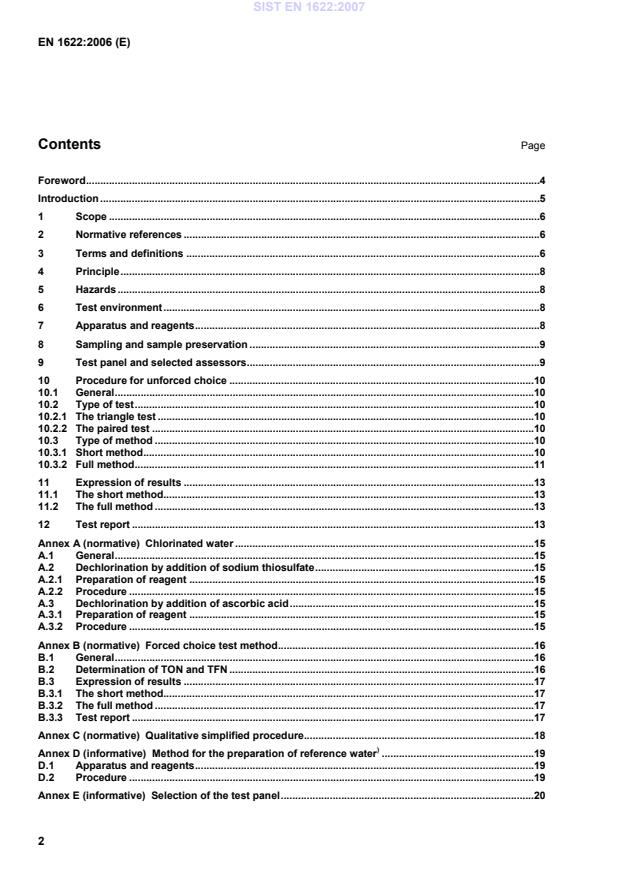
Chlorinated water.15 A.1 General.15 A.2 Dechlorination by addition of sodium thiosulfate.15 A.2.1 Preparation of reagent.15 A.2.2 Procedure.15 A.3 Dechlorination by addition of ascorbic acid.15 A.3.1 Preparation of reagent.15 A.3.2 Procedure.15 Annex B (normative)
Forced choice test method.16 B.1 General.16 B.2 Determination of TON and TFN.16 B.3 Expression of results.17 B.3.1 The short method.17 B.3.2 The full method.17 B.3.3 Test report.17 Annex C (normative)
Qualitative simplified procedure.18 Annex D (informative)
Method for the preparation of reference water).19 D.1 Apparatus and reagents.19 D.2 Procedure.19 Annex E (informative)
Selection of the test panel.20 SIST EN 1622:2007
Preparation of dilutions.23 Annex G (informative)
Interlaboratory test by forced choice methodology.24 Bibliography.27
Figures Figure G.1 — Graphical presentation of threshold flavour number; calculated threshold flavour number is 13,5.25
Tables Table 1 — Threshold numbers.13 Table E.1 — Long term constraints form.21 Table E.2 — Test report form for individual candidates.22 Table F.1 —Examples of successive dilutions, xp (10.3. 2.2).23 Table G.1 — Statistical evaluation by forced choice triangle test (TFN), concerning the measurements obtained by 10 selected assessors, for assessment of drinking water (x=2).24 Table G.2 — Measurements on odour and flavour on geosmin solutions (forced choice, triangle test)25 Table G.3 — Measurements on odour and flavour on geosmin solutions (forced choice, paired test).26
...