


EN 12641-1:2019
(Main)Intermodal loading units and commercial vehicles - Tarpaulins - Part 1: Minimum requirements
Intermodal loading units and commercial vehicles - Tarpaulins - Part 1: Minimum requirements
This document specifies minimum requirements for the strength and attachment of tarpaulins used on swap bodies and utility vehicles for road and road/rail combined (intermodal transport) traffic.
Intermodale Ladeeinheiten und Nutzfahrzeuge - Planen - Teil 1: Mindestanforderungen
Dieses Dokument legt Mindestanforderungen an die Festigkeit und Anbindung von Planen an Wechselbehältern und Nutzfahrzeugen für den Straßen- und kombinierten Straßen-/Schienen-Verkehr (intermodaler Verkehr) fest.
Unités de chargement intermodales et véhicules utilitaires - Bâches - Partie 1 : Exigences minimales
Le présent document spécifie les exigences minimales de résistance et de fixation des bâches pour caisses mobiles et véhicules utilitaires destinés au transport routier et au transport combiné rail route (transport intermodal).
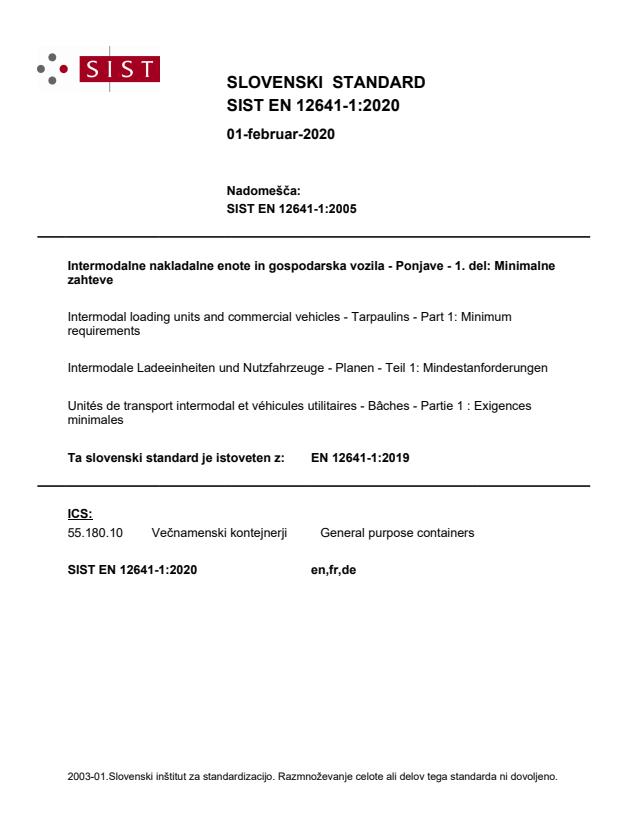
Intermodalne nakladalne enote in gospodarska vozila - Ponjave - 1. del: Minimalne zahteve
Ta dokument določa minimalne zahteve za trdnost in pritrditev ponjav, ki se uporabljajo na zamenljivih zabojnikih ter cestnih in kombiniranih cestnih/železniških gospodarskih vozilih (intermodalni prevoz).
General Information
Relations
Overview
EN 12641-1:2019 is a European standard developed by CEN that defines the minimum requirements for tarpaulins used on intermodal loading units and commercial vehicles. Specifically, it covers tarpaulins applicable to swap bodies and utility vehicles engaged in road and combined road/rail (intermodal) transport. The standard ensures that tarpaulins meet defined criteria for strength, durability, attachment methods, and material quality, thereby supporting secure cargo protection and compliance with transport regulations.
Key Topics
Scope and Application
EN 12641-1:2019 sets minimum performance requirements for tarpaulins on intermodal transport vehicles, focusing on strength and attachment to ensure protection against external influences during transit.Material Requirements
Tarpaulins must meet specific test criteria, including:- Breaking strength (≥ 2,850 N/5 cm at room temperature)
- Tear resistance in both warp and weft directions
- Adhesion strength of welded joints ≥ 100 N/5 cm
- Dimensional stability within 1% after 24 hours at 70 °C
- Resistance to cracking after repeated flexing (≥ 100,000 bending operations)
- Fire resistance with a burning rate less than 100 mm/min
- Mass per area specified and documented (typically > 650 g/m²)
Construction and Design
Multi-piece tarpaulins and vertically divided tarpaulins must meet the same performance standards as single-piece tarpaulins. Openings in vertically divided tarpaulins are permitted only if they provide mission-critical tightness and meet application-specific requirements.Attachment and Fixation
Tarpaulins must be securely attached using eyelets spaced a maximum of 200 mm apart, except around stanchions where spacing can increase to 300 mm. Attachments must be aligned vertically and horizontally - zigzag or sling-clasp arrangements are not allowed. Approved ropes for securing include hemp or sisal ropes (minimum 8 mm diameter with transparent plastic sheath) and steel wire ropes (minimum 3 mm diameter, optionally covered by plastic sheath).Marking Requirements
Each tarpaulin must be durably marked with:- The standard reference number (EN 12641-1)
- Date of manufacture (year and month)
- Manufacturer's name or trademark
- Mass per area of the tarpaulin material (g/m²)
- Lowest permissible operating temperature (e.g., -25 °C or -40 °C)
Applications
EN 12641-1:2019 tarpaulins are essential in intermodal transport operations, ensuring secure cargo coverage during transport segments involving road and rail. Applications include:
- Protection of goods on swap bodies, road trailers, and utility vehicles
- Compliance with customs and safety regulations that require tight and standardized fixing of tarpaulins
- Use in harsh environmental conditions, thanks to tested resistance to tearing, flexing, and temperature extremes
- Enhancing cargo security and minimizing damage by preventing ingress of weather and contaminants
Organizations involved in freight, logistics, and transport operations benefit from adhering to this standard by improving operational efficiency, reducing risk of cargo damage, and ensuring regulatory compliance.
Related Standards
- EN 1875-3 – Test method for tear strength of rubber or plastics-coated fabrics
- EN ISO 1421 – Tensile strength and elongation testing of coated fabrics
- EN ISO 2286-2 – Mass determination of coated fabrics
- EN ISO 2411 – Adhesion testing of coated fabrics and welded joints
- EN ISO 7854 – Flexing resistance tests of coated fabrics
- ISO 3795 – Determination of burning behavior of interior materials in vehicles
- ISO/IWA 16 – International harmonized methods for quantifying CO2 emissions in freight transport
By integrating EN 12641-1:2019 with these complementary standards, manufacturers and transport operators can ensure a holistic approach to quality, safety, and environmental impact in the production and use of tarpaulins for intermodal transport.
Keywords: EN 12641-1-2019, intermodal loading units, commercial vehicles, tarpaulins, minimum requirements, tarpaulin strength, intermodal transport, swap bodies, utility vehicles, tarpaulin attachment, transport safety standards, coated fabric testing, tarpaulin marking, road and rail transport tarpaulins.

Frequently Asked Questions
EN 12641-1:2019 is a standard published by the European Committee for Standardization (CEN). Its full title is "Intermodal loading units and commercial vehicles - Tarpaulins - Part 1: Minimum requirements". This standard covers: This document specifies minimum requirements for the strength and attachment of tarpaulins used on swap bodies and utility vehicles for road and road/rail combined (intermodal transport) traffic.
This document specifies minimum requirements for the strength and attachment of tarpaulins used on swap bodies and utility vehicles for road and road/rail combined (intermodal transport) traffic.
EN 12641-1:2019 is classified under the following ICS (International Classification for Standards) categories: 55.180.10 - General purpose containers. The ICS classification helps identify the subject area and facilitates finding related standards.
EN 12641-1:2019 has the following relationships with other standards: It is inter standard links to EN 12641-1:2005. Understanding these relationships helps ensure you are using the most current and applicable version of the standard.
EN 12641-1:2019 is associated with the following European legislation: EU Directives/Regulations: 2014/47/EU. When a standard is cited in the Official Journal of the European Union, products manufactured in conformity with it benefit from a presumption of conformity with the essential requirements of the corresponding EU directive or regulation.
You can purchase EN 12641-1:2019 directly from iTeh Standards. The document is available in PDF format and is delivered instantly after payment. Add the standard to your cart and complete the secure checkout process. iTeh Standards is an authorized distributor of CEN standards.
Standards Content (Sample)
SLOVENSKI STANDARD
01-februar-2020
Nadomešča:
SIST EN 12641-1:2005
Intermodalne nakladalne enote in gospodarska vozila - Ponjave - 1. del: Minimalne
zahteve
Intermodal loading units and commercial vehicles - Tarpaulins - Part 1: Minimum
requirements
Intermodale Ladeeinheiten und Nutzfahrzeuge - Planen - Teil 1: Mindestanforderungen
Unités de transport intermodal et véhicules utilitaires - Bâches - Partie 1 : Exigences
minimales
Ta slovenski standard je istoveten z: EN 12641-1:2019
ICS:
55.180.10 Večnamenski kontejnerji General purpose containers
2003-01.Slovenski inštitut za standardizacijo. Razmnoževanje celote ali delov tega standarda ni dovoljeno.
EN 12641-1
EUROPEAN STANDARD
NORME EUROPÉENNE
December 2019
EUROPÄISCHE NORM
ICS 55.180.10 Supersedes EN 12641-1:2005
English Version
Intermodal loading units and commercial vehicles -
Tarpaulins - Part 1: Minimum requirements
Unités de chargement intermodales et véhicules Intermodale Ladeeinheiten und Nutzfahrzeuge -
utilitaires - Bâches - Partie 1 : Exigences minimales Planen - Teil 1: Mindestanforderungen
This European Standard was approved by CEN on 9 September 2019.
CEN members are bound to comply with the CEN/CENELEC Internal Regulations which stipulate the conditions for giving this
European Standard the status of a national standard without any alteration. Up-to-date lists and bibliographical references
concerning such national standards may be obtained on application to the CEN-CENELEC Management Centre or to any CEN
member.
This European Standard exists in three official versions (English, French, German). A version in any other language made by
translation under the responsibility of a CEN member into its own language and notified to the CEN-CENELEC Management
Centre has the same status as the official versions.
CEN members are the national standards bodies of Austria, Belgium, Bulgaria, Croatia, Cyprus, Czech Republic, Denmark, Estonia,
Finland, France, Germany, Greece, Hungary, Iceland, Ireland, Italy, Latvia, Lithuania, Luxembourg, Malta, Netherlands, Norway,
Poland, Portugal, Republic of North Macedonia, Romania, Serbia, Slovakia, Slovenia, Spain, Sweden, Switzerland, Turkey and
United Kingdom.
EUROPEAN COMMITTEE FOR STANDARDIZATION
COMITÉ EUROPÉEN DE NORMALISATION
EUROPÄISCHES KOMITEE FÜR NORMUNG
CEN-CENELEC Management Centre: Rue de la Science 23, B-1040 Brussels
© 2019 CEN All rights of exploitation in any form and by any means reserved Ref. No. EN 12641-1:2019 E
worldwide for CEN national Members.
Contents Page
European foreword . 3
1 Scope . 4
2 Normative references . 4
3 Terms and definitions . 4
4 Requirements . 4
5 Marking . 6
Bibliography . 8
European foreword
This document (EN 12641-1:2019) has been prepared by Technical Committee CEN/TC 119
“Intermodal Loading Units and Cargo Securing (ILUCS)”, the secretariat of which is held by DIN.
This European Standard shall be given the status of a national standard, either by publication of an
identical text or by endorsement, at the latest by June 2020, and conflicting national standards shall be
withdrawn at the latest by June 2020.
Attention is drawn to the possibility that some of the elements of this document may be the subject of
patent rights. CEN shall not be held responsible for identifying any or all such patent rights.
This document supersedes EN 12641-1:2005.
The main technical changes are:
a) term 3.1 was added;
b) Table 1 – the row 'mass per area' was added;
c) Figure 2 – key 4 was added.
According to the CEN-CENELEC Internal Regulations, the national standards organisations of the
following countries are bound to implement this European Standard: Austria, Belgium, Bulgaria,
Croatia, Cyprus, Czech Republic, Denmark, Estonia, Finland, France, Germany, Greece, Hungary, Iceland,
Ireland, Italy, Latvia, Lithuania, Luxembourg, Malta, Netherlands, Norway, Poland, Portugal, Republic of
North Macedonia, Romania, Serbia, Slovakia, Slovenia, Spain, Sweden, Switzerland, Turkey and the
United Kingdom.
1 Scope
This document specifies minimum requirements for the strength and attachment of tarpaulins used on
swap bodies and utility vehicles for road and road/rail combined (intermodal transport) traffic.
2 Normative references
The following documents are referred to in the text in such a way that some or all of their content
constitutes requirements of this document. For dated references, only the edition cited applies. For
undated references, the latest edition of the referenced document (including any amendments) applies.
EN 1875-3, Rubber-
...
Questions, Comments and Discussion
Ask us and Technical Secretary will try to provide an answer. You can facilitate discussion about the standard in here.
Loading comments...