

prEN 350
(Main)Biological durability of wood and wood-based products - Testing and classification of the durability against biological agents of wood and wood-based materials
- Abstract
This document gives guidance on methods for determining and classifying the durability of wood and wood-based materials against biological wood-destroying agents.
The methods can be applied to individual wood species and processed wood-based materials, including thermally and chemically modified, and water-repellent impregnated wood. Examples of wood-based materials are oriented strand boards (OSB), particle boards, fibre boards, laminated veneer lumber (LVL), and plywood. However, this document is not intended to give guidance on methods for determining and classifying the durability of wood products, coated wood, and wood polymer composites.
Preservative-treated wood is not within the scope of this document, since requirements for the effectiveness of wood preservatives and durability requirements of wood treated with preservatives are regulated in several other European standards. However, this does not apply to modified wood, which is why it is included in the scope of this document.
The wood-destroying agents considered in this document are:
— wood-decay fungi (basidiomycete and soft-rot fungi);
— beetles capable of attacking dry wood;
— termites;
— marine organisms capable of attacking wood in service.
Data on the biological durability of the heartwood of selected wood species considered of economic importance in European countries are presented in Annex A (informative), which also provides information relating to their geographical origin, density, sapwood width and treatability.
NOTE Treatability, durability to disfiguring fungi, permeability to water and performance in use of wood and wood-based materials are also important issues. However, because standardized methods aiming to assess and classify these factors do not exist and/or have not been extensively experienced yet, preliminary guidance is given in Annex B (informative) for the classification of wood treatability with aqueous wood preservatives, Annex C (informative) for the classification of the permeability to water, and Annex D (informative) for the durability to disfiguring fungi.
- Status
- Not Published
- Publication Date
- 15-Feb-2028
- Technical Committee
- CEN/TC 38 - Durability of wood and derived materials
- Current Stage
- 4020 - Submission to enquiry - Enquiry
- Start Date
- 06-Aug-2026
- Due Date
- 04-Nov-2026
- Completion Date
- 06-Aug-2026

prEN 350 is a CEN draft European Standard on the biological durability of wood and wood-based products. It gives guidance on how to test and classify wood species and wood-based materials against wood-destroying biological agents, so users can compare materials for selection, specification and service-life assessment.
What does prEN 350 specify?
prEN 350 gives guidance on methods for determining and classifying durability against biological wood-destroying agents. It applies to individual wood species and to processed wood-based materials, including thermally and chemically modified wood and water-repellent impregnated wood.
The scope excludes wood products, coated wood and wood polymer composites. Preservative-treated wood is also outside the scope, while modified wood remains included.
The document is organized into:
- Clause 1 Scope
- Clause 2 Normative references
- Clause 3 Terms and definitions
- Clause 4 Sampling of wood and wood-based materials to be tested
- Clause 5 General principles for testing and classification
- Clause 6 Test methods and classification system
- Annexes A to E
| Annex | What it covers |
|---|---|
| Annex A | Guide to biological durability and treatability of wood species marketed in Europe |
| Annex B | Classification of treatability with aqueous wood preservatives |
| Annex C | Permeability to water |
| Annex D | Susceptibility to disfiguring fungi |
| Annex E | Form for adding new data on wood species or wood-based material |
What are the key requirements of prEN 350?
prEN 350 is mainly a guidance document, but it is very specific about how samples are taken, how tests are run, and how durability classes are assigned. In practice, the standard is about making durability comparisons that are traceable, repeatable and tied to the intended use.
Sampling and specimen preparation
Clause 4 sets minimum sampling expectations for logs, sawn timber, sets of wood, modified timber and wood-based panels. prEN 350 asks for representative material from multiple trees, sites or production batches, because durability can vary within one species or product line.
For wood species, the document expects sampling from at least 3 trees from 3 different sites, with at least 30 specimens per test variable. For sawn timber, it prefers as many boards as possible and at least 30 boards from at least 5 lots. For modified timber, it requires material from 3 production batches or lots, with 9 boards in total. For wood-based panels, at least 3 panels are taken and at least 12 replicate specimens are tested.
This matters because the durability class should reflect real material variability, not just one favorable sample. Clause 5.1 also requires conditioning at 20 ± 2 °C and 65 ± 5 % relative humidity to constant mass, and species identification according to EN 13556.
How the durability classes are assigned
Clause 5.2 and Clause 6 use separate durability scales for different organism groups. For fungi, the document uses a five-grade durability class scale from DC 1 to DC 5. For wood-boring beetles it uses DC D and DC S, while termites and marine organisms use three-grade scales with DC D, DC M and DC S.
prEN 350 bases fungal classification on relative values, or x-values, so the class depends on the test result compared with the reference material. That is important because it makes the classification less dependent on a single test method.
For wood species, the durability class applies to heartwood only, excluding juvenile wood. Sapwood is treated as not durable unless test data show otherwise.
Durability against fungi
Clause 6.1 covers fungi. For laboratory testing, prEN 350 points to EN 113-2 for basidiomycetes and CEN/TS 15083-2 for soft-rot fungi, with pre-ageing in accordance with EN 84. If a material is being assessed specifically for UC 1 or UC 2, EN 73 may be used instead of EN 84.
For field exposure, the standard allows in-ground and above-ground methods. EN 252 is used for in-ground testing, while above-ground durability can be assessed with methods such as EN 330, EN 12037, ground proximity, bundle, double-layer and sandwich tests. If field data exist, they take precedence over laboratory data.
This matters because laboratory tests are more controlled, but field tests better reflect service conditions. For practical selection, prEN 350 therefore links the test method to the intended use class.
Durability against beetles, termites and marine organisms
Clause 6.2 covers beetles using methods based on EN 46-1, EN 49-1 and EN 20-1. A specimen is classified as not durable if live insects remain at the end of the test; if no live insects remain and validity criteria are met, it is durable.
Clause 6.3 covers termites using EN 117, with the test organized around the termite genus relevant to the intended use region. Clause 6.4 covers marine organisms using procedures based on EN 275, with field testing recommended in more than one site when possible.
These sections matter because they translate biological attack into a usable durability class for different exposure situations, from dry-wood insects to marine borers.
What terms does prEN 350 define?
- wood species - A trade name according to EN 13556, which can sometimes cover more than one botanical species.
- set - A clearly identifiable collection of wood or wood-based product units from a commercial supply of defined origin.
- wood-based material - A material made from smaller wood parts joined together, with wood content by mass of at least 50 %.
- modified wood - Wood that has been changed by a chemical, biological or physical agent to give a permanent desired property.
- biological durability - The inherent resistance of a wood species or wood-based material against wood decay organisms, including natural and conferred durability.
- sapwood - The outer zone of wood that, in the growing tree, contains living cells and conducts sap.
- heartwood - The inner zone of wood that no longer contains living cells or conducts sap.
- permeability to water - The ease with which water penetrates a wood-based matrix and is later released by evaporation.
Who uses prEN 350?
prEN 350 is used by laboratories, timber producers, panel manufacturers, wood modification suppliers, specifiers, and technical staff who need to compare durability data. It is also relevant to quality managers, designers and buyers who need to choose wood or wood-based products for a given end use.
In practice, users apply it when sampling material, running durability tests, reporting results, ranking species, or deciding whether a wood species is suitable for a particular exposure condition. It is especially useful where service life prediction and material selection depend on biological durability rather than appearance or strength alone.
What changed in prEN 350 from the previous edition?
prEN 350 will supersede EN 350:2016. The foreword states these significant technical changes:
- preservative-treated wood is removed from the scope
- durability classes against wood-destroying fungi are newly defined, with relative values as the basis for assigning classes
- sampling guidance is specified for logs, sawn timber, sets of wood, modified timber and wood-based panels
- Annex A has been updated for taxonomy and now compiles the data in two tables, one for softwood and one for hardwood
Which standards are used with prEN 350?
| Standard | What it contributes |
|---|---|
| EN 13556 | Nomenclature of timbers used in Europe, for identifying wood species |
| EN 84 | Accelerated ageing of treated wood before biological testing |
| EN 113-2 | Laboratory test against wood-destroying basidiomycetes for solid wood |
| EN 113-3 | Laboratory test against wood-destroying basidiomycetes for wood-based panels |
| CEN/TS 15083-2 | Test method for soft-rot micro-fungi |
| EN 20-1 | Test method against Lyctus brunneus |
| EN 46-1 | Test method against Hylotrupes bajulus larvae |
| EN 49-1 | Test method against Anobium punctatum larvae |
| EN 117 | Laboratory method for termites |
| EN 252 | Field test method in ground contact |
| EN 275 | Test method against marine borers |
| EN 13183-1 | Moisture content by oven dry method |
| ISO 13061-1 | Moisture content for small clear wood specimens |
| ISO 13061-2 | Density for small clear wood specimens |
| EN 73 | Alternative ageing procedure for treated wood in UC 1 or UC 2 |
| EN 330 | Above-ground field test method in L-joint form |
| EN 12037 | Above-ground field test method in horizontal lap-joint form |
| EN 14734 | Treatability of timber species to be impregnated with wood preservatives |
| EN 335 | Use classes for solid wood and wood-based products |
| EN 460 | Guidance on performance |
| CEN/TS 16818 | Moisture dynamics of wood and wood-based products |
| EN 351-1 | Classification of preservative penetration and retention |
| CEN/TS 1099 | Guidance for plywood biological durability assessment |
| EN 15534-1 | Test methods for wood-polymer composites and natural fibre composites |
| ISO 2859-2 | Sampling plans for isolated lot inspection |
| ISO 3129 | Sampling methods for small clear wood specimens |
What does the prEN 350 document contain?
prEN 350 contains the sampling rules, test-method links and classification tables needed to assess biological durability of wood and wood-based products. It includes a figure that separates stem zones for sampling, a main test matrix for organism groups and use classes, and durability class tables for fungi, beetles, termites and marine organisms.
Annex A is a large species guide with durability, origin, density, sapwood width and treatability information for selected species marketed in Europe. Annexes B, C and D give preliminary guidance on treatability, permeability to water and susceptibility to disfiguring fungi, and Annex E provides a submission form for new data.
Relations
- Effective Date
- 06-Mar-2023
Get Certified
Connect with accredited certification bodies for this standard

Gozdarski inštitut Slovenije
Slovenian Forestry Institute. Forest management certification support, timber testing.
Sponsored listings
Frequently Asked Questions
prEN 350 is a draft published by the European Committee for Standardization (CEN). Its full title is "Biological durability of wood and wood-based products - Testing and classification of the durability against biological agents of wood and wood-based materials". This standard covers: This document gives guidance on methods for determining and classifying the durability of wood and wood-based materials against biological wood-destroying agents. The methods can be applied to individual wood species and processed wood-based materials, including thermally and chemically modified, and water-repellent impregnated wood. Examples of wood-based materials are oriented strand boards (OSB), particle boards, fibre boards, laminated veneer lumber (LVL), and plywood. However, this document is not intended to give guidance on methods for determining and classifying the durability of wood products, coated wood, and wood polymer composites. Preservative-treated wood is not within the scope of this document, since requirements for the effectiveness of wood preservatives and durability requirements of wood treated with preservatives are regulated in several other European standards. However, this does not apply to modified wood, which is why it is included in the scope of this document. The wood-destroying agents considered in this document are: — wood-decay fungi (basidiomycete and soft-rot fungi); — beetles capable of attacking dry wood; — termites; — marine organisms capable of attacking wood in service. Data on the biological durability of the heartwood of selected wood species considered of economic importance in European countries are presented in Annex A (informative), which also provides information relating to their geographical origin, density, sapwood width and treatability. NOTE Treatability, durability to disfiguring fungi, permeability to water and performance in use of wood and wood-based materials are also important issues. However, because standardized methods aiming to assess and classify these factors do not exist and/or have not been extensively experienced yet, preliminary guidance is given in Annex B (informative) for the classification of wood treatability with aqueous wood preservatives, Annex C (informative) for the classification of the permeability to water, and Annex D (informative) for the durability to disfiguring fungi.
This document gives guidance on methods for determining and classifying the durability of wood and wood-based materials against biological wood-destroying agents. The methods can be applied to individual wood species and processed wood-based materials, including thermally and chemically modified, and water-repellent impregnated wood. Examples of wood-based materials are oriented strand boards (OSB), particle boards, fibre boards, laminated veneer lumber (LVL), and plywood. However, this document is not intended to give guidance on methods for determining and classifying the durability of wood products, coated wood, and wood polymer composites. Preservative-treated wood is not within the scope of this document, since requirements for the effectiveness of wood preservatives and durability requirements of wood treated with preservatives are regulated in several other European standards. However, this does not apply to modified wood, which is why it is included in the scope of this document. The wood-destroying agents considered in this document are: — wood-decay fungi (basidiomycete and soft-rot fungi); — beetles capable of attacking dry wood; — termites; — marine organisms capable of attacking wood in service. Data on the biological durability of the heartwood of selected wood species considered of economic importance in European countries are presented in Annex A (informative), which also provides information relating to their geographical origin, density, sapwood width and treatability. NOTE Treatability, durability to disfiguring fungi, permeability to water and performance in use of wood and wood-based materials are also important issues. However, because standardized methods aiming to assess and classify these factors do not exist and/or have not been extensively experienced yet, preliminary guidance is given in Annex B (informative) for the classification of wood treatability with aqueous wood preservatives, Annex C (informative) for the classification of the permeability to water, and Annex D (informative) for the durability to disfiguring fungi.
prEN 350 is classified under the following ICS (International Classification for Standards) categories: 79.040 - Wood, sawlogs and sawn timber. The ICS classification helps identify the subject area and facilitates finding related standards.
prEN 350 has the following relationships with other standards: It is inter standard links to EN 350:2016. Understanding these relationships helps ensure you are using the most current and applicable version of the standard.
prEN 350 is available in PDF format for immediate download after purchase. The document can be added to your cart and obtained through the secure checkout process. Digital delivery ensures instant access to the complete standard document.
Standards Content (Sample)
SLOVENSKI STANDARD
01-oktober-2026
Biološka odpornost lesa in lesnih proizvodov - Preskušanje in razvrščanje
odpornosti proti biološkim dejavnikom lesa in lesnih materialov
Biological durability of wood and wood-based products - Testing and classification of the
durability against biological agents of wood and wood-based materials
Biologische Dauerhaftigkeit von Holz und Holzprodukten - Prüfung und Klassifikation der
Dauerhaftigkeit von Holz und holzbasierten Materialien gegenüber biologischem Angriff
Durabilité biologique du bois et des matériaux à base de bois - Méthodes d'essai et de
classification de la durabilité vis-à-vis des agents biologiques du bois et des matériaux
dérivés du bois
Ta slovenski standard je istoveten z: prEN 350
ICS:
79.040 Les, hlodovina in žagan les Wood, sawlogs and sawn
timber
2003-01.Slovenski inštitut za standardizacijo. Razmnoževanje celote ali delov tega standarda ni dovoljeno.
DRAFT
EUROPEAN STANDARD
NORME EUROPÉENNE
EUROPÄISCHE NORM
August 2026
ICS 79.040 Will supersede EN 350:2016
English Version
Biological durability of wood and wood-based products -
Testing and classification of the durability against
biological agents of wood and wood-based materials
Durabilité biologique du bois et des matériaux à base Biologische Dauerhaftigkeit von Holz und
de bois - Méthodes d'essai et de classification de la Holzprodukten - Prüfung und Klassifikation der
durabilité vis-à-vis des agents biologiques du bois et Dauerhaftigkeit von Holz und holzbasierten
des matériaux dérivés du bois Materialien gegenüber biologischem Angriff
This draft European Standard is submitted to CEN members for enquiry. It has been drawn up by the Technical Committee
CEN/TC 38.
If this draft becomes a European Standard, CEN members are bound to comply with the CEN/CENELEC Internal Regulations
which stipulate the conditions for giving this European Standard the status of a national standard without any alteration.
This draft European Standard was established by CEN in three official versions (English, French, German). A version in any other
language made by translation under the responsibility of a CEN member into its own language and notified to the CEN-CENELEC
Management Centre has the same status as the official versions.
CEN members are the national standards bodies of Austria, Belgium, Bulgaria, Croatia, Cyprus, Czech Republic, Denmark, Estonia,
Finland, France, Germany, Greece, Hungary, Iceland, Ireland, Italy, Latvia, Lithuania, Luxembourg, Malta, Netherlands, Norway,
Poland, Portugal, Republic of North Macedonia, Romania, Serbia, Slovakia, Slovenia, Spain, Sweden, Switzerland, Türkiye and
United Kingdom.
Recipients of this draft are invited to submit, with their comments, notification of any relevant patent rights of which they are
aware and to provide supporting documentation.
Warning : This document is not a European Standard. It is distributed for review and comments. It is subject to change without
notice and shall not be referred to as a European Standard.
EUROPEAN COMMITTEE FOR STANDARDIZATION
COMITÉ EUROPÉEN DE NORMALISATION
EUROPÄISCHES KOMITEE FÜR NORMUNG
CEN-CENELEC Management Centre: Rue de la Science 23, B-1040 Brussels
© 2026 CEN All rights of exploitation in any form and by any means reserved Ref. No. prEN 350:2026 E
worldwide for CEN national Members.
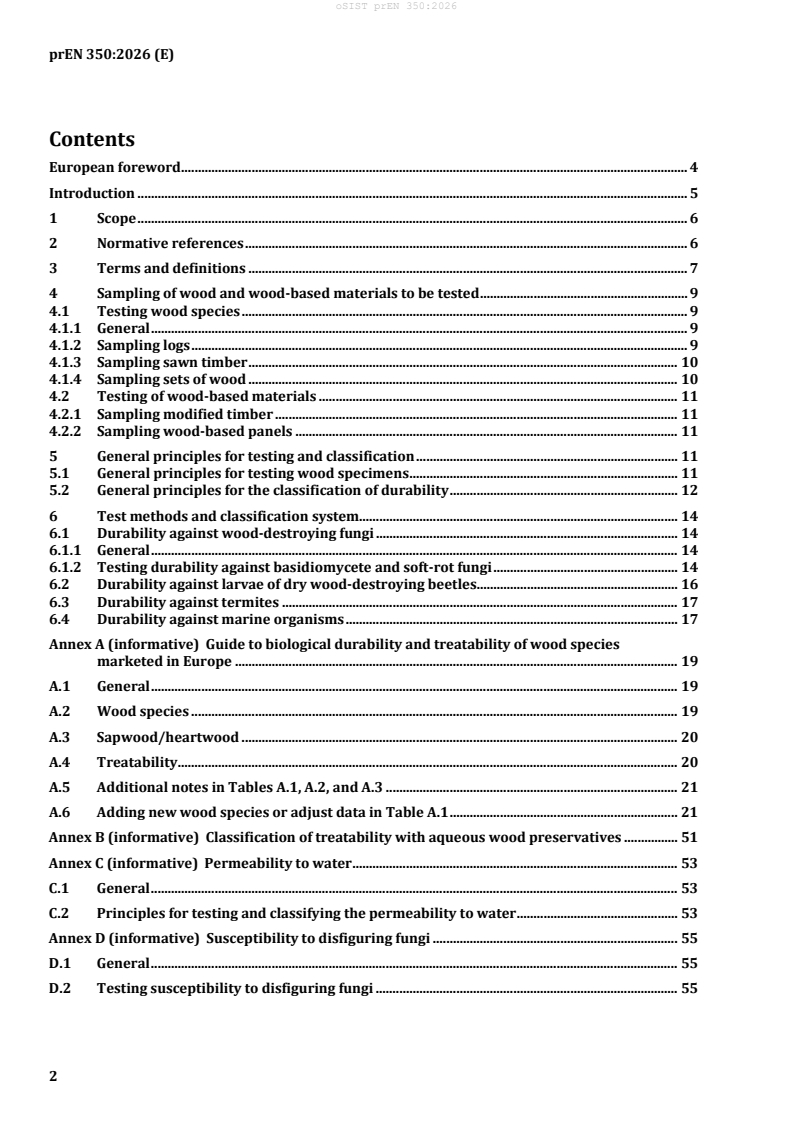
Contents
European foreword . 4
Introduction . 5
1 Scope . 6
2 Normative references . 6
3 Terms and definitions . 7
4 Sampling of wood and wood-based materials to be tested . 9
4.1 Testing wood species . 9
4.1.1 General . 9
4.1.2 Sampling logs . 9
4.1.3 Sampling sawn timber . 10
4.1.4 Sampling sets of wood . 10
4.2 Testing of wood-based materials . 11
4.2.1 Sampling modified timber . 11
4.2.2 Sampling wood-based panels . 11
5 General principles for testing and classification . 11
5.1 General principles for testing wood specimens . 11
5.2 General principles for the classification of durability . 12
6 Test methods and classification system. 14
6.1 Durability against wood-destroying fungi . 14
6.1.1 General . 14
6.1.2 Testing durability against basidiomycete and soft-rot fungi . 14
6.2 Durability against larvae of dry wood-destroying beetles . 16
6.3 Durability against termites . 17
6.4 Durability against marine organisms . 17
Annex A (informative) Guide to biological durability and treatability of wood species
marketed in Europe . 19
A.1 General . 19
A.2 Wood species . 19
A.3 Sapwood/heartwood . 20
A.4 Treatability . 20
A.5 Additional notes in Tables A.1, A.2, and A.3 . 21
A.6 Adding new wood species or adjust data in Table A.1 . 21
Annex B (informative) Classification of treatability with aqueous wood preservatives . 51
Annex C (informative) Permeability to water . 53
C.1 General . 53
C.2 Principles for testing and classifying the permeability to water . 53
Annex D (informative) Susceptibility to disfiguring fungi . 55
D.1 General . 55
D.2 Testing susceptibility to disfiguring fungi . 55
Annex E (informative) Form to be used for the inclusion of new data on wood species /
wood-based material . 56
Bibliography . 59
European foreword
This document (prEN 350:2026) has been prepared by Technical Committee CEN/TC 38 “Biological
durability of wood and wood-based products”, the secretariat of which is held by SIS.
This document will supersede EN 350:2016.
This document is currently submitted to the CEN Enquiry.
This document includes the following significant technical changes with respect to EN 350:2016:
• Preservative treated wood is not in the scope of this document.
• Durability classes (DC), i.e. classes of durability against wood-destroying fungi, are newly defined, on
the one hand with regard to organism groups that occur in different use classes, on the other hand
with regard to their basis of calculation. Relative values (i.e. x-values) are the basis for assigning DCs
independent from the applied test method.
• Guidance on sampling of wood and wood-based materials to be tested is specified for logs, sawn
timber, sets of wood, modified timber, and wood-based panels.
• Information compiled in Annex A had been updated with regard to taxonomy. It indicates on which
data basis a durability class was determined. Information is compiled now in only two tables, A.1 for
softwood, A.2 for hardwoods.
Introduction
Wood durability is an important material property and factor that influences the service life of a wood
product. This document provides input to service life prediction of wood and wood-based products. It is
intended to give information relevant to the use of wood products appropriate for different end-uses
avoiding excessive requirements. It also ranks biological durability against wood-decay organisms of
various wood species thereby allowing species of appropriate durability to be selected for a particular
use. It will however be emphasized that the biological durability rating of heartwood of a wood species
given in Annex A cannot be regarded as any guarantee of performance in service.
There are many other factors influencing service life of a wood product, such as the principles of good
design, use conditions, climate, maintenance which should be taken into consideration.
1 Scope
This document gives guidance on methods for determining and classifying the durability of wood and
wood-based materials against biological wood-destroying agents.
The methods can be applied to individual wood species and processed wood-based materials, including
thermally and chemically modified, and water-repellent impregnated wood. Examples of wood-based
materials are oriented strand boards (OSB), particle boards, fibre boards, laminated veneer lumber (LVL),
and plywood. However, this document is not intended to give guidance on methods for determining and
classifying the durability of wood products, coated wood, and wood polymer composites.
Preservative-treated wood is not within the scope of this document, since requirements for the
effectiveness of wood preservatives and durability requirements of wood treated with preservatives are
regulated in several other European standards. However, this does not apply to modified wood, which is
why it is included in the scope of this document.
The wood-destroying agents considered in this document are:
— wood-decay fungi (basidiomycete and soft-rot fungi);
— beetles capable of attacking dry wood;
— termites;
— marine organisms capable of attacking wood in service.
Data on the biological durability of the heartwood of selected wood species considered of economic
importance in European countries are presented in Annex A (informative), which also provides
information relating to their geographical origin, density, sapwood width and treatability.
NOTE Treatability, durability to disfiguring fungi, permeability to water and performance in use of wood and
wood-based materials are also important issues. However, because standardized methods aiming to assess and
classify these factors do not exist and/or have not been extensively experienced yet, preliminary guidance is given
in Annex B (informative) for the classification of wood treatability with aqueous wood preservatives, Annex C
(informative) for the classification of the permeability to water, and Annex D (informative) for the durability to
disfiguring fungi.
2 Normative references
The following documents are referred to in the text in such a way that some or all of their content
constitutes requirements of this document. For dated references, only the edition cited applies. For
undated references, the latest edition of the referenced document (including any amendments) applies.
CEN/TS 15083-2, Durability of wood and wood-based products - Determination of the natural durability of
solid wood against wood-destroying fungi, test methods - Part 2: Soft rotting micro-fungi
EN 20-1, Wood preservatives - Determination of the protective effectiveness against Lyctus brunneus
(Stephens) - Part 1: Application by surface treatment (laboratory method)
EN 46−1, Wood preservatives - Determination of the preventive action against recently hatched larvae of
Hylotrupes bajulus (Linnaeus) - Part 1: Application by surface treatment (laboratory method)
EN 49-1, Wood preservatives - Determination of the protective effectiveness against Anobium punctatum
(De Geer) by egg-laying and larval survival - Part 1: Application by surface treatment (Laboratory method)
EN 84, Durability of wood and wood-based products - Accelerated ageing of treated wood prior to biological
testing - Leaching procedure
EN 113-2, Durability of wood and wood-based products - Test method against wood destroying
basidiomycetes - Part 2: Assessment of inherent or enhanced durability
EN 113-3, Durability of wood and wood-based products - Test method against wood destroying
basidiomycetes - Part 3: Assessment of durability of wood-based panels
EN 117, Wood preservatives - Determination of toxic values against Reticulitermes species (European
termites) (Laboratory method)
EN 252, Field test method for determining the relative protective effectiveness of a wood preservative in
ground contact
EN 275, Wood preservatives - Determination of the protective effectiveness against marine borers
EN 13183-1, Moisture content of a piece of sawn timber - Part 1: Determination by oven dry method
EN 13556, Round and sawn timber - Nomenclature of timbers used in Europe
ISO 13061-1, Physical and mechanical properties of wood - Test methods for small clear wood specimens -
Part 1: Determination of moisture content for physical and mechanical tests
ISO 13061-2, Physical and mechanical properties of wood — Test methods for small clear wood specimens
— Part 2: Determination of density for physical and mechanical tests
3 Terms and definitions
For the purposes of this document, the following terms and definitions apply.
ISO and IEC maintain terminology databases for use in standardization at the following addresses:
• ISO Online browsing platform: available at https://www.iso.org/obp
• IEC Electropedia: available at https://www.electropedia.org/
3.1
wood species
trade name according to EN 13556 which can on occasion include more than one botanical tree species
Note 1 to entry: E.g. European oak which comprises both Quercus robur and Q. petraea.
3.2
pilot name for a wood species
result of a consensual choice due to practical considerations retaining the usual name under which the
wood is the most widely commercialised, adopted either by the main exporting country or by the main
importing country
Note 1 to entry: Pilot names are established since 1954 in the nomenclature of the ATIBT.
3.3
set
clearly identifiable collection of units of wood or wood-based products, originating from a commercial
supply of a defined origin (single or not) and likely comprising only some of the variability of the wood
species or of the wood-based material
Note 1 to entry: E.g. wood species sourced from a restricted geographical area.
3.4
wood-based material
materials that are made by cutting up the wood into smaller parts, like veneers, particles or fibres, and
then joining it together, usually by adding adhesives or binders, where the wood content by mass is at
least 50 %; not regarded as wood materials are glued solid wood products, like glulam or cross-laminated
timber
3.5
modified wood
wood that undergoes the action of a chemical, biological or physical agent, resulting in a permanent
desired property enhancement
Note1 to entry: If the modification is intended for improved resistance to biological attack, then the mode of
action is assumed to be non-biocidal.
3.6
biological durability
inherent resistance of a wood species or a wood-based material against wood decay organisms, including
the natural durability and the conferred durability achieved by a preservation, protection or modification
treatment
Note 1 to entry: This inherent resistance is due to the presence of natural or technically introduced components
that can exhibit different levels of toxicity towards biological organisms and/or to anatomical particularities or a
specific constitution of certain wood-based materials.
3.7
sapwood
outer zone of wood that, in the growing tree, contains living cells and conducts sap
Note 1 to entry: Depending on the species, age of the tree and the growing conditions the proportions of sapwood
and heartwood can vary.
Note 2 to entry: Frequently paler than heartwood though not always distinguishable from heartwood in some
wood species.
Note 3 to entry: Sapwood of all wood species is considered to be non-resistant against decay fungi unless other
data are available. Sapwood can have different levels of resistance against wood boring insects (excluding termites).
3.8
heartwood
inner zone of wood that, in the growing tree, has ceased to contain living cells or to conduct sap
Note 1 to entry: Frequently darker than sapwood though not always distinguishable from sapwood in some wood
species.
3.9
transition wood
wood in a zone between the sapwood and the heartwood
Note 1 to entry: The transition wood can be regarded as a region of the heartwood that has not fully matured.
This is only distinguishable in very few wood species. In general, its biological durability, treatability and
permeability to water is intermediate between that of sapwood and heartwood.
3.10
juvenile wood
portion of woody tissue nearest the pith of the tree, often having properties that differ from mature wood
Note 1 to entry: Juvenile wood is a zone near to the pith, displaying marked sudden changes in its properties.
There is no clear consensus as to where this zone ends. In temperate wood species, it is generally thought to end at
10 to 20 annual rings from the pith, but it depends on the wood species.
Note 2 to entry: The durability, permeability to water and treatability of juvenile wood can be different from that
of mature heartwood.
3.11
permeability to water
ease with which water penetrates a wood-based matrix (wood of a particular species, wood-based
material) and is released by evaporation
3.12
performance
ability of a wood species or a wood-based material to withstand deterioration over time
Note 1 to entry: Performance can depend on a number of factors which will vary in importance depending on the
end use.
Note 2 to entry: Guidance on performance is given by EN 460.
4 Sampling of wood and wood-based materials to be tested
4.1 Testing wood species
4.1.1 General
The origin of test specimens and the number of replicates is of great importance for the reliability of the
test results.
The reliability of conclusions relating to the durability of a wood species increases with the number and
diversity of growing sites from which trees are taken and the number of replicates from those trees. The
recommendations given in 4.1.2 to 4.1.3 shall be regarded as minima.
NOTE Background information on sampling can be found in ISO 2859-2 and ISO 3129.
4.1.2 Sampling logs
A log shall be taken from at least 3 trees of the species under test, originating from 3 different sites
representative of the diversity of the geographical regions or sites where the tree species grows. Samples
should be taken from at least 6 planks, originating from at least 3 trees when only sawn wood is available
(see Annex A).
If high between-tree variation is expected (e.g. different botanic species), it is recommended to test a
larger number of trees (e.g. 5 – 10).
Each log shall be of sufficient size to permit the required number of test specimens to be obtained from
it.
Each log shall be taken from the main trunk avoiding its extreme ends. Knots and other features which
can influence durability shall be avoided.
Sampling shall be done separately for sapwood and heartwood. If the log size allows for it, sampling shall
be done separately for juvenile heartwood, mature heartwood (i.e. central heartwood), and transition
wood (if present).
Key
1 juvenile heartwood
2 pith
3 sapwood
4 transition wood
5 mature (central) heartwood
Figure 1 — Differentiation of stem zones for sampling
For each part of the wood (juvenile heartwood, mature (central) heartwood, transition wood, sapwood)
to be tested, at least 30 test specimens shall be taken for each test variable (for example “test method” or
“test organism”). A minimum of 6 specimens shall be taken from each log.
NOTE The number of replicates for juvenile wood may also be smaller if the available wood requires this.
Depending on the selected test method, additional specimens might be required to determine the density
of the wood species and the moisture content of the specimens. The sampling shall be done according to
the relevant standards (ISO 13061-2 for density and ISO 13061-1 for moisture content).
4.1.3 Sampling sawn timber
Wood placed on the market is mostly available as sawn timber and hence it is difficult to identify boards
originating from specific trees. For this reason, it is preferred to sample as many boards as possible so as
to better estimate the overall biological durability. A minimum of 30 boards originating from minimum 5
lots and providing 1 specimen per board is required. The general considerations described in 4.1.2
related to sampling also apply for sawn wood.
4.1.4 Sampling sets of wood
Since (untreated) timbers are mostly presented on the market as commercial supplies there is a need to
assess their durability. The largest possible number of wood boards shall be used for the realization of
the test specimens (e.g. 2 replicate test specimens from each of 20 boards are preferred to 10 specimens
from each of 4 boards). To give a good indication on the variability of the tested set of wood, it is
recommended to test at least 30 specimens per variable (for example “test method” or “test organism”).
The general considerations described in 4.1.2 related to sampling also apply for sawn wood.
4.2 Testing of wood-based materials
4.2.1 Sampling modified timber
A modified timber (solid wood) is specified by the wood species, the type of modification process (e.g.
thermal, chemical) and the treatment intensity (i.e. temperature level for thermal, weight percent gain
for chemical modification). Samples of the modified timber should be taken from at least 3 production
batches or lots. From each production batch or lot, a minimum of 3 boards (pieces) shall be randomly
taken, in total 9 boards. The test specimens required for the biological tests shall be cut evenly from all 9
boards.
To give a good indication on the variability of the tested set of wood, it is recommended to test at least 30
specimens per variable (for example “test method” or “test organism”) and take samples randomly over
the entire cross section. The latter is also intended to ensure that both, sapwood and heartwood are
evenly represented as well as potential impregnation gradients.
4.2.2 Sampling wood-based panels
The sampling should take into account the variability of types of wood-based panels. A wood-based panel
material is specified mainly by type (e.g. plywood, OSB, particle board, fibre board), thickness, adhesive,
wood-species, and particle size. The information documented in the test report should allow to identify
the material.
At least three panels shall be taken randomly from a defined product or delivery unit (e.g. batch, lot, daily
production). From each panel, at least four test specimens shall be cut and exposed to each test fungus. A
minimum of 12 replicate test specimens shall be tested.
5 General principles for testing and classification
5.1 General principles for testing wood specimens
When testing a wood species, an identification of the tree or the wood species shall be done. Wood species
shall be specified according to EN 13556.
In order to get a homogeneous set of samples in terms of moisture content, the test specimens shall be
conditioned prior to testing in a ventilated conditioning chamber at 20 ± 2 °C / 65 ± 5 % relative
humidity, until constant mass according to EN 13183-1.
The sample selection requirement for reference specimens shall follow the instructions of the relevant
test method. If several wood species are tested at the same time, one set of reference specimens is
sufficient.
Test timber used to determine the durability of a wood species should not be oven-dried at temperatures
above 60 °C prior to the test.
If the common drying temperature is higher than 60 °C wood can be oven-dried at respective
temperatures higher than 60°C, but the latter shall be documented and reported.
If laboratory test vessels are used, reference specimens and test specimens shall be tested in separate
vessels.
The properties of the test specimen shall, as far as possible, be representative for the wood species being
tested even if this does not follow the instruction given on sample selection in the relevant test standard.
However, the results still cannot be expected to take into account the full range of variation of properties
within a species. Deviations from the instruction for sample selection shall be reported.
EXAMPLE 1: If the test method excludes the use of “wood of resinous appearance”, but the species to be tested
normally has a naturally resinous appearance, this exclusion is ignored, but shall be reported.
EXAMPLE 2: If the test method requires a certain number of growth rings per centimetre, this restriction is ignored
if growth rings do not exist or are too widely spaced, but shall be reported. This is of importance for some tropical
timbers, because it is sometimes impossible to see the growth rings; the rings can also correspond not to the annual
growth but to the alternation of dry and wet seasons.
In this document, different classes of durability are assigned for different organism groups. There are five
organism groups for which durability classes are assigned: decay fungi (above ground), decay fungi
(soil/water contact), wood boring beetles, termites, and marine organisms. The test requirements for
each of these is given in Table 1. These methods shall be used for determining the biological durability of
wood for each of the groups.
Table 1 — Organism groups in different use classes and test requirements relevant to the
durability classification within organism groups
Organism group Laboratory tests Field tests Use class
a
Decay fungi – above EN 113-2/-3 EN 12037 UC 2, UC 3.1, UC 3.2
a
ground EN 330
CEN/TS 16818
a
Bundle-test
a
Sandwich-test
a
etc.
Decay fungi – soil/water EN 113-2/-3 EN 252 UC 4, UC 5
contact
CEN/TS 15083-2
b
Wood boring beetles EN 46-1 n.a. All
EN 49-1
EN 20-1
c
Termites EN 117 EN 252 All
Ground proximity test
Marine organisms n.a. EN 275 UC 5
a
It is only necessary to undertake one of the above-ground field tests.
b
They may not be present or economically significant in all service conditions in all geographic regions, or may
c
not be able to attack some wood-based products due to the specific constitution of the product. for wood
used in regions with a termite hazard.
All laboratory tests in Table 1 shall be conducted after accelerated ageing in accordance with EN 84.
To ensure that durability classifications are made to be as applicable to as many use classes as possible,
leaching in accordance with EN 84 is required in all cases. However, leaching is not a hazard that is
associated with UC1 and UC2. If a wood species or wood-based material is being tested specifically for
use in UC1 or UC2 then this may be tested after accelerated ageing in accordance with EN 73 instead of
EN 84. In practice, for a given use class, different organism groups will need to be considered.
5.2 General principles for the classification of durability
The durability of a wood species or a wood-based material to various wood destroying organisms is
tested using methods described in relevant European Standards. The use of replicate specimens is a
requirement in all test methods.
For wood species, durability classes refer only to heartwood excluding juvenile wood. Sapwood is always
regarded as not durable, unless test data provide different information.
Based on test results, the durability of a wood species or a wood-based material to the various wood-
destroying organisms is classified within:
— a five grade scale for decay basidiomycete fungi and soft rotting micro-fungi
Table 2 — Durability classes (DC) of wood and wood-based materials to attack by decay fungi
Durability class Description
DC 1 Very durable
DC 2 Durable
DC 3 Moderately durable
DC 4 Slightly durable
DC 5 Not durable
NOTE 1 This five-grade scale was initially designed in order to inform on the expected levels of performance of
wood when used in contact with ground (service conditions as described for use class 4 in EN 335). Most of the data
on biological durability against fungi, reported in Annex A, are derived from field tests, mainly performed according
to the EN 252 standard. In other use classes, the service conditions can result in wood performance and durability
which differs from that implied by this classification.
— a two grade scale for beetles (Hylotrupes bajulus, Anobium punctatum, Lyctus brunneus and
Trichoferus holosericeus Rossi (= Trichoferus holosericeus cinereus)
Table 3 — Durability classes (DC) of wood and wood-based materials to attack by wood-boring
beetles
Durability class Description
DC D Durable
DC S Not durable
Durability to Hylotrupes bajulus is only given for softwoods (see Annex A, Table A.1) as hardwoods are
not attacked.
Durability to Lyctus brunneus is not mentioned in the list (see Annex A, Tables A.2 and A.3) as only the
wood of starch-containing hardwood species with pores of suitable width is susceptible. For species with
highly susceptible sapwood a specific note appears in the ‘Remarks’ column. Softwoods are not attacked.
Durability to Trichoferus holosericeus, which only attacks hardwoods in Southern Europe, is mentioned
in the ‘Remarks’ column if a wood species is known as highly susceptible.
NOTE 2 The classification of a wood species or wood-based material as ‘not durable’ does not necessarily
indicate that different products made with this material will be equally destroyed during their life in service.
Susceptibility to insect attack may change over time through chemical changes in extractives, such as the fate of
starch, which is the main source of food. Additionally, susceptibility of any commodity to biological attack may be
influenced by other factors, such as its moisture content, design, maintenance and presence of surface coatings.
— a three-grades scale for termites
Table 4 — Durability classes (DC) of wood and wood-based materials to attack by termites
Durability class
Description
DC D Durable
DC M Moderately durable
DC S Not durable
— a three-grades scale for marine organisms (or marine borers)
Table 5 — Durability classes (DC) of wood to attack by marine organisms
Durability class Description
DC D Durable
DC M Moderately durable
DC S Not durable
6 Test methods and classification system
NOTE Annex E provides a template form presenting the information which is required for adding new data to
the standard.
6.1 Durability against wood-destroying fungi
6.1.1 General
Durability against a well-defined set of wood-destroying fungi can be assessed by performing laboratory
tests including relevant ageing procedures (6.1.2.1 and 6.1.2.2). Durability against a wider range of wood-
destroying fungi and other microorganisms can be assessed by performing field tests (6.1.2.3 and 6.1.2.4).
If field test data are available, they shall take precedence over the data from laboratory tests. If no data
from field tests are available, a provisional classification using the data from laboratory tests is possible.
NOTE Field tests allow determining the durability of a wood species or a wood-based material in different end-
uses (above-ground, in-ground) and expose it to a wider range of wood colonising and destroying organisms and
long-term conditioning through exposure to weather. Laboratory tests are more specific as they are performed
under fully controlled conditions.
6.1.2 Testing durability against basidiomycete and soft-rot fungi
6.1.2.1 Solid wood tested in laboratory
Durability against wood decay fungi based on a laboratory test shall be determined using EN 113-2 for
basidiomycetes and CEN/TS 15083-2 for soft rotting micro fungi.
The criteria for determining durability classes (DC), based on EN 113-2 and CEN/TS 15083-2 are
presented in Table 6.
Table 6 — Durability classes (DC) of wood to fungal attack
Durability class Description x-value
DC 1 Very durable x ≤ 0.20
DC 2 Durable 0.20 < x ≤ 0.33
DC 3 Moderately durable 0.33 < x ≤ 0.50
DC 4 Slightly durable 0.50 < x ≤ 0.83
DC 5 Not durable x > 0.83
x = median value of mass loss for timber test specimens / median value of mass loss for reference
timber test specimens
Wood species known to be not durable should be used to test the virulence of fungi. Commonly, Pinus
sylvestris sapwood is used for testing softwoods and Fagus sylvatica for testing hardwoods. Using Picea
abies as an additional reference species can provide additional information; this species is frequently
used as reference in above-ground durability tests and for service life modelling.
The validity criteria of the test are given in the corresponding test method. For durability classification,
the median mass loss of the virulence control specimens both caused by basidiomycetes or soft-rotting
micro-fungi shall not exceed 45 %.
The durability classification is based on the highest median relative mass loss (x-value) determined for
all the test specimens exposed to each of the test fungi, however this can be incorrect if high variability
in results is present. The median x-value was introduced to eliminate outliers and can allow for up to
50 % of the values showing higher x-values than are linked to the assigned durability class.
Variable results:
Additional information about the spread of individual x-values should be provided.
If individual x-values are distributed over two durability classes (x and y) with at least 40 % of x-values
being in each of them, the retained durability class should not be based on the median x-value but
expressed as falling between “x – y “.
If individual x-values are distributed over three or more durability classes (x to z) with at least 15 % of
x-values being in each of them, the retained durability class should not be based on the median x-value
but as falling between x – z.
6.1.2.2 Wood-based materials tested in laboratory
The test procedure described in EN 113-3 applies to wood-based panels and the classification shall be
undertaken according to Table 6.
NOTE 1 CEN/TS 1099 specifies this method for testing biological durability of plywood.
NOTE 2 EN 15534–1 specifies this method for testing biological durability of wood polymer composites.
6.1.2.3 Durability of wood and wood-based materials tested in-ground
The EN 252 standard provides a method which is suitable for assessing the durability of wood and wood-
based materials in direct contact with the ground (use class 4). At least 30 specimens of the test wood
species or wood-based material shall be used in place of the impregnated test specimens described in
this standard. Specimens of Pinus sylvestris sapwood and Fagus sylvatica shall be used as references to
measure microbiological activity of the field soil throughout the test.
It is recommended to perform the test in more than one field site, because both, the decay rate and the
resulting durability class (DC) can vary between test sites due to different climate and soil parameters.
In the absence of a specific standard providing a test method allowing the determination of durability
classes, the median life (time until failure) of wooden specimens used in-ground can be expressed relative
to the life of the reference specimens i.e. x-values, as given in Table 7. For the calculation the set of
reference specimens with the higher decay rating is used; either Pinus sylvestris sapwood, or Fagus
sylvatica.
If the exposure time is at least five years and the median decay rating of one of the reference wood species
is higher than 3.0, the durability factor f shall be calculated. The durability factor, derived from the median
decay rate is used as a preliminary statement to assess the durability of the test wood material until the
x-value, derived by the median life is available. The closer a set of replicates approaches its median time
to failure, the closer comes the durability factor (which is a preliminary value) to the x-value (which is
the final basis for classifying the biological durability of the test wood material).
Table 7 — Durability classes (DC) against fungal attack for wood used in-ground determined
using field tests based on EN 252
Durability class (DC) Description Results of field tests
expressed as f- or x-values
DC 1 Very durable x > 5.0
DC 2 Durable 3.0 < x ≤ 5.0
DC 3 Moderately durable 2.0 < x ≤ 3.0
DC 4 Slightly durable 1.2 < x ≤ 2.0
DC 5 Not durable x ≤ 1.2
x-value = median life of specimens / median life of the reference specimens
f-value = median decay rate of the reference specimens / median decay rate of the test
specimens
6.1.2.4 Durability of wood and wood-based materials tested above-ground
Different field test methods, standardized or not, have been developed in order to assess the durability
of wood and wood-based materials in above-ground situations (use class 3) and can be used for that
purpose, such as the L-joint (EN 330), lap-joint (EN 12037), ground proximity, bundle, double-layer, and
sandwich tests.
It is recommended to perform the test in more than one field site, because both, the decay rate and the
resulting durability class (DC) can vary between test sites due to different climates.
Durability classes shall be assigned in analogy to those described for in-ground tests (see 6.1.2.3). For the
calculation of x-values the set of reference specimens with the higher decay rating is used; either Pinus
sylvestris sapwood, Picea abies, or Fagus sylvatica.
6.2 Durability against larvae of dry wood-destroying beetles
The durability of wood and wood-based-materials against attack by Hylotrupes bajulus, Anobium
punctatum and Lyctus brunneus shall be tested using procedures based on those in EN 46-1, EN 49-1 and
EN 20-1 respectively.
If durability to Trichoferus holosericeus is required, tests shall be carried out as for Hylotrupes bajulus, but
using Fagus sylvatica as the reference species.
Specimens of the test wood species (see Clause 4) shall be used in place of the preservative treated wood
specimens mentioned in those standards.
A wood species or a wood-based material is classified as “not durable” if one or more live insects of the
respective test organism are found at the end of the test. If no live insects are found at the end of the
respective test, and if the validity criteria for the respective test in the reference species are fulfilled, the
test species is classified as “durable”.
NOTE If it is expected, that the durability of a specific wood or wood-based material is based on behavioural
aspects of wood destroying adult beetles prior to egg laying, different test methods can need to be applied.
6.3 Durability against termites
The durability of wood and wood-based materials against attack by subterranean termites shall be tested
using procedures based on EN 117 in the absence of any other more specific standard. The durability
should be tested against the termite genus of major economic importance occurring in the area where
the wood is meant to be used.
NOTE 1 Usually, durability is tested on Reticulitermes termites in Europe and most frequently on Coptotermes,
Nasutitermes and Heterotermes in member state tropical regions outside the European continent, depending on
their geographical areas.
Specimens of the test wood species or wood-based material (see Clause 4) shall be used in place of the
preservative treated wood specimens mentioned in EN 117.
The test procedures described in EN 117 results in attack ratings on a scale 0 - 4. The test shall be
considered valid if the reference not durable species has a rating of 4 in the te
...