

EN 12602:2026
(Main)Precast autoclaved aerated concrete products
- Abstract
This document shall cover, regardless if manufactured in factories or in temporary plants on site under the same conditions, prefabricated reinforced components of autoclaved aerated concrete with a dry density between 250 and 1000 kg/m3 to be used in building construction as:
— solid, hollow core and multilayer wall elements intended to be used as structural elements;
— solid, hollow core and multilayer wall elements intended to be used as non-structural elements and if relevant for applications in contact with soil and ground water;
— retaining walls intended to be used as structural elements and if relevant for applications in contact with soil and ground water;
— solid, hollow core and multilayer roof elements intended to be used as structural elements;
— solid, hollow core and multilayer floor elements intended to be used as structural elements;
— solid, hollow core beams intended to be used as structural elements;
— solid piers intended to be used as structural elements and if relevant for applications in contact with soil and ground water;
— cladding elements intended to be used as non-loadbearing elements;
— rectangular cross-section box culverts intended not to be used as structural elements and if relevant for applications in contact with soil and ground water;
— components for noise barriers intended not to be used as structural elements and if relevant for applications in contact with soil and ground water.
This document does not cover:
— retaining walls intended to retain tanks or reservoirs of liquids;
— precast diaphragm walls (concrete sheet piling);
— ribbed floor elements;
— lintels.
- Status
- Published
- Publication Date
- 13-Oct-2026
- Technical Committee
- CEN/TC 177 - Prefabricated reinforced components of autoclaved aerated concrete or light-weight aggregate concret
- Drafting Committee
- CEN/TC 177/WG 1 - Autoclaved aerated concrete components
- Current Stage
- 6060 - Definitive text made available (DAV) - Publishing
- Start Date
- 14-Oct-2026
- Due Date
- 11-Dec-2026
- Completion Date
- 14-Oct-2026
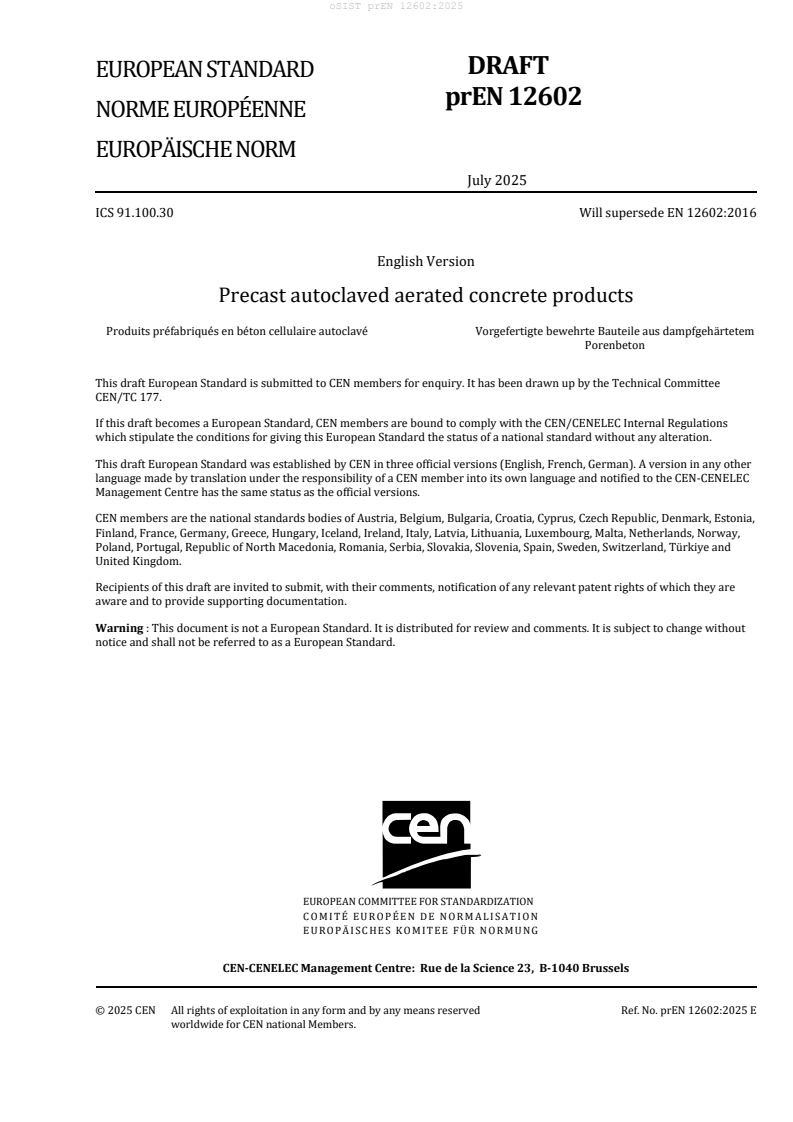

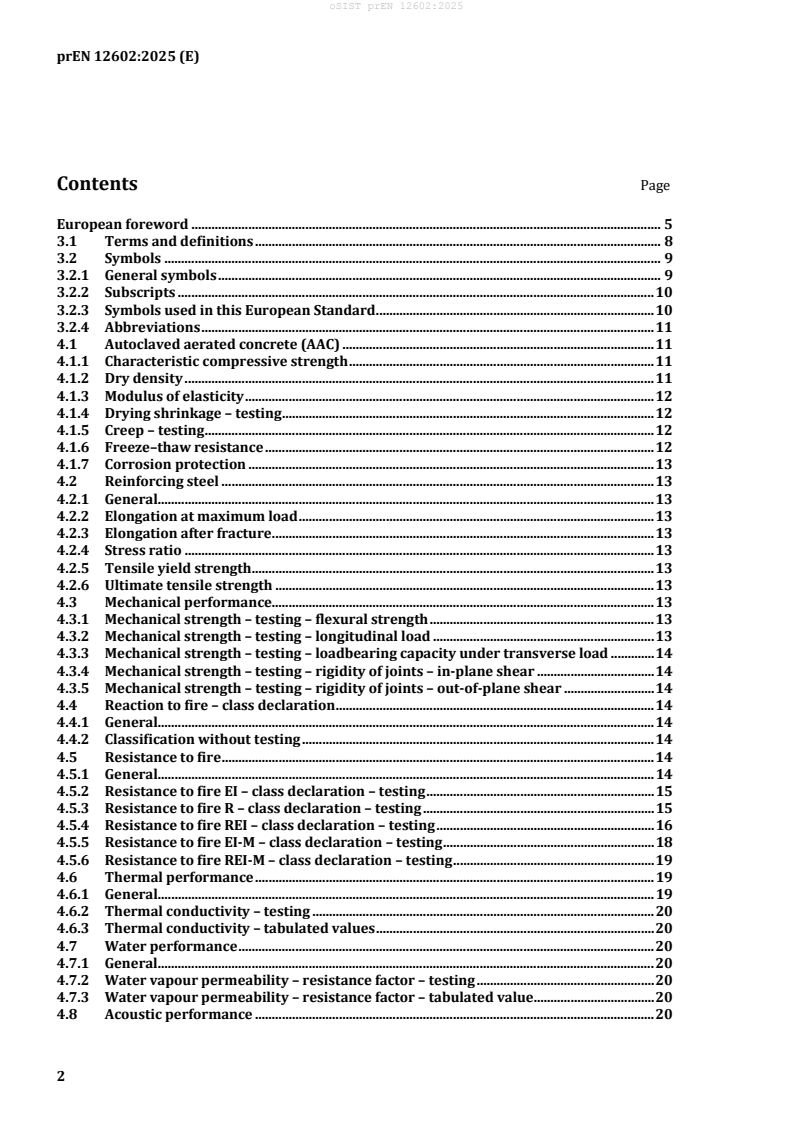
EN 12602:2026 is a CEN European Standard for precast autoclaved aerated concrete (AAC) products used in building construction. It sets out the product characteristics, test and calculation methods, and the information needed for declaration of performance and AVCP for manufacturers, laboratories, notified bodies, designers, and buyers. The standard applies to reinforced AAC components made in factories or in temporary plants on site under the same conditions.
What does EN 12602:2026 specify?
EN 12602:2026 covers prefabricated reinforced AAC components with a dry density between 250 and 1000 kg/m3. It defines which product families are in scope, which uses they are intended for, and which products are excluded. This matters in practice because the same standard is used for structural elements, non-loadbearing elements, and products that may be placed in contact with soil and ground water.
| Product family | Intended use covered by EN 12602:2026 |
|---|---|
| Wall elements | Structural or non-structural, including cases in contact with soil and ground water when relevant |
| Retaining walls | Structural, including cases in contact with soil and ground water when relevant |
| Roof elements | Structural |
| Floor elements | Structural |
| Beams | Structural |
| Piers | Structural, including cases in contact with soil and ground water when relevant |
| Cladding elements | Non-loadbearing |
| Rectangular cross-section box culverts | Not structural, including cases in contact with soil and ground water when relevant |
| Components for noise barriers | Not structural, including cases in contact with soil and ground water when relevant |
The standard excludes retaining walls for tanks or reservoirs of liquids, precast diaphragm walls, ribbed floor elements, and lintels. Its structure follows the usual pattern for a harmonized product standard: scope, normative references, terms and symbols, characteristics, testing and assessment methods, AVCP provisions, and Annex ZA for the link to Regulation (EU) No 305/2011.
What are the key requirements of EN 12602:2026?
EN 12602:2026 focuses on declared product performance, how that performance is determined, and how it is kept consistent in production. The most important requirements are the ones that affect design data, structural checking, fire performance, durability, emissions, and factory control.
Material and geometric basis
Clause 4.1 covers AAC properties such as characteristic compressive strength, dry density, modulus of elasticity, drying shrinkage, creep, freeze-thaw resistance, and corrosion protection. These are the basic parameters used to design the element and to verify that the AAC behaves as expected over time.
In practice, a manufacturer needs test data or declared values for these properties, and a specifier needs them when checking load capacity, deformation, durability, and serviceability.
Reinforcement
Clause 4.2 covers reinforcing steel properties, including elongation at maximum load, elongation after fracture, stress ratio, tensile yield strength, and ultimate tensile strength. This is important because the reinforced steel is part of the element’s structural performance and handling resistance.
For purchasers and designers, this means the reinforcement is not treated as a generic ingredient - its mechanical properties form part of the declared product behavior.
Structural performance
Clause 4.3 covers flexural strength, longitudinal load, transverse load capacity, and joint rigidity in both in-plane and out-of-plane shear. These are the core checks for loadbearing wall, roof, floor, beam, pier, and similar elements.
In practice, this is the section that supports structural design, product type testing, and the limits that a manufacturer can declare for use in the building.
Fire performance
Clause 4.4 deals with reaction to fire, and clause 4.5 deals with resistance to fire. Reaction to fire is declared as a Euroclass, and the standard allows classification without testing in a defined low-organic-content case. Fire resistance is declared as EI, R, REI, EI-M, or REI-M depending on the element and intended function.
This matters because the standard links fire claims to specific test and classification routes, so fire ratings are not free-text statements.
Thermal, moisture, and acoustic performance
Clauses 4.6 to 4.8 cover thermal conductivity, water vapour permeability, airborne sound insulation, impact sound insulation, and sound absorption. The document allows some properties to be based either on testing or on tabulated values.
For users, this is the part that feeds energy, hygrothermal, and acoustical design. It also tells manufacturers what evidence they need before they can publish declared performance values.
Dangerous substances and environmental sustainability
Clauses 4.10 and 4.11 cover release of dangerous substances to indoor air, soil, and ground water. Clauses 4.12 and 5.12 cover environmental sustainability, including reference service life, life cycle assessment indicators, resource use, waste, output flows, and biogenic carbon content.
This is relevant when the product is used indoors or in contact with ground, and when project teams need environmental data for declarations or procurement.
Documentation and AVCP
Clause 4.13 requires documents to accompany the declaration of performance. For all products, the attached documents include drawings with nominal dimensions, tolerances, and materials; for custom-made products they also include the applicable load and exposure scenarios and the associated calculations or tabulated values.
Clause 6 sets out assessment of performance and verification of constancy of performance, including testing, sampling, calculation, tabulated values, descriptive documentation, and factory production control (FPC). In practice, this is the production and certification backbone of the standard.
What terms does EN 12602:2026 define?
- Autoclaved aerated concrete (AAC) - Concrete with a dry density between 250 and 1000 kg/m3, made from binders, fine siliceous material, cell-forming material, and water, then cut and cured in autoclaves.
- Reinforcement - Strengthening material, commonly steel mats, cages, or bars, used either for loadbearing action or for handling and construction resistance.
- Corrosion protective coating - A coating applied to reinforcement to help protect it against corrosion.
- Pier - The vertical loadbearing part of a wall between or beside openings.
- Fire wall - A wall separating two spaces that is designed for fire resistance and structural stability.
- Factory production control (FPC) - The manufacturer’s ongoing control system for equipment, raw materials, traceability, marking, product evaluation, and documentation.
- Nationally Determined Parameter (NDP) - A parameter whose value is set nationally when the standard leaves a choice open.
- Relative humidity (RH) - The humidity measure used in the standard’s symbols and performance descriptions.
Who uses EN 12602:2026?
EN 12602:2026 is used by AAC manufacturers, including plants that produce elements on site under the same conditions as a factory. It is also used by testing laboratories, notified bodies, and certification bodies that carry out type testing, sampling, initial inspection, and ongoing surveillance.
Designers, structural engineers, specifiers, quality managers, and buyers use it to check whether a product is suitable for walls, roofs, floors, beams, piers, cladding, box culverts, or noise barriers, and whether the declared performance matches the intended use. It is also relevant for procurement teams that need a clear basis for DoP, CE marking, and environmental or emission declarations.
What changed in EN 12602:2026 from the previous edition?
EN 12602:2026 supersedes EN 12602:2016. The document states these main changes compared with the previous edition:
- the text has been aligned with the PCR
- the text has been aligned with the standardization request supporting Regulation (EU) No 305/2011
- terms and definitions have been updated
- the order of clauses has changed
- AAC parameters have been adapted
- normative references have been added
- normative references have been dated
- properties and requirements have been adapted, including acoustic properties and thermal resistance
- Annexes A to H have been deleted and Annex ZA has been adapted
Which standards are used with EN 12602:2026?
EN 12602:2026 relies on product-specific test and assessment standards for strength, deformation, fire, acoustics, thermal properties, emissions, leaching, and sustainability. In practice, these references tell users which method to apply for each declared characteristic.
- EN 678, EN 679, EN 680, EN 1352, EN 1355, EN 15304 - density, compressive strength, shrinkage, modulus of elasticity, creep, and freeze-thaw testing for AAC.
- EN 990 - verification of corrosion protection of reinforcement.
- EN 1356, EN 1739, EN 1740, EN 1741 - mechanical testing for transverse load, longitudinal load, and joint shear.
- EN 1363-2, EN 1364-1, EN 1365-1, EN 1365-2, EN 1365-3, EN 1365-4 - fire resistance test procedures for the relevant element types.
- EN 13501-1, EN 13501-2, EN ISO 1182, EN ISO 1716 - fire classification of reaction to fire and fire resistance.
- EN 1745, EN 12664, EN ISO 10456 - thermal properties and thermal design values.
- EN ISO 354, EN ISO 717-1, EN ISO 717-2, EN ISO 10140-1, EN ISO 10140-2, EN ISO 10140-3, EN ISO 10140-5, EN ISO 12354-2 - laboratory sound absorption, sound insulation measurement, and calculation.
- EN 16516, EN 16637-1, EN 16637-2 - emissions to indoor air and leaching to soil and ground water.
- EN 15804 and prEN 18185 - environmental product declaration rules and product category rules.
- ISO 16269-6 - statistical tolerance intervals used in data assessment.
What does the EN 12602:2026 document contain?
EN 12602:2026 contains the technical characteristics, test methods, assessment rules, and verification provisions needed to declare performance for AAC elements. Clauses 4 and 5 are the core of the document: clause 4 states the performance characteristics, and clause 5 gives the corresponding testing, calculation, tabulated values, and sampling methods.
The document also contains tables for indoor air emissions, soil and ground water leaching, environmental indicators, and the documentation to be attached to the declaration of performance. Annex ZA maps the relevant clauses to Regulation (EU) No 305/2011, identifies the AVCP system for each product family, and assigns tasks to the manufacturer and the notified body.
Relations
- Effective Date
- 29-Jan-2025
- Effective Date
- 21-Oct-2026
Get Certified
Connect with accredited certification bodies for this standard

DIBt (Deutsches Institut für Bautechnik)
German Institute for Building Technology.
DIN CERTCO
DIN Group product certification.

Aboma Certification B.V.
Specialized in construction, metal, and transport sectors.
Sponsored listings
Frequently Asked Questions
EN 12602:2026 is a draft published by the European Committee for Standardization (CEN). Its full title is "Precast autoclaved aerated concrete products". This standard covers: This document shall cover, regardless if manufactured in factories or in temporary plants on site under the same conditions, prefabricated reinforced components of autoclaved aerated concrete with a dry density between 250 and 1000 kg/m3 to be used in building construction as: — solid, hollow core and multilayer wall elements intended to be used as structural elements; — solid, hollow core and multilayer wall elements intended to be used as non-structural elements and if relevant for applications in contact with soil and ground water; — retaining walls intended to be used as structural elements and if relevant for applications in contact with soil and ground water; — solid, hollow core and multilayer roof elements intended to be used as structural elements; — solid, hollow core and multilayer floor elements intended to be used as structural elements; — solid, hollow core beams intended to be used as structural elements; — solid piers intended to be used as structural elements and if relevant for applications in contact with soil and ground water; — cladding elements intended to be used as non-loadbearing elements; — rectangular cross-section box culverts intended not to be used as structural elements and if relevant for applications in contact with soil and ground water; — components for noise barriers intended not to be used as structural elements and if relevant for applications in contact with soil and ground water. This document does not cover: — retaining walls intended to retain tanks or reservoirs of liquids; — precast diaphragm walls (concrete sheet piling); — ribbed floor elements; — lintels.
This document shall cover, regardless if manufactured in factories or in temporary plants on site under the same conditions, prefabricated reinforced components of autoclaved aerated concrete with a dry density between 250 and 1000 kg/m3 to be used in building construction as: — solid, hollow core and multilayer wall elements intended to be used as structural elements; — solid, hollow core and multilayer wall elements intended to be used as non-structural elements and if relevant for applications in contact with soil and ground water; — retaining walls intended to be used as structural elements and if relevant for applications in contact with soil and ground water; — solid, hollow core and multilayer roof elements intended to be used as structural elements; — solid, hollow core and multilayer floor elements intended to be used as structural elements; — solid, hollow core beams intended to be used as structural elements; — solid piers intended to be used as structural elements and if relevant for applications in contact with soil and ground water; — cladding elements intended to be used as non-loadbearing elements; — rectangular cross-section box culverts intended not to be used as structural elements and if relevant for applications in contact with soil and ground water; — components for noise barriers intended not to be used as structural elements and if relevant for applications in contact with soil and ground water. This document does not cover: — retaining walls intended to retain tanks or reservoirs of liquids; — precast diaphragm walls (concrete sheet piling); — ribbed floor elements; — lintels.
EN 12602:2026 is classified under the following ICS (International Classification for Standards) categories: 91.100.30 - Concrete and concrete products. The ICS classification helps identify the subject area and facilitates finding related standards.
EN 12602:2026 has the following relationships with other standards: It is inter standard links to EN 12602:2016, EN 680:2005. Understanding these relationships helps ensure you are using the most current and applicable version of the standard.
EN 12602:2026 is associated with the following European legislation: EU Directives/Regulations: 305/2011; Standardization Mandates: M/100, M/609, M/627. When a standard is cited in the Official Journal of the European Union, products manufactured in conformity with it benefit from a presumption of conformity with the essential requirements of the corresponding EU directive or regulation.
EN 12602:2026 is available in PDF format for immediate download after purchase. The document can be added to your cart and obtained through the secure checkout process. Digital delivery ensures instant access to the complete standard document.
Standards Content (Sample)
SLOVENSKI STANDARD
oSIST prEN 12602:2025
01-september-2025
Montažni izdelki iz avtoklaviranega celičnega betona
Precast autoclaved aerated concrete products
Vorgefertigte bewehrte Bauteile aus dampfgehärtetem Porenbeton
Produits préfabriqués en béton cellulaire autoclavé
Ta slovenski standard je istoveten z: prEN 12602
ICS:
91.100.30 Beton in betonski izdelki Concrete and concrete
products
oSIST prEN 12602:2025 en,fr,de
2003-01.Slovenski inštitut za standardizacijo. Razmnoževanje celote ali delov tega standarda ni dovoljeno.
oSIST prEN 12602:2025
oSIST prEN 12602:2025
DRAFT
EUROPEAN STANDARD
prEN 12602
NORME EUROPÉENNE
EUROPÄISCHE NORM
July 2025
ICS 91.100.30 Will supersede EN 12602:2016
English Version
Precast autoclaved aerated concrete products
Produits préfabriqués en béton cellulaire autoclavé Vorgefertigte bewehrte Bauteile aus dampfgehärtetem
Porenbeton
This draft European Standard is submitted to CEN members for enquiry. It has been drawn up by the Technical Committee
CEN/TC 177.
If this draft becomes a European Standard, CEN members are bound to comply with the CEN/CENELEC Internal Regulations
which stipulate the conditions for giving this European Standard the status of a national standard without any alteration.
This draft European Standard was established by CEN in three official versions (English, French, German). A version in any other
language made by translation under the responsibility of a CEN member into its own language and notified to the CEN-CENELEC
Management Centre has the same status as the official versions.
CEN members are the national standards bodies of Austria, Belgium, Bulgaria, Croatia, Cyprus, Czech Republic, Denmark, Estonia,
Finland, France, Germany, Greece, Hungary, Iceland, Ireland, Italy, Latvia, Lithuania, Luxembourg, Malta, Netherlands, Norway,
Poland, Portugal, Republic of North Macedonia, Romania, Serbia, Slovakia, Slovenia, Spain, Sweden, Switzerland, Türkiye and
United Kingdom.
Recipients of this draft are invited to submit, with their comments, notification of any relevant patent rights of which they are
aware and to provide supporting documentation.
Warning : This document is not a European Standard. It is distributed for review and comments. It is subject to change without
notice and shall not be referred to as a European Standard.
EUROPEAN COMMITTEE FOR STANDARDIZATION
COMITÉ EUROPÉEN DE NORMALISATION
EUROPÄISCHES KOMITEE FÜR NORMUNG
CEN-CENELEC Management Centre: Rue de la Science 23, B-1040 Brussels
© 2025 CEN All rights of exploitation in any form and by any means reserved Ref. No. prEN 12602:2025 E
worldwide for CEN national Members.
oSIST prEN 12602:2025
prEN 12602:2025 (E)
Contents Page
European foreword . 5
3.1 Terms and definitions . 8
3.2 Symbols . 9
3.2.1 General symbols . 9
3.2.2 Subscripts . 10
3.2.3 Symbols used in this European Standard . 10
3.2.4 Abbreviations . 11
4.1 Autoclaved aerated concrete (AAC) . 11
4.1.1 Characteristic compressive strength . 11
4.1.2 Dry density . 11
4.1.3 Modulus of elasticity . 12
4.1.4 Drying shrinkage – testing . 12
4.1.5 Creep – testing . 12
4.1.6 Freeze–thaw resistance . 12
4.1.7 Corrosion protection . 13
4.2 Reinforcing steel . 13
4.2.1 General. 13
4.2.2 Elongation at maximum load . 13
4.2.3 Elongation after fracture . 13
4.2.4 Stress ratio . 13
4.2.5 Tensile yield strength . 13
4.2.6 Ultimate tensile strength . 13
4.3 Mechanical performance. 13
4.3.1 Mechanical strength – testing – flexural strength . 13
4.3.2 Mechanical strength – testing – longitudinal load . 13
4.3.3 Mechanical strength – testing – loadbearing capacity under transverse load . 14
4.3.4 Mechanical strength – testing – rigidity of joints – in-plane shear . 14
4.3.5 Mechanical strength – testing – rigidity of joints – out-of-plane shear . 14
4.4 Reaction to fire – class declaration . 14
4.4.1 General. 14
4.4.2 Classification without testing . 14
4.5 Resistance to fire . 14
4.5.1 General. 14
4.5.2 Resistance to fire EI – class declaration – testing . 15
4.5.3 Resistance to fire R – class declaration – testing . 15
4.5.4 Resistance to fire REI – class declaration – testing . 16
4.5.5 Resistance to fire EI-M – class declaration – testing . 18
4.5.6 Resistance to fire REI-M – class declaration – testing . 19
4.6 Thermal performance . 19
4.6.1 General. 19
4.6.2 Thermal conductivity – testing . 20
4.6.3 Thermal conductivity – tabulated values . 20
4.7 Water performance . 20
4.7.1 General. 20
4.7.2 Water vapour permeability – resistance factor – testing . 20
4.7.3 Water vapour permeability – resistance factor – tabulated value . 20
4.8 Acoustic performance . 20
oSIST prEN 12602:2025
prEN 12602:2025 (E)
4.8.1 General . 20
4.8.2 Airborne sound insulation index – testing . 21
4.8.3 Airborne sound insulation index – calculation . 21
4.8.4 Impact sound insulation – testing . 21
4.8.5 Impact sound insulation – calculation . 21
4.8.6 Sound absorption coefficient building elements . 21
4.8.7 Sound absorption coefficient traffic elements . 21
4.9 Other performances – Mass of element . 22
4.10 Release of dangerous substances – indoor air . 22
4.11 Release of dangerous substances – soil and ground water . 22
4.12 Environmental sustainability . 24
4.12.1 Reference service life . 24
4.12.2 Life cycle assessment environmental characteristics . 24
4.12.3 Resource use environmental characteristics . 25
4.12.4 Waste environmental characteristics . 25
4.12.5 Output flows environmental characteristics . 25
4.12.6 Biogenic carbon content environmental characteristics . 26
4.13 Documents to be provided together with the declaration of performance . 26
4.13.1 General . 26
4.13.2 Off-the-shelf products . 26
4.13.3 Custom-made products . 27
5.1 Autoclaved aerated concrete (AAC) . 27
5.1.1 Compressive strength . 27
5.1.2 Dry density . 27
5.1.3 Modulus of elasticity . 27
5.1.4 Drying shrinkage – testing . 28
5.1.5 Creep – testing . 28
5.1.6 Freeze–thaw resistance . 28
5.1.7 Corrosion protection . 28
5.2 Reinforcing steel . 29
5.2.1 Elongation at maximum load — reinforcing steel . 29
5.2.2 Elongation after fracture — reinforcing steel . 29
5.2.3 Stress ratio — reinforcing steel . 29
5.2.4 Tensile yield strength — reinforcing steel . 29
5.2.5 Ultimate tensile strength — reinforcing steel . 29
5.3 Mechanical performance . 29
5.3.1 General . 29
5.3.2 Mechanical strength – testing – flexural strength . 29
5.3.3 Mechanical strength – testing – longitudinal load . 29
5.3.4 Mechanical strength – testing – loadbearing capacity under transverse load . 29
5.3.5 Mechanical strength – testing – rigidity of joints – in-plane shear . 29
5.3.6 Mechanical strength – testing – rigidity of joints – out-of-plane shear . 30
5.4 Reaction to fire – class declaration . 30
5.5 Resistance to fire – class declaration – testing . 30
5.6 Thermal performance . 30
5.6.1 General . 30
5.6.2 Thermal conductivity – testing . 30
5.6.3 Thermal conductivity – tabulated values . 30
5.7 Water performance . 30
5.7.1 Water vapour permeability – resistance factor – testing . 30
5.7.2 Water vapour permeability – tabulated values . 30
5.8 Acoustic performance . 30
5.8.1 Airborne sound insulation index – testing . 30
oSIST prEN 12602:2025
prEN 12602:2025 (E)
5.8.2 Airborne sound insulation index – calculation . 31
5.8.3 Impact sound insulation – testing . 31
5.8.4 Impact sound insulation – calculation . 31
5.8.5 Sound absorption coefficient building elements . 31
5.8.6 Sound absorption coefficient traffic elements . 31
5.9 Other performances . 31
5.9.1 Mass of element . 31
5.10 Release of dangerous substances – indoor air . 31
5.11 Release of dangerous substances – soil and ground water . 32
5.12 Environmental sustainability . 32
5.12.1 Reference service life . 32
5.12.2 Life cycle assessment environmental characteristics . 32
5.12.3 Resource use environmental characteristics . 32
5.12.4 Waste environmental characteristics . 33
5.12.5 Output flows environmental characteristics . 33
5.12.6 Biogenic carbon environmental characteristics . 33
5.13 Performances in attached documentation of the product . 33
5.13.1 General. 33
5.13.2 Off-the-shelf products . 33
5.13.3 Custom-made products . 34
6.1 General. 34
6.2 Assessment of performance . 34
6.2.1 General. 34
6.2.2 Test samples, testing, and assessment criteria . 35
6.3 Verification of constancy of performance . 42
6.3.1 Factory production control (FPC) . 42
6.3.2 Initial inspection of factory and of FPC . 45
6.3.3 Initial inspection of the factory to validate environmental sustainability company
specific data . 46
6.3.4 Continuous surveillance of FPC . 46
6.3.5 Environmental sustainability assessment validation . 47
Annex ZA (informative) Relationship of this European Standard with Regulation (EU)
No. 305/2011 . 48
ZA.1 Scope and relevant characteristics . 48
ZA.2 System of Assessment and Verification of Constancy of Performance (AVCP) . 71
ZA.3 Assignment of AVCP tasks . 72
Bibliography . 76
oSIST prEN 12602:2025
prEN 12602:2025 (E)
European foreword
This document (prEN 12602:2025) has been prepared by Technical Committee CEN/TC 177
“Prefabricated reinforced elements of autoclaved aerated concrete or lightweight aggregate concrete
with open structure”, the secretariat of which is held by DIN.
This document is currently submitted to the CEN Enquiry.
This document supersedes EN 12602:2016.
prEN 12602:2025 includes the following significant technical changes with respect to EN 12602:2016:
— the text has been adjusted in accordance with PCR;
— the text has been adjusted to the Standardization request to the European Committee for
Standardization as regards precast concrete products in support of Regulation (EU) No 305/2011;
— terms and definitions have been updated;
— the order of clauses has been changed;
— autoclaved aerated concrete parameters have been adapted;
— normative references have been added
— normative references have been dated;
— properties and requirements of elements have been adapted, e.g. acoustic properties, thermal
resistance;
— Annex A, Annex B, Annex C, Annex D, Annex E, Annex F, Annex G and Annex H have been deleted and
Annex ZA adapted;
This document has been prepared under a standardization request addressed to CEN by the European
Commission. The Standing Committee of the EFTA States subsequently approves these requests for its
Member States.
For the relationship with EU Legislation, see informative Annex ZA, which is an integral part of this
document.
oSIST prEN 12602:2025
prEN 12602:2025 (E)
1 Scope
This document shall cover, regardless if manufactured in factories or in temporary plants on site under
the same conditions, prefabricated reinforced components of autoclaved aerated concrete with a dry
density between 250 and 1000 kg/m to be used in building construction as:
— solid, hollow core and multilayer wall elements intended to be used as structural elements;
— solid, hollow core and multilayer wall elements intended to be used as non-structural elements and
if relevant for applications in contact with soil and ground water;
— retaining walls intended to be used as structural elements and if relevant for applications in contact
with soil and ground water;
— solid, hollow core and multilayer roof elements intended to be used as structural elements;
— solid, hollow core and multilayer floor elements intended to be used as structural elements;
— solid, hollow core beams intended to be used as structural elements;
— solid piers intended to be used as structural elements and if relevant for applications in contact with
soil and ground water;
— cladding elements intended to be used as non-loadbearing elements;
— rectangular cross-section box culverts intended not to be used as structural elements and if relevant
for applications in contact with soil and ground water;
— components for noise barriers intended not to be used as structural elements and if relevant for
applications in contact with soil and ground water.
This document does not cover:
— retaining walls intended to retain tanks or reservoirs of liquids;
— precast diaphragm walls (concrete sheet piling);
— ribbed floor elements;
— lintels.
2 Normative references
The following documents are referred to in the text in such a way that some or all of their content
constitutes requirements of this document. For dated references, only the edition cited applies. For
undated references, the latest edition of the referenced document (including any amendments) applies.
EN 678:1993, Determination of the dry density of autoclaved aerated concrete
EN 679:2005, Determination of the compressive strength of autoclaved aerated concrete
EN 680:2005, Determination of the drying shrinkage of autoclaved aerated concrete
EN 990:2002, Test methods for verification of corrosion protection of reinforcement in autoclaved aerated
concrete and lightweight aggregate concrete with open structure
oSIST prEN 12602:2025
prEN 12602:2025 (E)
EN 1352:1996, Determination of static modulus of elasticity under compression of autoclaved aerated
concrete or lightweight aggregate concrete with open structure
EN 1355:1996, Determination of creep strains under compression of autoclaved aerated concrete or
lightweight aggregate concrete with open structure
EN 1356:1996, Performance test for prefabricated reinforced components of autoclaved aerated concrete
or lightweight aggregate concrete with open structure under transverse load
EN 1363-2:1999, Fire resistance tests - Part 2: Alternative and additional procedures
EN 1364-1:2015, Fire resistance tests for non-loadbearing elements - Part 1: Walls
EN 1365-1:2012, Fire resistance tests for loadbearing elements - Part 1: Walls
EN 1365-2:2014, Fire resistance tests for loadbearing elements - Part 2: Floors and roofs
EN 1365-3:1999, Fire resistance tests for loadbearing elements - Part 3: Beams
EN 1365-4:1999, Fire resistance tests for loadbearing elements - Part 4: Columns
EN 1739:2007, Determination of shear strength for in-plane forces of joints between prefabricated
components of autoclaved aerated concrete or lightweight aggregate concrete with open structure
EN 1740:1998, Performance test for prefabricated reinforced components made of autoclaved aerated
concrete or lightweight aggregate concrete with open structure under predominantly longitudinal load
(vertical components)
EN 1741:1998, Determination of shear strength for out-of-plane forces of joints between prefabricated
components made of autoclaved aerated concrete or lightweight aggregate concrete with open structure
EN 1745:2020, Masonry and masonry products - Methods for determining thermal properties
EN 12664:2001, Thermal performance of building materials and products - Determination of thermal
resistance by means of guarded hot plate and heat flow meter methods - Dry and moist products of medium
and low thermal resistance
EN 13501-1:2018, Fire classification of construction products and building elements - Part 1: Classification
using data from reaction to fire tests
EN 13501-2:2023, Fire classification of construction products and building elements - Part 2: Classification
using data from fire resistance and/or smoke control tests, excluding ventilation services
EN 15304:2010, Determination of the freeze-thaw resistance of autoclaved aerated concrete
EN 15804:2012+A2:2019, Sustainability of construction works — Environmental product declarations —
Core rules for the product category of construction products
EN 16516:2017+A1:2020, Construction products: Assessment of release of dangerous substances -
Determination of emissions into indoor air
As impacted by EN 15804:2012+A2:2019/AC:2021.
oSIST prEN 12602:2025
prEN 12602:2025 (E)
EN 16637-1:2023, Construction products: Assessment of release of dangerous substances - Part 1: Guidance
for the determination of leaching tests and additional testing steps
EN 16637-2:2023, Construction products: Assessment of release of dangerous substances - Part 2:
Horizontal dynamic surface leaching test
prEN 18185:2025, Sustainability of construction works - Environmental product declarations - Product
Category Rules for precast lightweight concrete with an open structure and precast autoclaved aerated
concrete
EN ISO 354:2003, Acoustics - Measurement of sound absorption in a reverberation room (ISO 354:2003)
EN ISO 717-1:2020, Acoustics - Rating of sound insulation in buildings and of building elements - Part 1:
Airborne sound insulation (ISO 717-1:2020)
EN ISO 717-2:2020, Acoustics - Rating of sound insulation in buildings and of building elements - Part 2:
Impact sound insulation (ISO 717-2:2020)
EN ISO 10140-1:2021, Acoustics - Laboratory measurement of sound insulation of building elements - Part
1: Application rules for specific products (ISO 10140-1:2021)
EN ISO 10140-2:2021, Acoustics - Laboratory measurement of sound insulation of building elements - Part
2: Measurement of airborne sound insulation (ISO 10140-2:2021)
EN ISO 10140-3:2021, Acoustics - Laboratory measurement of sound insulation of building elements - Part
3: Measurement of impact sound insulation (ISO 10140-3:2021)
EN ISO 10140-5:2021, Acoustics - Laboratory measurement of sound insulation of building elements - Part
5: Requirements for test facilities and equipment (ISO 10140-5:2021)
EN ISO 10456:2007, Building materials and products — Hygrothermal properties — Tabulated design
values and procedures for determining declared and design thermal values (ISO 10456)
EN ISO 12354-2:2017, Building acoustics - Estimation of acoustic performance of buildings from the
performance of elements - Part 2: Impact sound insulation between rooms (ISO 12354-2:2017)
ISO 16269-6:2014, Statistical interpretation of data — Part 6: Determination of statistical tolerance
intervals
3 Terms and definitions, symbols and abbreviations
3.1 Terms and definitions
For the purposes of this document, the following terms and definitions apply.
ISO and IEC maintain terminology databases for use in standardization at the following addresses:
— ISO Online browsing platform: available at https://www.iso.org/obp/
— IEC Electropedia: available at https://www.electropedia.org/
As impacted by EN ISO 10456:2007/AC:2009.
oSIST prEN 12602:2025
prEN 12602:2025 (E)
3.1.1
autoclaved aerated concrete
AAC
concrete with a dry density between 250 and 1000 kg/m that is manufactured from binders such as
cement and/or lime combined with fine siliceous based material, recycled aggregates, cell generating
material and water whereby the raw materials are mixed together and cast into moulds where the mix is
allowed to rise and set into cakes
Note 1 to entry: After this part of the process, the cake is cut into the required sizes of components and cured with
high pressure steam in autoclaves.
3.1.2
raw materials
constituents which combined with additives and agents, where appropriate, can be used in the
manufacturing process
3.1.3
reinforcement
strengthening material that is commonly composed of steel mats, cages and/or steel bars
Note 1 to entry: Other types of reinforcement can be used. Depending on the function of the components, the
reinforcement can be structural or non-structural.
Note 2 to entry: Structural reinforcement is reinforcement which is necessary for the loadbearing function of the
component as part of the structure. It consists of steel.
Note 3 to entry: Non-structural reinforcement is reinforcement which is necessary in order to ensure adequate
resistance of the component during handling, transportation and construction. Any suitable kind of reinforcement
may be used for this purpose.
3.1.4
corrosion protective coating
coating applied on the surface of the reinforcement to protect the reinforcement against corrosion
3.1.5
pier
vertical loadbearing part of the wall between or besides openings
3.1.6
fire wall
wall separating two spaces (generally two fire compartments or buildings) that is designed for fire
resistance and structural stability
Note 1 to entry: A fire wall may include resistance to horizontal loading (criterion M) such that in case of fire and
failure of the structure on one side of the wall, fire spread beyond the wall is avoided (so that a fire wall is designated
REI-M or EI-M).
3.2 Symbols
3.2.1 General symbols
b width of component
d effective depth or thickness of component, diameter (e.g. of a bar)
E modulus of elasticity
oSIST prEN 12602:2025
prEN 12602:2025 (E)
f strength
F force
h depth or thickness of component
k coefficient, factor
l length, height of wall component, span length of roof or floor components
M bending moment
N axial force
R resistance, loadbearing capacity
V shear force
ε strain
3.2.2 Subscripts
c concrete parameter, compression
comp component
cr critical
dry in the dry state
g declared value
k characteristic value
l longitudinal
m mean or mass
R resistance
s steel parameter, shear
t tension
test in testing
u ultimate
y yield value (for steel)
3.2.3 Symbols used in this European Standard
d effective depth of a component
f characteristic compressive strength of AAC
ck
fck,g declared characteristic compressive strength of AAC
f tensile strength of reinforcing steel
st
f yield strength of reinforcing steel
y
f characteristic yield strength of reinforcing steel
yk
f characteristic yield strength of the stirrups
ywk
f characteristic 0,2 % proof stress of reinforcing steel
0,2k
N axial force (compression positive)
oSIST prEN 12602:2025
prEN 12602:2025 (E)
ε mean conventional reference value of shrinkage
cs,ref
ε total value of drying shrinkage
cs,tot
ε short-term prestrain
λ thermal conductivity in the dry state at a mean test temperature of 10 °C
10dry
µ water vapour resistance factor
µ mass related moisture content
m
ρ dry density of AAC
ρ characteristic dry density of AAC (95 % – quantile)
k
ρm mean value of the dry density of AAC
ρ mean of the upper and lower limit of the density class
m,g
Δρ declared tolerance of the dry density of AAC
g
ρ density to be used for calculation of transportation weight of AAC-components
trans
φ final creep coefficient
3.2.4 Abbreviations
AAC autoclaved aerated concrete
FPC factory production control
NDP Nationally Determined Parameter
RH relative humidity
4 Characteristics
4.1 Autoclaved aerated concrete (AAC)
4.1.1 Characteristic compressive strength
The characteristic compressive strength is applicable for all products mentioned in the scope but not for
solid, hollow core and multilayer non-load bearing wall elements and cladding elements.
The characteristic value of the compressive strength of AAC shall be determined in accordance with 5.1.1
and expressed in MPa, rounded to the nearest 0,1.
The characteristic compressive strength of AAC shall be classified as compressive strength class in
accordance with Table 1.
Table 1 — Compressive strength classes
Strengths in MPa
AAC AAC AAC AAC AAC AAC AAC AAC AAC AAC AAC AAC AAC
Strength
class
1,5 2 2,5 3 3,5 4 4,5 5 6 7 8 9 10
f 1,5 2,0 2,5 3,0 3,5 4,0 4,5 5,0 6,0 7,0 8,0 9,0 10,0
ck
4.1.2 Dry density
The dry density is applicable for all products mentioned in the scope.
oSIST prEN 12602:2025
prEN 12602:2025 (E)
The dry density shall be determined in accordance with 5.1.2 and expressed as a a class as specified in
Table 2 and expressed in kg/m , rounded to the nearest 10.
The expression (ρ + Δρ ) shall be taken as the upper limit and the expression (ρ – Δρ ) as the lower
m,g g m,g g
limit of the mean dry density, ρ as specified in Table 2.
m
Table 2 — Density classes
Dry densities in kg/m
Density class 300 350 400 450 500 550 600 650
> 250 > 300 > 350 > 400 > 450 > 500 > 550 > 600
Mean dry density ρm
≤ 300 ≤ 350 ≤ 400 ≤ 450 ≤ 500 ≤ 550 ≤ 600 ≤ 650
Density class 700 750 800 850 900 950 1000
> 650 > 700 > 750 > 800 > 850 > 900 > 950
Mean dry density ρ
m
≤ 700 ≤ 750 ≤ 800 ≤ 850 ≤ 900 ≤ 950 ≤ 1 000
4.1.3 Modulus of elasticity
4.1.3.1 Modulus of elasticity – testing
The modulus of elasticity is applicable for all products mentioned in the scope.
The modulus of elasticity E , shall be determined in accordance with 5.1.3.1. The modulus of elasticity
cm
shall be expressed in MPa and rounded to the nearest 100.
4.1.3.2 Modulus of elasticity – calculation
When assessed the mean value of the modulus of elasticity shall be obtained in accordance with 5.1.3.2.
The modulus of elasticity shall be expressed in MPa and rounded to the nearest 100
4.1.4 Drying shrinkage – testing
The drying shrinkage is applicable for all products mentioned in the scope.
The value of drying shrinkage shall be determined in accordance with 5.1.4. and shall be expressed as
shrinkage class as specified in Table 3.
Table 3 — Drying shrinkage classes for AAC
Drying shrinkage in mm/m
Drying shrinkage class 0,15 0,20 0,25 0,30 0,35 0,40
ε
cs,ref
≤ 0,15 ≤ 0,20 ≤ 0,25 ≤ 0,30 ≤ 0,35 ≤ 0,40
mm/m
4.1.5 Creep – testing
Creep is applicable for all products mentioned in the scope but not for solid, hollow core and multilayer
non-load bearing wall elements, cladding elements, box culverts and components for noise barriers.
The creep coefficient shall be indicated by the manufacturer on the basis of results of tests according to
5.1.5. The performance of creep shall be expressed in ‰ and rounded to 0,01.
4.1.6 Freeze–thaw resistance
The freeze–thaw resistance is applicable for all products mentioned in the scope.
The assessment of the freeze–thaw resistance is in accordance with 5.1.6 The performance shall be
expressed by the number of the executed freeze–thaw cycles.
oSIST prEN 12602:2025
prEN 12602:2025 (E)
4.1.7 Corrosion protection
The corrosion protection is applicable for all products mentioned in the scope.
The assessment of the corrosion protection is in accordance with 5.1.7. The performance is expressed by
the proportion of the corroded surface area of the steel, expressed in % and rounded to 1.
4.2 Reinforcing steel
4.2.1 General
The characteristics for the reinforcing steel are applicable for all products mentioned in the scope.
4.2.2 Elongation at maximum load
The elongation at maximum load of reinforcing steel (A ) shall be determined in accordance with 5.2.1.
gt
The performance of elongation at maximum load of reinforcing steel shall be expressed as a ratio,
rounded to the nearest 0,1.
4.2.3 Elongation after fracture
When assessing the elongation after fracture this shall be in accordance with 5.2.2 and expressed as a
percentage, rounded to the nearest 0,1 %.
4.2.4 Stress ratio
When assessing the stress ratio of steel or stainless steel, the this shall be in accordance with 5.2.3 and
expressed as a percentage, rounded to the nearest 0,01 %.
4.2.5 Tensile yield strength
When assessing the tensile yield strength of reinforcing steel (R ) this shall be determined in accordance
e
with 5.2.4. The performance of tensile yield strength of reinforcing steel shall be expressed in MPa,
rounded to the nearest integer.
4.2.6 Ultimate tensile strength
When assessing the ultimate tensile strength of reinforcing steel (R ) this shall be determined in
m
accordance with 5.2.5. The performance of ultimate tensile strength of reinforcing steel shall be
expressed in MPa, rounded to the nearest integer.
4.3 Mechanical performance
4.3.1 Mechanical strength – testing – flexural strength
The flexural strength is applicable for all products mentioned in the scope.
When assessing the mechanical strength of elements for bending this shall be determined in accordance
with 5.3.2.
4.3.2 Mechanical strength – testing – longitudinal load
The mechanical strength for longitudinal load is applicable for all products mentioned in the scope but
not for solid, hollow core and multilayer non-load bearing wall elements, retaining wall elements, solid,
hollow core and multilayer roof elements, solid, hollow core and multilayer floor elements, cladding
elements, box culverts and components for noise barriers.
When assessing the mechanical strength of elements under longitudinal load this shall be determined
following 5.3.3.
oSIST prEN 12602:2025
prEN 12602:2025 (E)
4.3.3 Mechanical strength – testing – loadbearing capacity under transverse load
The mechanical strength under transverse load is applicable for all products mentioned in the scope but
not for solid, hollow core and multilayer loadbearing wall elements.
When assessing the loadbearing capacity under transverse load this shall be determined following 5.3.4.
4.3.4 Mechanical strength – testing – rigidity of joints – in-plane shear
The rigidity of joints – in-plane shear is applicable for all products mentioned in the scope but not for
solid, hollow core beams, solid piers, box culverts and components for noise barriers.
When using the rigidity of joints in design the mechanical strength of joints under in-plane-shear shall be
determined in accordance with 5.3.5.
4.3.5 Mechanical strength – testing – rigidity of joints – out-of-plane shear
The rigidity of joints – in-plane shear is applicable for all products mentioned in the scope but not for
solid, hollow core beams, solid piers, box culverts and components for noise barriers.
When using the rigidity of joints in design the mechanical strength of joints under in-plane-shear shall be
determined following 5.3.6.
4.4 Reaction to fire – class declaration
4.4.1 General
The reaction to fire is applicable for all products mentioned in the scope.
AAC shall be tested in accordance with 5.4 and classified as specified in EN 13501-1:2018. If the content
of equally distributed organic material is less than 1 % by mass or volume (whichever is the more
onerous), the AAC is classified in Euroclass A1 without the need for testing [7].
4.4.2 Classification without testing
Whether products covered by this document fulfil the conditions, under which they have demonstrated
of having a stable reaction to fire performance in a given reaction to fire class, based on testing to the
appropriate EN test methods, the established assigned class applies to these products without the need
of carrying out further reaction to fire tests.
NOTE The rules to apply this classification are published as Commission Decisions or Commission Delegated
Regulations.
4.5 Resistance to fire
4.5.1 General
The resistance to fire is the capability of the product to provide, in the event of fire and for a given time,
one or more of the following behaviours:
— load-bearing capacity (R);
— integrity (E);
— insulation (I);
— mechanical action (M) When tested in accordance with the test method indicated in 5.5, the result is
expressed as class in minutes according to the classification published in the Official J
...