

prEN ISO 7396-1
(Main)Medical gas pipeline systems - Part 1: Pipeline systems for compressed medical gases and vacuum (ISO/FDIS 7396-1:2026)
- Abstract
ISO 7396-1:2016 specifies requirements for design, installation, function, performance, testing, commissioning and documentation of pipeline systems used in healthcare facilities for the following:
- oxygen;
- nitrous oxide;
- medical air;
- carbon dioxide;
- oxygen/nitrous oxide mixtures (see Note 1);
- helium/oxygen mixtures;
- (*) oxygen 93;
- gases and gas mixtures classified as medical device, gases delivered to medical devices or intended for medical purposes or gases and gas mixtures for medicinal use not specified above;
- air for driving surgical tools;
- nitrogen for driving surgical tools;
- vacuum.
NOTE 1 Regional or national regulations may prohibit the distribution of oxygen/nitrous oxide mixtures in medical gas pipeline systems.
NOTE 2 Anaesthetic gas scavenging disposal systems are covered in ISO 7396‑2.
This part of ISO 7396 includes requirements for supply systems, pipeline distribution systems, control systems, monitoring and alarm systems and non-interchangeability between components of different gas/vacuum systems.
This part of ISO 7396 specifies safety requirements for pipeline systems used in healthcare facilities, both public and private. It applies to all facilities providing healthcare services regardless of type, size, location or range of services, including, but not limited to:
a) acute care healthcare facilities;
b) internal patient continuing care healthcare facilities;
c) long-term care facilities;
d) community-based providers;
e) ambulatory and external patient care clinics (e.g. day surgery, endoscopy clinics and doctors' offices).
NOTE 3 This part of ISO 7396 may also be used as reference for pipeline systems for medical gases and vacuum intended to be installed in places other than healthcare facilities.
ISO 7396-1:2016 applies to the following different types of oxygen supply systems:
- supply systems in which all sources of supply deliver oxygen; in this case the concentration of the oxygen will be greater than 99%;
- supply systems in which all sources of supply deliver oxygen 93; in this case the concentration of the oxygen may vary between 90% and 96%;
NOTE 4 A mixture of oxygen 93 and oxygen may be delivered by a medical gas supply system. In this case the concentration of the gas can vary between 90% and >99%.
ISO 7396-1:2016 also applies to:
- extensions of existing pipeline distribution systems;
- modifications of existing pipeline distribution systems;
- modifications or replacement of supply systems or sources of supply.
Oxygen concentrators for domiciliary use are excluded from the scope of this part of ISO 7396.
NOTE 5 Requirements for oxygen concentrators for domiciliary use are specified in ISO 80601‑2-69.
(*) EN 14931 defines additional requirements for hyperbaric application, in particular for flows and pressures of compressed air required to pressurize the hyperbaric chamber and to drive other connected services. Also included are requirements for oxygen and other treatment gases administered to patients.
ISO 7396-1:2016 does not apply to vacuum systems intended to be used in dentistry.
ISO 7396-1:2016 does not apply to filling systems for transportable cylinders and transportable cylinder bundle systems.
- Status
- Not Published
- Publication Date
- 19-Dec-2027
- Technical Committee
- CEN/TC 215 - Respiratory and anaesthetic equipment
- Drafting Committee
- CEN/TC 215/WG 3 - Medical gas supply systems
- Current Stage
- 4060 - Closure of enquiry - Enquiry
- Start Date
- 22-Sep-2026
- Completion Date
- 22-Sep-2026


prEN ISO 7396-1 is a CEN draft for medical gas pipeline systems (MGPS) used in healthcare facilities. It specifies requirements for the design, installation, function, performance, testing, commissioning and documentation of pipeline systems for compressed medical gases and vacuum, and it is written for designers, installers, healthcare facility managers and maintenance teams.
What does prEN ISO 7396-1 specify?
prEN ISO 7396-1 covers safety and performance requirements for medical gas pipeline systems in healthcare facilities. It is intended for all healthcare settings, from acute care hospitals to clinics and long-term care, and it can also be used as a reference for installations outside healthcare facilities.
The document applies to supply systems, pipeline distribution systems, control systems, monitoring and alarm systems, and the non-interchangeability of different gas and vacuum systems. It also sets requirements for extensions, modifications and replacement work on existing systems, which matters because many projects are upgrades rather than new builds.
| Annex | What it covers |
|---|---|
| Annex A | Schematic representations of typical supply systems and area distribution systems |
| Annex B | Location guidance for cylinder manifolds, cylinder storage areas and stationary cryogenic vessels |
| Annex C | Example procedure for testing and commissioning |
| Annex D | Typical forms for conformity documentation |
| Annex E | Pressure and temperature correction example for leak testing |
| Annex F | Rationale for air compressor unit hazards |
| Annex G | Operational guidance, roles, procedures and maintenance practice |
| Annex H | Risk management procedure and checklist |
| Annex I | Rationale statements for selected requirements |
| Annex K | Responsibilities for medical gas quality and on-site manufacture |
| Annex L | Role allocation across design, installation, testing and maintenance |
| Annex M | Examples of pharmacopeial requirements for on-site production |
What are the key requirements of prEN ISO 7396-1?
prEN ISO 7396-1 is built around risk control, continuity of supply and prevention of wrong gas delivery. In practice, the document tells the reader how to design a safe MGPS, how to keep it supplied during failures and maintenance, how to verify gas quality, and how to prove the system was tested and accepted before use.
Safety, risk and materials
- Clause 4 requires risk management to be applied to the system as a whole, with documented risk assessments. This matters because decisions about layout, redundancy, alarms and maintenance have to be justified against patient and staff risk.
- Clause 4 also covers materials that contact medical gases or vacuum, including corrosion resistance, oxygen compatibility, cleanliness and lubricant compatibility. In practice, the system designer and purchaser need to check that components will not contaminate the gas or fail under pressure.
- Clause 4 places responsibility on the healthcare facility management for selecting the appropriate pharmacopeia for gases for medical use. That means the gas quality basis has to be chosen before on-site production or acceptance testing starts.
Supply systems and continuity of supply
- Clause 5 requires redundancy: medicinal gas supply systems need at least three independent sources of supply, air or nitrogen for driving surgical tools need at least two, and vacuum systems need at least three vacuum pumps. This reduces the chance that a single fault stops supply to patients or equipment.
- Clause 5 also requires capacity and storage to be based on the estimated flow profile and usage, with provision for continuity of supply and planned maintenance. For the facility, that means source sizing is not just a static equipment choice - it must match real demand and maintenance practice.
- Clause 5 sets special requirements for medical air, proportioning units and oxygen concentrator unit(s), including filtration, monitoring of dew point and carbon monoxide, and continuous analysis of oxygen concentration where relevant. This is important because air quality can affect both patient safety and downstream equipment.
- Clause 5 includes requirements for pressure relief, maintenance supply assemblies, source changeover, and the location of supply systems. These provisions help staff isolate equipment for service without creating a hazard or interrupting clinical use.
- Clause 5 separates different supply arrangements, including cylinders, cylinder bundles, high-pressure reservoir(s), cryogenic or non-cryogenic vessels, and systems assembled at site or preassembled in a factory. That distinction matters because the acceptance tests and documentation depend on how the system was built.
Monitoring, alarms and distribution
- Clause 6 defines four alarm functions: operating alarms, emergency operating alarms, emergency clinical alarms and information signals. In practice, this tells technical and clinical staff what type of abnormal condition has occurred and how urgently it must be handled.
- Clause 6 requires monitoring and alarm systems to be connected to normal and emergency power, and to alarm on communication failure. This matters because alarm visibility is part of the life-safety function of the MGPS.
- Clause 6 sets alarm conditions for source changeover, low source pressure or content, compressor malfunction, vacuum malfunction, abnormal oxygen concentration, carbon monoxide conditions and loss of external power. The reader uses this to decide what must be monitored and where alarms must be displayed.
- Clause 7 requires pipeline distribution systems to withstand pressure in single fault condition and sets limits for distribution pressure and terminal unit pressure. That protects the pipeline from rupture and helps ensure the right pressure reaches the patient or device.
- Clause 8 covers shut-off valves and non-return valves, including source shut-off valves, main shut-off valves, service valves, riser valves, branch valves and area shut-off valves. This is what allows safe isolation for maintenance, emergencies and zoning.
- Clause 9 requires gas-specific terminal units, compliance of medical supply units, line pressure regulators and pressure gauges with the named standards. In practice, these requirements reduce misconnection risk and make the system readable and serviceable.
- Clause 10 requires pipeline marking and, where used, colour coding. This is a simple but critical control against wrong-gas connection and maintenance error.
- Clause 11 sets installation rules for layout, supports, joints, bonding, protection from damage and extensions or modifications. This matters because a well-designed system can still fail if it is installed badly or altered without control.
Testing, commissioning and records
- Clause 12 requires inspection, testing and commissioning after installation, with documentation by the manufacturer and supervision by the healthcare facility. The system is not ready for patient use until these checks are complete.
- Clause 12 includes tests for leakage, mechanical integrity, cross-connection, obstruction, flow rate, particulate contamination, gas identity, pressure relief valves and alarm performance. This is the practical proof that the installed system matches the design and delivers the correct gas.
- Clause 12 requires a written statement of conformance and permanent test records in the healthcare facility file. That record is important for audits, troubleshooting and later modifications.
- Clause 13 requires installation, use, operational management, as-installed drawings and test reports to be documented in line with ISO 20417. This supports safe operation after handover and gives the facility traceable evidence of what was installed.
What terms does prEN ISO 7396-1 define?
prEN ISO 7396-1 defines the key terms that shape how the system is specified and operated. These terms matter because the document uses them to separate roles, equipment functions and alarm states.
- Applicable policy - the set of requirements that apply to the medical device or accessory, including form, function, process and manufacturer information.
- Air compressor unit - the part of the source of supply that compresses or moves ambient air, including the compressor, drive system and necessary operating components.
- Air for driving surgical tools - a gas mixture supplied by the MGPS and intended to drive surgical tools, with specified contaminant limits.
- Audio off - a limited-duration state in which the alarm system does not generate an auditory signal.
- Booster compressor unit - a compressor unit used to raise an already elevated pressure to a higher pressure.
Who uses prEN ISO 7396-1?
prEN ISO 7396-1 is used by healthcare facility owners and managers, technical services, installers, manufacturers, suppliers, contractors and quality staff. It is also relevant to pharmacists or equivalent quality controllers, because the document links system operation to gas quality.
Typical users include the executive manager, facilities engineering manager, authorized person, competent person, quality controller, designated medical officer and designated nursing officer described in Annex G. They use the document to assign responsibility, control work on the MGPS, plan maintenance, manage emergencies and keep the gas supply safe for clinical use.
It also matters to design consultants and procurement teams because it defines what needs to be specified, tested and documented before a system is accepted. Buyers use it to check that components, sources of supply and terminal equipment fit the required gas service.
Which standards are used with prEN ISO 7396-1?
prEN ISO 7396-1 uses several standards for specific components, test methods and supporting controls.
- ISO 14971 - risk management method for the medical gas pipeline system as a whole.
- ISO 20417 - manufacturer information to be supplied with the product.
- ISO 5359 - low-pressure hose assemblies and, where used, colour coding.
- ISO 9170-1 - gas-specific terminal units for compressed medical gases and vacuum.
- ISO 10524-2 - manifold and line pressure regulators.
- ISO 11197 - medical supply units such as ceiling pendants, bedhead units and booms.
- ISO 15001:2010 - oxygen compatibility of anaesthetic and respiratory equipment materials.
- ISO 17672 - brazing filler metals used for metallic pipeline joints.
- ISO 21969 - high-pressure flexible connections for medical gas systems.
- ISO 29463-1 - filter classification and performance for vacuum filtration.
- ISO 18562-2 - particulate emissions from breathing gas pathways.
- ISO 8573-1 and ISO 5011 - compressed air purity and inlet air cleaning for compressor-based systems.
- ISO 3746, ISO 4126-1 and IEC 60529 - noise measurement, safety valves and ingress protection where relevant.
- ISO 7396-2 - anaesthetic gas scavenging disposal systems.
- ISO 80601-2-69 - oxygen concentrators for domiciliary use, named as an exclusion reference.
- EN 14931 - additional requirements for hyperbaric application.
- EN 1012-1, EN 1254-1 and EN 837-1 - compressor units, copper pipe fittings and pressure gauges.
- ISO 10637 - dental vacuum, used as the reference point for the dental exclusion.
What does the prEN ISO 7396-1 document contain?
prEN ISO 7396-1 contains clause text, annexes, schematic figures, tables and example procedures that support design, installation, testing and operation. Annex A gives system schematics, Annex C gives an example commissioning procedure, Annex D gives documentation forms, and Annex E gives a temperature-pressure correction example used in leak testing.
The annexes also provide practical context: Annex F explains compressor hazards, Annex G sets out operating practice and responsibilities, Annex H gives a risk management checklist, Annex I gives rationale, Annex K addresses gas quality responsibilities, Annex L separates project roles and Annex M shows examples of pharmacopeial requirements for on-site production.
The body of the document also includes tables and test devices for alarm signalling, pressure ranges, contamination checks and other verification tasks. These are used for design review, installation checks, commissioning, conformity assessment and ongoing audits.
Relations
- Consolidated By
ISO 7396-1 - Medical gas pipeline systems — Part 1: Pipeline systems for compressed medical gases and vacuum - Effective Date
- 12-Feb-2026
- Effective Date
- 14-Jun-2023
- Effective Date
- 14-Jun-2023
Get Certified
Connect with accredited certification bodies for this standard

BSI Group
BSI (British Standards Institution) is the business standards company that helps organizations make excellence a habit.

TÜV Rheinland
TÜV Rheinland is a leading international provider of technical services.

TÜV SÜD
TÜV SÜD is a trusted partner of choice for safety, security and sustainability solutions.
Sponsored listings
Frequently Asked Questions
prEN ISO 7396-1 is a draft published by the European Committee for Standardization (CEN). Its full title is "Medical gas pipeline systems - Part 1: Pipeline systems for compressed medical gases and vacuum (ISO/FDIS 7396-1:2026)". This standard covers: ISO 7396-1:2016 specifies requirements for design, installation, function, performance, testing, commissioning and documentation of pipeline systems used in healthcare facilities for the following: - oxygen; - nitrous oxide; - medical air; - carbon dioxide; - oxygen/nitrous oxide mixtures (see Note 1); - helium/oxygen mixtures; - (*) oxygen 93; - gases and gas mixtures classified as medical device, gases delivered to medical devices or intended for medical purposes or gases and gas mixtures for medicinal use not specified above; - air for driving surgical tools; - nitrogen for driving surgical tools; - vacuum. NOTE 1 Regional or national regulations may prohibit the distribution of oxygen/nitrous oxide mixtures in medical gas pipeline systems. NOTE 2 Anaesthetic gas scavenging disposal systems are covered in ISO 7396‑2. This part of ISO 7396 includes requirements for supply systems, pipeline distribution systems, control systems, monitoring and alarm systems and non-interchangeability between components of different gas/vacuum systems. This part of ISO 7396 specifies safety requirements for pipeline systems used in healthcare facilities, both public and private. It applies to all facilities providing healthcare services regardless of type, size, location or range of services, including, but not limited to: a) acute care healthcare facilities; b) internal patient continuing care healthcare facilities; c) long-term care facilities; d) community-based providers; e) ambulatory and external patient care clinics (e.g. day surgery, endoscopy clinics and doctors' offices). NOTE 3 This part of ISO 7396 may also be used as reference for pipeline systems for medical gases and vacuum intended to be installed in places other than healthcare facilities. ISO 7396-1:2016 applies to the following different types of oxygen supply systems: - supply systems in which all sources of supply deliver oxygen; in this case the concentration of the oxygen will be greater than 99%; - supply systems in which all sources of supply deliver oxygen 93; in this case the concentration of the oxygen may vary between 90% and 96%; NOTE 4 A mixture of oxygen 93 and oxygen may be delivered by a medical gas supply system. In this case the concentration of the gas can vary between 90% and >99%. ISO 7396-1:2016 also applies to: - extensions of existing pipeline distribution systems; - modifications of existing pipeline distribution systems; - modifications or replacement of supply systems or sources of supply. Oxygen concentrators for domiciliary use are excluded from the scope of this part of ISO 7396. NOTE 5 Requirements for oxygen concentrators for domiciliary use are specified in ISO 80601‑2-69. (*) EN 14931 defines additional requirements for hyperbaric application, in particular for flows and pressures of compressed air required to pressurize the hyperbaric chamber and to drive other connected services. Also included are requirements for oxygen and other treatment gases administered to patients. ISO 7396-1:2016 does not apply to vacuum systems intended to be used in dentistry. ISO 7396-1:2016 does not apply to filling systems for transportable cylinders and transportable cylinder bundle systems.
ISO 7396-1:2016 specifies requirements for design, installation, function, performance, testing, commissioning and documentation of pipeline systems used in healthcare facilities for the following: - oxygen; - nitrous oxide; - medical air; - carbon dioxide; - oxygen/nitrous oxide mixtures (see Note 1); - helium/oxygen mixtures; - (*) oxygen 93; - gases and gas mixtures classified as medical device, gases delivered to medical devices or intended for medical purposes or gases and gas mixtures for medicinal use not specified above; - air for driving surgical tools; - nitrogen for driving surgical tools; - vacuum. NOTE 1 Regional or national regulations may prohibit the distribution of oxygen/nitrous oxide mixtures in medical gas pipeline systems. NOTE 2 Anaesthetic gas scavenging disposal systems are covered in ISO 7396‑2. This part of ISO 7396 includes requirements for supply systems, pipeline distribution systems, control systems, monitoring and alarm systems and non-interchangeability between components of different gas/vacuum systems. This part of ISO 7396 specifies safety requirements for pipeline systems used in healthcare facilities, both public and private. It applies to all facilities providing healthcare services regardless of type, size, location or range of services, including, but not limited to: a) acute care healthcare facilities; b) internal patient continuing care healthcare facilities; c) long-term care facilities; d) community-based providers; e) ambulatory and external patient care clinics (e.g. day surgery, endoscopy clinics and doctors' offices). NOTE 3 This part of ISO 7396 may also be used as reference for pipeline systems for medical gases and vacuum intended to be installed in places other than healthcare facilities. ISO 7396-1:2016 applies to the following different types of oxygen supply systems: - supply systems in which all sources of supply deliver oxygen; in this case the concentration of the oxygen will be greater than 99%; - supply systems in which all sources of supply deliver oxygen 93; in this case the concentration of the oxygen may vary between 90% and 96%; NOTE 4 A mixture of oxygen 93 and oxygen may be delivered by a medical gas supply system. In this case the concentration of the gas can vary between 90% and >99%. ISO 7396-1:2016 also applies to: - extensions of existing pipeline distribution systems; - modifications of existing pipeline distribution systems; - modifications or replacement of supply systems or sources of supply. Oxygen concentrators for domiciliary use are excluded from the scope of this part of ISO 7396. NOTE 5 Requirements for oxygen concentrators for domiciliary use are specified in ISO 80601‑2-69. (*) EN 14931 defines additional requirements for hyperbaric application, in particular for flows and pressures of compressed air required to pressurize the hyperbaric chamber and to drive other connected services. Also included are requirements for oxygen and other treatment gases administered to patients. ISO 7396-1:2016 does not apply to vacuum systems intended to be used in dentistry. ISO 7396-1:2016 does not apply to filling systems for transportable cylinders and transportable cylinder bundle systems.
prEN ISO 7396-1 is classified under the following ICS (International Classification for Standards) categories: 11.040.10 - Anaesthetic, respiratory and reanimation equipment. The ICS classification helps identify the subject area and facilitates finding related standards.
prEN ISO 7396-1 has the following relationships with other standards: It is inter standard links to ISO 7396-1, EN ISO 7396-1:2016, EN ISO 7396-1:2016/A1:2019. Understanding these relationships helps ensure you are using the most current and applicable version of the standard.
prEN ISO 7396-1 is associated with the following European legislation: EU Directives/Regulations: 2017/745, 93/42/EEC; Standardization Mandates: M/023, M/575, M/575 Amd 2. When a standard is cited in the Official Journal of the European Union, products manufactured in conformity with it benefit from a presumption of conformity with the essential requirements of the corresponding EU directive or regulation.
prEN ISO 7396-1 is available in PDF format for immediate download after purchase. The document can be added to your cart and obtained through the secure checkout process. Digital delivery ensures instant access to the complete standard document.
Standards Content (Sample)
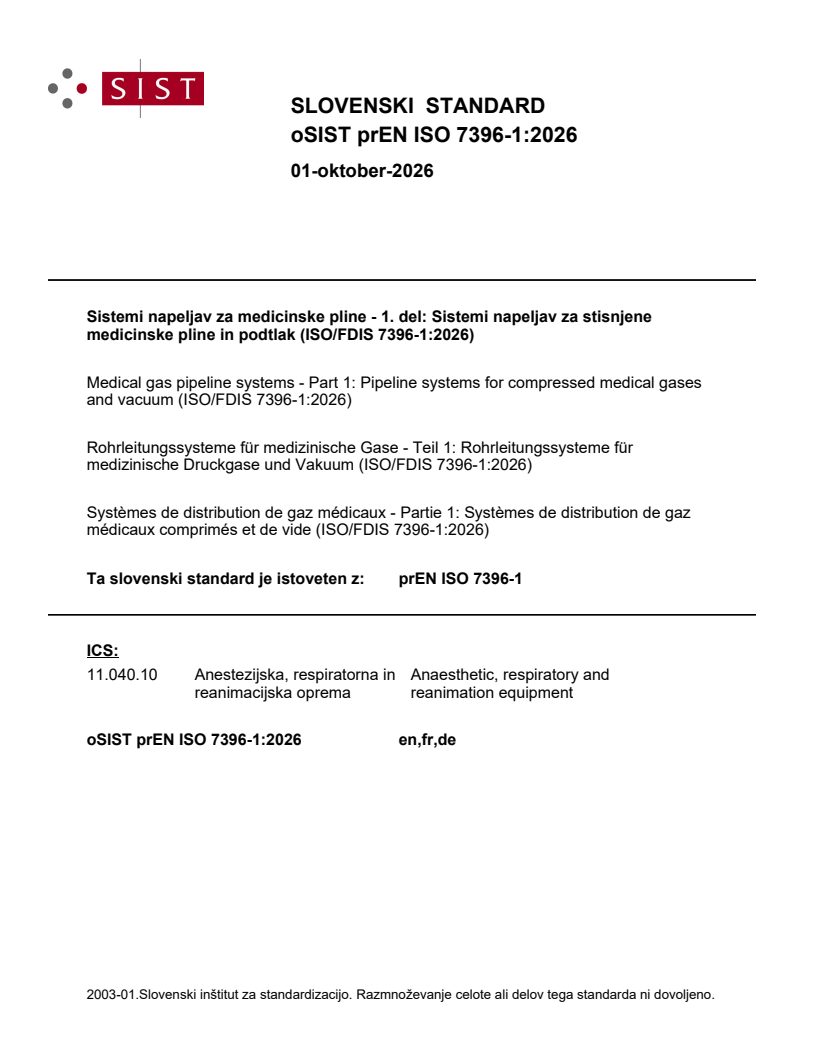
SLOVENSKI STANDARD
01-oktober-2026
Sistemi napeljav za medicinske pline - 1. del: Sistemi napeljav za stisnjene
medicinske pline in podtlak (ISO/FDIS 7396-1:2026)
Medical gas pipeline systems - Part 1: Pipeline systems for compressed medical gases
and vacuum (ISO/FDIS 7396-1:2026)
Rohrleitungssysteme für medizinische Gase - Teil 1: Rohrleitungssysteme für
medizinische Druckgase und Vakuum (ISO/FDIS 7396-1:2026)
Systèmes de distribution de gaz médicaux - Partie 1: Systèmes de distribution de gaz
médicaux comprimés et de vide (ISO/FDIS 7396-1:2026)
Ta slovenski standard je istoveten z: prEN ISO 7396-1
ICS:
11.040.10 Anestezijska, respiratorna in Anaesthetic, respiratory and
reanimacijska oprema reanimation equipment
2003-01.Slovenski inštitut za standardizacijo. Razmnoževanje celote ali delov tega standarda ni dovoljeno.
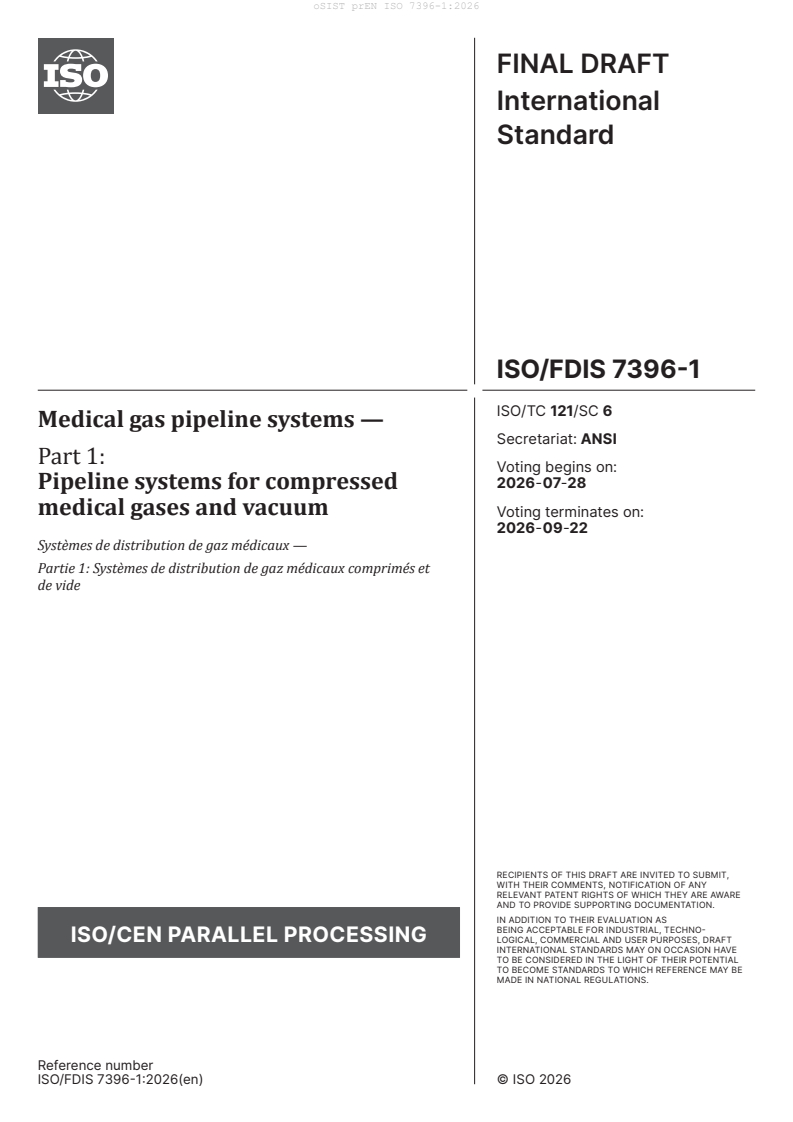
FINAL DRAFT
International
Standard
ISO/FDIS 7396-1
ISO/TC 121/SC 6
Medical gas pipeline systems —
Secretariat: ANSI
Part 1:
Voting begins on:
2026-07-28
Pipeline systems for compressed
medical gases and vacuum
Voting terminates on:
2026-09-22
Systèmes de distribution de gaz médicaux —
Partie 1: Systèmes de distribution de gaz médicaux comprimés et
de vide
RECIPIENTS OF THIS DRAFT ARE INVITED TO SUBMIT,
WITH THEIR COMMENTS, NOTIFICATION OF ANY
RELEVANT PATENT RIGHTS OF WHICH THEY ARE AWARE
AND TO PROVIDE SUPPOR TING DOCUMENTATION.
IN ADDITION TO THEIR EVALUATION AS
BEING ACCEPTABLE FOR INDUSTRIAL, TECHNO-
ISO/CEN PARALLEL PROCESSING LOGICAL, COMMERCIAL AND USER PURPOSES, DRAFT
INTERNATIONAL STANDARDS MAY ON OCCASION HAVE
TO BE CONSIDERED IN THE LIGHT OF THEIR POTENTIAL
TO BECOME STAN DARDS TO WHICH REFERENCE MAY BE
MADE IN NATIONAL REGULATIONS.
Reference number
ISO/FDIS 7396-1:2026(en) © ISO 2026
FINAL DRAFT
ISO/FDIS 7396-1:2026(en)
International
Standard
ISO/FDIS 7396-1
ISO/TC 121/SC 6
Medical gas pipeline systems —
Secretariat: ANSI
Part 1:
Voting begins on:
Pipeline systems for compressed
medical gases and vacuum
Voting terminates on:
Systèmes de distribution de gaz médicaux —
Partie 1: Systèmes de distribution de gaz médicaux comprimés et
de vide
RECIPIENTS OF THIS DRAFT ARE INVITED TO SUBMIT,
WITH THEIR COMMENTS, NOTIFICATION OF ANY
RELEVANT PATENT RIGHTS OF WHICH THEY ARE AWARE
AND TO PROVIDE SUPPOR TING DOCUMENTATION.
© ISO 2026
IN ADDITION TO THEIR EVALUATION AS
All rights reserved. Unless otherwise specified, or required in the context of its implementation, no part of this publication may
BEING ACCEPTABLE FOR INDUSTRIAL, TECHNO-
ISO/CEN PARALLEL PROCESSING
LOGICAL, COMMERCIAL AND USER PURPOSES, DRAFT
be reproduced or utilized otherwise in any form or by any means, electronic or mechanical, including photocopying, or posting on
INTERNATIONAL STANDARDS MAY ON OCCASION HAVE
the internet or an intranet, without prior written permission. Permission can be requested from either ISO at the address below
TO BE CONSIDERED IN THE LIGHT OF THEIR POTENTIAL
or ISO’s member body in the country of the requester.
TO BECOME STAN DARDS TO WHICH REFERENCE MAY BE
MADE IN NATIONAL REGULATIONS.
ISO copyright office
CP 401 • Ch. de Blandonnet 8
CH-1214 Vernier, Geneva
Phone: +41 22 749 01 11
Email: copyright@iso.org
Website: www.iso.org
Published in Switzerland Reference number
ISO/FDIS 7396-1:2026(en) © ISO 2026
ii
ISO/FDIS 7396-1:2026(en)
Contents Page
Foreword .vi
Introduction .viii
1 Scope . 1
2 Normative references . 2
3 Terms and definitions . 3
4 General requirements . 9
4.1 General .9
4.2 Safety and risk management .9
4.3 Gases for medical use .10
4.4 Materials .10
4.5 System design . 12
4.5.1 Requirements in the design . 12
4.5.2 Extensions and modifications of existing medical gas pipeline systems .14
4.5.3 Provision for Electrical Supply . 15
4.5.4 Biological risk . 15
4.5.5 Software . 15
4.5.6 Damage . 15
5 Supply systems .15
5.1 Supply system components . 15
5.2 General Requirements for supply systems .17
5.2.1 Capacity and storage.17
5.2.2 Continuity of supply .17
5.2.3 Primary source of supply .17
5.2.4 Secondary source of supply .17
5.2.5 Reserve source(s) of supply .17
5.2.6 Requirements for outlet pressure .18
5.2.7 Means of pressure relief .18
5.2.8 Maintenance supply assembly .19
5.2.9 Line pressure regulators .19
5.2.10 Ozone sterilizers .19
5.3 Supply systems with cylinders, cylinder bundles or high pressure reservoir(s).19
5.4 Supply systems with cryogenic or non cryogenic vessels . 20
5.5 Supply systems for air .21
5.6 Supply systems with oxygen concentrator unit(s) .27
5.6.1 General requirements .27
5.6.2 Primary source of supply .27
5.6.3 Secondary source of supply .27
5.6.4 Reserve source of supply .27
5.6.5 Specifications for pharmacopeial oxygen .27
5.6.6 Sources of supply with oxygen concentrator unit(s) . 28
5.6.7 Local filling of permanently attached high-pressure reservoir(s), acting as reserve
source of supply .32
5.7 Supply systems for vacuum . 33
5.8 Location of supply systems and sources of supply . 34
5.9 Sources of supply and supply systems assembled at site . 35
5.10 Sources of supply and supply systems preassembled in a factory . . 36
5.10.1 Leakage . 36
5.10.2 Marking . . 36
5.10.3 Packaging . 36
5.10.4 Information for installation .37
5.10.5 Information for use .37
5.10.6 Information for maintenance .37
6 Monitoring and alarms . .38
iii
ISO/FDIS 7396-1:2026(en)
6.1 General . 38
6.2 Installation requirements . 38
6.3 Monitoring and alarm signals . 39
6.3.1 General . 39
6.3.2 Auditory signals . 39
6.3.3 Visual signals . 39
6.3.4 Emergency and operating alarm characteristics . 39
6.3.5 Information signals . 40
6.3.6 Remote alarm extensions . 40
6.4 Provision of operating alarms . 40
6.5 Provision of emergency clinical alarms .41
6.6 Provision of emergency operating alarms .41
7 Pipeline distribution systems . 41
7.1 Mechanical resistance in single fault condition .41
7.2 Distribution pressure .41
7.3 Low-pressure hose assemblies and low-pressure flexible connections .43
7.4 Double-stage pipeline distribution systems.43
8 Shut-off valves and non-return valves .44
8.1 General . 44
8.2 Source shut-off valve . 44
8.3 Main shut-off valve . 44
8.4 Service shut-off valves .45
8.5 Riser shut-off valves .45
8.6 Pipeline branch shut-off valves .45
8.7 Area shut-off valves .45
8.8 Non-return valves . 46
9 Terminal units, pressure regulators and pressure gauges .46
10 Marking and colour coding .47
10.1 Marking .47
10.2 Colour coding .47
11 Pipeline Installation. 47
11.1 General .47
11.2 Pipeline supports . 48
11.3 Pipeline joints . 49
11.4 Extensions and modifications of existing medical gas pipeline systems . 49
12 Testing and commissioning .50
12.1 General . 50
12.2 General requirements for tests . 50
12.3 Inspections and tests for sources of supply and supply systems . 50
12.3.1 Tests of all sources of supply . 50
12.3.2 Tests for sources of supply with air compressor unit(s) .52
12.3.3 Tests for supply systems with oxygen concentrator unit(s) .52
12.3.4 Tests of the quality of air for driving surgical tools . . 54
12.3.5 Tests of the quality of medical air produced by supply systems with
proportioning unit(s). 54
12.3.6 Tests of the supply systems for vacuum . 54
12.3.7 Verification of restart after power supply failure . 54
12.4 Pipeline Tests . 54
12.4.1 Tests, checks and procedures before use of the pipeline distribution system . 54
12.4.2 Requirements for inspections and checks before concealment . 55
12.4.3 Requirements for tests, checks and procedures before use of the system . 55
12.4.4 Tests for leakage and mechanical integrity . 55
12.4.5 Tests of area shut-off valves for leakage and closure and checks for correct
zoning and correct identification .57
12.4.6 Test for cross-connection .57
12.4.7 Test for obstruction and flow rate . 58
iv
ISO/FDIS 7396-1:2026(en)
12.4.8 Checks of terminal units and NIST, DISS or SIS connectors for mechanical
function, gas-specificity and identification . 58
12.4.9 Tests or checks of system performance .59
12.4.10 Tests of pressure relief valves.59
12.4.11 Test for particulate contamination of pipeline distribution systems .59
12.4.12 Filling with specific gas . 60
12.4.13 Tests of gas identity . 60
12.5 Tests of monitoring and alarm systems . 60
12.6 Statement of conformance to this document . 60
13 Documentation requirements . 61
13.1 Instructions for installation .61
13.2 Instructions for use .61
13.3 Operational management information .62
13.4 “As-installed” drawings .62
13.5 Test reports . 63
Annex A (informative) Schematic representations of typical supply systems and area
distribution systems .64
Annex B (informative) Guidelines for location of cylinder manifolds, cylinder storage areas and
stationary vessels for cryogenic or non-cryogenic liquids .96
Annex C (informative) Example of procedure for testing and commissioning .97
Annex D (informative) Typical forms for documenting conformance of the medical gas pipeline
systems . .110
Annex E (informative) Temperature and pressure relationships .135
Annex F (informative) Rationale for air compressor unit hazards .137
Annex G (informative) Operational management .139
Annex H (informative) Risk management checklist . 158
Annex I (informative) Rationale .169
Annex J (informative) Considerations for implementation and use of oxygen following alternate
pharmacopeial specifications . .173
Annex K (informative) Manufacture of medical gases on site and responsibility for medical gas
quality .175
Annex L (informative) Roles and responsibilities .178
Annex M (Informative) Examples of pharmacopeial requirements for on-site production .180
Annex N (Informative) Application of this document together with other requirements .182
Annex ZA (informative) Relationship between this European standard and the General Safety
and Performance Requirements of Regulation (EU) 2017/745 aimed to be covered .183
Bibliography .193
v
ISO/FDIS 7396-1:2026(en)
Foreword
ISO (the International Organization for Standardization) is a worldwide federation of national standards
bodies (ISO member bodies). The work of preparing International Standards is normally carried out through
ISO technical committees. Each member body interested in a subject for which a technical committee
has been established has the right to be represented on that committee. International organizations,
governmental and non-governmental, in liaison with ISO, also take part in the work. ISO collaborates closely
with the International Electrotechnical Commission (IEC) on all matters of electrotechnical standardization.
The procedures used to develop this document and those intended for its further maintenance are described
in the ISO/IEC Directives, Part 1. In particular, the different approval criteria needed for the different types
of ISO document should be noted. This document was drafted in accordance with the editorial rules of the
ISO/IEC Directives, Part 2 (see www.iso.org/directives).
ISO draws attention to the possibility that the implementation of this document may involve the use of (a)
patent(s). ISO takes no position concerning the evidence, validity or applicability of any claimed patent
rights in respect thereof. As of the date of publication of this document, ISO had not received notice of (a)
patent(s) which may be required to implement this document. However, implementers are cautioned that
this may not represent the latest information, which may be obtained from the patent database available at
www.iso.org/patents. ISO shall not be held responsible for identifying any or all such patent rights.
Any trade name used in this document is information given for the convenience of users and does not
constitute an endorsement.
For an explanation of the voluntary nature of standards, the meaning of ISO specific terms and expressions
related to conformity assessment, as well as information about ISO's adherence to the World Trade
Organization (WTO) principles in the Technical Barriers to Trade (TBT), see www.iso.org/iso/foreword.html.
This document was prepared by Technical Committee ISO/TC 121, Anaesthetic and respiratory equipment,
Subcommittee SC 6, Medical gas supply systems, in collaboration the European Committee for Standardization
(CEN) Technical Committee CEN/TC 215, Respiratory and anaesthetic equipment, in accordance with the
Agreement on technical cooperation between ISO and CEN (Vienna Agreement).
This fourth edition cancels and replaces the third edition (ISO 7396-1:2016), which has been technically
revised. It also incorporates the Amendment ISO 7396-1:2016/Amd 1:2017.
The main changes are as follows:
— Compared to previous editions, there are few major changes to the pipeline system. Most updates are
improvements and clarifications based on practical experience, such as better drawings.
— Compressors have now been added as an integrated part of the standard, and oxygen concentrators have
been added as a subsystem. When reading this standard, it is important to note which section you are
in: the pipeline, packaged gases (manifolds and cryogenic supply), compressor section, or the oxygen
concentrator section.
— The number of annexes with additional information has increased. However, Annex D with typical forms
for test results is now available separately for download from the ISO portal (add link!).
— Annex G, which covered operations, has been removed. Such management topics are now included in
quality management standards. Annex G will become the foundation of a new document for operational
management.
— The revision of this standard was delayed by the COVID pandemic. During the pandemic, many healthcare
facilities discovered problems because the medical gas pipeline system had been designed with too little
capacity, was not well maintained, or had been expanded until the design limits were fully reached. For
this reason, the role of hospital management in the design, planning, construction, and future strategy
of the medical gas pipeline systems has been made more explicit.
— Clause 12 still covers the testing and commissioning of the installation, which should make becoming
familiar with this standard easier.
vi
ISO/FDIS 7396-1:2026(en)
A list of all parts in the ISO 7396 series can be found on the ISO website.
Any feedback or questions on this document should be directed to the user’s national standards body. A
complete listing of these bodies can be found at www.iso.org/members.html.
vii
ISO/FDIS 7396-1:2026(en)
Introduction
Many healthcare facilities use medical gas pipeline systems to deliver medical gases and to provide vacuum
to areas where they are used in patient care or to power equipment such as ventilators and surgical tools.
This document specifies requirements for medical gas pipeline systems for gases for medicinal use, medical
device gases, gases for driving surgical tools and vacuum. It is intended for use by those persons involved
in the design, construction, inspection, and operation of healthcare facilities treating human beings. Those
persons involved in the design, manufacture and testing of equipment intended to be connected to these
medical gas pipeline systems should also be aware of the contents of this document.
This document seeks to ensure that medical gas pipelines contain only the specific gas (or vacuum) intended
to be supplied. For this reason, gas-specific components are used for terminal units and for other connectors
which are intended to be used by the operator. In addition, each system is tested and certified to contain
only the specific gas (or vacuum).
The objectives of this document are to ensure the following:
a) non-interchangeability between different medical gas pipeline systems by design, installation and
testing;
b) continuous supply of gases and vacuum at specified quality, pressures and design flow rates by providing
appropriate sources;
c) use of suitable materials;
d) cleanliness of components;
e) correct installation;
f) provision of monitoring and alarm systems;
g) correct marking of the pipeline system;
h) testing and commissioning;
i) quality of the gases delivered by the pipeline system;
j) correct operational management;
k) safety features of the sources to ensure the quality and pressure of the gases delivered to the terminals
according to specification.
It is normal practice to assign responsibility for the quality of the medical gas supplied to a nominated person
within the healthcare facility such as the head pharmacist. Where the healthcare facility manufactures the
medical gas on site the healthcare facility is responsible for all aspects of the medical gas quality.
Vacuum for medical suction is also the responsibility of the healthcare facility.
[37]
EN 14931:2006 defines additional requirements for hyperbaric application, in particular for flow rates
and pressures of compressed air required to pressurize hyperbaric chambers and to drive other connected
services. Also included are requirements for oxygen and other treatment gases administered to patients
during hyperbaric therapies. Annex G, J and K provides guidance for the assignment of responsibility for
production and quality control of the gases and vacuum.
Annexes G and H provide some guidance as to how the quality of the gas should be managed to maintain
patient safety at the highest level.
Annex I contains rationale statements for some of the requirements of this document. It is included to
provide additional insight into the reasoning that led to the requirements and recommendations that have
been incorporated into this document.
viii
FINAL DRAFT International Standard ISO/FDIS 7396-1:2026(en)
Medical gas pipeline systems —
Part 1:
Pipeline systems for compressed medical gases and vacuum
1 Scope
This document specifies requirements for design, installation, function, performance, testing, commissioning
and documentation of medical gas pipeline systems used in healthcare facilities for the following:
— argon;
— pharmacopeial oxygen;
— nitrous oxide;
— medical air;
— carbon dioxide;
— oxygen/nitrous oxide mixtures;
— helium/oxygen mixtures;
— gases and gas mixtures classified as medical device, gases delivered to medical devices or intended for
medical purposes or gases and gas mixtures for medicinal use not specified above;
— air for driving surgical tools;
— nitrogen;
— vacuum.
NOTE 1 A rationale for this is contained in Annex I.2
[6]
NOTE 2 Anaesthetic gas scavenging disposal systems are covered in ISO 7396-2 .
This document includes requirements for supply systems, medical gas pipeline distribution systems, control
system(s), monitoring and alarm systems and non-interchangeability between different gas/vacuum
systems.
This document specifies safety requirements for medical gas pipeline systems used in healthcare facilities.
It applies to all facilities providing healthcare services regardless of type, size, location or range of services,
including, but not limited to:
a) acute care healthcare facilities;
b) internal patient continuing care healthcare facilities;
c) long-term care facilities;
d) community-based providers;
e) ambulatory and external patient care clinics (e.g. day surgery, endoscopy clinics and doctors’ offices).
This document may also be used as reference for medical gas pipeline systems intended to be installed
in places other than healthcare facilities.
ISO/FDIS 7396-1:2026(en)
This document applies to the following different types of oxygen supply systems:
— supply systems in which all sources of supply deliver oxygen produced off-site;
— supply systems in which some or all sources of supply deliver oxygen produced on-site; in this case the
concentration of the oxygen may vary, depending on the pharmacopeial specification selected by the
healthcare facility
Oxygen concentrators for domiciliary use are excluded from the scope of this document. This document also
applies to:
— extensions of existing pipeline distribution systems;
— modifications of existing pipeline distribution systems;
— modifications or replacement of supply systems or sources of supply.
This document does not apply to vacuum systems intended to be used in dentistry (A rationale is discussed
in Annex I.2)
This document does not apply to filling systems for transportable cylinders and transportable cylinder
bundle systems.
This document does not apply to cryogenic pipeline systems conveying liquified gases.
2 Normative references
The following documents are referred to in the text in such a way that some or all of their content constitutes
requirements of this document. For dated references, only the edition cited applies. For undated references,
the latest edition of the referenced document (including any amendments) applies.
ISO 3746, Acoustics — Determination of sound power levels and sound energy levels of noise sources using sound
pressure — Survey method using an enveloping measurement surface over a reflecting plane
ISO 4126-1, Safety devices for protection against excessive pressure — Part 1: Safety valves
ISO 5011, Inlet air cleaning equipment for internal combustion engines and compressors — Performance testing
ISO 5359, Anaesthetic and respiratory equipment — Low-pressure hose assemblies for use with medical gases
ISO 8573-1, Compressed air — Part 1: Contaminants and purity classes
ISO 9170-1, Terminal units for medical gas pipeline systems — Part 1: Terminal units for use with compressed
medical gases and vacuum
ISO 10524-2, Pressure regulators for use with medical gases — Part 2: Manifold and line pressure regulators
ISO 11197, Medical supply units
ISO 14971, Medical devices — Application of risk management to medical devices
ISO 15001:2010, Anaesthetic and respiratory equipment — Compatibility with oxygen
ISO 17672, Brazing — Filler metals
ISO 20417, Medical devices — Information to be supplied by the manufacturer
ISO 21969, High-pressure flexible connections for use with medical gas systems
ISO 29463-1, High efficiency filters and filter media for removing particles in air — Part 1: Classification,
performance, testing and marking
ISO 18562-2, Biocompatibility evaluation of breathing gas pathways in healthcare applications — Part 2: Tests
for emissions of particulate matter
ISO/FDIS 7396-1:2026(en)
IEC 60529, Degrees of protection provided by enclosures (IP Code)
IEC 60601-1-8, Medical electrical equipment — Part 1-8: General requirements for basic safety and essential
performance — Collateral standard: General requirements, tests and guidance for alarm systems in medical
electrical equipment and medical electrical systems
IEC 62304, Medical device software — Software life cycle processes
EN 286-1, Simple unfired pressure vessels designed to contain air or nitrogen — Part 1: Pressure vessels for
general purposes
EN 837-1, Pressure gauges, Bourdon tube pressure gauges, Dimensions, metrology, requirements and testing
EN 1254-1, Copper and copper alloys - Plumbing fittings - Fittings with ends for capillary soldering or capillary
brazing to copper tubes
EN 1012-1, Compressors and vacuum pumps - Safety requirements - Part 1: Air Compressors
EN 1012-2, Compressors and vacuum pumps - Safety requirements - Part 2: Vacuum Pumps
EN 13348, Copper and copper alloys — Seamless, round copper tubes for medical gases or vacuum
EN 13445-1, Unfired pressure vessels - Part 1: General
3 Terms and definitions
For the purposes of this document, the following terms and definitions apply.
ISO and IEC maintain terminology databases for use in standardization at the following addresses:
— ISO Online browsing platform: available at https:// www .
...