

EN 13763-1:2025
(Main)Explosives for civil uses - Detonators and detonating cord relays - Part 1: Requirements
- Abstract
This document specifies the requirements for electric detonators, non-electric detonators, electronic detonators, plain detonators, semi-finished detonators, electronic initiation systems, surface connectors, shock tubes and detonating cord relays.
- Status
- Published
- Publication Date
- 30-Sep-2025
- Technical Committee
- CEN/TC 321 - Explosives for civil uses
- Drafting Committee
- CEN/TC 321/WG 4 - Detonators and relays
- Current Stage
- 6060 - Definitive text made available (DAV) - Publishing
- Start Date
- 01-Oct-2025
- Due Date
- 29-Aug-2022
- Completion Date
- 01-Oct-2025

Overview
EN 13763-1:2025 is a key European standard published by CEN that establishes requirements for explosives used in civil applications, focusing specifically on detonators and detonating cord relays. This standard underpins the safe and reliable use of electric, non-electric, electronic, and plain detonators, as well as semi-finished detonators, electronic initiation systems, surface connectors, shock tubes, and detonating cord relays.
The document defines the critical information that must be supplied with such products and sets out criteria and verification methods to assess their properties. EN 13763-1:2025 supports compliance with EU legislation and harmonizes requirements for safety, performance, and interoperability across the European market.
Key Topics
Types of Detonators Covered:
- Electric detonators
- Non-electric detonators
- Electronic detonators
- Plain detonators
- Semi-finished detonators
- Electronic initiation systems
- Surface connectors
- Shock tubes
- Detonating cord relays
Requirements Defined:
- Information to be provided (e.g., temperature and humidity ranges, storage conditions, delay characteristics)
- Classification and specifications for detonators (including resistance to environmental and mechanical factors)
- Pass/fail criteria referencing standardized testing methods within the EN 13763 series
Updated Scope:
- Enhanced differentiation between detonator types
- Inclusion of electronic detonators and initiation systems
- Revised structure for clarity, supporting easier regulatory compliance
Applications
EN 13763-1:2025 is applicable across multiple civil sectors where the controlled use of explosives is required, such as:
- Mining and Quarrying: Ensures reliable initiation and timing of blasts for rock fragmentation, optimizing productivity and safety.
- Civil Engineering and Construction: Used for tunneling, demolition, and site preparation, helping to coordinate precise sequencing and minimizing risks.
- Infrastructure Projects: Supports activities like road building and dam construction, where complex blast patterns require predictable initiation systems.
- Surface and Subsurface Blasting: Provides guidance for configuring both simple and sophisticated blast initiation networks using various detonator types, relays, and connectors.
- Compliance with EU Directives: Addresses essential safety and performance requirements in line with Directive 2014/28/EU on the supervision of explosives for civil uses.
By adhering to EN 13763-1:2025, organizations achieve consistent product specifications, interoperable systems, and enhanced safety margins, thereby reducing the likelihood of accidents and regulatory non-compliance.
Related Standards
EN 13763-1:2025 forms part of the broader EN 13763 series, each part focusing on specific test methods and verification processes essential for full compliance. Notable related standards include:
- EN 13763-2:2025: Verification of thermal stability of detonators and relays
- EN 13763-3:2025: Verification of insensitiveness to impact
- EN 13763-4:2025: Resistance to abrasion of wires and tubes
- EN 13763-5-25:2025: Additional mechanical, electrical, and environmental test methods (e.g., resistance to cutting, bending, vibration, water pressure, and electrostatic discharge)
- EN 13857-1:2025: Vocabulary for explosives for civil uses
- EN IEC 60812:2018: Failure modes and effects analysis (FMEA)
- EN 61882:2016: Hazard and operability studies (HAZOP)
- EN ISO 13849-2:2012: Validation of safety-related machinery control systems
Integration with these standards ensures comprehensive verification of product performance, safety, and suitability for their intended use, further cementing EN 13763-1:2025 as an essential reference for all stakeholders in the civil explosives sector.
Keywords: EN 13763-1:2025, explosives for civil uses, detonators, detonating cord relays, standard requirements, CEN, civil engineering, mining safety, EU compliance, initiation systems, shock tubes.
Relations
- Effective Date
- 19-Jan-2023
- Effective Date
- 18-Jan-2023
- Effective Date
- 09-Feb-2026
- Effective Date
- 09-Feb-2026
- Effective Date
- 28-Jan-2026
- Effective Date
- 28-Jan-2026
- Effective Date
- 28-Jan-2026
- Effective Date
- 28-Jan-2026
- Effective Date
- 28-Jan-2026
- Effective Date
- 28-Jan-2026
- Effective Date
- 28-Jan-2026
- Effective Date
- 28-Jan-2026
- Effective Date
- 28-Jan-2026
- Effective Date
- 28-Jan-2026
- Effective Date
- 28-Jan-2026
Get Certified
Connect with accredited certification bodies for this standard

ECOCERT
Organic and sustainability certification.

Eurofins Food Testing Global
Global leader in food, environment, and pharmaceutical product testing.

Intertek Bangladesh
Intertek certification and testing services in Bangladesh.
Sponsored listings
Frequently Asked Questions
EN 13763-1:2025 is a standard published by the European Committee for Standardization (CEN). Its full title is "Explosives for civil uses - Detonators and detonating cord relays - Part 1: Requirements". This standard covers: This document specifies the requirements for electric detonators, non-electric detonators, electronic detonators, plain detonators, semi-finished detonators, electronic initiation systems, surface connectors, shock tubes and detonating cord relays.
This document specifies the requirements for electric detonators, non-electric detonators, electronic detonators, plain detonators, semi-finished detonators, electronic initiation systems, surface connectors, shock tubes and detonating cord relays.
EN 13763-1:2025 is classified under the following ICS (International Classification for Standards) categories: 71.100.30 - Explosives. Pyrotechnics and fireworks. The ICS classification helps identify the subject area and facilitates finding related standards.
EN 13763-1:2025 has the following relationships with other standards: It is inter standard links to EN 13763-1:2004, EN 13857-3:2002, EN 61882:2016, EN IEC 60812:2018, EN 13763-24:2025, EN 13763-21:2025, EN 13763-3:2025, EN 13763-8:2025, EN 13763-17:2025, EN ISO 13849-2:2012, EN 13763-19:2025, EN 13857-1:2025, EN 13630-1:2025, EN 13763-6:2025, EN 13763-15:2025. Understanding these relationships helps ensure you are using the most current and applicable version of the standard.
EN 13763-1:2025 is associated with the following European legislation: EU Directives/Regulations: 2014/28/EU; Standardization Mandates: M/562. When a standard is cited in the Official Journal of the European Union, products manufactured in conformity with it benefit from a presumption of conformity with the essential requirements of the corresponding EU directive or regulation.
EN 13763-1:2025 is available in PDF format for immediate download after purchase. The document can be added to your cart and obtained through the secure checkout process. Digital delivery ensures instant access to the complete standard document.
Standards Content (Sample)
SLOVENSKI STANDARD
01-december-2025
Eksplozivi za civilno uporabo - Detonatorji in zakasnilniki - 1. del: Zahteve
Explosives for civil uses - Detonators and detonating cord relays - Part 1: Requirements
Explosivstoffe für zivile Zwecke - Zünder und Sprengschnurverzögerer - Teil 1:
Anforderungen
Explosifs à usage civil - Détonateurs et relais pour cordeau détonant - Partie 1 :
Exigences
Ta slovenski standard je istoveten z: EN 13763-1:2025
ICS:
71.100.30 Eksplozivi. Pirotehnika in Explosives. Pyrotechnics and
ognjemeti fireworks
2003-01.Slovenski inštitut za standardizacijo. Razmnoževanje celote ali delov tega standarda ni dovoljeno.
EN 13763-1
EUROPEAN STANDARD
NORME EUROPÉENNE
October 2025
EUROPÄISCHE NORM
ICS 71.100.30 Supersedes EN 13763-1:2004, EN 13857-3:2002
English Version
Explosives for civil uses - Detonators and detonating cord
relays - Part 1: Requirements
Explosifs à usage civil - Détonateurs et relais pour Explosivstoffe für zivile Zwecke - Zünder und
cordeau détonant - Partie 1 : Exigences Sprengschnurverzögerer - Teil 1: Anforderungen
This European Standard was approved by CEN on 29 September 2025.
CEN members are bound to comply with the CEN/CENELEC Internal Regulations which stipulate the conditions for giving this
European Standard the status of a national standard without any alteration. Up-to-date lists and bibliographical references
concerning such national standards may be obtained on application to the CEN-CENELEC Management Centre or to any CEN
member.
This European Standard exists in three official versions (English, French, German). A version in any other language made by
translation under the responsibility of a CEN member into its own language and notified to the CEN-CENELEC Management
Centre has the same status as the official versions.
CEN members are the national standards bodies of Austria, Belgium, Bulgaria, Croatia, Cyprus, Czech Republic, Denmark, Estonia,
Finland, France, Germany, Greece, Hungary, Iceland, Ireland, Italy, Latvia, Lithuania, Luxembourg, Malta, Netherlands, Norway,
Poland, Portugal, Republic of North Macedonia, Romania, Serbia, Slovakia, Slovenia, Spain, Sweden, Switzerland, Türkiye and
United Kingdom.
EUROPEAN COMMITTEE FOR STANDARDIZATION
COMITÉ EUROPÉEN DE NORMALISATION
EUROPÄISCHES KOMITEE FÜR NORMUNG
CEN-CENELEC Management Centre: Rue de la Science 23, B-1040 Brussels
© 2025 CEN All rights of exploitation in any form and by any means reserved Ref. No. EN 13763-1:2025 E
worldwide for CEN national Members.
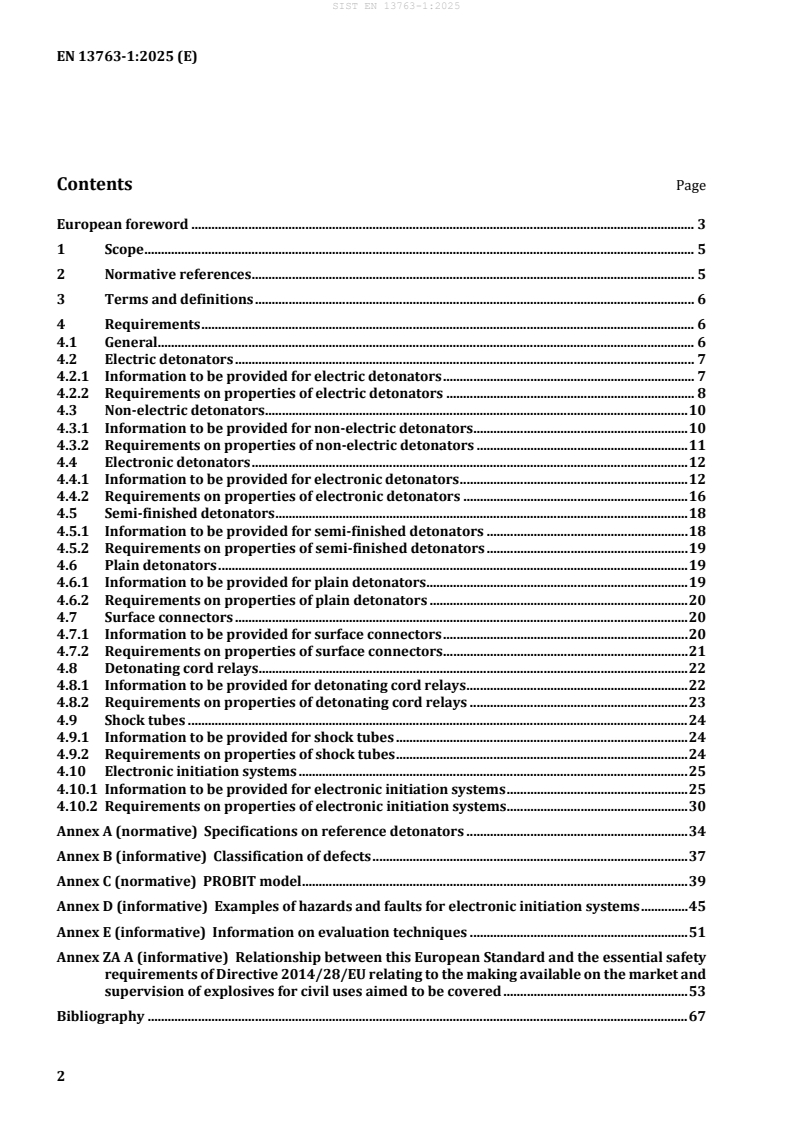
Contents Page
European foreword . 3
1 Scope . 5
2 Normative references . 5
3 Terms and definitions . 6
4 Requirements . 6
4.1 General. 6
4.2 Electric detonators . 7
4.2.1 Information to be provided for electric detonators . 7
4.2.2 Requirements on properties of electric detonators . 8
4.3 Non-electric detonators . 10
4.3.1 Information to be provided for non-electric detonators . 10
4.3.2 Requirements on properties of non-electric detonators . 11
4.4 Electronic detonators . 12
4.4.1 Information to be provided for electronic detonators . 12
4.4.2 Requirements on properties of electronic detonators . 16
4.5 Semi-finished detonators . 18
4.5.1 Information to be provided for semi-finished detonators . 18
4.5.2 Requirements on properties of semi-finished detonators . 19
4.6 Plain detonators . 19
4.6.1 Information to be provided for plain detonators . 19
4.6.2 Requirements on properties of plain detonators . 20
4.7 Surface connectors . 20
4.7.1 Information to be provided for surface connectors . 20
4.7.2 Requirements on properties of surface connectors . 21
4.8 Detonating cord relays . 22
4.8.1 Information to be provided for detonating cord relays . 22
4.8.2 Requirements on properties of detonating cord relays . 23
4.9 Shock tubes . 24
4.9.1 Information to be provided for shock tubes . 24
4.9.2 Requirements on properties of shock tubes . 24
4.10 Electronic initiation systems . 25
4.10.1 Information to be provided for electronic initiation systems . 25
4.10.2 Requirements on properties of electronic initiation systems . 30
Annex A (normative) Specifications on reference detonators . 34
Annex B (informative) Classification of defects . 37
Annex C (normative) PROBIT model . 39
Annex D (informative) Examples of hazards and faults for electronic initiation systems . 45
Annex E (informative) Information on evaluation techniques . 51
Annex ZA A (informative) Relationship between this European Standard and the essential safety
requirements of Directive 2014/28/EU relating to the making available on the market and
supervision of explosives for civil uses aimed to be covered . 53
Bibliography . 67
European foreword
This document (EN 13763-1:2025) has been prepared by Technical Committee CEN/TC 321 “Explosives
for civil uses”, the secretariat of which is held by UNE.
This European Standard shall be given the status of a national standard, either by publication of an
identical text or by endorsement, at the latest by April 2026 and conflicting national standards shall be
withdrawn at the latest by April 2026.
Attention is drawn to the possibility that some of the elements of this document may be the subject of
patent rights. CEN shall not be held responsible for identifying any or all such patent rights.
This document supersedes EN 13763-1:2004. Together with EN 13630-1:2025, EN 13631-1:2025 and
EN 13938-1:2025 this document will supersede EN 13857-3:2002.
a) the document title has been changed from “Detonators and relays — Part 1: Requirements” to
“Detonators and detonating cord relays — Part 1: Requirements”;
b) the Scope has been revised to clarify the covered explosives and to include semi-finished detonators,
electronic detonators and electronic initiation systems;
c) the normative references have been updated;
d) the Clause 4 “Requirements” has been completely revised so that now for each explosive a separate
subclause has been added divided into the following two sections each time:
1) a section on the requirements on information to be provided for the explosive – these
requirements have partly been moved here from EN 13857-3:2002 in revised form;
2) a section on the requirements on properties for the explosive – these requirements have partially
been taken over from the former Clause 4;
e) a differentiation between the different types of detonators has been introduced to Clause 4 – non-
electric, electric, electronic, plain and semi-finished detonators;
f) the requirements on electronic detonators, semi-finished detonators and electronic initiation
systems have been added;
g) the requirements on properties of the explosives covered in this document have been converted into
“pass”/ “fail”-criteria and the specification on these criteria are now given in the corresponding test
method standards of the EN 13763 series;
h) the former Annex A “Classification of electric detonators” has been removed;
i) a new Annex A “Specifications on reference detonators” has been added;
j) the former Annex B “Bruceton method” has been removed;
k) the Annex C is now called “PROBIT model” instead of “PROBIT TEST (PBBS test)”;
l) the former Annex D “Classification of defects” is now Annex B and has been updated to consider all
explosives covered in this document;
m) the former Annex E “Range of validity of test results” has been removed;
n) the Annex ZA has been updated;
o) the Bibliography has been updated.
This document has been prepared under a standardization request addressed to CEN by the European
Commission. The Standing Committee of the EFTA States subsequently approves these requests for its
Member States.
For the relationship with EU Legislation, see informative Annex ZA, which is an integral part of this
document.
A list of all parts in the EN 13763 series, published under the general title Explosives for civil uses —
Detonators and detonating cord relays, can be found on the CEN website.
Any feedback and questions on this document should be directed to the users’ national standards body.
A complete listing of these bodies can be found on the CEN website.
According to the CEN-CENELEC Internal Regulations, the national standards organizations of the
following countries are bound to implement this European Standard: Austria, Belgium, Bulgaria, Croatia,
Cyprus, Czech Republic, Denmark, Estonia, Finland, France, Germany, Greece, Hungary, Iceland, Ireland,
Italy, Latvia, Lithuania, Luxembourg, Malta, Netherlands, Norway, Poland, Portugal, Republic of North
Macedonia, Romania, Serbia, Slovakia, Slovenia, Spain, Sweden, Switzerland, Türkiye and the United
Kingdom.
1 Scope
This document specifies the requirements for electric detonators, non-electric detonators, electronic
detonators, plain detonators, semi-finished detonators, electronic initiation systems, surface connectors,
shock tubes and detonating cord relays.
2 Normative references
The following documents are referred to in the text in such a way that some or all of their content
constitutes requirements of this document. For dated references, only the edition cited applies. For
undated references, the latest edition of the referenced document (including any amendments) applies.
EN 13763-2:2025, Explosives for civil uses — Detonators and detonating cord relays — Part 2: Verification
of thermal stability of detonators, surface connectors, detonating cord relays and shock tubes
EN 13763-3:2025, Explosives for civil uses — Detonators and detonating cord relays — Part 3: Verification
of insensitiveness to impact of detonators, surface connectors, detonating cord relays and shock tubes
EN 13763-4:2025, Explosives for civil uses — Detonators and detonating cord relays — Part 4: Verification
of resistance to abrasion of leading wires and shock tubes
EN 13763-5:2025, Explosives for civil uses — Detonators and detonating cord relays — Part 5: Verification
of resistance to cutting damage of leading wires and shock tubes
EN 13763-6:2025, Explosives for civil uses — Detonators and detonating cord relays — Part 6: Verification
of resistance to cracking of leading wires
EN 13763-7:2025, Explosives for civil uses — Detonators and detonating cord relays — Part 7: Verification
of pull-out resistance of detonators
EN 13763-8:2025, Explosives for civil uses — Detonators and detonating cord relays — Part 8: Verification
of resistance to vibration of plain and semi-finished detonators
EN 13763-9:2025, Explosives for civil uses — Detonators and detonating cord relays — Part 9: Verification
of resistance to bending of detonators
EN 13763-11:2025, Explosives for civil uses — Detonators and detonating cord relays — Part 11:
Verification of resistance to damage by dropping of detonators, detonating cord relays and surface
connectors
EN 13763-12:2025, Explosives for civil uses — Detonators and detonating cord relays — Part 12:
Verification of resistance to hydrostatic pressure of detonators, detonating cord relays and surface
connectors
EN 13763-13:2025, Explosives for civil uses — Detonators and detonating cord relays — Part 13:
Verification of the resistance to electrostatic discharge (ESD) of electric and electronic detonators
EN 13763-15:2025, Explosives for civil uses — Detonators and detonating cord relays — Part 15:
Verification of equivalent initiating capability of electric, non-electric and electronic detonators
EN 13763-16:2025, Explosives for civil uses — Detonators and detonating cord relays — Part 16:
Verification of delay time accuracy of electric and non-electric detonators, surface connectors and
detonating cord relays
EN 13763-17:2025, Explosives for civil uses — Detonators and detonating cord relays — Part 17:
Verification of the no-fire current of electric detonators
EN 13763-18:2025, Explosives for civil uses — Detonators and detonating cord relays — Part 18:
Verification of the series firing current for electric detonators
EN 13763-19:2025, Explosives for civil uses — Detonators and detonating cord relays — Part 19:
Verification of all-fire impulse and no-fire impulse of electric detonators
EN 13763-20:2025, Explosives for civil uses — Detonators and detonating cord relays — Part 20:
Verification of total electrical resistance of electric detonators
EN 13763-21:2025, Explosives for civil uses — Detonators and detonating cord relays — Part 21:
Verification of flash-over voltage of electric detonators
EN 13763-22:2025, Explosives for civil uses — Detonators and detonating cord relays — Part 22:
Verification of capacitance, insulation resistance and insulation breakdown of leading wires
EN 13763-23:2025, Explosives for civil uses — Detonators and detonating cord relays — Part 23:
Verification of the shock wave velocity of shock tubes
EN 13763-24:2025, Explosives for civil uses — Detonators and detonating cord relays — Part 24:
Verification of electrical non-conductivity of shock tubes
EN 13763-25:2025, Explosives for civil uses — Detonators and detonating cord relays — Part 25:
Verification of transfer capability of detonating cord relays, surface connectors and coupling accessories
EN 13763-27:2025, Explosives for civil uses — Detonators and detonating cord relays — Part 27: Test
methods for electronic initiation systems
EN 13857-1:2025, Explosives for civil uses — Part 1: Vocabulary
EN IEC 60812:2018, Failure modes and effects analysis (FMEA and FMECA) (IEC 60812:2018)
EN 61882:2016, Hazard and operability studies (HAZOP studies) — Application guide (IEC 61882:2016)
EN ISO 13849-2:2012, Safety of machinery — Safety related parts of control systems — Part 2 Validation
(ISO 13849-2:2012)
3 Terms and definitions
For the purposes of this document, the terms and definitions given in EN 13857-1:2025 apply.
ISO and IEC maintain terminology databases for use in standardization at the following addresses:
— IEC Electropedia: available at https://www.electropedia.org/
— ISO Online browsing platform: available at https://www.iso.org/obp/
4 Requirements
4.1 General
For the verification of the properties of the explosives covered in this document, Annex B provides
information on the minimum test sample size under consideration of the classification of defects. Annex B
does not apply to electronic initiation systems and their components different from electronic detonators.
4.2 Electric detonators
4.2.1 Information to be provided for electric detonators
4.2.1.1 Temperature of use
The temperature range in which the detonator may be used shall be given as minimum and as maximum
temperature expressed in °C.
If the detonator may be temporarily subjected to a temperature outside of the above temperature range,
the minimum or the maximum temperature shall be given and the exposure time during which the
detonator may be subjected to this temperature shall be given.
For detonators with a maximum temperature of use > 100 °C, the maximum exposure time shall be
specified.
EXAMPLE
— “suitable for use up to a maximum temperature of .°C for .min or h or d”;
— “suitable for use down to a minimum temperature of .°C for .min (or h or d)”.
4.2.1.2 Storage conditions
4.2.1.2.1 Temperature
The temperature range for storage of the detonator shall be given as minimum and as maximum
temperature expressed in °C.
4.2.1.2.2 Relative humidity
The range of relative humidity for storage of the detonator shall be given as minimum and as maximum
value expressed in %.
4.2.1.3 Use in wet conditions
It shall be specified whether or not the detonator may be used in wet conditions.
In case that the detonator is resistant to hydrostatic pressure, the value of resistance against hydrostatic
pressure shall be specified and expressed in MPa.
4.2.1.4 Means of initiation
The means of initiation for the detonator shall be specified.
The series firing current, I , shall be specified.
S
The all-fire current, I , shall be specified.
AF
The no-fire current, I , shall be specified.
NF
The all-fire impulse, W , shall be specified.
AF
The no-fire-impulse WNF shall be specified.
Depending on the specified no-fire current, the class of the electric detonator shall be specified in
accordance with Table 1.
Table 1 — Overview on electric detonator classes
Class of the electric detonator
Class I Class II Class III Class IV
No-fire current [A] 0,18 < I < 0,45 0,45 ≤ I < 1,20 1,20 ≤ I < 4,00 4,00 ≤ I
nf nf nf nf
Minimum no-fire [mJ/Ω] 0,5 8 80 500
impulse, W
nf
4.2.1.5 Leading wires
It shall be specified whether the leading wires are category 1 or category 2 leading wires in relation to
testing according to EN 13763-4:2025.
It shall be specified whether the leading wires are single or dual.
The length of the leading wires shall be expressed in m. In case of more than one leading wire length for
the detonator, all different lengths shall be specified.
The temperature of use shall be as specified in 4.2.1.1 and the temperature range for the storage shall be
as specified in 4.2.1.2.1.
4.2.1.6 Delay characteristics
It shall be specified whether the detonator contains a delay element.
It shall be specified whether the detonator forms part of a delay series.
If the detonators form part of a delay series, the delay numbers (k) and the corresponding nominal delay
times (𝑡𝑡 ) shall be specified.
𝑛𝑛om,𝑘𝑘
If the detonators form part of a delay series, it shall be specified whether different delay compositions
are used for different detonators of different delay times.
It shall be specified whether the fuse head of all detonators of the delay series consisting of delay and
instantaneous detonators have the same design.
4.2.1.7 Initiating capability
The corresponding reference detonator in accordance with Table A.1 shall be specified.
4.2.1.8 Total electric resistance
The total electric resistance of the detonator shall be given for the detonators with the longest and
shortest leading wire as specified in 4.2.1.5.
4.2.2 Requirements on properties of electric detonators
4.2.2.1 Thermal stability
When tested in accordance with EN 13763-2:2025, Clauses 5 to 7, the test result shall be “pass” in
accordance with EN 13763-2:2025, Clause 8.
4.2.2.2 Insensitiveness to impact
When tested in accordance with EN 13763-3:2025, Clauses 5 to 7, the test result shall be “pass” in
accordance with EN 13763-3:2025, Clause 8.
4.2.2.3 Resistance to abrasion of leading wires
When tested in accordance with EN 13763-4:2025, Clauses 5 to 7, the test result shall be “pass” in
accordance with EN 13763-4:2025, 8.1.
4.2.2.4 Resistance to cutting damage of leading wires
When tested in accordance with EN 13763-5:2025, Clauses 5 to 7, the test result shall be “pass” in
accordance with EN 13763-5:2025, 8.1.
4.2.2.5 Resistance to cracking of insulation in low temperatures of leading wires
When tested in accordance with EN 13763-6:2025 Clauses 5 to 7, the test result shall be “pass” in
accordance with EN 13763-6:2025, Clause 8.
4.2.2.6 Pull-out resistance
When tested in accordance with EN 13763-7:2025 Clauses 5 to 7, the test result shall be “pass” in
accordance with EN 13763-7:2025, Clause 8.
4.2.2.7 Resistance to bending
When tested in accordance with EN 13763-9:2025, Clauses 5 to 7, the test result shall be “pass” in
accordance with EN 13763-9:2025, Clause 8.
4.2.2.8 Resistance to damage by dropping
When tested in accordance with EN 13763-11:2025, Clauses 5 to 7, the test result shall be “pass” in
accordance with EN 13763-11:2025 8.1.
4.2.2.9 Resistance to hydrostatic pressure
For detonators for which resistance to water is specified in accordance with 4.2.1.3, when tested in
accordance with EN 13763-12:2025, Clauses 6 to 8, the test result shall be “pass” in accordance with
EN 13763-12:2025, 9.1.
4.2.2.10 Resistance to electrostatic discharge (ESD)
When tested in accordance with EN 13763-13:2025, Clauses 5 to 7, the test result shall be “pass” in
accordance with EN 13763-13:2025, Clause 8.
4.2.2.11 Equivalent initiating capability
When tested in accordance with EN 13763-15:2025, Clauses 5 to 7, the test result shall be “pass” in
accordance with EN 13763-15:2025, Clause 8.
4.2.2.12 Delay accuracy
For detonators that form part of a delay series as specified in accordance with 4.2.1.6, when tested in
accordance with EN 13763-16:2025, Clauses 5 to 7, the test result shall be “pass” in accordance with
EN 13763-16:2025, 8.1.
4.2.2.13 No-fire current
When tested in accordance with EN 13763-17:2025, Clauses 5 to 7, the test result shall be “pass” in
accordance with EN 13763-17:2025, Clause 8.
NOTE For the determination of the no-fire current level in accordance with EN 13763-17:2025, 7.3, the PROBIT
model in accordance with Annex C is applied.
4.2.2.14 Series firing current
When tested in accordance with EN 13763-18:2025, Clauses 5 to 7, the test result shall be “pass” in
accordance with EN 13763-18:2025, Clause 8.
4.2.2.15 All-fire and no-fire impulse
When tested in accordance with EN 13763-19:2025, Clauses 5 to 7, the test result shall be “pass” in
accordance with EN 13763-19:2025, Clause 8.
NOTE For the determination of the all-fire and no-fire impulse values in accordance with
EN 13763-19:2025, 7.3, the PROBIT model in accordance with Annex C is applied.
4.2.2.16 Total electrical resistance
When tested in accordance with EN 13763-20:2025, Clauses 5 to 7, the test result shall be “pass” in
accordance with EN 13763-20:2025, Clause 8.
4.2.2.17 Flash-over voltage
When tested in accordance with EN 13763-21:2025, Clauses 5 to 7, the test result shall be “pass” in
accordance with EN 13763-21:2025, Clause 8.
4.2.2.18 Capacitance, insulation resistance and insulation breakdown of leading wires
When tested in accordance with EN 13763-22:2025, Clauses 5 to 7, the test result shall be “pass” in
accordance with EN 13763-22:2025, Clause 8.
4.3 Non-electric detonators
4.3.1 Information to be provided for non-electric detonators
4.3.1.1 Temperature of use
The temperature range in which the detonator may be used shall be given as minimum and as maximum
temperature expressed in °C.
If the detonator may be temporarily subjected to a temperature outside of the above temperature range,
the minimum or the maximum temperature shall be given and the maximum duration during which the
detonator may be subjected to this temperature shall be given.
EXAMPLE
— “suitable for use up to a maximum temperature of .°C for .min or h or d”;
— “suitable for use down to a minimum temperature of .°C for .min (or h or d)”.
4.3.1.2 Storage conditions
4.3.1.2.1 Temperature
The temperature range for storage of the detonator shall be given as minimum and as maximum
temperature expressed in °C.
4.3.1.2.2 Relative humidity
The range of relative humidity for storage of the detonator shall be given as minimum and as maximum
value expressed in %.
4.3.1.3 Use in wet conditions
It shall be specified whether or not the detonator may be used in wet conditions.
In case that the detonator is resistant to hydrostatic pressure, the value of resistance against hydrostatic
pressure shall be specified and expressed in MPa.
4.3.1.4 Means of initiation
The means of initiation for the used shock tube of the non-electric detonator is specified in 4.9.1.4.
4.3.1.5 Shock tube
The shock tube of the non-electric detonator shall be specified in accordance with 4.9.1.
4.3.1.6 Delay characteristics
It shall be specified whether the detonator contains a delay element.
It shall be specified whether the detonator forms part of a delay series.
If the detonators form part of a delay series, the delay numbers (k) and the corresponding nominal delay
times (𝑡𝑡 ) shall be specified.
𝑛𝑛om,𝑘𝑘
If the detonators form part of a delay series, it shall be specified whether different delay compositions
are used for different detonators of different delay times.
4.3.1.7 Initiating capability
The corresponding reference detonator in accordance with Table A.1 shall be specified.
4.3.2 Requirements on properties of non-electric detonators
4.3.2.1 Thermal stability
When tested in accordance with EN 13763-2:2025, Clauses 5 to 7, the test result shall be “pass” in
accordance with EN 13763-2:2025, Clause 8.
4.3.2.2 Insensitiveness to impact
When tested in accordance with EN 13763-3:2025, Clauses 5 to 7, the test result shall be “pass” in
accordance with EN 13763-3:2025, Clause 8.
4.3.2.3 Resistance to abrasion of shock tube
In case that the detonator is equipped with shock tube, when tested in accordance with EN 13763-4:2025,
Clauses 5 to 7, the test result shall be “pass” in accordance with EN 13763-4:2025, 8.2.
4.3.2.4 Resistance to cutting damage of shock tube
In case that the detonator is equipped with shock tube, when tested in accordance with
EN 13763-5:2025, Clauses 5 to 7, the test result shall be “pass” in accordance with EN 13763-5:2025, 8.2.
4.3.2.5 Pull-out resistance
In case that the detonator is equipped with shock tube, when tested in accordance with
EN 13763-7:2025, Clauses 5 to 7, the test result shall be “pass” in accordance with EN 13763-7:2025,
Clause 8.
4.3.2.6 Resistance to bending
When tested in accordance with EN 13763-9:2025, Clauses 5 to 7, the test result shall be “pass” in
accordance with EN 13763-9:2025, Clause 8.
4.3.2.7 Resistance to damage by dropping
When tested in accordance with EN 13763-11:2025, Clauses 5 to 7, the test result shall be “pass” in
accordance with EN 13763-11:2025, 8.1.
4.3.2.8 Resistance to hydrostatic pressure
When tested in accordance with EN 13763-12:2025, Clauses 6 to 8, the test result shall be “pass” in
accordance with EN 13763-12:2025, 9.1.
4.3.2.9 Equivalent initiating capability
When tested in accordance with EN 13763-15:2025, Clauses 5 to 7, the test result shall be “pass” in
accordance with EN 13763-15:2025, Clause 8.
4.3.2.10 Delay accuracy
For detonators that form part of a delay series as specified in accordance with 4.3.1.6, when tested in
accordance with EN 13763-16:2025, Clauses 5 to 7, the test result shall be “pass” in accordance with
EN 13763-16:2025, 8.1.
4.3.2.11 Shock wave velocity of shock tube
When tested in accordance with EN 13763-23:2025, Clauses 5 to 7, the test result shall be “pass” in
accordance with EN 13763-23:2025, Clause 8.
4.3.2.12 Electrical non-conductivity of shock tube
In case that the detonator is equipped with shock tube, when tested in accordance with
EN 13763-24:2025, Clauses 5 to 7, the test result shall be “pass” in accordance with EN 13763-24:2025,
Clause 8.
4.3.2.13 Transfer capability
For detonators equipped with a shock tube with a coupling accessory, when tested in accordance with
EN 13763-25:2025, Clauses 5 to 7, the test result shall be “pass” in accordance with EN 13763-25:2025,
Clause 8.
4.4 Electronic detonators
4.4.1 Information to be provided for electronic detonators
4.4.1.1 Temperature of use
The temperature range in which the detonator may be used shall be given as minimum and as maximum
temperature expressed in °C.
If the detonator may be temporarily subjected to a temperature outside of the above temperature range,
the minimum or the maximum temperature shall be given and the maximum duration during which the
detonator may be subjected to this temperature shall be given.
EXAMPLE
— “suitable for use up to a maximum temperature of .°C for .min or h or d”;
— “suitable for use down to a minimum temperature of .°C for .min (or h or d)”.
4.4.1.2 Storage conditions
4.4.1.2.1 Temperature
The temperature range for storage of the detonator shall be given as minimum and as maximum
temperature expressed in °C.
4.4.1.2.2 Relative humidity
The range of relative humidity for storage of the detonator shall be given as minimum and as maximum
value expressed in %.
4.4.1.3 Use in wet conditions
It shall be specified whether or not the detonator may be used in wet conditions.
In case that the detonator is resistant to hydrostatic pressure, the value of resistance against hydrostatic
pressure shall be specified and expressed in MPa.
4.4.1.4 Means of initiation
The means of initiation for the detonator shall be specified.
If the electronic detonator is equipped with a shock tube, the means of initiation for the used shock tube
is specified in accordance with 4.9.1.4.
4.4.1.5 Leading wires
It shall be specified whether the leading wires are category 1 or category 2 leading wires in relation to
testing according to EN 13763-4:2025.
The length of the leading wires shall be specified expressed in m. In case of more than one leading wire
length, all different lengths shall be specified.
It shall be specified whether the leading wires are equipped with a connector.
The temperature of use shall be as specified in 4.4.1.1 and the temperature range for the storage shall be
as specified in 4.4.1.2.1.
4.4.1.6 Bus wires
For bus wires the following characteristics shall be specified:
a) the material of the conductors;
b) the diameter of the conductors;
c) the design of the conductors, e.g. single core or multi core;
d) the resistance of the conductor, expressed in Ω/m;
e) the insulation material;
f) the number of conductors; and
g) the construction of the bus wire, e.g. twisted pair, ribbon conductor.
4.4.1.7 Shock tube
In case that the detonator is equipped with a shock tube, the shock tube shall be specified in accordance
with 4.9.1.
4.4.1.8 Delay characteristics
4.4.1.8.1 General
It shall be specified whether the detonator contains a delay element.
It shall be specified whether the detonator is programmable or pre-programmed.
4.4.1.8.2 Programmable electronic detonators
The delay range of the electronic initiation system with programmable electronic detonators shall be
specified together with
a) the programmable step size of the delays;
b) the recommended step size of the delay, if applicable;
c) the delay accuracy, according to temperature range and firing mode (calibration options or other
options of the firing unit), if applicable.
If any of these parameters changes over the entire delay range, sub-delay ranges shall be specified.
The delay accuracy shall be expressed as standard deviation or coefficient of variation, i.e. the standard
deviation divided by the delay time.
It is recommended to specify the characteristics for the programmable electronic detonators in a table.
An example for such a table is given as Table 2.
Table 2 — Example for a table, which includes the information on delay time for programmable
electronic detonators
Delay Programmable Recommended Delay Temperature Firing
range step size step size accuracy range mode
[ms] [ms] [ms] μs/ % [°C]
4.4.1.8.3 Pre-programmed electronic detonators
In case of pre-programmed electronic detonators, it shall be specified whether the detonators are part of
a delay series.
If the detonators are part of a delay series, the delay range of the electronic initiation system with pre-
programmed electronic detonators shall be specified together with the delay numbers (k) and the
corresponding nominal delay times (𝑡𝑡 ).
𝑛𝑛om,𝑘𝑘
If the detonators are not part of a delay series, all delay times shall be specified.
The delay accuracy, according to temperature range and firing mode (e.g. calibration options or other
options of the firing unit), if applicable, shall be specified.
If the delay accuracy changes over the entire delay range, sub-delay ranges shall be specified.
The delay accuracy shall be expressed as standard deviation or coefficient of variation, i.e. the standard
deviation divided by the delay time.
It is recommended to specify the characteristics for the pre-programmable electronic detonators being
part of a delay series in a table. An example for such a table is given as Table 3.
Table 3 — Example for a table, which includes the information on delay time for pre-
programmed electronic detonators
Delay Delay Delay Temperature Firing
range Interval accuracy range mode
[ms] [ms] μs/ % [°C]
4.4.1.9 Initiating capability
The corresponding reference detonator in accordance with Table A.1 shall be specified.
4.4.1.10 Wiring scheme
For electronic detonators, not equipped with connectors, instructions shall be provided which describe
the wiring for connecting multiple detonators to the firing unit.
4.4.1.11 Design drawings and circuit diagrams
Drawings of the mechanical design as well as circuit diagrams of the electronic circuits of the electronic
detonator shall be provided.
4.4.1.12 Firing capacitor
The firing capacitor shall be specified, if applicable.
4.4.1.13 Fuse head parameters
The following parameters of the fuse head shall be specified:
a) no-fire impulse;
b) no-fire energy;
c) no-fire current;
d) resistance with the tolerance.
4.4.1.14 Minimum distance for no sympathetic detonation
The minimum distance at which no sympathetic detonation occurs shall be specified in cm in relation to
testing dynamic pressure (EN 13763-27:2025, 5.2).
4.4.1.15 Minimum distance for no misfire
The minimum distance at which no misfire occurs shall be specified in cm in relation to testing dynamic
pressure (EN 13763-27:2025, 5.2).
4.4.1.16 Reference detonator for dynamic pressure
The reference detonator in relation to testing dynamic pressure (see EN 13763-27:2025, 5.2) shall be
specified in accordance with Table A.1.
4.4.1.17 No-fire voltage
The maximum voltage supplied to the detonator that will not initiate the detonator when commanded to
fire shall be specified as the no-fire voltage.
4.4.2 Requirements on properties of electronic detonators
4.4.2.1 Thermal stability
When tested in accordance with EN 13763-2:2025, Clauses 5 to 7, the test result shall be “pass” in
accordance with EN 13763-2:2025, Clause 8.
4.4.2.2 Insensitiveness to impact
When tested in accordance with EN 13763-3:2025, Clauses 5 to 7, the test result shall be “pass” in
accordance with EN 13763-3:2025, Clause 8.
4.4.2.3 Resistance to abrasion of leading wires or shock tube
For detonators equipped with leading wires, when tested in accordance with EN 13763-4:2025, Clauses 5
to 7, the test result shall be “pass” in accordance with EN 13763-4:2025, 8.1.
For detonators equipped with shock tube, when tested in accordance with EN 13763-4:2025, Clauses 5
to 7, the test result shall be “pass” in accordance with EN 13763-4:2025, 8.2.
4.4.2.4 Resistance to cutting damage of leading wires or shock tube
For detonators equipped with leading wires, when tested in accordance with EN 13763-5:2025, Clauses 5
to 7, the test result shall be “pass” in accordance with EN 13763-5:2025, 8.1.
For detonators equipped with shock tube, when tested in accordance with EN 13763-5:2025, Clauses 5
to 7, the test result shall be “pass” in accordance with EN 13763-5:2025, 8.2.
4.4.2.5 Resistance to cracking of insulation in low temperatures of leading wires
For detonators equipped with leading wires, when tested in accordance with EN 13763-6:2025, Clauses 5
to 7, the test result shall be “pass” in accordance with EN 13763-6:2025, Clause 8.
4.4.2.6 Pull-out resistance
For detonators equipped with leading wires or shock tube, when tested in accordance with EN
13763-7:2025, Clauses 5 to 7, the test result shall be “pass” in accordance with EN 13763-7:2025,
Clause 8.
4.4.2.7 Resistance to bending
When tested in accordance with EN 13763-9:2025, Clauses 5 to 7, the test result shall be “pass” in
accordance with EN 13763-9:2025, Clause 8.
4.4.2.8 Resistance to damage by dropping
When tested in accordance with EN 13763-11:2025, Clauses 5 to 7, the test result shall be “pass” in
accordance with EN 13763-11:2025, 8.1.
4.4.2.9 Resistance to hydrostatic pressure
When tested in accordance with EN 13763-12:2025, Clauses 6 to 8, the test result shall be “pass” in
accordance with EN 13763-12:2025, Clause 9.1.
4.4.2.10 Resistance to electrostatic discharge (ESD)
When tested in accordance with EN 13763-13:2025, Clauses 5 to 7, the test result shall be “pass” in
accordance with EN 13763-13:2025, Clause 8.
4.4.2.11 Equivalent initiating capability
When tested in accordance with EN 13763-15:2025, Clauses 5 to 7, the test result shall be “pass” in
accordance with EN 13763-15:2025, Clause 8.
4.4.2.12 Capacitance, insulation resistance and insulation breakdown of leading wires
For detonators equipped with leading wires, when tested in accordance with EN 13763-22:2025,
Clauses 5 to 7, the test result shall be “pass” in accordance with EN 13763-22:2025, Clause 8.
4.4.2.13 Shock wave velocity of shock tubes
In case that the detonator is equipped with shock tube, when tested in accordance with
EN 13763-23:2025, Clauses 5 to 7, the test result shall be “pass” in accordance with EN 13763-23:2025,
Clause 8.
4.4.2.14 Electrical non-conductivity of shock tube
In case that the detonator is equipped with shock tube, when tested in accordance with
EN 13763-24:2025, Clauses 5 to 7, the test result shall be “pass” in accordance with EN 13763-24:2025,
Clause 8.
4.4.2.15 Transfer capability
For detonators equipped with a shock tube with a coupling accessory, when tested in accordance with
EN 13763-25:2025, Clauses 5 to 7, the test result shall be “pass” in accordance with EN 13763-25:2025,
Clause 8.
4.4.2.16 Resistance to overvoltage
When tested in accordance with EN 13763-27:2025, 5.1.2 to 5.1.4, the test result shall be “pass” in
accordance with EN 13763-27:2025, 5.1.5.
4.4.2.17 Resistance to dynamic pressure
When tested in accordance with EN 13763-27:2025, 5.1.2 to 5.2.4, the test result shall be “pass” in
accordance with EN 13763-27:2025, 5.2.5.
4.4.2.18 Resistance to slow temperature change
When tested in accordance with EN 13763-27:2025, 5.1.2 to 5.3.4, the test result shall be “pass” in
accordance with EN 13763-27:2025, 5.3.5.
4.4.2.19 Resistance to rapid temperature change
When tested in accordance with EN 13763-27:2025, 5.1.2 to 5.4.4, the test result shall be “pass” in
accordance with EN 13763-27:2025, 5.4.5.
4.4.2.20 Safety against unintended initiation due to electric energy storage in the detonator
When tested in accordance with EN 13763-27:2025, 5.1.2 to 5.5.4, the test result shall be “pass” in
accordance with EN 13763-27:2025, 5.5.5.
4.4.2.21 Defined ways of firing electronic detonators
When tested in accordance with EN 13763-27:2025, 5.1.2 to 5.6.4, the test result shall be “pass” in
accordance with EN 13763-27:2025, 5.6.5.
4.4.2.22 Discharge of firing capacitors of electronic detonators
When tested in accordance with EN 13763-27:2025, 5.1.2 to 5.7.4, the test result shall be “pass” in
accordance with EN 13763-27:2025, 5.7.5.
4.4.2.23 Fuse head current of electronic detonators
When tested in accordance with EN 13763-27:2025, 5.1.2 to 5.8.4, the test result shall be “pass” in
ac
...