

EN 13277-1:2000
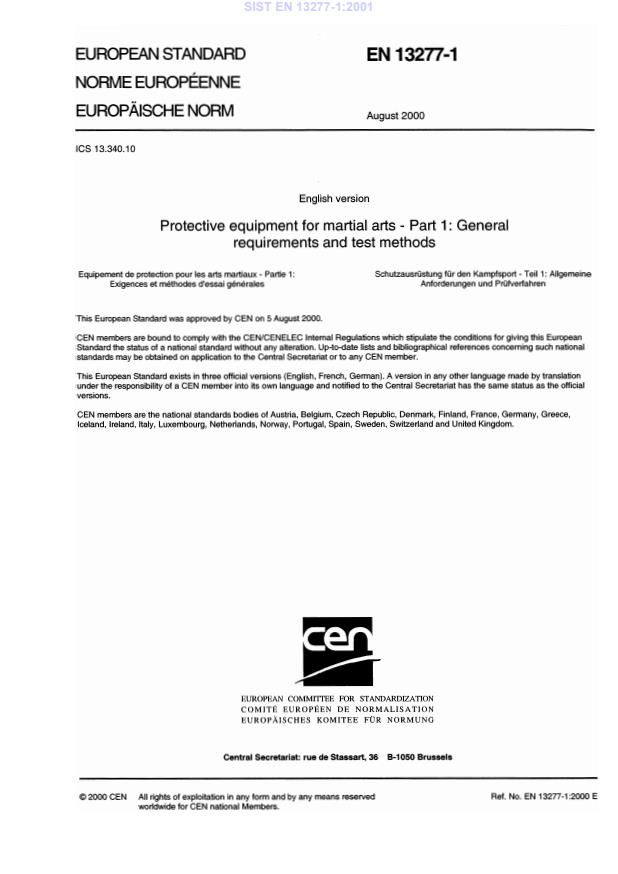
(Main)Protective equipment for martial arts - Part 1: General requirements and test methods
- Abstract
This European Standard specifies the general requirements and test methods for innocuousness, ergonomics, restraint, zone of protection, impact performance as well as provisions for marking and the information supplied by the manufacturer for protective equipment used in martial arts. The protectors covered by this European Standard are mainly designed for using in unarmed martial arts such as taekwondo, karate, kick-boxing and similar disciplines. Additional requirements and test methods for components of protectors for specific kinds of martial arts are specified in further parts of this European Standard.
- Status
- Published
- Publication Date
- 22-Aug-2000
- Withdrawal Date
- 27-Feb-2001
- Technical Committee
- CEN/TC 162 - Protective clothing including hand and arm protection and lifejackets
- Drafting Committee
- CEN/TC 162/WG 11 - Body protection for sports
- Current Stage
- 9060 - Closure of 2 Year Review Enquiry - Review Enquiry
- Start Date
- 02-Dec-2022
- Completion Date
- 02-Dec-2022
- Directive
- 2016/425 - Regulation (EU) 2016/425 of the European Parliament and of the Council of 9 March 2016 on personal protective equipment and repealing Council Directive 89/686/EECOJ Ref: C, C 113 OJ Date: 27-Mar-2018
89/686/EEC - Personal protective equipment (PPE)OJ Ref: C 2, C 203, C 247, C 306, C 367, C 46, C 91 OJ Date: 21-Dec-2001

Overview
EN 13277-1:2000 is a European Standard published by CEN that outlines the general requirements and test methods for protective equipment used in martial arts. This standard establishes a consistent framework for evaluating the safety, ergonomics, and performance of personal protective equipment (PPE) designed for practitioners of unarmed martial arts such as taekwondo, karate, kickboxing, and similar disciplines. EN 13277-1:2000 is intended to ensure that martial arts protective gear meets essential safety and performance benchmarks, supporting the well-being of athletes across different levels of experience.
Key Topics
EN 13277-1:2000 addresses fundamental considerations in the design and assessment of martial arts protective equipment, covering the following key areas:
- Innocuousness: Ensuring materials used in protective gear are not harmful to the user.
- Ergonomics: Evaluating that equipment fits properly and allows sufficient freedom of movement.
- Restraint: Addressing the stability of the protector during usage to avoid shifting or detachment.
- Zone of Protection: Defining which areas of the body must be protected for various martial arts disciplines.
- Impact Performance: Establishing minimum standards for shock absorption and energy dispersion.
- Marking and Information: Specifying requirements for product labelling and the supply of vital information by manufacturers.
Testing and assessment methods are detailed to verify compliance with these requirements, fostering transparency and reliability in development and market release of martial arts protective gear.
Applications
Protective equipment produced and tested according to EN 13277-1:2000 is primarily intended for:
- Unarmed Martial Arts: Such as taekwondo, karate, and kickboxing, as well as other disciplines requiring body protection.
- Indoor Sports Environments: Aligning with regulations for equipment used within sports halls and training facilities.
- Athletes of All Ages and Levels: Including novices, experienced practitioners, and competitors in martial arts events.
The standard benefits manufacturers, retailers, and regulatory bodies by providing a clear reference against which to evaluate protective products before bringing them to market or using them in organized competitions.
Related Standards
EN 13277-1:2000 serves as the foundational part in a series dedicated to martial arts protective equipment. Additional modules in the EN 13277 series define further requirements and specific test methods for particular types of protectors and martial arts styles. Closely related standards include:
- EN 13277 (Parts 2 and beyond): Detailing requirements for individual protector types such as body, hand, and foot protection.
- ICS Codes: 97.220.30 for indoor sports equipment and 13.340.10 for protective clothing, indicating its relevance within wider safety equipment standards.
- Other Sports PPE Standards: Referencing similar methodology and objectives found in broader sports safety and protective equipment regulations.
Organizations and individuals involved in the manufacture, certification, and selection of martial arts protective gear should ensure products comply with EN 13277-1:2000 and any relevant supplementary standards for optimal safety and performance outcomes.
Relations
- Effective Date
- 28-Jan-2026
- Effective Date
- 28-Jan-2026
- Effective Date
- 28-Jan-2026
- Effective Date
- 28-Jan-2026
- Effective Date
- 28-Jan-2026
- Effective Date
- 28-Jan-2026
- Effective Date
- 28-Jan-2026
- Effective Date
- 28-Jan-2026
- Effective Date
- 22-Dec-2008
- Effective Date
- 22-Dec-2008
Get Certified
Connect with accredited certification bodies for this standard

CIS Institut d.o.o.
Personal Protective Equipment (PPE) certification body. Notified Body NB-2890 for EU Regulation 2016/425 PPE.

Kiwa BDA Testing
Building and construction product certification.
Kmetijski inštitut Slovenije
Agricultural Institute of Slovenia. Soil testing, plant health, agricultural product analysis.
Sponsored listings
Frequently Asked Questions
EN 13277-1:2000 is a standard published by the European Committee for Standardization (CEN). Its full title is "Protective equipment for martial arts - Part 1: General requirements and test methods". This standard covers: This European Standard specifies the general requirements and test methods for innocuousness, ergonomics, restraint, zone of protection, impact performance as well as provisions for marking and the information supplied by the manufacturer for protective equipment used in martial arts. The protectors covered by this European Standard are mainly designed for using in unarmed martial arts such as taekwondo, karate, kick-boxing and similar disciplines. Additional requirements and test methods for components of protectors for specific kinds of martial arts are specified in further parts of this European Standard.
This European Standard specifies the general requirements and test methods for innocuousness, ergonomics, restraint, zone of protection, impact performance as well as provisions for marking and the information supplied by the manufacturer for protective equipment used in martial arts. The protectors covered by this European Standard are mainly designed for using in unarmed martial arts such as taekwondo, karate, kick-boxing and similar disciplines. Additional requirements and test methods for components of protectors for specific kinds of martial arts are specified in further parts of this European Standard.
EN 13277-1:2000 is classified under the following ICS (International Classification for Standards) categories: 13.340.10 - Protective clothing. The ICS classification helps identify the subject area and facilitates finding related standards.
EN 13277-1:2000 has the following relationships with other standards: It is inter standard links to EN 13277-4:2001, EN 13277-8:2017, EN 13277-3:2013, EN 13277-6:2003, EN 13277-7:2009, EN 13277-5:2002, EN 13277-2:2000, EN 13277-3:2000; is excused to EN 13277-2:2000, EN 13277-3:2000. Understanding these relationships helps ensure you are using the most current and applicable version of the standard.
EN 13277-1:2000 is associated with the following European legislation: EU Directives/Regulations: 2016/425, 89/686/EEC; Standardization Mandates: M/031. When a standard is cited in the Official Journal of the European Union, products manufactured in conformity with it benefit from a presumption of conformity with the essential requirements of the corresponding EU directive or regulation.
EN 13277-1:2000 is available in PDF format for immediate download after purchase. The document can be added to your cart and obtained through the secure checkout process. Digital delivery ensures instant access to the complete standard document.
Standards Content (Sample)
2003-01.Slovenski inštitut za standardizacijo. Razmnoževanje celote ali delov tega standarda ni dovoljeno.Varovalna oprema za borilne športe - 1. del: Splošne zahteve in preskusne metodeSchutzausrüstung für den Kampfsport - Teil 1: Allgemeine Anforderungen und PrüfverfahrenEquipement de protection pour les arts martiaux - Partie 1: Exigences et méthodes d'essai généralesProtective equipment for martial arts - Part 1: General requirements and test methods97.220.30Oprema z
...