

EN 13277-7:2009
(Main)Protective equipment for martial arts - Part 7: Additional requirements and test methods for hand and foot protectors
- Abstract
This European Standard specifies additional requirements and test methods for hand and foot protectors which are used in unarmed martial arts, including boxing, for strikes against other persons or training equipment.
- Status
- Published
- Publication Date
- 10-Mar-2009
- Technical Committee
- CEN/TC 162 - Protective clothing including hand and arm protection and lifejackets
- Drafting Committee
- CEN/TC 162/WG 11 - Body protection for sports
- Current Stage
- 9060 - Closure of 2 Year Review Enquiry - Review Enquiry
- Start Date
- 02-Dec-2024
- Completion Date
- 02-Dec-2024
- Directive
- 2016/425 - Regulation (EU) 2016/425 of the European Parliament and of the Council of 9 March 2016 on personal protective equipment and repealing Council Directive 89/686/EECOJ Ref: C, C 113 OJ Date: 27-Mar-2018
89/686/EEC - Personal protective equipment (PPE)OJ Ref: C, C 205 OJ Date: 09-Jul-2011

Overview
EN 13277-7:2009 - published by CEN - is the European standard that specifies additional requirements and test methods for hand and foot protectors used in unarmed martial arts (including boxing) for strikes against other persons or training equipment. It complements the general requirements in EN 13277-1 and defines sizing, protection zones, restraint performance, impact testing and marking requirements to ensure user safety and consistent product evaluation.
Key topics and technical requirements
- Scope and purpose
- Applies to hand and foot protectors intended to reduce injury to the wearer during strikes; it does not address protection of the opponent.
- Classification
- Hand protectors: Class A (normal protection) and Class B (increased protection).
- Foot protectors: single class (no sub-classes).
- Sizing and zones of protection
- Dimensions and placement of protection zones are defined by specified figures and tables for different sizes to ensure adequate coverage of the hand or foot.
- Restraint system
- Restraint must allow self-application (for foot protectors) or, in some cases, the assistance of another person (for hand protectors).
- Restraint devices must not cause unnatural forces or constriction; effectiveness is checked by testing (including a 20 N test force applied at prescribed positions and directions).
- Impact performance
- Specifies impact testing methods and acceptance limits (peak force thresholds and test energies) for the defined protection zones. Worst-case positions are to be selected for testing.
- Testing procedures
- Sampling and conditioning are referenced from EN 13277-1.
- Impact apparatus, test positions, conditioning and restraint checks are described to deliver repeatable performance results.
- Marking and manufacturer information
- Requirements for size labelling, performance information and warnings are included to support correct selection and safe use.
Applications and who uses it
- Manufacturers and product designers use EN 13277-7:2009 to design compliant hand and foot protectors, define sizing and labelling, and prepare technical documentation for CE marking.
- Test laboratories and certification bodies apply the specified test methods (impact, restraint, sampling, conditioning) to verify conformity.
- Procurement officers, sports clubs, coaches and gym operators use the standard to choose equipment meeting recognized safety criteria.
- Regulators and conformity assessors reference the standard when assessing compliance with EU personal protective equipment directives (see Annex ZA linkage).
Related standards
- EN 13277 series - Part 1 (general requirements and test methods) and Parts 2–6 (instep/shin/forearm, trunk, head, genital/abdominal, female breast protectors).
- EN 13277-1:2000 is the normative reference for sampling, conditioning and general test principles.
Keywords: EN 13277-7:2009, protective equipment for martial arts, hand protectors, foot protectors, CEN standard, test methods, impact performance, restraint system, zone of protection.
Relations
- Effective Date
- 28-Jan-2026
Get Certified
Connect with accredited certification bodies for this standard

CIS Institut d.o.o.
Personal Protective Equipment (PPE) certification body. Notified Body NB-2890 for EU Regulation 2016/425 PPE.

Kiwa BDA Testing
Building and construction product certification.
Kmetijski inštitut Slovenije
Agricultural Institute of Slovenia. Soil testing, plant health, agricultural product analysis.
Sponsored listings
Frequently Asked Questions
EN 13277-7:2009 is a standard published by the European Committee for Standardization (CEN). Its full title is "Protective equipment for martial arts - Part 7: Additional requirements and test methods for hand and foot protectors". This standard covers: This European Standard specifies additional requirements and test methods for hand and foot protectors which are used in unarmed martial arts, including boxing, for strikes against other persons or training equipment.
This European Standard specifies additional requirements and test methods for hand and foot protectors which are used in unarmed martial arts, including boxing, for strikes against other persons or training equipment.
EN 13277-7:2009 is classified under the following ICS (International Classification for Standards) categories: 13.340.40 - Hand and arm protection; 13.340.50 - Leg and foot protection. The ICS classification helps identify the subject area and facilitates finding related standards.
EN 13277-7:2009 has the following relationships with other standards: It is inter standard links to EN 13277-1:2000. Understanding these relationships helps ensure you are using the most current and applicable version of the standard.
EN 13277-7:2009 is associated with the following European legislation: EU Directives/Regulations: 2016/425, 89/686/EEC; Standardization Mandates: M/031. When a standard is cited in the Official Journal of the European Union, products manufactured in conformity with it benefit from a presumption of conformity with the essential requirements of the corresponding EU directive or regulation.
EN 13277-7:2009 is available in PDF format for immediate download after purchase. The document can be added to your cart and obtained through the secure checkout process. Digital delivery ensures instant access to the complete standard document.
Standards Content (Sample)
2003-01.Slovenski inštitut za standardizacijo. Razmnoževanje celote ali delov tega standarda ni dovoljeno.Schutzausrüstung für den Kampfsport - Teil 7: Zusätzliche Anforderungen und Prüfverfahren für Hand- und FußschützerEquipement de protection pour les arts martiaux - Partie 7 : Exigences et méthodes d'essai complémentaires pour protecteurs de main et de piedProtective equipment for martial arts - Part 7: Additional requirements and test methods for hand and foot protectors97.220.30Oprema za dvoranske športeIndoor sports equipment13.340.50Varovanje nog in stopalLeg and foot protection13.340.40Varovanje dlani in rokHand and arm protectionICS:Ta slovenski standard je istoveten z:EN 13277-7:2009SIST EN 13277-7:2009en,fr,de01-julij-2009SIST EN 13277-7:2009SLOVENSKI
STANDARD
EUROPEAN STANDARDNORME EUROPÉENNEEUROPÄISCHE NORMEN 13277-7March 2009ICS 13.340.40; 13.340.50 English VersionProtective equipment for martial arts - Part 7: Additionalrequirements and test methods for hand and foot protectorsÉquipement de protection pour les arts martiaux - Partie 7:Exigences et méthodes d'essai complémentaires relativesaux protecteurs de main et de piedSchutzausrüstung für den Kampfsport - Teil 7: ZusätzlicheAnforderungen und Prüfverfahren für Hand- undFußschützerThis European Standard was approved by CEN on 31 January 2009.CEN members are bound to comply with the CEN/CENELEC Internal Regulations which stipulate the conditions for giving this EuropeanStandard the status of a national standard without any alteration. Up-to-date lists and bibliographical references concerning such nationalstandards may be obtained on application to the CEN Management Centre or to any CEN member.This European Standard exists in three official versions (English, French, German). A version in any other language made by translationunder the responsibility of a CEN member into its own language and notified to the CEN Management Centre has the same status as theofficial versions.CEN members are the national standards bodies of Austria, Belgium, Bulgaria, Cyprus, Czech Republic, Denmark, Estonia, Finland,France, Germany, Greece, Hungary, Iceland, Ireland, Italy, Latvia, Lithuania, Luxembourg, Malta, Netherlands, Norway, Poland, Portugal,Romania, Slovakia, Slovenia, Spain, Sweden, Switzerland and United Kingdom.EUROPEAN COMMITTEE FOR STANDARDIZATIONCOMITÉ EUROPÉEN DE NORMALISATIONEUROPÄISCHES KOMITEE FÜR NORMUNGManagement Centre:
Avenue Marnix 17,
B-1000 Brussels© 2009 CENAll rights of exploitation in any form and by any means reservedworldwide for CEN national Members.Ref. No. EN 13277-7:2009: ESIST EN 13277-7:2009
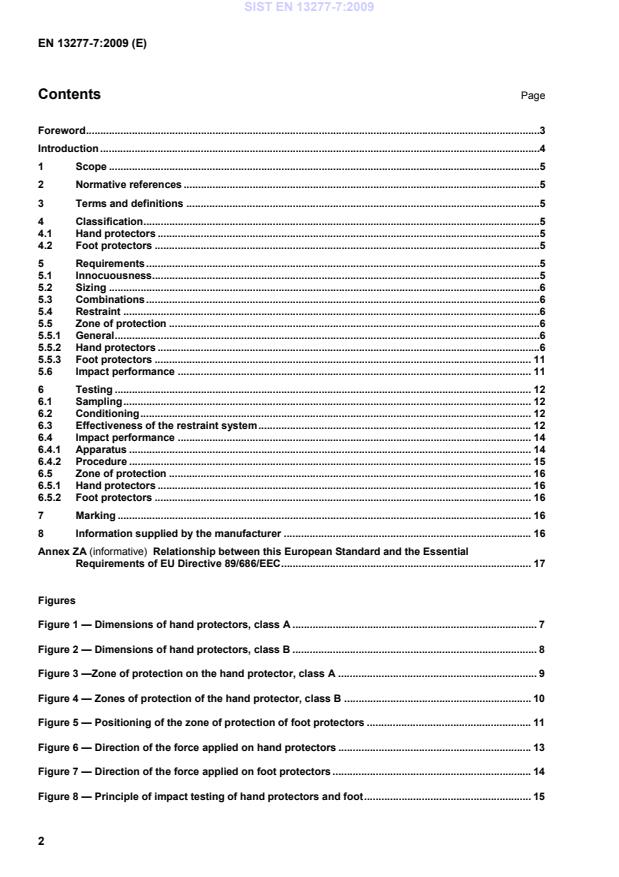
Relationship between this European Standard and the Essential Requirements of EU Directive 89/686/EEC . 17 Figures Figure 1 — Dimensions of hand protectors, class A . 7 Figure 2 — Dimensions of hand protectors, class B . 8 Figure 3 —Zone of protection on the hand protector, class A . 9 Figure 4 — Zones of protection of the hand protector, class B . 10 Figure 5 — Positioning of the zone of protection of foot protectors . 11 Figure 6 — Direction of the force applied on hand protectors . 13 Figure 7 — Direction of the force applied on foot protectors . 14 Figure 8 — Principle of impact testing of hand protectors and foot . 15 SIST EN 13277-7:2009
1 Scope This European Standard specifies additional requirements and test methods for hand and foot protectors which are used in unarmed martial arts, including boxing, for strikes against other persons or training equipment. 2 Normative references The following referenced documents are indispensable for the application of this document. For dated references, only the edition cited applies. For undated references, the latest edition of the referenced document (including any amendments) applies. EN 13277-1:2000, Protective equipment for martial arts — Part 1: General requirements and test methods 3 Terms and definitions For the purposes of this document, the following terms and definitions apply. 3.1 hand protector equipment worn on the hand to protect the user against injuries caused by strikes against other persons or training equipment
3.2 foot protector equipment to protect the entire foot (without the sole area) against injuries caused by strikes against other persons or training equipment
4 Classification 4.1 Hand protectors The following classes of hand protectors are defined: Class A: Hand protectors comprising a zone of normal (simple) protection (see Figure 1). Class B: Hand protectors comprising a zone of increased protection (see Figure 2). 4.2 Foot protectors There are no different classes specified. 5 Requirements 5.1 Innocuousness Hand and foot protectors shall comply with the requirements in EN 13277-1:2000, 4.2. SIST EN 13277-7:2009
5.3 Combinations Hand protectors or foot protectors can be used together with other protective equipment for martial arts. If the combined use is not appropriate, this shall be indicated in the information supplied by the manufacturer. 5.4 Restraint
The restraint system shall meet the requirements defined in EN 13277-1:2000, 4.3. A restraint system shall be supplied by the manufacturer which enables the user to attach the foot protector without any assistance. In the case of hand protectors, the assistance of an additional p
...