


EN 1918-2:2016
(Main)Gas infrastructure - Underground gas storage - Part 2: Functional recommendations for storage in oil and gas fields
Gas infrastructure - Underground gas storage - Part 2: Functional recommendations for storage in oil and gas fields
This European Standard covers the functional recommendations for design, construction, testing, commissioning, operation, maintenance and abandonment of underground gas storage facilities in oil and gas fields up to and including the wellhead.
It specifies practices which are safe and environmentally acceptable.
For necessary surface facilities for underground gas storage, FprEN 1918-5 applies.
In this context "gas" is any hydrocarbon fuel:
- which is in a gaseous state at a temperature of 15 °C and under a pressure of 0,1 MPa (this includes natural gas, compressed natural gas (CNG) and liquefied petroleum gas (LPG). The stored product is also named fluid);
- which meets specific quality requirements in order to maintain underground storage integrity, performance, environmental compatibility and fulfils contractual requirements.
This European Standard specifies common basic principles for underground gas storage facilities. Users of this European Standard should be aware that more detailed standards and/or codes of practice exist. A non-exhaustive list of relevant standards can be found in Annex A.
This European Standard is intended to be applied in association with these national standards and/or codes of practice and does not replace them.
In the event of conflicts in terms of more restrictive requirements in the national legislation/regulation with the requirements of this European Standard, the national legislation/regulation takes precedence as illustrated in CEN/TR 13737 (all parts).
NOTE CEN/TR 13737 (all parts) contains:
- clarification of relevant legislation/regulations applicable in a country;
- if appropriate, more restrictive national requirements;
- national contact point for the latest information.
This European Standard is not intended to be applied retrospectively to existing facilities.
Gasinfrastruktur - Untertagespeicherung von Gas - Teil 2: Funktionale Empfehlungen für die Speicherung in Öl- und Gasfeldern
Diese Europäische Norm legt die funktionalen Empfehlungen für Planung, Errichtung, Prüfung, Inbetriebnahme, Betrieb, Instandhaltung und Stilllegung von Untertagegasspeicheranlagen in Öl- und Gasfeldern bis einschließlich des Bohrlochkopfes fest.
Sie legt sichere und umweltverträgliche Verfahrensweisen fest.
Für erforderliche Übertageanlagen für einen Untertagegasspeicher gilt EN 1918 5.
In diesem Zusammenhang ist „Gas“ jeder Brennstoff auf Kohlenwasserstoffbasis, der:
— sich bei einer Temperatur von 15 °C und unter einem Druck von 0,1 MPa in gasförmigem Zustand befindet (dazu gehören Erdgas, komprimiertes Erdgas (en: compressed natural gas, CNG) und Flüssiggas (en: liquefied petroleum gas, LPG). Das gespeicherte Produkt wird auch als Medium bezeichnet);
— bestimmte Qualitätsanforderungen erfüllt, um die Integrität des Untertagespeichers, die Leistung und die Umweltverträglichkeit aufrechtzuerhalten, und vertragliche Anforderungen erfüllt.
Die vorliegende Europäische Norm legt allgemeine Grundsätze für Untertagegasspeicheranlagen fest. Die Anwender dieser Europäischen Norm sollten sich bewusst sein, dass detailliertere Normen und/oder Technische Regeln existieren. Eine Liste einschlägiger Normen, die allerdings nicht abschließend ist, findet sich in Anhang A.
Es ist vorgesehen, dass diese Europäische Norm in Verbindung mit nationalen Normen und/oder Technischen Regeln angewendet wird. Sie ersetzt diese nicht.
Beim Auftreten von Widersprüchen aufgrund restriktiverer Anforderungen in nationalen Gesetzen/Vor-schriften als in der vorliegenden Europäischen Norm gefordert haben nationale Gesetze/Vorschriften Vorrang, wie in CEN/TR 13737 (alle Teile) dargestellt.
ANMERKUNG CEN/TR 13737 (alle Teile) enthält:
— Darstellung der in den einzelnen Ländern zu beachtenden Gesetze/Vorschriften;
— wenn notwendig, darin enthaltene restriktivere nationale Anforderungen;
— eine nationale Kontaktstelle für die aktuellsten Informationen.
Es ist nicht vorgesehen, diese Europäische Norm rückwirkend auf bestehende Anlagen anzuwenden.
Infrastructures gazières - Stockage souterrain de gaz - Partie 2: Recommandations fonctionnelles pour le stockage en gisements de pétrole et de gaz
La présente Norme européenne décrit les recommandations fonctionnelles pour la conception, la construction, les essais, la mise en service, l'exploitation, la maintenance et l'abandon des stockages souterrains de gaz (UGS) en gisements de pétrole et de gaz jusqu'à la tête de puits incluse.
Elle spécifie les pratiques acceptables pour la sécurité et l'environnement.
Pour les installations de surface qui sont nécessaires pour un stockage souterrain de gaz, l'EN 1918-5 s’applique.
Dans ce contexte, le terme « gaz » désigne tout combustible hydrocarboné :
— qui est à l'état gazeux à une température de 15 °C et sous une pression de 0,1 MPa (sont inclus le gaz naturel, le gaz naturel comprimé (GNC) et le gaz de pétrole liquéfié (GPL)). Le produit stocké est également appelé « fluide » ;
— qui satisfait à des prescriptions spécifiques en matière de qualité afin de maintenir l'intégrité, les performances, la compatibilité environnementale du stockage souterrain et qui respecte les prescriptions contractuelles.
La présente Norme européenne spécifie les principes communs fondamentaux des stockages souterrains de gaz. Il convient que les utilisateurs de la présente Norme européenne gardent à l'esprit qu'il existe des normes et/ou des codes de bonne pratique plus détaillés. Une liste non exhaustive des normes pertinentes figure à l'Annexe A.
La présente Norme européenne est destinée à s'appliquer conjointement avec ces normes nationales et/ou codes de bonne pratique ; elle ne les remplace pas.
En cas de conflits en termes de prescriptions plus restrictives dans la réglementations/législation nationale vis-à-vis des prescriptions de la présente Norme européenne, la réglementation/législation nationale prévaut comme illustré dans le CEN/TR 13737 (toutes les parties).
NOTE Le CEN/TR 13737 (toutes les parties) donne :
— la clarification des législations/règlements applicables dans un pays ;
— si approprié, des prescriptions nationales plus restrictives ;
— un point de contact national pour une information ultérieure.
La présente Norme européenne n'est pas prévue pour être appliquée de façon rétroactive aux installations existantes.
Infrastruktura za plin - Podzemna plinska skladišča - 2. del: Funkcionalna priporočila za skladiščenje na naftnih in plinskih poljih
Ta standard zajema funkcionalna priporočila za načrtovanje, izgradnjo, preskušanje, delovanje, vzdrževanje in opustitev podzemnih plinskih skladišč na naftnih in plinskih poljih, vključno z ustjem vrtine. Določa prakse, ki so varne in okoljsko sprejemljive. Potrebni nadzemni objekti za podzemno skladiščenje plina so opisani v standardu prEN 1918-5. »Plin« v tem kontekstu pomeni vsako ogljikovodikovo gorivo, ki je v plinastem stanju pri temperaturi 15 °C in tlaku 1 bar. To vključuje zemeljski plin (imenovan tudi CNG) in LPG.
General Information
- Status
- Published
- Publication Date
- 22-Mar-2016
- Withdrawal Date
- 29-Sep-2016
- Technical Committee
- CEN/TC 234 - Gas infrastructure
- Drafting Committee
- CEN/TC 234/WG 4 - Gas underground storage
- Current Stage
- 9092 - Decision on results of review/2YR ENQ - revise - Review Enquiry
- Start Date
- 20-Dec-2022
- Completion Date
- 14-Apr-2025
Relations
- Effective Date
- 30-Mar-2016
- Effective Date
- 18-Jan-2023
Overview
EN 1918-2:2016 is the CEN European Standard that gives functional recommendations for underground gas storage (UGS) in oil and gas fields, covering design, construction, testing, commissioning, operation, maintenance and abandonment up to and including the wellhead. The standard applies to hydrocarbon gases that are gaseous at 15 °C and 0,1 MPa (for example natural gas, CNG and LPG) and addresses requirements needed to maintain storage integrity, performance and environmental compatibility. EN 1918-2:2016 is Part 2 of the EN 1918 series on underground gas storage and is intended to be used alongside national standards and codes of practice; national legislation takes precedence where more restrictive.
Key Topics
- Scope and definitions: common terminology for UGS in oil and gas fields (wells, casings, annuli, cushion gas, working gas, etc.).
- Design principles: field description, geological modelling, reservoir behaviour, determination of maximum operating pressure (MOP) and minimum operating limits.
- Well design and completion: drilling, casing, cementing, liners, completions and wellhead arrangements up to the master valve.
- Construction and commissioning: recommended practices for safe build-up, testing and initial commissioning of wells and subsurface systems.
- Operation and monitoring: injection/withdrawal procedures, inventory management (working vs cushion gas), continuous monitoring systems, monitoring wells and surveillance programmes.
- Safety and environment: practices to ensure safe operation and environmental protection, HSE considerations and handling of gas quality requirements.
- Abandonment and decommissioning: withdrawal, plugging and permanent abandonment of wells, removal or management of surface facilities and post‑closure monitoring.
- Interfaces and neighbouring activities: coordination with other subsurface uses and surface facilities (EN 1918-5 for surface facilities).
Applications
EN 1918-2:2016 is practical for:
- UGS project owners and asset operators planning storage in depleted oil and gas fields.
- Reservoir and well engineers defining MOP, cushion gas and completion designs.
- Design consultants and EPC contractors preparing engineering specifications and commissioning plans.
- HSE and environmental managers developing monitoring, testing and abandonment strategies.
- Regulators and permitting authorities assessing compliance with functional recommendations for safety and environmental protection.
Keywords: EN 1918-2:2016, underground gas storage, UGS, oil and gas fields, well design, maximum operating pressure, monitoring, decommissioning.
Related Standards
- EN 1918-1, -3, -4, -5 (other parts of the UGS series; Part 5 covers surface facilities)
- CEN/TR 13737 (clarifies national legislation/regulatory precedence)
- Annex A of EN 1918-2:2016 lists a non-exhaustive set of further relevant standards and codes of practice.


Frequently Asked Questions
EN 1918-2:2016 is a standard published by the European Committee for Standardization (CEN). Its full title is "Gas infrastructure - Underground gas storage - Part 2: Functional recommendations for storage in oil and gas fields". This standard covers: This European Standard covers the functional recommendations for design, construction, testing, commissioning, operation, maintenance and abandonment of underground gas storage facilities in oil and gas fields up to and including the wellhead. It specifies practices which are safe and environmentally acceptable. For necessary surface facilities for underground gas storage, FprEN 1918-5 applies. In this context "gas" is any hydrocarbon fuel: - which is in a gaseous state at a temperature of 15 °C and under a pressure of 0,1 MPa (this includes natural gas, compressed natural gas (CNG) and liquefied petroleum gas (LPG). The stored product is also named fluid); - which meets specific quality requirements in order to maintain underground storage integrity, performance, environmental compatibility and fulfils contractual requirements. This European Standard specifies common basic principles for underground gas storage facilities. Users of this European Standard should be aware that more detailed standards and/or codes of practice exist. A non-exhaustive list of relevant standards can be found in Annex A. This European Standard is intended to be applied in association with these national standards and/or codes of practice and does not replace them. In the event of conflicts in terms of more restrictive requirements in the national legislation/regulation with the requirements of this European Standard, the national legislation/regulation takes precedence as illustrated in CEN/TR 13737 (all parts). NOTE CEN/TR 13737 (all parts) contains: - clarification of relevant legislation/regulations applicable in a country; - if appropriate, more restrictive national requirements; - national contact point for the latest information. This European Standard is not intended to be applied retrospectively to existing facilities.
This European Standard covers the functional recommendations for design, construction, testing, commissioning, operation, maintenance and abandonment of underground gas storage facilities in oil and gas fields up to and including the wellhead. It specifies practices which are safe and environmentally acceptable. For necessary surface facilities for underground gas storage, FprEN 1918-5 applies. In this context "gas" is any hydrocarbon fuel: - which is in a gaseous state at a temperature of 15 °C and under a pressure of 0,1 MPa (this includes natural gas, compressed natural gas (CNG) and liquefied petroleum gas (LPG). The stored product is also named fluid); - which meets specific quality requirements in order to maintain underground storage integrity, performance, environmental compatibility and fulfils contractual requirements. This European Standard specifies common basic principles for underground gas storage facilities. Users of this European Standard should be aware that more detailed standards and/or codes of practice exist. A non-exhaustive list of relevant standards can be found in Annex A. This European Standard is intended to be applied in association with these national standards and/or codes of practice and does not replace them. In the event of conflicts in terms of more restrictive requirements in the national legislation/regulation with the requirements of this European Standard, the national legislation/regulation takes precedence as illustrated in CEN/TR 13737 (all parts). NOTE CEN/TR 13737 (all parts) contains: - clarification of relevant legislation/regulations applicable in a country; - if appropriate, more restrictive national requirements; - national contact point for the latest information. This European Standard is not intended to be applied retrospectively to existing facilities.
EN 1918-2:2016 is classified under the following ICS (International Classification for Standards) categories: 75.200 - Petroleum products and natural gas handling equipment. The ICS classification helps identify the subject area and facilitates finding related standards.
EN 1918-2:2016 has the following relationships with other standards: It is inter standard links to EN 1918-2:1998, prEN 1918-2. Understanding these relationships helps ensure you are using the most current and applicable version of the standard.
EN 1918-2:2016 is associated with the following European legislation: Standardization Mandates: M/017. When a standard is cited in the Official Journal of the European Union, products manufactured in conformity with it benefit from a presumption of conformity with the essential requirements of the corresponding EU directive or regulation.
You can purchase EN 1918-2:2016 directly from iTeh Standards. The document is available in PDF format and is delivered instantly after payment. Add the standard to your cart and complete the secure checkout process. iTeh Standards is an authorized distributor of CEN standards.
Standards Content (Sample)
2003-01.Slovenski inštitut za standardizacijo. Razmnoževanje celote ali delov tega standarda ni dovoljeno.NFLRQDOQDGasinfrastruktur - Untertagespeicherung von Gas - Teil 2: Funktionale Empfehlungen für die Speicherung in Öl- und GasfeldernInfrastructures gazières - Stockage souterrain de gaz - Partie 2: Recommandations fonctionnelles pour le stockage en gisements de pétrole et de gazGas infrastructure - Underground gas storage - Part 2: Functional recommendations for storage in oil and gas fields75.200Petroleum products and natural gas handling equipmentICS:Ta slovenski standard je istoveten z:EN 1918-2:2016SIST EN 1918-2:2016en,fr,de01-november-2016SIST EN 1918-2:2016SLOVENSKI
STANDARDSIST EN 1918-2:19991DGRPHãþD
EUROPEAN STANDARD NORME EUROPÉENNE EUROPÄISCHE NORM
EN 1918-2
March
t r s x ICS
y wä t r r Supersedes EN
s { s zæ tã s { { zEnglish Version
Gas infrastructure æ Underground gas storage æ Part
tã Functional recommendations for storage in oil and gas fields Infrastructures gazières æ Stockage souterrain de gaz æ Partie
tã Recommandations fonctionnelles pour le stockage en gisements de pétrole et de gaz
Gasinfrastruktur æ Untertagespeicherung von Gas æ Teil
tã Funktionale Empfehlungen für die Speicherung in Ölæ und Gasfeldern This European Standard was approved by CEN on
s r January
t r s xä
egulations which stipulate the conditions for giving this European Standard the status of a national standard without any alterationä Upætoædate lists and bibliographical references concerning such national standards may be obtained on application to the CENæCENELEC Management Centre or to any CEN memberä
translation under the responsibility of a CEN member into its own language and notified to the CENæCENELEC Management Centre has the same status as the official versionsä
CEN members are the national standards bodies of Austriaá Belgiumá Bulgariaá Croatiaá Cyprusá Czech Republicá Denmarká Estoniaá Finlandá Former Yugoslav Republic of Macedoniaá Franceá Germanyá Greeceá Hungaryá Icelandá Irelandá Italyá Latviaá Lithuaniaá Luxembourgá Maltaá Netherlandsá Norwayá Polandá Portugalá Romaniaá Slovakiaá Sloveniaá Spainá Swedená Switzerlandá Turkey and United Kingdomä
EUROPEAN COMMITTEE FOR STANDARDIZATION COMITÉ EUROPÉEN DE NORMALISATION EUROPÄISCHES KOMITEE FÜR NORMUNG
CEN-CENELEC Management Centre:
Avenue Marnix 17,
B-1000 Brussels
t r s x CEN All rights of exploitation in any form and by any means reserved worldwide for CEN national Membersä Refä Noä EN
s { s zæ tã t r s x ESIST EN 1918-2:2016
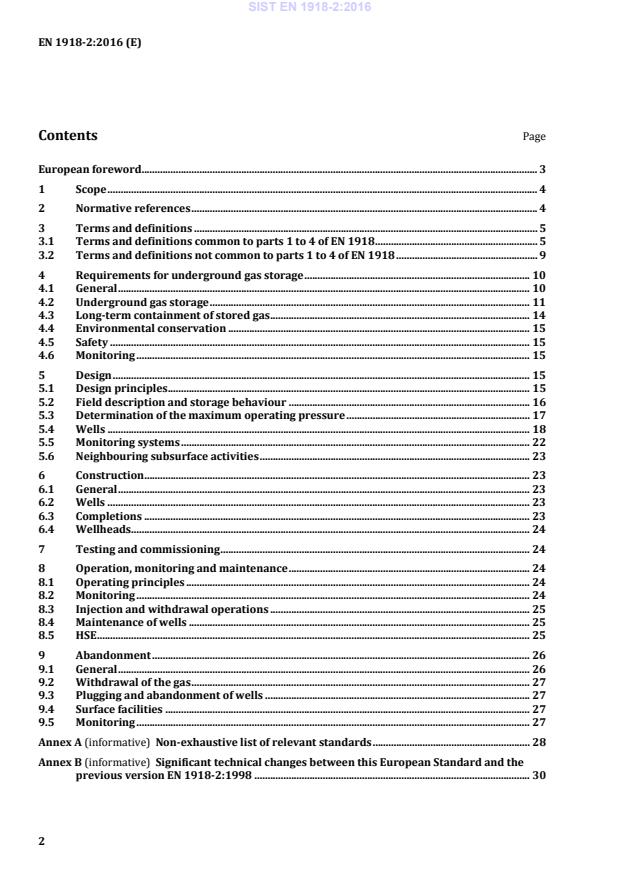
Non-exhaustive list of relevant standards . 28 Annex B (informative)
Significant technical changes between this European Standard and the previous version EN 1918-2:1998 . 30
MOP maximum pressure of the storage reservoir or cavern, normally at maximum inventory of gas in storage, which has not to be exceeded in order to ensure the integrity of the UGS and is based on the outcome of geological/technical engineering and is approved by authorities Note 1 to entry: The maximum operating pressure is related to a datum depth and in caverns usually to the casing shoe of the last cemented casing. 3.1.26 minimum operating pressure minimum pressure of the storage reservoir or cavern, normally reached at the end of the decline phase of the withdrawal profile and for caverns is based on geomechanical investigations to ensure stability and to limit the effect of subsidence and normally has to be approved by authorities and has not to be underrun Note 1 to entry: The minimum pressure is related to a datum depth. 3.1.27 monitoring well observation well well for purposes of monitoring the storage horizon and/or overlying or underlying horizons for subsurface phenomena such as pressure fluctuation, fluid flow and qualities, temperature, etc. 3.1.28 operating well well used for gas withdrawal and/or injection 3.1.29 overburden all sediments or rock that overlie a geological formation SIST EN 1918-2:2016
It contains fluids which are internally in pressure communication. 3.1.33 saturation percentages of pore space occupied by fluids 3.1.34 seismic technology technology to characterize the subsurface image with respect to extent, geometry, fault pattern and fluid content applying acoustic waves, impressed by sources near to surface in the subsurface strata, which pass through strata with different seismic responses and filtering effects back to surface, where they are recorded and analysed 3.1.35 string entity of casing or tubing plus additional equipment, screwed or welded together as parts of a well respectively completion 3.1.36 subsurface safety valve valve installed in casing and/or tubing beneath the wellhead or the lower end of the tubing for the purpose of stopping the flow of gas in case of emergency 3.1.37 tubing pipe or set of pipes that are screwed or welded together to form a string, through which fluids are injected or withdrawn or which can be used for monitoring 3.1.38 well borehole and its technical equipment including the wellhead 3.1.39 well integrity well condition without uncontrolled release of fluids throughout the life cycle SIST EN 1918-2:2016
Key 1 operating wells 2 monitoring wells 3 indicator horizon 4 caprock 5 storage reservoir and stored gas 6 salt dome 7 cavern Figure 1 — Storage in aquifers, oil and gas fields, solution mined salt caverns For LPG storage only salt or rock caverns can be applied. The UGS type applied is dependent on the geological conditions and prerequisites as well on the designed capacity layout. 4.2.3 General characterization of UGS UGS are naturally or artificially developed reservoirs respectively artifically developed caverns in subsurface geological formations used for the storage of natural gas (or LPG). A UGS consists of all subsurface and surface facilities required for the storage and for the withdrawal and injection of natural gas (or storage of LPG). Several subsurface storage reservoirs or caverns may be connected to one or several common surface facilities. The suitability of subsurface geological formations have to be investigated individually for each location, in order to operate the storage facilities in an efficient, safe and environmentally compatible manner. In order to construct a storage facility wells are used to establish a controlled connection between the reservoir or cavern and the surface facilities at the well head. The wells used for cycling the storage gas are called operating wells. In addition to the operating wells specially assigned observation wells may be used to monitor SIST EN 1918-2:2016
Key 1 storage wells 2 monitoring wells 3 indicator horizon 4 caprock 5 storage reservoir and stored gas Figure 2 — Storage in oil and gas fields 4.3 Long-term containment of stored gas The storage facility shall be designed, constructed and operated to ensure the continuing long-term containment of the stored gas. This presupposes: — adequate prior knowledge of the geological formation, in which the storage is to be developed and of its geological environment; — acquisition of all relevant information needed for specifying parameter limits for construction and operation; — demonstration that the storage is capable of ensuring long-term containment of the stored gas through its hydraulic and mechanical integrity. SIST EN 1918-2:2016
Key 1 wellhead 10 production packer with snap-latch seal assembly 2 wing valve 11 landing nipple 3 master valve 12 sand screen 4 casing 13 gravel pack 5 control line for subsurface safety valve 14 underreamed storage horizon 6 subsurface safety valve 15 perforation 7 tubing 16 sump 8 sliding side door 17 cement head 9 production gravel pack packer – safety joint 18 storage reservoir Figure 3 — Examples for well completions – gravel pack completion (left) and perforated cased hole completion (right) SIST EN 1918-2:2016
...
SIST EN 1918-2:2016 표준은 석유 및 가스 분야의 지하 가스 저장 시설에 대한 기능적 권장 사항을 규명하고 있습니다. 이 표준은 설계, 건설, 테스트, 시운전, 운영, 유지보수 및 폐기의 모든 단계를 포함하여 지하 가스 저장소의 안전하고 환경적으로 수용 가능한 관행을 제시합니다. SIST EN 1918-2:2016의 주요 강점 중 하나는 잘 정의된 기준을 제공함으로써, 사용자들이 명확한 지침을 가지고 효율적으로 시설을 관리할 수 있도록 지원한다는 점입니다. 이 표준은 가스 저장의 무결성 및 성능을 유지하기 위해 필요한 특정 품질 요구 사항을 포함하여, 안전성을 확보하고 환경 적합성을 보장하는 데 중점을 두고 있습니다. 또한, 이 표준은 지하 가스 저장을 위한 공통의 기본 원칙을 명시하고 있으므로, 다양한 국가의 기존 표준 및 실천 규범과 함께 적용될 수 있도록 설계되었습니다. 이러한 점에서 SIST EN 1918-2:2016은 지하 가스 저장소의 설계 및 운영에 있어 매우 중요한 자료입니다. 이 표준은 예외적으로 기존 시설에 소급 적용되지 않지만, 사용자는 더 세부적인 표준이나 실천 규범도 존재한다는 점을 인식해야 합니다. 따라서, SIST EN 1918-2:2016은 지하 가스 저장 시설의 안전성과 효율성을 확보하기 위해 필수적으로 참고해야 할 기준으로서의 역할을 다하고 있습니다.
規格 EN 1918-2:2016 に関するレビューは、その設計、建設、テスト、運用、保守、および廃止のための機能的推奨事項を提供する重要な文書です。特に、石油およびガス田内の地下ガス貯蔵施設に焦点を当てており、ウェルヘッドまでの範囲をカバーしています。この規格は、安全かつ環境に配慮した実践を規定しており、地下ガス貯蔵の設計において非常に重要なガイドラインを提供します。 この規格では、地下ガス貯蔵に関連する「ガス」を、15℃の温度および0.1 MPaの圧力下で気体の状態にある炭化水素燃料として明記しています。具体的には、天然ガス、圧縮天然ガス(CNG)、液化石油ガス(LPG)などが含まれます。また、地下貯蔵の整合性、性能、環境適合性を維持するための特定の品質要件も満たす必要があります。これにより、設計及び運用における基準が明確化され、関連する施設の整備にも寄与します。 さらに、EN 1918-2:2016 は、地下ガス貯蔵施設に対して共通の基本原則を定めています。これにより、ユーザーはより詳細な基準や慣行規範の存在を意識し、それらとの併用が求められることを理解する必要があります。附属書Aには、関連する規範の非排他的リストが含まれており、これによりさらなる参考情報を提供しています。また、国家の法律や規制がこの基準よりも厳しい要求を提示する場合には、国家の法律が優先されるという重要な点も示されています。 このように、EN 1918-2:2016 の規格は、地下ガス貯蔵における設計や運営の指針を提供するだけでなく、従来の施設に対して遡及的に適用されるものではなく、現行の施設に対する規範を補完する形で意義を持ちます。ガスインフラストラクチャーの効果的な管理と持続可能性を考慮した場合、この規格はますます重要性を増すでしょう。
The EN 1918-2:2016 standard offers a comprehensive framework for the functional recommendations concerning underground gas storage within oil and gas fields, emphasizing critical aspects such as design, construction, testing, commissioning, operation, maintenance, and abandonment of these facilities. This European Standard establishes directives that prioritize safety and environmental acceptability, making it a vital reference for professionals in the gas infrastructure sector. One of the significant strengths of this standard lies in its clear identification of the scope concerning various hydrocarbon fuels classified as "gas," including natural gas, compressed natural gas (CNG), and liquefied petroleum gas (LPG). By defining these parameters, the standard provides a clear context for practitioners to ensure compliance with quality requirements, which are crucial for maintaining the integrity and performance of underground storage operations. Additionally, EN 1918-2:2016 outlines basic principles applicable to underground gas storage, stressing the importance of adhering to both this standard and additional national standards or codes of practice. This hierarchical approach facilitates a comprehensive understanding of regulatory frameworks and encourages the integration of EN 1918-2:2016 with existing legislation, thus enhancing operational effectiveness in the field. The non-retroactive nature of this standard regarding existing facilities ensures that operators can implement its recommendations moving forward without being burdened by modifications to preexisting infrastructures. This practicality makes the standard relevant for future developments in underground gas storage while allowing ongoing operations to continue without disruption. Furthermore, the standard underlines the importance of aligning operational practices with national legislation, as indicated in CEN/TR 13737, which clarifies relevant regulations and includes more restrictive national requirements. Such provisions reinforce the relevance of EN 1918-2:2016 as a contemporary reference, ensuring stakeholders are equipped with essential guidance compatible with evolving legislation. In summary, EN 1918-2:2016 is an indispensable standard that strengthens industry practices related to underground gas storage by promoting safety, environmental responsibility, and compliance with regulatory frameworks, ultimately fostering the development of a resilient and efficient gas infrastructure.
Die EN 1918-2:2016 ist eine bedeutende europäische Norm, die sich mit der Gasinfrastruktur und insbesondere mit der unterirdischen Gasspeicherung in Öl- und Gasfeldern befasst. Ihr Schwerpunkt liegt auf funktionalen Empfehlungen, die für Design, Konstruktion, Prüfung, Inbetriebnahme, Betrieb, Wartung und das Verlassen von unterirdischen Gasspeichereinrichtungen bis hin zum Bohrloch gelten. Diese Norm hat das Ziel, sichere und umweltverträgliche Praktiken zu fördern, was in der heutigen Zeit von großer Bedeutung ist. Ein wesentlicher Stärke dieser Norm ist die klare Definition des Anwendungsbereichs, der die unterschiedlichen Aspekte einer unterirdischen Gasspeicheranlage umreißt. Insbesondere wird die Bedeutung der Einhaltung spezifischer Qualitätsanforderungen hervorgehoben, die für die Integrität der unterirdischen Speicherung, die Leistung, die Umweltverträglichkeit und die Erfüllung vertraglicher Anforderungen entscheidend sind. Die Norm stellt sicher, dass alle gängigen Kohlenwasserstoffbrennstoffe – einschließlich Erdgas, komprimiertem Erdgas (CNG) und Flüssiggas (LPG) – in einem sicheren Rahmen gehandhabt werden. Darüber hinaus bietet die EN 1918-2:2016 ein solides Grundgerüst, auf dem Betreiber von unterirdischen Gasspeichern erfolgreiche Strategien zur Einhaltung der Anforderungen entwickeln können. Sie wird in Verbindung mit nationalen Normen und/oder Praxisrichtlinien angewendet, was ihre Relevanz in einem breiteren regulatorischen Kontext unterstreicht. Dies gewährleistet, dass nationale Gesetze, die möglicherweise strengere Anforderungen enthalten, Vorrang haben, was durch die Hinweise im CEN/TR 13737 (alle Teile) untermauert wird. Ein weiterer positiver Aspekt ist die Klarstellung, dass diese Norm nicht rückwirkend auf bestehende Einrichtungen angewendet wird. Dies schafft Planungssicherheit für Betreiber und hilft, mögliche rechtliche Konflikte zu vermeiden. Insgesamt ist die EN 1918-2:2016 ein unverzichtbares Dokument für die Branche, das nicht nur die Sicherheit, sondern auch die Umweltverantwortung in der Gasspeicherung fördert. Die klare Struktur und die umfassenden Empfehlungen dieser Norm bieten einen wertvollen Leitfaden für den Betrieb und die Verwaltung von unterirdischen Gasspeichern.
La norme EN 1918-2:2016 fournit des recommandations fonctionnelles essentielles pour la conception, la construction, les tests, la mise en service, l'exploitation, l'entretien et l'abandon des installations de stockage souterrain de gaz dans les champs pétroliers et gaziers, incluant les infrastructures jusqu'au niveau du puits. En précisant des pratiques sûres et acceptables sur le plan environnemental, cette norme joue un rôle crucial dans l'amélioration de la sécurité et de l'efficacité des opérations de stockage de gaz. Les points forts de cette norme résident dans sa capacité à établir des principes fondamentaux communs, qui s'appliquent dans divers contextes des infrastructures de gaz souterrain. Son cadre offre une base solide permettant aux parties prenantes d’atteindre des objectifs de performance tout en respectant les exigences environnementales. De plus, la présentation de recommandations spécifiques pour le stockage de divers types de gaz, y compris le gaz naturel, le gaz naturel comprimé (CNG) et le gaz de pétrole liquéfié (LPG), rend cette norme particulièrement pertinente dans le secteur énergétique contemporain. Il est également important de noter que la norme EN 1918-2:2016 encourage complémentarité avec d'autres normes nationales et codes de pratique, tout en rappelant que, en cas de conflit, la législation nationale prévaudra. Cela garantit que cette norme soit non seulement pertinente mais également adaptable aux exigences législatives locales, ce qui est essentiel pour les exploitants d'installations de stockage souterrain de gaz. La norme souligne également le fait qu’elle ne s'applique pas rétroactivement aux installations existantes, ce qui permet aux exploitants de planifier l'intégration des recommandations dans les nouveaux projets sans être contraints par des ajustements dans les installations déjà en service. Ainsi, EN 1918-2:2016 représente une avancée significative pour l'optimisation des pratiques de gestion des infrastructures de stockage de gaz, tout en veillant à une conformité rigoureuse vis-à-vis des réglementations en vigueur.
Questions, Comments and Discussion
Ask us and Technical Secretary will try to provide an answer. You can facilitate discussion about the standard in here.
Loading comments...