

EN ISO 16484-5:2026
(Main)Building automation and control systems (BACS) - Part 5: Data communication protocol (ISO 16484-5:2026)
- Abstract
The purpose of this document is to define data communication services and protocols for computer equipment used for monitoring and control of HVAC&R and other building systems and to define, in addition, an abstract, object-oriented representation of information communicated between such equipment, thereby facilitating the application and use of digital control technology in buildings.
- Status
- Published
- Publication Date
- 25-Aug-2026
- Technical Committee
- CEN/TC 247 - Building Automation, Controls and Building Management
- Drafting Committee
- CEN/TC 247/WG 4 - Open System Data Transmission
- Current Stage
- 6060 - Definitive text made available (DAV) - Publishing
- Start Date
- 26-Aug-2026
- Due Date
- 26-Aug-2026
- Completion Date
- 26-Aug-2026
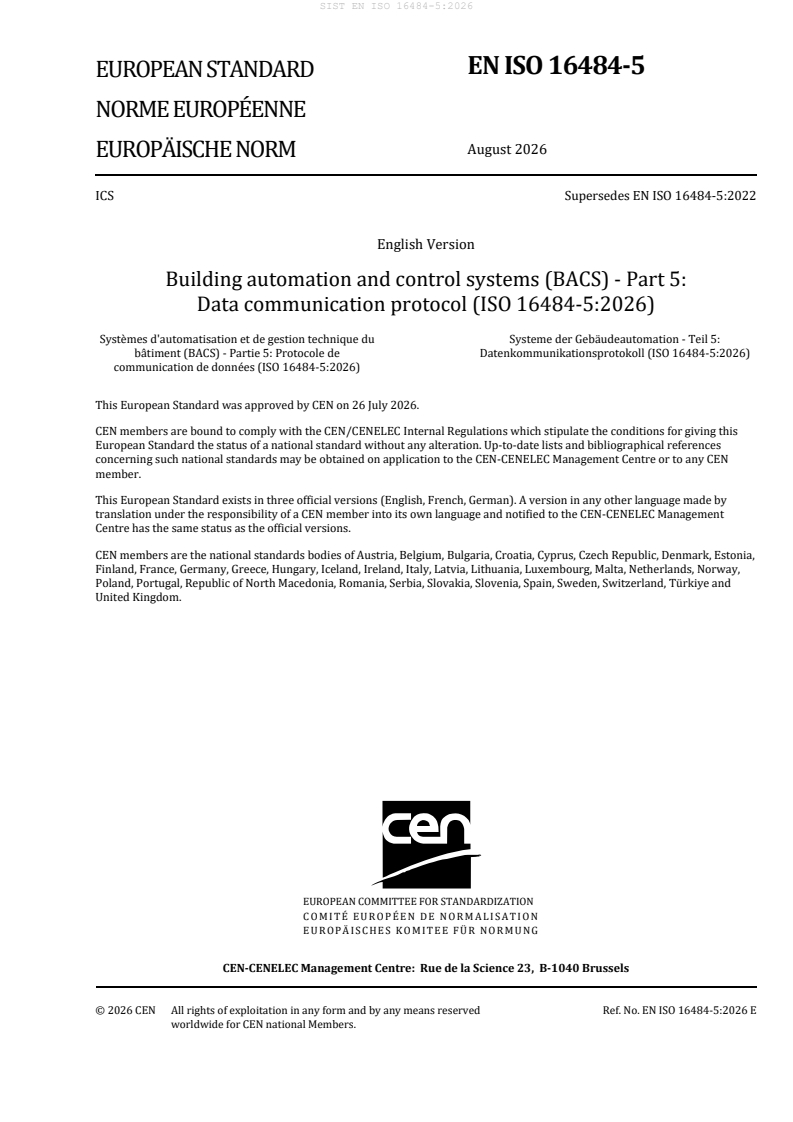


EN ISO 16484-5:2026 is the CEN adoption of ISO 16484-5:2026 for Building automation and control systems (BACS), Part 5. It specifies the BACnet data communication protocol for equipment used to monitor and control HVAC&R and other building systems, and it defines the object-oriented information model those devices use to exchange data. Engineers, integrators, buyers, and quality teams use it to specify interoperable building control communications and device behavior.
What does EN ISO 16484-5:2026 specify?
EN ISO 16484-5:2026 defines the communication services, protocol behavior, and object model used by BACnet devices in building automation and control systems. Its scope covers encoded binary, analog, and alphanumeric data, plus schedules, alarms and events, files, and control logic.
The document is organized from general purpose and definitions through protocol layers, object types, services, procedures, encoding, conformance, and annexes. That structure matters in practice because it lets a reader move from network setup to device data modeling to interoperability and testing.
| Annex | What it covers |
|---|---|
| A | Protocol Implementation Conformance Statement (PICS) |
| B | Guide to specifying BACnet devices |
| E | Examples of BACnet application services |
| F | Examples of APDU encoding |
| G | Calculation of CRC |
| H | Combining BACnet networks with non-BACnet networks |
| I | Commandable properties with minimum on and off times |
| J | BACnet/IP |
| K | BACnet Interoperability Building Blocks (BIBBs) |
| N | Former BACnet/WS web services interface |
| U | BACnet/IPv6 |
| V | Migration from SOAP services |
| W | BACnet/WS RESTful web services interface |
| X | PICS declarations and object/property/datatype examples |
| Y | Abstract data model |
| Z | JSON data formats |
| AA | Time series data exchange file format and certificate authority requirements interchange file format |
| AB | BACnet Secure Connect |
| AC | Examples of authentication and authorization |
| AD | BACnet Energy Services Interface |
What are the key requirements of EN ISO 16484-5:2026?
EN ISO 16484-5:2026 sets out how BACnet devices communicate, how they are modeled as objects, and how different network technologies carry BACnet data. For implementation, the most important points are the protocol stack, message handling, data link mappings, and the standardized services and object properties.
Protocol architecture and addressing
EN ISO 16484-5:2026 uses a four-layer collapsed architecture aligned to the physical, data link, network, and application layers of the OSI model. Clause 4 also describes BACnet network topology as flexible rather than fixed, with devices attached to local area networks or serial links and interconnected by BACnet routers.
This matters because system designers have to choose the right LAN type, router arrangement, and addressing scheme for the site. Clause 6 says a device is located by a network number and a MAC address, which is the basis for routing between BACnet networks.
Application layer behavior
EN ISO 16484-5:2026 defines application-layer segmentation, transmission rules, state machines, time-sequence diagrams, and service conventions in Clauses 5.2 to 5.6. Only Confirmed-Request and ComplexACK messages may be segmented, and segmentation is optional.
In practice, this is what controls large messages, retry behavior, and timing. The client and server state machines, together with the APDU_Timeout-related behavior in Clause 5.3, tell implementers how to handle acknowledgments, errors, rejects, aborts, duplicates, and incomplete transactions.
Network layer functions
EN ISO 16484-5:2026 gives the BACnet network layer unacknowledged connectionless transfer services and the message formats that support routing, broadcast, multicast, and network management. Clause 6 also defines router procedures, including BACnet routers and point-to-point half-routers.
That matters when devices sit on different BACnet networks or different media. The document also sets rules for network-layer messages such as router discovery, routing table updates, congestion control, and establishment or disconnection of network connections.
Data link and physical layer mappings
EN ISO 16484-5:2026 maps BACnet onto several data link and physical technologies, including Ethernet, ARCNET, Multidrop Serial Bus/Token Passing (MS/TP), Point-to-Point (PTP), LonTalk, BACnet/IP, BACnet/IPv6, ZigBee, and BACnet Secure Connect. Clauses 7 to 11 describe the service mappings, frame formats, and media rules for those transports.
For implementers, this is where cable type, frame structure, priority handling, and error detection become concrete. MS/TP uses token passing on EIA-485, Ethernet and ARCNET use LLC Class I, PTP uses alternating-bit acknowledgement, and LonTalk maps BACnet to the LonTalk application layer.
Object model and standard services
EN ISO 16484-5:2026 models each device as a collection of objects, and Clause 12 defines common object rules and many standard object types. Every object has an Object_Identifier, and each object in a device has a unique value for that property.
This is central to day-to-day use because application services read and write object properties rather than device internals. The standard includes object types for analog and binary inputs and outputs, schedules, trend logs, access control, lighting, elevators, audit reporting, and color-related functions, so the same protocol can cover many building subsystems.
Conformance, security, and extensions
EN ISO 16484-5:2026 includes alarm and event services, file access, object access, remote device management, authentication and authorization, error handling, and BACnet procedures such as backup and restore, command prioritization, audit logging, discovery, and certificate replacement. Annex A provides the PICS structure, and Annex K sets out BACnet Interoperability Building Blocks (BIBBs).
This matters for procurement and testing because it gives a common way to declare device capabilities and check interoperability. Clause 17 and Annex AC also show that authentication and authorization are part of the document’s security model, while Clause 23 defines how vendor-proprietary information may be added without breaking the standardized model.
What terms does EN ISO 16484-5:2026 define?
- Application Protocol Data Unit (APDU) - The application-layer packet exchanged between BACnet devices, including confirmed and unconfirmed service messages.
- BACnet router - A device that interconnects BACnet networks and relays network-layer traffic between them.
- BACnet Secure Connect (BACnet/SC) - The BACnet secure-connect profile covered in Annex AB for secure network connections and node operation.
- Multidrop Serial Bus/Token Passing (MS/TP) - A BACnet data link protocol that uses token passing over an EIA-485 bus.
- Object_Identifier - The property that identifies every BACnet object by object type and object instance.
- Protocol Implementation Conformance Statement (PICS) - The statement format in Annex A used to declare which BACnet capabilities a device implements.
- BACnet/IPv6 (B/IPv6) - The BACnet IPv6 profile covered in Annex U for BACnet communication over IPv6-based transport.
Who uses EN ISO 16484-5:2026?
EN ISO 16484-5:2026 is used by BACS manufacturers, system integrators, and software developers who implement BACnet devices, controllers, gateways, and supervisory systems. It is also used by commissioning engineers and test labs when they need to verify object behavior, services, and transport compatibility.
Facility owners, specifiers, buyers, and quality managers use it to define what a device must be able to communicate, how interoperability is declared, and which BACnet options a project should accept. It is relevant across HVAC&R, lighting, access control, lifts, energy management, and other building systems that exchange structured control data.
What changed in EN ISO 16484-5:2026 from the previous edition?
EN ISO 16484-5:2026 supersedes EN ISO 16484-5:2022.
Which standards are used with EN ISO 16484-5:2026?
- ISO 7498 - Provides the OSI basic reference model used to explain BACnet’s layered architecture.
- ISO TR 8509 - Provides the service conventions used to describe application-layer service primitives.
- ISO 8802-2 - Supplies the LLC service model used in the Ethernet, ARCNET, and LonTalk mappings.
- ISO/IEC 8802-3 - Supplies the Ethernet LAN transport described in Clause 7.
- ATA 878.1 - Supplies the ARCNET LAN transport described in Clause 8.
- EIA-485 - Supplies the physical-layer basis for MS/TP in Clause 9.
- ISO/IEC 14908.1 - Supplies the LonTalk transport referenced in Clause 11.
- EIA/CEA-709.1-B-2002 - The LonTalk control network protocol specification referenced for BACnet over LonTalk.
What does the EN ISO 16484-5:2026 document contain?
EN ISO 16484-5:2026 contains protocol architecture descriptions, service models, state machines, message formats, and routing procedures that are used to implement and test BACnet communications. Clauses 5 and 6 include transmission rules, network-layer PDUs, router messages, and point-to-point procedures; Clauses 7 to 11 give the transport mappings for Ethernet, ARCNET, MS/TP, PTP, and LonTalk.
The document also contains large tables of object types and properties in Clause 12, together with the alarm, event, file access, object access, and device-management services in Clauses 13 to 19. Annexes provide conformance statements, worked examples of services and APDU encoding, CRC calculations, gateway guidance, BACnet/IP, BACnet/IPv6, BACnet Secure Connect, JSON data formats, abstract data modeling, and BACnet Energy Services Interface material.
Relations
- Effective Date
- 21-May-2025
- Effective Date
- 02-Sep-2026
- Effective Date
- 02-Sep-2026
- Effective Date
- 02-Sep-2026
- Consolidated By
ISO 16484-5:2026 - Building automation and control systems (BACS) — Part 5: Data communication protocol - Effective Date
- 12-Feb-2026
Frequently Asked Questions
EN ISO 16484-5:2026 is a standard published by the European Committee for Standardization (CEN). Its full title is "Building automation and control systems (BACS) - Part 5: Data communication protocol (ISO 16484-5:2026)". This standard covers: The purpose of this document is to define data communication services and protocols for computer equipment used for monitoring and control of HVAC&R and other building systems and to define, in addition, an abstract, object-oriented representation of information communicated between such equipment, thereby facilitating the application and use of digital control technology in buildings.
The purpose of this document is to define data communication services and protocols for computer equipment used for monitoring and control of HVAC&R and other building systems and to define, in addition, an abstract, object-oriented representation of information communicated between such equipment, thereby facilitating the application and use of digital control technology in buildings.
EN ISO 16484-5:2026 has the following relationships with other standards: It is inter standard links to EN ISO 16484-5:2022, EN IEC 60730-1:2024, EN ISO 16484-3:2005, CEN/TR 18081:2024, ISO 16484-5:2026. Understanding these relationships helps ensure you are using the most current and applicable version of the standard.
EN ISO 16484-5:2026 is available in PDF format for immediate download after purchase. The document can be added to your cart and obtained through the secure checkout process. Digital delivery ensures instant access to the complete standard document.
Standards Content (Sample)
Contents
- 2 SCOPE
- 3 DEFINITIONS
- 3.1 Terms Adopted from International Standards
- 3. DEFINITIONS
- 3.2 Terms Defined for this Standard
- 3. DEFINITIONS
- 3. DEFINITIONS
- 3. DEFINITIONS
- 3. DEFINITIONS
- 3. DEFINITIONS
- 3. DEFINITIONS
- 3.3 Abbreviations and Acronyms Used in this Standard
- 3. DEFINITIONS
- 3. DEFINITIONS
- 3. DEFINITIONS
- 4. BACnet PROTOCOL ARCHITECTURE
- 4 BACnet PROTOCOL ARCHITECTURE
- 4. BACnet PROTOCOL ARCHITECTURE
- 4.1 The BACnet Collapsed Architecture
- 4. BACnet PROTOCOL ARCHITECTURE
- 4. BACnet PROTOCOL ARCHITECTURE
- 4.2 BACnet Network Topology
- 4. BACnet PROTOCOL ARCHITECTURE
- 4.3 Security
- 5. THE APPLICATION LAYER
- 5 THE APPLICATION LAYER
- 5.1 The Application Layer Model
- 5. THE APPLICATION LAYER
- 5. THE APPLICATION LAYER
- 5. THE APPLICATION LAYER
- 5. THE APPLICATION LAYER
- 5. THE APPLICATION LAYER
- 5. THE APPLICATION LAYER
- 5.2 Segmentation of BACnet Messages
- 5. THE APPLICATION LAYER
- 5.3 Transmission of BACnet APDUs
- 5. THE APPLICATION LAYER
- 5. THE APPLICATION LAYER
- 5. THE APPLICATION LAYER
- 5. THE APPLICATION LAYER
- 5.4 Application Protocol State Machines
- 5. THE APPLICATION LAYER
- 5. THE APPLICATION LAYER
- 5. THE APPLICATION LAYER
- 5. THE APPLICATION LAYER
- 5. THE APPLICATION LAYER
- 5. THE APPLICATION LAYER
- 5. THE APPLICATION LAYER
- 5. THE APPLICATION LAYER
- 5. THE APPLICATION LAYER
- 5. THE APPLICATION LAYER
- 5. THE APPLICATION LAYER
- 5. THE APPLICATION LAYER
- 5. THE APPLICATION LAYER
- 5. THE APPLICATION LAYER
- 5. THE APPLICATION LAYER
- 5. THE APPLICATION LAYER
- 5. THE APPLICATION LAYER
- 5. THE APPLICATION LAYER
- 5.5 Application Protocol Time Sequence Diagrams
- 5. THE APPLICATION LAYER
- 5. THE APPLICATION LAYER
- 5. THE APPLICATION LAYER
- 5. THE APPLICATION LAYER
- 5. THE APPLICATION LAYER
- 5. THE APPLICATION LAYER
- 5. THE APPLICATION LAYER
- 5. THE APPLICATION LAYER
- 5. THE APPLICATION LAYER
- 5.6 Application Layer Service Conventions
- 5. THE APPLICATION LAYER
- 6. THE NETWORK LAYER
- 6 THE NETWORK LAYER
- 6.1 Network Layer Service Specification
- 6. THE NETWORK LAYER
- 6. THE NETWORK LAYER
- 6.2 Network Layer PDU Structure
- 6. THE NETWORK LAYER
- 6. THE NETWORK LAYER
- 6. THE NETWORK LAYER
2 SCOPE
2.1 This protocol provides a comprehensive set of messages for conveying encoded binary, analog, and alphanumeric data between devices including, but not limited to:
(a) hardware binary input and output values, (b) hardware analog input and output values, (c) software binary and analog values, (d) text string values, (e) schedule information, (f) alarm and event information, (g) files, and (h) control logic.
2.2 This protocol models each building automation and control computer as a collection of data structures called "objects," the properties of which represent various aspects of the hardware, software, and operation of the device. These objects provide a means of identifying and accessing information without requiring knowledge of the details of the device's internal design or configuration.
3 DEFINITIONS
3.1 Terms Adopted from International Standards
The following terms used in this standard are defined by international standards or draft standards for open system interconnection (OSI). The definitions are repeated here and a reference to the appropriate standard is provided. Clause 25 contains the titles of all national and international standards referenced in this clause and elsewhere in this standard. Words or phrases in italics refer to terms defined elsewhere in this clause.
abstract syntax: the specification of application layer data or application-protocol-control-information by using notation rules which are independent of the encoding technique used to represent them (ISO 8822).
application: a set of a USER's information processing requirements (ISO 8649).
application-entity: the aspects of an application-process pertinent to OSI (ISO 7498).
application-process: an element within a real open system which performs the information processing for a particular application (ISO 7498).
application-protocol-control-information: information exchanged between application-entities, using presentation services, to coordinate their joint operation (ISO 9545).
application-protocol-data-unit: a unit of data specified in an application protocol and consisting of applicationprotocol-control-information and possibly application-user-data (ISO 9545).
application-service-element: that part of an application-entity which provides an OSI environment capability, using underlying services when appropriate (ISO 7498).
concrete syntax: those aspects of the rules used in the formal specification of data which embody a specific representation of that data (ISO 7498).
SIST EN ISO 16484-5:2026 ISO 16484-5:2026(en)
3. DEFINITIONS
confirm (primitive): a representation of an interaction in which a service-provider indicates, at a particular serviceaccess-point, completion of some procedure previously invoked, at that service-access-point, by an interaction represented by a request primitive (ISO TR 8509).
indication (primitive): a representation of an interaction in which a service-provider either (a) indicates that it has, on its own initiative, invoked some procedure; or (b) indicates that a procedure has been invoked by the service-user at the peer service-access-point (ISO TR 8509).
peer-entities: entities within the same layer (ISO 7498).
persistent: when used to describe property values, the property value is stored in non-volatile storage so as to survive device resets and power failures.
real open system: a real system which complies with the requirements of OSI standards in its communication with other real systems (ISO 7498).
real system: a set of one or more computers, the associated software, peripherals, terminals, human operators, physical processes, information transfer means, etc., that forms an autonomous whole capable of performing information processing and/or information transfer (ISO 7498).
request (primitive): a representation of an interaction in which a service-user invokes some procedure (ISO TR 8509).
response (primitive): a representation of an interaction in which a service-user indicates that it has completed some procedure previously invoked by an interaction represented by an indication primitive (ISO TR 8509).
(N)-service-access-point: the point at which (N)-services are provided by an (N)-entity to an (N+1)-entity (ISO 7498).
(N)-service-data-unit: an amount of (N)-interface-data whose identity is preserved from one end of an (N)-connection to the other (ISO 7498).
service-user: an entity in a single open system that makes use of a service through service-access-points (ISO TR 8509).
service-primitive; primitive: an abstract, implementation-independent representation of an interaction between the service-user and the service-provider (ISO TR 8509).
service-provider: an abstract of the totality of those entities which provide a service to peer service-users (ISO TR 8509).
transfer-syntax: that concrete syntax used in the transfer of data between open systems (ISO 7498).
user element: the representation of that part of an application-process which uses those application-service-elements needed to accomplish the communications objectives of that application-process (ISO 7498).
3.2 Terms Defined for this Standard
access control: a method for regulating or restricting access to network resources.
access rights (physical access control): the access privileges granted to a credential.
access user (physical access control): the person or asset holding one or more credentials.
alarm: 1. An annunciation, either audible or visual or both, that alerts an operator to an off-normal condition that may require corrective action. 2. An abnormal condition detected by a device or controller that implements a rule or logic specifically designed to look for that condition.
SIST EN ISO 16484-5:2026 ISO 16484-5:2026(en)
3. DEFINITIONS
alarm-acknowledgment: the process of indicating that a human operator has seen and responded to an event notification.
algorithmic change reporting: the detection and reporting of an alarm or event, based on an algorithm specified in an Event Enrollment object. See intrinsic reporting.
authentication: the act of verifying identity
authentication factor: a data element of the credential which is used to verify a credential's identity.
authorization (network security): the control of access to network resources based on known identity and access rules.
authorization (physical access control): the process of determining whether the access user is permitted to enter a protected zone through an access controlled point.
BACnet address: address format used by the BACnet network layer, as defined in Clause 6, consisting of a network number and a MAC address.
BACnet device: any device, real or virtual, that supports digital communication using the BACnet protocol.
BACnet network: a network of BACnet devices that share the MAC or VMAC address space under a particular BACnet network number.
BACnet-user: that portion of an application-process that is represented by the BACnet user element.
blink-warn: in lighting control, typically a method of notifying room occupants of an impending automated command to turn off the lights whereby the lights may be blinked, once or multiple times, or an audible signal is generated. After the warning occurs, the room lights are held on for a grace period to allow occupants to either safely leave the room or to initiate a request to keep the room lights on. Also known as "flick warn" or "flash warn."
bridge: a device that connects two or more segments at the physical and data link layers. This device may also perform message filtering based upon MAC layer addresses.
broadcast: a message sent as a single unit, which may apply to more than one device.
change of state: an event that occurs when a measured or calculated Boolean or discrete enumerated value changes.
change of value: an event that occurs when a measured or calculated analog value changes by a predefined amount.
clamped: the act of limiting a value based on another parameter to a restricted range.
client: a system or device that makes use of another device for some particular purpose via a service request instance. A client requests service from a server.
confidentiality: the property that information is not made available or disclosed to unauthorized individuals, entities, or processes.
configurable: a property, setting, or value in a device is configurable if it can be changed via BACnet services or some other method. A property, setting, or value that is one-time writable or not changeable in situ is not considered to be configurable.
context: a set of data or information that completely describes a particular communication environment at a particular point in time.
SIST EN ISO 16484-5:2026 ISO 16484-5:2026(en)
3. DEFINITIONS
controller: a device for regulation or management of a system or component.
correlated color temperature (CCT): a concept that is defined in ANSI_ANSLG C78.377-2015 to specify the color temperature along a white light curve through the CIE chromaticity space.
credential (physical access control): the combination of authentication factors and access rights. current command priority: In priority arrays, the array index of the entry in the priority array from which the Present_Value's value has been taken.
date pattern: a date that may contain one or more unspecified octets or special date values.
directly connected network: a network that is accessible from a BACnet router without messages being relayed through an intervening BACnet router. A PTP connection is to a directly connected network if the PTP connection is currently active and no intervening BACnet router is used.
download: a particular type of file transfer that refers to the transfer of an executable program or database to a remote device where it may be executed.
encrypted message: a message that is wrapped in a security header, signed, and encrypted.
entity: something that has a separate and distinct existence. An identifiable item that is described by a set or collection of properties.
error detection: a procedure used to identify the presence of errors in a communication.
error recovery: a procedure invoked in response to a detected error that permits the information exchange to continue.
event algorithm: the rules that determine when an event-initiating object changes between normal and offnormal states. The event algorithm has no impact on an event-initiating object's transition to or from fault.
event-initiating object: an object that generates event notifications.
event-notification-distribution: the process that a notification-server performs in the determination of notificationclients and in the sending of notifications to notification-clients when an event-initiating object changes the event or acknowledgment state.
event notification message: a ConfirmedEventNotification or UnconfirmedEventNotification service request used to indicate a change in the event or acknowledgment state of an event-initiating object.
event-state-detection: the process of executing an event-initiating object's event algorithm and monitoring the object's Reliability property to detect changes in the object's event state.
event-summarization: the querying of event-initiating objects in a device through one of the event summarization services to determine those that meet specific event state or reporting conditions.
fading: the gradual increase or decrease of the luminance from one setting to another over a fixed period of time, or the change of color or color temperature from one color to another over a fixed period of time, or a change of both luminance level and color.
gateway: a device that connects two or more dissimilar networks, permitting information exchange between them.
global: pertaining to all devices or nodes on a communication internetwork.
global broadcast: a message addressed to all devices or nodes on all networks in a BACnet internet.
SIST EN ISO 16484-5:2026 ISO 16484-5:2026(en)
3. DEFINITIONS
half router: a device or node that can participate as one partner in a PTP connection. The two half-router partners that form an active PTP connection together make up a single BACnet router.
initialization: the process of establishing a known state, usually from a power up condition. Initialization may require re-establishment of a node's logical or physical address.
integrity: the property that data has not been altered or destroyed in an unauthorized manner.
internetwork: a set of two or more networks interconnected by BACnet routers. In a BACnet internetwork interconnected by BACnet routers, there exists exactly one message path between any two nodes.
intrinsic reporting: the detection and reporting of an alarm or event, based on an algorithm defined as part of the object type specification. No external reference to an Event Enrollment is involved. See algorithmic change reporting.
invalid character: Character-level encoding within a BACnet character string that is not defined by the governing body of the character encoding, or that breaks the rules of the governing body, or is not allowed by the rules of BACnet such as a null character when printable characters are required.
inverted network: a BACnet internetwork where two or more BACnet networks are connected by a BACnet network with an NPDU size smaller than the networks it joins.
key: a sequence of symbols that controls the operations of encipherment and decipherment.
link: a communication facility or medium over which nodes can communicate at the IP link layer.
local: pertaining to devices on the same network as the referenced device.
local broadcast: a message addressed to all devices or nodes on the same BACnet network as the originator.
medium: the physical transmission entity. Typical media are twisted-pair wire, fiber optic cable, and coaxial cable.
medium access control: a process used to maintain order and provide access to the communication medium.
multicast domain: A group of B/IPv6 nodes that can communicate with each other using a particular IPv6 multicast address and UDP port combination.
network: a set of one or more segments interconnected by bridges that have the same network address.
network resource: any physical or logical entity that may be accessed via a communication medium.
node: an addressable device connected to the communication medium.
notification-client: a BACnet device that receives and processes event notification messages.
notification-server: a BACnet device that contains event-initiating objects and performs event-notification-distribution.
numeric quantity: a value that is the magnitude of a quantity. A representation of a specific amount such as temperature, volume or counts.
object: a specific instance of an object type. While an object type is identified by a unique Object_Type property, an object is identified by its Object_Identifier property.
object profile: an object profile is a means of defining objects beyond those defined in Clause 12. A profile defines the set of properties, behavior, and/or requirements for a proprietary object, or for proprietary extensions to a standard object.
SIST EN ISO 16484-5:2026 ISO 16484-5:2026(en)
3. DEFINITIONS
object type: a generic classification of data that is defined by a set of properties.
operator authentication: the corroboration that the operator logging on to a device is as claimed.
peer entity authentication: the corroboration that a peer entity in an association is the one claimed.
physical access control system: an electronic system that controls the ability of people or vehicles to enter a protected area, by means of authentication and authorization at access control points.
physical segment: a single contiguous medium to which BACnet nodes are attached.
physically secure: a device or network that is protected from physical access by unauthorized individuals.
printable character: a character that represents a printable symbol as opposed to a device control character. Printable characters include, but are not limited to, upper and lowercase letters, punctuation marks, and mathematical symbols. The exact set depends upon the character set being used.
property: a particular characteristic of an object type.
proprietary: within the context of BACnet, any extension of or addition to object types, properties, PrivateTransfer services, or enumerations specified in this standard.
ramping: the gradual increase or decrease of the actual output from one setting to another at a fixed rate of change.
receiving BACnet-user: the BACnet-user that receives an indication or confirm service primitive.
reliability-evaluation: the process by which an object determines its reliability and thus the value to set into its Reliability property.
remote: pertaining to devices or nodes on a different network than the referenced device.
remote broadcast: a message addressed to all devices or nodes on a different BACnet network than the originator.
repeater: a device that connects two or more physical segments at the physical layer.
requesting BACnet-user: the BACnet-user that assumes the role of a client in a confirmed service.
responding BACnet-user: the BACnet-user that assumes the role of a server in a confirmed service.
role-based access control: access privileges that are assigned to specific roles. Access users acquire privileges through their assigned role.
router: a device that connects two or more BACnet networks at the network layer.
secure device: a device that is connected to a secure network.
secure network: a network on which all traffic is required to be signed or encrypted.
security: any of a variety of procedures used to ensure that information exchange is guarded to prevent disclosure to unauthorized individuals. Security measures are intended to prevent disclosure of sensitive information even to those who have valid access to the communication network. Security is distinct from access control, although some security can be provided by limiting physical access to the communication medium itself.
segment: a segment consists of one or more physical segments interconnected by repeaters.
SIST EN ISO 16484-5:2026 ISO 16484-5:2026(en)
3. DEFINITIONS
sending BACnet-user: the BACnet-user that issues a request or response service primitive.
server: a system or device that responds to a service request instance for some particular purpose. The server provides service to a client.
special date value: a date value that is one of the special values such as "even months", "last day of month", etc. These special date values are used in subcomponents (octets) of a value of type Date.
specific date: a fully specified date. For example, January 24, 1991, Day of week = Thursday. A specific date shall contain no unspecified octets or Special Date Values.
specific datetime: a BACnetDateTime construct composed of a specific date and a specific time.
specific time: a fully specified time. For example, 17:35:45.17 (= 5:35:45.17 P.M.). A specific time shall contain no unspecified octets.
standard object type: an object type defined by this standard where the numerical value is within the range reserved for ASHRAE.
standard property: a required or optional property of a standard object type where the numerical value of the property identifier is within the range reserved for ASHRAE and the property is listed in the object type's properties table in Clause 12.
stepping: the increase or decrease of an output value in discrete steps.
synchronization: a facility that allows processes to define and identify specific places in a transmission or exchange that can be used to reset a communication session to a predefined state.
time distributor: a server device distributes time via the time synchronization services.
time pattern: a time that may contain one or more unspecified octets.
...