

EN 1594:2024/FprA1
(Amendment)Gas infrastructure - Pipelines for maximum operating pressure over 16 bar - Functional requirements
- Abstract
This document describes the functional requirements for pipelines for maximum operating pressure over 16 bar. This document also describes the mechanical requirements for pipework in stations with a maximum operating pressure greater than 16 bar.
NOTE 1 Welding requirements are described in EN 12732. Functional requirements for stations are given in EN 1776, EN 1918-5, EN 12186, and EN 12583.
This document is applicable for transporting gas via onshore high-pressure steel pipeline infrastructures, where the following applies:
- onshore:
- from the point where the pipeline first crosses what is normally accepted as battery limit between onshore and offshore, and that is not located within commercial or industrial premises as an integral part of the industrial process on these premises except for any pipelines and facilities supplying such premises;
- pipeline system with a starting point onshore, also when parts of the pipeline system on the mainland subsequently cross fjords, lakes, etc.
- high pressure: gas with a maximum operating pressure over 16 bar and a design temperature between −40 °C and 120 °C.
- steel pipeline infrastructure: infrastructure consisting of pipeline components, such as pipes, valves, couplings and other equipment, restricted to components made of unalloyed or low alloyed carbon steel and joined by welds, flanges or mechanical couplings.
- gas: non-corrosive natural gas, biomethane gas, hydrogen gas and mixtures of these gases where technical evaluation has ensured that operating conditions or constituents or properties of the gas do not affect the safe operation of the pipeline.
Gas infrastructures covered by this document begin after the gas producer's metering station.
NOTE 2 The functional demarcation of the pipeline system is usually directly after an isolating valve of the installation, but can differ in particular situations. The functional demarcation of the pipeline system is usually located on an isolating valve of the installation, but can differ in particular situations.
A schematic representation of pipelines for gas infrastructure is given in Figure 1.
This document can also be applied to the repurposing of existing pipelines.
[Figure 1 - Schematic representation of pipelines for gas supply over 16 bar]
This document specifies common basic principles for gas infrastructure. Users of this standard are expected to be aware that more detailed national standards and/or code of practice can exist in the CEN member countries.
This document is intended to be applied in association with these national standards and/or codes of practice setting out the above-mentioned basic principles.
In the event of conflicts in terms of more restrictive requirements in national legislation/regulation with the requirements of this standard, the national legislation/regulation takes precedence as illustrated in CEN/TR 13737.
CEN/TR 13737 gives:
- clarification of all legislations/regulations applicable in a member state;
- if appropriate, more restrictive national requirements;
- a national contact point for the latest information.
- Status
- Not Published
- Publication Date
- 10-Feb-2027
- Technical Committee
- CEN/TC 234 - Gas infrastructure
- Drafting Committee
- CEN/TC 234/WG 3 - Gas Transportation
- Current Stage
- 5020 - Submission to Vote - Formal Approval
- Start Date
- 22-Oct-2026
- Due Date
- 16-Jul-2026
- Completion Date
- 22-Oct-2026

EN 1594:2024/prA1 is a CEN draft amendment to EN 1594:2024 for gas infrastructure pipelines with a maximum operating pressure over 16 bar. It adds hydrogen and blended hydrogen provisions for onshore high-pressure steel pipeline infrastructures and updates the conversion and fracture-assessment rules used when pipelines are repurposed or operated with hydrogen.
What does EN 1594:2024/prA1 specify?
EN 1594:2024/prA1 modifies EN 1594:2024, which sets functional requirements for gas pipelines over 16 bar and mechanical requirements for pipework in stations above 16 bar. The scope covers onshore high-pressure steel pipeline infrastructures, including gas transported from the gas producer’s metering station, and it can also be applied to repurposing existing pipelines.
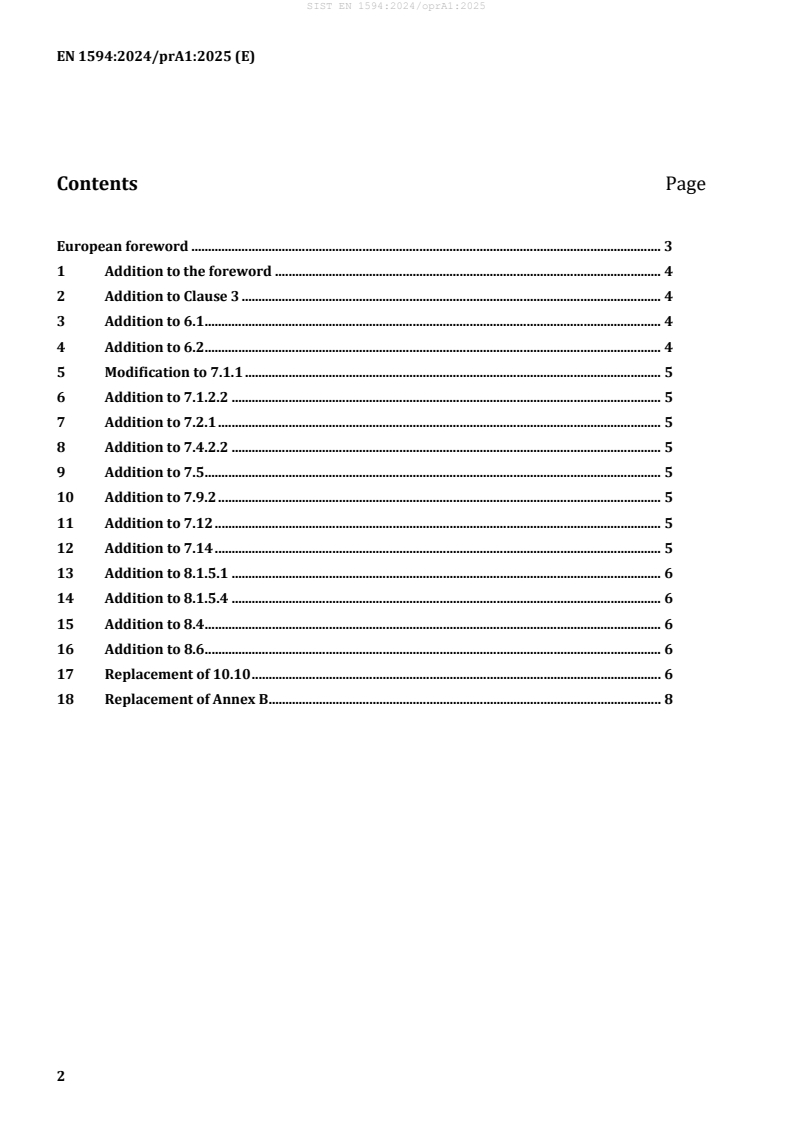
The amendment is organized as additions or replacements in the foreword, Clause 3, Clauses 6, 7, 8 and 10, plus a replacement of Annex B.
| Annex | What it covers |
|---|---|
| Annex B | Fatigue crack growth calculations and monitoring concepts for hydrogen service |
What are the key requirements of EN 1594:2024/prA1?
Hydrogen operation and pressure cycling
EN 1594:2024/prA1 adds explicit controls for hydrogen and blended hydrogen operations. Clauses 6.1 and 6.2 require adequate monitoring for pressure cycling and require that cycling stays within the design case. In practice, operators need pressure-history data, not only static design checks.
Design factors, strain and wall thickness
EN 1594:2024/prA1 links hydrogen service to more cautious design choices. Clause 7.1.2.2 notes that a lower design factor can be used to accommodate larger pressure cycles or a longer service life, and Clause 7.2.1 recommends not exceeding a design factor of 0.67 for hydrogen and blended hydrogen service. Clause 7.4.2.2 sets a maximum limit strain of 0.5%, and Clause 7.9.2 requires pressure-cycling differences from maintenance or operations to be included in minimum wall-thickness determination. This means the wall thickness calculation must reflect the actual cycling the line will see.
Station and valve arrangements
Clause 7.12 recommends a double block and bleed design for hydrogen or blended hydrogen service so an inert gas can separate hydrogen from air. Clause 7.14 adds hydrogen injection stations to the list of station-related requirements, with EN 17928-1/-2/-3. For readers, this ties hydrogen use to the correct station design and isolation philosophy.
Materials and component suitability
Clause 8.1.5.1 adds a minimum fracture toughness value that can be assumed when materials are ordered according to this document, and it requires a fracture-toughness test program if a higher value is used in design. Clause 8.1.5.4 adds a hardness limit of 300 HV10 for hydrogen and blended hydrogen service. Clause 8.4 says suitability of non-metallic materials has to be considered with reference to EN ISO 11114-2, and Clause 8.6 requires hydrogen service to be included in the requisition so valve manufacturers can make the needed design adaptations.
Converting existing pipelines to hydrogen service
Clause 10.10 gives a structured conversion process for existing onshore pipelines. It requires checking suitability from construction, operation and maintenance records, reviewing materials, welds, previous transported fluids, pressure records, external influences, corrosion and cathodic protection, and documenting the conversion procedure and technical report. In practice, this is the section an operator uses to decide whether an existing line can be repurposed and what evidence is needed.
Fracture mechanics and monitoring
Annex B makes fatigue crack growth calculations and monitoring concepts normative for hydrogen service. It uses fracture-mechanics assessment methods, fatigue crack growth rate (FCGR) concepts, pressure-cycle recording, and verification of crack growth during operation. For an operator, this is the technical basis for deciding whether a hydrogen line can safely remain in service over time.
What terms does EN 1594:2024/prA1 define?
- gas/gases - A gaseous energy carrier in the gaseous state at 15 °C and 0.1 MPa; the definition includes hydrogen-rich and methane-rich gases, DME, propane, butanes and admixtures.
- blended hydrogen operation - Transmission of a gas mixture where the hydrogen partial pressure is over 2 bar.
- conversion - Switching a gas pipeline from transporting methane-rich gases to transporting hydrogen gas within the scope of the document.
- hydrogen service - Operating a gas transmission system with a hydrogen pressure over 2 bar.
Who uses EN 1594:2024/prA1?
EN 1594:2024/prA1 is used by gas transmission operators, pipeline designers, integrity engineers, station designers, and maintenance teams working on onshore high-pressure steel pipelines. It is also relevant to quality managers, materials engineers, welding and NDT personnel, valve and station suppliers, and conformity assessment bodies involved in hydrogen repurposing decisions. Buyers and specifiers use it when they need to define technical requirements for hydrogen-ready pipeline assets and station equipment.
What changed in EN 1594:2024/prA1 from the previous edition?
The amendment states these main changes relative to EN 1594:2024:
- the full standard is adapted to include hydrogen as a gas
- provisions are added for using an existing line to transport gaseous hydrogen
- provisions are added for fracture-mechanical verifications for gaseous hydrogen service
- Annex B is replaced by a normative annex on fatigue crack growth calculations and monitoring concepts for hydrogen service
Which standards are used with EN 1594:2024/prA1?
| Standard | What it contributes |
|---|---|
| EN 12732 | Welding requirements |
| EN 1776 | Functional requirements for stations |
| EN 1918-5 | Functional requirements for stations |
| EN 12186 | Functional requirements for stations |
| EN 12583 | Functional requirements for stations |
| EN 17928-1/-2/-3 | Hydrogen injection stations |
| EN ISO 11114-2 | Suitability of non-metallic materials in hydrogen service |
| CEN/TR 13737 | How to handle more restrictive national legislation and regulation |
| API 579-1/ASME FFS-1 | Fracture-mechanics crack assessment guidance |
| BS 7910 | Crack acceptance and fracture-mechanics assessment guidance |
| ASTM E1820 | Fracture toughness testing |
| ASTM E 647 | Fatigue crack growth testing |
| API RP 1176 | Cracking assessment and management in pipelines |
| ASME B31.12 | Hydrogen piping and pipeline guidance, including fatigue crack growth rate material data |
What does the EN 1594:2024/prA1 document contain?
The document contains the amendment foreword, clause-by-clause additions and modifications, and a full replacement of Annex B. Annex B provides crack-assessment models, fracture-toughness guidance, FCGR concepts, safety-factor and limit-state examples, initial-crack assumptions, crack-growth calculation steps, and monitoring methods based on pressure histories and inspection data. It also refers to figures and worked calculation concepts for failure assessment diagrams and equivalent cyclic loading, which are used for design review, conversion studies, integrity management, and ongoing operation of hydrogen pipelines.
Relations
- Effective Date
- 31-Jul-2024
Get Certified
Connect with accredited certification bodies for this standard

Element Materials Technology
Materials testing and product certification.

ABS Group Brazil
ABS Group certification services in Brazil.

ABS Quality Evaluations Inc.
American Bureau of Shipping quality certification.
Sponsored listings
Frequently Asked Questions
EN 1594:2024/FprA1 is a draft published by the European Committee for Standardization (CEN). Its full title is "Gas infrastructure - Pipelines for maximum operating pressure over 16 bar - Functional requirements". This standard covers: This document describes the functional requirements for pipelines for maximum operating pressure over 16 bar. This document also describes the mechanical requirements for pipework in stations with a maximum operating pressure greater than 16 bar. NOTE 1 Welding requirements are described in EN 12732. Functional requirements for stations are given in EN 1776, EN 1918-5, EN 12186, and EN 12583. This document is applicable for transporting gas via onshore high-pressure steel pipeline infrastructures, where the following applies: - onshore: - from the point where the pipeline first crosses what is normally accepted as battery limit between onshore and offshore, and that is not located within commercial or industrial premises as an integral part of the industrial process on these premises except for any pipelines and facilities supplying such premises; - pipeline system with a starting point onshore, also when parts of the pipeline system on the mainland subsequently cross fjords, lakes, etc. - high pressure: gas with a maximum operating pressure over 16 bar and a design temperature between −40 °C and 120 °C. - steel pipeline infrastructure: infrastructure consisting of pipeline components, such as pipes, valves, couplings and other equipment, restricted to components made of unalloyed or low alloyed carbon steel and joined by welds, flanges or mechanical couplings. - gas: non-corrosive natural gas, biomethane gas, hydrogen gas and mixtures of these gases where technical evaluation has ensured that operating conditions or constituents or properties of the gas do not affect the safe operation of the pipeline. Gas infrastructures covered by this document begin after the gas producer's metering station. NOTE 2 The functional demarcation of the pipeline system is usually directly after an isolating valve of the installation, but can differ in particular situations. The functional demarcation of the pipeline system is usually located on an isolating valve of the installation, but can differ in particular situations. A schematic representation of pipelines for gas infrastructure is given in Figure 1. This document can also be applied to the repurposing of existing pipelines. [Figure 1 - Schematic representation of pipelines for gas supply over 16 bar] This document specifies common basic principles for gas infrastructure. Users of this standard are expected to be aware that more detailed national standards and/or code of practice can exist in the CEN member countries. This document is intended to be applied in association with these national standards and/or codes of practice setting out the above-mentioned basic principles. In the event of conflicts in terms of more restrictive requirements in national legislation/regulation with the requirements of this standard, the national legislation/regulation takes precedence as illustrated in CEN/TR 13737. CEN/TR 13737 gives: - clarification of all legislations/regulations applicable in a member state; - if appropriate, more restrictive national requirements; - a national contact point for the latest information.
This document describes the functional requirements for pipelines for maximum operating pressure over 16 bar. This document also describes the mechanical requirements for pipework in stations with a maximum operating pressure greater than 16 bar. NOTE 1 Welding requirements are described in EN 12732. Functional requirements for stations are given in EN 1776, EN 1918-5, EN 12186, and EN 12583. This document is applicable for transporting gas via onshore high-pressure steel pipeline infrastructures, where the following applies: - onshore: - from the point where the pipeline first crosses what is normally accepted as battery limit between onshore and offshore, and that is not located within commercial or industrial premises as an integral part of the industrial process on these premises except for any pipelines and facilities supplying such premises; - pipeline system with a starting point onshore, also when parts of the pipeline system on the mainland subsequently cross fjords, lakes, etc. - high pressure: gas with a maximum operating pressure over 16 bar and a design temperature between −40 °C and 120 °C. - steel pipeline infrastructure: infrastructure consisting of pipeline components, such as pipes, valves, couplings and other equipment, restricted to components made of unalloyed or low alloyed carbon steel and joined by welds, flanges or mechanical couplings. - gas: non-corrosive natural gas, biomethane gas, hydrogen gas and mixtures of these gases where technical evaluation has ensured that operating conditions or constituents or properties of the gas do not affect the safe operation of the pipeline. Gas infrastructures covered by this document begin after the gas producer's metering station. NOTE 2 The functional demarcation of the pipeline system is usually directly after an isolating valve of the installation, but can differ in particular situations. The functional demarcation of the pipeline system is usually located on an isolating valve of the installation, but can differ in particular situations. A schematic representation of pipelines for gas infrastructure is given in Figure 1. This document can also be applied to the repurposing of existing pipelines. [Figure 1 - Schematic representation of pipelines for gas supply over 16 bar] This document specifies common basic principles for gas infrastructure. Users of this standard are expected to be aware that more detailed national standards and/or code of practice can exist in the CEN member countries. This document is intended to be applied in association with these national standards and/or codes of practice setting out the above-mentioned basic principles. In the event of conflicts in terms of more restrictive requirements in national legislation/regulation with the requirements of this standard, the national legislation/regulation takes precedence as illustrated in CEN/TR 13737. CEN/TR 13737 gives: - clarification of all legislations/regulations applicable in a member state; - if appropriate, more restrictive national requirements; - a national contact point for the latest information.
EN 1594:2024/FprA1 is classified under the following ICS (International Classification for Standards) categories: 23.040.01 - Pipeline components and pipelines in general; 75.200 - Petroleum products and natural gas handling equipment. The ICS classification helps identify the subject area and facilitates finding related standards.
EN 1594:2024/FprA1 has the following relationships with other standards: It is inter standard links to EN 1594:2024. Understanding these relationships helps ensure you are using the most current and applicable version of the standard.
EN 1594:2024/FprA1 is associated with the following European legislation: Standardization Mandates: M/017, M/617. When a standard is cited in the Official Journal of the European Union, products manufactured in conformity with it benefit from a presumption of conformity with the essential requirements of the corresponding EU directive or regulation.
EN 1594:2024/FprA1 is available in PDF format for immediate download after purchase. The document can be added to your cart and obtained through the secure checkout process. Digital delivery ensures instant access to the complete standard document.
Standards Content (Sample)
SLOVENSKI STANDARD
01-junij-2025
Infrastruktura za plin - Cevovodni sistemi za najvišji delovni tlak nad 16 bar -
Funkcionalne zahteve - Dopolnilo A1
Gas infrastructure - Pipelines for maximum operating pressure over 16 bar - Functional
requirements
Gasinfrastruktur - Rohrleitungen für einen maximal zulässigen Betriebsdruck über 16 bar
- Funktionale Anforderungen
Infrastructures gazières - Canalisation pour pression maximale de service supérieure à
16 bar - Prescriptions fonctionnelles
Ta slovenski standard je istoveten z: EN 1594:2024/prA1
ICS:
91.140.40 Sistemi za oskrbo s plinom Gas supply systems
2003-01.Slovenski inštitut za standardizacijo. Razmnoževanje celote ali delov tega standarda ni dovoljeno.
DRAFT
EUROPEAN STANDARD
EN 1594:2024
NORME EUROPÉENNE
EUROPÄISCHE NORM
prA1
June 2025
ICS
English Version
Gas infrastructure - Pipelines for maximum operating
pressure over 16 bar - Functional requirements
Infrastructures gazières - Canalisation pour pression Gasinfrastruktur - Rohrleitungen für einen maximal
maximale de service supérieure à 16 bar - zulässigen Betriebsdruck über 16 bar - Funktionale
Prescriptions fonctionnelles Anforderungen
This draft amendment is submitted to CEN members for enquiry. It has been drawn up by the Technical Committee CEN/TC 234.
This draft amendment A1, if approved, will modify the European Standard EN 1594:2024. If this draft becomes an amendment,
CEN members are bound to comply with the CEN/CENELEC Internal Regulations which stipulate the conditions for inclusion of
this amendment into the relevant national standard without any alteration.
This draft amendment was established by CEN in three official versions (English, French, German). A version in any other
language made by translation under the responsibility of a CEN member into its own language and notified to the CEN-CENELEC
Management Centre has the same status as the official versions.
CEN members are the national standards bodies of Austria, Belgium, Bulgaria, Croatia, Cyprus, Czech Republic, Denmark, Estonia,
Finland, France, Germany, Greece, Hungary, Iceland, Ireland, Italy, Latvia, Lithuania, Luxembourg, Malta, Netherlands, Norway,
Poland, Portugal, Republic of North Macedonia, Romania, Serbia, Slovakia, Slovenia, Spain, Sweden, Switzerland, Türkiye and
United Kingdom.
Recipients of this draft are invited to submit, with their comments, notification of any relevant patent rights of which they are
aware and to provide supporting documentation.
Warning : This document is not a European Standard. It is distributed for review and comments. It is subject to change without
notice and shall not be referred to as a European Standard.
EUROPEAN COMMITTEE FOR STANDARDIZATION
COMITÉ EUROPÉEN DE NORMALISATION
EUROPÄISCHES KOMITEE FÜR NORMUNG
CEN-CENELEC Management Centre: Rue de la Science 23, B-1040 Brussels
© 2025 CEN All rights of exploitation in any form and by any means reserved Ref. No. EN 1594:2024/prA1:2025 E
worldwide for CEN national Members.
EN 1594:2024/prA1:2025 (E)
Contents Page
European foreword . 3
1 Addition to the foreword . 4
2 Addition to Clause 3 . 4
3 Addition to 6.1 . 4
4 Addition to 6.2 . 4
5 Modification to 7.1.1 . 5
6 Addition to 7.1.2.2 . 5
7 Addition to 7.2.1 . 5
8 Addition to 7.4.2.2 . 5
9 Addition to 7.5 . 5
10 Addition to 7.9.2 . 5
11 Addition to 7.12 . 5
12 Addition to 7.14 . 5
13 Addition to 8.1.5.1 . 6
14 Addition to 8.1.5.4 . 6
15 Addition to 8.4 . 6
16 Addition to 8.6 . 6
17 Replacement of 10.10 . 6
18 Replacement of Annex B . 8
EN 1594:2024/prA1:2025 (E)
European foreword
This document (EN 1594:2024/prA1:2025) has been prepared by Technical Committee CEN/TC 234
“Gas Infrastructure”, the secretariat of which is held by DIN.
This document is currently submitted to the CEN Enquiry.
This document has been prepared under a standardization request addressed to CEN by the European
Commission. The Standing Committee of the EFTA States subsequently approves these requests for its
Member States.
EN 1594:2024/prA1:2025 (E)
1 Addition to the foreword
In the foreword replace the 5th paragraph or add at the end of the 5th parapraph:
“The main changes between this document and the previous edition EN 1594:2024 are as follows:
— the full standard has been adapted to include hydrogen as a gas in this standard to replace the
informative annex of the previous edition,
— addition of provisions to be considered when using an existing line to transport gaseous hydrogen,
— addition of provisions on fracture mechanical verifications for gaseous hydrogen service,
— replacement of Annex B (informative) “Hydrogen gas pipelines” by Annex B (normative) “Fatigue
crack growth calculations and monitoring concepts for hydrogen service”.
2 Addition to Clause 3
In 3.11, replace title and definition by:
gas/gases
gaseous energy carrier which is in the gaseous state at a temperature of 15 °C and under an absolute
pressure of 0,1 MPa
Note 1 to entry: This includes hydrogen rich and methane rich gases, dimethyl ether (DME) and propane and
butanes and admixtures.
Add the following new definitions:
3.48
blended hydrogen operation
transmission of a gas mixture where the hydrogen partial pressure is over 2 bar
3.49
conversion
conversion of a gas pipeline as defined by this document refers to switching from the transportation of
methane-rich gases to the transportation of hydrogen gas pursuant to the scope of application
3.50
hydrogen service
operating a gas transmission system with a hydrogen pressure over 2 bar
3 Addition to 6.1
In 6.1, add as last sentence:
“For hydrogen or blended hydrogen operations, adequate monitoring for pressure cycling shall be
incorporated.”
4 Addition to 6.2
In 6.2, add as last sentence:
“For hydrogen or blended hydrogen operations, it shall be ensured that the pressure cycling shall be
within the design case.”
EN 1594:2024/prA1:2025 (E)
5 Modification to 7.1.1
In 7.1.1, in the last sentence, replace “repurposed are given in 10.6 and Annex B” with “converted
incorporated in this document”
6 Addition to 7.1.2.2
In 7.1.2.2, add after the third paragraph the second note:
“NOTE 2 For hydrogen or blended hydrogen a lower design factor can be used to accommodate larger
pressure cycles or a longer service life time.”
7 Addition to 7.2.1
In 7.2.1, renumber the “NOTE” as “NOTE 1”.
In 7.2.1, add NOTE 2 below the first note:
“NOTE 2 For hydrogen and blended hydrogen service it is recommended to not exceed the design factor
of 0,67, with the further wall thickness requirements in 7.9.2.”
8 Addition to 7.4.2.2
In 7.4.2.2, add at “relevant limit states” to item 'b Strain', after the second sentence:
“For hydrogen and blended hydrogen service the maximum limit strain is 0,5%.”
9 Addition to 7.5
In 7.5, add to the first summation at a) 2) the item iiii:
“iiii) for hydrogen or blended hydrogen service, the number and range of pressure cycles”;
10 Addition to 7.9.2
In 7.9.2, add to the fourth paragraph as last sentence:
“For hydrogen and blended hydrogen services, any differences in pressure cycling due to maintenance or
operations shall be included in the determination of the minimum wall thickness.”
11 Addition to 7.12
In 7.12, add a note after the first sentence:
“NOTE For hydrogen service or blended hydrogen service a double block and bleed design is recommended to
enable the use of an inert gas as separation between hydrogen and air.”
12 Addition to 7.14
In 7.14, add to summation as last point:
“ — Hydrogen injection stations: EN 17928-1/-2/-3”
EN 1594:2024/prA1:2025 (E)
13 Addition to 8.1.5.1
In 8.1.5.1, add after the last sentence:
“For hydrogen or blended hydrogen service a minimum value of 55 MPasqr(m) can be assumed for
fracture toughness when materials are ordered according to this document. When a larger toughness
value is used in the design of the pipeline, a proper fracture toughness test program on the pipeline
components shall be established to validate this higher value.”
14 Addition to 8.1.5.4
In 8.1.5.4, add after the last sentence:
“For hydrogen and blended hydrogen service the hardness shall not exceed 300 HV10”
15 Addition to 8.4
In 8.4, add after second sentence:
“For hydrogen or blended hydrogen service the suitability shall be taken into account, as a reference
EN ISO 11114-2: non-metallic materials can be used.”
16 Addition to 8.6
In 8.6, add after the last sentence:
“For hydrogen and blended hydrogen service this shall be included in the requisition and appropriate
design adaptions shall be included by the valve manufacturer.”
17 Replacement of 10.10
In 10.10 replace the current text by the following:
“10.10 Conversion process of existing onshore pipelines into hydrogen service
10.10.1 General
The aim of this paragraph is to provide guidance and technical requirements to gas transportation
operators to account for the effects of hydrogen on existing steel pipelines operating over 16 bar for
converting existing onshore pipelines into hydrogen service:
— existing pipelines designed, constructed, operated and maintained according EN 1594.
— existing pipelines not designed according EN 1594. Specific assessment should be done, specially for
fluids other than defined in Clause 1 of this document.
10.10.2 Checking of suitability
The conversion of gas pipelines should be carried out in accordance with the general consensus state-of
the-art that is in force at the time of conversion.
Impact and relevance of the changes between the standards as used in construction and the time of
conversion should be evaluated for the applicability and need for additional mitigation for the line to be
converted.
Specific attention should be paid to used materials, welds, the fluids that have been hitherto transported
in the pipeline, the pipeline’s former and future modes of operation, and eventually existing damaging as
well as local conditions.
EN 1594:2024/prA1:2025 (E)
It should be ensured that gas concomitant substances do not pose a hazard to the gas pipeline’s safety.
For the conversion of a gas pipeline, the tests listed in detail below shall be carried out and documented
by the operator in accordance with relevant standards with regard to installation, operation and
maintenance.
NOTE National regulations might exist for conversion of gas pipelines.
10.10.3 Documentation of Construction, Operation and Maintenance
The operator’s documentation on the construction of the gas pipeline, including all modifications, on the
previous mode of operation and on safety-relevant events should be examined for completeness and
compliance with the technical regulations and evaluated with regard to the planned conversion to
hydrogen. it should be checked whether the gas pipeline has been impaired by the previous mode of
operation with regard to the planned conversion.
Specific attention should be paid to the given items in the subsequent subclauses of 10.10.
10.10.4 Construction
When converting existing onshore pipelines into hydrogen service, specific attention should be paid to
the following items related to construction:
— current pipeline documentation (routing maps, as-built drawings, pipe book, pipe order list etc.).
— the suitability of material and the need of material testing
NOTE Certification on material tests or other technical aspects might be required by national authorities; also
third party certification might be required in some countries.
— documentation on type of product previously transported (e.g. sour service, sweet service).
— pressure test certificates.
— maintenance records (including repairs, fittings).
— current condition analysis / integrity (e.g. by inline inspection and direct assessment processes).
— results of NDT of girth welds.
10.10.5 Operation
When converting existing onshore pipelines into hydrogen service, specific attention should be paid to
the following items related to operation:
— documentation and properties of other fluids, including concomitant substances, that were
transported to date.
— pressure recordings of the operating conditions (recommended in case of suspecting large pressure
fluctuations), including corresponding analyses.
— external influences (e.g. mining activity, corrosive soil, built-up areas).
EN 1594:2024/prA1:2025 (E)
10.10.6 Maintenance
When converting existing onshore pipelines into hydrogen service, specific attention should be paid to
the following items related to maintenance:
— internal and external corrosion (condition of cathodic protection).
— Cathodic Protection report (effectiveness, electrical interferences, overprotection, etc.).
— current technical condition analysis.
If the pipeline documentation on pipeline construction is incomplete, appropriate analysis should be
made to establish alternative means and methods to provide sufficient reliance to enable the change of
fluid on the specific topics.
10.10.7 Gas Pipeline Hydrogen Suitability
10.10.7.1 General
The fracture toughness in hydrogen shall be established for the pipeline which will be transferred to
hydrogen service, together with all the relevant parameters (asset and operating conditions), shall be
used by the operator before the conversion to assess the feasibility of the change of fluid and during the
subsequent operation for the integrity assessment. Detailed description of pipeline fracture mechanics
assessment is described in Annex B.
10.10.7.2 Sampling
Detailed description of pipeline fracture mechanics assessment is described in Annex B.
10.10.8 Conversion Procedure and Report
The operator should elaborate a conversion procedure and a technical report for the potential
reconversion of an existing gas pipeline into hydrogen service.
NOTE National authorities and/or regulations and standards might require the submission of this Report for
the approval of authorities or its representatives.
10.10.9 Commissioning
The commissioning of the gas pipeline after its conversion is governed by the requirements established
in the applicable National Regulations and Standards.
10.10.10 Operation
The operation of the gas pipeline after conversion is governed by the requirements established in the
applicable National Regulations and Standards.
It is recommended to record and document the pressure load cycles of the converted pipeline. The
actually occurring load cycles should be compared to the assumed load cycles. Crack growth should be
repeatedly verified through calculation in continuous intervals.
10.10.11 Concluding Certification
Insofar substantive alterations have occurred, if explicitly stated by National Authorities and/or
Regulations and Standards, a test certificate should be issued by a Conformity Assessment-Body after the
changes and tests have been completed.
18 Replacement of Annex B
Annex B, replace by the following:
EN 1594:2024/prA1:2025 (E)
Annex B
(normative)
Fatigue crack growth calculations and monitoring concepts for hydrogen
service
B.1 Introduction and scope of application
High pressure natural gas pipelines usually are designed for predominantly static loads since barely any
significant changes in operating pressure (load cycles) occur and even sharp-edged defects that might
occur under such conditions exhibit a negligible growth rate. When operating the pipeline with hydrogen,
the fracture toughness can be lower and the steel potential fatigue crack growth rate (FCGR) larger than
the values obtained from operating with natural gas. Consequently, the operation with hydrogen usually
requires a fracture assessment for estimating its operational life or, if necessary, the operating conditions
in which fatigue crack can reasonably be expected to pose no risk to the integrity of a H2 pipeline along
its planned operational life.
This appendix shall apply for the fracture mechanical assessment of steel gas pipelines that already exist
or are projected for construction with a design pressure of more than 16 bar for the transmission or
distribution of hydrogen. Guidance is given for assessing cracks under both static loads (static strength)
and cyclic loads (fatigue strength) in H .
B.2 Crack Assessment models
In the following sections, as a rule, crack should be assumed to be a semi elliptical shape longitudinal
crack at the inner pipe wall for the purposes of a fracture mechanical assessment and can be described
by its height (a) and its length (2c) as shown in Figure B.1.
Figure B.1 — Main crack dimensions (cylinder shape)
API 579-1/ASME FFS-1 2019 (level 2) or BS 7910:2019 standards provide guidance for using fracture
mechanics to assess the static strength and the fatigue strength of a crack. Both documents are widely
used in the pipeline industry. The assessment procedures and failure assessment lines in
EN 1594:2024/prA1:2025 (E)
API 579-1/ASME FFS-1 and BS 7910 are similar and use a Failure Assessment Diagram (FAD) for crack
assessment.
The FAD is based on the principles of fracture mechanics. It considers failure by fracture and by plastic
collapse, and the relationship between the two. An example FAD is presented in Figure B.2.
The FAD has two p
...