


EN 12269-1:2000
(Main)Determination of the bond behaviour between reinforcing steel and autoclaved aerated concrete by the "beam test" - Part 1: Short term test
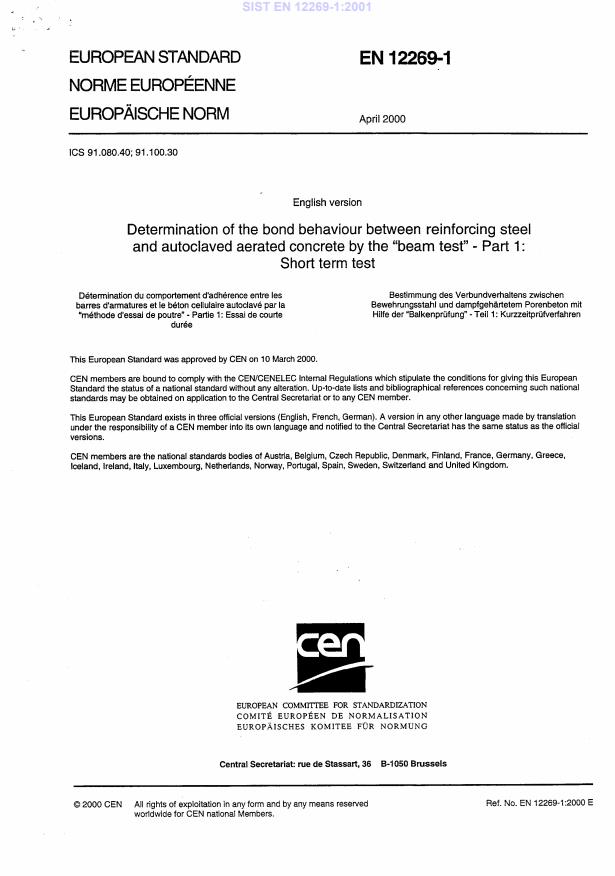
Determination of the bond behaviour between reinforcing steel and autoclaved aerated concrete by the "beam test" - Part 1: Short term test
This European Standard specifies a method of determining the bond behaviour between reinforcing bars and autoclaved aerated concrete (AAC) in prefabricated reinforced components according to prEN 12602. The test method is conceived to obtain values for the short term bond strength, tbm, with different combinations of concrete type, bar shape and corrosion protection system.
Bestimmung des Verbundverhaltens zwischen Bewehrungsstahl und dampfgehärtetem Porenbeton mit Hilfe der "Balkenprüfung" - Teil 1: Kurzzeitprüfverfahren
Diese Europäische Norm legt Festlegungen fest für ein Verfahren zur Bestimmung des Verbundverhaltens zwischen Bewehrungsstäben und dampfgehärtetem Porenbeton (AAC) in vorgefertigten bewehrten Bauteilen nach prEN 12602. Mit dem Prüfverfahren werden Ergebnisse für die Kurzzeit-Verbundfestigkeit, tbm, bei verschiedenen Kombinationen von Betonart, Stabform un Korrosionsschutzsystem erzielt.
Détermination du comportement d'adhérence entre les barres d'armatures et le béton cellulaire autoclavé par la "méthode d'essai de poutre" - Partie 1: Essai de courte durée
La présente Norme Européenne spécifie une méthode pour déterminer le comportement d'adhérence entre les barres d'armature et le béton cellulaire autoclavé (AAC) dans des éléments préfabriqués armés conformément au prEN 12602. La méthode d'essai est conçue en vue d'obtenir des valeurs de la résistance d'adhérence de courte durée tbm, pour diverses combinaisons de type de béton, de forme des barres et de système de protection contre la corrosion.
Določevanje sprijemnosti med armaturnim jeklom in avtoklaviranim celičastim betonom z upogibnim preskusom nosilca - 1. del: Kratkotrajni preskus
General Information
Relations
Overview
EN 12269-1:2000 is a European standard developed by CEN that specifies a test method for determining the bond behaviour between reinforcing steel bars and autoclaved aerated concrete (AAC) using the "beam test" technique. This standard focuses on short term testing to assess the bond strength in prefabricated reinforced AAC components, aligning with prEN 12602 requirements. Accurate measurement of bond strength is critical for ensuring the structural integrity of reinforced AAC elements in construction.
Key Topics
Bond Behaviour Assessment
The standard outlines procedures to evaluate the interaction between reinforcing bars and AAC, emphasizing the mechanical bond that enables load transfer in reinforced components.Short Term Test Method
EN 12269-1 describes a beam test designed specifically to determine the short term bond strength (tbm) under controlled conditions, measuring immediate bond performance under load.Material Combinations
The method considers different variables including concrete type, steel bar shape, and corrosion protection systems, allowing practitioners to assess how these factors influence bond behaviour.Prefabricated Components
The focus on prefabricated reinforced AAC elements supports quality assurance and design validation in off-site manufacturing processes.
Applications
Structural Design Verification
Engineers use the short term bond strength data to validate the design of reinforced AAC structural elements such as beams, panels, and blocks, ensuring safety and compliance with building codes.Quality Control in Production
Manufacturers of AAC components apply this test for quality control, verifying that reinforcement bonding meets the required specifications before delivery and installation.Material Development and Research
Researchers utilize the beam test to analyze new reinforcement materials, corrosion protection techniques, and different AAC formulations, optimizing bond performance.Corrosion Protection Evaluation
The standard facilitates testing how corrosion protection systems impact bond strength, critical for durability assessments in aggressive environments.
Related Standards
prEN 12602
Specifies requirements for prefabricated reinforced concrete products including AAC components, complementing EN 12269-1 by defining product standards and performance criteria.EN 1992 (Eurocode 2)
Provides general design principles for concrete structures, where bond behaviour data from EN 12269-1 supports the verification of reinforced AAC applications.EN 10138
Covers technical delivery conditions for prefabricated reinforcement, relevant for ensuring compatibility of steel bars tested under the beam test.EN 13693
Focuses on physical and mechanical properties of autoclaved aerated concrete, which affects bond behaviour and performance.
Keywords: EN 12269-1, bond behaviour, reinforcing steel, autoclaved aerated concrete, beam test, short term test, bond strength, AAC reinforcement, prefabricated concrete, corrosion protection, concrete standards, structural testing.
Frequently Asked Questions
EN 12269-1:2000 is a standard published by the European Committee for Standardization (CEN). Its full title is "Determination of the bond behaviour between reinforcing steel and autoclaved aerated concrete by the "beam test" - Part 1: Short term test". This standard covers: This European Standard specifies a method of determining the bond behaviour between reinforcing bars and autoclaved aerated concrete (AAC) in prefabricated reinforced components according to prEN 12602. The test method is conceived to obtain values for the short term bond strength, tbm, with different combinations of concrete type, bar shape and corrosion protection system.
This European Standard specifies a method of determining the bond behaviour between reinforcing bars and autoclaved aerated concrete (AAC) in prefabricated reinforced components according to prEN 12602. The test method is conceived to obtain values for the short term bond strength, tbm, with different combinations of concrete type, bar shape and corrosion protection system.
EN 12269-1:2000 is classified under the following ICS (International Classification for Standards) categories: 91.080.40 - Concrete structures; 91.100.30 - Concrete and concrete products. The ICS classification helps identify the subject area and facilitates finding related standards.
EN 12269-1:2000 has the following relationships with other standards: It is excused to EN 12269-2:2003. Understanding these relationships helps ensure you are using the most current and applicable version of the standard.
EN 12269-1:2000 is associated with the following European legislation: EU Directives/Regulations: 305/2011, 89/106/EEC; Standardization Mandates: M/BC/CEN/92/14. When a standard is cited in the Official Journal of the European Union, products manufactured in conformity with it benefit from a presumption of conformity with the essential requirements of the corresponding EU directive or regulation.
You can purchase EN 12269-1:2000 directly from iTeh Standards. The document is available in PDF format and is delivered instantly after payment. Add the standard to your cart and complete the secure checkout process. iTeh Standards is an authorized distributor of CEN standards.
Standards Content (Sample)
2003-01.Slovenski inštitut za standardizacijo. Razmnoževanje celote ali delov tega standarda ni dovoljeno.FHOLþDVWLPNXVBestimmung des Verbundverhaltens zwischen Bewehrungsstahl und dampfgehärtetem Porenbeton mit Hilfe der "Balkenprüfung" - Teil 1: KurzzeitprüfverfahrenDétermination du comportement d'adhérence entre les barres d'armatures et le béton cellulaire autoclavé par la "méthode d'essai de poutre" - Partie 1: Essai de courte duréeDetermination of the bond behaviour between reinforcing steel an
...
Questions, Comments and Discussion
Ask us and Technical Secretary will try to provide an answer. You can facilitate discussion about the standard in here.
Loading comments...