

EN 12390-12:2026
(Main)Testing of hardened concrete - Part 12: Determination of the carbonation resistance of concrete - Accelerated carbonation method
- Abstract
This document describes a method for evaluating the carbonation resistance of concrete using test conditions that accelerate carbonation. After a defined period of curing and a period of preconditioning, the test is carried out under controlled exposure conditions using an increased level of carbon dioxide.
NOTE The test performed under reference conditions takes a minimum of 112 days comprising a minimum age of the specimen prior to curing under water of 28 days, a minimum preconditioning period of 14 days and an exposure period to increased carbon dioxide level of 70 days.
This procedure is not a method for the determination of carbonation depths in existing concrete structures.
- Status
- Not Published
- Publication Date
- 15-Dec-2026
- Technical Committee
- CEN/TC 104 - Concrete and related products
- Current Stage
- 6055 - CEN Ratification completed (DOR) - Publishing
- Start Date
- 23-Nov-2026
- Due Date
- 31-Dec-2026
- Completion Date
- 31-Dec-2026

EN 12390-12 is a CEN standard for testing hardened concrete. It specifies an accelerated carbonation method for assessing the carbonation resistance of concrete cast as test specimens under controlled carbon dioxide, temperature and humidity conditions. The method is used to compare concrete mixes and to quantify carbonation behaviour, not to determine carbonation depth in existing concrete structures.
What does EN 12390-12 specify?
EN 12390-12 specifies how to prepare concrete specimens, condition them, expose them to increased carbon dioxide, and measure the resulting carbonation depth. It covers the full test sequence from specimen production through to calculation of the carbonation rate and reporting of results.
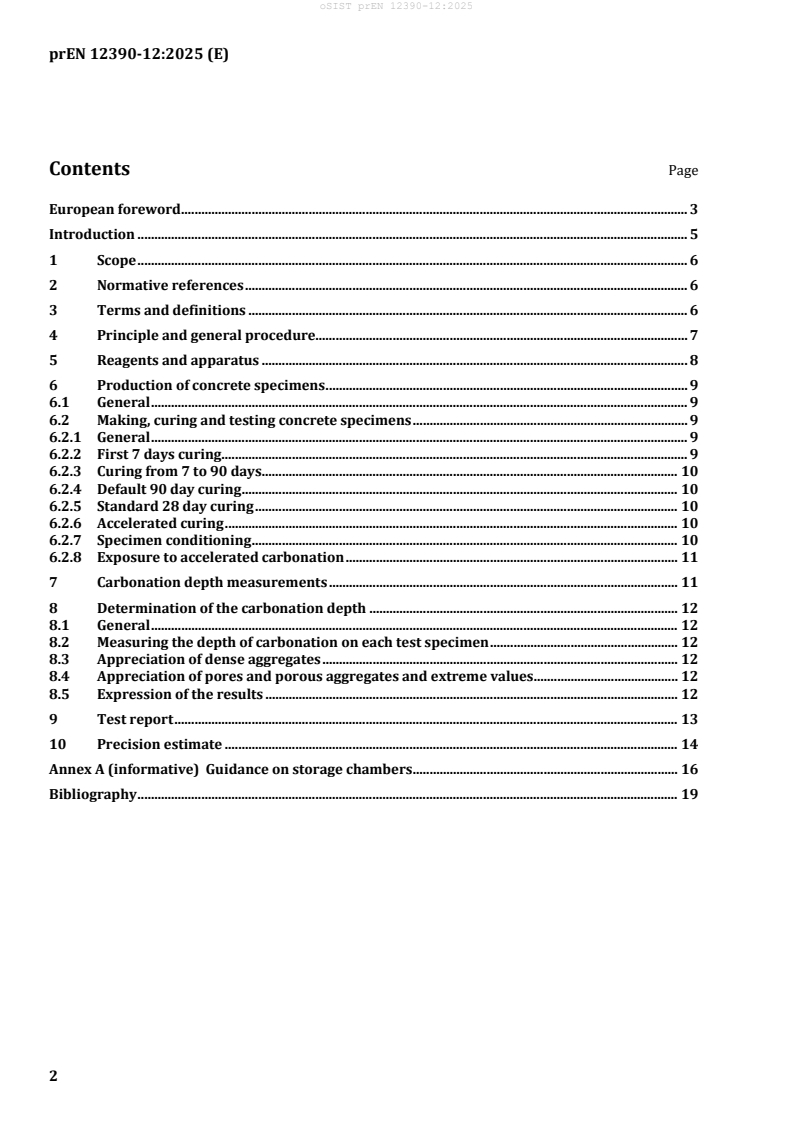
The document is organized into Scope, normative references, terms and definitions, principle and general procedure, reagents and apparatus, specimen production, carbonation depth measurement, determination of carbonation depth, test report, precision estimate, and an informative annex.
| Annex | What it covers |
|---|---|
| Annex A | Guidance on storage chambers for accelerated carbonation |
What are the key requirements of EN 12390-12?
Specimens and preparation
EN 12390-12 requires specimens to be made from a single batch of concrete for one test, using representative constituent materials. The test may use two prisms, eight cubes, or five cylinders, and the specimen size has to be large enough relative to the maximum aggregate size. In practice, this is to keep the test representative of the mix and avoid specimen size effects.
The standard asks for fresh concrete consistence or the relevant self-compacting concrete properties to be recorded using the appropriate fresh-concrete test method. It also recommends making and testing compressive strength specimens at 28 days, which helps confirm that the batch was made consistently.
Curing and conditioning
EN 12390-12 sets out default and alternative curing routes. The reference approach includes wet curing, followed by a laboratory drying period of 14 days in controlled ambient conditions before carbonation exposure. The document also allows 28-day curing or accelerated curing when specified, provided the report states which route was used.
The standard also permits an alternative conditioning route with oven drying at controlled temperature followed by storage at controlled room conditions. This matters because some concretes dry or react differently, and the conditioning step can strongly influence measured carbonation resistance.
Carbonation exposure
EN 12390-12 exposes specimens in a storage chamber with carbon dioxide at (3.0 ± 0.5) % by volume, temperature at (20 ± 2) °C, and relative humidity at (57 ± 3) %. The chamber has to maintain active control of these conditions, with monitoring of carbon dioxide, temperature, and humidity.
The standard uses exposure periods of 7, 28, and 70 days in the chamber. At each age, specimens are removed temporarily for slicing and depth measurement. The note in the scope gives the reference test duration as at least 112 days overall when the stated curing and conditioning periods are used.
Measuring carbonation depth
EN 12390-12 measures carbonation depth on freshly split surfaces using phenolphthalein solution or another indicator that changes colour in the pH 8 to 11 range. The surface is sprayed after breaking, and the depth measurements begin within a defined time window unless a fixing solution is used to preserve the colour change.
For each specimen face, the standard requires multiple measurement points and a gauge with 0.5 mm precision. The procedure also explains how to treat dense aggregate particles, pores, porous aggregates, and voids so that local anomalies do not distort the result. That is important because the carbonation front does not always appear as a straight, uniform line.
Calculating and expressing results
EN 12390-12 calculates mean carbonation depth for each face, each specimen, and each test age, then uses the exposure time in the chamber to determine the carbonation rate. The rate is obtained from a linear regression of carbonation depth against the square root of exposure time, and the slope is reported as K_AC in mm/√d.
The standard expects a coefficient of determination of at least 0.95 under standard test conditions. If very low carbonation depths are involved, the precision estimates are not applicable, so the result needs to be interpreted with care.
Reporting
EN 12390-12 requires the test report to identify the concrete, specimen type and size, casting and curing history, conditioning conditions, exposure periods, carbonation depths at each age, the carbonation rate, intercept, regression plot, and any deviations from the procedure. This gives the reader enough information to understand how the test was done and whether the result can be compared with other tests.
What terms does EN 12390-12 define?
- Carbonation rate - The average rate at which the carbonation front moves into the concrete, expressed in mm/√d; in this document it is the value K_AC.
- Depth of carbonation - The depth identified by the colour change of indicator solution on a freshly split concrete surface.
- Effective time - The time, in days, that specimens spend in the storage chamber while continuously exposed to carbon dioxide.
- Mean carbonation depth - The average carbonation depth of two specimens.
- Single point carbonation depth - The carbonation depth measured at one point on a specimen.
- Specimen carbonation depth - The average carbonation depth of one specimen.
- Specimen face carbonation depth - The average carbonation depth of one exposed face of one specimen.
Who uses EN 12390-12?
EN 12390-12 is used by concrete testing laboratories, concrete producers, materials engineers, quality managers, and specifiers who need to assess carbonation resistance of a concrete mix. It is relevant to cast test specimens prepared for product development, comparative mix testing, conformity work, and durability assessment.
The standard is aimed at the concrete and concrete products sector. It is useful where carbonation-related durability is part of design review, production control, or acceptance testing, especially for reinforced concrete applications.
What changed in EN 12390-12 from the previous edition?
EN 12390-12 supersedes EN 12390-12:2020. The document states that the main technical changes are:
- the scope has been updated;
- alternatives for adapted curing times and procedures have been added;
- an alternative preconditioning procedure has been added;
- the changes support concretes with slowly reacting binders.
Which standards are used with EN 12390-12?
EN 12390-12 refers to several other standards for specimen preparation and fresh-concrete testing:
- EN 12350-2 - slump test for fresh concrete, used to record consistence.
- EN 12350-3 - Vebe test, used where that method is appropriate for fresh consistency.
- EN 12350-4 - degree of compactability, used for fresh concrete characterization.
- EN 12350-5 - flow table test, used for consistency assessment.
- EN 12390-2 - making and curing specimens for strength tests, used for casting and curing the test specimens.
- EN 12390-10 - carbonation resistance of concrete at atmospheric levels of carbon dioxide, used as a related comparison method for carbonation performance.
- EN 12390-1 - specimen shape, dimensions and other requirements, used when selecting specimen dimensions.
- EN 206 - concrete specification, performance, production and conformity, used as a broader reference for concrete mix specification and production context.
What does the EN 12390-12 document contain?
EN 12390-12 contains a principle and general procedure, apparatus requirements, specimen production rules, carbonation depth measurement instructions, and a method for calculating carbonation rate from measurements taken at 7, 28, and 70 days of chamber exposure. It also includes the reporting requirements and a precision estimate based on validation work.
The document also includes two figures in the main text showing how to treat dense aggregates, porous aggregates, and voids when locating the carbonation front. Annex A provides guidance on storage chambers, including chamber layout, gas injection, air circulation, specimen spacing, and active control of carbon dioxide, temperature, and relative humidity.
Clause 10 provides precision estimates from a CEN validation exercise at 4 % carbon dioxide, and the bibliography points to EN 206, EN 12350-8, EN 12390-10, and CEN/TR 17172 for related context.
Relations
- Effective Date
- 18-Jan-2023
Get Certified
Connect with accredited certification bodies for this standard

DIBt (Deutsches Institut für Bautechnik)
German Institute for Building Technology.

DIN CERTCO
DIN Group product certification.

Aboma Certification B.V.
Specialized in construction, metal, and transport sectors.
Sponsored listings
Frequently Asked Questions
EN 12390-12:2026 is a draft published by the European Committee for Standardization (CEN). Its full title is "Testing of hardened concrete - Part 12: Determination of the carbonation resistance of concrete - Accelerated carbonation method". This standard covers: This document describes a method for evaluating the carbonation resistance of concrete using test conditions that accelerate carbonation. After a defined period of curing and a period of preconditioning, the test is carried out under controlled exposure conditions using an increased level of carbon dioxide. NOTE The test performed under reference conditions takes a minimum of 112 days comprising a minimum age of the specimen prior to curing under water of 28 days, a minimum preconditioning period of 14 days and an exposure period to increased carbon dioxide level of 70 days. This procedure is not a method for the determination of carbonation depths in existing concrete structures.
This document describes a method for evaluating the carbonation resistance of concrete using test conditions that accelerate carbonation. After a defined period of curing and a period of preconditioning, the test is carried out under controlled exposure conditions using an increased level of carbon dioxide. NOTE The test performed under reference conditions takes a minimum of 112 days comprising a minimum age of the specimen prior to curing under water of 28 days, a minimum preconditioning period of 14 days and an exposure period to increased carbon dioxide level of 70 days. This procedure is not a method for the determination of carbonation depths in existing concrete structures.
EN 12390-12:2026 is classified under the following ICS (International Classification for Standards) categories: 91.100.30 - Concrete and concrete products. The ICS classification helps identify the subject area and facilitates finding related standards.
EN 12390-12:2026 has the following relationships with other standards: It is inter standard links to EN 12390-12:2020. Understanding these relationships helps ensure you are using the most current and applicable version of the standard.
EN 12390-12:2026 is available in PDF format for immediate download after purchase. The document can be added to your cart and obtained through the secure checkout process. Digital delivery ensures instant access to the complete standard document.
Standards Content (Sample)
Contents
- Introduction
- 1 Scope
- 2 Normative references
- 3 Terms and definitions
- 3.1 carbonation rate
- 3.2 depth of carbonation
- 3.3 effective time
- 3.4 mean carbonation depth
- 3.5 single point carbonation depth
- 3.6 specimen carbonation depth
- 3.7 specimen face carbonation depth
- 4 Principle and general procedure
- 5 Reagents and apparatus
- 6 Production of concrete specimens
- 6.1 General
- 6.2 Making, curing and testing concrete specimens
- 7 Carbonation depth measurements
- 8 Determination of the carbonation depth
- 8.1 General
- 8.2 Measuring the depth of carbonation on each test specimen
- 8.3 Appreciation of dense aggregates
- 8.4 Appreciation of pores and porous aggregates and extreme values
- 8.5 Expression of the results
- 9 Test report
- 10 Precision estimate
- Annex A
- 4 CO2 inlet 10 gas input
- Bibliography
Introduction
Reinforced concrete structures need to be durable to ensure that the intended working life is achieved. The resistance to corrosion of reinforcement induced by carbonation plays a significant role in a structure’s serviceability and consequently carbonation behaviour of concrete is an important property to measure. This document specifies an accelerated test method applicable to cast test specimens, in order to assess the carbonation behaviour of a concrete mix.
oSIST prEN 12390-12:2025 prEN 12390-12:2025 (E)
1 Scope
This document describes a method for evaluating the carbonation resistance of concrete using test conditions that accelerate carbonation. After a defined period of curing and a period of preconditioning, the test is carried out under controlled exposure conditions using an increased level of carbon dioxide. NOTE The test performed under reference conditions takes a minimum of 112 days comprising a minimum age of the specimen prior to curing under water of 28 days, a minimum preconditioning period of 14 days and an exposure period to increased carbon dioxide level of 70 days.
This procedure is not a method for the determination of carbonation depths in existing concrete structures.
2 Normative references
The following documents are referred to in the text in such a way that some or all of their content constitutes requirements of this document. For dated references, only the edition cited applies. For undated references, the latest edition of the referenced document (including any amendments) applies. EN 12350-2, Testing fresh concrete — Part 2: Slump test EN 12350-3, Testing fresh concrete — Part 3: Vebe test EN 12350-4, Testing fresh concrete — Part 4: Degree of compactability EN 12350-5, Testing fresh concrete — Part 5: Flow table test EN 12390-2, Testing hardened concrete — Part 2: Making and curing specimens for strength tests
3 Terms and definitions
For the purposes of this document, the following terms and definitions apply. ISO and IEC maintain terminology databases for use in standardization at the following addresses:
- IEC Electropedia: available at https://www.electropedia.org/
- ISO Online browsing platform: available at https://www.iso.org/obp
3.1 carbonation rate
average rate at which the carbonation front penetrates concrete expressed as mm/√d (days) Note 1 to entry: The carbonation rate varies depending upon the test curing, preconditioning or exposure conditions. The carbonation rate is strictly associated with the conditions under which it was obtained. The abbreviation ‘KAC’ is the carbonation rate under the test conditions specified in this document.
3.2 depth of carbonation
depth as measured using a phenolphthalein solution or an alternative indicator that results in a colour change in the range of pH 8 to pH 11 on the freshly-split concrete surface
3.3 effective time
time in days spent in the storage chamber with the concrete specimens continually exposed to carbon dioxide
oSIST prEN 12390-12:2025 prEN 12390-12:2025 (E)
3.4 mean carbonation depth
d k mean depth of carbonation of two specimens
3.5 single point carbonation depth
d k, point depth of carbonation recorded for a single point on a specimen Note 1 to entry: This is the measured depth of carbonation except where the measurement point coincides with a dense particle, porous particle or void, see 8.3 and 8.4.
3.6 specimen carbonation depth
d k, spec mean depth of carbonation of a single specimen
3.7 specimen face carbonation depth
d k, face mean depth of carbonation of a single exposed face of a single specimen
4 Principle and general procedure
2 concrete prisms, 8 concrete cubes or 5 concrete cylinders are cast and thereupon after a defined period of curing and conditioning, and then placed in a storage chamber with a carbon dioxide concentration within the storage chamber in percent by volume of (3,0 ± 0,5) % when the storage
chamber is at normal conditions (1 013 mbar at 25 °C) , temperature (20 ± 2) °C and relative humidity (57 ± 3) % for periods of up to 70 days. Immediately prior to placing specimens in the storage chamber and after prescribed ages corresponding to 7, 28 and 70 days of storage in the chamber (this gives approximately equidistant values of √days), 2 of the cubes are split in half; 1 cylinder is split in half along its vertical axis and a 50 mm slice is split from each of the prisms and the depths of carbonation measured.
On one half of each cylinder or each slice of prism or on one half of each cube, twelve single point carbonation depths (d ) are measured after each exposure period and the depth of carbonation d , k,point k at that exposure time is expressed as the mean of the two test specimens. Using measurements taken at the fixed times, the carbonation rate expressed as mm/√d is determined.
CO concentration can vary with altitude above the sea level.
oSIST prEN 12390-12:2025 prEN 12390-12:2025 (E)
5 Reagents and apparatus
A solution of 0,8 g of phenolphthalein powder dissolved in a solution of 70 ml ethanol and 30 ml of deionised water or a suitable alternative indicator giving a colour change in the range pH 8 to 11 that gives a sufficiently clear colour change in concrete to differentiate the neutralized zone, e.g.
thymolphthalein .
WARNING — Phenolphthalein is listed in REACH appendix 2 and its lists of substances of very high concern. Phenolphthalein powder should be handled with the greatest care using safety gloves in a fume cupboard fitted with an extractor.
Where needed, a fixing solution to permanently fix the colour change in the concrete specimen, see Clause 7.
NOTE 1 Suppliers of some indicator solutions also provide a fixing solution that permanently fixes the colour change.
A magnifier and a gauge with a precision of 0,5 mm.
A ventilated oven in which the temperature is capable of being controlled to (45 ± 5) °C. The oven is only used in case of alternative conditioning. The volume of the oven shall be not less than 2,5 times the volume of all the specimens to be dried at the same time.
A storage chamber with a carbon dioxide concentration within the storage chamber in percent by volume as indicated in Clause 4, temperature at (20 ± 2) °C and a relative humidity at (57 ± 3) %, see Annex A for details of a suitable chamber. The carbon dioxide concentration shall be within ± 0,5 % by volume of the target value with no variation for longer than 4 h outside the target value ± 1,0 %. NOTE 2 Experience [5] has shown that if saturated surface-dry specimens are placed in the storage chamber shortly after removal from water curing, the relative humidity can exceed that permitted. Also, without active control of the carbon dioxide concentration, the levels can drop below the permitted tolerance as the carbonation process continues. Therefore, it is important that the storage chamber has active control on carbon dioxide concentration, relative humidity and temperature.
NOTE 3 Relative humidity levels is maintained using methods at the discretion of the laboratory, for example active humidification/dehumidification.
When the door of the storage chamber is opened, the carbon dioxide concentration within the chamber can fall rapidly, and therefore, for practical reasons, a short period of low carbon dioxide concentration is acceptable. The cumulative periods of times of low carbon dioxide concentration cannot exceed 4 % of the storage time of 63 days. The relative carbon dioxide concentration is expected to be within ± 0,1 % by volume of the target value during 96 % of the storage time in the carbonation chamber Apparatus for recording the relative humidity with a maximum permissible measurement error of ± 3,0 % and the temperature with a maximum permissible measurement error of ± 0,5 °C. Apparatus for recording CO concentration with a maximum permissible measurement error of ± 0,1 %
by volume.
The recording apparatus can be fitted with an audio/visual/email or other suitable alarm to alert breaches of CO concentration within the storage chamber due to possible apparatus malfunction.
Thymolphthalein is not currently classified under REACH as a health or environmental hazard.
oSIST prEN 12390-12:2025 prEN 12390-12:2025 (E) The accuracy of the sensors shall be higher than the requirements for the CO and humidity content
measurements. The CO and humidity sensors shall be controlled and calibrated regularly
Fans to facilitate steady circulation of air within the storage chamber.
6 Production of concrete specimens
6.1 General
Representative samples of the constituents, e.g. cement, aggregates, shall be used for making the test specimens. Either a sample of concrete is taken from the concrete production plant or the concrete mixes shall be produced using the laboratory’s standard procedures. The specimens for one test shall be cast from a single batch of concrete.
NOTE A minimum batch volume of 50 l is sufficient.
Where the specimens are prepared by the client or their representative, the test laboratory shall be informed of the day of casting and a confirmation that the specimens were stored as required by this document.
Each test shall comprise at least two prismatic beams each being at least 280 mm long and the designated size d, according to EN 12390-1, shall be at least three times the maximum aggregate size or two cubes per test age with a side length of at least three times the maximum aggregate size. Prismatic beams with designated size d of 100 mm are the reference specimens. Avoid or minimize the use of mould release agents on the moulds as they may influence the carbonation depth.
...