

EN 12004-2:2017
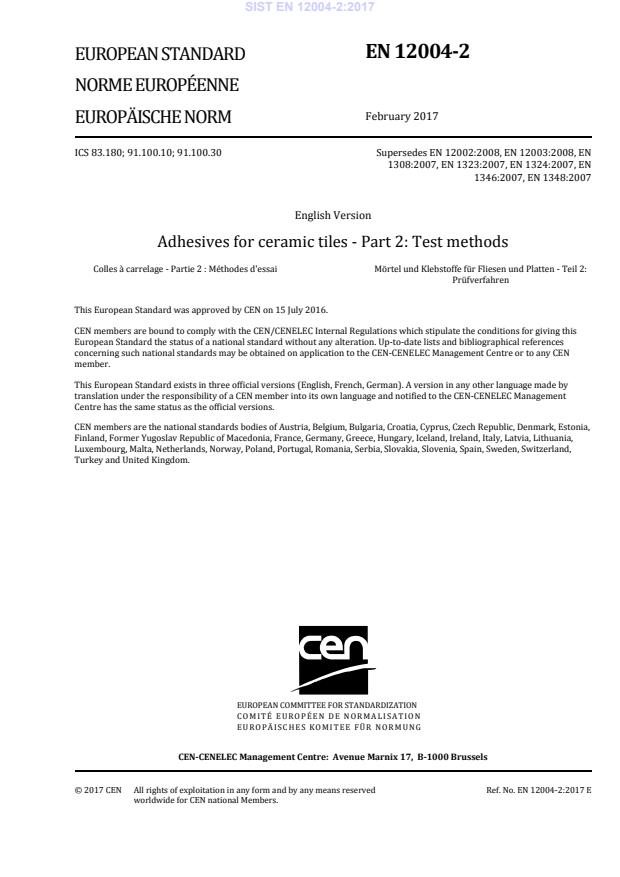
(Main)Adhesives for ceramic tiles - Part 2: Test methods
General Information
- Abstract
This European Standard specifies the methods for determining characteristics for adhesives used in internal and external installation of ceramic tiles.
This European Standard does not contain performance requirements or recommendations for the design and installation of ceramic tiles.
The following test methods are described:
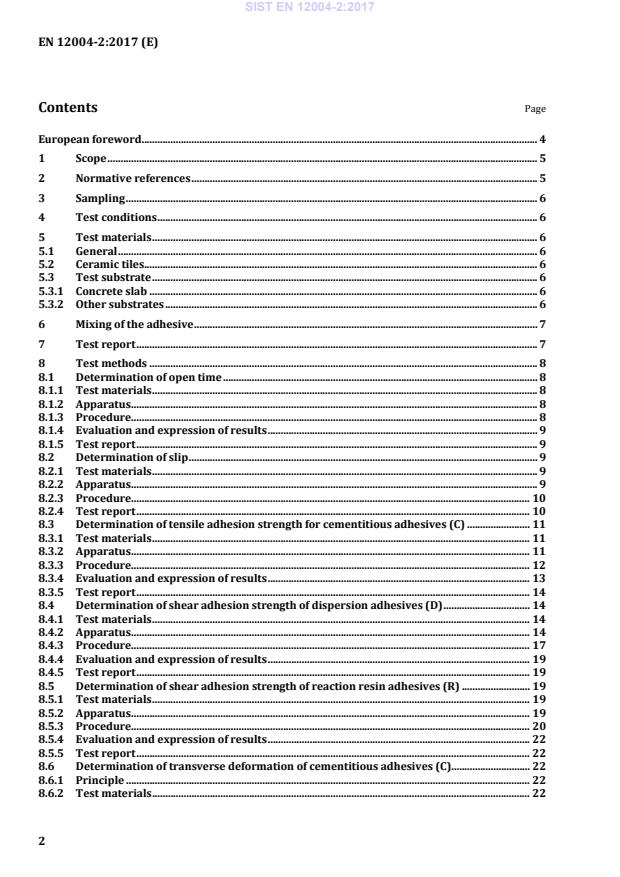
- determination of open time (8.1);
- determination of slip (8.2);
- determination of tensile adhesion strength for cementitious adhesives (8.3);
- determination of shear adhesion strength of dispersion adhesives (8.4);
- determination of shear adhesion strength of reaction resin adhesives (8.5);
- determination of transverse deformation of cementitious adhesives (8.6).
NOTE Ceramic tile adhesives can be used also for other kinds of tiles (natural and agglomerated stones, etc.), if they do not adversely affect the stones.
WARNING - This European Standard can involve hazardous materials and operations. Persons using this standard should be familiar with normal laboratory practice. This European Standard does not purport to address all the safety problems, if any, associated with its use. It is the responsibility of the user to establish appropriate safety and health practices and to ensure compliance with any European and national regulatory conditions.
- Status
- Published
- Publication Date
- 14-Feb-2017
- Withdrawal Date
- 30-Aug-2017
- Technical Committee
- CEN/TC 67 - Ceramic tiles
- Drafting Committee
- CEN/TC 67/WG 3 - Adhesives and grouts for tiles
- Current Stage
- 9093 - Decision to confirm - Review Enquiry
- Start Date
- 28-Feb-2023
- Completion Date
- 23-Sep-2026

Overview - EN 12004-2:2017 (Adhesives for ceramic tiles - Test methods)
EN 12004-2:2017, published by CEN, specifies standardized laboratory test methods for adhesives used in internal and external installation of ceramic tiles. It defines how to sample, condition, prepare and test adhesives (cementitious, dispersion and reaction-resin types) to determine key performance characteristics. This Part 2 standard is strictly about test methods - it does not set performance requirements or provide design/installation guidance.
Key facts
- Intended for adhesive testing in controlled laboratory conditions: (23 ± 2) °C, (50 ± 5) % RH, air speed < 0.2 m/s.
- Minimum sample: 2 kg (per EN ISO 15605 / EN 1067).
- Safety notice: tests may involve hazardous materials; normal laboratory practice is required.
Key topics and technical requirements
- Test methods covered
- Determination of open time (Clause 8.1)
- Determination of slip (8.2)
- Tensile adhesion strength for cementitious adhesives (8.3)
- Shear adhesion strength for dispersion adhesives (8.4)
- Shear adhesion strength for reaction resin adhesives (8.5)
- Transverse deformation of cementitious adhesives (8.6)
- Test substrates and concrete slab requirements
- Concrete slab ≥ 35 mm thick, surface water absorption after 4 h: 0.5–1.5 cm³, moisture < 3 % (carbide method), and tensile adhesion strength ≥ 1.5 N/mm².
- Mixing and sample preparation
- Cementitious adhesives mixed to manufacturer’s specified liquid-to-powder ratio.
- Detailed mixer procedure: use ~2 kg batch in a mixer per EN 196‑1:2016 slow settings (≈ 140 ± 5 rpm, planetary movement 62 ± 5), with defined mixing and maturation steps.
- Conditioning tolerances
- Examples: 6 h ±15 min; 7 d ±3 h; 28 d ±12 h - testing must occur within these windows.
Applications and who uses this standard
EN 12004-2 is primarily used by:
- Independent testing laboratories and conformity assessment bodies performing standardized tile adhesive tests.
- Adhesive manufacturers validating product performance and compiling technical data.
- Product certifiers and compliance teams referencing test methods for CE marking or national certification.
- Specifiers, architects and consultants who require reliable laboratory data when comparing adhesives (note: use alongside EN 12004‑1 for classification and requirements).
Practical uses include generating reproducible data for technical datasheets, supporting product development and troubleshooting field failures by comparing laboratory adhesion and deformation properties.
Related standards
- EN 12004-1: Requirements, classification and marking (complements Part 2)
- EN 196-1: Methods for testing cement (mixing guidance)
- EN 14411: Ceramic tiles - definitions and classifications
- EN ISO 15605, EN 1067: Sampling and sample preparation
Keywords: EN 12004-2, adhesives for ceramic tiles, test methods, tile adhesive testing, tensile adhesion strength, open time, slip, transverse deformation.
Relations
- Effective Date
- 08-Jun-2022
- Effective Date
- 22-Feb-2017
- Effective Date
- 22-Feb-2017
- Effective Date
- 22-Feb-2017
- Effective Date
- 12-Dec-2012
- Effective Date
- 28-Jan-2026
- Effective Date
- 28-Jan-2026
- Effective Date
- 28-Jan-2026
- Effective Date
- 28-Jan-2026
- Effective Date
- 28-Jan-2026
- Effective Date
- 28-Jan-2026
- Effective Date
- 28-Jan-2026
- Effective Date
- 28-Jan-2026
- Effective Date
- 28-Jan-2026
- Effective Date
- 28-Jan-2026
Get Certified
Connect with accredited certification bodies for this standard

DIN CERTCO
DIN Group product certification.
DIBt (Deutsches Institut für Bautechnik)
German Institute for Building Technology.

Aboma Certification B.V.
Specialized in construction, metal, and transport sectors.
Sponsored listings
Frequently Asked Questions
EN 12004-2:2017 is a standard published by the European Committee for Standardization (CEN). Its full title is "Adhesives for ceramic tiles - Part 2: Test methods". This standard covers: This European Standard specifies the methods for determining characteristics for adhesives used in internal and external installation of ceramic tiles. This European Standard does not contain performance requirements or recommendations for the design and installation of ceramic tiles. The following test methods are described: - determination of open time (8.1); - determination of slip (8.2); - determination of tensile adhesion strength for cementitious adhesives (8.3); - determination of shear adhesion strength of dispersion adhesives (8.4); - determination of shear adhesion strength of reaction resin adhesives (8.5); - determination of transverse deformation of cementitious adhesives (8.6). NOTE Ceramic tile adhesives can be used also for other kinds of tiles (natural and agglomerated stones, etc.), if they do not adversely affect the stones. WARNING - This European Standard can involve hazardous materials and operations. Persons using this standard should be familiar with normal laboratory practice. This European Standard does not purport to address all the safety problems, if any, associated with its use. It is the responsibility of the user to establish appropriate safety and health practices and to ensure compliance with any European and national regulatory conditions.
This European Standard specifies the methods for determining characteristics for adhesives used in internal and external installation of ceramic tiles. This European Standard does not contain performance requirements or recommendations for the design and installation of ceramic tiles. The following test methods are described: - determination of open time (8.1); - determination of slip (8.2); - determination of tensile adhesion strength for cementitious adhesives (8.3); - determination of shear adhesion strength of dispersion adhesives (8.4); - determination of shear adhesion strength of reaction resin adhesives (8.5); - determination of transverse deformation of cementitious adhesives (8.6). NOTE Ceramic tile adhesives can be used also for other kinds of tiles (natural and agglomerated stones, etc.), if they do not adversely affect the stones. WARNING - This European Standard can involve hazardous materials and operations. Persons using this standard should be familiar with normal laboratory practice. This European Standard does not purport to address all the safety problems, if any, associated with its use. It is the responsibility of the user to establish appropriate safety and health practices and to ensure compliance with any European and national regulatory conditions.
EN 12004-2:2017 is classified under the following ICS (International Classification for Standards) categories: 83.180 - Adhesives; 91.100.10 - Cement. Gypsum. Lime. Mortar; 91.100.30 - Concrete and concrete products. The ICS classification helps identify the subject area and facilitates finding related standards.
EN 12004-2:2017 has the following relationships with other standards: It is inter standard links to EN 12002:2008, EN 12003:2008/AC:2009, EN 1324:2007, EN 1323:2007, EN 12003:2008, EN 12004-1:2017, EN 14411:2016, EN 1067:2005, EN 196-1:2016, EN 459-2:2021, EN ISO 15605:2004, EN 13408:2002, EN ISO 17178:2020, EN 14293:2006, EN 14891:2012. Understanding these relationships helps ensure you are using the most current and applicable version of the standard.
EN 12004-2:2017 is available in PDF format for immediate download after purchase. The document can be added to your cart and obtained through the secure checkout process. Digital delivery ensures instant access to the complete standard document.
Standards Content (Sample)
2003-01.Slovenski inštitut za standardizacijo. Razmnoževanje celote ali delov tega standarda ni dovoljeno.Mörtel und Klebstoffe für Fliesen und Platten - Teil 2: PrüfverfahrenColles à carrelage - Partie 2: Méthodes d'essaiAdhesives for tiles - Part 2: Test methods91.100.23Ceramic tiles83.180LepilaAdhesivesICS:Ta slovenski standard je istoveten z:EN 12004-2:2017SIST EN 12004-2:2017en,fr,de01-maj-2017SIST EN 12004-2:2017SLOVENSKI
STANDARDSIST EN 1324:2007SIST EN 1323:2007SIST EN 1348:2007SIST EN 1346:2007SIST EN 12003:2009SIST EN 12002:2009SIST EN 1308:2007SIST EN 12003:2009/AC:20091DGRPHãþD
EUROPEAN STANDARD NORME EUROPÉENNE EUROPÄISCHE NORM
EN 12004-2
February
t r s y ICS
z uä s z râ
{ sä s r rä s râ
{ sä s r rä u r Supersedes EN
s t r r tã t r r zá EN
s t r r uã t r r zá EN
s u r zã t r r yá EN
s u t uã t r r yá EN
s u t vã t r r yá EN
s u v xã t r r yá EN
s u v zã t r r yEnglish Version
Adhesives for ceramic tiles æ Part
tã Test methods Colles à carrelage æ Partie
t ã Méthodes d 5essai
Mörtel und Klebstoffe für Fliesen und Platten æ Teil
tã Prüfverfahren This European Standard was approved by CEN on
s w July
t r s xä
egulations which stipulate the conditions for giving this European Standard the status of a national standard without any alterationä Upætoædate lists and bibliographical references concerning such national standards may be obtained on application to the CENæCENELEC Management Centre or to any CEN memberä
translation under the responsibility of a CEN member into its own language and notified to the CENæCENELEC Management Centre has the same status as the official versionsä
CEN members are the national standards bodies of Austriaá Belgiumá Bulgariaá Croatiaá Cyprusá Czech Republicá Denmarká Estoniaá Finlandá Former Yugoslav Republic of Macedoniaá Franceá Germanyá Greeceá Hungaryá Icelandá Irelandá Italyá Latviaá Lithuaniaá Luxembourgá Maltaá Netherlandsá Norwayá Polandá Portugalá Romaniaá Serbiaá Slovakiaá Sloveniaá Spainá Swedená Switzerlandá Turkey and United Kingdomä
EUROPEAN COMMITTEE FOR STANDARDIZATION COMITÉ EUROPÉEN DE NORMALISATION EUROPÄISCHES KOMITEE FÜR NORMUNG
CEN-CENELEC Management Centre:
Avenue Marnix 17,
B-1000 Brussels
t r s y CEN All rights of exploitation in any form and by any means reserved worldwide for CEN national Membersä Refä Noä EN
s t r r væ tã t r s y ESIST EN 12004-2:2017
Concrete slab for test . 27 A.1 General information . 27 A.2 Test conditions . 27 A.3 Apparatus . 27 A.4 Concrete slab . 27 A.4.1 Manufacture of the concrete slab. 27 A.4.2 Conditioning of the concrete slab . 28 A.4.3 Water absorption at the surface. 28 A.4.4 Tensile adhesion strength . 28 A.4.5 Data recorded . 28 Annex B (normative)
Failure patterns . 31 B.1 Adhesion failure (AF-S or AF-T) . 31 B.2 Cohesive failure within the adhesive (CF-A) . 32 B.3 Cohesive failure in the substrate or in the tile (CF-S or CF-T) . 33 Bibliography . 35
¶ 0,5 % by mass, unglazed, with plane adhering surface and with facial dimensions of (100 ± 1) mm x (100 ± 1) mm, a mass of (200 ± 10) g and a thickness in the range of 8 mm to 10 mm. 8.2.1.2 Test substrate The concrete slab shall comply with the requirements given in 5.3.1. 8.2.2 Apparatus 8.2.2.1 Steel straight edge. 8.2.2.2 Clamps. SIST EN 12004-2:2017
Key 1 steel straight edge 2 masking tape 25 mm wide 3 25 mm x 25 mm x 10 mm thick spacers 4 tile: 100 mm x 100 mm 5 adhesive 6 concrete slab Figure 1 — Slip test 8.3 Determination of tensile adhesion strength for cementitious adhesives (C) 8.3.1 Test materials 8.3.1.1 Ceramic tiles The tiles used for this test shall be dry pressed ceramic tile in accordance with EN 14411, Group BIa, fully vitrified, with a water absorption of
¶ 0,5 % by mass, unglazed and with a plain, matt, adhering surface, with facial dimensions of (50 ± 1) mm x (50 ± 1) mm. 8.3.1.2 Test substrate The concrete test substrate shall conform to requirements given in 5.3.1. 8.3.2 Apparatus 8.3.2.1 Weight (Mass). SIST EN 12004-2:2017
...