

EN 13888-1:2022
(Main)Grouts for ceramic tiles - Part 1: Requirements, classification, designation, marking and labelling
General Information
- Abstract
This document is applicable to ceramic tile grouts for internal and external tile installations on walls and floors.
This document gives the terminology concerning the products, working methods (see Annex A), application properties, etc. for ceramic tile grouts.
This document specifies the performance requirements for cementitious and reaction resin grouts for ceramic tiles.
This document does not contain criteria or recommendations for the design and installation of ceramic tiles.
Ceramic tile grouts can also be used for other types of tiles (natural and agglomerated stones, etc.), where these do not adversely affect these materials.
- Status
- Published
- Publication Date
- 13-Sep-2022
- Technical Committee
- CEN/TC 67 - Ceramic tiles
- Drafting Committee
- CEN/TC 67/WG 3 - Adhesives and grouts for tiles
- Current Stage
- 6060 - Definitive text made available (DAV) - Publishing
- Start Date
- 14-Sep-2022
- Due Date
- 12-Nov-2021
- Completion Date
- 14-Sep-2022



Overview
EN 13888-1:2022 – Grouts for Ceramic Tiles – Part 1: Requirements, Classification, Designation, Marking and Labelling is a key European standard developed by CEN for quality assurance in the manufacture and application of grouts for ceramic tiles. The document applies to ceramic tile grouts used for both internal and external installations on walls and floors. It provides standardized terminology and sets out essential performance requirements for both cementitious and reaction resin grouts. While the standard does not address tile installation or design, its guidance ensures that grouts meet quality, durability, and labeling expectations across a variety of applications.
Key Topics
Product Types and Definitions
EN 13888-1:2022 distinguishes between two main types of grouts:- Cementitious grouts (CG): Traditional grouts based on hydraulic binding agents.
- Reaction resin grouts (RG): Grouts based on synthetic resins, requiring specific curing through chemical reaction.
Performance Requirements
The standard outlines clear requirements for:- Flexural and compressive strength
- Abrasion resistance
- Water absorption
- Shrinkage and chemical resistance These characteristics ensure grout performance under varied environmental and usage conditions.
Classification and Designation
Grouts are classified using an easy-to-understand reference system that identifies key qualities:- CG1/CG2: Normal or improved cementitious grout
- F: Fast setting
- W/A: Reduced water absorption / High abrasion resistance
Marking and Labelling
EN 13888-1 mandates comprehensive labelling, including:- Product and manufacturer details
- Date or production code
- Grout type and application instructions
- Shelf life and storage conditions Such marking supports product traceability and correct on-site usage.
Applications
EN 13888-1:2022 is widely applicable in numerous construction settings, promoting quality, consistency, and reliable performance for:
Residential and Commercial Flooring and Walls:
Suitable for bathrooms, kitchens, public areas, and exterior facades, where consistent grout quality prevents premature joint failure and supports long-lasting tile installations.Special Substrates:
While targeted at ceramic tiles, the standard also applies-when compatible-to grouting natural stone and agglomerated stone tiles, enhancing its practical reach.Industrial and Hygienic Environments:
Reaction resin grouts, with their higher abrasion, chemical, and water resistance, are specified for more demanding settings such as food processing, laboratories, and industrial facilities.Renovation and New Construction:
Builders, tile contractors, and renovation specialists benefit from standardized product labeling and performance criteria, ensuring compliance and durability in both refurbishment and new builds.
Related Standards
EN 13888-2:2022 – Grouts for Ceramic Tiles – Part 2: Test Methods:
Provides test methods for verifying the performance requirements outlined in Part 1.EN 14411 – Ceramic Tiles:
Defines properties, classification, and assessment of ceramic tiles, offering context for appropriate grout selection.ISO and IEC Terminologies:
Referenced for standardized definitions and further harmonization across international standards.
By adhering to EN 13888-1:2022, manufacturers, specifiers, and installers ensure reliable, durable grout performance in all types of ceramic tile applications. The standard integrates clear classification, performance testing, and labeling to support safe and effective use in construction projects throughout Europe and beyond.
Relations
- Effective Date
- 28-Jan-2026
- Effective Date
- 28-Jan-2026
- Effective Date
- 21-Sep-2022
Get Certified
Connect with accredited certification bodies for this standard

DIBt (Deutsches Institut für Bautechnik)
German Institute for Building Technology.
DIN CERTCO
DIN Group product certification.

Aboma Certification B.V.
Specialized in construction, metal, and transport sectors.
Sponsored listings
Frequently Asked Questions
EN 13888-1:2022 is a standard published by the European Committee for Standardization (CEN). Its full title is "Grouts for ceramic tiles - Part 1: Requirements, classification, designation, marking and labelling". This standard covers: This document is applicable to ceramic tile grouts for internal and external tile installations on walls and floors. This document gives the terminology concerning the products, working methods (see Annex A), application properties, etc. for ceramic tile grouts. This document specifies the performance requirements for cementitious and reaction resin grouts for ceramic tiles. This document does not contain criteria or recommendations for the design and installation of ceramic tiles. Ceramic tile grouts can also be used for other types of tiles (natural and agglomerated stones, etc.), where these do not adversely affect these materials.
This document is applicable to ceramic tile grouts for internal and external tile installations on walls and floors. This document gives the terminology concerning the products, working methods (see Annex A), application properties, etc. for ceramic tile grouts. This document specifies the performance requirements for cementitious and reaction resin grouts for ceramic tiles. This document does not contain criteria or recommendations for the design and installation of ceramic tiles. Ceramic tile grouts can also be used for other types of tiles (natural and agglomerated stones, etc.), where these do not adversely affect these materials.
EN 13888-1:2022 is classified under the following ICS (International Classification for Standards) categories: 01.040.91 - Construction materials and building (Vocabularies); 91.100.10 - Cement. Gypsum. Lime. Mortar. The ICS classification helps identify the subject area and facilitates finding related standards.
EN 13888-1:2022 has the following relationships with other standards: It is inter standard links to EN 13888-2:2022, EN 419212-2:2017, EN 13888:2009. Understanding these relationships helps ensure you are using the most current and applicable version of the standard.
EN 13888-1:2022 is available in PDF format for immediate download after purchase. The document can be added to your cart and obtained through the secure checkout process. Digital delivery ensures instant access to the complete standard document.
Standards Content (Sample)
SLOVENSKI STANDARD
01-november-2022
Nadomešča:
SIST EN 13888:2009
Fugirne mase za keramične ploščice - 1. del: Zahteve, klasifikacija, označba,
označevanje in etiketiranje
Grouts for ceramic tiles - Part 1: Requirements, classification, designation, marking and
labelling
Fugenmörtel für keramische Fliesen und Platten - Teil 1: Anforderungen, Klassifizierung,
Bezeichnung und Kennzeichnung
Mortiers de jointoiement pour carreaux et dalles céramiques - Partie 1 : Exigences,
classification, désignation, marquage et étiquetage
Ta slovenski standard je istoveten z: EN 13888-1:2022
ICS:
01.040.91 Gradbeni materiali in gradnja Construction materials and
(Slovarji) building (Vocabularies)
91.100.10 Cement. Mavec. Apno. Malta Cement. Gypsum. Lime.
Mortar
91.100.23 Keramične ploščice Ceramic tiles
2003-01.Slovenski inštitut za standardizacijo. Razmnoževanje celote ali delov tega standarda ni dovoljeno.
EN 13888-1
EUROPEAN STANDARD
NORME EUROPÉENNE
September 2022
EUROPÄISCHE NORM
ICS 01.040.91; 91.100.10 Supersedes EN 13888:2009
English Version
Grouts for ceramic tiles - Part 1: Requirements,
classification, designation, marking and labelling
Mortiers de jointoiement pour carreaux et dalles Fugenmörtel für keramische Fliesen und Platten - Teil
céramiques - Partie 1 : Exigences, classification, 1: Anforderungen, Klassifizierung, Bezeichnung und
désignation, marquage et étiquetage Kennzeichnung
This European Standard was approved by CEN on 28 November 2021.
CEN members are bound to comply with the CEN/CENELEC Internal Regulations which stipulate the conditions for giving this
European Standard the status of a national standard without any alteration. Up-to-date lists and bibliographical references
concerning such national standards may be obtained on application to the CEN-CENELEC Management Centre or to any CEN
member.
This European Standard exists in three official versions (English, French, German). A version in any other language made by
translation under the responsibility of a CEN member into its own language and notified to the CEN-CENELEC Management
Centre has the same status as the official versions.
CEN members are the national standards bodies of Austria, Belgium, Bulgaria, Croatia, Cyprus, Czech Republic, Denmark, Estonia,
Finland, France, Germany, Greece, Hungary, Iceland, Ireland, Italy, Latvia, Lithuania, Luxembourg, Malta, Netherlands, Norway,
Poland, Portugal, Republic of North Macedonia, Romania, Serbia, Slovakia, Slovenia, Spain, Sweden, Switzerland, Türkiye and
United Kingdom.
EUROPEAN COMMITTEE FOR STANDARDIZATION
COMITÉ EUROPÉEN DE NORMALISATION
EUROPÄISCHES KOMITEE FÜR NORMUNG
CEN-CENELEC Management Centre: Rue de la Science 23, B-1040 Brussels
© 2022 CEN All rights of exploitation in any form and by any means reserved Ref. No. EN 13888-1:2022 E
worldwide for CEN national Members.
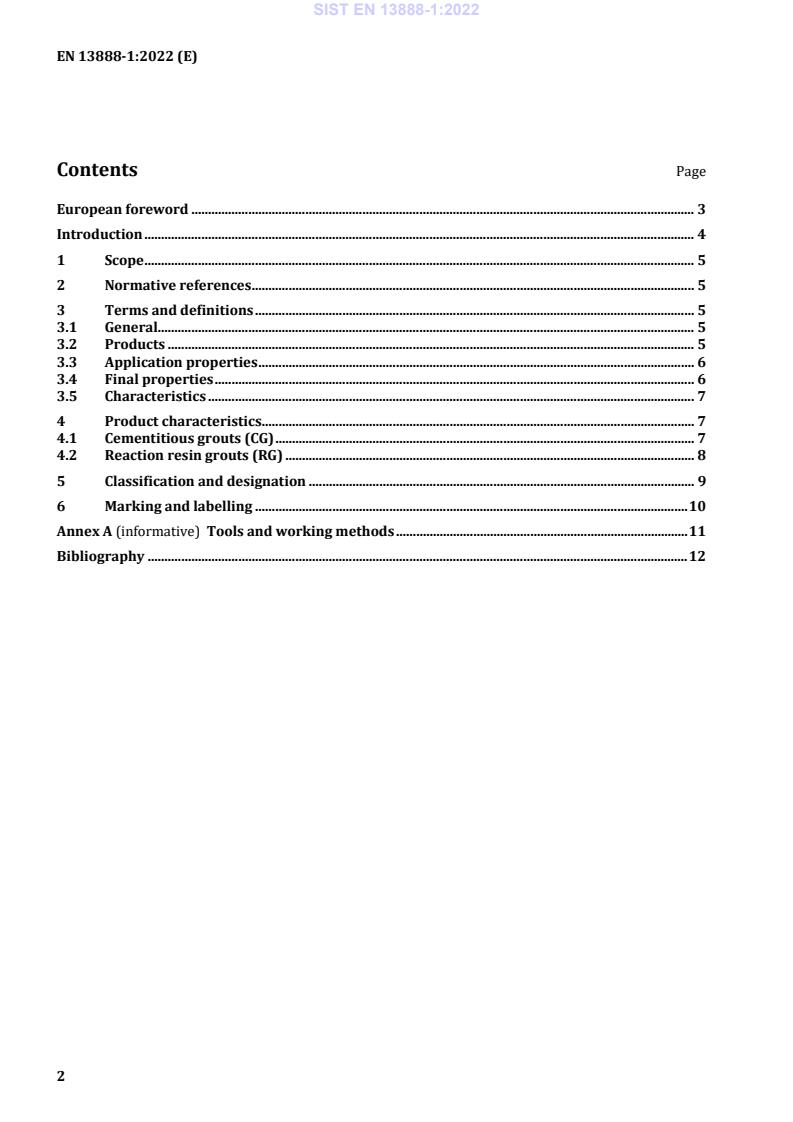
Contents Page
European foreword . 3
Introduction . 4
1 Scope . 5
2 Normative references . 5
3 Terms and definitions . 5
3.1 General. 5
3.2 Products . 5
3.3 Application properties . 6
3.4 Final properties . 6
3.5 Characteristics . 7
4 Product characteristics . 7
4.1 Cementitious grouts (CG) . 7
4.2 Reaction resin grouts (RG) . 8
5 Classification and designation . 9
6 Marking and labelling . 10
Annex A (informative) Tools and working methods . 11
Bibliography . 12
European foreword
This document (EN 13888-1:2022) has been prepared by Technical Committee CEN/TC 67 “Ceramic
tiles”, the secretariat of which is held by UNI.
This European Standard shall be given the status of a national standard, either by publication of an
identical text or by endorsement, at the latest by March 2023, and conflicting national standards shall
be withdrawn at the latest by March 2023.
Attention is drawn to the possibility that some of the elements of this document may be the subject of
patent rights. CEN shall not be held responsible for identifying any or all such patent rights.
This document supersedes EN 13888:2009.
The significant changes between this document and the previous edition are listed herewith:
— Clause 2 Normative references;
— Clause 3 Terms and definitions;
— Clause 4 Specifications;
— Clause 5 Evaluation of conformity of the previous edition has been deleted;
— Clause 5 Classification and designation (Clause 6 of the previous edition).
This document belongs to the EN 13888 series, Grouts for ceramic tiles, which consists of the following
parts:
— Part 1: Requirements, classification, designation, marking and labelling;
— Part 2: Test methods.
Any feedback and questions on this document should be directed to the users’ national standards body.
A complete listing of these bodies can be found on the CEN website.
According to the CEN-CENELEC Internal Regulations, the national standards organisations of the
following countries are bound to implement this European Standard: Austria, Belgium, Bulgaria,
Croatia, Cyprus, Czech Republic, Denmark, Estonia, Finland, France, Germany, Greece, Hungary, Iceland,
Ireland, Italy, Latvia, Lithuania, Luxembourg, Malta, Netherlands, Norway, Poland, Portugal, Republic of
North Macedonia, Romania, Serbia, Slovakia, Slovenia, Spain, Sweden, Switzerland, Türkiye and the
United Kingdom.
Introduction
The characteristics of the construction products defined in this document take into consideration that
the normal stresses due to the works for which they are intended, assembled or installed, can be
properly accommodated. Some special characteristics will take into account the type of substrate and
that the grouts should resist the degrading actions of climate, environment, etc.
Many properties of grouts for ceramic tiles are mainly determined by the type of binders used.
Tile grouts are defined in different types depending on the chemical nature of their binders.
The different types have specific characteristics in terms of application properties and final
performance.
The relationship between characteristics and the working conditions (dry or humid conditions, hot
climate, fast setting, etc.) is not given in this document.
The manufacturer gives information about the use of the product and the correct conditions of use.
The specifier evaluates the state of the job site (mechanical, thermal and chemical influences) and
chooses the appropriate product considering all the possible risks.
1 Scope
This document is applicable to ceramic tile grouts for internal and external tile installations on walls
and floors.
This document gives the terminology concerning the products, working methods (see Annex A),
application properties, etc. for ceramic tile grouts.
This document specifies the performance requirements for cementitious and reaction resin grouts for
ceramic tiles.
This document does not contain criteria or recommendations for the design and installation of ceramic
tiles.
Ceramic tile grouts can also be used for other types of tiles (natural and agglomerated stones, etc.),
where these do not adversely affect these materials.
2 N
...