

EN 12004-1:2017
(Main)Adhesives for ceramic tiles - Part 1: Requirements, assessment and verification of constancy of performance, classification and marking
- Abstract
This European Standard is applicable to the following three types of adhesives for ceramic tiles, i.e. cementitious ones for internal and external tile installations, dispersion and reaction resin ones for internal tile installations, on walls and floors.
This European Standard gives the terminology concerning the products, working methods, application properties, etc, for ceramic tile adhesives.
This European Standard specifies the performance requirements for the adhesives for ceramic tiles.
It also specifies the appurtenant test methods, assessment and verification of constancy of performance (AVCP), as well as classification, designation and marking of adhesives for ceramic tiles.
This European Standard does not provide criteria or recommendations for the design and installation of ceramic tiles.
Ceramic tile adhesives may also be used for other types of tiles (natural and agglomerated stones, etc.), if they do not adversely affect these materials.
- Status
- Published
- Publication Date
- 14-Feb-2017
- Withdrawal Date
- 29-Nov-2018
- Technical Committee
- CEN/TC 67 - Ceramic tiles
- Drafting Committee
- CEN/TC 67/WG 3 - Adhesives and grouts for tiles
- Current Stage
- 9093 - Decision to confirm - Review Enquiry
- Start Date
- 13-Oct-2025
- Completion Date
- 07-Oct-2026

Overview
EN 12004-1:2017 - "Adhesives for ceramic tiles - Part 1" is a CEN European Standard that defines the requirements, assessment and verification of constancy of performance (AVCP), classification and marking for adhesives used with ceramic tiles. The standard covers three adhesive types: cementitious (C) for internal and external installations, dispersion (D) and reaction resin (R) for internal installations on walls and floors. It provides product terminology, performance requirements and references to test methods, but does not give design or installation guidance.
Key topics and technical requirements
- Scope and product types: cementitious, dispersion and reaction resin adhesives, including applicability to some natural and agglomerated stones provided they are not harmed by the adhesive.
- Terminology: unified terms for tools, working methods (thin bed, floating, floating-and-buttering), application properties (open time, pot-life, wetting, slip) and final properties (adhesion strength, deformability, transverse deformation).
- Performance requirements: defined basic and optional characteristics for each adhesive type. Examples from the standard:
- Cementitious adhesives (C1, C1F) have tensile adhesion strength criteria (e.g., initial and after conditioning), open time requirements (e.g., not less than 20 min for some classes) and early strength for fast-setting types (C1F).
- Testing and AVCP: specifies test methods (see EN 12004-2:2017 for test methods), sampling, type testing, factory production control (FPC) and reporting requirements to ensure constancy of performance.
- Classification, designation and marking: rules for product designation (e.g., C1, C1F, D, R) and labelling so manufacturers and specifiers can identify applicable performance classes.
- Reaction to fire & chemical resistance: includes provisions for fire classification (A1, E, etc.) and resistance to chemical attack where relevant.
- Regulatory alignment: includes informative Annex ZA to relate the standard to the Construction Products Regulation (EU) No. 305/2011.
Applications and who uses this standard
EN 12004-1:2017 is used by:
- Manufacturers - to develop, classify and label ceramic tile adhesives and prepare Declarations of Performance (DoP).
- Testing laboratories - to perform type testing and verify performance (tensile adhesion, open time, durability).
- Specifiers, architects and consultants - to select adhesives that meet defined performance classes for specific substrates and service conditions.
- Contractors and installers - to understand product claims (though not a substitute for installation guidance).
- Regulatory authorities and procurement - to assess compliance with EU rules and contract requirements.
Practical uses include specifying the right adhesive for interior or exterior tiling, ensuring product conformity for safety and durability, and supporting CE marking and DoP documentation.
Related standards
- EN 12004-2:2017 (Test methods)
- EN 14411 (Ceramic tiles)
- EN 13238, EN 13501-1 (reaction to fire)
- EN 12808-1 (chemical resistance for reaction resin mortars)
Keywords: EN 12004-1:2017, adhesives for ceramic tiles, cementitious adhesives, dispersion adhesives, reaction resin adhesives, AVCP, classification and marking, test methods.
Relations
- Effective Date
- 22-Feb-2017
- Effective Date
- 05-Aug-2026
- Effective Date
- 28-Jan-2026
- Effective Date
- 28-Jan-2026
- Effective Date
- 28-Jan-2026
- Effective Date
- 28-Jan-2026
- Effective Date
- 28-Jan-2026
- Effective Date
- 28-Jan-2026
- Effective Date
- 28-Jan-2026
- Effective Date
- 28-Jan-2026
- Effective Date
- 28-Jan-2026
- Effective Date
- 18-Jan-2023
- Effective Date
- 18-Jan-2023
Get Certified
Connect with accredited certification bodies for this standard

DIN CERTCO
DIN Group product certification.
DIBt (Deutsches Institut für Bautechnik)
German Institute for Building Technology.

Aboma Certification B.V.
Specialized in construction, metal, and transport sectors.
Sponsored listings
Frequently Asked Questions
EN 12004-1:2017 is a standard published by the European Committee for Standardization (CEN). Its full title is "Adhesives for ceramic tiles - Part 1: Requirements, assessment and verification of constancy of performance, classification and marking". This standard covers: This European Standard is applicable to the following three types of adhesives for ceramic tiles, i.e. cementitious ones for internal and external tile installations, dispersion and reaction resin ones for internal tile installations, on walls and floors. This European Standard gives the terminology concerning the products, working methods, application properties, etc, for ceramic tile adhesives. This European Standard specifies the performance requirements for the adhesives for ceramic tiles. It also specifies the appurtenant test methods, assessment and verification of constancy of performance (AVCP), as well as classification, designation and marking of adhesives for ceramic tiles. This European Standard does not provide criteria or recommendations for the design and installation of ceramic tiles. Ceramic tile adhesives may also be used for other types of tiles (natural and agglomerated stones, etc.), if they do not adversely affect these materials.
This European Standard is applicable to the following three types of adhesives for ceramic tiles, i.e. cementitious ones for internal and external tile installations, dispersion and reaction resin ones for internal tile installations, on walls and floors. This European Standard gives the terminology concerning the products, working methods, application properties, etc, for ceramic tile adhesives. This European Standard specifies the performance requirements for the adhesives for ceramic tiles. It also specifies the appurtenant test methods, assessment and verification of constancy of performance (AVCP), as well as classification, designation and marking of adhesives for ceramic tiles. This European Standard does not provide criteria or recommendations for the design and installation of ceramic tiles. Ceramic tile adhesives may also be used for other types of tiles (natural and agglomerated stones, etc.), if they do not adversely affect these materials.
EN 12004-1:2017 is classified under the following ICS (International Classification for Standards) categories: 83.180 - Adhesives; 91.100.10 - Cement. Gypsum. Lime. Mortar. The ICS classification helps identify the subject area and facilitates finding related standards.
EN 12004-1:2017 has the following relationships with other standards: It is inter standard links to EN 12004:2007+A1:2012, EN 13238:2026, EN 14411:2016, EN 13888-2:2022, EN 13238:2010, EN 13501-1:2018, EN 14891:2017, EN 1348:2007, EN 1346:2007, EN 14891:2012, EN 12004-2:2017, prEN 12004-3, FprEN 12004-1. Understanding these relationships helps ensure you are using the most current and applicable version of the standard.
EN 12004-1:2017 is associated with the following European legislation: EU Directives/Regulations: 305/2011; Standardization Mandates: M/127. When a standard is cited in the Official Journal of the European Union, products manufactured in conformity with it benefit from a presumption of conformity with the essential requirements of the corresponding EU directive or regulation.
EN 12004-1:2017 is available in PDF format for immediate download after purchase. The document can be added to your cart and obtained through the secure checkout process. Digital delivery ensures instant access to the complete standard document.
Standards Content (Sample)
2003-01.Slovenski inštitut za standardizacijo. Razmnoževanje celote ali delov tega standarda ni dovoljeno.YHUMDQMHMörtel und Klebstoffe für keramische Fliesen und Platten - Teil 1: Anforderungen, Bewertung und Überprüfung der Leistungsbeständigkeit, Einstufung und KennzeichnungColles à carrelage - Partie 1: Exigences, évaluation et vérification de la constance de performance, classification et marquageAdhesives for ceramic tiles - Part 1: Requirements, assessment and verification of constancy of performance, classification and marking91.100.23Ceramic tiles91.100.10Cement. Mavec. Apno. MaltaCement. Gypsum. Lime. Mortar83.180LepilaAdhesivesICS:Ta slovenski standard je istoveten z:EN 12004-1:2017SIST EN 12004-1:2017en,fr,de01-maj-2017SIST EN 12004-1:2017SLOVENSKI
STANDARDSIST EN 12004:2007+A1:20121DGRPHãþD
EUROPEAN STANDARD NORME EUROPÉENNE EUROPÄISCHE NORM
EN 12004-1
February
t r s y ICS
z uä s z râ
{ sä s r rä s r Supersedes EN
s t r r vã t r r y ªA sã t r s tEnglish Version
Adhesives for ceramic tiles æ Part
sã Requirementsá assessment and verification of constancy of performanceá classification and marking Colles à carrelage æ Partie
sã Exigencesá évaluation et vérification de la constance de performanceá classification et marquage
Mörtel und Klebstoffe für keramische Fliesen und Platten æ Teil
sã Anforderungená Bewertung und Überprüfung der Leistungsbeständigkeitá Einstufung und Kennzeichnung This European Standard was approved by CEN on
t z November
t r s xä
egulations which stipulate the conditions for giving this European Standard the status of a national standard without any alterationä Upætoædate lists and bibliographical references concerning such national standards may be obtained on application to the CENæCENELEC Management Centre or to any CEN memberä
translation under the responsibility of a CEN member into its own language and notified to the CENæCENELEC Management Centre has the same status as the official versionsä
CEN members are the national standards bodies of Austriaá Belgiumá Bulgariaá Croatiaá Cyprusá Czech Republicá Denmarká Estoniaá Finlandá Former Yugoslav Republic of Macedoniaá Franceá Germanyá Greeceá Hungaryá Icelandá Irelandá Italyá Latviaá Lithuaniaá Luxembourgá Maltaá Netherlandsá Norwayá Polandá Portugalá Romaniaá Serbiaá Slovakiaá Sloveniaá Spainá Swedená Switzerlandá Turkey and United Kingdomä
EUROPEAN COMMITTEE FOR STANDARDIZATION COMITÉ EUROPÉEN DE NORMALISATION EUROPÄISCHES KOMITEE FÜR NORMUNG
CEN-CENELEC Management Centre:
Avenue Marnix 17,
B-1000 Brussels
t r s y CEN All rights of exploitation in any form and by any means reserved worldwide for CEN national Membersä Refä Noä EN
s t r r væ sã t r s y ESIST EN 12004-1:2017
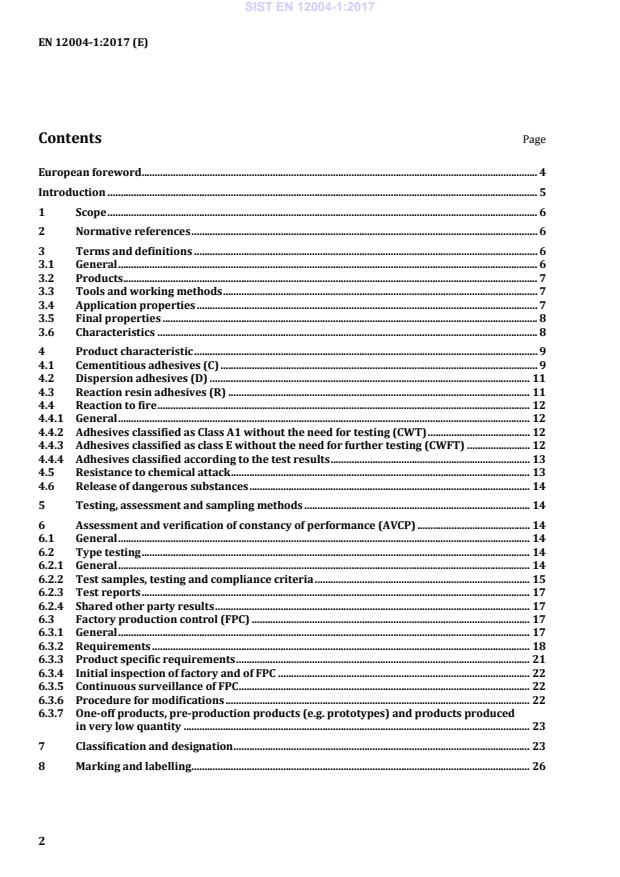
Relationship of this European Standard with Regulation (EU) No. 305/2011 . 27 ZA.1 Scope and relevant characteristics . 27 ZA.2 System of Assessment and Verification of Constancy of Performance (AVCP) . 30 ZA.3 Assignment of AVCP tasks . 30 Bibliography . 33
NORMAL SETTING ADHESIVES (C1) Characteristic Requirement Test Method Initial tensile adhesion strength
0,5 N/mm2 EN 12004–2:2017, 8.3 Tensile adhesion strength after water immersion
0,5 N/mm2 Tensile adhesion strength after heat ageing
0,5 N/mm2 Tensile adhesion strength after freeze–thaw cycles
0,5 N/mm2 Open time: tensile adhesion strength
0,5 N/mm2 after not less than 20 min EN 12004–2:2017, 8.1 1 b
FAST SETTING ADHESIVES (C1F) Characteristic Requirement Test Method Early tensile adhesion strength
0,5 N/mm2 after not more than 6 h EN 12004–2:2017, 8.3 Open time: tensile adhesion strength
0,5 N/mm2 after not less than 10 min EN 12004–2:2016, 8.1 All other requirements as in Table 1 a EN 12004–2:2017, 8.3 OPTIONAL CHARACTERISTICS 1 c
SPECIAL CHARACTERISTICS Characteristic Requirement Test Method Slip (T)
0,5 mm EN 12004–2:2017, 8.2 Extended open time (E): tensile adhesion strength
0,5 N/mm2 after not less than 30 min EN 12004–2:2017, 8.1 Deformable adhesive (S1): transverse deformation
2,5 mm and < 5 mm EN 12004–2:2017, 8.6 Highly deformable adhesive (S2): transverse deformation:
5 mm 1 d
ADDITIONAL CHARACTERISTICS (C2) Characteristic Requirement Test Method High initial tensile adhesion strength
1 N/mm2 EN 12004–2:2017, 8.3 High tensile adhesion strength after water immersion
1 N/mm2 High tensile adhesion strength after heat ageing
1 N/mm2 High tensile adhesion strength after freeze–thaw cycles
1 N/mm2 1 e
FAST SETTING ADHESIVES (C2F) Characteristic Requirement Test Method Early tensile adhesion strength
0,5 N/mm2 after not more than 6 h EN 12004–2:2017, 8.3 Open time: tensile adhesion strength
0,5 N/mm2 after not less than 10 min EN 12004–2:2017, 8.1 All other requirements as in Table 1 d EN 12004–2:2017, 8.3 SIST EN 12004-1:2017
BASIC CHARACTERISTICS (D1) Characteristic Requirement Test Method Initial shear adhesion strength
1 N/mm2 EN 12004–2:2017, 8.4 Shear adhesion strength after heat ageing
1 N/mm2 Open time: tensile adhesion strength
0,5 N/mm2 after not less than 20 min EN 12004–2:2017, 8.1 OPTIONAL CHARACTERISTICS 2 b
SPECIAL CHARACTERISTICS Characteristic Requirement Test Method Slip (T)
0,5 mm EN 12004–2:2017, 8.2 Extended open time (E): tensile adhesion strength
0,5 N/mm2 after not less than 30 min EN 12004–2:2017, 8.1 2 c
ADDITIONAL CHARACTERISTICS (D2) Characteristic Requirement Test Method Shear adhesion strength after water immersion
0,5 N/mm2 EN 12004–2:2017, 8.4 Shear adhesion strength at elevated temperature
1 N/mm2 4.3 Reaction resin adhesives (R) Characteristics of the reaction resin adhesive for ceramic tiles shall comply with the requirements specified in Table 3 a. When needed for special service condition(s) of reaction resin adhesive for ceramic tiles, its optional characteristics shall comply with the requirements specified in Tables 3 b and/or 3 c. SIST EN 12004-1:2017
BASIC CHARACTERISTICS (R1) Characteristic Requirement Test Method Initial shear adhesion strength
2 N/mm2 EN 12004–2:2017, 8.5 Shear adhesion strength after water immersion
2 N/mm2 Open time: tensile adhesion strength
0,5 N/mm2 after not less than 20 min EN 12004–2:2017, 8.1 OPTIONAL CHARACTERISTICS 3 b
SPECIAL CHARACTERISTICS Characteristic Requirement Test Method Slip (T)
0,5 mm EN 12004–2:2017, 8.2 3 c
ADDITIONAL CHARACTERISTICS (R2) Characteristic Requirement Test Method Shear adhesion strength after thermal shock
2 N/mm2 EN 12004–2:2017, 8.5 4.4 Reaction to fire 4.4.1 General The reaction to fire performance of adhesive for ceramic tiles shall be declared as the class in accordance with EN 13501-1, based on one of the following options: a) either without the need for testing (CWT), according to 4.4.2, or without the need for further testing (CWFT), according to 4.4.3, when meeting the requirements, specified therein, or otherwise b) based on results of the test method(s), relevant to specific reaction to fire class, and carried out in accordance with the standard(s), referred to in EN 13501-1, as specified in 4.4.4. 4.4.2 Adhesives classified as Class A1 without the need for testing (CWT) The reaction to fire performance of a given type of adhesive for ceramic tiles may be declared as Class A11) without the need for testing, provided that it contains not more than 1 % of homogeneously distributed organic material, by mass or volume (whichever is the most onerous). 4.4.3 Adhesives classified as class E without the need for further testing (CWFT) The reaction to fire performance of a given type of adhesive for ceramic tiles may be declared as class given in Table 4 2) when meeting the requirements for specific type of adhesive, specified therein.
1) See Decision of the Commission 96/603/EC of 1996-10-04 (see OJEU L267 of 1996-10-19), as amended by 2000/605/EC of 2000-09-26 (see OJEU L258 of 2000-10-12) and 2003/424/EC of 2003-06-06 (see OJEU L144 of 2003-06-12). 2) This table is the same as Table of the Commission Decision 2010/81/EC of 2010-02-09 (see OJEU L038 of 2010-02-11). SIST EN 12004-1:2017
680 kg/m3. b Class as provided for in Table 1 of the Annex to the Commission delegated regulation (EU) 2016/364. 4.4.4 Adhesives classified according to the test results 4.4.4.1 The reaction to fire performance of a given type of adhesive for ceramic tiles shall be declared as class (including the additional classification for smoke production and flaming droplets/particles, if any), determined on a base of results of the tests carried out on the specimens prepared according to 4.4.4.2 and 4.4.4.3, in accordance with the relevant methods, which are specified for considered class in the standards referred in EN 13501-1. 4.4.4.2 The specimens of the adhesive, which are to be tested, shall be sampled, prepared and conditioned according to EN 13238 under the following test conditions: — substrate: paper-faced gypsum plaster board; — conditioning: 28 days, (23 ± 2) °C and (50 ± 5) % relative humidity; — number of specimen: 6. 4.4.4.3 In addition, the test specimen shall be prepared as follows for the following reaction to fire classes: a) for class E or EFL and class F or FFL: — apply the adhesive with a notched trowel 10 mm × 10 mm, notches at 20 mm centres; b) for class (A2, B, C or D) or (A2FL, BFL, CFL or DFL): — apply the adhesive with a notched trowel 10 mm × 10 mm, notches at 20 mm centres; — position and align ceramic tiles, classified as group BIa according to EN 14411, with facial dimensions (50 ± 1) mm × (50 ± 1) mm into the adhesive; — place the tiles 5 mm apart. 4.5 Resistance to chemical attack The resistance to chemical attack of the reaction resin adhesive for ceramic tiles shall be determined in accordance with EN 12808-1. NOTE 1 The resistance to chemical attack is relevant for the reaction resin adhesives for ceramic tiles only. SIST EN 12004-1:2017
a For uses subject to the reaction to fire regulations only. b Appropriate test/assessment method(s) to check compliance with the requirements relevant for application of CWT or CWFT cases (see 4.4.2 and 4.4.3, respectively). c Test method(s), which are specified for considered class in the standards referred in EN 13501–1. d Minimum FPC frequency: A means at least one test for every 1000 tonnes, with a minimum of one time per year and a maximum of one time per month, B means at least one test per year for production below 2500 tonnes/y and two tests per year for production over 2500 tonnes/y. C means no direct testing. However, the composition shall be checked at regular intervals. 6.3.2.7 Non-complying products The manufacturer shall have written procedures which specify how non-complying products shall be dealt with. Any such events shall be recorded as they occur and these records shall be kept for the period defined in the manufacturer’s written procedures. Where the product fails to satisfy the acceptance criteria, the provisions for non-complying products shall apply, the necessary corrective action(s) shall immediately be taken and the products or batches not complying shall be isolated and properly identified. Once the fault has been corrected, the test or verification in question shall be repeated. SIST EN 12004-1:2017
...