

EN 14324:2004
(Main)Brazing - Guidance on the application of brazed joints
General Information
- Abstract
This document gives guidance on the application of brazing and the manufacture of brazed joints. This standard gives an introduction to brazing and a basis for the understanding and use of brazing in different applications. Because of the wide range of applications of brazing this standard does not give detailed guidance that might be product specific. For such information reference should be made to the appropriate product standard or, for applications where this does not exist, the relevant criteria should be clearly established before any brazing is undertaken.
This standard covers joint design and assembly, material aspects for both parent material and filler materials, brazing process and process variables, pre- and post-braze treatment and inspection.
- Status
- Published
- Publication Date
- 21-Sep-2004
- Withdrawal Date
- 30-Mar-2005
- Technical Committee
- CEN/TC 121 - Welding
- Drafting Committee
- CEN/TC 121/WG 20 - Brazing
- Current Stage
- 9093 - Decision to confirm - Review Enquiry
- Start Date
- 08-May-2009
- Completion Date
- 08-May-2009

Overview
EN 14324:2004 - Brazing: Guidance on the application of brazed joints (CEN) is a European guidance standard that introduces brazing principles and provides a practical basis for the correct use of brazed joints. It explains the brazing process (a joining method using a filler metal with liquidus > 450 °C), key design and material considerations, process variables, pre- and post-braze treatment and inspection. The standard is intentionally non-product-specific and directs users to relevant product standards where more detailed requirements are needed.
Key topics and requirements
- Joint design
- Basic joint types (lap and butt) and practical design guidance to optimise strength and manufacturability.
- Control of assembly gap (room temperature) vs brazing gap (at brazing temperature) and capillary flow considerations.
- Stress distribution, fit-up, surface finish and assembly methods affecting joint performance.
- Materials
- Guidance on parent materials and selection considerations for dissimilar metals.
- Filler materials: selection, common forms and compatibility with parent metals.
- Fluxes and flux removal, plus guidance on protective and vacuum atmospheres.
- Brazing methods
- Overview of typical methods: flame, induction, resistance, furnace (including vacuum and protective atmosphere), immersion, and special methods (laser, braze-welding).
- Practical notes on method selection, size limitations and safety considerations.
- Process control and heat treatment
- Key process variables, pre/post-braze treatments and recommended heat treatment considerations to protect parent material properties.
- Inspection and testing
- Guidance on inspection and acceptance; references to destructive and non-destructive tests and brazer/procedure approval processes.
- Scope limitation
- Not a product specification - users must consult product standards (e.g., EN 1044, EN 12797, EN 12799) when applicable.
Applications and users
EN 14324 is practical for:
- Design and manufacturing engineers specifying brazed assemblies
- Fabricators and brazing operatives selecting processes and filler metals
- Quality, inspection and NDT personnel establishing acceptance criteria
- R&D and product development teams evaluating joint configurations Typical applications include joining, cladding and component assembly across aerospace, HVAC, automotive, heat-exchanger and general metal fabrication industries.
Related standards (select)
- EN 1044 - Brazing filler metals
- EN 1045 - Fluxes for brazing
- EN 12797 - Destructive tests of brazed joints
- EN 12799 - Non-destructive examination of brazed joints
- EN 13133 / EN 13134 - Brazer and procedure approval
EN 14324:2004 is a practical entry point for understanding brazed joint application and provides the foundation for selecting the correct materials, joint designs and brazing methods while pointing users to product-specific and test standards for detailed requirements.
Relations
- Effective Date
- 28-Jan-2026
- Effective Date
- 28-Jan-2026
- Effective Date
- 28-Jan-2026
- Effective Date
- 28-Jan-2026
- Effective Date
- 28-Jan-2026
- Effective Date
- 28-Jan-2026
- Effective Date
- 28-Jan-2026
- Effective Date
- 09-Feb-2026
- Effective Date
- 09-Feb-2026
- Effective Date
- 28-Jan-2026
- Effective Date
- 28-Jan-2026
- Effective Date
- 19-Jan-2023
Get Certified
Connect with accredited certification bodies for this standard

DVS-ZERT GmbH
German welding certification society.
CARES (UK Certification Authority for Reinforcing Steels)
UK certification for reinforcing steels and construction.
EWF/IIW (European/International Welding Federation)
International welding personnel certification.
Sponsored listings
Frequently Asked Questions
EN 14324:2004 is a standard published by the European Committee for Standardization (CEN). Its full title is "Brazing - Guidance on the application of brazed joints". This standard covers: This document gives guidance on the application of brazing and the manufacture of brazed joints. This standard gives an introduction to brazing and a basis for the understanding and use of brazing in different applications. Because of the wide range of applications of brazing this standard does not give detailed guidance that might be product specific. For such information reference should be made to the appropriate product standard or, for applications where this does not exist, the relevant criteria should be clearly established before any brazing is undertaken. This standard covers joint design and assembly, material aspects for both parent material and filler materials, brazing process and process variables, pre- and post-braze treatment and inspection.
This document gives guidance on the application of brazing and the manufacture of brazed joints. This standard gives an introduction to brazing and a basis for the understanding and use of brazing in different applications. Because of the wide range of applications of brazing this standard does not give detailed guidance that might be product specific. For such information reference should be made to the appropriate product standard or, for applications where this does not exist, the relevant criteria should be clearly established before any brazing is undertaken. This standard covers joint design and assembly, material aspects for both parent material and filler materials, brazing process and process variables, pre- and post-braze treatment and inspection.
EN 14324:2004 is classified under the following ICS (International Classification for Standards) categories: 25.160.50 - Brazing and soldering. The ICS classification helps identify the subject area and facilitates finding related standards.
EN 14324:2004 has the following relationships with other standards: It is inter standard links to EN ISO 13585:2024, EN ISO 18496:2021, EN ISO 17779:2025, EN 12797:2000, EN 1044:1999, EN ISO 18279:2023, EN 12799:2000, EN 60404-6:2003, EN 62044-3:2001, EN 16125:2015, EN 16125:2019, prEN 14324. Understanding these relationships helps ensure you are using the most current and applicable version of the standard.
EN 14324:2004 is available in PDF format for immediate download after purchase. The document can be added to your cart and obtained through the secure checkout process. Digital delivery ensures instant access to the complete standard document.
Standards Content (Sample)
2003-01.Slovenski inštitut za standardizacijo. Razmnoževanje celote ali delov tega standarda ni dovoljeno.Trdo spajkanje – Navodilo za uporabo spajkanih spojevHartlöten - Anleitung zur Anwendung hartgelöteter VerbindungenBrasage fort - Guide d'application pour les assemblages réalisés par brasage fortBrazing - Guidance on the application of brazed joints25.160.50Trdo in mehko lotanjeBrazing and solderingICS:Ta slovenski standard je istoveten z:EN 14324:2004SIST EN 14324:2004en01-november-2004SIST EN 14324:2004SLOVENSKI
STANDARD
EUROPEAN STANDARDNORME EUROPÉENNEEUROPÄISCHE NORMEN 14324September 2004ICS 25.160.50 English versionBrazing - Guidance on the application of brazed jointsBrasage fort - Guide d'application pour les assemblagesréalisés par brasage fortHartlöten - Anleitung zur Anwendung hartgelöteterVerbindungenThis European Standard was approved by CEN on 9 July 2004.CEN members are bound to comply with the CEN/CENELEC Internal Regulations which stipulate the conditions for giving this EuropeanStandard the status of a national standard without any alteration. Up-to-date lists and bibliographical references concerning such nationalstandards may be obtained on application to the Central Secretariat or to any CEN member.This European Standard exists in three official versions (English, French, German). A version in any other language made by translationunder the responsibility of a CEN member into its own language and notified to the Central Secretariat has the same status as the officialversions.CEN members are the national standards bodies of Austria, Belgium, Cyprus, Czech Republic, Denmark, Estonia, Finland, France,Germany, Greece, Hungary, Iceland, Ireland, Italy, Latvia, Lithuania, Luxembourg, Malta, Netherlands, Norway, Poland, Portugal, Slovakia,Slovenia, Spain, Sweden, Switzerland and United Kingdom.EUROPEAN COMMITTEE FOR STANDARDIZATIONCOMITÉ EUROPÉEN DE NORMALISATIONEUROPÄISCHES KOMITEE FÜR NORMUNGManagement Centre: rue de Stassart, 36
B-1050 Brussels© 2004 CENAll rights of exploitation in any form and by any means reservedworldwide for CEN national Members.Ref. No. EN 14324:2004: ESIST EN 14324:2004
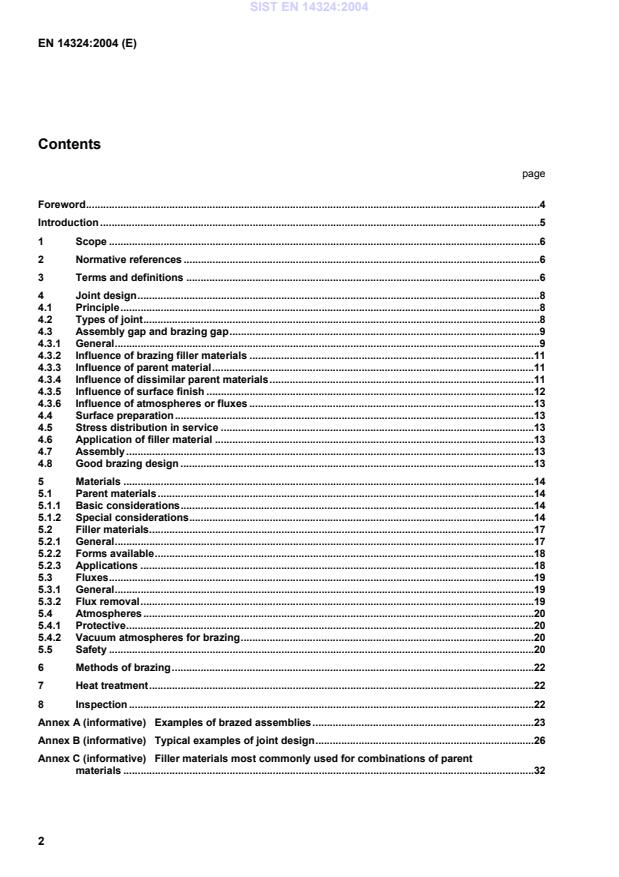
Examples of brazed assemblies.23 Annex B (informative)
Typical examples of joint design.26 Annex C (informative)
Filler materials most commonly used for combinations of parent materials.32 SIST EN 14324:2004
Suitability of brazing filler material classes for the commoner brazing methods.33 Annex E (informative)
Methods of brazing.34 E.1 Flame brazing.34 E.1.1 General.34 E.1.2 Hand torch brazing.34 E.1.3 Mechanized flame brazing.36 E.2 Induction brazing.37 E.2.1 Process.37 E.2.2 Application.38 E.2.3 Advantages/limitations.38 E.2.4 Size limitations.38 E.2.5 Safety.38 E.3 Resistance brazing.39 E.3.1 Process.39 E.3.2 Application.39 E.3.3 Advantages/limitations.39 E.3.4 Size limitations.39 E.3.5 Safety.40 E.4 Furnace brazing.40 E.4.1 Process variants.40 E.4.2 Protective atmosphere brazing.40 E.4.3 Vacuum brazing.42 E.5 Immersion brazing.43 E.5.1 General.43 E.5.2 Flux bath brazing.43 E.5.3 Dip bath brazing.44 E.5.4 Salt bath brazing.45 E.6 Special methods.46 E.6.1 Laser beam brazing.46 E.6.2 Brazing/braze welding with an arc.47 E.6.3 Other methods.47 Bibliography.48
According to the CEN/CENELEC Internal Regulations, the national standards organizations of the following countries are bound to implement this European Standard: Austria, Belgium, Cyprus, Czech Republic, Denmark, Estonia, Finland, France, Germany, Greece, Hungary, Iceland, Ireland, Italy, Latvia, Lithuania, Luxembourg, Malta, Netherlands, Norway, Poland, Portugal, Slovakia, Slovenia, Spain, Sweden, Switzerland and United Kingdom.
1 Scope This document gives guidance on the application of brazing and the manufacture of brazed joints. This standard gives an introduction to brazing and a basis for the understanding and use of brazing in different applications. Because of the wide range of applications of brazing this standard does not give detailed guidance that might be product specific. For such information reference should be made to the appropriate product standard or, for applications where this does not exist, the relevant criteria should be clearly established before any brazing is undertaken. This standard covers joint design and assembly, material aspects for both parent material and filler materials, brazing process and process variables, pre- and post-braze treatment and inspection. 2 Normative references The following referenced documents are indispensable for the application of this document. For dated references, only the edition cited applies. For undated references, the latest edition of the referenced document (including any amendments) applies.
EN 1044:1999, Brazing — Filler metals. EN 1045, Brazing — Fluxes for brazing — Classification and technical delivery conditions. EN 12797, Brazing — Destructive tests of brazed joints. EN 12799, Brazing — Non-destructive examination of brazed joints. EN 13133, Brazing — Brazer approval. EN 13134, Brazing — Procedure approval. EN ISO 18279, Brazing — Imperfections in brazed joints (ISO 18279:2003). 3 Terms and definitions For the purposes of this document, the following terms and definitions apply. 3.1 brazing joining process in which a filler material is used which has a liquidus temperatur above 450 °C, but below the solidus of the parent material, and which is mainly distributed in the brazing gap by capillary attraction NOTE Other joining methods exist (see E.6.3). 3.2 brazed joint result of a joining process where the parent materials are not melted and the filling material and braze material have different chemical compositions compared to the parent materials 3.3 brazing gap narrow, mainly parallel gap at the brazing temperature between the components to be brazed (see Figure 1 and 4.3.4) SIST EN 14324:2004
ABg1g2 g2 < g1 a) Constrained butt joint ABg1g2 g2 > g1 Shaded component has higher coefficient of expansion. b) Tube joint (dissimilar materials) Key A Assembly at ambient temperature B Assembly at brazing temperature g1 Assembly gap g2 Brazing gap Figure 1 — Assembly gap and brazing gap SIST EN 14324:2004
a) Lap
b) Butt Figure 2 — Basic joint types Lap joints are generally used because they are easier to fabricate and offer increased strength. Butt joints are used where adequate strength is readily obtained, e.g. where the mechanical properties of the parent materials are lower than those of the brazed joint, or where the thickness and/or length of a lap joint is undesirable. It should be noted that the useful overlap for a lap joint in shear is related to the thickness of the thinner component; beyond the optimum overlap there is little to be gained in joint strength by increasing the overlap length. SIST EN 14324:2004
Table 1 — Typical brazing gaps Filler material class according to EN 1044 Brazing gapa mm AL 0,05 to 0,25 AG 0,05 to 0,30 CP 0,05 to 0,30 CU1XX CU2XX & CU3XX Up to 0,15 0,05 to 0,20 NI Up to 0,15 AU Up to 0,10 a Brazing gap will depend on the selected filler materials, the brazing process and the brazing conditions.
a) Simple brazed assembly
Key
Parent material
Parent material affected by brazing (heat affected zone (HAZ))
Diffusion-transition zone
Braze material
NOTE Extent of HAZ will vary with materials and brazing process. b) Section through assembly in a) Figure 3 — Schematic of brazed assembly
Key 1 Mechanized flame brazing with flux 2 Hand flame brazing with flux Figure 4 — Schematic of differences in brazing gap ranges with different brazing processes (in this example for mild steel brazed with an AG filler materials) 4.3.2 Influence of brazing filler materials Those types with the shortest melting range, often containing significant additions of temperature depressant elements (e.g. Si, B, P and Zn) exhibit enhanced fluidity and excellent capillary penetration. This also applies to most eutectic compositions and many pure metals. Conversely, those filler materials having wide melting ranges will generally have better wide gap filling characteristics and are more suitable for brazing when gaps are at the upper end of the stated range. 4.3.3 Influence of parent material For those parent materials that are not readily soluble in the brazing filler material, or do not undergo mutual interaction to form alloy layers, gaps may, in general, be tighter than with those combinations where significant alloying occurs. Extensive inter-alloying will impair the fluidity of the brazing filler material and necessitate the use of wider brazing gaps to ensure complete penetration of the joint by the brazing filler material. 4.3.4 Influence of dissimilar parent materials When dissimilar parent materials, of different coefficients of thermal expansion, are to be joined, care has to be exercised in designing the joint in order to obtain the correct brazing gap (see Figure 5). In extreme cases, joint gaps may close completely or open excessively at brazing temperature resulting in non-penetration or non-retention of the brazing filler material, respectively. Given that the brazing gap is the essential parameter, the assembly gap (to which the components will be machined) has to be calculated from the expansion coefficients of the parent materials, the sizes of the components and the brazing temperature. This problem becomes greater: as the size of the brazed assembly increases; as the brazing temperature becomes higher; as the thermal expansion differential widens. SIST EN 14324:2004
Thermal expansion coefficient . . steel > . molybdenum
Figure 5 — Influence on the brazing gap of dissimilar parent materials with different thermal expansion coefficients (schematic) 4.3.5 Influence of surface finish Too coarse or too fine a surface finish will adversely affect the filling of the joint gap. The flow of the filler material may be influenced by the surface finishes of the joint materials. SIST EN 14324:2004
Special ‘vacuum application’ versions of certain AG, PD and AU brazing filler materials
2004006008001 0001 2001 4001 6001 8000CPCUNIAGCOAUALPDPDØ(C) Figure 6 — Melting range of main filler material groups (schematic) SIST EN 14324:2004
The choice of atmosphere will be influenced by the parent and filler materials and may be active or inert. 5.4.2 Vacuum atmospheres for brazing A vacuum atmosphere is achieved in a vessel specifically designed for brazing or heat treatment by pumping out the furnace gases, usually air. The pumps are generally a carefully designed combination of mechanical and oil diffusion which are matched in pumping capacity, and of sufficient size to evacuate rapidly the furnace space. Outgassing of the charge of components and the interior of the furnace will occur during the heating cycle, and the pumps are frequently automatically interlocked with vacuum measuring instruments to accommodate this. A vacuum of better than 10–3 mbar is easily achieved, but a low leak rate is equally important to control the residual atmosphere. 10–3 mbar is equivalent to a gas impurity content of approximately 1,1 × 10⁻⁶ (parts per million) by volume. 5.5 Safety The manufacturer's advice should be sought to ensure that the flux, atmospheres, filler material and parent materials are compatible. SIST EN 14324:2004
Table 3 — Examples of protective atmospheres Approximate composition Applications No. Source Typical dew point of incoming gas °C
H2
%
N2
%
CO
% CO2
%
Filler material class Parent materials 1 Combusted fuel gasd (low hydrogen) Up to + 30 1 to 5 87 1 to 5 11 to 12 AGa, CP, CU3XXa Cu and some Cu alloys. Low and medium carbon steels 2 Combusted fuel gasd (decarburizing) Up to + 30 14 to 15 70 to 71 9 to 10 5 to 6 AGa ,CP, CU1XX, CU2XX CU3XXa
Cu and some Cu alloys, low and medium C steel, Ni, Ni-Cu alloy 3 Combusted fuel gasf, dried - 40 15 to 16 73 to 75 10 to 11 - AGa,CP,
CU1XX, CU2XX, CU3XXa
Cu and some Cu alloys, carbon steels, Ni-Cu alloy, Ni, Ni-Fe alloys 4 Combusted fuel gase, dried (carburizing) - 40 38 to 40 41 to 45 17 to 19 - AGa ,CP,
CU1XX, CU3XXa Cu and some Cu alloys, carbon steels, Ni-Cu alloy, Ni 5 Dissociated ammoniag (cracked ammonia) - 54 75 25 - - AG, CP CU1XX, CU2XX, CU3XX, NI106, NI107 Cu and some Cu alloys, carbon steels, Ni-Cu alloy, Ni and Ni alloys, alloys containing Crb 6 Cylinder hydrogen Down to
- 60 100 d
- - AG, CP, CU1XX, CU2XX, CU3XX,
NI107 Cu and some Cu alloys, low and medium carbon steels, Ni and Ni alloys and alloys of Co, Cr and cemented carbidesb
7 Inert gasg, e.g. argon, nitrogenc
Below – 60 - - - - CP,CU1XX, CU2XX, NI Cu and some Cu alloys, carbon steels, Ni and Ni alloysb, alloys containing Cr a Flux additionally required when filler materials containing volatile elements are used. b Flux required in addition to atmosphere when appreciable quantities of aluminium, titanium, silicon or beryllium are present. c It is essential that nitrogen is not used with refractory metals or aluminium or when the filler material contains boron or silicon. d The combusted fuel gas (low hydrogen or decarburizing) may be referred to as exothermic. It may also be available as synthetic gas. e The combustable fuel gas (carburizing) may be referred to as endothermic. It may also be available as synthetic gas. f I
...