


EN 16757:2017
(Main)Sustainability of construction works - Environmental product declarations - Product Category Rules for concrete and concrete elements
Sustainability of construction works - Environmental product declarations - Product Category Rules for concrete and concrete elements
This European Standard complements the core rules for the product category of construction products as defined in EN 15804:2012+A1:2013 and is intended to be used in conjunction with that standard.
This European Standard applies to concrete and concrete elements for building and civil engineering, excluded autoclaved aerated concrete.
This document defines the parameters to be reported, what EPD types (and life cycle stages) to be covered, what rules to be followed in order to generate Life Cycle Inventories (LCI) and conduct Life Cycle Impact Assessment (LCIA) and the data quality to be used in the development of EPDs.
In addition to the common parts of EN 15804:2012+A1:2013, this European Standard for concrete and concrete elements:
- defines the system boundaries;
- defines the modelling and assessment of material-specific characteristics;
- defines allocation procedures for multi-output processes along the production chain;
- defines allocation procedures for reuse and recycling;
- includes the rules for calculating the LCI and the LCIA underlying the EPD;
- provides guidance/specific rules for the determination of the reference service life (RSL);
- gives guidance on the establishment of default scenarios;
- gives guidance on default functional units for concrete elements.
This document is intended to be used either for cradle to gate, cradle to gate with options or cradle to grave assessment, provided the intentions are properly stated in the system boundary description.
Within the construction works context, a cradle to grave declaration delivers a more comprehensive understanding of the environmental impact associated with concrete and concrete elements.
Nachhaltigkeit von Bauwerken - Umweltproduktdeklarationen - Produktkategorieregeln für Beton und Betonelemente
Diese Europäische Norm vervollständigt die Kernregeln für die Produktkategorie von Bauprodukten, wie in EN 15804:2012+A1:2013 definiert, und soll in Übereinstimmung mit dieser Norm verwendet werden.
Diese Europäische Norm gilt für Betone und Betonelemente für Gebäude und für Ingenieurbauwerke.
Dieses Dokument legt die zu dokumentierenden Parameter fest, welche EPD-Typen (und Phasen des Lebenszyklus) zu behandeln und welche Regeln zu befolgen sind, um Sachbilanzen (LCI) zu generieren und Wirkungsabschätzungen (LCIA) durchzuführen, und welche Qualität die bei der Erstellung von EPDs verwendeten Daten haben sollen.
Zusätzlich zu den allgemeinen Abschnitten von EN 15804:2012+A1:2013 hat die vorliegende Europäische Norm für Betonfertigteile folgende Ziele: Sie
- legt die Systemgrenzen fest;
- legt die Modellierung und Bewertung der materialspezifischen Eigenschaften fest;
- legt die Allokationsverfahren für Multi-Output-Prozesse entlang der Produktionskette fest;
- legt die Allokationsverfahren für die Wiederverwendung und das Recycling fest;
- enthält die Regeln für die Berechnung der LCI und der Wirkungsabschätzung, die der EPD zugrunde liegen;
- liefert eine Anleitung/spezielle Vorschriften für die Ermittlung der Referenz-Nutzungsdauer (RSL);
- gibt eine Anleitung zur Festlegung von Normszenarios;
- gibt eine Anleitung für normkonforme funktionale Einheiten für Betonfertigteile.
Dieses Dokument ist vorgesehen, entweder für die Produktionsphase (Wiege bis Werkstor), die Produktionsphase (Wiege bis Werkstor) mit Optionen oder die Bewertung des Lebenszyklus (Wiege bis Bahre) verwendet zu werden, vorausgesetzt, dass der Zweck ordnungsgemäß in der Beschreibung der Systemgrenze festgelegt ist.
Im Kontext der Bauwerke liefert eine umfassende Deklaration ein besseres Gesamtverständnis der Umweltfolgen, die sich aus Betonen und Betonelemente ergeben.
Contribution des ouvrages de construction au développement durable - Déclarations environnementales sur les produits - Règles régissant la catégorie de produits pour le béton et les éléments en béton
La présente Norme européenne complète les règles de base des catégories de produits applicables aux produits de construction, telles que définies dans la norme EN 15804:2012+A1:2013 avec laquelle elle est destinée à être utilisée conjointement.
La présente Norme européenne s'applique au béton et aux éléments en béton destinés à être utilisés dans la construction de bâtiments et d'ouvrages de génie civil.
Le présent document définit les paramètres à consigner, les types de DEP (et les étapes du cycle de vie) à couvrir, les règles à suivre pour calculer l'inventaire du cycle de vie et procéder à l'évaluation de l'impact du cycle de vie, ainsi que la qualité des données à utiliser pour l'élaboration des DEP.
En plus des parties communes de l'EN 15804:2012+A1:2013, la présente Norme européenne relative au béton et aux éléments en béton :
- définit les frontières du système ;
- définit la modélisation et l'évaluation des caractéristiques spécifiques du matériau ;
- définit les procédures d'affectation pour les processus multi-débouchés tout au long de la chaîne de production ;
- définit les procédures d'affectation relatives à la réutilisation et au recyclage ;
- intègre les règles de calcul de l'inventaire du cycle de vie et de l'évaluation de l'impact du cycle de vie servant de base à la DEP ;
- fournit des lignes directrices/règles spécifiques relatives à la durée de vie de référence (DVR) ;
- fournit des lignes directrices pour déterminer les scénarios par défaut ;
- fournit des lignes directrices sur les unités fonctionnelles par défaut pour les éléments en béton.
Le présent document est destiné à être utilisé soit « du berceau à la sortie de l'usine », soit « du berceau à la sortie de l'usine avec options » ou pour une évaluation « du berceau à la tombe », à condition que les intentions soient correctement formulées dans la description des frontières du système.
Dans le cadre des ouvrages de construction, une déclaration « du berceau à la tombe » donne une meilleure compréhension de l'impact environnemental associé au béton et aux éléments en béton.
Trajnostnost gradbenih objektov - Okoljske deklaracije za proizvode - Pravila za kategorije proizvodov za beton in betonske elemente
Ta evropski standard dopolnjuje osnovna pravila za opredelitev kategorije gradbenih proizvodov, določena v standardu EN 15804+A1, in je namenjen za uporabo s tem standardom.
Ta evropski standard se uporablja za beton in betonske elemente za visoke ali nizke gradnje.
Ta dokument določa parametre, ki jih je treba podati, katere vrste EPD (in stopnje življenjskega cikla) je treba zajeti, katera pravila je treba upoštevati za izdelavo inventarja življenjskega cikla (LCI) in oceno življenjskega cikla (LCIA), ter kakovost podatkov, uporabljeno pri razvoju EPD-jev.
Dodatno k splošnim delom standarda EN 15804+A1, ta evropski standard za beton in betonske elemente:
– določa meje sistema;
– določa modeliranje in ocenjevanje lastnosti, bistvenih za to vrsto materiala;
– določa postopke dodeljevanja za večizhodne procese v proizvodni verigi;
– določa postopke dodeljevanja za ponovno uporabo in reciklažo;
– vključuje pravila za izračun inventarja življenjskega cikla in vrednotenje vplivov življenjskega cikla, ki sta osnova deklaracije EPD;
– podaja smernice/posebna pravila za določevanje referenčne življenjske dobe (RSL);
– podaja smernice o vzpostavitvi privzetih scenarijev;
– podaja smernice o privzetih funkcionalnih enotah za betonske elemente.
Ta dokument se predvidoma uporablja za ocenjevanje faze izdelave »od zibelke do vrat«, »od zibelke do vrat z možnostmi« ali »od zibelke do groba«, če so namere jasno navedene v opisu meja sistema.
V kontekstu gradbenih del deklaracija »od zibelke do groba« zagotavlja obsežnejšo razumevanje vplivov na okolje v povezavi z betonom in betonskimi elementi.
General Information
- Status
- Withdrawn
- Publication Date
- 20-Jun-2017
- Withdrawal Date
- 10-Feb-2026
- Technical Committee
- CEN/TC 229 - Precast concrete products
- Current Stage
- 9960 - Withdrawal effective - Withdrawal
- Start Date
- 26-Oct-2022
- Completion Date
- 11-Feb-2026
Relations
- Effective Date
- 11-Dec-2019
- Effective Date
- 28-Jan-2026
- Effective Date
- 28-Jan-2026



Get Certified
Connect with accredited certification bodies for this standard

ICC Evaluation Service
Building products evaluation and certification.

QAI Laboratories
Building and construction product testing and certification.

Aboma Certification B.V.
Specialized in construction, metal, and transport sectors.
Sponsored listings
Frequently Asked Questions
EN 16757:2017 is a standard published by the European Committee for Standardization (CEN). Its full title is "Sustainability of construction works - Environmental product declarations - Product Category Rules for concrete and concrete elements". This standard covers: This European Standard complements the core rules for the product category of construction products as defined in EN 15804:2012+A1:2013 and is intended to be used in conjunction with that standard. This European Standard applies to concrete and concrete elements for building and civil engineering, excluded autoclaved aerated concrete. This document defines the parameters to be reported, what EPD types (and life cycle stages) to be covered, what rules to be followed in order to generate Life Cycle Inventories (LCI) and conduct Life Cycle Impact Assessment (LCIA) and the data quality to be used in the development of EPDs. In addition to the common parts of EN 15804:2012+A1:2013, this European Standard for concrete and concrete elements: - defines the system boundaries; - defines the modelling and assessment of material-specific characteristics; - defines allocation procedures for multi-output processes along the production chain; - defines allocation procedures for reuse and recycling; - includes the rules for calculating the LCI and the LCIA underlying the EPD; - provides guidance/specific rules for the determination of the reference service life (RSL); - gives guidance on the establishment of default scenarios; - gives guidance on default functional units for concrete elements. This document is intended to be used either for cradle to gate, cradle to gate with options or cradle to grave assessment, provided the intentions are properly stated in the system boundary description. Within the construction works context, a cradle to grave declaration delivers a more comprehensive understanding of the environmental impact associated with concrete and concrete elements.
This European Standard complements the core rules for the product category of construction products as defined in EN 15804:2012+A1:2013 and is intended to be used in conjunction with that standard. This European Standard applies to concrete and concrete elements for building and civil engineering, excluded autoclaved aerated concrete. This document defines the parameters to be reported, what EPD types (and life cycle stages) to be covered, what rules to be followed in order to generate Life Cycle Inventories (LCI) and conduct Life Cycle Impact Assessment (LCIA) and the data quality to be used in the development of EPDs. In addition to the common parts of EN 15804:2012+A1:2013, this European Standard for concrete and concrete elements: - defines the system boundaries; - defines the modelling and assessment of material-specific characteristics; - defines allocation procedures for multi-output processes along the production chain; - defines allocation procedures for reuse and recycling; - includes the rules for calculating the LCI and the LCIA underlying the EPD; - provides guidance/specific rules for the determination of the reference service life (RSL); - gives guidance on the establishment of default scenarios; - gives guidance on default functional units for concrete elements. This document is intended to be used either for cradle to gate, cradle to gate with options or cradle to grave assessment, provided the intentions are properly stated in the system boundary description. Within the construction works context, a cradle to grave declaration delivers a more comprehensive understanding of the environmental impact associated with concrete and concrete elements.
EN 16757:2017 is classified under the following ICS (International Classification for Standards) categories: 91.100.30 - Concrete and concrete products. The ICS classification helps identify the subject area and facilitates finding related standards.
EN 16757:2017 has the following relationships with other standards: It is inter standard links to EN 16757:2022, EN 15804:2012+A1:2013, EN 206:2013+A1:2016. Understanding these relationships helps ensure you are using the most current and applicable version of the standard.
EN 16757:2017 is available in PDF format for immediate download after purchase. The document can be added to your cart and obtained through the secure checkout process. Digital delivery ensures instant access to the complete standard document.
Standards Content (Sample)
SLOVENSKI STANDARD
01-september-2017
Trajnostnost gradbenih objektov - Okoljske deklaracije za proizvode - Pravila za
kategorije proizvodov za beton in betonske elemente
Sustainability of construction works - Environmental product declarations - Product
Category Rules for concrete and concrete elements
Nachhaltigkeit von Bauwerken - Umweltproduktdeklarationen - Produktkategorieregeln
für Beton und Betonelemente
Contribution des ouvrages de construction au développement durable - Déclarations
environnementales sur les produits - Règles régissant la catégorie de produits pour le
béton et les éléments en béton
Ta slovenski standard je istoveten z: EN 16757:2017
ICS:
13.020.20 Okoljska ekonomija. Environmental economics.
Trajnostnost Sustainability
91.100.30 Beton in betonski izdelki Concrete and concrete
products
2003-01.Slovenski inštitut za standardizacijo. Razmnoževanje celote ali delov tega standarda ni dovoljeno.
EN 16757
EUROPEAN STANDARD
NORME EUROPÉENNE
June 2017
EUROPÄISCHE NORM
ICS 91.100.30
English Version
Sustainability of construction works - Environmental
product declarations - Product Category Rules for concrete
and concrete elements
Contribution des ouvrages de construction au Nachhaltigkeit von Bauwerken -
développement durable - Déclarations Umweltproduktdeklarationen -
environnementales sur les produits - Règles régissant Produktkategorieregeln für Beton und Betonelemente
la catégorie de produits pour le béton et les éléments
en béton
This European Standard was approved by CEN on 11 May 2017.
CEN members are bound to comply with the CEN/CENELEC Internal Regulations which stipulate the conditions for giving this
European Standard the status of a national standard without any alteration. Up-to-date lists and bibliographical references
concerning such national standards may be obtained on application to the CEN-CENELEC Management Centre or to any CEN
member.
This European Standard exists in three official versions (English, French, German). A version in any other language made by
translation under the responsibility of a CEN member into its own language and notified to the CEN-CENELEC Management
Centre has the same status as the official versions.
CEN members are the national standards bodies of Austria, Belgium, Bulgaria, Croatia, Cyprus, Czech Republic, Denmark, Estonia,
Finland, Former Yugoslav Republic of Macedonia, France, Germany, Greece, Hungary, Iceland, Ireland, Italy, Latvia, Lithuania,
Luxembourg, Malta, Netherlands, Norway, Poland, Portugal, Romania, Serbia, Slovakia, Slovenia, Spain, Sweden, Switzerland,
Turkey and United Kingdom.
EUROPEAN COMMITTEE FOR STANDARDIZATION
COMITÉ EUROPÉEN DE NORMALISATION
EUROPÄISCHES KOMITEE FÜR NORMUNG
CEN-CENELEC Management Centre: Avenue Marnix 17, B-1000 Brussels
© 2017 CEN All rights of exploitation in any form and by any means reserved Ref. No. EN 16757:2017 E
worldwide for CEN national Members.
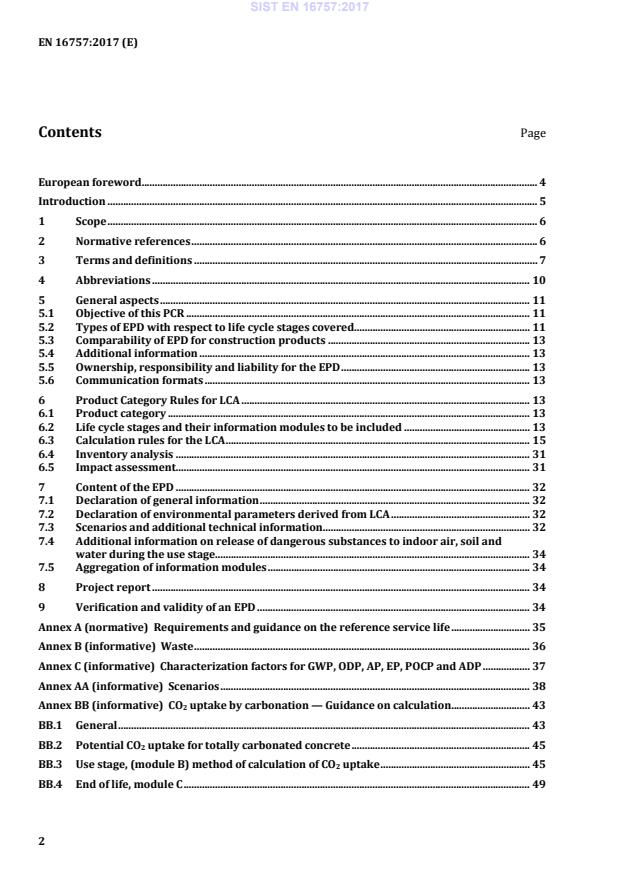
Contents Page
European foreword . 4
Introduction . 5
1 Scope . 6
2 Normative references . 6
3 Terms and definitions . 7
4 Abbreviations . 10
5 General aspects . 11
5.1 Objective of this PCR . 11
5.2 Types of EPD with respect to life cycle stages covered . 11
5.3 Comparability of EPD for construction products . 13
5.4 Additional information . 13
5.5 Ownership, responsibility and liability for the EPD . 13
5.6 Communication formats . 13
6 Product Category Rules for LCA . 13
6.1 Product category . 13
6.2 Life cycle stages and their information modules to be included . 13
6.3 Calculation rules for the LCA . 15
6.4 Inventory analysis . 31
6.5 Impact assessment . 31
7 Content of the EPD . 32
7.1 Declaration of general information . 32
7.2 Declaration of environmental parameters derived from LCA . 32
7.3 Scenarios and additional technical information. 32
7.4 Additional information on release of dangerous substances to indoor air, soil and
water during the use stage . 34
7.5 Aggregation of information modules . 34
8 Project report . 34
9 Verification and validity of an EPD . 34
Annex A (normative) Requirements and guidance on the reference service life . 35
Annex B (informative) Waste . 36
Annex C (informative) Characterization factors for GWP, ODP, AP, EP, POCP and ADP . 37
Annex AA (informative) Scenarios . 38
Annex BB (informative) CO uptake by carbonation — Guidance on calculation . 43
BB.1 General . 43
BB.2 Potential CO uptake for totally carbonated concrete . 45
BB.3 Use stage, (module B) method of calculation of CO uptake . 45
BB.4 End of life, module C . 49
BB.5 Beyond the system boundary, module D . 50
BB.6 Additional information . 50
BB.7 Regional, national or product specific calculation . 50
BB.8 References . 50
BB.9 Some recent literature on CO uptake . 51
Bibliography . 52
European foreword
This document (EN 16757:2017) has been prepared by Technical Committee CEN/TC 229 “Precast
Concrete Products”, the secretariat of which is held by AFNOR.
This European Standard shall be given the status of a national standard, either by publication of an
identical text or by endorsement, at the latest by December 2017, and conflicting national standards
shall be withdrawn at the latest by December 2017.
Attention is drawn to the possibility that some of the elements of this document may be the subject of
patent rights. CEN [and/or CENELEC] shall not be held responsible for identifying any or all such patent
rights.
According to the CEN-CENELEC Internal Regulations, the national standards organisations of the
following countries are bound to implement this European Standard: Austria, Belgium, Bulgaria,
Croatia, Cyprus, Czech Republic, Denmark, Estonia, Finland, Former Yugoslav Republic of Macedonia,
France, Germany, Greece, Hungary, Iceland, Ireland, Italy, Latvia, Lithuania, Luxembourg, Malta,
Netherlands, Norway, Poland, Portugal, Romania, Serbia, Slovakia, Slovenia, Spain, Sweden, Switzerland,
Turkey and the United Kingdom.
Introduction
The European Standard EN 15804:2012+A1:2013 provides core rules for all construction products and
services.
It provides a structure to ensure that all Environmental Product Declarations (EPD) of construction
products, construction services and construction processes are derived, verified and presented in a
harmonized way.
This European Standard provides additional rules for Environmental Product Declarations (EPD)
specifically for concrete and concrete elements. It complements the core rules for all construction
products and services as established in EN 15804:2012+A1:2013.
An EPD communicates verifiable, accurate, non-misleading environmental information for products and
their applications, thereby supporting scientifically based, fair choices and stimulating the potential for
market-driven continuous environmental improvement.
The standardization process has taken place in accordance with ISO 14025. All common issues are
covered horizontally for all product types in order to minimize vertical (branch specific) deviations. All
common issues are covered horizontally for all concrete and concrete elements in order to minimize
intra-sectorial deviations.
EPD information is expressed in information modules as defined in EN 15804:2012+A1:2013, which
allow easy organization and expression of data packages throughout the life cycle of concrete and
concrete elements. The approach requires that the underlying data should be consistent, reproducible
and comparable.
In line with EN 15804:2012+A1:2013 the EPD is expressed in a form that allows aggregation (addition)
to provide complete information for buildings. This standard does not deal with aggregation at the
building level nor does this standard describe the rules for applying EPD in a building assessment.
The standard deals with a limited number of quantifiable parameters as predefined in
EN 15804:2012+A1:2013. Future revisions of EN 15804 may lead to the incorporation in this standard
of additional predetermined parameters. This European Standard provides the means for developing a
Type III environmental declaration of concrete and concrete elements in the context of the suite of
standards that are intended to assess the sustainability of construction works.
This suite of standards includes:
— EN 15643-1, Sustainability of construction works —Sustainability assessment of buildings — Part 1:
General framework
— EN 15643-2, Sustainability of construction works — Assessment of buildings — Part 2: Framework
for the assessment of environmental performance
— EN 15978, Sustainability of construction works — Assessment of environmental performance of
buildings —Calculation methods
— EN 15804:2012+A1:2013, Sustainability of construction works — Environmental product
declaration — Core rules for the product category of construction products
— CEN/TR 15941, Sustainability of construction works — Environmental product declarations —
Methodology for selection and use of generic data
— EN 15942, Sustainability of construction works — Environmental product declarations —
Communication format - business to business
— CEN/TR 16970:2016, Sustainability of construction works - Guidance for the implementation of
EN 15804
1 Scope
This European Standard complements the core rules for the product category of construction products
as defined in EN 15804:2012+A1:2013 and is intended to be used in conjunction with that standard.
This European Standard applies to concrete and concrete elements for building and civil engineering,
excluded autoclaved aerated concrete.
This document defines the parameters to be reported, what EPD types (and life cycle stages) to be
covered, what rules to be followed in order to generate Life Cycle Inventories (LCI) and conduct Life
Cycle Impact Assessment (LCIA) and the data quality to be used in the development of EPDs.
In addition to the common parts of EN 15804:2012+A1:2013, this European Standard for concrete and
concrete elements:
— defines the system boundaries;
— defines the modelling and assessment of material-specific characteristics;
— defines allocation procedures for multi-output processes along the production chain;
— defines allocation procedures for reuse and recycling;
— includes the rules for calculating the LCI and the LCIA underlying the EPD;
— provides guidance/specific rules for the determination of the reference service life (RSL);
— gives guidance on the establishment of default scenarios;
— gives guidance on default functional units for concrete elements.
This document is intended to be used either for cradle to gate, cradle to gate with options or cradle to
grave assessment, provided the intentions are properly stated in the system boundary description.
Within the construction works context, a cradle to grave declaration delivers a more comprehensive
understanding of the environmental impact associated with concrete and concrete elements.
2 Normative references
The following documents, in whole or in part, are normatively referenced in this document and are
indispensable for its application. For dated references, only the edition cited applies. For undated
references, the latest edition of the referenced document (including any amendments) applies.
EN 206:2013+A1:2016, Concrete - Specification, performance, production and conformity
EN 15804:2012+A1:2013, Sustainability of construction works - Environmental product declarations -
Core rules for the product category of construction products
3 Terms and definitions
For the purposes of this document, the terms and definitions given in EN 15804:2012+A1:2013 and the
following apply.
3.1
environmental product declaration
EPD
fr: déclaration environnementale de produit
de: Umweltdeklaration
environmental declaration providing quantified environmental data using predetermined parameters
and, where relevant, additional environmental information
[SOURCE: ISO 21930:2007]
3.2
concrete
fr: béton
de: Beton
material formed by mixing cement, coarse and fine aggregate and water, with or without the
incorporation of admixtures, additions or fibres, which develops its properties by hydration of cement
and hydraulic additions as defined in EN 206, as appropriate
[SOURCE: EN 206:2013+A1:2016]
3.3
concrete element
fr: élément en béton
de: Betonelement
part of a construction work made of concrete, either precast or cast on site or a combination of both
3.4
precast (concrete) element
fr: élément préfabriqué (en béton)
de: vorgefertigtes Betonerzeugnis
concrete element cast and cured in a place other than the final location of use (factory produced or site
manufactured)
[SOURCE: EN 206:2013+A1:2016]
3.5
precast (concrete) product
fr: produit préfabriqué (en béton)
de: Fertigteil (aus Beton)
product made of concrete and manufactured in accordance with EN 13369 or a specific product
standard in a place different from the final destination of use, protected from adverse weather
conditions during production
Note 1 to entry: The product is the result of an industrial process under a factory production control system
and with the possibility of sorting before delivery.
[SOURCE: EN 13369:2013]
3.6
ready-mixed concrete
fr: béton prêt à l’emploi
de: Transportbeton
— concrete delivered in a fresh state by a person or body who is not the user; or
— concrete produced off site by the user; or
— concrete produced on site, but not by the user
[SOURCE: EN 206:2013+A1:2016]
3.7
site-mixed concrete
fr: béton de chantier
de: Baustellenbeton
concrete produced on the construction site by the user of the concrete for his own use
[SOURCE: EN 206:2013+A1:2016]
3.8
addition
fr: addition
de: Betonzusatzstoff
finely-divided-inorganic constituent used in concrete in order to improve certain properties or to
achieve special properties
Note 1 to entry: The addition could be nearly inert (type I), pozzolanic or latent hydraulic addition (type II).
[SOURCE: EN 206:2013+A1:2016]
3.9
admixture
fr: adjuvant
de: Betonzusatzmittel
constituent added during the mixing process in small quantities related to the mass of cement to modify
the properties of fresh or hardened concrete
[SOURCE: EN 206:2013+A1:2016]
3.10
aggregate
fr: granulat
de: Gesteinskörnung
granular material of natural, manufactured, or recycled origin used in construction
[SOURCE: EN 12620:2002+A1:2008]
3.11
cement
fr: ciment
de: Zement
finely ground inorganic material which, when mixed with water, forms a paste that sets and hardens by
means of hydration reactions and processes and which, after hardening, retains its strength and
stability even under water
[SOURCE: EN 197-1:2011]
3.12
binder
combination of cement and reactive (type II) additions
3.13
clinker
main constituent of most cement, made by heating at high temperature a homogeneous mixture of raw
materials (mostly limestone and clay)
3.14
polymer fibre
fr: fibres polymères
de: Polymerfasern
straight or deformed piece of extruded, orientated and cut material, which are suitable to be
homogenously mixed into concrete
[SOURCE: EN 14889-2 :2006]
3.15
steel fibre
fr: fibres d’acier
de: Stahlfasern
straight or deformed piece of cold-drawn steel wire, straight or deformed cut sheet fibres, melt
extracted fibres, shaved cold drawn wire fibres or fibres milled from steel blocks, which are suitable to
be homogeneously mixed into concrete
[SOURCE: EN 14889-1:2006]
3.16
reinforcement steel
steel (wire, strand or bars) subjected to pre- or post-tensioning, and steel (bars, wire, strand, welded
mesh fabrics, lattice girder) not subjected to pre- or post-tensioning
3.17
cubic metre of concrete
fr: mètre cube de béton
de: Kubikmeter Beton
quantity of fresh concrete which, when compacted in accordance with the procedure given in
EN 12350-6, occupies a volume of one cubic metre
3.18
truck mixer
fr: camion malaxeur
de: Fahrmischer
concrete mixer mounted on a self-propelled chassis capable of mixing and delivering a homogeneous
concrete
[SOURCE: EN 206:2013+A1:2016]
3.19
falsework
fr: étayement
de: Lehrgerüst
temporary support for a part of a structure while it is not self-supporting and for associated service
load
3.20
formwork
fr: coffrage
de: Schalung
structure, permanent or temporary, for containing poured concrete, moulding it to the required
dimensions and supporting it until it is able to support itself
3.21
carbonation
fr: carbonatation
de: Carbonatisierung
chemical reaction, a natural process by which carbon dioxide in the ambient air penetrates and reacts
with hydration products
3.22
estimated service life
fr: durée de vie estimée
de: voraussichtliche Nutzungsdauer
service life that a building or an assembled system (part of works) would be expected to have in a set of
specific in-use conditions, determined from reference service life data after taking into account any
differences from the reference in use conditions
[SOURCE: EN 15978]
4 Abbreviations
For the purposes of this document, the abbreviations given in EN 15804:2012+A1:2013 and the
following apply.
GGBS Ground Granulated Blastfurnace Slag
PFA Pulverized Fuel Ash”
5 General aspects
5.1 Objective of this PCR
The objective of this PCR is to provide common rules specific for concrete and concrete elements for the
application of EN 15804:2012+A1:2013, for building and civil engineering works.
In addition to the objectives of EN 15804:2012+A1:2013 this document aims to:
— define the parameters to be declared and the way in which they are collated and reported;
— describe which stages of a product’s life cycle are considered in the EPD and which processes are to
be included in the life cycle stages;
— define rules for the development of scenarios, including the rules for calculating the Life Cycle
Inventory and the Life Cycle Impact Assessment underlying the EPD, including the specification of
the data quality to be applied;
— communicate EPDs and environmental information about concrete and concrete elements;
— ensure that comparisons between construction products are carried out in the context of their use
in the building on the basis of the functional unit.
5.2 Types of EPD with respect to life cycle stages covered
EN 15804:2012+A1:2013 shall apply.
Figure 1 — Types of EPD with respect to life cycle stages covered
5.3 Comparability of EPD for construction products
EN 15804:2012+A1:2013 shall apply.
5.4 Additional information
EN 15804:2012+A1:2013 shall apply.
5.5 Ownership, responsibility and liability for the EPD
EN 15804:2012+A1:2013 shall apply.
5.6 Communication formats
EN 15804:2012+A1:2013 shall apply.
6 Product Category Rules for LCA
6.1 Product category
The product category referred to in this standard includes concrete and concrete elements for building
and civil engineering works.
6.2 Life cycle stages and their information modules to be included
6.2.1 General
In addition to the text of EN 15804:2012+A1:2013:
As all life cycle stages (from A1 to C4) shall be included when assessing a construction work (building
or civil engineering), it is recommended that EPDs prepared cover the same life cycle, i.e. cradle to
grave.
A general description of the life cycle stages is given in Figure 1.
6.2.2 A1-A3, Product stage, information modules
In addition to the text of EN 15804:2012+A1:2013:
NOTE Concrete and concrete elements may contain the following constituents or products (not exhaustive
list):
— aggregates;
— cement;
— water;
— admixtures;
— additions;
— fibres;
— reinforcing steel (for precast concrete elements).
When the full LCI of constituents is not available, impact indicators and aspects from the EPDs
complying to EN 15804:2012+A1:2013 for the constituents or for ready-mixed concrete, covering
modules A1 to A3, can be used for the assessment of module A1 of the concrete or concrete element. If
transport is included, then the impacts and aspects covering modules A1 to A4 can be used for the
assessment of modules A1 and A2 (see Figure 2).
Figure 2 — EPD for constituents (top) and for concrete and concrete elements (bottom)
As an example, for the use of aggregate in concrete, when the EPD of aggregate is used, modules A1 to
A3 of the aggregate EPD becomes part of modules A1 of concrete EPD and module A4 of aggregate EPD
becomes part of modules A2 of concrete EPD.
6.2.3 A4-A5, Construction process stage, information modules
In addition to the text of EN 15804:2012+A1:2013:
At the construction stage (A5), additional constituents or products may be added to the concrete or
concrete element to obtain the defined functional unit; in this case these constituents should be also
taken into account during this stage.
EXAMPLE Reinforcing steel, mortar, structural topping, etc.
6.2.4 B1-B5, Use stage, information modules related to the building fabric
EN 15804:2012+A1:2013 shall apply.
6.2.5 B6-B7, use stage, information modules related to the operation of the building
EN 15804:2012+A1:2013 shall apply.
6.2.6 C1-C4 End-of-life stage, information modules
EN 15804:2012+A1:2013 shall apply.
6.2.7 D, Benefits and loads beyond the system boundary, information module
EN 15804:2012+A1:2013 shall apply.
6.3 Calculation rules for the LCA
6.3.1 Functional unit
In addition to the text in EN 15804:2012+A1:2013:
The functional unit is based on the function performed by the product in the construction work and on
the RSL of the product. It depends on the type of the concrete element. The functional unit is defined in
function of the application of the product in the construction work.
Functional units for concrete elements shall give the following information:
— type and dimension;
— intended use;
— main performance characteristics of concrete (e.g. strength class, exposure class in accordance with
EN 206) or of concrete element (e.g. load bearing capacity, thermal and acoustic performance);
— reference service life.
NOTE 1 Examples of functional unit are:
1 m of an exterior load bearing wall or 1 linear metre of a beam with a defined load bearing capacity
which fulfils the performance requirements concerning construction, like thermal insulation, sound
insulation, fire resistance, etc. for a defined reference service life (see 6.3.3).
NOTE 2 As additional information, the environmental impacts and aspects may be expressed in terms of
“impacts and aspects per year of RSL”.
6.3.2 Declared unit
In addition to the text in EN 15804:2012+A1:2013:
Mass may also be expressed in tonnes (1 000 kg).
6.3.3 Reference service life (RSL)
In addition to the text in EN 15804:2012+A1:2013:
When the use of the concrete or concrete element in the building or civil engineering work is known,
the RSL of the product shall be consistent with its Estimated Service Life (at least equal to).
When the use is not known the RSL of concrete or concrete element should be assessed by the producer
or by the manufacturer for the intended use. Guidance is given in Annex A and Annex AA of this
standard.
6.3.4 System boundaries
6.3.4.1 General
In addition to the text in EN 15804:2012+A1:2013:
The general layout of system boundaries may be found in Figures 3 and 4.
Carbonation
The impacts of the use and end-of-life stages may include carbonation of the concrete. Some precast
concrete elements may also be subjected to carbonation during production stage (e.g. induced
carbonation, long term storage before delivery).
Carbonation is a natural process which occurs during the life cycle of concrete. It shall be considered
during the use and the end-of-life stages of the product and may be considered during production stage.
For concrete, this means that part of carbon dioxide emitted during cement production is rebound to
the concrete during use and end of life stages of a building. As an option, CO absorptions associated
with carbonation may be reported at each of these life cycle stages.
The quantity of CO bound varies considerably according to the type of concrete, the environmental
conditions in use and the end-of-life scenario.
Annex BB provides a possible method to assess carbon dioxide uptake through carbonation in the
different life cycle stages depending on the above mentioned parameters. Other calculation methods
may be used if transparently documented.
When CO2 absorption is not taken into account, this shall be stated on the EPD. When carbonation is
taken into account assumptions are specified.
If carbonation is taken into account during the production stage, information on carbonation at all life
cycle stages shall be reported.
In Module D, carbonation may be taken into account up to the point of functional equivalence.
6.3.4.5 clearly defines the system boundaries of the end of life stage, in order to distinguish between the
benefits within and beyond the system boundaries.
6.3.4.2 Product stage
In addition to the text in EN 15804:2012+A1:2013:
— A1 Production of raw materials or constituent products
For ready-mixed and site-mixed concrete, materials to be taken into account are the constituents of
concrete (e.g. cement, aggregates, admixtures, additions, water or fibres as appropriate)
For precast concrete elements, in addition to the constituents of concrete, the production of any
other product or system used in the precast concrete element (e.g. steel reinforcement, insulation
material) should be taken into account in A1.
— A2 Transport of raw material to the mixing or precast plant
— A3 Manufacturing
The manufacture of ready-mixed or site-mixed concrete may include the following:
— production of ancillary materials used in the mixing plant including, but not limited to,
lubricating oils, engine oils, conveyor belts;
— transportation activities on the production site;
— land filling, disposal and processing (up to the end-of-waste stage) of any output from this
stage of the product system at this unit process (A3) which reaches the end-of-waste state;
— use of materials and equipment for waste water treatment;
— energy used during manufacture.
The manufacture of precast concrete elements may include the following:
— production of ancillary materials used in the manufacture of precast concrete elements
including, but not limited to, lubricating oils, disposable moulds, sanding paper, engine oils,
production and manufacture of pre-products;
NOTE 1 Examples of pre-products include pre-mixing, processing of aggregates and
manufacturing of reinforcement steel and steel strands.
— transportation and storage activities on the production site;
— manufacture of products and co-products;
— curing of products including the necessary energy;
— any additional treatment of the product (heating, surface treatment, etc.)
— manufacturing of any packaging used for the product;
— land filling, disposal and processing (up to the end-of-waste stage) of any output from this
stage of the product system (A3) which reaches the end-of-waste state;
— use of materials and equipment for waste water treatment;
— energy used in the manufacturing.
Production waste leaving the system from a ready-mixed, site mixed or precast plant, while reaching
the end-of-waste state (see EN 15804:2012+A1:2013, 6.2.2, 6.3.4.2, 6.3.4.5 and Annex B) shall be
treated as a co-product and the flows allocated according to EN 15804:2012+A1:2013. If production
waste is re-used internally, it becomes part of module A3.
Some infrastructure equipment (such as moulds or trench boxes) are reusable for a limited number of
times. In this case their impact shall be taken into account at the product stage by dividing their total
impact by the number of uses.
The total carbonation should be taken into account when assessing the impact of the whole life cycle.
NOTE 2 The assessment of biogenic carbon flows associated with wood or packaging is carried out in
accordance with recommendations of CEN/TR 16970 “Sustainability of construction works - Guidance for the
implementation of EN 15804”.
6.3.4.3 Construction stage
In addition to the text in EN 15804:2012+A1:2013:
— A4 Transport of concrete or precast concrete element to the site;
— A5 Installation in the building or civil engineering work;
A description of the reference scenarios used for the construction phase shall be part of the EPD where
relevant.
Construction and installation processes of concrete or precast concrete elements may also include the
following:
For ready mixed or site mixed concrete:
— the steel reinforcement and other products required as part of the functional unit (only for
Functional Unit, not for Declared Unit);
— any process linked to the placing of concrete (e.g. pouring, pumping, vibrating, curing) or processes
linked to the use of the steel or other product;
— any temporary works needed (e.g. formwork, falsework). The reuse of temporary works shall be
accounted by dividing any impacts by the number of uses;
— any other process and material included in the scenarios assigned to this stage (see under 6.3.8),
— any loss occurring during this stage.
For precast concrete elements:
— concrete and other products used to finalise the assembly of precast concrete elements. any
process linked with these products (e.g. pouring, pumping, vibrating, curing of concrete) or with
formwork used on site as part of the Declared / Functional Unit;
— use of any equipment to lift, erect, and fix precast concrete elements in place on site;
— any other process and material included in the scenarios assigned to this stage (see under 6.3.8).
Figure 3 — System boundary for ready-mixed and site mixed concrete
Figure 4 — System boundary for precast concrete elements
6.3.4.4 Use stage
6.3.4.4.1 General
EN 15804:2012+A1:2013 shall apply.
6.3.4.4.2 B1 - B5 Use stage information modules related to the building fabric
In addition to the text in EN 15804:2012+A1:2013:
— B1 Use of the installed product in terms of any emissions to the environment (not covered by B2 -
B7)
When carbonation is taken into account during use stage, it shall be taken into account in module
B1, see Annex BB.
— B2 Maintenance
For some architectural concrete, account should be taken of any regularly required cleaning.
— B3 Repair and B4 replacement
In most cases, concrete elements have a longer RSL than the building, and no maintenance, repair
or replacement is needed during the RSL of the considered unit. In the case of non-structural
concrete, with a RSL shorter than the ESL of the work, replacement may be undertaken in order to
adapt to changed functions of the building works.
— B5 Refurbishment
NOTE Refurbishment is generally relevant only for the building works, not for concrete elements themselves.
6.3.4.4.3 B6 – B7 use stage information modules related to the operation of the building
— B6 Energy use to operate building integrated technical systems
Generally not relevant (see 6.3.8.3.6).
— B7 operational water use by building integrated technical systems
Generally not relevant (see 6.3.8.3.7).
6.3.4.5 End-of-life stage
In addition to the text in EN 15804:2012+A1:2013:
— carbonation at the end-of-life of concrete.
When the CO uptake due to the carbonation of concrete is taken into account, it shall be included in the
respective modules in which it occurs (see Figure 5).
NOTE The legal interpretation of End-of-Waste can differ significantly at national level. At some regions,
crushed concrete stored indefinitely at demolition sites over long periods will revert to being waste. In such case,
certainty over the legal End-of-Waste status is only confirmed when demand exists and a certain market is
allocated and the crushed concrete is removed from site.
Figure 5 — Typical processes at the end-of-life of concrete and concrete product and their
assignment to the life cycle modules C1-C4 and D (transport processes not shown)
6.3.4.6 Benefits and loads beyond the product system boundary in module D
In addition to the text in EN 15804:2012+A1:2013:
See Figure 5 for assignment of impacts.
When module D is used for concrete and concrete elements, it can be applied for the following:
— reuse of concrete elements;
— recycling of constituents;
a) concrete;
b) reinforcing and pre-stressing steel;
c) other constituents.
Carbonation beyond the point of functional equivalence may be declared as an additional information
associated with the use of the recycled concrete.
An assessment of which amount (percentage) of constituents reaches the end of waste status should be
based on locally available data and national regulations. It is technically possible today for both
(crushed) concrete and steel to fully reach the end of waste stage when correctly sorted out.
6.3.5 Criteria for the exclusion of inputs and outputs
EN 15804:2012+A1:2013 shall apply.
6.3.6 Selection of data
In addition to the text in EN 15804:2012+A1:2013:
It is recommended to have data which meet EPD objectives, at the appropriate level (e.g. national,
European level) especially for the following:
— cement;
— additions;
— reinforcement;
— transport;
— energy use;
— water use.
It shall be stated whether a specific concrete mix design or a generic design is used to make the
assessment.
Similarly, it shall be stated whether transport data are plant-specific or average.
When data from EPDs are used for upstream and downstream processes, the use of an
EN 15804:2012+A1:2013 compliant format for an EPD is preferable.
When available, energy mixes used for EPD are those provided by the suppliers. If not available,
reference databases shall be used.
Data assumption for average EPDs can be developed at national level, taking into account principles
employed at the place of production and place of use.
6.3.7 Data quality requirements
EN 15804:2012+A1:2013 shall apply.
6.3.8 Developing product level scenarios
6.3.8.1 General
In addition to the text of EN 15804:2012+A1:2013:
The description of the unit (functional or declared) is the basis for developing the life cycle scenario
(e.g. different scenarios for a beam and for a foundation). EN 15804:2012+A1:2013, 6.3.8 excludes
modules A1 to A3 from product scenarios. Therefore, the main topics to be included in the appropriate
life cycle stages are the following, where relevant:
— downstream transport (A4);
— for ready-mixed and site-mixed concretes, reinforcement type and quantity (A5);
— method of installation on site (A5);
— reference Service Life for the Unit and relevant in-use conditions (B1 to B7);
— for each destination (crushing, stockpiling and disposal) percentage of constituents use after
demolition (C1 to C4);
— benefits and loads after the system boundary.
When a Declared Unit is used, the scenario shall specify the exact use of the concrete (except in the case
of cradle to gate EPD where no scenario is needed), and any relevant technical characteristic e.g.:
— m of concrete for construction of a private house (specific);
— m of concrete for building a 20 cm thick wall;
— metre of concrete pipe 300 mm diameter for sewage applications.
6.3.8.2 Construction stage
6.3.8.2.1 A4, Transportation of products to the site
Scenarios shall consider the most common way to deliver the product from the factory to the site, the
most plausible route and vehicle.
Scenarios shall include:
— fuel type and consumption of vehicle or vehicle type used for transport the declared unit;
— distance from factory to site;
— capacity utilization according to volume or weight limits, including empty returns.
6.3.8.2.2 A5, Construction and installation process
Scenarios shall consider the most common ways to install the concrete or the concrete element. For
heavy products, use of specific cranes or machinery shall be considered including any additional
process. Specific scenarios shall be developed where the product requires additional works (e.g.
formwork for stitching slabs).
Any wastage of materials generated during the installation of product at the construction site shall be
reported in this Module.
EXAMPLE 1 Installation of cladding panels using cranes from the delivery vehicle to the facade, including
mechanical fixing using specific connection and sealing of the perimeter.
EXAMPLE 2 Installation of hollow core slabs using cranes from the delivery vehicle to the works, including
pumping and compacting of ready-mixed concrete used as topping.
EXAMPLE 3 Placing of the concrete using cranes to transport the concrete from the truck mixer to the
formwork, and vibrators to compact the fresh concrete.
Scenarios for concrete (ready-mixed and site-mixed) shall include the following:
— impact of all ancillary materials for placing, compacting and curing;
— reinforcing steel (only for Functional Unit);
— formwork and falsework;
— water use;
— quantitative description of energy type (regional or national mix) and consumption during the
installation process, including specific consumption of cranes, pumps, compacting devices and
other machinery; heating of the concrete (if relevant);
— waste processing and output materials (specified by type) at the building site e.g. collection for
recycling, for energy recovery, or for disposal;
— direct emissions to air, soil and water.
Scenarios for concrete elements (factory produced or site produced) shall include the following:
— impact of all ancillary materials for installation;
— water use, if relevant;
— other resource use;
— quantitative description of energy type (regional or national mix) and consumption during the
installation process, in
...
Questions, Comments and Discussion
Ask us and Technical Secretary will try to provide an answer. You can facilitate discussion about the standard in here.
Loading comments...