

EN 15743:2010+A1:2015
(Main + Amendment)Supersulfated cement - Composition, specifications and conformity criteria
- Abstract
This European Standard defines and gives the specifications of supersulfated cement and its constituents. The definition of supersulfated cement includes the proportions in which the constituents are to be combined to produce products in accordance with this standard. The definition also includes requirements the constituents have to meet and the mechanical, physical, chemical including heat of hydration requirements. This standard also states the conformity criteria and the related rules.
NOTE 1 In addition to the specified requirements, an exchange of additional information between the cement manufacturer and user may be helpful. The procedures for such an exchange are not within the scope of this standard but should be dealt with in accordance with national standards or regulations or may be agreed between the parties concerned.
NOTE 2 The word "cement" in this standard is used to refer only to supersulfated cement unless otherwise specified.
- Status
- Published
- Publication Date
- 07-Apr-2015
- Technical Committee
- CEN/TC 51 - Cement and building limes
- Drafting Committee
- CEN/TC 51/WG 6 - Definitions and terminology of cement
- Current Stage
- 9093 - Decision to confirm - Review Enquiry
- Start Date
- 10-Mar-2026
- Completion Date
- 07-Oct-2026
Overview
EN 15743:2010+A1:2015 (CEN) specifies the composition, specifications and conformity criteria for supersulfated cement. The standard defines what constitutes supersulfated cement (mainly granulated blastfurnace slag activated by calcium sulfate), the allowed proportions of constituents, required properties (mechanical, physical, chemical, heat of hydration) and the rules for conformity assessment. It includes Amendment 1 (2015) and supports requirements of the EU Construction Products Regulation (CPR).
Key topics and technical requirements
- Definition and composition
- Main constituents: granulated blastfurnace slag (S) and calcium sulfate (Cs) - together >90% of main/additional constituents.
- Additional constituents: limited amounts (≤10%) of Portland cement clinker (K) and other specified inorganic additions (A). Additives are permitted.
- Performance criteria
- Mechanical: compressive strength requirements (standard strength and early strength) expressed as strength classes.
- Physical: initial setting time, soundness and heat of hydration requirements (lower heat of hydration is characteristic).
- Chemical and durability: chemical composition limits, provisions for sulfate resistance and other durability concerns.
- Dangerous substances: assessment and labelling provisions.
- Conformity and testing
- Autocontrol testing by manufacturers, sampling plans, control periods and both statistical and single-result conformity criteria.
- Procedures for assessment and verification of constancy of performance (AVCP) are linked to EN 197-2.
- Informative annexes cover precautions in use, AVCP details and CE marking/Declaration of Performance (DoP).
Applications and practical value
- Supersulfated cement is suitable where low heat of hydration and chemical (sulfate) resistance are needed, for example:
- Foundations, massive concrete elements and structures exposed to aggressive sulfate environments.
- Projects requiring reduced thermal cracking risk during curing.
- Practical considerations highlighted in the standard include slower early strength development and the need for appropriate curing, blending and site-use precautions.
Who should use this standard
- Cement manufacturers and quality managers (production, composition control, AVCP compliance)
- Concrete technologists, specifiers and structural engineers (material selection, mix design)
- Test laboratories and conformity assessment bodies (sampling and testing to EN 196 methods)
- Regulators and procurement teams requiring CE-marked supersulfated cement
Related standards (normative references)
- EN 196 series (Methods of testing cement: parts 1, 2, 3, 7, 8, 9)
- EN 197-1 / EN 197-2 (common cements; conformity evaluation)
- EN 459-1 (building lime), EN 934 (admixtures)
- EU Construction Products Regulation (CPR) - Annex ZA guidance in EN 15743
Keywords: EN 15743:2010+A1:2015, supersulfated cement, granulated blastfurnace slag, calcium sulfate, composition, specifications, conformity, heat of hydration, sulfate resistance, AVCP, CE marking.
Relations
- Merged From
EN 15743:2010 - Supersulfated cement - Composition, specifications and conformity criteria - Effective Date
- 18-Jan-2023
- Merged From
EN 15743:2010/FprA1 - Supersulfated cement - Composition, specifications and conformity criteria - Effective Date
- 18-Jan-2023
- Effective Date
- 28-Jan-2026
- Refers
EN 196-3:2016 - Methods of testing cement - Part 3: Determination of setting times and soundness - Effective Date
- 28-Jan-2026
- Effective Date
- 28-Jan-2026
- Effective Date
- 28-Jan-2026
- Effective Date
- 28-Jan-2026
- Effective Date
- 28-Jan-2026
- Effective Date
- 28-Jan-2026
- Effective Date
- 28-Jan-2026
- Effective Date
- 28-Jan-2026
- Effective Date
- 28-Jan-2026
- Effective Date
- 28-Jan-2026
- Effective Date
- 28-Jan-2026
- Effective Date
- 28-Jan-2026
Get Certified
Connect with accredited certification bodies for this standard

DIBt (Deutsches Institut für Bautechnik)
German Institute for Building Technology.
DIN CERTCO
DIN Group product certification.

Aboma Certification B.V.
Specialized in construction, metal, and transport sectors.
Sponsored listings
Frequently Asked Questions
EN 15743:2010+A1:2015 is a standard published by the European Committee for Standardization (CEN). Its full title is "Supersulfated cement - Composition, specifications and conformity criteria". This standard covers: This European Standard defines and gives the specifications of supersulfated cement and its constituents. The definition of supersulfated cement includes the proportions in which the constituents are to be combined to produce products in accordance with this standard. The definition also includes requirements the constituents have to meet and the mechanical, physical, chemical including heat of hydration requirements. This standard also states the conformity criteria and the related rules. NOTE 1 In addition to the specified requirements, an exchange of additional information between the cement manufacturer and user may be helpful. The procedures for such an exchange are not within the scope of this standard but should be dealt with in accordance with national standards or regulations or may be agreed between the parties concerned. NOTE 2 The word "cement" in this standard is used to refer only to supersulfated cement unless otherwise specified.
This European Standard defines and gives the specifications of supersulfated cement and its constituents. The definition of supersulfated cement includes the proportions in which the constituents are to be combined to produce products in accordance with this standard. The definition also includes requirements the constituents have to meet and the mechanical, physical, chemical including heat of hydration requirements. This standard also states the conformity criteria and the related rules. NOTE 1 In addition to the specified requirements, an exchange of additional information between the cement manufacturer and user may be helpful. The procedures for such an exchange are not within the scope of this standard but should be dealt with in accordance with national standards or regulations or may be agreed between the parties concerned. NOTE 2 The word "cement" in this standard is used to refer only to supersulfated cement unless otherwise specified.
EN 15743:2010+A1:2015 is classified under the following ICS (International Classification for Standards) categories: 91.100.10 - Cement. Gypsum. Lime. Mortar. The ICS classification helps identify the subject area and facilitates finding related standards.
EN 15743:2010+A1:2015 has the following relationships with other standards: It is inter standard links to EN 15743:2010, EN 15743:2010/FprA1, EN 934-3:2009+A1:2012, EN 196-3:2016, EN 196-8:2010, EN 934-6:2019, EN 459-1:2015, EN 934-7:2024, EN 196-1:2016, EN 196-7:2007, EN 196-9:2010, EN 934-5:2007, EN 934-4:2009, EN 197-2:2014, EN 196-2:2025. Understanding these relationships helps ensure you are using the most current and applicable version of the standard.
EN 15743:2010+A1:2015 is associated with the following European legislation: EU Directives/Regulations: 305/2011; Standardization Mandates: M/114. When a standard is cited in the Official Journal of the European Union, products manufactured in conformity with it benefit from a presumption of conformity with the essential requirements of the corresponding EU directive or regulation.
EN 15743:2010+A1:2015 is available in PDF format for immediate download after purchase. The document can be added to your cart and obtained through the secure checkout process. Digital delivery ensures instant access to the complete standard document.
Standards Content (Sample)
2003-01.Slovenski inštitut za standardizacijo. Razmnoževanje celote ali delov tega standarda ni dovoljeno.Sulfathüttenzement - Zusammensetzung, Anforderungen und KonformitätskriterienCiment sursulfaté - Composition, spécifications et critères de conformitéSupersulfated cement - Composition, specifications and conformity criteria91.100.10Cement. Mavec. Apno. MaltaCement. Gypsum. Lime. MortarICS:Ta slovenski standard je istoveten z:EN 15743:2010+A1:2015SIST EN 15743:2010+A1:2015en,fr,de01-julij-2015SIST EN 15743:2010+A1:2015SLOVENSKI
STANDARDSIST EN 15743:20101DGRPHãþD
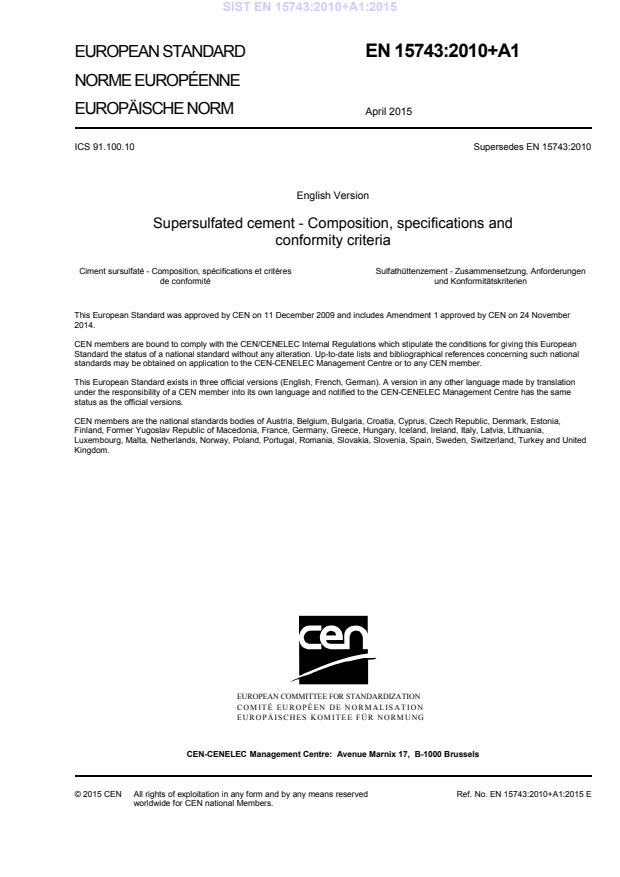
EUROPEAN STANDARD NORME EUROPÉENNE EUROPÄISCHE NORM
EN 15743:2010+A1
April 2015 ICS 91.100.10 Supersedes EN 15743:2010English Version
Supersulfated cement - Composition, specifications and conformity criteria
Ciment sursulfaté - Composition, spécifications et critères de conformité
Sulfathüttenzement - Zusammensetzung, Anforderungen und Konformitätskriterien This European Standard was approved by CEN on 11 December 2009 and includes Amendment 1 approved by CEN on 24 November 2014.
CEN members are bound to comply with the CEN/CENELEC Internal Regulations which stipulate the conditions for giving this European Standard the status of a national standard without any alteration. Up-to-date lists and bibliographical references concerning such national standards may be obtained on application to the CEN-CENELEC Management Centre or to any CEN member.
This European Standard exists in three official versions (English, French, German). A version in any other language made by translation under the responsibility of a CEN member into its own language and notified to the CEN-CENELEC Management Centre has the same status as the official versions.
CEN members are the national standards bodies of Austria, Belgium, Bulgaria, Croatia, Cyprus, Czech Republic, Denmark, Estonia, Finland, Former Yugoslav Republic of Macedonia, France, Germany, Greece, Hungary, Iceland, Ireland, Italy, Latvia, Lithuania, Luxembourg, Malta, Netherlands, Norway, Poland, Portugal, Romania, Slovakia, Slovenia, Spain, Sweden, Switzerland, Turkey and United Kingdom.
EUROPEAN COMMITTEE FOR STANDARDIZATION
COMITÉ EUROPÉEN DE NORMALISATION EUROPÄISCHES KOMITEE FÜR NORMUNG
CEN-CENELEC Management Centre:
Avenue Marnix 17,
B-1000 Brussels © 2015 CEN All rights of exploitation in any form and by any means reserved worldwide for CEN national Members. Ref. No. EN 15743:2010+A1:2015 ESIST EN 15743:2010+A1:2015
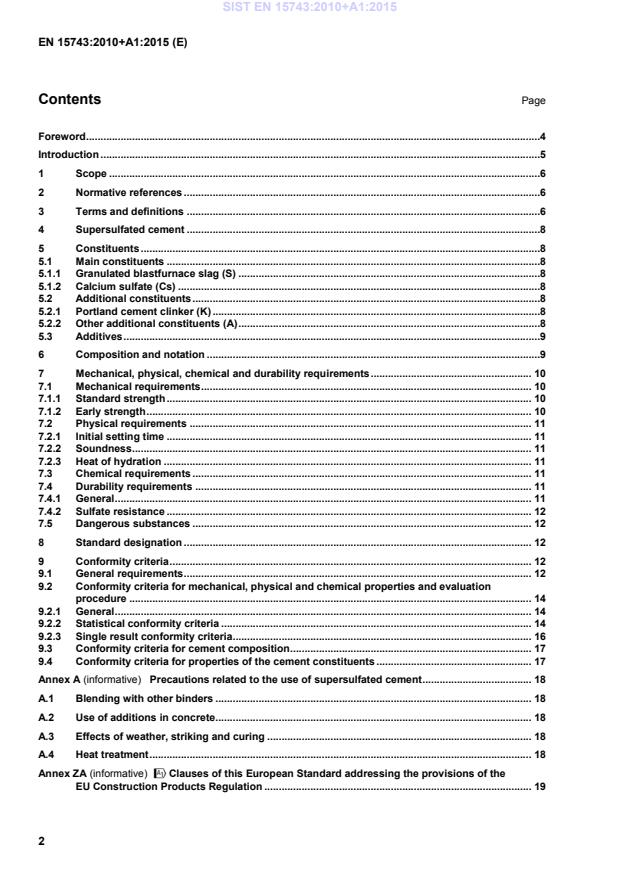
Precautions related to the use of supersulfated cement . 18 A.1 Blending with other binders . 18 A.2 Use of additions in concrete . 18 A.3 Effects of weather, striking and curing . 18 A.4 Heat treatment . 18 Annex ZA (informative)
!Clauses of this European Standard addressing the provisions of the EU Construction Products Regulation . 19 SIST EN 15743:2010+A1:2015
1 Scope This European Standard defines and gives the specifications of supersulfated cement and its constituents. The definition of supersulfated cement includes the proportions in which the constituents are to be combined to produce products in accordance with this standard. The definition also includes requirements the constituents have to meet and the mechanical, physical, chemical including heat of hydration requirements. This standard also states the conformity criteria and the related rules. NOTE 1 In addition to the specified requirements, an exchange of additional information between the cement manufacturer and user may be helpful. The procedures for such an exchange are not within the scope of this standard but should be dealt with in accordance with national standards or regulations or may be agreed between the parties concerned. NOTE 2
The word "cement" in this standard is used to refer only to supersulfated cement unless otherwise specified. 2 Normative references The following referenced documents are indispensable for the application of this document. For dated references, only the edition cited applies. For undated references, the latest edition of the referenced document (including any amendments) applies. EN 196-1, Methods of testing cement
Part 1: Determination of strength EN 196-2, analysis of cement EN 196-3,
EN 196-7, Methods of testing cement
mart 7: Methods of taking and preparing samples of cement EN 196-8, Methods of testing cement
Part 8: Heat of hydration - polution method EN 196-9, Methods of testing cement
mart s: eeat of hydration - Semi-adiabatic method EN 197-1, Cement
mart k: Compositionf specifications and conformity criteria for common cements !EN 197-2:2014", ormity evaluation EN 459-1, Building lime
mart k: aefinitionsf specifications and conformity criteria EN 934 (all parts), Admixtures for concretef mortar and grout 3 Terms and definitions For the purposes of this document, the following terms and definitions apply. 3.1 heat of hydration quantity of heat generated by cement hydration within a given period of time SIST EN 15743:2010+A1:2015
Supersulfated cement. The composition of supersulfated cement shall be in accordance with Table 1. NOTE The requirements for the composition refer to the sum of all main and additional constituents. The final cement should be understood as the main and additional constituents plus the necessary additives. SIST EN 15743:2010+A1:2015
Other
S Cs K A SSC Supersulfated cement SSC ≥ 75 5 ≤ Cs ≤ 20 0 < K ≤ 5 0 ≤ A ≤ 5 a The values in the table refer to the sum of the main and additional constituents. 7 Mechanical, physical, chemical and durability requirements 7.1 Mechanical requirements 7.1.1 Standard strength The standard strength of supersulfated cement is the compressive strength determined in accordance with EN 196-1 at 28 days and shall conform to the requirements in Table 2. Three classes of standard strength are included: class 32,5, class 42,5 and class 52,5 (see Table 2). 7.1.2 Early strength The early strength of supersulfated cement is the compressive strength determined in accordance with EN 196-1 at either two days or seven days and shall conform to the requirements in Table 2. Two classes of early strength are included for each class of standard strength, a class with low early strength, indicated by L and a class with ordinary early strength, indicated by N (see Table 2). Table 2 — Mechanical and physical requirements given as characteristic values Strength class Compressive strength MPa Initial setting time min Soundness (expansion) mm Early strength Standard strength 2 days 7 days 28 days 32,5 L – ≥ 12,0 ≥ 32,5 ≤ 52,5 ≥ 75
32,5 N – ≥ 16,0 ≤ 10 42,5 L – ≥ 16,0 ≥ 42,5 ≤ 62,5 ≥ 60 42,5 N ≥ 10,0 – 52,5 L ≥ 10,0 – ≥ 52,5 – ≥ 45 52,5 N ≥ 20,0 – SIST EN 15743:2010+A1:2015
...