

EN 60947-5-4:2003
(Main)Low-voltage switchgear and controlgear - Part 5-4: Control circuit devices and switching elements - Method of assessing the performance of low-energy contacts - Special tests
General Information
- Abstract
IEC 60947-5-4:2002 applies to separable contacts used in the utilization area considered, such as switching elements for control circuits. This standard takes into consideration two rated voltage areas: a) above (and including) 10 V (typically 24 V) where contacts are used for switching loads with possible electrical erosion, such as programmable controller inputs; b) below 10 V (typically 5 V) with negligible electrical erosion, such as electronic circuits. This second edition cancels and replaces the first edition which was issued as a technical report in 1996. It now has the status of an International Standard.
- Status
- Published
- Publication Date
- 04-Dec-2003
- Withdrawal Date
- 30-Nov-2006
- Technical Committee
- CLC/TC 121A - Low-voltage switchgear and controlgear
- Drafting Committee
- IEC/SC 17B - IEC_SC_17B
- Parallel Committee
- IEC/SC 17B - IEC_SC_17B
- Current Stage
- 6060 - Document made available - Publishing
- Start Date
- 05-Dec-2003
- Completion Date
- 05-Dec-2003
- Directive
- 2006/95/EC - Directive 2006/95/EC of the European Parliament and of the Council of 12 December 2006 on the harmonisation of the laws of Member States relating to electrical equipment designed for use within certain voltage limits (codified version)OJ Ref: C 71/, C 71/17, C 348/03 OJ Date: 28-Nov-2013
2014/35/EU - Directive 2014/35/EU of the European Parliament and of the Council of 26 February 2014 on the harmonisation of the laws of the Member States relating to the making available on the market of electrical equipment designed for use within certain voltage limitsOJ Ref: C 249/03 OJ Date: 08-Jul-2016

Overview
EN 60947-5-4:2003 (identical to IEC 60947-5-4:2002) defines a method for assessing the performance of low-energy contacts used in control circuits of low-voltage switchgear and controlgear. It establishes special tests and reporting methods so manufacturers, test laboratories and users can predict contact behaviour and reliability when switching very small voltages and currents. The standard addresses two rated voltage areas:
- ≥ 10 V (typically 24 V) - contacts that may experience electrical erosion (e.g., programmable controller inputs)
- < 10 V (typically 5 V) - circuits with negligible electrical erosion (e.g., electronic inputs)
This edition replaces the earlier technical report and elevates the procedures to an International Standard, including normative annexes (A and ZA) that specify required manufacturer information and harmonized references.
Key topics and requirements
- Scope and definitions: Clear definitions for reliability, contact reliability, failure and defect tailored to low-energy switching.
- General test principles: Methods to monitor and record contact behaviour at each operation (sequential and time-terminated tests).
- Measurement methods: Electrical and mechanical measurement practices for characterizing contact performance under defined conditions.
- Test sequences and load monitoring: Diagrams and circuits for basic methods and for monitoring loads during switching operations.
- Failure criteria and reporting: Procedures for reporting observed failure rates (λob), interpreting results and presenting reliability data with stated operating-cycle intervals.
- Ambient and preconditioning: Requirements for normal and particular test environments (referencing IEC 60068 series for environmental tests).
- Information to include in test reports: Manufacturer-supplied data and standardized reporting content (see normative Annex A).
Practical applications
- Verifying suitability of control and switching elements for PLC inputs, industrial automation, and low-voltage electronic control circuits.
- Establishing contact reliability data for product datasheets, procurement specifications and conformity assessment.
- Guiding test laboratories in producing repeatable, comparable endurance and failure-rate results for small-signal contacts.
Who should use this standard
- Manufacturers of control circuit devices and switching elements
- Independent test laboratories and conformity assessment bodies
- Design and reliability engineers specifying low-energy switching components
- Procurement and QA teams setting acceptance criteria for control components
Related standards
- IEC/EN 60947-1 (General rules for low-voltage switchgear)
- IEC/EN 60947-5-1 (Electromechanical control-circuit devices)
- IEC 61131-2 (Programmable controllers)
- IEC 60068 series (Environmental testing)
- IEC 60605-6 (Equipment reliability testing)
Keywords: EN 60947-5-4, IEC 60947-5-4, low-energy contacts, low-voltage switchgear, control circuit devices, switching elements, contact reliability, special tests, PLC inputs, low-voltage testing.
Relations
- Effective Date
- 29-Jan-2023
- Effective Date
- 10-Feb-2026
- Effective Date
- 09-Feb-2026
- Effective Date
- 03-Feb-2026
- Effective Date
- 03-Feb-2026
- Effective Date
- 03-Feb-2026
- Effective Date
- 03-Feb-2026
- Effective Date
- 03-Feb-2026
- Effective Date
- 03-Feb-2026
- Effective Date
- 03-Feb-2026
- Effective Date
- 03-Feb-2026
- Effective Date
- 03-Feb-2026
- Effective Date
- 09-Feb-2026
- Effective Date
- 09-Feb-2026
- Effective Date
- 09-Feb-2026
Get Certified
Connect with accredited certification bodies for this standard

IMQ S.p.A. (Certification)
Italian electrical product certification.

SLG Prüf- und Zertifizierungs GmbH
German testing and certification body.

UL Solutions
Global safety science company with testing, inspection and certification.
Sponsored listings
Frequently Asked Questions
EN 60947-5-4:2003 is a standard published by CLC. Its full title is "Low-voltage switchgear and controlgear - Part 5-4: Control circuit devices and switching elements - Method of assessing the performance of low-energy contacts - Special tests". This standard covers: IEC 60947-5-4:2002 applies to separable contacts used in the utilization area considered, such as switching elements for control circuits. This standard takes into consideration two rated voltage areas: a) above (and including) 10 V (typically 24 V) where contacts are used for switching loads with possible electrical erosion, such as programmable controller inputs; b) below 10 V (typically 5 V) with negligible electrical erosion, such as electronic circuits. This second edition cancels and replaces the first edition which was issued as a technical report in 1996. It now has the status of an International Standard.
IEC 60947-5-4:2002 applies to separable contacts used in the utilization area considered, such as switching elements for control circuits. This standard takes into consideration two rated voltage areas: a) above (and including) 10 V (typically 24 V) where contacts are used for switching loads with possible electrical erosion, such as programmable controller inputs; b) below 10 V (typically 5 V) with negligible electrical erosion, such as electronic circuits. This second edition cancels and replaces the first edition which was issued as a technical report in 1996. It now has the status of an International Standard.
EN 60947-5-4:2003 is classified under the following ICS (International Classification for Standards) categories: 29.130.20 - Low voltage switchgear and controlgear. The ICS classification helps identify the subject area and facilitates finding related standards.
EN 60947-5-4:2003 has the following relationships with other standards: It is inter standard links to EN 60947-5-4:1997, IEC 60605-6:1997, EN 432:1994, EN 60947-1:1999/A2:2001, EN 60947-5-1:1997/A2:2000, EN 61131-2:1994, EN 60068-2-43:2003, EN 60068-1:1994, EN 60947-5-1:1997/A1:1999, EN 60947-1:1999/A1:2000, EN 60947-1:1999, EN 60947-5-1:1997, EN 13814:2004, EN 15746-1:2020, EN 15746-1:2010+A1:2011. Understanding these relationships helps ensure you are using the most current and applicable version of the standard.
EN 60947-5-4:2003 is associated with the following European legislation: EU Directives/Regulations: 2006/95/EC, 2014/35/EU, 2014/53/EU, 73/23/EEC. When a standard is cited in the Official Journal of the European Union, products manufactured in conformity with it benefit from a presumption of conformity with the essential requirements of the corresponding EU directive or regulation.
EN 60947-5-4:2003 is available in PDF format for immediate download after purchase. The document can be added to your cart and obtained through the secure checkout process. Digital delivery ensures instant access to the complete standard document.
Standards Content (Sample)
SLOVENSKI SIST EN 60947-5-4:2004
STANDARD
junij 2004
Low-voltage switchgear and controlgear - Part 5-4: Control circuit devices and
switching elements - Method of assessing the performance of low-energy contacts -
Special tests
ICS 29.130.20 Referenčna številka
© Standard je založil in izdal Slovenski inštitut za standardizacijo. Razmnoževanje ali kopiranje celote ali delov tega dokumenta ni dovoljeno
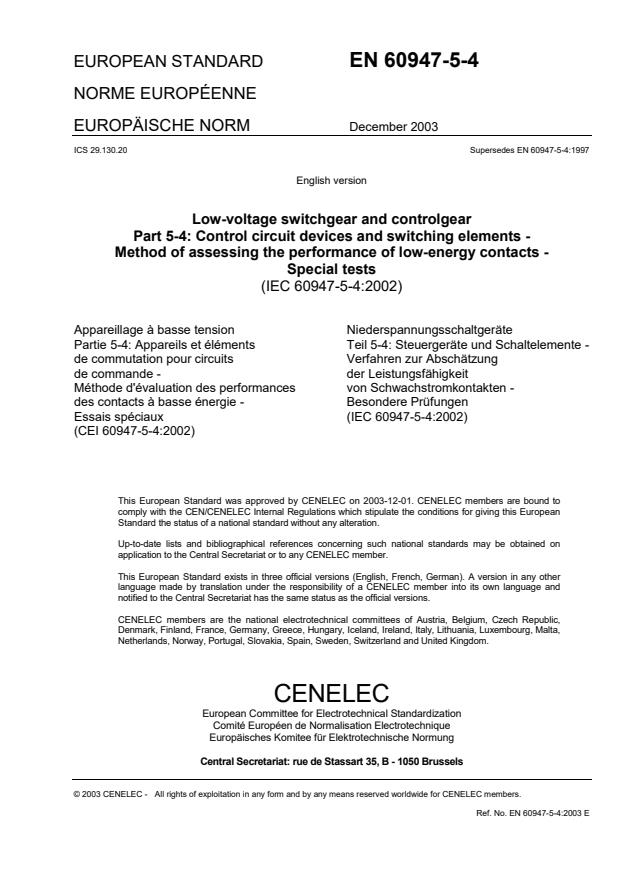
EUROPEAN STANDARD EN 60947-5-4
NORME EUROPÉENNE
EUROPÄISCHE NORM December 2003
ICS 29.130.20 Supersedes EN 60947-5-4:1997
English version
Low-voltage switchgear and controlgear
Part 5-4: Control circuit devices and switching elements -
Method of assessing the performance of low-energy contacts -
Special tests
(IEC 60947-5-4:2002)
Appareillage à basse tension Niederspannungsschaltgeräte
Partie 5-4: Appareils et éléments Teil 5-4: Steuergeräte und Schaltelemente -
de commutation pour circuits Verfahren zur Abschätzung
de commande - der Leistungsfähigkeit
Méthode d'évaluation des performances von Schwachstromkontakten -
des contacts à basse énergie - Besondere Prüfungen
Essais spéciaux (IEC 60947-5-4:2002)
(CEI 60947-5-4:2002)
This European Standard was approved by CENELEC on 2003-12-01. CENELEC members are bound to
comply with the CEN/CENELEC Internal Regulations which stipulate the conditions for giving this European
Standard the status of a national standard without any alteration.
Up-to-date lists and bibliographical references concerning such national standards may be obtained on
application to the Central Secretariat or to any CENELEC member.
This European Standard exists in three official versions (English, French, German). A version in any other
language made by translation under the responsibility of a CENELEC member into its own language and
notified to the Central Secretariat has the same status as the official versions.
CENELEC members are the national electrotechnical committees of Austria, Belgium, Czech Republic,
Denmark, Finland, France, Germany, Greece, Hungary, Iceland, Ireland, Italy, Lithuania, Luxembourg, Malta,
Netherlands, Norway, Portugal, Slovakia, Spain, Sweden, Switzerland and United Kingdom.
CENELEC
European Committee for Electrotechnical Standardization
Comité Européen de Normalisation Electrotechnique
Europäisches Komitee für Elektrotechnische Normung
Central Secretariat: rue de Stassart 35, B - 1050 Brussels
© 2003 CENELEC - All rights of exploitation in any form and by any means reserved worldwide for CENELEC members.
Ref. No. EN 60947-5-4:2003 E
Foreword
The text of the International Standard IEC 60947-5-4:2002, prepared by SC 17B, Low-voltage
switchgear and controlgear, of IEC TC 17, Switchgear and controlgear, was submitted to the Unique
Acceptance Procedure and was approved by CENELEC as EN 60947-5-4 on 2003-12-01.
This European Standard supersedes EN 60947-5-4:1997.
The following dates were fixed:
- latest date by which the EN has to be implemented
at national level by publication of an identical
national standard or by endorsement (dop) 2004-12-01
- latest date by which the national standards conflicting
with the EN have to be withdrawn (dow) 2006-12-01
Annexes designated "normative" are part of the body of the standard.
In this standard, Annexes A and ZA are normative.
Annex ZA has been added by CENELEC.
__________
Endorsement notice
The text of the International Standard IEC 60947-5-4:2002 was approved by CENELEC as a European
Standard without any modification.
__________
- 3 - EN 60947-5-4:2003
Annex ZA
(normative)
Normative references to international publications
with their corresponding European publications
This European Standard incorporates by dated or undated reference, provisions from other
publications. These normative references are cited at the appropriate places in the text and the
publications are listed hereafter. For dated references, subsequent amendments to or revisions of any
of these publications apply to this European Standard only when incorporated in it by amendment or
revision. For undated references the latest edition of the publication referred to applies (including
amendments).
NOTE When an international publication has been modified by common modifications, indicated by (mod), the relevant
EN/HD applies.
Publication Year Title EN/HD Year
IEC 60068-1 1988 Environmental testing
+ corr. October 1988 Part 1: General and guidance
+ A1 1992 EN 60068-1 1994
IEC 60068-2 Series Environmental testing EN 60068-2 Series
Part 2: Tests HD 323.2 Series
IEC 60605-6 1997 Equipment reliability testing - -
Part 6: Tests for the validity of the
constant failure rate or constant failure
intensity assumptions
IEC 60947-1 1999 Low-voltage switchgear and controlgear EN 60947-1 1999
(mod) Part 1: General rules + corr. October 1999
A1 2000 A1 2000
A2 2001 A2 2001
IEC 60947-5-1 1997 Part 5-1: Control circuit devices and EN 60947-5-1 1997
switching elements - Electromechanical + A12 1999
control circuit devices
A1 1999 A1 1999
A2 1999 A2 2000
1)
IEC 61131-2 1992 Programmable controllers EN 61131-2 1994
Part 2: Equipment requirements and
tests
1)
EN 61131-2:1994 is superseded by EN 61131-2:2003 + corrigendum August 2003, which is based on
IEC 61131-2:2003.
NORME CEI
INTERNATIONALE IEC
60947-5-4
INTERNATIONAL
Deuxième édition
STANDARD
Second edition
2002-10
Appareillage à basse tension –
Partie 5-4:
Appareils et éléments de commutation
pour circuits de commande –
Méthode d'évaluation des performances
des contacts à basse énergie –
Essais spéciaux
Low-voltage switchgear and controlgear –
Part 5-4:
Control circuit devices and switching elements –
Method of assessing the performance of
low-energy contacts – Special tests
IEC 2002 Droits de reproduction réservés Copyright - all rights reserved
Aucune partie de cette publication ne peut être reproduite ni No part of this publication may be reproduced or utilized in any
utilisée sous quelque forme que ce soit et par aucun procédé, form or by any means, electronic or mechanical, including
électronique ou mécanique, y compris la photocopie et les photocopying and microfilm, without permission in writing from
microfilms, sans l'accord écrit de l'éditeur. the publisher.
International Electrotechnical Commission, 3, rue de Varembé, PO Box 131, CH-1211 Geneva 20, Switzerland
Telephone: +41 22 919 02 11 Telefax: +41 22 919 03 00 E-mail: inmail@iec.ch Web: www.iec.ch
CODE PRIX
T
Commission Electrotechnique Internationale PRICE CODE
International Electrotechnical Commission
Международная Электротехническая Комиссия
Pour prix, voir catalogue en vigueur
For price, see current catalogue
60947-5-4 IEC:2002 – 3 –
CONTENTS
FOREWORD . 5
INTRODUCTION .9
1 Scope and object .11
2 Normative references.11
3 Definitions and list of symbols used .13
3.1 Definitions .13
3.2 List of symbols used .17
4 General principles.19
5 General test method .21
6 General characteristics .23
6.1 Measurement methods .23
6.2 Sequences of operations .25
6.3 Electrical characteristics .29
6.4 Characteristics of operation .31
7 Characterization of defects .33
7.1 Basic method.33
7.2 Monitoring the load (figure 3).33
8 Ambient conditions .33
8.1 Normal conditions.33
8.2 Preconditioning.35
8.3 Particular conditions .35
9 Methods of reporting.35
9.1 Failure criterion .35
9.2 Reporting the failure rate .35
10 Information to be provided in the test report.39
Annex A (normative) Information to be supplied by the manufacturer .43
Bibliography.49
Figure 1 – Functional diagram of the testing equipment.21
Figure 2 – Typical test circuit for the basic method.23
Figure 3 – Test circuit for monitoring a load .25
Figure 4 – Sequential diagram with load-switching contacts .27
Figure 5 – Sequential diagram without load-switching contacts .29
Table 1 – Coefficient K for a time-terminated test .41
c
60947-5-4 IEC:2002 – 5 –
INTERNATIONAL ELECTROTECHNICAL COMMISSION
____________
LOW-VOLTAGE SWITCHGEAR AND CONTROLGEAR –
Part 5-4: Control circuit devices and switching elements –
Method of assessing the performance of low-energy contacts –
Special tests
FOREWORD
1) The IEC (International Electrotechnical Commission) is a worldwide organization for standardization comprising
all national electrotechnical committees (IEC National Committees). The object of the IEC is to promote
international co-operation on all questions concerning standardization in the electrical and electronic fields. To
this end and in addition to other activities, the IEC publishes International Standards. Their preparation is
entrusted to technical committees; any IEC National Committee interested in the subject dealt with may
participate in this preparatory work. International, governmental and non-governmental organizations liaising
with the IEC also participate in this preparation. The IEC collaborates closely with the International
Organization for Standardization (ISO) in accordance with conditions determined by agreement between the
two organizations.
2) The formal decisions or agreements of the IEC on technical matters express, as nearly as possible, an
international consensus of opinion on the relevant subjects since each technical committee has representation
from all interested National Committees.
3) The documents produced have the form of recommendations for international use and are published in the form
of standards, technical specifications, technical reports or guides and they are accepted by the National
Committees in that sense.
4) In order to promote international unification, IEC National Committees undertake to apply IEC International
Standards transparently to the maximum extent possible in their national and regional standards. Any
divergence between the IEC Standard and the corresponding national or regional standard shall be clearly
indicated in the latter.
5) The IEC provides no marking procedure to indicate its approval and cannot be rendered responsible for any
equipment declared to be in conformity with one of its standards.
6) Attention is drawn to the possibility that some of the elements of this International Standard may be the subject
of patent rights. The IEC shall not be held responsible for identifying any or all such patent rights.
International Standard IEC 60947-5-4 has been prepared by subcommittee 17B: Low-voltage
switchgear and controlgear, of IEC technical committee 17: Switchgear and controlgear.
This second edition cancels and replaces the first edition which was issued as a technical
report in 1996. It now has the status of an International Standard.
The text of this standard is based on the following documents:
FDIS Report on voting
17B/1228/FDIS 17B/1254/RVD
Full information on the voting for the approval of this standard can be found in the report on
voting indicated in the above table.
This publication has been drafted in accordance with the ISO/IEC Directives, Part 2.
Some slight modifications, mainly of an editorial nature, have been introduced since the first
edition.
60947-5-4 IEC:2002 – 7 –
The committee has decided that the contents of this publication will remain unchanged until
2006. At this date, the publication will be
• reconfirmed;
• withdrawn;
• replaced by a revised edition, or
• amended.
60947-5-4 IEC:2002 – 9 –
INTRODUCTION
Control switches may not be suitable for use at very low voltages and therefore it is
recommended to seek the advice of the manufacturer concerning any application with a low
value of operational voltage, for example, below 100 V a.c. or d.c. (see IEC 60947-5-1, note 2
of 4.3.1.1).
However, the development of electronic systems and programmable controllers in industrial
processes increases the use of switching elements in low-voltage circuit control.
It is thus necessary to define how predictional behaviour of contacts in this area should be
established (with an acceptable confidence level), by using precise conventional testing
methods, down to specified values (such as 24 V, 1 mA; 5 V, 10 mA).
60947-5-4 IEC:2002 – 11 –
LOW-VOLTAGE SWITCHGEAR AND CONTROLGEAR –
Part 5-4: Control circuit devices and switching elements –
Method of assessing the performance of low-energy contacts –
Special tests
1 Scope and object
This part of IEC 60947 applies to separable contacts used in the utilization area considered,
such as switching elements for control circuits.
This standard takes into consideration two rated voltage areas:
a) above (and including) 10 V (typically 24 V) where contacts are used for switching loads
with possible electrical erosion, such as programmable controller inputs;
b) below 10 V (typically 5 V) with negligible electrical erosion, such as electronic circuits.
This standard does not apply to contacts used in the very low energy area of measurement,
for example, sensor or thermocouple systems.
The object of this standard is to propose a method of assessing the performances of low
energy contacts giving
– useful definitions;
– general principles of test methods which are to monitor and record the behaviour of
contacts at each operation;
– functional bases for the definition of a general testing equipment;
– preferred test values;
– particular conditions for testing contacts intended for specific applications (such as
switching of PC inputs);
– information to be given in the test report;
– interpretation and presentation of the rest results.
2 Normative references
The following referenced documents are indispensable for the application of this document.
For dated references, only the edition cited applies. For undated references, the latest edition
of the referenced document (including any amendments) applies.
IEC 60068-1:1988, Environmental testing – Part 1: General and guidance
Amendment 1 (1992)
IEC 60068-2 (all parts), Environmental testing – Part 2: Tests
IEC 60605-6:1997, Equipment reliability testing – Part 6: Tests for the validity of the constant
failure rate or constant failure intensity assumptions
60947-5-4 IEC:2002 – 13 –
IEC 60947-1:1999, Low-voltage switchgear and controlgear – Part 1: General rules
Amendment 1 (2000)
Amendment 2 (2001)
IEC 60947-5-1:1997, Low-voltage switchgear and controlgear – Part 5-1: Control circuit
devices and switching elements – Electromechanical control-circuit devices
Amendment 1 (1999)
Amendment 2 (1999)
IEC 61131-2:1992, Programmable controllers – Part 2: Equipment requirements and tests
3 Definitions and list of symbols used
3.1 Definitions
For the purpose of this part of IEC 60947, the following definitions apply.
In this standard the term “time interval” is expressed as the “number of operating cycles”, as
appropriate in definitions.
3.1.1
reliability
probability that an item can perform a required function, under given conditions, for a given
time interval (t , t )
1 2
NOTE 1 It is generally assumed that the item is in a state to perform this required function at the beginning of
the time interval.
NOTE 2 The term “reliability” is also used to denote the reliability performance quantified by this probability (see
IEV 191-02-06).
[IEV 191-12-01]
3.1.2
contact reliability
probability that a contact can perform a required function, under given conditions, for a given
number of operating cycles
3.1.3
failure
termination of the ability of an item to perform a required function
NOTE 1 After a failure the item has a fault.
NOTE 2 “Failure” is an event, as distinguished from “fault”, which is a state.
NOTE 3 This concept as defined does not apply to items consisting of software only.
[IEV 191-04-01]
———————
A consolidated version of this standard exists.
A consolidated version of this standard exists.
60947-5-4 IEC:2002 – 15 –
3.1.4
defect
non-fulfilment of an intended requirement or an expectation for an entity, including one
concerned with safety
NOTE The requirement or expectation should be reasonable under the existing circumstances.
3.1.5
observed failure rate λλλλ
ob
for a stated period in the life of an item, ratio of the total number of failures in a sample to
cumulated observed number of cycles on that sample. The observed failure rate is to be
associated with particular and stated numbers of operating cycles (or summation of operating
cycles) in the life of the item and with stated conditions
3.1.6
assessed failure rate λλλλ
c
failure rate of an item determined by a limiting value or values of the confidence interval
associated with a stated confidence level, based on the same data as the observed failure
rate of nominally identical items
NOTE 1 The source of the data should be stated.
NOTE 2 Results can be accumulated (combined) only when all conditions are similar.
NOTE 3 The assumed underlaying distribution of failures against time should be stated.
NOTE 4 It should be stated whether a one-side or a two-side interval is being used.
NOTE 5 Where only one limiting value is given, this is usually the upper limit.
3.1.7
constant failure rate period
that period, if any, in the life of a non-repaired item during which the failure rate is approx-
imately constant
[IEV 191-10-09]
NOTE In reliability engineering, it is often assumed that the failure rate λ is constant, that is that the times to
failure are distributed exponentially.
3.1.8
controlling unit
equipment generating commands to run a specified test sequence controlling synchronization
and the flow of orders (such as starts, measurements, stops)
3.1.9
steady state (of the contacts after closing)
state of the contact after mechanical stabilization (after operation bounces)
3.1.10
load
device which is to be controlled by the contact under test
3.1.11
duty ratio
ratio, for a given time interval, of the on-load duration to the total time
[IEV 151-04-13]
60947-5-4 IEC:2002 – 17 –
3.1.12
contact voltage drop U
k
voltage between the contact members in the steady state
3.1.13
defect contact voltage drop U
kd
value of the voltage drop for which a defect is registered if it is exceeded for a time more
than t
d
3.1.14
defect time t
d
minimum time during which a contact voltage drop greater than U is considered as a defect
kd
3.1.15
ON voltage U
ON
minimum voltage necessary for activating the load from the OFF to the ON state
3.1.16
ON time t
ON
corresponding minimum duration of the application of voltage U for activating the load from
ON
the OFF to the ON state
3.1.17
OFF voltage U
OFF
maximum voltage necessary for deactivating the load from the ON to the OFF state
3.1.18
OFF time t
OFF
corresponding minimum time to change from the ON to the OFF state when the voltage drops
to U or below
OFF
3.2 List of symbols used
AX auxiliary contact (see figure 2)
B coefficient used for statistical analysis (see table 1)
c confidence level
C contact under test (see figure 2)
I test current
m statistical assessed constant
...