


EN 50540:2010
(Main)Conductors for overhead lines - Aluminium Conductors Steel Supported (ACSS)
Conductors for overhead lines - Aluminium Conductors Steel Supported (ACSS)
This draft European Standard specifies the electrical and mechanical characteristics of ACSS conductors made of round or formed annealed aluminium wires and steel wires stranded in alternate directions, made of one or a combination of any of the following. 1.1 Outer/conductive layers Annealed Aluminium wire as per requirements of Clause 5. 1.2 Steel core a) Galvanized steel wire type ST6A according to EN 50189 and requirements of Clause 5; b) Zn95Al5 alloy coated steel wire with MM (mischmetal) as per EN 10244-2 and mechanical and mass of coating requirements as per Tables 2 and 3, in the following options: i Extra High Strength; ii Ultra High Strength. NOTE MM elements are mandatory. Coatings without MM can be used, if agreed between Supplier and Purchaser. Tests without MM must show the same behaviour than the MM coatings. c) Aluminium-clad steel wire 20,3 % conductivity in the following options: - as per EN 61232 with class designation 20 SA; - aluminium-clad steel wire Extra High Strength with designation 20 EHSA as per Table 4. d) Aluminium-clad steel wire 14 % conductivity, Extra High Strength with designation 14 EHSA as per Table 5.
Leiter für Freileitungen - Aluminiumleiter, von beschichtetem Stahl getragen (Ausführung ACSS)
Diese Europäische Norm beschreibt die elektrischen und mechanischen Eigenschaften vom ACSS Leitern aus in wechselnden Richtungen verseilten runden oder trapezförmigen Drähten aus weich-geglühten Aluminiumdrähten und Stahldrähten, hergestellt aus einem oder einer Kombination von irgendeinem der folgenden Werkstoffe. 1.1 Äußere/leitende Lagen Weich-geglühter Aluminiumdraht nach Abschnitt 5. 1.2 Stahlkern a) Verzinkter Stahldraht, Festigkeitsklasse ST6A nach EN 50189 und den Anforderungen nach Abschnitt 5; b) Mit Zn95Al5-Legierung beschichteter Stahldraht mit MM (Mischmetall) nach EN 10244-2 und den mechanischen Anforderungen und den Anforderungen an die Masse entsprechend den Tabellen 2 und 3, in den folgenden Ausführungen: i extra hohe Festigkeit; ii extrem hohe Festigkeit; ANMERKUNG MM-Bestandteile sind zwingend erforderlich, Beschichtungen ohne MM können verwendet werden, wenn zwischen Lieferant und Käufer vereinbart. Prüfergebnisse ohne MM müssen das gleiche Verhalten zeigen wie die der MM-Beschichtungen. c) Aluminium-beschichteter Stahldraht 20,3 % Leitfähigkeit in den folgenden Ausführungen: – nach EN 61232 entsprechend Klasse 20SA; – Aluminium-beschichteter Stahldraht, extra hohe Festigkeit mit der Bezeichnung 20EHSA wie nach Tabelle 4; d) Aluminium-beschichteter Stahldraht 14 % Leitfähigkeit, extra hohe Festigkeit mit der Bezeichnung 14EHSA wie nach Tabelle 5.
Conducteurs pour lignes aériennes - Conducteurs à faible dilatation (ACSS)
Le présent projet de Norme Européenne spécifie les caractéristiques électriques et mécaniques des conducteurs ACSS constitués de fils d'aluminium recuit, ronds ou de forme et de fils d'acier câblés en sens alterné; ces conducteurs sont réalisés suivant une ou toute combinaison ci-après. 1.1 Couches externes/conductrices Fil d'aluminium recuit, selon des exigences de l'Article 5. 1.2 Âme acier a) Fil d'acier galvanisé de type ST6A, conformément à la EN 50189 et aux exigences de l'Article 5; b) Fil d'acier à revêtement d'alliage Zn95Al5 avec mischmetal (MM) selon la EN 10244-2, et avec les exigences mécaniques et de masse de revêtement des Tableaux 2 et 3 de la présente norme, en considérant les options suivantes: i Très haute résistance; ii Ultra haute résistance. NOTE Les éléments MM sont obligatoires. Des revêtements sans MM peuvent être utilisés, si cela est convenu entre le fournisseur et l'acheteur. Les essais des revêtements sans MM doivent démontrer le même comportement que celui des revêtements avec MM. c) Fil d'acier revêtu d'aluminium, de niveau de conductivité 20,3 %, avec les options suivantes: – selon la EN 61232, de classe désignée 20 SA; – fil d'acier revêtu d'aluminium, à très haute résistance, de classe désignée 20 EHSA selon le Tableau 4 de la présente norme. d) fil d'acier revêtu d'aluminium, de niveau de conductivité 14 %, à très haute résistance, de classe désignée 14 EHSA selon le Tableau 5 de la présente norme.
Aluminijevi vodniki z jekleno podporo (ACSS) za nadzemne vode
Ta evropski standard določa električne in mehanske značilnosti vodnikov ACSS, izdelanih iz okroglih ali oblikovanih žarjenih aluminijastih žic in jeklenih žic, sukanih v različnih smereh, izdelanih iz ene ali kombinacije katere koli od teh.
General Information
Overview
EN 50540:2010 - Conductors for overhead lines - Aluminium Conductors Steel Supported (ACSS) - is a CENELEC (CLC) European standard that specifies the electrical and mechanical characteristics, designation and testing requirements for ACSS conductors. The standard covers concentric-lay stranded conductors made of annealed aluminium outer layers and a steel support core (one or a combination of galvanized steel, Zn95Al5 alloy-coated steel, or aluminium‑clad steel). It sets requirements for materials, stranding, surface condition, dimensions, mechanical properties, joints, mass, resistance, testing, packaging and marking.
Key topics and technical requirements
- Scope & conductor makeup: Defines ACSS conductor construction using annealed aluminium outer wires (AL0) around a supporting steel core (options include ST6A galvanized steel, Zn95Al5 alloy coated steel with mischmetal, and aluminium-clad steel 20SA/20EHSA/14EHSA).
- Designation system: Formal naming conventions (examples: 401-AL0/28-ST6A, 401-AL0/28-MEHST, 401-AL0/28-20EHSA) to identify aluminium area and core type.
- Material and mechanical requirements: Material classes and permitted mechanical properties for steel and aluminium wires are defined (see tables for ST6A, Extra/Ultra High Strength Zn95Al5, and aluminium-clad steel characteristics).
- Stranding and geometry: Requirements for lay lengths, lay ratios and conductor diameter, including increments due to forming or stranding.
- Electrical characteristics: Nominal DC resistance and aluminium-area variation tolerances are specified, with references to measurement methods (e.g., AC resistance measurement).
- Tests and inspection: Classification of type, sample and routine tests, including stress-strain testing, inspection rules, rounding/acceptance criteria and special tests for erection by tension stringing (annexes cover test methods).
- Joints, packaging & marking: Limits on number of joints per length, drum and length tolerances, and mandatory marking/packaging information.
Practical applications and users
EN 50540:2010 is used by:
- Overhead line designers and transmission/distribution utilities specifying ACSS conductors for line projects
- Conductor manufacturers and suppliers to qualify products and label offerings
- Procurement and specification writers preparing tender documents
- Testing laboratories performing acceptance, type and sample tests in accordance with the standard
- Engineers verifying compatibility of conductor materials (ST6A, Zn95Al5, aluminium-clad options) with project requirements
Typical applications include specification and conformity assessment of ACSS conductors for power transmission and distribution overhead lines where standardized material, mechanical and electrical properties are required.
Related standards
- EN 50182, EN 50189, EN 10244-2, EN 61232, EN 62219, EN 60889, IEC 60050-466, IEC 60468
Keywords: EN 50540:2010, ACSS, aluminium conductors steel supported, overhead lines, Zn95Al5, ST6A, aluminium-clad steel, conductor testing.
Standards Content (Sample)
SLOVENSKI STANDARD
01-junij-2011
Aluminijevi vodniki z jekleno podporo (ACSS) za nadzemne vode
Aluminium Conductors Steel Supported (ACSS) for overhead lines
Leiter für Freileitungen - Aluminiumleiter, von beschichtetem Stahl getragen (Ausführung
ACSS)
Conducteurs pour lignes aériennes - Conducteurs à faible dilatation (ACSS)
Ta slovenski standard je istoveten z: EN 50540:2010
ICS:
29.060.20 Kabli Cables
29.240.20 Daljnovodi Power transmission and
distribution lines
2003-01.Slovenski inštitut za standardizacijo. Razmnoževanje celote ali delov tega standarda ni dovoljeno.
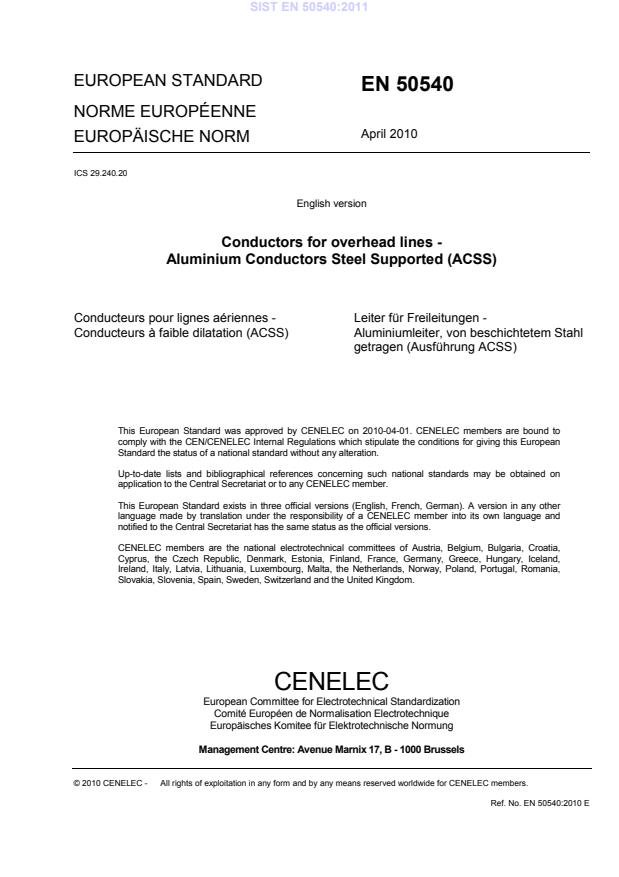
EUROPEAN STANDARD
EN 50540
NORME EUROPÉENNE
April 2010
EUROPÄISCHE NORM
ICS 29.240.20
English version
Conductors for overhead lines -
Aluminium Conductors Steel Supported (ACSS)
Conducteurs pour lignes aériennes - Leiter für Freileitungen -
Conducteurs à faible dilatation (ACSS) Aluminiumleiter, von beschichtetem Stahl
getragen (Ausführung ACSS)
This European Standard was approved by CENELEC on 2010-04-01. CENELEC members are bound to
comply with the CEN/CENELEC Internal Regulations which stipulate the conditions for giving this European
Standard the status of a national standard without any alteration.
Up-to-date lists and bibliographical references concerning such national standards may be obtained on
application to the Central Secretariat or to any CENELEC member.
This European Standard exists in three official versions (English, French, German). A version in any other
language made by translation under the responsibility of a CENELEC member into its own language and
notified to the Central Secretariat has the same status as the official versions.
CENELEC members are the national electrotechnical committees of Austria, Belgium, Bulgaria, Croatia,
Cyprus, the Czech Republic, Denmark, Estonia, Finland, France, Germany, Greece, Hungary, Iceland,
Ireland, Italy, Latvia, Lithuania, Luxembourg, Malta, the Netherlands, Norway, Poland, Portugal, Romania,
Slovakia, Slovenia, Spain, Sweden, Switzerland and the United Kingdom.
CENELEC
European Committee for Electrotechnical Standardization
Comité Européen de Normalisation Electrotechnique
Europäisches Komitee für Elektrotechnische Normung
Management Centre: Avenue Marnix 17, B - 1000 Brussels
© 2010 CENELEC - All rights of exploitation in any form and by any means reserved worldwide for CENELEC members.
Ref. No. EN 50540:2010 E
Foreword
This European Standard was prepared by CENELEC BTTF 132-1, Aluminium conductors steel supported
(ACSS type) for overhead electrical lines, based on the text of BT/ES0023/NOT. It was submitted to the
CENELEC Unique Acceptance Procedure and was approved by CENELEC as EN 50540 on 2010-04-01.
Attention is drawn to the possibility that some of the elements of this document may be the subject of
patent rights. CEN and CENELEC shall not be held responsible for identifying any or all such patent rights.
The following dates were fixed:
– latest date by which the EN has to be implemented
at national level by publication of an identical
national standard or by endorsement
(dop) 2011-04-01
– latest date by which the national standards conflicting
with the EN have to be withdrawn
(dow) 2013-04-01
__________
- 3 - EN 50540:2010
Contents
1 Scope . 5
1.1 Outer/conductive layers . 5
1.2 Steel core . 5
2 Normative re f e r enc es . 5
3 Definitions . 6
4 Designation system . 7
5 Requirements for ACSS stranded conductors . 8
5.1 Material . 8
5.2 Str anding . 11
5.3 Surface condition . 12
5.4 Conductor diameter . 12
5.5 Mechanical characteristics . 12
5.6 Joints . 13
5.7 Conductor mass per unit length . 13
5.8 Nominal DC resistance . 15
5.9 Variation in Aluminium area . 16
6 Tests . 16
6.1 Classification of tests . 16
6.2 Sample size . 17
6.3 Rounding rules . 17
6.4 Properties of c onduc tor . 17
6.5 Properties of wires . 19
6.6 Ins pec tion . 19
6.7 Acceptance or rejection . 20
7 Packaging and marking . 20
7.1 Packaging . 20
7.2 Marking and tare. 20
7.3 Random lengths . 20
7.4 Accuracy of lengths . 20
7.5 Drum barrel dim ensions . 21
8 Information to be clarified by the purchaser and manufacturer . 21
Annex A (normative) Stress - strain test method . 22
Annex B (informative) Lay ratios used for calculation of increments due to stranding
in Tables 5 and 6 . 25
Annex C (normative) Test for ability of a conductor to be erected using tension stringing . 26
Annex D (informative) AC resistance measurement method . 28
Figures
Figure C.1 - Test arrangement . 27
Figure C.2 – Drum holder and tensioner set–up . 27
Tables
Table 1 - Mechanical characteristics steel ST6A wires before stranding . 8
Table 2 - Characteristics of Extra High Strength Zn95Al5 steel wires (before stranding) . 9
Table 3 - Characteristics of Ultra High Strength Zn95Al5 steel wires (before stranding) . 9
Table 4 - Characteristics of Extra High Strength aluminium clad steel wires 20EHSA
(before stranding) . 10
Table 5 - Characterístics of Extra High Strength aluminium clad steel wires 14EHSA
(before stranding) . 10
Table 6 - Physical constants . 11
Table 7 - Lay ratios for galvanized steel, Zn95Al5 coated steel or aluminium-clad steel
layers . 12
Table 8 - Lay ratios for aluminium layers . 12
Table 9 - Number of joints permitted in a given length . 13
Table 10 - Increments due to stranding for formed Al wires . 14
Table 11 - Increments due to stranding for round Al wires . 15
Table 12 - Type and sample tests for conductors and wires . 16
Table 13 - Permitted reductions in wire properties after stranding . 19
Table B.1 - Lay ratios used for calculation of increments due to stranding in Tables 10 & 11 . 25
- 5 - EN 50540:2010
1 Scope
This European Standard specifies the electrical and mechanical characteristics of ACSS conductors made
of round or formed annealed aluminium wires and steel wires stranded in alternate directions, made of
one or a combination of any of the following.
1.1 Outer/conductive layers
Annealed Aluminium wire as per requirements of Clause 5.
1.2 Steel core
a) Galvanized steel wire type ST6A according to EN 50189 and requirements of Clause 5;
b) Zn95Al5 alloy coated steel wire with MM (mischmetal) as per EN 10244-2 and mechanical and mass of
coating requirements as per Tables 2 and 3, in the following options:
i Extra High Strength;
ii Ultra High Strength.
NOTE MM elements are mandatory. Coatings without MM can be used, if agreed between Supplier and Purchaser. Tests
without MM must show the same behaviour than the MM coatings.
c) Aluminium-clad steel wire 20,3 % conductivity in the following options:
- as per EN 61232 with class designation 20 SA;
- aluminium-clad steel wire Extra High Strength with designation 20 EHSA as per Table 4.
d) Aluminium-clad steel wire 14 % conductivity, Extra High Strength with designation 14 EHSA as per
Table 5.
2 Normative references
The following referenced documents are indispensable for the application of this document. For dated
references, only the edition cited applies. For undated references, the latest edition of the referenced
document (including any amendments) applies.
EN 10244-2 Steel wire and wire products. Non-ferrous metallic coating on steel wire
Part 2: zinc or zinc alloy coatings
EN 50182 Conductors for overhead lines - Round wire concentric lay stranded conductors
EN 50189 Conductors for overhead lines - Zinc coated steel wires (for testing purposes only)
EN 60889 Hard-drawn aluminum wire for overhead line conductors (for testing purposes only)
(IEC 60889)
EN 61232 Aluminium-clad steel wires for electrical purposes (IEC 61232)
EN 62219 Overhead electrical conductors - Formed wire, concentric lay, stranded conductors
(IEC 62219)
IEC 60050-466 International Electrotechnical Vocabulary (IEV) - Chapter 466: Overhead lines
IEC 60468 Method of measurement of resistivity of metallic materials
3 Definitions
In addition to the definitions given in IEC 60050-466, EN 50182 and EN 62219, the following definitions
apply.
3.1
aluminium
the most abundant of all metals. It is a ductile metal, silver-white in colour, which can be readily worked by
rolling, drawing, spinning, extruding, and forging. For the purpose of this European Standard, the
aluminium must be annealed
3.2
conductor
material intended to be used for carrying electric current consisting of a plurality of uninsulated wires
twisted together
3.3
concentric lay stranded conductor
conductor composed of a central core surrounded by one or more adjacent layers of wires being laid
helically in opposite directions
3.4
lay length
axial length of one complete turn of the helix formed by an individual wire in a stranded
conductor
3.5
lay ratio
ratio of the lay length to the external diameter of the corresponding layer of wires in the
stranded conductor
3.6
direction of lay
3.6.1
direction of lay (general definition)
direction of twist of a layer of wires as it moves away from the viewer
NOTE A right-hand lay is a clockwise direction and a left-hand lay is an anti-clockwise direction.
3.6.2
direction of lay (alternative definition)
the direction of lay is defined as right-hand or left-hand
NOTE With right-hand lay, the wires conform to the direction of the central part of the letter Z when the conductor is held vertically.
With left-hand lay, the wires conform to the direction of the central part of the letter S when the conductor is held vertically.
3.7
round wire
filament of drawn metal having a constant circular cross-section
3.8
formed wire
filament of metal having a constant cross-section and a non-circular shape
3.9
equivalent wire diameter
the diameter of a round wire which would have the same cross-sectional area, mass and electrical
resistance as a given formed wire of the same material
- 7 - EN 50540:2010
3.10
lot
group of conductors manufactured by the same manufacturer under similar conditions of production
NOTE A lot may consist of part or all of the purchased quantity.
3.11
nominal
name or identifying value of a measurable property by which a conductor or component of a conductor is
identified and to which tolerances are applied
NOTE Nominal values should be target values.
3.12
rated tensile strength
an estimate of the conductor breaking load calculated using the specified tensile properties of the
component wires
4 Designation system
a) Annealed aluminium wire: AL0
b) Galvanized steel wire according to EN 50189: ST6A
c) Zn95Al5 coated steel: MEHST or MUHST with mischmetal elements
Zn95Al5 coated steel: EHST or UHST without mischmetal elements (see note in Scope)
d) Aluminium clad steel 20,3 % according to EN 61232 classes: 20SA or 20EHSA
e) Aluminium clad steel 14 % EHS: 14EHSA
EXAMPLES:
401-AL0/28-ST6A Conductor made of AL0 wires around a core of ST6 class A zinc
coated steel wires. The integer area of AL0 is 401 mm and that of
ST6A wires, 28 mm .
401-AL0/28-MEHST Conductor made of AL0 wires around a core of Zn95Al5 coated
MEHST steel wires. The integer area of AL0 is 401 mm and that
of Zn95Al5 wires, 28 mm .
401-AL0/28-20EHSA Conductor made of AL0 wires around a core of Aluminium clad
steel 20,3 % wires. The integer area of AL0 is 401 mm and that of
Aluminium clad steel 20,3 %, 28 mm .
401-AL0/28-14EHSA Conductor made of AL0 wires around a core Aluminium clad 14 %
EHS steel wires. The integer area of AL0 is 401 mm and that
Aluminium clad steel 14 % wires, 28 mm .
f) Generic designations:
- ACSS: Concentric-Lay –Stranded Aluminium Conductors, Coated Steel Supported
- ACSS/TW: Formed Wire Compact Concentric-Lay –Stranded Aluminium Conductors, Coated Steel
Supported.
5 Requirements for ACSS stranded conductors
5.1 Material
5.1.1 ACSS conductors shall consist of a supporting core made of the following:
a) Galvanized steel wire type ST6A according to Table 1 (based on EN 50189)
Table 1 - Mechanical characteristics steel ST6A wires before stranding
Nominal Diameter Stress Ultimate tensile Elongation Mandrel Nº of 1 min Mass of Number
wire tolerance at 1 % strength at diameter immersions coating of
a
diameter breaking for torsions
on 250 mm wrapping
R
m
A and
mm
adherence
test
Individual Average
wires
2 2
Over Up to mm MPa N/mm % xD Nº g/m Nº
+ - min. min. min. min. min.
1,75 2,25 0,04 0,04 1 450 1 700 1 800 2,0 4 2 1/2 215 14
2,25 2,75 0,04 0,04 1 410 1 650 1 750 2,0 4 3 230 14
2,75 3,00 0,05 0,05 1 410 1 650 1 750 2,5 4 3 230 12
3,00 3,50 0,05 0,05 1 380 1 600 1 700 2,5 4 3 1/2 245 12
3,50 4,25 0,06 0,06 1 340 1 600 1 700 2,5 5 3 1/2 260 10
4,25 4,75 0,06 0,06 1 340 1 600 1 700 2,5 5 4 275 10
a
In case of galvanizing before final drawing, minimum number of torsions will be increase by 2 and minimum elongation will be decreased in 1 %.
- 9 - EN 50540:2010
b) Round steel wires coated by Zn95Al5 alloy, complying with the requirements of Tables 2 and 3
Rest of characteristics according to EN 50189 and zinc alloy coatings according to EN 10244-2
Table 2 - Characteristics of Extra High Strength Zn95Al5 steel wires (before stranding)
Nominal wire Diameter Stress Ultimate Elongation at Mandrel Mandrel Mass of
diameter tolerance at 1 % tensile breaking on diameter for diameter for coating
strength 250 mm A wrapping test adherence test
mm
R
m
Over Up to mm MPa MPa % g/m
+ - min. min. min. xD xD min.
1,91 2,28 0,038 0,025 1 550 1 825 3,0 4 4 214
2,29 2,64 0,051 0,051 1 515 1 790 3,0 4 4 229
2,65 3,04 0,051 0,051 1 515 1 790 3,0 4 4 244
3,05 3,55 0,076 0,051 1 480 1 760 3,5 4 4 259
3,56 4,57 0,102 0,076 1 450 1 725 3,5 4 5 274
4,58 4,82 0,102 0,076 1 450 1 725 3,5 4 5 305
Table 3 - Characteristics of Ultra High Strength Zn95Al5 steel wires (before stranding)
Nominal wire Diameter Stress Ultimate Elongation at Mandrel Mandrel Mass of
diameter tolerance at 1 % tensile breaking on diameter for diameter for coating
strength 250 mm A wrapping adherence test
test
mm
R
m
Over Up to (mm) MPa MPa (%) g/m
+ - min. min. min. xD xD min.
1,91 2,28 0,038 0,025 1 580 1 965 3,0 4 4 214
2,29 2,64 0,051 0,051 1 550 1 900 3,0 4 4 229
2,65 3,04 0,051 0,051 1 550 1 900 3,0 4 4 244
3,05 3,55 0,076 0,051 1 515 1 860 3,5 4 4 259
3,56 4,57 0,102 0,076 1 480 1 825 3,5 4 5 274
4,58 4,82 0,102 0,076 1 480 1 825 3,5 4 5 305
c) Round aluminium clad steel wires type 20 SA, fully complying with the requirements of EN 61232
d) Round aluminium clad Extra High Strength steel wires type 20 EHSA, as per the requirements of
Table 4
Table 4 - Characteristics of Extra High Strength aluminium clad steel wires 20EHSA
(before stranding)
Diameter Diameter Stress at 1% Tensile strength Elongation at Torsions
tolerance 250 mm
mm mm MPa MPa % Nº
Over Up to min. min. min. min.
1,28 2,28 ± 0,04 1 390 1 620 1,5 20
2,29 3,04 ± 0,05 1 360 1 580 1,5 20
3,05 3,55 ± 0,05 1 330 1 545 1,5 20
3,56 4,82 ± 0,06 1 300 1 515 1,5 20
e) Round aluminium clad Extra High Strength steel wires type 14EHSA, as per the requirements of
Table 5
Table 5 - Characterístics of Extra High Strength aluminium clad steel wires 14EHSA
(before stranding)
Diameter Diameter Stress at 1% Tensile strength Elongation at Torsions
tolerance 250 mm
mm mm MPa MPa % Nº
Over Up to min. min. min. min.
1,75 2,25 ± 0,04 1 550 1 825 1,5 20
2,26 3,00 ± 0,05 1 500 1 790 1,5 20
3,01 3,50 ± 0,05 1 470 1 760 1,5 20
3,51 4,75 ± 0,06 1 430 1 725 1,5 20
- 11 - EN 50540:2010
Table 6 - Physical constants
Coated steel wires
Characteristics of
wires
Galvanized Aluminium clad Aluminium clad
Unit Zn95Al5 wire
steel wire steel wire 20 SA steel wire 14 SA
Final modulus of
GPa 207 207 162 174
elasticity (practical)
Coefficient of linear -1 -6 -6 -6 -6
K 11,5 x 10 11,5 x 10 13 x 10 11,9 x 10
expansion
Temperature
coefficient of
-1
K - - 0,003 6 0,003 6
resistance to
constant mass (α)
Density kg/dm³ 7,78 7,78 6,59 7,29
Resistivity max. ηΩ.m - - 84,8 123,15
Aluminium
% radio - - 10 4,6
thickness, min.
Aluminium
proportion % - - 25 10
in cross section
5.1.2 Over the supporting core, ACSS conductors will have one or several layers of the following
material:
Round or formed annealed aluminium wires helically stranded, having the following requirements for all
range of sizes:
Aluminium wires (before and after stranding):
- tensile strength: min.: 60 Mpa - max: 95 Mpa;
- elongation at breaking: min.: 20 % in 250 mm;
- electrical resistivity: max.: 0,027899 ohm.mm /m.
5.2 Stranding
5.2.1 All wires of the conductor shall be concentrically stranded. The Al wires should be fully annealed
before stranding.
In case of formed wire, the only process acceptable is first to shape the wires in one process and after to
strand them in another one.
Adjacent wire layers shall be stranded with reverse lay directions. The direction of lay of the external layer
shall be right hand except when otherwise specified by the purchaser.
5.2.2 The lay ratios for the galvanized steel, Zn95Al5 alloy coated or aluminium-clad steel wire layers
shall be as given in Table 7.
5.2.3 In a multi-layer conductor, the lay ratio of any layer shall be equal to or less than the lay ratio of
the layer immediately beneath it.
Table 7 - Lay ratios for galvanized steel, Zn95Al5 coated steel or aluminium-clad steel layers
Number of 6 wire layer 12 wire layer 18 wire layer
steel wires
min. max. min. max. min. max.
7 16 26 - - - -
19 16 26 14 22 - -
37 17 25 16 22 14 18
The lay ratios for the aluminium layers of all types of conductor shall be as given in Table 8.
Table 8 - Lay ratios for aluminium layers
All inner layers Outer layer
min. max. min. max.
10 16 10 14
5.2.4 All steel wires shall lie naturally in their position in the stranded core, and where the core is cut,
the wire ends shall remain in position or be readily replaced by hand and then remain approximately in
position. This requirement also applies to the aluminium wires of a conductor.
5.2.5 Before stranding, aluminium and steel wires shall have approximately equal temperatures.
5.2.6 The conductor shall have the ability to be installed, using the purchaser's recommended
installation method, without damage to the conductor. If required, this shall be demonstrated according to
6.4.11.
5.3 Surface condition
The surface of the conductor shall be free from all imperfections visible to the unaided eye (normal
corrective lenses accepted), such as nicks, indentations, etc., not consistent with good commercial
practice.
5.4 Conductor diameter
The conductor diameter shall not vary from the nominal value, specified by the purchaser, by more than
- ± 1 % for diameters larger or equal to 10 mm,
- ± 0,1 mm for diameters smaller than 10 mm.
5.5 Mechanical characteristics
The rated tensile strength of an ACSS conductor shall be the sum of the 96 % of minimum tensile strength
of the aluminium portion (based on a minimum tensile strength of 60 MPa plus the 100 % of the minimum
tensile strength of galvanized, Zn95Al5 steel coated or aluminium clad steel (based on the minimum
tensile strength required for the component wires). In case of ST6C wires, the minimum average tensile
strength should be used for the calculation.
- 13 - EN 50540:2010
5.6 Joints
5.6.1 During stranding, no aluminium wire welds shall be made for the purpose of achieving the
required conductor length. There shall be no joints of any kind made in the finished galvanized, Zn95Al5
coated wire or aluminium-clad steel core wire during stranding.
5.6.2 Joints are permitted in aluminium wires unavoidably broken during stranding, provided such
breaks are not associated with either inherently defective wire or with the use of short lengths of
aluminium wires. Joints shall conform to the geometry of the original wire, i.e. joints shall be dressed
smoothly with a diameter equal to that of the parent wires and shall not be kinked.
The number of joints in aluminium wires shall not exceed those specified in Table 9. These joints shall not
be closer than 15 m from a joint in the same wire or in any other aluminium wire of the completed
conductor.
Joints shall be made by electric butt welding, cold pressure welding or other methods approved by the
purchaser. The first type of joint shall be electrically annealed for approximately 250 mm on both sides of
the weld.
The manufacturer shall, if required by the purchaser, demonstrate that the method used for jointing
aluminium wires meets the strength requirement of 60 MPa by performing the tensile test.
Table 9 - Number of joints permitted in a given length
Conductor length L Number of
m
joints permitted
Number of aluminium layers
1 2 3 4
L ≤ 1 500 - - -
L ≤ 1 500 - -
1 500 < L ≤ 2 000
L ≤ 1 500 -
L > 2 000 1 500 < L ≤ 2 000
L ≤ 1 500
- 1 500 < L ≤ 2 000
2 000 < L ≤ 2 500 5
- 1 500 < L ≤ 2 000
L > 2 500 2 000 < L ≤ 2 500 6
-
- 2 500 < L ≤ 3 000 2 000 < L ≤ 2 500 7
-
- 2 500 < L ≤ 3 000 8
3 000 < L ≤ 3 500
-
- 9
L > 3 500 3 000 < L ≤ 3 500
-
- 10
-
3 500 < L ≤ 4 000
-
- 11
-
L > 4 000
5.7 Conductor mass per unit length
The increments, in per cent, for mass due to stranding, shall be as given in Tables 10 and 11, which have
been calculated using the commonly used lay ratios for each applicable layer of aluminium or steel wire
given in Annex B.
The mass per unit length of the conductor shall be calculated by using the following specific weights:
- Aluminium: 2,703 g/cm ;
- Galvanized or covered with Zn95Al5 steel wire (all types): 7,78 g/cm ;
- Aluminium clad steel wire 20SA or 20EHSA: 6,59 g/cm ;
- 3
Aluminium clad steel wire 14EHSA: 7,29 g/cm .
Table 10 - Increments due to stranding for formed Al wires
Increment (increase)
%
Stranding of ACSS/TW mass and electrical resistance
Mass Electrical resistance
Ratio C. Sections Steel/Al
ST6A,
Number of Steel Wires
Aluminium-
%
Aluminium Zn95Al5 or Al Aluminium
clad steel
clad steel
Two –Al Layers Designs
0,52 0,52
7 7 2,0 2,0
0,52 0,52
10 7 2,11 2,11
0,52 0,52
13 7 2,27 2,27
16 7 2,21 0,52 2,21 0,52
23 7 2,31 0,52 2,31 0,52
24 19 2,32 0,86 2,32 0,86
25 19 2,32 0,86 2,32 0,86
28 19 2,35 0,86 2,35 0,86
Three –Al Layers Designs
0,52 0,52
5 7 2,21 2,21
0,52 0,52
7 7 2,22 2,22
8 19 2,27 0,79 2,27 0,79
10 7 2,31 0,52 2,31 0,52
13 19 2,33 0,79 2,33 0,79
26 37 2,67 0,96 2,67 0,96
Four–Al Layers Designs
8 19 2,46 0,79 2,46 0,79
- 15 - EN 50540:2010
Table 11 - Increments due to stranding for round Al wires
Stranding of conductor Increment (increase)
%
Aluminium Steel Mass Electrical resistance
Number Number Number Number Aluminium ST6A, Aluminium Aluminium-
of wires of layers of wires of layers Zn95Al5 or clad steel
a a
Al clad steel
10 1
1 7 2,01 0,52 2,01 0,52
12 1
1 7 2,17 0,52 2,17 0,52
14 1
1 7 2,30 0,52 2,30 0,52
18 1
2 7 1,94 0,52 1,94 0,52
22 1
2 7 2,07 0,52 2,07 0,52
24 1
2 7 2,13 0,52 2,13 0,52
26 1
2 7 2,18 0,52 2,18 0,52
28 1
2 7 2,22 0,52 2,22 0,52
30 1
2 7 2,26 0,52 2,26 0,52
32 1
2 7 2,30 0,52 2,30 0,52
36 1
2 7 2,37 0,52 2,37 0,52
42 1
3 7 2,20 0,52 2,20 0,52
45 1
3 7 2,23 0,52 2,23 0,52
48 1
3 7 2,26 0,52 2,26 0,52
54 1
3 7 2,31 0,52 2,31 0,52
72 1
4 7 2,40 0,52 2,40 0,52
84 1
4 7 2,46 0,52 2,46 0,52
14 2
1 19 2,50 0,82 2,50 0,82
15 2
1 19 2,56 0,82 2,56 0,82
16 2
1 19 2,61 0,82 2,61 0,82
18 2
1 19 2,70 0,82 2,70 0,82
30 2
2 19 2,36 0,86 2,36 0,86
32 2
2 19 2,41 0,86 2,41 0,86
36 2
2 19 2,48 0,86 2,48 0,86
42 2
2 19 2,57 0,86 2,57 0,86
54 2
3 19 2,26 0,79 2,26 0,79
38+22 2
3 19 2,22 0,79 2,22 0,79
42+20 2
3 19 2,18 0,79 2,18 0,79
66 2
3 19 2,34 0,79 2,34 0,79
78 2
3 19 2,40 0,79 2,40 0,79
96 2
4 19 2,46 0,79 2,46 0,79
100 2
4 19 2,47 0,79 2,47 0,79
18 3
1 37 2,70 1,09 2,70 1,09
24 3
1 37 2,91 1,09 2,91 1,09
72 3
3 37 2,43 0,96 2,43 0,96
54+66 3
4 37 2,32 0,86 2,32 0,86
150 3
5 37 2,38 0,86 2,38 0,86
a
Number of layers of each type of wire, not including the centre wire.
5.8 Nominal DC resistance
The nominal DC resistance at 20 °C of a conductor, expressed in Ω/km to three significant figures, is
based on the resistivity value for calculation purposes and on the nominal cross section of the aluminium
and aluminium clad steel wires referenced in Clauses 2 and 5, increased by the increments in Tables 10
or 11. The resistivity to be used in the calculations, for the different Aluminium clad steel cores, is shown
in Table 6. The resistivity for aluminium wire is shown in 5.1.2.
5.9 Variation in Aluminium area
The area of cross section of the aluminium wires of a conductor shall be between ± 2 % of the nominal.
6 Tests
6.1 Classification of tests
6.1.1 Type tests are intended to verify the main characteristics of a conductor which depend mainly on
its design. They shall be carried out once . be it for a new design, a new manufacturer or manufacturing
process of conductor and then subsequently repeated only when the design, manufacturer or
manufacturing process is changed. The type tests are listed in Table 12.
6.1.2 Sample tests are intended to guarantee the quality of conductors and compliance with the
requirements of this standard. The sample tests are also listed in Table 12.
Table 12 - Type and sampl
...
Frequently Asked Questions
EN 50540:2010 is a standard published by CLC. Its full title is "Conductors for overhead lines - Aluminium Conductors Steel Supported (ACSS)". This standard covers: This draft European Standard specifies the electrical and mechanical characteristics of ACSS conductors made of round or formed annealed aluminium wires and steel wires stranded in alternate directions, made of one or a combination of any of the following. 1.1 Outer/conductive layers Annealed Aluminium wire as per requirements of Clause 5. 1.2 Steel core a) Galvanized steel wire type ST6A according to EN 50189 and requirements of Clause 5; b) Zn95Al5 alloy coated steel wire with MM (mischmetal) as per EN 10244-2 and mechanical and mass of coating requirements as per Tables 2 and 3, in the following options: i Extra High Strength; ii Ultra High Strength. NOTE MM elements are mandatory. Coatings without MM can be used, if agreed between Supplier and Purchaser. Tests without MM must show the same behaviour than the MM coatings. c) Aluminium-clad steel wire 20,3 % conductivity in the following options: - as per EN 61232 with class designation 20 SA; - aluminium-clad steel wire Extra High Strength with designation 20 EHSA as per Table 4. d) Aluminium-clad steel wire 14 % conductivity, Extra High Strength with designation 14 EHSA as per Table 5.
This draft European Standard specifies the electrical and mechanical characteristics of ACSS conductors made of round or formed annealed aluminium wires and steel wires stranded in alternate directions, made of one or a combination of any of the following. 1.1 Outer/conductive layers Annealed Aluminium wire as per requirements of Clause 5. 1.2 Steel core a) Galvanized steel wire type ST6A according to EN 50189 and requirements of Clause 5; b) Zn95Al5 alloy coated steel wire with MM (mischmetal) as per EN 10244-2 and mechanical and mass of coating requirements as per Tables 2 and 3, in the following options: i Extra High Strength; ii Ultra High Strength. NOTE MM elements are mandatory. Coatings without MM can be used, if agreed between Supplier and Purchaser. Tests without MM must show the same behaviour than the MM coatings. c) Aluminium-clad steel wire 20,3 % conductivity in the following options: - as per EN 61232 with class designation 20 SA; - aluminium-clad steel wire Extra High Strength with designation 20 EHSA as per Table 4. d) Aluminium-clad steel wire 14 % conductivity, Extra High Strength with designation 14 EHSA as per Table 5.
EN 50540:2010 is classified under the following ICS (International Classification for Standards) categories: 29.240.20 - Power transmission and distribution lines. The ICS classification helps identify the subject area and facilitates finding related standards.
You can purchase EN 50540:2010 directly from iTeh Standards. The document is available in PDF format and is delivered instantly after payment. Add the standard to your cart and complete the secure checkout process. iTeh Standards is an authorized distributor of CLC standards.
The standard EN 50540:2010 outlines the essential electrical and mechanical characteristics for Aluminium Conductors Steel Supported (ACSS), addressing both performance metrics and material specifications that are critical for overhead line applications. This document serves as a comprehensive guide for manufacturers and suppliers, ensuring that ACSS conductors meet stringent requirements in terms of safety, durability, and efficiency. One of the significant strengths of this standard is its detailed specification of components, particularly concerning the materials used in the conductors. By stipulating the use of round or formed annealed aluminium wires, alongside a variety of steel wire types-including galvanized and alloy-coated options-EN 50540:2010 enables manufacturers to achieve high-performance ACSS conductors that can withstand the rigors of diverse environmental conditions. The clarity in material guidelines enhances the interoperability and quality assurance that customers expect in modern electrical infrastructure. The document not only outlines various conductor configurations but also includes explicit performance criteria related to mechanical strength and coating requirements. This focus on both mechanical and electrical properties ensures that conductors are fit for purpose, thereby promoting greater reliability in overhead line networks. The inclusion of recommendations for both standard and extra high strength options reflects the standard's relevance in addressing the evolving needs of the power transmission industry. Moreover, the standard's emphasis on the use of Mischmetal (MM) coatings for steel wires presents an innovative approach to enhance corrosion resistance, contributing to the longevity and maintenance of ACSS conductors. By specifying that alternative coatings can only be adopted with prior agreement between suppliers and purchasers, the standard maintains a high level of quality control, which is critical for safeguarding electrical safety and operational efficiency. Overall, EN 50540:2010 is a vital resource that establishes a robust framework for the manufacturing and application of ACSS conductors, ensuring that they are constructed to meet high standards of performance while catering to the practical requirements of modern overhead line designs. The comprehensive nature of this standard makes it a cornerstone for compliance and best practices in the industry.
SIST EN 50540:2011 문서는 전선의 표준화에 중요한 내용을 포함하고 있으며, ACSS(Aluminium Conductors Steel Supported) 전선에 대한 전기적 및 기계적 특성을 명확하게 규명합니다. 이 표준은 섬세하게 규명된 오버헤드 전선의 설계와 구현에 필수적인 지침을 제공하여, 알루미늄과 강선이 교차하여 조합된 구조에 대한 기술적 요구사항을 체계적으로 다룹니다. 이 표준의 강점 중 하나는 다양한 도금 선택지의 명확한 정의입니다. ST6A 강선, Zn95Al5 합금 도금 강선, 그리고 다양한 종류의 알루미늄 도금 강선을 포함하여, 각 조합이 부여하는 전기적 성능과 기계적 강도를 상세히 설명합니다. 이를 통해 제조업체와 구매자 간의 상호 협의에 대한 유연성을 제공하면서도, 표준의 일관성을 유지합니다. ACSS 전선의 특성은 전력 송전 효율성에 큰 기여를 하며, 이는 현대 전력망의 지속 가능성을 높이는 데 매우 중요한 요소입니다. EN 50540:2010은 알루미늄 도금 강선의 전도성과 기계적 강도를 최대한 활용할 수 있는 방법을 제시하고 있어, 고강도 요구를 충족하는 핵심적인 기준을 제공합니다. 이 표준은 오버헤드 전선 분야에 대한 전문가들에게 필수적인 자료로 작용하며, 업계의 관련 법규 및 규제 준수에 있어 중요한 역할을 담당합니다. 따라서 EN 50540:2010은 전력 송전 솔루션의 품질과 신뢰성을 확보하는 데 매우 relevantes한 기준이라 할 수 있습니다.
SIST EN 50540:2011は、アルミニウム導体鋼支持(ACSS)に関する重要なヨーロッパ標準であり、この文書はACSS導体の電気的および機械的特性を具体的に示しています。この標準は、丸形または成形された焼き入れアルミニウムワイヤーと、交互の方向にストランドされた鋼ワイヤーから成るもので、特にその構造におけるさまざまな材料の特性を網羅しています。 この標準の強みは、明確な規格に基づくことで、導体の性能を一貫して確保できる点にあります。具体的には、焼き入れアルミニウムワイヤーや、異なるコーティングを施した鋼ワイヤーを使用する選択肢があり、それらが一致した性能を発揮するように設計されています。例えば、ST6Aガルバニゼーション鋼ワイヤーやZn95Al5合金コーティング鋼ワイヤーの使用は、使用条件に応じて高い強度と耐久性を保証します。 さらに、標準は、電気導体の効率性をさらに高めるための異なる導電率のアルミニウムクラッド鋼ワイヤーの設計を含んでおり、特により高い強度が求められる産業用途において、大変有用です。これにより、ACSS導体は様々な環境条件下でも安定した性能を提供できることが期待されます。 また、SIST EN 50540:2011は、供給者と購入者間での合意に基づく調整が可能であり、特にMM(ミスケメタル)を含まないコーティングの使用に関する柔軟性は、市場ニーズに迅速に対応できる点でも特筆に値します。これは、導電性とコストのバランスを求める企業にとって、非常に大きな利点となります。 全体として、SIST EN 50540:2011は、ACSS導体の設計と製造において、基準とガイドラインを提供し、電力伝送システムの効率性と信頼性を向上させるための不可欠な文書であると言えます。特に、その詳細な性能要件と複数の選択肢が、業界全体にとっての価値を高めています。
Questions, Comments and Discussion
Ask us and Technical Secretary will try to provide an answer. You can facilitate discussion about the standard in here.
Loading comments...