

FprEN IEC 60598-2-2:2026
(Main)Luminaires - Part 2-2: Particular requirements - Recessed luminaires and recessed air-handling luminaires
- Status
- Not Published
- Publication Date
- 03-Mar-2027
- Technical Committee
- CLC/TC 34 - Lighting
- Current Stage
- 5020 - Vote circulated - Formal Approval
- Start Date
- 16-Oct-2026
- Due Date
- 19-Dec-2025
- Completion Date
- 19-Dec-2025



FprEN IEC 60598-2-2:2026 is a CLC draft for recessed luminaires and recessed air-handling luminaires. It specifies particular safety and test requirements for luminaires used in ceilings, ventilation ducts, or ventilated spaces, for electric light sources and supply voltages up to 1 000 V.
What does FprEN IEC 60598-2-2:2026 specify?
FprEN IEC 60598-2-2:2026 gives the particular requirements for recessed luminaires and recessed air-handling luminaires used with forced ventilation systems. The document is built to be used together with IEC 60598-1, and it adds product-specific clauses, symbols, test methods, and thermal test annexes.
The structure is straightforward: clauses 1 to 17 cover scope, references, definitions, testing, marking, construction, wiring, earthing, shock protection, ingress protection, insulation, creepage, thermal endurance, heat/fire/tracking, and terminals. The annexes provide the special test arrangements and explanatory material that are needed for recessed products.
| Annex | What it covers |
|---|---|
| Annex AAA | Measurement of ambient temperature in an installation |
| Annex AAB | Recessed luminaires thermal test methods |
| Annex AAC | Explanation of t for air-handling luminaires |
| Annex AAD | Schedule of amended subclauses that may trigger retesting |
What are the key requirements of FprEN IEC 60598-2-2:2026?
FprEN IEC 60598-2-2:2026 keeps the Part 1 framework, but adds requirements that matter for recessed installation, ceiling cavities, airflow, and heat build-up. In practice, the main job is to show that the luminaire remains safe when it is partly hidden in a recess and affected by the surrounding cavity.
Test sequence and assessment approach
Clause 4 sets the order in which the document’s clauses are applied. That matters because recessed luminaires have thermal, wiring, and protection checks that need to be carried out in a defined sequence, especially when the product has an IP rating greater than IP20.
Clause 4 also says that products already assessed to the previous edition are generally not retested from scratch. Instead, they are reviewed against the amended clauses listed in Annex AAD, which helps manufacturers and test labs focus on the changed parts.
Marking that affects installation
Clause 6 requires dual IP ratings to be clearly and durably marked when applicable, and the marking must remain visible during installation. The same clause requires symbols for luminaires not suitable for direct mounting on normally flammable surfaces and for luminaires not suitable for covering with thermally insulating material.
This matters because installers need to see, before the luminaire is fixed in place, whether it can touch the building fabric or be covered by insulation. The symbols are also linked to the manufacturer’s instructions, so the marking and the instructions have to agree.
Wiring, earthing, and electric shock protection
Clause 8 requires flexible cables or cords supplied by the manufacturer to meet the mechanical, electrical, and temperature performance of the IEC 60227 series or IEC 60245 series. Clause 10 requires the parts in the ceiling space or cavity to provide the same degree of protection against electric shock as the visible parts below the ceiling.
In practice, this means the hidden parts cannot be treated as less critical simply because they are above the ceiling line. The ceiling cavity is treated as accessible for installation and maintenance, so barriers alone are not enough.
IP testing and thermal testing in the recess
Clause 11 requires the recessed parts and the protruding parts to be tested according to the IP classification stated in the mounting instructions. Clause 14 then requires the luminaire to be mounted and tested according to Annex AAB, including the thermal behaviour of wiring that can touch or pass into the luminaire.
This is important because the enclosure rating does not automatically protect ceiling seals or surrounding construction joints. The tests check the luminaire itself, and they check whether connected wiring stays within safe temperature limits.
Air-handling luminaires and ambient temperature
Clause 14.103 and Annex AAC address air-handling luminaires under static operating conditions, meaning no forced supply or extract air, but natural convection is allowed. The document sets temperature limits for normal and abnormal conditions, and the luminaire’s t marking is tied to that assessment.
For users, that means the ambient temperature in the cavity and the way the air system operates can determine whether a chosen luminaire is suitable. Annex AAA gives a practical method for measuring that ambient temperature in an installation.
What terms does FprEN IEC 60598-2-2:2026 define?
- Air-handling luminaire - a luminaire designed to work with an air conditioning system, with air passing through the lamp chamber or separate passages.
- Static operation - operation without forced supply or extract air, while natural convection still occurs.
- Rated maximum ambient temperature (t) - the maximum ambient temperature for which the luminaire is marked under the specified conditions.
- IP classification - the ingress protection rating used to check how the luminaire parts are tested in the recess and outside it.
- Normally flammable surfaces - surfaces for which the document uses a special marking when the luminaire is not suitable for direct mounting.
- Thermally insulating material - insulation used around suitable recessed luminaires in the thermal test arrangement.
Who uses FprEN IEC 60598-2-2:2026?
FprEN IEC 60598-2-2:2026 is used by luminaire manufacturers, test laboratories, certification bodies, lighting designers, installers, and quality or compliance teams. They use it to design recessed products, choose markings, prepare installation instructions, set up thermal and IP tests, and check whether a product is suitable for a ceiling cavity or an air-handling application.
It is also relevant for buyers and specifiers who need to compare recessed luminaire products on a defined safety basis.
What changed in FprEN IEC 60598-2-2:2026 from the previous edition?
FprEN IEC 60598-2-2:2026 is the fifth edition and cancels and replaces the fourth edition published in 2023. The stated technical change is that the clause numbers and structure have been aligned with IEC 60598-1.
Annex AAD states that no requirements in this document are considered more onerous than in the previous edition.
Which standards are used with FprEN IEC 60598-2-2:2026?
FprEN IEC 60598-2-2:2026 is used with the latest edition of IEC 60598-1 and its amendments, which provide the general luminaire requirements that this Part 2-2 modifies and supplements.
The normative references named in the document are:
- IEC 60227 - used for PVC insulated cables and cords up to and including 450/750 V
- IEC 60245 - used for rubber insulated cables up to and including 450/750 V
What does the FprEN IEC 60598-2-2:2026 document contain?
The document contains the core safety clauses for recessed luminaires, plus the special test arrangements needed for ceiling installation and forced-ventilation use. It includes two marking figures for installation warnings, one table for cable operating temperature limits, and three figures in Annex AAB showing example test recesses and box dimensions.
Annex AAA explains how to measure ambient temperature in an installation, while Annex AAC explains how t applies to air-handling luminaires. Annex AAB gives the thermal test set-ups for products that can or cannot be covered with thermal insulating material, and Annex AAD lists the subclauses to review if a product is being reassessed against changes from the previous edition.
Relations
- Effective Date
- 23-Apr-2024
Get Certified
Connect with accredited certification bodies for this standard

IMQ S.p.A. (Certification)
Italian electrical product certification.

SLG Prüf- und Zertifizierungs GmbH
German testing and certification body.

UL Solutions
Global safety science company with testing, inspection and certification.
Sponsored listings
Frequently Asked Questions
FprEN IEC 60598-2-2:2026 is a draft published by CLC. Its full title is "Luminaires - Part 2-2: Particular requirements - Recessed luminaires and recessed air-handling luminaires". This standard covers: Luminaires - Part 2-2: Particular requirements - Recessed luminaires and recessed air-handling luminaires
Luminaires - Part 2-2: Particular requirements - Recessed luminaires and recessed air-handling luminaires
FprEN IEC 60598-2-2:2026 is classified under the following ICS (International Classification for Standards) categories: 29.140.50 - Lighting installation systems. The ICS classification helps identify the subject area and facilitates finding related standards.
FprEN IEC 60598-2-2:2026 has the following relationships with other standards: It is inter standard links to EN IEC 60598-2-2:2024. Understanding these relationships helps ensure you are using the most current and applicable version of the standard.
FprEN IEC 60598-2-2:2026 is associated with the following European legislation: EU Directives/Regulations: 2014/35/EU; Standardization Mandates: M/511. When a standard is cited in the Official Journal of the European Union, products manufactured in conformity with it benefit from a presumption of conformity with the essential requirements of the corresponding EU directive or regulation.
FprEN IEC 60598-2-2:2026 is available in PDF format for immediate download after purchase. The document can be added to your cart and obtained through the secure checkout process. Digital delivery ensures instant access to the complete standard document.
Standards Content (Sample)
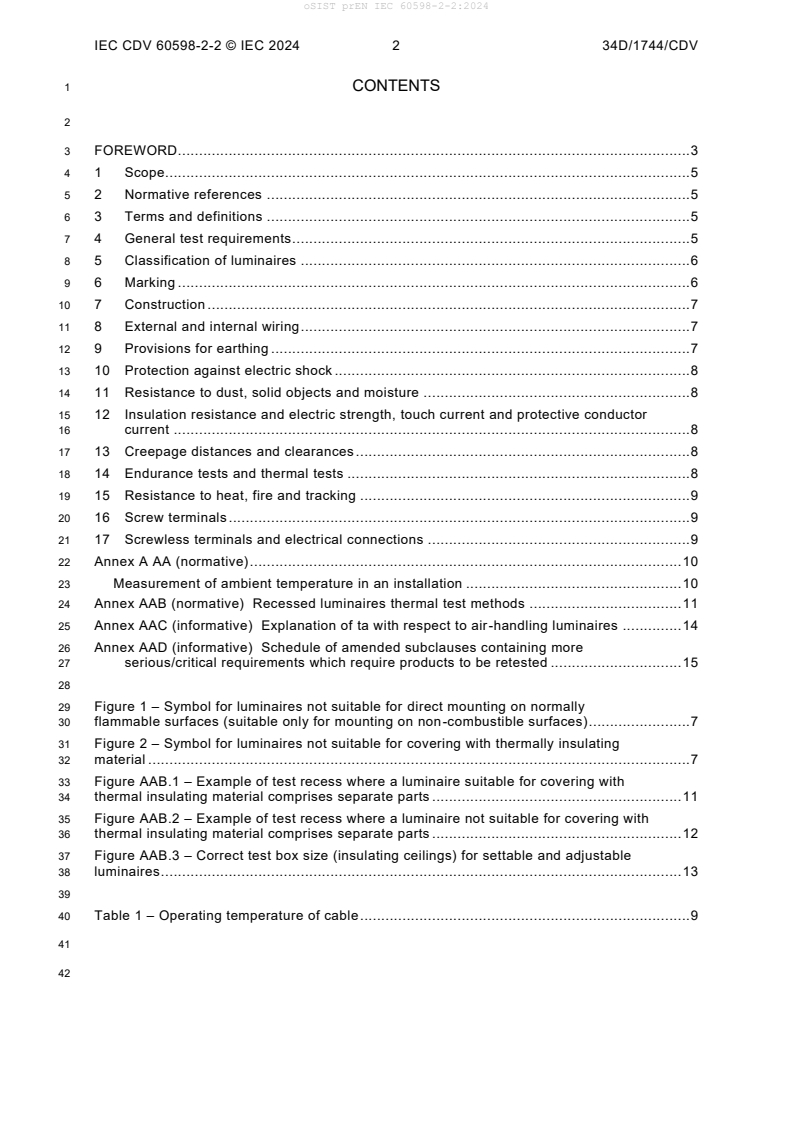
Contents
- 3 FOREWORD
- 4 1 Scope
- 5 2 Normative references
- 6 3 Terms and definitions
- 7 4 General test requirements
- 8 5 Classification of luminaires
- 9 6 Marking
- 10 7 Construction
- 11 8 External and internal wiring
- 12 9 Provisions for earthing
- 13 10 Protection against electric shock
- 14 11 Resistance to dust, solid objects and moisture
- 15 12 Insulation resistance and electric strength, touch current and protective conductor 16 current
- 17 13 Creepage distances and clearances
- 18 14 Endurance tests and thermal tests
- 19 15 Resistance to heat, fire and tracking
- 20 16 Screw terminals
- 21 17 Screwless terminals and electrical connections
- 22 Annex A AA (normative)
- 23 Measurement of ambient temperature in an installation
- 24 Annex AAB (normative) Recessed luminaires thermal test methods
- 25 Annex AAC (informative) Explanation of ta with respect to air-handling luminaires
- 26 Annex AAD (informative) Schedule of amended subclauses containing more 27 serious/critical requirements which require products to be retested
- 29 Figure 1 – Symbol for luminaires not suitable for direct mounting on normally 30 flammable surfaces (suitable only for mounting on non-combustible surfaces)
- 31 Figure 2 – Symbol for luminaires not suitable for covering with thermally insulating 32 material
- 33 Figure AAB.1 – Example of test recess where a luminaire suitable for covering with 34 thermal insulating material comprises separate parts
- 35 Figure AAB.2 – Example of test recess where a luminaire not suitable for covering with 36 thermal insulating material comprises separate parts
- 37 Figure AAB.3 – Correct test box size (insulating ceilings) for settable and adjustable 38 luminaires
- 40 Table 1 – Operating temperature of cable
43 INTERNATIONAL ELECTROTECHNICAL COMMISSION 44 ____________ 45 46 LUMINAIRES – 47 48 Part 2-2: Particular requirements – 49 Recessed luminaires and recessed air-handling luminaires 50 51 52 FOREWORD 53 1) The International Electrotechnical Commission (IEC) is a worldwide organization for standardization comprising 54 all national electrotechnical committees (IEC National Committees). The object of IEC is to promote international 55 co-operation on all questions concerning standardization in the electrical and electronic fields. To this end and 56 in addition to other activities, IEC publishes International Standards, Technical Specifications, Technical Reports, 57 Publicly Available Specifications (PAS) and Guides (hereafter referred to as "IEC Publication(s)"). Their 58 preparation is entrusted to technical committees; any IEC National Committee interested in the subject dealt with 59 may participate in this preparatory work. International, governmental and non-governmental organizations liaising 60 with the IEC also participate in this preparation. IEC collaborates closely with the International Organization for 61 Standardization (ISO) in accordance with conditions determined by agreement between the two organizations. 62 2) The formal decisions or agreements of IEC on technical matters express, as nearly as possible, an international 63 consensus of opinion on the relevant subjects since each technical committee has representation from all 64 interested IEC National Committees.
65 3) IEC Publications have the form of recommendations for international use and are accepted by IEC National 66 Committees in that sense. While all reasonable efforts are made to ensure that the technical content of IEC 67 Publications is accurate, IEC cannot be held responsible for the way in which they are used or for any 68 misinterpretation by any end user.
69 4) In order to promote international uniformity, IEC National Committees undertake to apply IEC Publications 70 transparently to the maximum extent possible in their national and regional publications. Any divergence between 71 any IEC Publication and the corresponding national or regional publication shall be clearly indicated in the latter. 72 5) IEC itself does not provide any attestation of conformity. Independent certification bodies provide conformity 73 assessment services and, in some areas, access to IEC marks of conformity. IEC is not responsible for any 74 services carried out by independent certification bodies.
75 6) All users should ensure that they have the latest edition of this publication.
76 7) No liability shall attach to IEC or its directors, employees, servants or agents including individual experts and 77 members of its technical committees and IEC National Committees for any personal injury, property damage or 78 other damage of any nature whatsoever, whether direct or indirect, or for costs (including legal fees) and 79 expenses arising out of the publication, use of, or reliance upon, this IEC Publication or any other IEC 80 Publications.
81 8) Attention is drawn to the Normative references cited in this publication. Use of the referenced publications is 82 indispensable for the correct application of this publication.
83 9) IEC draws attention to the possibility that the implementation of this document may involve the use of (a) 84 patent(s). IEC [takes no position concerning the evidence, validity or applicability of any claimed patent rights in 85 respect thereof. As of the date of publication of this document, IEC had not received notice of (a) patent(s), which 86 may be required to implement this document. However, implementers are cautioned that this may not represent 87 the latest information, which may be obtained from the patent database available at https://patents.iec.ch. IEC 88 shall not be held responsible for identifying any or all such patent rights.
89 IEC 60598-2-2 has been prepared by subcommittee 34D: Luminaires, of IEC technical 90 committee 34: Lighting. It is an International Standard.
91 This fifth edition cancels and replaces the fourth edition published in 2023. This edition 92 constitutes a technical revision.
93 This edition includes the following significant technical changes with respect to the previous 94 edition:
95 a) the clause numbers and structure have been aligned with those of IEC 60598-1 97 The text of this International Standard is based on the following documents:
Draft Report on voting
XX/XX/FDIS XX/XX/RVD 99 100 Full information on the voting for its approval can be found in the report on voting indicated in 101 the above table.
102 The language used for the development of this International Standard, Technical is English. 103 This document was drafted in accordance with ISO/IEC Directives, Part 2, and developed in 104 accordance with ISO/IEC Directives, Part 1 and ISO/IEC Directives, IEC Supplement, and the 105 ISO/IEC Directives, JTC 1 Supplement available at www.iec.ch/members_experts/refdocs. The 106 main document types developed by IEC are described in greater detail at 107 www.iec.ch/publications.
108 This Part 2-2 is to be used in conjunction with the latest edition of IEC 60598-1 and its amendment(s). 109 It was established on the basis of the tenth edition (20XX) of that standard.
110 111 NOTE When “Part 1” is mentioned in this document, it refers to IEC 60598-1.
112 113 Where this document states "addition", "modification" or "replacement", the relevant text of Part 1 is to 114 be adapted accordingly.
115 116 Subclauses, notes, figures and tables additional to those in Part 1 are numbered starting from 101; 117 supplementary annexes are entitled AAA, AAB, etc.
118 119 A list of all parts in the IEC 60598 series, published under the general title Luminaires can be found 120 on the IEC website.
121 122 The committee has decided that the contents of this document will remain unchanged until the 123 stability date indicated on the IEC website under webstore.iec.ch in the data related to the 124 specific document. At this date, the document will be 125 • reconfirmed, 126 • withdrawn, 127 • replaced by a revised edition, or 128 • amended.
132 LUMINAIRES – 133 134 Part 2-2: Particular requirements – 135 Recessed luminaires and recessed air-handling luminaires 136 137 1 Scope 138 This part of IEC 60598 specifies requirements for recessed luminaires and recessed air- 139 handling luminaires for use within ventilation ducts or ventilated spaces. These luminaires are 140 for use with electric light sources and with supply voltages up to 1 000 V.
141 NOTE The expressions "ventilation" and "ventilated" in this document refer to forced ventilation. 142 2 Normative references 143 This clause of Part 1 applies with the following additions::
144 IEC 60227 (all parts), Polyvinyl chloride insulated cables of rated voltages up to and including 145 450/750 V 146 IEC 60245 (all parts), Rubber insulated cables – Rated voltages up to and including 450/750 V 147 3 Terms and definitions 148 For the purposes of this document, the terms and definitions given in Part 1 applies with the 149 following additions:
150 ISO and IEC maintain terminology databases for use in standardization at the following 151 addresses:
...