

EN 50306-4:2020
(Main)Railway applications - Railway rolling stock cables having special fire performance - Thin wall - Part 4: Multicore and multipair screened or not screened sheathed cables
General Information
- Abstract
This document specifies requirements for, and constructions and dimensions of, multicore and multipair cables rated voltage U0/U: 300/500 V, of the following types: - unscreened, sheathed for either exposed or protected wiring (0,5 mm2 to 2,5 mm2, number of cores from 2 to 48); - screened, sheathed for either exposed or protected wiring (0,5 mm2 to 2,5 mm2, number of cores from 2 to 8); - unscreened, sheathed for either exposed or protected wiring (0,5 mm2 to 1,5 mm2, number of screened pairs of cores from 2 to 7). - screened, sheathed for either exposed or protected wiring (0,5 mm2 to 1,5 mm2, number of unscreened pairs of cores from 2 to 7). All cables have stranded tinned copper conductors, halogen-free, thin wall thickness insulation and standard wall thickness sheath. Cable types are specified for use in exposed situations (Class E), and for protected situations (Class P). They are for use in railway rolling stock as fixed wiring or wiring where limited flexing in operation is encountered. These cables are rated for occasional thermal stresses causing ageing equivalent to continuous operational life at a temperature of 90 °C. For standard cables this is determined by the acceptance test defined in EN 50305, using accelerated long-term (5 000 h) thermal ageing indicating a 110 °C/20 000 h temperature index. If the customer were to require lifetime predictions this would be demonstrated based on the temperature index of the product as supplied by the manufacturer. The maximum temperature for short circuit conditions is 160 °C based on duration of 5 s. Under fire conditions the cables exhibit special performance characteristics in respect of maximum permissible flame propagation (flame spread) and maximum permissible emission of smoke and toxic gases. These requirements are specified to permit the cables to satisfy Hazard Level 3 of EN 45545 1 and EN 45545 2. EN 50306 4:2020 is expected to be used in conjunction with EN 50306-1:2020, General requirements, EN 50306-2:2020, Single core cables, and EN 50306-3:2020, Single core and multicore cables.
- Status
- Published
- Publication Date
- 19-Mar-2020
- Withdrawal Date
- 29-Dec-2022
- Technical Committee
- CLC/TC 20 - Electric cables
- Drafting Committee
- CLC/TC 20 - Electric cables
- Current Stage
- 9093 - Decision to confirm - Review Enquiry
- Start Date
- 23-Oct-2024
- Completion Date
- 25-Aug-2026



Overview
EN 50306-4:2020 specifies construction, dimensions and performance requirements for thin‑wall multicore and multipair sheathed cables used in railway rolling stock. It covers both screened and unscreened variants rated U0/U = 300/500 V, with stranded tinned copper conductors and halogen‑free insulation and sheath. These cables are designed for fixed wiring or applications with limited flexing and are intended to meet enhanced fire‑performance needs typical in modern trains.
Key topics and technical requirements
- Cable types and ranges
- Unscreened multicore sheathed: conductor sizes 0.5 mm2 to 2.5 mm2, 2 to 48 cores.
- Screened multicore sheathed: 0.5 mm2 to 2.5 mm2, 2 to 8 cores.
- Multipair with individually screened pairs or screened overall: 0.5 mm2 to 1.5 mm2, pairs from 2 to 7.
- Materials and construction
- Stranded, tinned copper conductors.
- Halogen‑free, thin wall insulation; standard wall sheath.
- Options for exposed (Class E) or protected (Class P) installations.
- Electrical and thermal limits
- Rated for thermal ageing equivalent to continuous operation at 90 °C. Acceptance testing uses accelerated long‑term ageing (EN 50305) - 5 000 h corresponding to a 110 °C / 20 000 h temperature index.
- Maximum short‑circuit temperature: 160 °C for 5 s.
- Fire performance
- Defined limits on flame propagation (flame spread), smoke emission, and toxic gas release to enable compliance with Hazard Level 3 (HL3) of EN 45545‑1 and EN 45545‑2.
- Tests and verification
- Included tests: voltage tests, low temperature, ozone resistance, compatibility, spark tests (where applicable), and dedicated fire tests (referencing EN 60332, EN 60332‑3, EN 61034‑2 and EN 50305).
Applications and practical value
- Suitable for rolling stock fixed wiring and circuits subject to limited mechanical movement (e.g., carriage interconnections, control and signal circuits).
- Chosen where stringent fire safety, low smoke and halogen‑free characteristics are required - particularly in passenger areas and high‑risk zones where EN 45545 HL3 is specified.
- Enables manufacturers, specifiers and integrators to select cables that meet defined mechanical, electrical and fire safety performance for modern train fleets.
Who should use this standard
- Cable manufacturers and compound suppliers
- Rolling stock designers and system engineers
- Procurement and specification teams in rail operators and OEMs
- Test laboratories, certification bodies and safety assessors
- Installation and maintenance teams verifying conformity
Related standards
- EN 50306‑1, ‑2, ‑3 (EN 50306 series - general, single core and related types)
- EN 50305 (test methods)
- EN 45545‑1 / EN 45545‑2 (fire hazard levels)
- EN 60332, EN 61034, EN 60811 (fire and material test series)
Keywords: EN 50306-4:2020, railway rolling stock cables, thin wall, multicore and multipair, screened sheathed cables, halogen-free, flame propagation, smoke emission, EN 45545 HL3, stranded tinned copper, thermal ageing.
Relations
- Effective Date
- 15-May-2018
- Refers
EN 45545-1:2013 - Railway applications - Fire protection on railway vehicles - Part 1: General - Effective Date
- 09-Feb-2026
- Effective Date
- 03-Feb-2026
- Effective Date
- 03-Feb-2026
- Effective Date
- 03-Feb-2026
- Effective Date
- 03-Feb-2026
- Effective Date
- 03-Feb-2026
- Effective Date
- 03-Feb-2026
- Effective Date
- 03-Feb-2026
- Effective Date
- 03-Feb-2026
- Effective Date
- 03-Feb-2026
- Effective Date
- 03-Feb-2026
- Effective Date
- 03-Feb-2026
- Effective Date
- 03-Feb-2026
- Effective Date
- 03-Feb-2026
Get Certified
Connect with accredited certification bodies for this standard

IMQ S.p.A. (Certification)
Italian electrical product certification.

IRIS Certification (UNIFE)
International Railway Industry Standard certification.

SLG Prüf- und Zertifizierungs GmbH
German testing and certification body.
Sponsored listings
Frequently Asked Questions
EN 50306-4:2020 is a standard published by CLC. Its full title is "Railway applications - Railway rolling stock cables having special fire performance - Thin wall - Part 4: Multicore and multipair screened or not screened sheathed cables". This standard covers: This document specifies requirements for, and constructions and dimensions of, multicore and multipair cables rated voltage U0/U: 300/500 V, of the following types: - unscreened, sheathed for either exposed or protected wiring (0,5 mm2 to 2,5 mm2, number of cores from 2 to 48); - screened, sheathed for either exposed or protected wiring (0,5 mm2 to 2,5 mm2, number of cores from 2 to 8); - unscreened, sheathed for either exposed or protected wiring (0,5 mm2 to 1,5 mm2, number of screened pairs of cores from 2 to 7). - screened, sheathed for either exposed or protected wiring (0,5 mm2 to 1,5 mm2, number of unscreened pairs of cores from 2 to 7). All cables have stranded tinned copper conductors, halogen-free, thin wall thickness insulation and standard wall thickness sheath. Cable types are specified for use in exposed situations (Class E), and for protected situations (Class P). They are for use in railway rolling stock as fixed wiring or wiring where limited flexing in operation is encountered. These cables are rated for occasional thermal stresses causing ageing equivalent to continuous operational life at a temperature of 90 °C. For standard cables this is determined by the acceptance test defined in EN 50305, using accelerated long-term (5 000 h) thermal ageing indicating a 110 °C/20 000 h temperature index. If the customer were to require lifetime predictions this would be demonstrated based on the temperature index of the product as supplied by the manufacturer. The maximum temperature for short circuit conditions is 160 °C based on duration of 5 s. Under fire conditions the cables exhibit special performance characteristics in respect of maximum permissible flame propagation (flame spread) and maximum permissible emission of smoke and toxic gases. These requirements are specified to permit the cables to satisfy Hazard Level 3 of EN 45545 1 and EN 45545 2. EN 50306 4:2020 is expected to be used in conjunction with EN 50306-1:2020, General requirements, EN 50306-2:2020, Single core cables, and EN 50306-3:2020, Single core and multicore cables.
This document specifies requirements for, and constructions and dimensions of, multicore and multipair cables rated voltage U0/U: 300/500 V, of the following types: - unscreened, sheathed for either exposed or protected wiring (0,5 mm2 to 2,5 mm2, number of cores from 2 to 48); - screened, sheathed for either exposed or protected wiring (0,5 mm2 to 2,5 mm2, number of cores from 2 to 8); - unscreened, sheathed for either exposed or protected wiring (0,5 mm2 to 1,5 mm2, number of screened pairs of cores from 2 to 7). - screened, sheathed for either exposed or protected wiring (0,5 mm2 to 1,5 mm2, number of unscreened pairs of cores from 2 to 7). All cables have stranded tinned copper conductors, halogen-free, thin wall thickness insulation and standard wall thickness sheath. Cable types are specified for use in exposed situations (Class E), and for protected situations (Class P). They are for use in railway rolling stock as fixed wiring or wiring where limited flexing in operation is encountered. These cables are rated for occasional thermal stresses causing ageing equivalent to continuous operational life at a temperature of 90 °C. For standard cables this is determined by the acceptance test defined in EN 50305, using accelerated long-term (5 000 h) thermal ageing indicating a 110 °C/20 000 h temperature index. If the customer were to require lifetime predictions this would be demonstrated based on the temperature index of the product as supplied by the manufacturer. The maximum temperature for short circuit conditions is 160 °C based on duration of 5 s. Under fire conditions the cables exhibit special performance characteristics in respect of maximum permissible flame propagation (flame spread) and maximum permissible emission of smoke and toxic gases. These requirements are specified to permit the cables to satisfy Hazard Level 3 of EN 45545 1 and EN 45545 2. EN 50306 4:2020 is expected to be used in conjunction with EN 50306-1:2020, General requirements, EN 50306-2:2020, Single core cables, and EN 50306-3:2020, Single core and multicore cables.
EN 50306-4:2020 is classified under the following ICS (International Classification for Standards) categories: 13.220.40 - Ignitability and burning behaviour of materials and products; 29.060.20 - Cables; 45.060.01 - Railway rolling stock in general. The ICS classification helps identify the subject area and facilitates finding related standards.
EN 50306-4:2020 has the following relationships with other standards: It is inter standard links to EN 50306-4:2002, EN 45545-1:2013, EN 60811-1-3:1995/A1:2001, EN 60811-1-2:1995, EN 50305:2020, EN 60811-1-1:1995/A1:2001, EN 61034-2:2005, EN 60332-1-2:2004, EN IEC 60332-3-24:2018, EN 60811-1-3:1995, EN 60811-1-4:1995, EN 50306-3:2020, EN 50264-1:2008, EN 60811-1-1:1995, EN 50306-2:2020. Understanding these relationships helps ensure you are using the most current and applicable version of the standard.
EN 50306-4:2020 is available in PDF format for immediate download after purchase. The document can be added to your cart and obtained through the secure checkout process. Digital delivery ensures instant access to the complete standard document.
Standards Content (Sample)
SLOVENSKI STANDARD
01-junij-2020
Nadomešča:
SIST EN 50306-4:2003
Železniške naprave - Kabli v železniških vozilih s posebno požarno odpornostjo -
Tanka stena - 4. del: Večžilni in večparni zaslonjeni in nezaslonjeni oplaščeni kabli
Railway applications - Railway rolling stock cables having special fire performance - Thin
wall - Part 4: Multicore and multipair screened or not screened sheathed cables
Bahnanwendungen - Kabel und Leitungen für Schienenfahrzeuge mit verbessertem
Verhalten im Brandfall - Reduzierte Isolierwanddicken - Teil 4: Mehradrige und
mehrpaarige Leitungen
Applications ferroviaires - Câbles pour matériel roulant ferroviaire ayant des
performances particulières de comportement au feu - Isolation mince - Partie 4: Câbles
multiconducteurs et multipaires gainés blindés ou non blindés
Ta slovenski standard je istoveten z: EN 50306-4:2020
ICS:
13.220.40 Sposobnost vžiga in Ignitability and burning
obnašanje materialov in behaviour of materials and
proizvodov pri gorenju products
29.060.20 Kabli Cables
45.060.01 Železniška vozila na splošno Railway rolling stock in
general
2003-01.Slovenski inštitut za standardizacijo. Razmnoževanje celote ali delov tega standarda ni dovoljeno.
EUROPEAN STANDARD EN 50306-4
NORME EUROPÉENNE
EUROPÄISCHE NORM
March 2020
ICS 13.220.40; 29.060.20; 45.060.01 Supersedes EN 50306-4:2002 and all of its amendments
and corrigenda (if any)
English Version
Railway applications - Railway rolling stock cables having
special fire performance - Thin wall - Part 4: Multicore and
multipair screened or not screened sheathed cables
Applications ferroviaires - Câbles pour matériel roulant Bahnanwendungen - Kabel und Leitungen für
ferroviaire ayant des performances particulières de Schienenfahrzeuge mit verbessertem Verhalten im
comportement au feu - Isolation mince - Partie 4: Câbles Brandfall - Reduzierte Isolierwanddicken - Teil 4:
multiconducteurs et multipaires gainés blindés ou non Mehradrige und mehrpaarige Leitungen
blindés
This European Standard was approved by CENELEC on 2019-12-30. CENELEC members are bound to comply with the CEN/CENELEC
Internal Regulations which stipulate the conditions for giving this European Standard the status of a national standard without any alteration.
Up-to-date lists and bibliographical references concerning such national standards may be obtained on application to the CEN-CENELEC
Management Centre or to any CENELEC member.
This European Standard exists in three official versions (English, French, German). A version in any other language made by translation
under the responsibility of a CENELEC member into its own language and notified to the CEN-CENELEC Management Centre has the
same status as the official versions.
CENELEC members are the national electrotechnical committees of Austria, Belgium, Bulgaria, Croatia, Cyprus, the Czech Republic,
Denmark, Estonia, Finland, France, Germany, Greece, Hungary, Iceland, Ireland, Italy, Latvia, Lithuania, Luxembourg, Malta, the
Netherlands, Norway, Poland, Portugal, Republic of North Macedonia, Romania, Serbia, Slovakia, Slovenia, Spain, Sweden, Switzerland,
Turkey and the United Kingdom.
European Committee for Electrotechnical Standardization
Comité Européen de Normalisation Electrotechnique
Europäisches Komitee für Elektrotechnische Normung
CEN-CENELEC Management Centre: Rue de la Science 23, B-1040 Brussels
© 2020 CENELEC All rights of exploitation in any form and by any means reserved worldwide for CENELEC Members.
Ref. No. EN 50306-4:2020 E
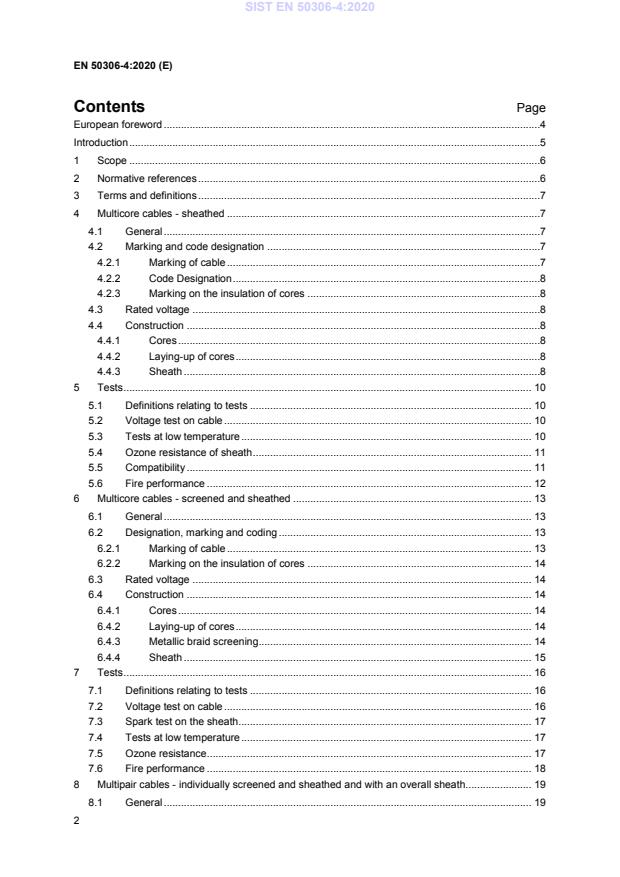
Contents Page
European foreword .4
Introduction .5
1 Scope .6
2 Normative references .6
3 Terms and definitions .7
4 Multicore cables - sheathed .7
4.1 General .7
4.2 Marking and code designation .7
4.2.1 Marking of cable .7
4.2.2 Code Designation .8
4.2.3 Marking on the insulation of cores .8
4.3 Rated voltage .8
4.4 Construction .8
4.4.1 Cores .8
4.4.2 Laying-up of cores .8
4.4.3 Sheath .8
5 Tests . 10
5.1 Definitions relating to tests . 10
5.2 Voltage test on cable . 10
5.3 Tests at low temperature . 10
5.4 Ozone resistance of sheath . 11
5.5 Compatibility . 11
5.6 Fire performance . 12
6 Multicore cables - screened and sheathed . 13
6.1 General . 13
6.2 Designation, marking and coding . 13
6.2.1 Marking of cable . 13
6.2.2 Marking on the insulation of cores . 14
6.3 Rated voltage . 14
6.4 Construction . 14
6.4.1 Cores . 14
6.4.2 Laying-up of cores . 14
6.4.3 Metallic braid screening . 14
6.4.4 Sheath . 15
7 Tests . 16
7.1 Definitions relating to tests . 16
7.2 Voltage test on cable . 16
7.3 Spark test on the sheath . 17
7.4 Tests at low temperature . 17
7.5 Ozone resistance . 17
7.6 Fire performance . 18
8 Multipair cables - individually screened and sheathed and with an overall sheath. 19
8.1 General . 19
8.2 Designation, marking and coding . 19
8.2.1 Marking of the cable . 19
8.2.2 Marking on the insulation of cores . 20
8.2.3 Marking on the sheath of the pair . 20
8.3 Rated voltage . 20
8.4 Construction . 20
8.4.1 Pairs . 20
8.4.2 Laying-up of pairs . 20
9 Tests . 21
9.1 Definitions relating to tests . 21
9.2 Voltage test . 22
10 Multipair cables – general screened and sheathed . 23
10.1 General . 23
10.2 Designation, marking and coding . 23
10.2.1 Marking of cable . 23
10.2.2 Marking on the insulation of cores . 24
10.3 Rated voltage . 24
10.4 Construction . 24
10.4.1 Pairs . 24
10.4.2 Laying-up of pairs . 24
10.4.3 Metallic braid screening . 24
10.4.4 Outer sheath of the cable . 25
11 Tests . 26
11.1 Definitions relating to tests . 26
11.2 Voltage test - core to screen. 26
Annex A (informative) Guidance on selection of cables for type approval . 29
Bibliography . 30
European foreword
This document (EN 50306-4:2020) has been prepared by CLC/TC 20, “Electric cables.
The following dates are fixed:
• latest date by which this document has (dop) 2020-12-30
to be implemented at national level by
publication of an identical national
standard or by endorsement
• latest date by which the national (dow) 2022-12-30
standards conflicting with this document
have to be withdrawn
This document supersedes EN 50306-4:2002 and all of its amendments and corrigenda (if any).
This edition includes the following significant technical changes with respect to the previous edition:
— The documents have been updated to reflect the changes in the test standard EN 50305;
— The range of the conductor cross sections has been extended;
— The reference to cited standards (e.g. EN 60811 series) has been updated.
Attention is drawn to the possibility that some of the elements of this document may be the subject of
patent rights. CENELEC shall not be held responsible for identifying any or all such patent rights.
Introduction
The EN 50306 series covers a range of sheathed and unsheathed cables with thin wall thickness
insulation, based on halogen-free materials, for use in railway rolling stock. It is divided into four parts:
Part 1: General requirements;
Part 2: Single core cables;
Part 3: Single core and multicore cables screened and thin wall sheathed;
Part 4: Multicore and multipair screened or not screened sheathed cables.
Special test methods referred to in the EN 50306 series are given in EN 50305. A guide to use is
given in EN 50355 and rules for installation are given in EN 50343.
EN 50306-1:2020, General requirements, contains a more extensive introduction to the EN 50306
series and should be read in conjunction with this document.
1 Scope
This document specifies requirements for, and constructions and dimensions of, multicore and
multipair cables rated voltage U /U: 300/500 V, of the following types:
2 2
— unscreened, sheathed for either exposed or protected wiring (0,5 mm to 2,5 mm , number of
cores from 2 to 48);
2 2
to 2,5 mm , number of cores
— screened, sheathed for either exposed or protected wiring (0,5 mm
from 2 to 8);
2 2
to 1,5 mm , number of
— unscreened, sheathed for either exposed or protected wiring (0,5 mm
screened pairs of cores from 2 to 7).
2 2
to 1,5 mm , number of
— screened, sheathed for either exposed or protected wiring (0,5 mm
unscreened pairs of cores from 2 to 7).
All cables have stranded tinned copper conductors, halogen-free, thin wall thickness insulation and
standard wall thickness sheath. Cable types are specified for use in exposed situations (Class E), and
for protected situations (Class P). They are for use in railway rolling stock as fixed wiring or wiring
where limited flexing in operation is encountered.
These cables are rated for occasional thermal stresses causing ageing equivalent to continuous
operational life at a temperature of 90 °C. For standard cables this is determined by the acceptance
test defined in EN 50305, using accelerated long-term (5 000 h) thermal ageing indicating a
110 °C/20 000 h temperature index. If the customer were to require lifetime predictions this would be
demonstrated based on the temperature index of the product as supplied by the manufacturer.
The maximum temperature for short circuit conditions is 160 °C based on duration of 5 s.
Under fire conditions the cables exhibit special performance characteristics in respect of maximum
permissible flame propagation (flame spread) and maximum permissible emission of smoke and toxic
gases. These requirements are specified to permit the cables to satisfy Hazard Level 3 of EN 45545-1
and EN 45545-2.
EN 50306-2:2020, Single core cables, and EN 50306-3:2020, Single core and multicore cables.
2 Normative references
The following documents are referred to in the text in such a way that some or all of their content
constitutes requirements of this document. For dated references, only the edition cited applies. For
undated references, the latest edition of the referenced document (including any amendments)
applies.
EN 45545-1, Railway applications - Fire protection on railway vehicles - Part 1: General
EN 50264-1:2008, Railway applications - Railway rolling stock power and control cables having
special fire performance - Part 1: General requirements
EN 50305:2020, Railway applications - Railway rolling stock cables having special fire performance -
Test methods
EN 50306-1:2020, Railway applications - Railway rolling stock cables having special fire performance -
Thin wall - Part 1: General requirements
EN 50306-2:2020, Railway applications - Railway rolling stock cables having special fire performance -
Thin wall - Part 2: Single core cables
EN 50306-3:2020, Railway applications - Railway rolling stock cables having special fire performance -
Thin wall - Part 3: Single core and multicore cables screened and thin wall sheathed
EN 60332-1-2, Tests on electric and optical fibre cables under fire conditions - Part 1-2: Test for
vertical flame propagation for a single insulated wire or cable - Procedure for 1 kW pre-mixed flame
EN 60332-3-24, Tests on electric and optical fibre cables under fire conditions - Part 3-24: Test for
vertical flame spread of vertically-mounted bunched wires or cables - Category C
EN 61034-2, Measurement of smoke density of cables burning under defined conditions - Part 2: Test
procedure and requirements
EN 60811 (all parts), Electric and optical fibre cables - Test methods for non-metallic materials
3 Terms and definitions
No terms and definitions are listed in this document.
ISO and IEC maintain terminological databases for use in standardization at the following addresses:
— ISOOnline browsing platform: available at https://www.iso.org/obp
— IEC Electropedia: available at http://www.electropedia.org/
4 Multicore cables - sheathed
4.1 General
The completed cables shall conform to the applicable general requirements given in EN 50306-1:2020
and to the specific requirements of Clause 4 and Clause 5.
Conformity with the requirements shall be checked by inspection and by the tests given in Table 2.
4.2 Marking and code designation
4.2.1 Marking of cable
Cables shall be marked with the following:
— Manufacturer's name;
— EN reference;
— table number;
— cable class (P or E);
— Voltage rating (U0);
— No. of cores and conductor size;
— A code designation according for use of the cable (see 4.2.2);
— Conductor temperature rating
For example:
XYZ EN 50306-4 1E 300 V 2x1,5 MM 90
The marking shall conform to the requirements of EN 50306-1:2020, Clause 5.
4.2.2 Code Designation
The following letters shall be used as a code to identify the suitability of a particular cable for use
under one of the Hazard Levels of EN 45545-1, and to indicate performance levels relating to low
temperature and to oil and fuel resistance:
Hazard Level EN 45545-1 HL3
— low temperature / oil resistance C
— extra low temperature / oil resistance F
— low temperature / extra oil and fuel resistance J
— extra low temperature / extra oil and fuel resistance M
For sheathed cables two letters are required, one for the insulation and one for the sheath
4.2.3 Marking on the insulation of cores
The cores shall be marked 1, 2, etc., in accordance with the requirements, given in EN 50306-2:2020,
4.3.2.
However, the core number one may be marked as the relevant single core in accordance with the
requirements of EN 50306-2:2020, 4.3.2.
Durability of marking shall be in accordance with EN 50305:2020, 10.1.
4.3 Rated voltage
The rated voltage recognized for the purposes of this standard shall be U0/U = 300V / 500V
NOTE See EN 50355 and 50343 for further information.
4.4 Construction
4.4.1 Cores
Each insulated single core shall conform to the requirements given in EN 50306-2:2020.
4.4.2 Laying-up of cores
The cores shall be twisted together.
The pitch of lay for the cores shall not be greater than 20 times the diameter of the laid-up cores in the
cable.
4.4.3 Sheath
The sheath shall be a compound of type EM 101 to EM 104, and shall be applied by extrusion.
Compounds type EM 101 to EM 104 together with their requirements are defined in EN 50264-1.
The sheath material from the finished cable shall be tested in accordance with the requirements given
in EN 50264-1:2008, Table 4.
The sheath shall be smooth and uniformly applied; the application shall ensure that cables with a class
E sheath are substantially circular. The thickness of sheath shall conform to the specified value given
in Table 1 according to the class.
The sheath colour shall be black, unless otherwise specified.
Table 1 — Requirements for construction of multicore cables - sheathed
1 2 3 4 5 6 7
Number of Cables class E Cables class P
cores and
nominal
cross-section
of the
conductor
Average Overall diameter Minimum Overall diameter
minimum thickness
thickness of sheath at
of sheath any point
min. max. min. max.
mm mm mm mm mm mm mm
2 × 0,5 1,0 4,9 5,9 0,42 3,5 4,5
3 × 0,5 1,0 5,1 6,1 0,42 3,8 4,8
4 × 0,5 1,0 5,5 6,5 0,42 4,1 5,3
7 × 0,5 1,0 6,3 7,3 0,42 4,9 6,1
13 × 0,5 1,0 8,3 9,3 0,56 7,3 8,5
19 × 0,5 1,0 9,0 10,2 0,56 8,1 9,3
37 × 0,5 1,0 12,3 13,5 0,56 10,8 12,2
2 × 0,75 1,0 5,3 6,3 0,42 4,0 5,0
3 × 0,75 1,0 5,5 6,5 0,42 4,2 5,2
4 × 0,75 1,0 6,0 7,0 0,42 4,6 5,8
7 × 0,75 1,0 6,9 7,9 0,42 5,5 6,6
13 × 0,75 1,0 9,1 10,3 0,56 8,2 9,4
19 × 0,75 1,0 10,0 11,2 0,56 9,0 10,4
37 × 0,75 1,0 13,2 14,4 0,56 12,2 13,6
48 × 0,75 1,0 14,8 16,4 0,56 13,9 15,7
2 × 1,0 1,0 5,6 6,6 0,42 4,3 5,3
3 × 1,0 1,0 5,9 6,9 0,42 4,6 5,6
4 × 1,0 1,0 6,3 7,3 0,42 4,9 6,1
7 × 1,0 1,0 7,3 8,3 0,42 6,0 7,2
13 × 1,0 1,0 9,7 10,9 0,56 8,7 10,1
19 × 1,0 1,0 10,7 11,9 0,56 9,8 11,2
37 × 1,0 1,0 14,0 15,6 0,56 13,3 14,7
2 × 1,5 1,0 6,3 7,3 0,42 5,0 6,0
3 × 1,5 1,0 6,6 7,6 0,42 5,3 6,3
4 × 1,5 1,0 7,4 8,4 0,42 6,0 7,2
7 × 1,5 1,0 8,6 9,8 0,56 7,7 8,9
13 × 1,5 1,0 11,7 12,9 0,56 10,7 12,1
19 × 1,5 1,0 13,0 14,2 0,56 12, 13,4
37 × 1,5 1,0 17,2 18,8 0,56 16,2 18,
1 2 3 4 5 6 7
Number of Cables class E Cables class P
cores and
nominal
cross-section
of the
conductor
Average Overall diameter Minimum Overall diameter
minimum thickness
thickness of sheath at
of sheath any point
min. max. min. max.
mm mm mm mm mm mm mm
2 × 2,5 1,0 7,7 8,7 0,56 6,7 7,9
3 × 2,5 1,0 8,1 9,1 0,56 7,1 8,3
4 × 2,5 1,0 8,8 10,0 0,56 7,9 9,1
For other compositions (number of cores), sheath thicknesses shall follow in principle the value
mentioned in the Table 1 or ask the manufacturer for adequate technical design depending on the
application requirements. The cable marking shall keep the standard name as EN 50306-4:2020.
5 Tests
5.1 Definitions relating to tests
The definition of Type (T), Sample (S) and Routine (R) tests is as given in EN 50306-1:2020,
Clause 3.
NOTE 1 Tests classified as Sample (S) or Routine (R) could be required as part of any approval schemes.
NOTE 2 Annex A gives guidance on the selection of cables for type approval.
5.2 Voltage test on cable
The test shall be carried out in accordance with EN 50305:2020, 6.2.1, using an AC or DC voltage and
the following conditions:
— sample length 20 m
— voltage (AC) 2 kV
— voltage (DC) 4,8 kV
— duration of application 5 min
— test temperature (20 ± 5) °C
At the conclusion of the test there shall be no breakdown of the insulation.
5.3 Tests at low temperature
a) Bending test for cable diameter ≤ 12,5mm
The test shall be carried out at (- 40 ± 2) °C in accordance with EN 60811-504.
At the conclusion of the test there shall be no cracks in the sheath.
Where cables sheaths are not to be used at extra low temperature, the test may be carried out at
(- 25 ± 2) °C.
b) Elongation test for cable diameter > 12,5mm
The test shall be carried out at (- 40 ± 2) °C in accordance with EN 60811-505.
The elongation of the sheath shall be not less than 30 %.
Where cables sheaths are not to be used at extra low temperatures, the test may be carried out at
(- 25 ± 2) °C.
c) Impact
The test shall be carried out at (- 25 ± 2) °C in accordance with EN 50305:2020, 5.1.
At the conclusion of the test there shall be no cracks in the inside or the outside of the sheath, nor on
the outside of the insulation.
5.4 Ozone resistance of sheath
The test shall be carried out either in accordance with EN 60811-403 (for Method A) or
EN 50305:2020, 7.4.2, (for Method B), using the following conditions:
The choice of Method A or Method B may be made by the supplier.
Method A:
−4
concentration (%) (250 to 300) × 10
test temperature (25 ± 2) °C
test duration 24 h
test requirements no cracks
Method B:
−6
concentration (%) (200 ± 50) × 10
test temperature (40 ± 2) °C
relative humidity (%) 55 ± 5
test duration 72 h
test requirements no cracks
5.5 Compatibility
The test shall be carried out in accordance with EN 50305:2020, 7.1. Cable shall be aged for 7 days at
the following temperatures:
(100 ± 2) °C for cables with a designated operating temperature of 90 °C;
Test requirement:
— tensile strength variation ± 30 % maximum
— elongation at break variation ± 30 % maximum
5.6 Fire performance
The completed cable shall conform to the requirements given in EN 50306-1:2020, 8.1, 8.2.1, 8.2.2 or
8.2.3 (depending upon overall diameter) and 8.3.
The sheath shall conform to the requirements of EN 50306-1:2020, Clause 9.
Table 2 — Schedule of tests for multicore cables - sheathed
1 2 3 4 5 6
Ref Test Catego-ry Test method given in Requirement
No of test given in
a
EN (Sub)clause
1 Electrical tests
1.1 Electrical resistance of conductors T, S EN 50305:2020 6.1 Table 1 of EN
50306-2:2020
1.2 Voltage test on complete cable T, S EN 50305:2020 6.2.1 5.2
2 Provisions covering constructional and
dimensional characteristics
2.1 Checking of conformity and constructional T, S EN 50306-1 Inspection 3.4 and Clause 6 of
provisions EN 50306-1:2020
2.2 Sheath:
(a) Application S EN 50306-1 Inspection and 6.6.2 of
manual test EN 50306-1:2020
(b) Thickness T, S EN 50306-1 A.2 Table 1
2.3 Overall diameter T, S EN 50306-1 6.7 Table 1
2.4 Identification and marking T, S EN 50306-4 Inspection and 4.2.1 and 4.2.3
measurement
2.5 Durability of identification T, S EN 50305:2020 10.1 5.3 of
EN 50306-1:2020
3 Tests of sheath material
3.1 Mechanical properties of sheath in state as T, S EN 60811-501 9.2 Table 4 of
delivered EN 50264-1:2008
3.2 Tests at low temperature
...