

FprEN 50600-2-2:2026
(Main)Information technology - Data centre facilities and infrastructures - Part 2-2: Power supply and distribution
- Abstract
This document addresses power supplies to, and power distribution within, data centres based upon the criteria and classifications for “availability”, “physical security” and “resource and energy efficiency enablement” within EN 50600-1. This document specifies requirements and recommendations for the following: a) power supplies to data centres; b) power distribution systems to all equipment within data centres; c) telecommunications infrastructure bonding; d) lightning protection; e) devices for the measurement of the energy consumption and power quality characteristics at points along the power distribution system and their integration within management tools. NOTE Safety and electromagnetic compatibility (EMC) requirements are outside the scope of this document and are covered by other standards and regulations. However, information given in this document can be of assistance in meeting these standards and regulations.
- Status
- Not Published
- Publication Date
- 31-Jan-2027
- Technical Committee
- CLC/TC 215 - Electrotechnical aspects of telecommunication equipment
- Drafting Committee
- CLC/TC 215/WG 03 - Facilities and infrastructures
- Current Stage
- 5020 - Vote circulated - Formal Approval
- Start Date
- 09-Oct-2026
- Due Date
- 26-May-2026
- Completion Date
- 26-May-2026

FprEN 50600-2-2:2026 is a CENELEC draft European Standard for power supply and power distribution in data centres. It specifies requirements and recommendations for how data centres are supplied, distributed, bonded and monitored, with a focus on availability, physical security, and resource and energy efficiency enablement.
It is written for people who design, build, install, operate and maintain data centres, and for buyers or engineers deciding what power architecture and measurement capability a site needs. The document ties power design to the EN 50600-1 classifications and to the interfaces used for management, KPIs and resilience analysis.
What does FprEN 50600-2-2:2026 specify?
FprEN 50600-2-2:2026 specifies the power-related part of data centre facilities and infrastructures. It covers power supplies to the data centre, power distribution inside the data centre, telecommunications infrastructure bonding, lightning protection, and devices for measuring energy consumption and power quality at points along the power distribution system.
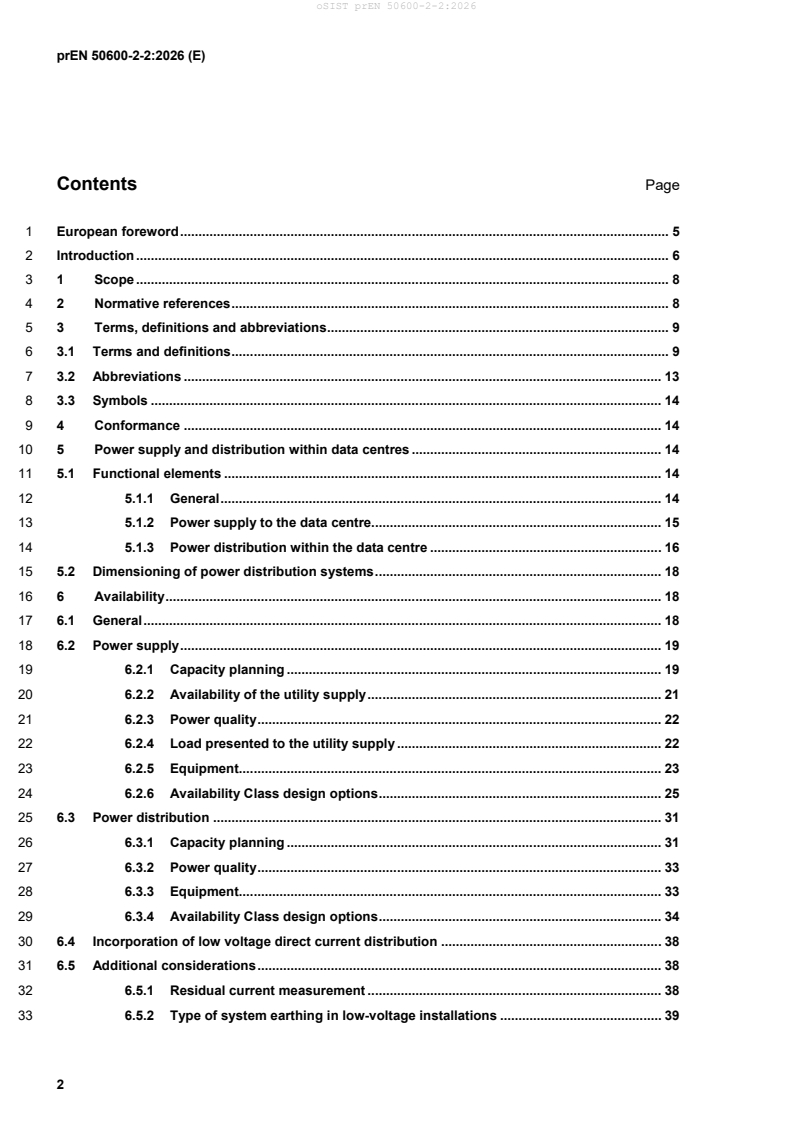
The document is organized into clauses 1 to 8 plus a bibliography. Its structure is shown below.
| Clause | Content |
|---|---|
| 1 | Scope |
| 2 | Normative references |
| 3 | Terms, definitions and abbreviations |
| 4 | Conformance |
| 5 | Power supply and distribution within data centres |
| 6 | Availability |
| 7 | Physical security |
| 8 | Energy efficiency enablement and power distribution |
FprEN 50600-2-2:2026 states that safety and EMC requirements are outside its scope, although its guidance can help meet those requirements in other standards and regulations.
What are the key requirements of FprEN 50600-2-2:2026?
Conformance links the power design to the data centre class
A data centre conforming to FprEN 50600-2-2:2026 must have a power supply and distribution design that meets Clause 6 and the required Availability Class, physical security measures from Clause 7, and energy efficiency enablement from Clause 8. The telecommunications bonding system must follow EN 50310, and low-voltage installations must follow HD 60364. This matters because the power design is not treated as a standalone system - it must match the overall data centre classification.
Capacity planning must cover normal load, growth and unusual loads
FprEN 50600-2-2:2026 requires the maximum capacity of the power supply and the power distribution system to cover planned ICT load, environmental control load, extra loads such as lighting and security, losses, construction power, day-one load, growth, variations in power factor and load factor, maintenance, and exceptional loads. The document also requires a network study covering at least load flow, short-circuit current and protection studies. In practice, this means the designer must size the system for present demand and foreseeable changes, not only for the first installed load.
Availability is based on source and path architecture
The standard defines four Availability Class design options for both supply and distribution. Class 1 uses a single path and single source, Class 2 adds a redundant source, Class 3 adds multiple paths with redundant sources, and Class 4 adds multiple paths with multiple sources and fault tolerance during operation. This gives buyers and designers a clear way to choose between lower-cost single-path systems and higher-resilience architectures for critical sites.
Power quality and equipment selection are tightly linked
Primary and secondary utility supplies must meet EN 50160, while additional non-utility supplies must meet EN IEC 61000-2-4:2024, Class 2a. The document also sets requirements for transformers, LV and HV/MV switchgear, UPS, and energy storage or grid-stabilization measures. In practice, the chosen equipment has to tolerate the site’s load profile, harmonic content, inrush current, and operating mode without compromising service.
The standard defines how protected loads are supplied
FprEN 50600-2-2:2026 distinguishes unprotected, protected, locally protected and short-break connection points. Protected connection points are intended for critical equipment that cannot tolerate loss of supply, while short-break connection points can ride through a defined interruption before an additional supply comes online. This matters because the designer must match each class of load to an appropriate supply path and backup strategy.
Physical security and environmental events are part of the power design
Access to power supply and distribution systems must be limited, and equipment must be placed in areas of Protection Class 3 or above when under control of the premises owner. Pathways in lower protection areas need monitoring for unauthorized access, and spaces with electrical equipment need leakage drainage and leakage monitoring for piping systems. That means the power system has to be protected not only electrically, but also against access, water and other internal hazards.
Measurement and monitoring support energy efficiency enablement
Clause 8 introduces Granularity Levels 1 to 3 for measuring power supply characteristics at different points in the supply and distribution chain. The standard requires defined measurement quality, including current transformers, metering devices and power metering and monitoring devices, depending on the application. This helps operators collect usable data for KPIs, energy reporting and trend analysis instead of relying on coarse site totals only.
Emergency power off is controlled, not casual
Data centres shall implement emergency power off [EPO] switches according to national or local regulations and the risk analysis of EN 50600-1. Where used, the EPO switch must be protected against accidental operation, and the standard recommends avoiding EPO switches where possible. In practice, this keeps emergency shutdown available without making unintended shutdown too easy.
What terms does FprEN 50600-2-2:2026 define?
| Term or abbreviation | Meaning in the standard |
|---|---|
| primary supply | The principal power supply used under normal operating conditions. |
| secondary supply | An independent supply that is continuously available to back up the primary supply. |
| additional supply | A supply that provides power if the primary and/or secondary supply fails. |
| protected connection point | A connection that continues to deliver power for a defined period after failure of power supply and distribution equipment. |
| short-break connection point | A connection that receives power from an additional supply after a defined interruption period. |
| locally protected connection point | A connection supported by a nearby battery supply or UPS that keeps power available for a defined period. |
| primary distribution equipment | Equipment that manages, controls and/or converts incoming supplies for distribution by secondary distribution equipment. |
| UPS | uninterruptible power system, used to maintain conditioned power or ride through supply interruptions. |
Who uses FprEN 50600-2-2:2026?
FprEN 50600-2-2:2026 is used by data centre owners, operators, facility managers and ICT managers, together with architects, building designers, builders, system and installation designers, consulting engineers, auditors, test and commissioning agents, integrators, suppliers, installers and maintainers. It is relevant in enterprise, co-location, co-hosting and network operator data centres. These groups use it when planning power architecture, selecting equipment, checking conformance, and deciding how to measure power quality and energy use.
What changed in FprEN 50600-2-2:2026 from the previous edition?
FprEN 50600-2-2:2026 will supersede EN 50600-2-2:2019. The foreword states these significant technical changes:
- the document has been technically and editorially revised and aligned with EN 50600-1 and EN 50600-2-3
- resource enablement aspects have been added
- terms and definitions were revised, including replacing “demarcation point” with “virtual point” and “socket” with “termination point”
- Clause 5 was updated for energy efficiency and environmental impact considerations
- Clause 6 was updated with provisioning, forecasting and management for capacity planning, KPI-based resilience criteria, revised power quality requirements, and new subclause 6.7 on control system capacity planning
- Clause 7 was editorially improved
- Clause 8 was revised, especially for measurement quality and Granularity Level requirements
Which standards are used with FprEN 50600-2-2:2026?
- EN 50600-1 - gives the general concepts and the availability, physical security and resource/energy efficiency classifications used throughout the document
- EN 50600-2-3 - sets environmental control requirements for the spaces that house the power systems
- EN 50600-2-4 - supports telecommunications cabling segregation and the cabling infrastructure needed for energy efficiency enablement
- EN 50600-2-5 - provides the security-system and protection-class framework for limiting access and protecting pathways
- EN 50310 - defines telecommunications bonding networks and the local mesh bonding requirements used here
- EN 50160 - gives the voltage characteristics of public electricity networks used for primary and secondary supply quality
- EN IEC 62305 series and EN IEC 62305-4 - provide lightning protection and surge-protective-device requirements
- HD 60364 - covers low-voltage electrical installations
- EN IEC 60947, EN IEC 61439 and EN IEC 62271-200 - cover LV switchgear, LV assemblies, and HV/MV switchgear
- EN IEC 62040 and EN 88528-11 - cover static UPS and dynamic UPS performance
- EN 62586-1, EN 62586-2, EN IEC 61557-12 and EN IEC 62974-1 - support power-quality instruments, PMD/PMF devices, and monitoring/analysis systems
- EN 13160, EN 61869-2, EN IEC 62053-21, EN IEC 62053-22 and EN IEC 61000-2-4:2024 - support leakage monitoring, current transformers, metering and power-quality classification
- ISO/IEC TS 8236-1 and ISO/IEC TS 8236-2 - support provisioning, forecasting and management for capacity planning
- CLC/TS 50600-4-31 and CLC/TS 50600-5-1 - connect the document to resilience KPIs and the energy-management maturity model
What does the FprEN 50600-2-2:2026 document contain?
FprEN 50600-2-2:2026 contains a functional breakdown of power supply and distribution, including sources, devices and pathways, plus examples of primary, secondary and tertiary distribution arrangements. It also includes example figures for Class 1 to Class 4 supply and distribution topologies, and a figure showing possible measurement points for energy efficiency enablement.
The document further contains requirements and recommendations on network studies, transformer and switchgear selection, UPS integration, EPO, residual-current measurement, lightning and surge protection, and the measurement quality needed for power and energy data. For an engineer or buyer, the practical value is that it shows where to measure, how to classify the architecture, and which supporting standards to use when designing, reviewing or commissioning a data centre power system.
Relations
- Effective Date
- 09-Apr-2024
Get Certified
Connect with accredited certification bodies for this standard

BSI Group
BSI (British Standards Institution) is the business standards company that helps organizations make excellence a habit.

DIBt (Deutsches Institut für Bautechnik)
German Institute for Building Technology.

DIN CERTCO
DIN Group product certification.
Sponsored listings
Frequently Asked Questions
FprEN 50600-2-2:2026 is a draft published by CLC. Its full title is "Information technology - Data centre facilities and infrastructures - Part 2-2: Power supply and distribution". This standard covers: This document addresses power supplies to, and power distribution within, data centres based upon the criteria and classifications for “availability”, “physical security” and “resource and energy efficiency enablement” within EN 50600-1. This document specifies requirements and recommendations for the following: a) power supplies to data centres; b) power distribution systems to all equipment within data centres; c) telecommunications infrastructure bonding; d) lightning protection; e) devices for the measurement of the energy consumption and power quality characteristics at points along the power distribution system and their integration within management tools. NOTE Safety and electromagnetic compatibility (EMC) requirements are outside the scope of this document and are covered by other standards and regulations. However, information given in this document can be of assistance in meeting these standards and regulations.
This document addresses power supplies to, and power distribution within, data centres based upon the criteria and classifications for “availability”, “physical security” and “resource and energy efficiency enablement” within EN 50600-1. This document specifies requirements and recommendations for the following: a) power supplies to data centres; b) power distribution systems to all equipment within data centres; c) telecommunications infrastructure bonding; d) lightning protection; e) devices for the measurement of the energy consumption and power quality characteristics at points along the power distribution system and their integration within management tools. NOTE Safety and electromagnetic compatibility (EMC) requirements are outside the scope of this document and are covered by other standards and regulations. However, information given in this document can be of assistance in meeting these standards and regulations.
FprEN 50600-2-2:2026 is classified under the following ICS (International Classification for Standards) categories: 35.020 - Information technology (IT) in general; 35.110 - Networking; 91.140.50 - Electricity supply systems. The ICS classification helps identify the subject area and facilitates finding related standards.
FprEN 50600-2-2:2026 has the following relationships with other standards: It is inter standard links to EN 50600-2-2:2019. Understanding these relationships helps ensure you are using the most current and applicable version of the standard.
FprEN 50600-2-2:2026 is associated with the following European legislation: Standardization Mandates: M/462. When a standard is cited in the Official Journal of the European Union, products manufactured in conformity with it benefit from a presumption of conformity with the essential requirements of the corresponding EU directive or regulation.
FprEN 50600-2-2:2026 is available in PDF format for immediate download after purchase. The document can be added to your cart and obtained through the secure checkout process. Digital delivery ensures instant access to the complete standard document.
Standards Content (Sample)
93 Introduction
94 The unrestricted access to internet-based information demanded by the information society has led to an 95 exponential growth of both internet traffic and the volume of stored/retrieved data. Data centres are housing and 96 supporting the information technology and network telecommunications equipment for data processing, data 97 storage and data transport. They are required both by network operators (delivering those services to customer 98 premises) and by enterprises within those customer premises. 99 Data centres usually need to provide modular, scalable and flexible facilities and infrastructures to easily 100 accommodate the rapidly changing requirements of the market. In addition, energy consumption and 101 water/resource usage of data centres has become critical both from an environmental point of view (reduction 102 of environmental footprint) and with respect to economical considerations (cost of energy) for the data centre 103 operator.
104 The implementation of data centres varies in terms of:
105 a) purpose (enterprise, co-location, co-hosting or network operator facilities); 106 b) security level; 107 c) physical size; 108 d) accommodation (mobile, temporary and permanent constructions). 109 The needs of data centres also vary in terms of availability of service, the provision of security and the objectives 110 for energy efficiency. These needs and objectives influence the design of data centres in terms of building 111 construction, power distribution, environmental control, telecommunications cabling and physical security as 112 well as the operation of the data centre. Effective management and operational information is required to monitor 113 achievement of the defined needs and objectives.
114 Recognizing the substantial resource consumption, particularly of energy, of larger data centres, it is also 115 important to provide tools for the assessment of that consumption both in terms of overall value and of source 116 mix and to provide Key Performance Indicators (KPIs) to evaluate trends and drive performance improvements. 117 At the time of publication of this document, the EN 50600 series have been designed as a framework of 118 standards, technical specifications and technical reports covering the design, the operation and management, 119 the key performance indicators for energy efficient operation of the data centre as well as a maturity model for 120 energy management and environmental sustainability.
121 This series of documents specifies requirements and recommendations to support the various parties involved 122 in the design, planning, procurement, integration, installation, operation and maintenance of facilities and 123 infrastructures within data centres. These parties include:
124 1) owners, operators, facility managers, ICT managers, project managers, main contractors; 125 2) consulting engineers, architects, building designers and builders, system and installation designers, 126 auditors, test and commissioning agents; 127 3) facility and infrastructure integrators, suppliers of equipment; 128 4) installers, maintainers.
129 The inter-relationship of the documents within the EN 50600 series is shown in Figure 1.
oSIST prEN 50600-2-2:2026 prEN 50600-2-2:2026 (E)
131 Figure 1 — Schematic relationship between EN 50600 series of documents 132 EN 50600-1 introduces the general concepts relevant for the design and operation of data centres. 133 EN 50600-2-X documents define the requirements for the data centre design and specify requirements and 134 recommendations for particular facilities and infrastructures to support the relevant classification for 135 “availability”, “physical security” and “energy efficiency enablement” selected from EN 50600-1. 136 EN 50600-3-1 specifies requirements and recommendations for data centre operations, processes and 137 management.
138 EN 50600-4-X documents specify requirements and recommendations for key performance indicators (KPIs) 139 used to assess and improve the resource usage efficiency and effectiveness, respectively, and criteria of 140 resilience of a data centre.
141 CLC/TS 50600-5-1 specifies the maturity model for energy management and environmental sustainability and 142 refers amongst others to EN 50600-4-X for KPIs as appropriate. 143 At the time of publication of this document, EN 50600-2 series comprises the following documents:
144 EN 50600-2-1: Information technology — Data centre facilities and infrastructures — Part 2-1: Building 145 construction; 146 EN 50600-2-2: Information technology — Data centre facilities and infrastructures — Part 2-2: Power supply 147 and distribution; 148 EN 50600-2-3: Information technology — Data centre facilities and infrastructures — Part 2-3: Environmental 149 control; 150 EN 50600-2-4: Information technology — Data centre facilities and infrastructures — Part 2-4:
151 Telecommunications cabling infrastructure; 152 EN 50600-2-5: Information technology — Data centre facilities and infrastructures — Part 2-5: Security 153 systems; 154 CLC/TS 50600-2-10: Information technology — Data centre facilities and infrastructures — Part 2-10:
155 Earthquake risk and impact analysis.
156 This document, EN 50600-2-2, addresses facilities and infrastructures for power supplies to, and power 157 distribution within, data centres together with the interfaces for monitoring the performance of those facilities 158 and infrastructures in line with EN 50600-3-1 and the EN 50600-4 series (in accordance with the requirements 159 of EN 50600-1). The line diagrams used in certain Figures are not intended to replace the more familiar electrical 160 circuit diagrams associated with power supply and distribution systems. 161 This document is intended for use by and collaboration between architects, building designers and builders, 162 system and installation designers.
163 This series of European Standards does not address the selection of information technology and network 164 telecommunications equipment, software and associated configuration issues.
oSIST prEN 50600-2-2:2026 prEN 50600-2-2:2026 (E) 165 1 Scope 166 This document addresses power supplies to, and power distribution within, data centres based upon the criteria 167 and classifications for “availability”, “physical security” and “resource and energy efficiency enablement” within 168 EN 50600-1.
169 This document specifies requirements and recommendations for the following:
170 a) power supplies to data centres; 171 b) power distribution systems to all equipment within data centres; 172 c) telecommunications infrastructure bonding; 173 d) lightning protection; 174 e) devices for the measurement of the energy consumption and power quality characteristics at points along 175 the power distribution system and their integration within management tools. 176 Safety and electromagnetic compatibility (EMC) requirements are outside the scope of this document and are 177 covered by other standards and regulations. However, information given in this document can be of assistance 178 in meeting these standards and regulations.
179 2 Normative references 180 The following documents are referred to in the text in such a way that some or all of their content constitutes 181 requirements of this document. For dated references, only the edition cited applies. For undated references, the 182 latest edition of the referenced document (including any amendments) applies. 183 EN 13160 (all parts), Leak detection systems
184 EN 50160:2022, Voltage characteristics of electricity supplied by public electricity networks 185 EN 50174-2, Information technology - Cabling installation - Part 2: Installation planning and practices inside 186 buildings 187 EN 50174-3, Information technology - Cabling installation - Part 3: Installation planning and practices outside 188 buildings 189 EN 50310, Telecommunications bonding networks for buildings and other structures 190 EN 50600-1, Information technology - Data centre facilities and infrastructures - Part 1: General concepts 191 EN 50600-2-3, Information technology - Data centre facilities and infrastructures - Part 2-3: Environmental 192 control 193 EN 50600-2-4, Information technology – Data centre facilities and infrastructures – Part 2-4: Telecommuni- 194 cations cabling infrastructure 195 EN 50600-2-5, Information technology - Data centre facilities and infrastructures - Part 2-5: Security systems 196 EN IEC 60076-11, Power transformers - Part 11: Dry-type transformers
As impacted by EN 50160:2022/A1:2025.
oSIST prEN 50600-2-2:2026 prEN 50600-2-2:2026 (E)
197 Low-voltage switchgear and controlgear (IEC 60947) EN IEC 60947 (all parts), 198 EN IEC 61000-2-4:2024, Electromagnetic compatibility (EMC) - Part 2-4: Environment - Compatibility levels in 199 power distribution systems in industrial locations for low-frequency conducted disturbances
200 Low-voltage switchgear and controlgear assemblies (IEC 61439) EN IEC 61439 (all parts), 201 EN IEC 61557-12:2022, Electrical safety in low voltage distribution systems up to 1 000 V AC and 1 500 V DC 202 - Equipment for testing, measuring or monitoring of protective measures - Part 12: Power metering and 203 monitoring devices (PMD) 204 EN 61869-2:2012, Instrument transformers - Part 2: Additional requirements for current transformers
205 Uninterruptible power systems (UPS) (IEC 62040) EN IEC 62040 (all parts), 206 EN 62053-21:2021, Electricity metering equipment (a.c.) - Particular requirements - Part 21: Static meters for 207 active energy (classes 1 and 2) 208 EN IEC 62271-200, High-voltage switchgear and controlgear - Part 200: AC metal-enclosed switchgear and 209 controlgear for rated voltages above 1 kV and up to and including 52 kV 210 EN IEC 62305 (all parts), Protection against lightning (IEC 62305) 211 EN IEC 62305-4, Protection against lightning - Part 4: Electrical and electronic systems within structures 212 EN 62586-1:2017, Power quality measurement in power supply systems - Part 1: Power quality instruments 213 (PQI)
214 Power quality measurement in power supply systems – Part 2: Functional tests and EN 62586-2:2017, 215 uncertainty requirements 216 EN IEC 62974-1, Monitoring and measuring systems used for data collection, aggregation and analysis - Part 217 1: Device requirements 218 EN 88528-11, Reciprocating internal combustion engine driven alternating current generating sets - Part 11:
219 Rotary uninterruptible power systems - Performance requirements and test methods 220 HD 60364 (all parts), Low-voltage electrical installations 221 IEC/TS 60076-20:2017, Power transformers - Part 20: Energy efficiency 222 3 Terms, definitions and abbreviations 223 3.1 Terms and definitions 224 For the purposes of this document, the terms and definitions given in EN 50600-1 and the following apply. 225 ISO and IEC maintain terminology databases for use in standardization at the following addresses:
Some documents of the series are still published as “EN 60947-X”.
Some documents of the series are still published as “EN 61439-X”.
Some documents of the series are still published as “EN 62040-X”.
As impacted by EN 62586-2:2017/A1:2021 and EN 62586-2:2017/AC:2018-09.
oSIST prEN 50600-2-2:2026 prEN 50600-2-2:2026 (E)
- IEC Electropedia: available at http://www.electropedia.org/ 227 — ISO Online browsing platform: available at http://www.iso.org/obp 228 3.1.1 229 active power 230 under periodic conditions, mean value, taken over one period T, of the instantaneous power p T
231 P= pdt
T
232 Note 1 to entry: Under sinusoidal conditions, the active power is the real part of the complex power S, thus P = Re S. 233 Note 2 to entry: The coherent SI unit for active power is watt, W. 234 [SOURCE: IEC 60050-131:2002, 131-11-42] 235 3.1.2 236 additional supply 237 power supply that provides power in the event of failure of primary and/or secondary supply 238 3.1.3 239 apparent power 240 product of the rms voltage U between the terminals of a two-terminal element or two-terminal circuit and the 241 rms electric current I in the element or circuit S = UI 242 Note 1 to entry: Under sinusoidal conditions, the apparent power is the modulus of the complex power S, thus S = |S| . 243 Note 2 to entry: The coherent SI unit for apparent power is voltampere, VA. 244 [SOURCE: IEC 60050-131:2002, 131-11-41] 245 3.1.4 246 capacitive load 247 load that is capacitive, so that the alternating current is out of phase with and leads the voltage 248 3.1.5 249 catenary 250 wire hung at a specific tension between supporting structures of power cabling 251 3.1.6 252 connection point 253 socket/outlet or a connection enabling supply of power to attached/connected equipment 254 Note 1 to entry: This can be a de-mateable or a hardwired connection. 255 3.1.7 256 diverse route 257 alternative, separate, pathway intended to provide adequate segregation from another pathway, in order to 258 provide resilient service provision in the event of physical damage to one of the pathways 259 3.1.8 260 dual-corded equipment 261 equipment served by multiple power supply input interfaces
oSIST prEN 50600-2-2:2026 prEN 50600-2-2:2026 (E) 262 3.1.9 263 emergency power off 264 designated device to provide emergency switching which disconnects power from one or more data centre 265 facilities, infrastructures or spaces 266 Note 1 to entry: The configuration and function of emergency power off devices can be subject to national or local regulations. 267 3.1.10 268 fire compartment 269 discrete zone designed to contain a fire within that zone 270 3.1.11 271 high voltage 272 ≤ 150 kV voltage with a nominal rms-value 36 kV < Un 273 Note 1 to entry: Whereas in most other standards HV covers the total AC-voltage- range > 1 kV, for the purpose of this 274 document this range is separated in the three parts MV, HV, and EHV. 275 [SOURCE: EN 50160:2022, 3.2.2] 276 3.1.12 277 integrated energy storage 278 IES 279 uninterruptible power supply, integrated inside electric devices, e.g. ICT equipment 280 3.1.13 281 inductive load 282 load that is inductive, so that the alternating current is out of phase with and lags behind the voltage 283 3.1.14 284 ICT load 285 electrical consumption of all the information, communication technology equipment, providing data storage, 286 processing and transport services 287 3.1.15 288 load factor 289 ratio, expressed as a numerical value or as a percentage, of the consumption within a specified period (year, 290 month, day, etc.), to the consumption that would result from continuous use of the maximum or other specified 291 demand occurring within the same period 292 Note 1 to entry: This term should not be used without specifying the demand and the period to which it relates. 293 Note 2 to entry: The load factor for a given demand is also equal to the ratio of the utilization time to the time in hours within 294 the same period.
295 [SOURCE: IEC 60050-691:1973, 691-10-02] 296 3.1.16 297 locally protected connection point 298 socket/outlet or a connection which continues to deliver power to connected equipment for a defined period 299 following failure of power supply and distribution equipment by means of a battery supply or UPS adjacent to, 300 or co-located with, those connections 301 3.1.17 302 low voltage 303 voltage whose nominal r.m.s. value is Un ≤ 1 kV 304 [SOURCE: EN 50160:2010, 3.9]
oSIST prEN 50600-2-2:2026 prEN 50600-2-2:2026 (E) 305 3.1.18 306 main-tie-tie-main 307 electrical connection between two power supply or power distribution circuits which allows current to flow in 308 either direction and containing two circuit breakers enabling maintenance while one of the circuits is active 309 3.1.19 310 medium voltage 311 voltage whose nominal r.m.s. value is 1 kV < U ≤ 36 kV n 312 Note 1 to entry: Because of existing network structures, in some countries the boundary between MV and HV can be 313 different.
314 [SOURCE: EN 50160:2010, 3.11] 315 3.1.20 316 pathway 317 defined route for cables between termination points 318 [SOURCE: EN 50174-1:2018, 3.1.31] 319 3.1.21 320 power factor 321 under periodic conditions, ratio of the absolute value of the active power P to the apparent power S: λ = |P|/S 322 Note 1 to entry: The ratio of the active (real) power flowing to the load to the apparent power (as a result of the capacitive 323 or inductive nature of the load) and is a dimensionless number between 0 and 1. 324 [SOURCE: IEC 60050-131:2002, 131-11-46, modified: Note 1 to entry reworded] 325 3.1.22 326 primary distribution equipment 327 equipment which is required to manage, control and/or convert incoming power supplies (primary, secondary 328 and, where appropriate, additional) in a form suitable for distribution by secondary distribution equipment 329 3.1.23 330 primary supply 331 principal power supply that provides power to the data centre under normal operating conditions 332 3.1.24 333 protected connection point 334 socket/outlet or a connection which continues to deliver power to connected equipment for a defined period 335 following failure of power supply and distribution equipment 336 3.1.25 337 secondary distribution equipment 338 equipment which is required to manage, control and distribute the power provided by the primary distribution 339 equipment to the short-break, protected and unprotected connection points within the data centre and to the 340 tertiary distribution equipment 341 Note 1 to entry: The power supply can be single-phase AC, three-phase AC or DC. If there is a change from 3-phase to 1- 342 phase supply, this is generally achieved at the secondary distribution equipment that is served directly from the primary 343 distribution equipment.
344 3.1.26 345 secondary supply 346 power supply independent from the primary supply, and that is continuously available to be used to provide 347 power to the data centre
oSIST prEN 50600-2-2:2026 prEN 50600-2-2:2026 (E) 348 Note 1 to entry: A second feed to a separate transformer from the same grid is not a secondary supply. 349 3.1.27 350 short-break connection point 351 sockets/outlet or a connection which, upon failure of power supply and distribution equipment, will be provided 352 with power from an additional supply after a defined period 353 3.1.28 354 tertiary distribution equipment 355 power supply equipment, typically accommodated within the cabinets, frames and racks of the data centre 356 spaces, which directly feeds the protected connection points therein 357 3.1.29 358 unprotected connection point 359 socket/outlet or a connection which fails to deliver power to connected equipment following failure in power 360 supply or distribution equipment 361 3.1.30 362 virtual point 363 virtual interface between the power supply system and power distribution system infrastructures 364 3.2 Abbreviations 365 For the purposes of this document, the abbreviations given in EN 50600-1 and the following apply. AC alternating current DC direct current EMC electromagnetic compatibility ERF energy reuse factor EPO emergency power off ICT information and communication technology IES integrated energy storage HV high voltage KPI key performance indicator LV low voltage LSC loss of service continuity MV medium voltage PMF power metering and monitoring function PUE power usage effectiveness dPUE designed power usage effectiveness PMD power metering and monitoring device REF renewable energy factor r.m.s. root mean square SPD surge protective device TN-S terra neutral - separation UPS uninterruptible power system
...