

EN 50600-2-2:2019
(Main)Information technology - Data centre facilities and infrastructures - Part 2-2: Power supply and distribution
General Information
- Abstract
This European Standard addresses power supplies to, and power distribution within, data centres based upon the criteria and classifications for "availability", "physical security" and "energy efficiency enablement" within EN 50600 1.
- Status
- Published
- Publication Date
- 06-Jun-2019
- Withdrawal Date
- 28-Apr-2022
- Technical Committee
- CLC/TC 215 - Electrotechnical aspects of telecommunication equipment
- Drafting Committee
- CLC/TC 215 - Electrotechnical aspects of telecommunication equipment
- Current Stage
- 6060 - Document made available - Publishing
- Start Date
- 07-Jun-2019
- Due Date
- 10-Jun-2020
- Completion Date
- 07-Jun-2019



Overview
EN 50600-2-2:2019 is the CENELEC / CLC European standard that specifies requirements and recommendations for power supply and power distribution in data centres. Aligned with the classification criteria in EN 50600-1, it covers how data centres should be supplied from the utility and how power is distributed to ICT equipment while addressing availability, physical security, and energy efficiency enablement. The standard replaces EN 50600-2-2:2014 and was published in 2019.
Key topics and technical requirements
EN 50600-2-2:2019 addresses technical aspects including:
Power supply to the data centre
- Utility interface, capacity planning and redundancy options
- Availability-class design choices and how they map to supply strategies
Power distribution within the data centre
- Design of distribution systems to feed racks and equipment (PDUs, switchgear, cabling)
- Capacity planning and power quality considerations
Monitoring and measurement
- Requirements for measurement devices and interfaces to support performance monitoring and KPIs (linked to EN 50600-3/4)
Electrical safety and protection
- Lightning and surge protection
- Residual current measurement and segregation of power and ICT cabling
Physical security for power systems
- Access control, protection against internal/external environmental events and unauthorized attachments
Operational controls
- Emergency Power Off (EPO) requirements and recommendations
Energy efficiency enablement
- Granularity Levels (1–3) for monitoring and control to support energy-efficiency objectives and KPIs
Emerging technologies
- Incorporation of low-voltage direct current (LVDC) distribution options
Note: The standard defines terms, conformance criteria and design options for different availability classes but does not specify selection of IT/network equipment.
Practical applications and users
EN 50600-2-2:2019 is intended for professionals involved in the design, construction, commissioning, operation and maintenance of data centre electrical infrastructure, including:
- Data centre owners, operators and facility managers
- ICT and power system designers, consulting engineers and main contractors
- Architects and building designers integrating data centre power systems
- Equipment suppliers, integrators, installers and maintainers
- Auditors, test and commissioning agents
Typical uses:
- Writing specifications for power systems, UPS, generators and PDUs
- Designing redundant supply topologies to meet defined availability classes
- Implementing monitoring and metering regimes to support energy-efficiency KPIs
- Specifying lightning protection, bonding and segregation practices
Related standards
- EN 50600-1 (classification framework: availability, security, energy)
- EN 50600-2-1 (building construction)
- EN 50600-2-3 (environmental control)
- EN 50600-2-4 (telecommunications cabling)
- EN 50600-2-5 (security systems)
- EN 50600-3 series (operations & management)
- EN 50600-4 series (KPIs for data centre performance)
Keywords: EN 50600-2-2:2019, data centre power, power supply and distribution, availability classes, energy efficiency enablement, physical security, LVDC, emergency power off, lightning protection, data centre standard.
Relations
- Effective Date
- 11-Jun-2019
- Effective Date
- 12-May-2026
- Effective Date
- 03-Feb-2026
- Effective Date
- 03-Feb-2026
- Effective Date
- 03-Feb-2026
- Effective Date
- 03-Feb-2026
- Effective Date
- 03-Feb-2026
- Effective Date
- 03-Feb-2026
- Effective Date
- 09-Apr-2024
Get Certified
Connect with accredited certification bodies for this standard

BSI Group
BSI (British Standards Institution) is the business standards company that helps organizations make excellence a habit.

DIBt (Deutsches Institut für Bautechnik)
German Institute for Building Technology.
DIN CERTCO
DIN Group product certification.
Sponsored listings
Frequently Asked Questions
EN 50600-2-2:2019 is a standard published by CLC. Its full title is "Information technology - Data centre facilities and infrastructures - Part 2-2: Power supply and distribution". This standard covers: This European Standard addresses power supplies to, and power distribution within, data centres based upon the criteria and classifications for "availability", "physical security" and "energy efficiency enablement" within EN 50600 1.
This European Standard addresses power supplies to, and power distribution within, data centres based upon the criteria and classifications for "availability", "physical security" and "energy efficiency enablement" within EN 50600 1.
EN 50600-2-2:2019 is classified under the following ICS (International Classification for Standards) categories: 35.020 - Information technology (IT) in general; 35.110 - Networking; 91.140.50 - Electricity supply systems. The ICS classification helps identify the subject area and facilitates finding related standards.
EN 50600-2-2:2019 has the following relationships with other standards: It is inter standard links to EN 50600-2-2:2014, EN 50600-3-1:2026, CLC/TS 50600-5-1:2023, EN 50600-2-5:2021, EN 50600-2-1:2021, EN 50600-3-1:2016, EN 50600-2-1:2014, EN 50600-2-5:2016, FprEN 50600-2-2:2026. Understanding these relationships helps ensure you are using the most current and applicable version of the standard.
EN 50600-2-2:2019 is associated with the following European legislation: Standardization Mandates: M/462. When a standard is cited in the Official Journal of the European Union, products manufactured in conformity with it benefit from a presumption of conformity with the essential requirements of the corresponding EU directive or regulation.
EN 50600-2-2:2019 is available in PDF format for immediate download after purchase. The document can be added to your cart and obtained through the secure checkout process. Digital delivery ensures instant access to the complete standard document.
Standards Content (Sample)
SLOVENSKI STANDARD
01-september-2019
Nadomešča:
SIST EN 50600-2-2:2014
Informacijska tehnologija - Naprave in infrastruktura podatkovnega centra - 2-2.
del: Napajanje in distribucija električne energije
Information technology - Data centre facilities and infrastructures - Part 2-2: Power
supply and distribution
Informationstechnik - Einrichtungen und Infrastrukturen von Rechenzentren - Teil 2-2:
Stromversorgung und Stromverteilung
Technologie de linformation - Installation et infrastructures de centres de traitement de
données - Partie 2-2: Alimentation en énergie et distribution de l’énergie
Ta slovenski standard je istoveten z: EN 50600-2-2:2019
ICS:
29.240.01 Omrežja za prenos in Power transmission and
distribucijo električne energije distribution networks in
na splošno general
35.110 Omreževanje Networking
2003-01.Slovenski inštitut za standardizacijo. Razmnoževanje celote ali delov tega standarda ni dovoljeno.
EUROPEAN STANDARD EN 50600-2-2
NORME EUROPÉENNE
EUROPÄISCHE NORM
June 2019
ICS 35.020; 35.110; 91.140.50 Supersedes EN 50600-2-2:2014
English Version
Information technology - Data centre facilities and infrastructures
- Part 2-2: Power supply and distribution
Technologie de l'information - Installation et infrastructures Informationstechnik - Einrichtungen und Infrastrukturen von
de centres de traitement de données Rechenzentren - Teil 2-2: Stromversorgung
This European Standard was approved by CENELEC on 2019-04-29. CENELEC members are bound to comply with the CEN/CENELEC
Internal Regulations which stipulate the conditions for giving this European Standard the status of a national standard without any alteration.
Up-to-date lists and bibliographical references concerning such national standards may be obtained on application to the CEN-CENELEC
Management Centre or to any CENELEC member.
This European Standard exists in three official versions (English, French, German). A version in any other language made by translation
under the responsibility of a CENELEC member into its own language and notified to the CEN-CENELEC Management Centre has the
same status as the official versions.
CENELEC members are the national electrotechnical committees of Austria, Belgium, Bulgaria, Croatia, Cyprus, the Czech Republic,
Denmark, Estonia, Finland, Former Yugoslav Republic of Macedonia, France, Germany, Greece, Hungary, Iceland, Ireland, Italy, Latvia,
Lithuania, Luxembourg, Malta, the Netherlands, Norway, Poland, Portugal, Romania, Serbia, Slovakia, Slovenia, Spain, Sweden,
Switzerland, Turkey and the United Kingdom.
European Committee for Electrotechnical Standardization
Comité Européen de Normalisation Electrotechnique
Europäisches Komitee für Elektrotechnische Normung
CEN-CENELEC Management Centre: Rue de la Science 23, B-1040 Brussels
© 2019 CENELEC All rights of exploitation in any form and by any means reserved worldwide for CENELEC Members.
Ref. No. EN 50600-2-2:2019 E
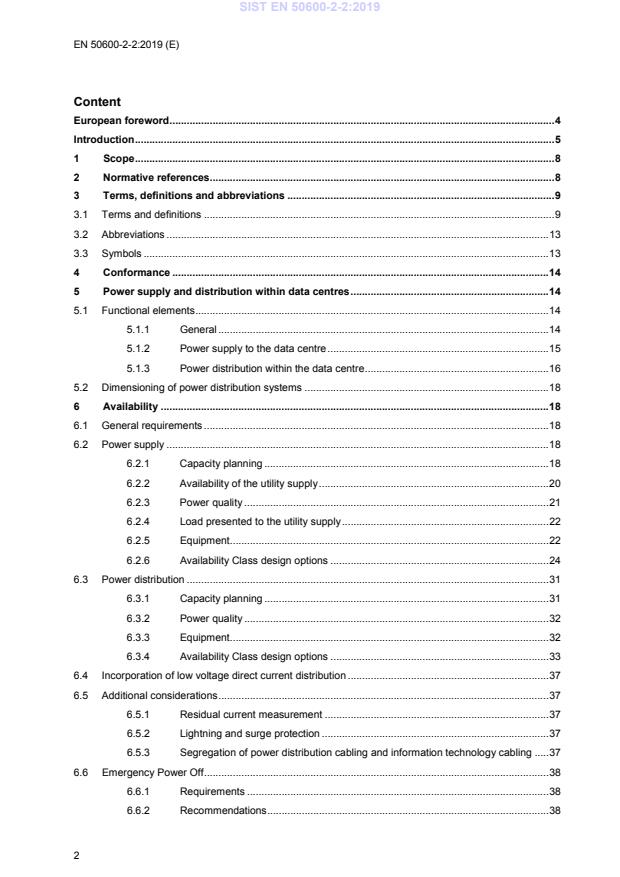
Content
European foreword . 4
Introduction . 5
1 Scope . 8
2 Normative references. 8
3 Terms, definitions and abbreviations . 9
3.1 Terms and definitions . 9
3.2 Abbreviations . 13
3.3 Symbols . 13
4 Conformance . 14
5 Power supply and distribution within data centres . 14
5.1 Functional elements . 14
5.1.1 General . 14
5.1.2 Power supply to the data centre . 15
5.1.3 Power distribution within the data centre . 16
5.2 Dimensioning of power distribution systems . 18
6 Availability . 18
6.1 General requirements . 18
6.2 Power supply . 18
6.2.1 Capacity planning . 18
6.2.2 Availability of the utility supply . 20
6.2.3 Power quality . 21
6.2.4 Load presented to the utility supply . 22
6.2.5 Equipment . 22
6.2.6 Availability Class design options . 24
6.3 Power distribution . 31
6.3.1 Capacity planning . 31
6.3.2 Power quality . 32
6.3.3 Equipment . 32
6.3.4 Availability Class design options . 33
6.4 Incorporation of low voltage direct current distribution . 37
6.5 Additional considerations . 37
6.5.1 Residual current measurement . 37
6.5.2 Lightning and surge protection . 37
6.5.3 Segregation of power distribution cabling and information technology cabling . 37
6.6 Emergency Power Off . 38
6.6.1 Requirements . 38
6.6.2 Recommendations . 38
7 Physical security . 38
7.1 General . 38
7.2 Access . 38
7.2.1 Power supply . 38
7.2.2 Power distribution . 38
7.2.3 Attachment of unauthorised end-equipment . 38
7.3 Internal environmental events. 38
7.3.1 Power supply . 38
7.3.2 Power distribution . 39
7.4 External environmental events . 39
8 Energy efficiency enablement and power distribution . 39
8.1 General . 39
8.2 Granularity Level 1 . 40
8.2.1 Requirements . 40
8.2.2 Recommendations . 40
8.3 Granularity Level 2 . 41
8.3.1 Requirements . 41
8.3.2 Recommendations . 41
8.4 Granularity Level 3 . 42
8.4.1 Requirements . 42
8.4.2 Recommendations . 42
8.5 Cabling infrastructure to support energy efficiency enablement . 42
Bibliography . 43
European foreword
This document (EN 50600-2-2:2019) has been prepared by CLC/TC 215 “Electrotechnical aspects of
telecommunication equipment”.
The following dates are fixed:
• latest date by which this document has to be (dop) 2020-04-29
implemented at national level by publication of
an identical national standard or by
endorsement
• latest date by which the national standards (dow) 2022-04-29
conflicting with this document have to be
withdrawn
This document will supersede EN 50600-2-2:2014.
The following changes have been made:
a) title modified to emphasize distinction between power supply and power distribution requirements;
b) Clause 5 updated, in particular subclauses 5.1 regarding the power supply to the data centre and 5.2 on
the power distribution within the data centre;
c) availability requirements in Clause 6 revised and aligned with EN 50600-1:2018 and EN 50600-2-
3:2018;
d) physical security requirements revised, mainly regarding the power distribution in the data centre (see
7.3.2);
e) granularity level requirements amended (see 8.2 to 8.4);
f) Annex A removed;
g) minor technical and editorial improvements to the whole document.
Attention is drawn to the possibility that some of the elements of this document may be the subject of patent
rights. CENELEC shall not be held responsible for identifying any or all such patent rights.
This document has been prepared under a mandate given to CENELEC by the European Commission and
the European Free Trade Association.
Introduction
The unrestricted access to internet-based information demanded by the information society has led to an
exponential growth of both internet traffic and the volume of stored/retrieved data. Data centres are housing
and supporting the information technology and network telecommunications equipment for data processing,
data storage and data transport. They are required both by network operators (delivering those services to
customer premises) and by enterprises within those customer premises.
Data centres usually need to provide modular, scalable and flexible facilities and infrastructures to easily
accommodate the rapidly changing requirements of the market. In addition, energy consumption of data
centres has become critical both from an environmental point of view (reduction of environmental footprint)
and with respect to economical considerations (cost of energy) for the data centre operator.
The implementation of data centres varies in terms of:
a) purpose (enterprise, co-location, co-hosting or network operator facilities);
b) security level;
c) physical size;
d) accommodation (mobile, temporary and permanent constructions).
The needs of data centres also vary in terms of availability of service, the provision of security and the
objectives for energy efficiency. These needs and objectives influence the design of data centres in terms of
building construction, power distribution, environmental control, telecommunications cabling and physical
security as well as the operation of the data centre. Effective management and operational information is
required to monitor achievement of the defined needs and objectives.
Recognizing the substantial resource consumption, particularly of energy, of larger data centres, it is also
important to provide tools for the assessment of that consumption both in terms of overall value and of
source mix and to provide Key Performance Indicators (KPIs) to evaluate trends and drive performance
improvements.
At the time of publication of this European Standard, EN 50600 series is designed as a framework of
standards and technical reports covering the design, the operation and management as well as the key
performance indicators for energy efficient operation of the data centre.
The EN 50600-2 series defines the requirements for the data centre design.
The EN 50600-3 series defines the requirements for the operation and the management of the data centre.
The EN 50600-4 series defines the key performance indicators for the data centre.
The CLC/TR 50600-99-X Technical Reports cover recommended practices and guidance for specific topics
around data centre operation and design.
This series of European Standards specifies requirements and recommendations to support the various
parties involved in the design, planning, procurement, integration, installation, operation and maintenance of
facilities and infrastructures within data centres. These parties include:
1) owners, operators, facility managers, ICT managers, project managers, main contractors;
2) consulting engineers, architects, building designers and builders, system and installation designers,
auditors, test and commissioning agents;
3) facility and infrastructure integrators, suppliers of equipment;
4) installers, maintainers.
At the time of publication of this European Standard, EN 50600-2 series comprises the following standards:
EN 50600-2-1: Information technology — Data centre facilities and infrastructures — Part 2-1: Building
construction;
EN 50600-2-2: Information technology — Data centre facilities and infrastructures — Part 2-2: Power supply
and distribution;
EN 50600-2-3: Information technology — Data centre facilities and infrastructures — Part 2-3: Environmental
control;
EN 50600-2-4: Information technology — Data centre facilities and infrastructures — Part 2-4:
Telecommunications cabling infrastructure;
EN 50600-2-5: Information technology — Data centre facilities and infrastructures — Part 2-5: Security
systems.
The inter-relationship of the standards and technical reports within the EN 50600 series is shown in Figure 1.
Figure 1 — Schematic relationship between the EN 50600 standard
EN 50600-2-X standards specify requirements and recommendations for particular facilities and
infrastructures to support the relevant classification for “availability”, “physical security” and “energy efficiency
enablement” selected from EN 50600-1.
EN 50600-3-X documents specify requirements and recommendations for data centre operations, processes
and management.
EN 50600-4-X documents specify requirements and recommendations for key performance indicators (KPIs)
used to assess and improve the resource usage efficiency and effectiveness, respectively, of a data centre.
This European Standard addresses facilities and infrastructures for power supplies to, and power distribution
within, data centres together with the interfaces for monitoring the performance of those facilities and
infrastructures in line with EN 50600-3 series and EN 50600-4 series standards (in accordance with the
requirements of EN 50600-1). The line diagrams used in certain Figures are not intended to replace the
more familiar electrical circuit diagrams associated with power supply and distribution systems which are
included where relevant.
This European Standard is intended for use by and collaboration between architects, building designers and
builders, system and installation designers.
This series of European Standards does not address the selection of information technology and network
telecommunications equipment, software and associated configuration issues.
1 Scope
This document addresses power supplies to, and power distribution within, data centres based upon the
criteria and classifications for “availability”, “physical security” and “energy efficiency enablement” within
EN 50600-1.
This document specifies requirements and recommendations for the following:
a) power supplies to data centres;
b) power distribution systems to all equipment within data centres;
c) telecommunications infrastructure bonding;
d) lightning protection;
e) devices for the measurement of the power consumption and power quality characteristics at points
along the power distribution system and their integration within management tools.
Safety and electromagnetic compatibility (EMC) requirements are outside the scope of this European
Standard and are covered by other standards and regulations. However, information given in this European
Standard can be of assistance in meeting these standards and regulations.
Conformance of data centres to the present document is covered in Clause 4.
2 Normative references
The following documents are referred to in the text in such a way that some or all of their content constitutes
requirements of this document. For dated references, only the edition cited applies. For undated references,
the latest edition of the referenced document (including any amendments) applies.
EN 13160 (all parts), Leak detection systems
EN 50160:2010, Voltage characteristics of electricity supplied by public electricity networks
EN 50174-2, Information technology - Cabling installation - Part 2: Installation planning and practices inside
buildings
EN 50174-3, Information technology - Cabling installation - Part 3: Installation planning and practices outside
buildings
EN 50310, Telecommunications bonding networks for buildings and other structures
EN 50600-1, Information technology - Data centre facilities and infrastructures - Part 1: General concepts
EN 50600-2-3, Information technology - Data centre facilities and infrastructures - Part 2-3: Environmental
control
EN 50600-2-5, Information technology - Data centre facilities and infrastructures - Part 2-5: Security systems
EN 60076-11, Power transformers - Part 11: Dry-type transformers
EN 60947 (all parts), Low-voltage switchgear and controlgear (IEC 60947, all parts)
EN 61000-2-4:2002, Electromagnetic compatibility (EMC) - Part 2-4: Environment - Compatibility levels in
industrial plants for low-frequency conducted disturbances
EN 61439 (all parts), Low-voltage switchgear and controlgear assemblies (IEC 61439, all parts)
EN 61557-12:2008, Electrical safety in low voltage distribution systems up to 1 000 V a.c. and 1 500 V d.c. -
Equipment for testing, measuring or monitoring of protective measures - Part 12: Performance measuring
and monitoring devices (PMD)
EN 61869-2:2012, Instrument transformers - Part 2: Additional requirements for current transformers
EN 62040 (all parts), Uninterruptible power systems (UPS) (IEC 62040, all parts)
EN 62053-21:2003, Electricity metering equipment (a.c.) - Particular requirements - Part 21: Static meters for
active energy (classes 1 and 2)
EN 62053-22:2003, Electricity metering equipment (a.c.) - Particular requirements - Part 22: Static meters for
active energy (classes 0,2 S and 0,5 S)
EN 62271-200:2012, High-voltage switchgear and controlgear. Part 200. AC metal-enclosed switchgear and
controlgear for rated voltages above 1 kV and up to and including 52 kV
EN 62305 (all parts), Protection against lightning (IEC 62305, all parts)
EN 62305-4, Protection against lightning - Part 4: Electrical and electronic systems within structures
EN 62586-1:2017, Power quality measurement in power supply systems – Part 1: Power quality instruments
(PQI)
EN 62586-2:2017, Power quality measurement in power supply systems – Part 2: Functional tests and
uncertainty requirements
EN 62974-1, Monitoring and measuring systems used for data collection, gathering and analysis - Part 1:
Device requirements
EN 88528-11, Reciprocating internal combustion engine driven alternating current generating sets - Part 11:
Rotary uninterruptible power systems - Performance requirements and test methods
HD 60364 (all parts), Low-voltage electrical installations
3 Terms, definitions and abbreviations
3.1 Terms and definitions
For the purposes of this document, the terms and definitions given in EN 50600-1 and the following apply.
ISO and IEC maintain terminological databases for use in standardization at the following addresses:
• IEC Electropedia: available at http://www.electropedia.org/
• ISO Online browsing platform: available at http://www.iso.org/obp
3.1.1
active power
under periodic conditions, mean value, taken over one period T, of the instantaneous power p
T
P= ∫ pdt
T
Note 1 to entry: Under sinusoidal conditions, the active power is the real part of the complex power S, thus P = Re S.
Note 2 to entry: The coherent SI unit for active power is watt, W.
[SOURCE: IEC 60050-131:2002, 131-11-42]
3.1.2
additional supply
power supply that provides power in the event of failure of primary and/or secondary supply
3.1.3
apparent power
product of the rms voltage U between the terminals of a two-terminal element or two-terminal circuit and the
rms electric current I in the element or circuit S = UI
Note 1 to entry: Under sinusoidal conditions, the apparent power is the modulus of the complex power S, thus S = |S| .
Note 2 to entry: The coherent SI unit for apparent power is voltampere, VA.
[SOURCE: IEC 60050-131:2002, 131-11-41]
3.1.4
capacitive load
load that is capacitive, so that the alternating current is out of phase with and leads the voltage
3.1.5
catenary
wire hung at a specific tension between supporting structures of power cabling
3.1.6
demarcation point
virtual interface between the power supply system and power distribution system infrastructures
3.1.7
diverse route
alternative, separate, pathway intended to provide adequate segregation from another pathway, in order to
provide resilient service provision in the event of physical damage to one of the pathways
3.1.8
dual-corded equipment
equipment served by multiple power supply input interfaces
3.1.9
emergency power off
designated device to provide emergency switching which disconnects power from one or more data centre
facilities, infrastructures or spaces
Note 1 to entry: The configuration and function of emergency power off devices can be subject to national or local
regulations.
3.1.10
fire compartment
discrete zone designed to contain a fire within that zone
3.1.11
high voltage
voltage whose nominal r.m.s. value is 36 kV < Un ≤ 150 kV
Note 1 to entry: Because of existing network structures, in some countries the boundary between MV and HV can be
different.
[SOURCE: EN 50160:2010, 3.7]
3.1.12
inductive load
load that is inductive, so that the alternating current is out of phase with and lags behind the voltage
3.1.13
information technology equipment
equipment providing data storage, processing and transport services together with equipment dedicated to
providing direct connection to core and/or access networks
3.1.14
IT load
electrical consumption of all the information technology equipment measured at its input terminals including
all on-board integrated power supplies and cooling fans
3.1.15
load factor
ratio, expressed as a numerical value or as a percentage, of the consumption within a specified period (year,
month, day, etc.), to the consumption that would result from continuous use of the maximum or other
specified demand occurring within the same period
Note 1 to entry: This term should not be used without specifying the demand and the period to which it relates.
Note 2 to entry: The load factor for a given demand is also equal to the ratio of the utilization time to the time in hours
within the same period.
[SOURCE: IEC 60050-691:1973, 691-10-02]
3.1.16
locally protected supply provision
sockets which continue to deliver power to connected equipment for a defined period following failure of
power supply and distribution equipment by means of a battery supply or UPS adjacent to, or co-located
with, those sockets (e.g. emergency lighting)
3.1.17
low voltage
voltage whose nominal r.m.s. value is Un ≤ 1 kV
[SOURCE: EN 50160:2010, 3.9]
3.1.18
Main-Tie-Tie-Main
electrical connection between two power supply or power distribution circuits which allows current to flow in
either direction and containing two circuit breakers enabling maintenance while one of the circuits is active
3.1.19
medium voltage
voltage whose nominal r.m.s. value is 1 kV < Un ≤ 36 kV
Note 1 to entry: Because of existing network structures, in some countries the boundary between MV and HV can be
different.
[SOURCE: EN 50160:2010, 3.11]
3.1.20
pathway
defined route for cables between termination points
[SOURCE: EN 50174-1:2018, 3.1.31]
3.1.21
power factor
under periodic conditions, ratio of the absolute value of the active power P to the apparent power S: λ = |P|/S
Note 1 to entry: The ratio of the active (real) power flowing to the load to the apparent power (as a result of the capacitive
or inductive nature of the load) and is a dimensionless number between 0 and 1.
[SOURCE: IEC 60050-131:2002, 131-11-46, modified: Note 1 to entry reworded]
3.1.22
protected supply provision
no break protected supply provision
sockets which continue to deliver power to connected equipment for a defined period following failure of
power supply and distribution equipment
3.1.23
primary distribution equipment
equipment which is required to manage, control and convert incoming power supplies (primary, secondary
and, where appropriate, additional) in a form suitable for distribution by secondary distribution equipment
3.1.24
primary supply
principal power supply that provides power to the data centre under normal operating conditions
3.1.25
resistive load
load in which the alternating current is in phase with the voltage
Note 1 to entry: The total reactance is zero.
3.1.26
secondary distribution equipment
equipment which is required to manage, control and distribute the power provided by the primary distribution
equipment to the short-break, protected and unprotected sockets within the data centre and to the tertiary
distribution equipment
Note 1 to entry: The power supply may be single-phase AC, three-phase AC or DC. If there is a change from 3-phase to
1-phase supply, this is generally achieved at the secondary distribution equipment that is served directly from the primary
distribution equipment.
3.1.27
secondary supply
power supply independent from, and that is continuously available to be used to provide power to the data
centre following the disruption of, the primary power supply
Note 1 to entry: a second feed to a separate transformer from the same grid is not a secondary supply.
3.1.28
short-break supply provision
sockets which, upon failure of power supply and distribution equipment, will be provided with power from an
additional supply after a defined period
3.1.29
socket
connection enabling supply of power to attached equipment
Note 1 to entry: This can be a de-mateable or a hardwired connection.
3.1.30
tertiary distribution equipment
power supply equipment, typically accommodated within the cabinets, frames and racks of the data centre
spaces, which directly feeds the protected sockets therein
3.1.31
total harmonic distortion of current
measurement of the harmonic distortion present on a current level, defined as the ratio of the sum of the
powers of all harmonic components to the power of the fundamental frequency
3.1.32
total harmonic distortion of voltage
measurement of the harmonic distortion present on a voltage level, defined as the ratio of the sum of the
powers of all harmonic components to the power of the fundamental frequency
3.1.33
unprotected supply provision
sockets which fail to deliver power to connected equipment following failure in power supply or distribution
equipment
3.2 Abbreviations
For the purposes of this document, the abbreviations given in EN 50600-1 and the following apply.
AC Alternating Current
DC Direct Current
EPO Emergency Power Off
HV High Voltage
LV Low Voltage
MV Medium Voltage
PMD Power Metering and monitoring Device
PSU Power Supply Unit
r.m.s. root mean square
SPD Surge Protective Device
UPS Uninterruptible Power System
3.3 Symbols
For the purposes of this document, the following symbols apply.
THDi
Total harmonic distortion of current
THDu Total harmonic distortion of voltage
4 Conformance
For a data centre to conform to this European Standard:
a) it shall feature a power supply and distribution design solution that meets both the general requirements,
and the required Availability Class, of Clause 6;
b) the environmental controls applied to the spaces accommodating the power supply and distribution
system within the premises and serving the data centre shall be in accordance with EN 50600-2-3;
c) it shall feature an approach to physical security in relation to the power supply and distribution solution
that meets the requirements of Clause 7;
d) it shall feature an energy efficiency enablement solution that meets the requirements of the relevant
Granularity Level of Clause 8;
e) the telecommunications bonding system within the computer room and telecommunications spaces of
the data centre shall be in accordance with the local mesh bonding requirements of EN 50310;
f) where lightning protection is required, it shall be in accordance with the EN 62305 series applied with
reference to EN 50310;
g) the design of low voltage (LV) power supply and distribution installations shall be in accordance with the
HD 60364 series;
h) local regulations, including safety, shall be met.
The Availability Class of the power distribution infrastructure is based on the required Availability Class of the
data centre. The power supply infrastructure shall be of the same or higher Availability Class.
5 Power supply and distribution within data centres
5.1 Functional elements
5.1.1 General
The distribution of electrical power is one of the most important aspects of data centre infrastructure.
Disturbances of power supply voltage, current and frequency have a direct effect on the operational safety of
the data centre infrastructure and its availability.
The functional elements of power supply and distribution to the data centre are described as:
− sources: e.g. primary, secondary or additional supplies;
− devices: e.g. supply transfer switchgear;
− paths: pathways, spaces and cabling.
Typical sources and devices of power supply to and distribution within data centres are described in Table 1.
The requirements and recommendations for the provision of physical security to the spaces accommodating
the functional elements are described in Clause 7.
Implementations need not include all of the elements listed in Table 1. Also the types of equipment
comprising certain functional elements can exist in both the area of supply and distribution.
Table 1 — Typical functional elements of power supply and distribution
Area Functional element Typical accommodation
(using spaces of EN 50600-1)
Primary supply Transformer space
Secondary supply
Supply transfer equipment (where Electrical space
Supply
multiple supplies exists)
Additional supply (e.g. generator, Generator space or electrical space
uninterruptible power system (UPS))
Primary distribution equipment Electrical distribution space
Transformer space (if required)
UPS Electrical space (or computer room
space)
Distribution
Secondary distribution equipment Electrical space (but also present in
many other areas)
Transformer space (if required)
Tertiary distribution equipment Computer room spaces or spaces
requiring provision of protected supplies
5.1.2 Power supply to the data centre
The functional elements of power supply and distribution to the data centre are described as:
− sources: e.g. primary, secondary or additional supplies;
− devices: e.g. supply transfer switchgear;
− paths: pathways, spaces and cabling that connects sources and devices.
The power supply schematic of Figure 2 indicates two implementations. Figure 2 a) shows the minimum
implementation comprising a single source (primary power supply) only. Figure 2 b) shows multiple sources
and includes a secondary supply and also an additional supply that provides power to relevant equipment in
the data centre.
The primary and secondary supplies are typically provided from transformers which can be within the
premises containing the data centre (and can be owned by either the utility or the data centre premises
owner) or external and owned by the utility (and not considered to be a functional element of the data
centre).
An additional supply is one of the possible functional elements for supplying the data centre with power. The
additional supply will provide energy in case the primary and secondary supplies are not available.
Therefore, parameters such as the sizing, the basic design as well as the availability of the overall power
supply concept have to be precisely planned.
While the additional supply is typically a locally managed supply, it may be provided by a separate utility
supply provided that it is protected from failures in the primary or secondary supplies. In such cases, the
concept of short-break (see 5.1.3) is not relevant. If the additional supply is a locally managed supply, with
no connection to the utility, it shall be designed to be able to totally replace the power supply(ies) in case of
their failure
The primary distribution equipment may also contain transformers.
a) minimum implementation
b) multiple sources
Figure 2 — Power supply functional elements
The primary distribution equipment provides the interface between the supply and distribution areas.
The input to the primary distribution equipment may be LV and/or MV.
The output from the primary distribution equipment may be LV and/or MV depending upon the size of the
premises and the input requirements of any uninterruptible power system (UPS) or DC supply equipment
installed between the primary and secondary distribution equipment.
5.1.3 Power distribution within the data centre
The functional elements of the power distribution within the data centre are described as:
− devices: e.g. primary, secondary and tertiary distribution equipment, UPS;
− paths: pathways, spaces and cabling that connects the devices.
The distribution system is shown in Figure 3. The power is distributed via one or more instances of
secondary distribution equipment. These and subsequent figures adopt a system level approach to the
implementation.
The input to the secondary distribution equipment may be LV and/or MV.
Equipment within the power distribution system may also contain transformers.
Figure 3 — Types of sockets served by the power distribution system
Within Figure 3 the power is provided to sockets in the distribution area that are categorized as:
1) unprotected sockets: suitable for equipment that is not critical to the function of the data centre (e.g.
normal lighting and powering of tools and equipment required for the maintenance of the facility);
2) protected sockets: intended for equipment that is critical to the function of the data centre (e.g.
information technology and network telecommunications equipment, certain elements of environmental
control and security systems) and which cannot tolerate failure of supply, served by solutions including
UPS installed as part of the distribution system;
3) locally protected sockets: intended for equipment (e.g. emergency lighting) served by solutions including
UPS or local battery supplies installed at or close to the socket;
4) short-break sockets (available where the primary and/or secondary power supply is augmented with an
additional supply): intended for equipment (e.g. environmental control equipment) that is critical to the
function of the data centre but which can tolerate a failure of supply for a defined period before the
additional supply (e.g. generator) is brought into service.
The output from the secondary distribution equipment is typically LV. Additional secondary distribution
equipment is typically installed where there is a need to change the current capacity of the power supply
cabling.
5.2 Dimensioning of power distribution systems
In small data centres, the data centre can only contain the functional elements within the distribution area
(the primary distribution equipment being elsewhere in the premises and serving the power distribution in the
remainder of the premises). In large data centres, primary distribution equipment can be dedicated to the
demands of the data centre itself.
The smallest data centres can comprise a single cabinet containing in-cabinet distribution equipment
providing protected power supplies to data processing, storage and transport equipment. In such cases the
functionality of the secondary distribution equipment is provided by the in-cabinet distribution equipment. It
may not be necessary to provide any unprotected or short-break power supplies within the cabinet.
In the small data centres comprising a limited number of cabinets, frames or racks, the UPS equipment may
be installed immediately prior to, or within, the tertiary distribution area.
As shown in Figure 2, a generator is included as an additional power supply. That is intended to deliver
short-break power supply and protected supply for an extended period in case of failures of the primary and
secondary power supply of the data centre.
The use of secondary power supplies and additional supplies and primary distribution equipment in order to
enhance levels of availability are addressed in 6.2.6.
6 Availability
6.1 General requirements
The power supply and distribution systems for a data centre comprise a complex sequence of functional
elements in a hierarchical structure. A series of serial and parallel systems convert the power from the
primary, secondary or additional supplies and maintaining and/or improving its quality and availability, deliver
that power to the mix of end-equipment within the data centre.
The measurement of power supply parameters at the locations described in Clause 8 and the associated
monitoring of those parameters and their trends is also able to indicate conditions where demand is
threatened by the available capacity.
The power supply and distribution systems within the data centre shall be designed and/or selected in order
to provide the required availability of power supply to the end-equipment.
The Availability Class of the power supply and distribution systems shall be at least equal to that required by
the Availability Class of the overall set of facilities and infrastructures chosen in accordance with EN 50600-
1.
Subclause 6.2 defines general requirements and recommendations for the design and selection of the power
supply system and in terms of Availability Class.
Subclause 6.3 defines general requirements and recommendations for the design of the power distribution
system and in terms of Availability Class.
6.2 Power supply
6.2.1 Capacity planning
6.2.1.1 Sizing
6.2.1.1.1 Requirements
The maximum capacity of the power supply system to the data centre shall be sized to accommodate:
a) the maximum planned IT load (typically, but not necessarily, based upon the published ‘start up’ power
requirements supplied by the equipment manufacturers) taking into account allowance for future growth
and technology developments (including increased power density of the IT equipment);
b) the maximum load associated with the environmental control systems serving the data centre spaces
taking into account:
• the predicted external ambient temperature and humidity conditions;
• the Availability Class of the environmental control systems;
c) additional loads including, but not restricted to, security, lighting and building/energy controls, standby
consumption for generators and rotary UPS and also batter
...