

FprEN IEC 63569:2026
(Main)High-level test description table for development of production test programs
- Status
- Not Published
- Publication Date
- 21-Feb-2027
- Technical Committee
- CLC/SR 91 - Electronics assembly technology
- Current Stage
- 5020 - Vote circulated - Formal Approval
- Start Date
- 09-Oct-2026
- Completion Date
- 09-Oct-2026

FprEN IEC 63569:2026 is a CENELEC/IEC document on the High-Level Test Description Table (HTD Table) for developing production test programs. It specifies how to structure test flow, power supply setup, signal or stimulus sources, measurement information, and result handling for electronic equipment and systems. The standard is aimed at test program developers and teams working with automated test systems (ATS) in electronics assembly technology.
What does FprEN IEC 63569:2026 specify?
FprEN IEC 63569:2026 specifies the method for using an HTD Table to develop production test programs. The table is a visual, hierarchical way to organize test information so that upstream test design can be shared and reused in a controlled format.
The document is organized into:
- Clause 1 - Scope
- Clause 2 - Normative references
- Clause 3 - Terms and definitions
- Clause 4 - High-Level Test Description Table (HTD Table)
- Annex A - Visualization of Test Hierarchy
Annex A supports the main method with a summary view of the test hierarchy.
| Annex | What it covers |
|---|---|
| Annex A | Visualization of Test Hierarchy, including an example summary table for individual function test flow |
What are the key requirements of FprEN IEC 63569:2026?
FprEN IEC 63569:2026 organizes production test-program development around a fixed HTD Table structure. Clause 4 is the core of the document, and it tells the reader what information belongs in each part of the table and how that information should be organized in practice.
Inputs to the HTD Table
Clause 4 says the HTD Table is prepared from four inputs: customer requirements, UUT hardware specifications, basic test specifications, and quality information. In practice, this means the test program should reflect what the customer wants, how the UUT is built, which functions must be tested, and what past fault knowledge should be reused.
Fixed frames and their purpose
Clause 4 says the HTD Table has six fixed frames, with the option to extend the structure when needed. The frames cover test flow, UUT power supply configuration, signal or stimulus sources, measurement information, test result handling, and notes. This gives the developer a consistent layout for documenting the full test setup.
What each frame contains
The first frame records the test number, test name or process, test description, test label, and execution timing. The second frame describes the power supply resources and how they connect to the UUT. The third frame describes signal or stimulus sources, including electrical and other physical stimuli such as mechanical, thermal, or optical inputs. The fourth frame describes the measurement instruments and measurement terminals. In practice, these frames force the test definition to state what is needed, what is connected, and what is measured.
Signal-based measurement description
Clause 4.1.4.1 says measurement information must be described as signals, not as hardware information from the ATS. That matters because the same test logic can then be traced by product signal names rather than by bench hardware names.
Result handling and abnormal conditions
Clause 4.1.5 covers PASS, FAIL, and ERROR/out of range messages, storage destinations, and next-step branching. Clause 4.1.5.2 says an abnormal result disconnects power to the UUT and terminates the test. In practice, the developer must define how results are recorded and what the test system should do after each outcome.
Rows, cells, and hierarchy
Clause 4.2 says rows represent the test flow from top to bottom, while clause 4.3 says each cell is the smallest data unit and may contain numbers, text, or formulas. The document also says the same HTD Table format should be used from the highest level down into detailed tests. This is what makes the hierarchy readable and reusable.
What terms does FprEN IEC 63569:2026 define?
FprEN IEC 63569:2026 uses the terms and definitions from IEC 61671 (IEEE Std 1671). The document's main working terms include:
- HTD Table (High-Level Test Description Table) - the visual table used to organize test requirements and test flow in a hierarchical form.
- UUT (Unit Under Test) - the product or device being tested.
- ATS (Automated Test System) - the automated system used to execute and evaluate the tests.
- Test Requirement Data - input information that captures what the product must satisfy in testing.
- Diagnostics Data - information used to support fault detection and test interpretation.
- Prognostics Data - information used to support prediction of future faults or condition.
Who uses FprEN IEC 63569:2026?
FprEN IEC 63569:2026 is used by test program developers, ATS development staff, and test administrators working on electronic equipment and systems. It is also relevant to manufacturers that need to standardize upstream test-program design and share detailed test flow in a common format.
In practice, these users apply the standard when they:
- define test flow and labels
- document power, signal, and measurement setup
- record PASS/FAIL/ERROR handling
- organize detailed tests into a hierarchy
- capture operator notes and special measurement conditions
What changed in FprEN IEC 63569:2026 from the previous edition?
FprEN IEC 63569:2026 states that it supersedes 91/1993/CD and 91/2031/CC.
Which standards are used with FprEN IEC 63569:2026?
FprEN IEC 63569:2026 lists no normative references. For terms and definitions, clause 3 points to IEC 61671 (IEEE Std 1671), and it names IEC Electropedia and the ISO Online Browsing Platform as terminology databases.
What does the FprEN IEC 63569:2026 document contain?
FprEN IEC 63569:2026 contains a conceptual model for building production test programs with an HTD Table. It explains the test-program development flow in Figure 1 and gives a sample HTD Table in Figure 2.
The document also describes the roles of frames, rows, and cells, with examples of what belongs in each frame. It includes guidance for power supplies, signal sources, measurement instruments, test-result messages, and abnormal-condition handling. Annex A adds a visualization of test hierarchy and includes Table A.1 as an example summary table for individual function test flow.
Get Certified
Connect with accredited certification bodies for this standard

BSI Group
BSI (British Standards Institution) is the business standards company that helps organizations make excellence a habit.

DVS-ZERT GmbH
German welding certification society.
CARES (UK Certification Authority for Reinforcing Steels)
UK certification for reinforcing steels and construction.
Sponsored listings
Frequently Asked Questions
FprEN IEC 63569:2026 is a draft published by CLC. Its full title is "High-level test description table for development of production test programs". This standard covers: High-level test description table for development of production test programs
High-level test description table for development of production test programs
FprEN IEC 63569:2026 is classified under the following ICS (International Classification for Standards) categories: 25.040.01 - Industrial automation systems in general; 35.240.50 - IT applications in industry. The ICS classification helps identify the subject area and facilitates finding related standards.
FprEN IEC 63569:2026 is available in PDF format for immediate download after purchase. The document can be added to your cart and obtained through the secure checkout process. Digital delivery ensures instant access to the complete standard document.
Standards Content (Sample)
SLOVENSKI STANDARD
oSIST prEN IEC 63569:2025
01-september-2025
Tabela visokonivojskega opisa preizkusov za razvoj proizvodnih preizkusnih
programov
High-level test description table for development of production test programs
Ta slovenski standard je istoveten z: prEN IEC 63569:2025
ICS:
25.040.01 Sistemi za avtomatizacijo v Industrial automation
industriji na splošno systems in general
35.240.50 Uporabniške rešitve IT v IT applications in industry
industriji
oSIST prEN IEC 63569:2025 sl
2003-01.Slovenski inštitut za standardizacijo. Razmnoževanje celote ali delov tega standarda ni dovoljeno.
oSIST prEN IEC 63569:2025
oSIST prEN IEC 63569:2025
91/2040/CDV
COMMITTEE DRAFT FOR VOTE (CDV)
PROJECT NUMBER:
IEC 63569 ED1
DATE OF CIRCULATION: CLOSING DATE FOR VOTING:
2025-07-04 2025-09-26
SUPERSEDES DOCUMENTS:
91/1993/CD, 91/2031/CC
IEC TC 91 : ELECTRONICS ASSEMBLY TECHNOLOGY
SECRETARIAT: SECRETARY:
Japan Mr Osamu IKEDA
OF INTEREST TO THE FOLLOWING COMMITTEES: HORIZONTAL FUNCTION(S):
ASPECTS CONCERNED:
SUBMITTED FOR CENELEC PARALLEL VOTING NOT SUBMITTED FOR CENELEC PARALLEL VOTING
Attention IEC-CENELEC parallel voting
The attention of IEC National Committees, members of
CENELEC, is drawn to the fact that this Committee Draft for
Vote (CDV) is submitted for parallel voting.
The CENELEC members are invited to vote through the
CENELEC online voting system.
This document is still under study and subject to change. It should not be used for reference purposes.
Recipients of this document are invited to submit, with their comments, notification of any relevant patent rights of which they
are aware and to provide supporting documentation.
Recipients of this document are invited to submit, with their comments, notification of any relevant “In Some Countries”
clauses to be included should this proposal proceed. Recipients are reminded that the CDV stage is the final stage for
submitting ISC clauses. (SEE AC/22/2007 OR NEW GUIDANCE DOC).
TITLE:
High-level test description table for development of production test programs
PROPOSED STABILITY DATE: 2031
NOTE FROM TC/SC OFFICERS:
electronic file, to make a copy and to print out the content for the sole purpose of preparing National Committee positions.
You may not copy or "mirror" the file or printed version of the document, or any part of it, for any other purpose without
permission in writing from IEC.
oSIST prEN IEC 63569:2025
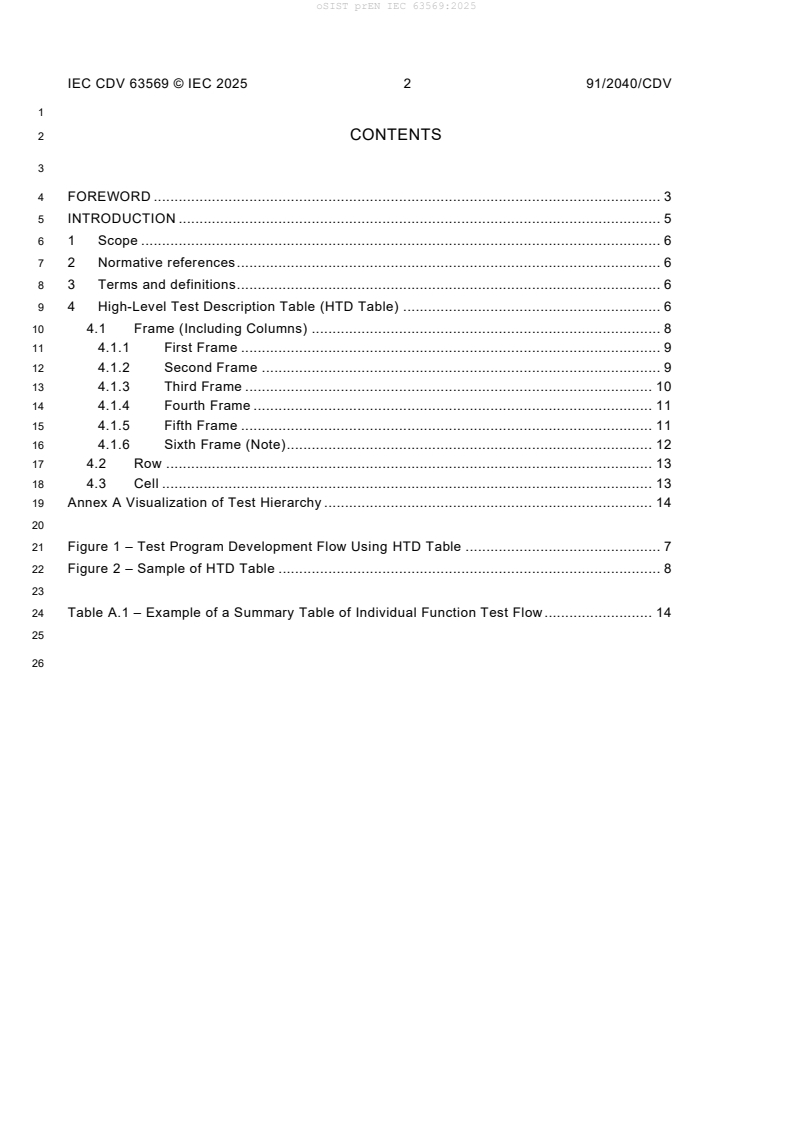
IEC CDV 63569 © IEC 2025 2 91/2040/CDV
2 CONTENTS
4 FOREWORD . 3
5 INTRODUCTION . 5
6 1 Scope . 6
7 2 Normative references . 6
8 3 Terms and definitions . 6
9 4 High-Level Test Description Table (HTD Table) . 6
10 4.1 Frame (Including Columns) . 8
11 4.1.1 First Frame . 9
12 4.1.2 Second Frame . 9
13 4.1.3 Third Frame . 10
14 4.1.4 Fourth Frame . 11
15 4.1.5 Fifth Frame . 11
16 4.1.6 Sixth Frame (Note) . 12
17 4.2 Row . 13
18 4.3 Cell . 13
19 Annex A Visualization of Test Hierarchy . 14
21 Figure 1 – Test Program Development Flow Using HTD Table . 7
22 Figure 2 – Sample of HTD Table . 8
24 Table A.1 – Example of a Summary Table of Individual Function Test Flow . 14
oSIST prEN IEC 63569:2025
IEC CDV 63569 © IEC 2025 3 91/2040/CDV
27 INTERNATIONAL ELECTROTECHNICAL COMMISSION
28 ____________
30 HIGH-LEVEL TEST DESCRIPTION TABLE FOR DEVELOPMENT OF PRODUCTION
31 TEST PROGRAMS
33 FOREWORD
34 1) The International Electrotechnical Commission (IEC) is a worldwide organization for standardization comprising all national
35 electrotechnical committees (IEC National Committees). The object of IEC is to promote international co -operation on all
36 questions concerning standardization in the electrical and electronic fields. To this end and in addition to other activities ,
37 IEC publishes International Standards, Technical Specifications, Technical Reports, Publicly Available Specifications (PAS)
38 and Guides (hereafter referred to as "IEC Publication(s)"). Their preparation is entrusted to technical committees; any IEC
39 National Committee interested in the subject dealt with may participate in this preparatory work. International, governmental
40 and non-governmental organizations liaising with the IEC also participate in this preparation. IEC collaborates closely with
41 the International Organization for Standardization (ISO) in accordance with conditions determined by agreement between
42 the two organizations.
43 2) The formal decisions or agreements of IEC on technical matters express, as nearly as possible, an international consensus
44 of opinion on the relevant subjects since each technical committee has representation from all interested IEC National
45 Committees.
46 3) IEC Publications have the form of recommendations for international use and are accepted by IEC National Committees in
47 that sense. While all reasonable efforts are made to ensure that the technical content of IEC Publications is accurate, IEC
48 cannot be held responsible for the way in which they are used or for any misinterpretation by any end user.
49 4) In order to promote international uniformity, IEC National Committees undertake to apply IEC Publications transparently to
50 the maximum extent possible in their national and regional publications. Any divergence between any IEC Publication and
51 the corresponding national or regional publication shall be clearly indicated in the latter.
52 5) IEC itself does not provide any attestation of conformity. Independent certification bodies provide conformity assessment
53 services and, in some areas, access to IEC marks of conformity. IEC is not responsible for any services carried out by
54 independent certification bodies.
55 6) All users should ensure that they have the latest edition of this publication.
56 7) No liability shall attach to IEC or its directors, employees, servants or agents including individual experts and members of
57 its technical committees and IEC National Committees for any personal injury, property damage or other damage of any
58 nature whatsoever, whether direct or indirect, or for costs (including legal fees) and expenses arising out of the publicatio n,
59 use of, or reliance upon, this IEC Publication or any other IEC Publications.
60 8) Attention is drawn to the Normative references cited in this publication. Use of the referenced publications is indispensable
61 for the correct application of this publication.
62 9) IEC and ISO draw attention to the possibility that the implementation of this document may involve the use of (a) patent(s).
63 IEC and ISO take no position concerning the evidence, validity or applicability of any claimed patent rights in respect thereof.
64 As of the date of publication of this document, IEC and ISO had not received notice of (a) patent(s), which may be required
65 to implement this document. However, implementers are cautioned that this may not represent the latest information, which
66 may be obtained from the patent database available at https://patents.iec.ch and/or www.iso.org/patents. EC and ISO sh all
67 not be held responsible for identifying any or all such patent rights.
68 IEC 63569 has been prepared by subcommittee WG15: Design Automation, of IEC technical committee
69 TC19. Electronics assembly technology. It is an International Standard.
70 The text of this International Standard is based on the following documents:
Draft Report on voting
XX/XX/FDIS XX/XX/RVD
72 Full information on the voting for its approval can be found in the report on voting indicated in the above
73 table.
74 The language used for the development of this International Standard is English.
75 This document was drafted in accordance with ISO/IEC Directives, Part 2, and developed in accordance
76 with ISO/IEC Directives, Part 1 and ISO/IEC Directives, IEC Supplement, available at
oSIST prEN IEC 63569:2025
IEC CDV 63569 © IEC 2025 4 91/2040/CDV
77 www.iec.ch/members_experts/refdocs. The main document types developed by IEC are described in
78 greater detail at www.iec.ch/publications.
79 The committee has decided that the contents of this document will remain unchanged until the stability
80 date indicated on the IEC website under webstore.iec.ch in the data related to the specific document.
81 At this date, the document will be
82 • reconfirmed,
83 • withdrawn,
84 • replaced by a revised edition, or
85 • amended.
oSIST prEN IEC 63569:2025
IEC CDV 63569 © IEC 2025 5 91/2040/CDV
87 INTRODUCTION
88 The test program development process is divided into two stages, an upstream design process to clarify
89 the flow of program development, and a detailed design process to embody and execute the program
90 development flow using a programming language. The detailed design process is generally a program
91 description process using the Program Development Environment.
92 The upstream design process is not explicitly described in the relevant standards in general, and it is
93 left to the test program developer to decide how to execute the upstream design process. As a result,
94 the upstream design process is rarely standardized. In addition, the tools used to execute the upstream
95 design process are not standardized. These two factors create an "invisible process" in the upstream
96 design process.
97 Large companies are aware that the degree of completion of the upstream design process greatly affects
98 the quality of the final program, and therefore, they invest significant resources and costs in the
99 upstream design process of test program development. However, the upstream design process of large
100 companies is unique, and large companies do not share upstream design techniques as standard design
101 techniques. Therefore, large companies also incur extra costs by redeveloping from scratch each time
102 they develop a test program. On the other hand, companies with inferior financial and technological
103 capabilities are often unable to devote sufficient resources to upstream design.
104 It would be very beneficial for any manufacturer, regardless of the size of the company, to be able to
105 use standardized mechanisms and tools to easily perform upstream design with a high degree of
106 completeness, because this standardization will contribute to improving the market quality of final
107 products and accelerating the time to market, To achieve international standardization in this area
oSIST prEN IEC 63569:2025
IEC CDV 63569 © IEC 2025 6 91/2040/CDV
109 HIGH-LEVEL TEST DESCRIPTION TABLE FOR DEVELOPMENT OF PRODUCTION
110 TEST PROGRAMS
112 Scope
113 This standard specifies the method for High-Level Test Description Table (HTD Table) for development
114 of production test program. High-level test description technology is a test verification technology that
115 takes into account the various operating environments of electronic equipment and systems. It is a
116 technology to effectively deploy the process of test program design and development, which was
117 developed to accurately and efficiently conduct electronic equipment and system tests.
118 The upstream design of a test program for an automated test system (ATS) is a complex process that
119 involves Test Requirement Data, Unit Under Test (UUT) Data, Diagnostics Data, Prognostics Data, and
120 Program Development Environment. It is the most important process in the verification of system test
121 products. Standardization of the upstream design of test programs is in line with the efficiency
122 requirements of the testing field.
123 Normative references
124 There are no normative references in this document.
125 Terms and definitions
126 For the purposes of this document, the terms and definitions given in IEC61671(IEEE Std 1671) apply.
127 ISO and IEC maintain terminology databases for use in standardization at the following addresses:
128 • IEC Electropedia: available at https://www.electropedia.org/
129 • ISO Online browsing platform: available at https://www.iso.org/obp
130 High-Level Test Description Table (HTD Table)
131 The following four documents are necessary to prepare for developing test program as inputs.
132 1) Customer requirements
133 2) UUT Hardware specifications
134 3) Basic test specifications
135 4) Quality information
136 The test program for the development of the High-Level Test Program is described by a description
137 containing the rules to which the above four files relate, and HTD Table, a table of test requirements
138 described in a formal format.
139 The Test Requirement Description Standard for High-Level Test Program Development assumes that
140 the specification of test verification is described by means of HTD Table. HTD Table is a visual means
141 of organizing and displaying test information/data and describes the basic elements of the test. Because
142 detailed tests can be difficult to decipher if described on a single Test Requirements Table for all tests,
143 the test program developer should describe HTD Table in a hierarchical manner. Figure 1 shows the
144 test program development flow using HTD Table with four inputs.
145 1) Customer requirements
146 These are what customer ask the product to meet. From the customer requirements, we identify
147 what features are necessary to realize on the product, such as communication, sensor and actuator
148 controls, security functions, operation temperature range and the others.
oSIST prEN IEC 63569:2025
IEC CDV 63569 © IEC 2025 7 91/2040/CDV
149 2) UUT Hardware specifications
150 These include specifications for interfaces (Ethernet, USB, LED, etc.), power supply, and so on.
151 3) Basic test specifications
152 This specifies which UUT function of the product should be tested.
153 4) Quality information
154 This information is about faults and failures that have occurred in the past for similar products and
155 the test countermeasures to prevent reoccurrence. Most manufactures have their own knowledge
156 database on the past faults/failure experiences and countermeasures. Test-related issues and
157 countermeasures among them should be included in this document.
160 Figure 1 – Test Program Development Flow Using HTD Table
161 HTD Table consists of 6 frames. Each frame can be extended and additional Frames added. The frame
162 consists of the row with a column. Column is included in each fram
...