


IEC 61821:2011
(Main)Electrical installations for lighting and beaconing of aerodromes - Maintenance of aeronautical ground lighting constant current series circuits
Electrical installations for lighting and beaconing of aerodromes - Maintenance of aeronautical ground lighting constant current series circuits
IEC 61821:2011 applies to the maintenance of AGL constant current series circuits. This International Standard:
- covers constant current series circuits for AGL installed at aerodromes and heliports;
- concentrates on providing the safety requirements for the maintenance of an AGL constant current series circuit. It is recognized that AGL constant current series circuits of different design characteristics and parameters are in existence;
- is mainly concerned with safety to persons by specifying the rules and fundamental principles for the maintenance of AGL constant current series circuits;
- is not intended to apply to AGL primary series circuits supplied directly from a mains constant voltage source;
- is not intended to be used for public street lighting, roadway lighting or any other installation requiring the use of constant current series circuits.
This second edition cancels and replaces the first edition published in 2002. It is a technical revision. This edition includes the following significant technical changes with respect to the previous edition:
a) addition of references to normative references;
b) addition of notes in Clauses 5, 6 and 7;
c) modification of pre-work procedures in item e) of 7.2.2.
Installations électriques pour l'éclairage et le balisage des aérodromes - Maintenance des circuits série à courant constant pour le balisage aéronautique au sol
La CEI 61821:2011 s'applique à la maintenance des circuits série à courant constant pour le balisage aéronautique au sol (AGL). Cette norme internationale:
- couvre les circuits série à courant constant pour le balisage aéronautique au sol installé dans les aérodromes et les héliports;
- se concentre sur la fourniture d'exigences en matière de sécurité pour la maintenance des circuits série à courant constant pour le balisage aéronautique au sol. L'existence d'une diversité de circuits série à courant constant pour balisage aéronautique au sol, possédant des caractéristiques et des paramètres différents d'un circuit à l'autre, est admise;
- s'intéresse principalement à la sécurité des personnes et spécifie les règles et les principes fondamentaux liés à la maintenance des circuits série à courant constant pour le balisage aéronautique au sol;
- ne s'applique pas aux circuits série primaires pour le balisage aéronautique au sol alimentés directement à partir d'une source à tension constante provenant du secteur;
- ne s'applique pas à l'éclairage public des rues ou des routes, ou à toute autre installation requérant l'utilisation de circuits série à courant constant.
Cette deuxième édition annule et remplace la première édition parue en 2002. Elle constitue une révision technique. Cette édition inclut les modifications techniques majeures suivantes par rapport à l'édition précédente:
a) ajout de références dans les références normatives;
b) ajout de notes dans les Articles 5, 6 et 7;
c) modification des procédures de pré-travail dans le point e) du 7.2.2.
General Information
- Status
- Published
- Publication Date
- 28-Sep-2011
- Technical Committee
- TC 97 - Electrical installations for lighting and beaconing of aerodromes
- Current Stage
- PPUB - Publication issued
- Start Date
- 29-Sep-2011
- Completion Date
- 31-Oct-2011
Relations
- Effective Date
- 05-Sep-2023
Overview
IEC 61821:2011 is an international standard developed by the International Electrotechnical Commission (IEC) that focuses on the maintenance of aeronautical ground lighting (AGL) constant current series circuits. This standard specifically addresses the safety requirements and fundamental principles associated with maintaining these electrical circuits, which are critical for lighting and beaconing at aerodromes and heliports. It replaces the first edition published in 2002, incorporating updated safety notes and refined maintenance procedures to enhance operational reliability and personnel safety.
Key Topics
Scope and Applicability
IEC 61821:2011 applies exclusively to the maintenance of constant current series circuits used for aeronautical ground lighting at aerodromes and heliports. It excludes AGL primary series circuits supplied directly from mains constant voltage sources, as well as other lighting installations such as public street lighting or roadway lighting that use constant current systems.Safety Requirements
The standard places a significant emphasis on the safety of personnel during maintenance activities. It outlines safety procedures, the use of personal protective equipment (PPE), safe working practices including live working protocols, and necessary checks to prevent electrical hazards.Competence and Training
The competence of maintenance personnel is a critical requirement. The standard defines the essential qualifications, training, and experience required to safely perform work on AGL constant current series circuits.Maintenance Management
IEC 61821 includes guidelines for organizing maintenance activities. This covers defining organizational roles and responsibilities, managing contractors, developing maintenance policies and procedures, and controlling access to AGL work areas to ensure safety and compliance.Maintenance Procedures
Detailed procedural requirements include pre-work safety checks, handling of cables and equipment, execution of maintenance tasks, and documentation practices. The standard encourages comprehensive record-keeping to support operational integrity and facilitate audits.
Applications
IEC 61821:2011 is essential for organizations involved in the maintenance and operational safety of electrical installations for aerodrome lighting. Typical applications include:
Aerodrome and Heliport Operators
Ensuring ongoing operational reliability of ground lighting systems to support the safe movement of aircraft and ground vehicles.Maintenance Contractors
Providing a clear framework for planning and performing maintenance work on AGL circuits in conformity with internationally recognized safety and quality standards.Safety and Compliance Authorities
Using the standard as a benchmark for auditing aerodrome lighting maintenance practices and enforcing regulatory compliance.Electrical and Airport Facility Managers
Implementing maintenance management systems that reduce the likelihood of lighting system failures and enhance personnel safety during maintenance activities.
Related Standards
IEC 60903 – Live Working: Gloves of Insulating Material
This standard complements IEC 61821 by specifying requirements for gloves used by personnel working on live electrical installations, providing a key safety element in AGL maintenance.Other Aeronautical Lighting Standards
While IEC 61821 focuses on maintenance, related IEC standards provide guidance on the installation, operation, and design of aerodrome lighting systems to ensure overall functional safety and efficacy.National and Regional Safety Standards
IEC 61821 aligns with many national regulations concerning electrical safety and workplace health, serving as a reference for harmonizing local rules with international best practices.
This internationally recognized IEC standard is indispensable for ensuring the safe operation, maintenance, and management of aeronautical ground lighting constant current series circuits. By adhering to IEC 61821:2011, aerodrome operators and maintenance providers can enhance safety for personnel and aircraft alike while upholding operational excellence in lighting systems critical to aviation safety.
Frequently Asked Questions
IEC 61821:2011 is a standard published by the International Electrotechnical Commission (IEC). Its full title is "Electrical installations for lighting and beaconing of aerodromes - Maintenance of aeronautical ground lighting constant current series circuits". This standard covers: IEC 61821:2011 applies to the maintenance of AGL constant current series circuits. This International Standard: - covers constant current series circuits for AGL installed at aerodromes and heliports; - concentrates on providing the safety requirements for the maintenance of an AGL constant current series circuit. It is recognized that AGL constant current series circuits of different design characteristics and parameters are in existence; - is mainly concerned with safety to persons by specifying the rules and fundamental principles for the maintenance of AGL constant current series circuits; - is not intended to apply to AGL primary series circuits supplied directly from a mains constant voltage source; - is not intended to be used for public street lighting, roadway lighting or any other installation requiring the use of constant current series circuits. This second edition cancels and replaces the first edition published in 2002. It is a technical revision. This edition includes the following significant technical changes with respect to the previous edition: a) addition of references to normative references; b) addition of notes in Clauses 5, 6 and 7; c) modification of pre-work procedures in item e) of 7.2.2.
IEC 61821:2011 applies to the maintenance of AGL constant current series circuits. This International Standard: - covers constant current series circuits for AGL installed at aerodromes and heliports; - concentrates on providing the safety requirements for the maintenance of an AGL constant current series circuit. It is recognized that AGL constant current series circuits of different design characteristics and parameters are in existence; - is mainly concerned with safety to persons by specifying the rules and fundamental principles for the maintenance of AGL constant current series circuits; - is not intended to apply to AGL primary series circuits supplied directly from a mains constant voltage source; - is not intended to be used for public street lighting, roadway lighting or any other installation requiring the use of constant current series circuits. This second edition cancels and replaces the first edition published in 2002. It is a technical revision. This edition includes the following significant technical changes with respect to the previous edition: a) addition of references to normative references; b) addition of notes in Clauses 5, 6 and 7; c) modification of pre-work procedures in item e) of 7.2.2.
IEC 61821:2011 is classified under the following ICS (International Classification for Standards) categories: 29.140.50 - Lighting installation systems; 93.120 - Construction of airports. The ICS classification helps identify the subject area and facilitates finding related standards.
IEC 61821:2011 has the following relationships with other standards: It is inter standard links to IEC 61821:2002. Understanding these relationships helps ensure you are using the most current and applicable version of the standard.
You can purchase IEC 61821:2011 directly from iTeh Standards. The document is available in PDF format and is delivered instantly after payment. Add the standard to your cart and complete the secure checkout process. iTeh Standards is an authorized distributor of IEC standards.
Standards Content (Sample)
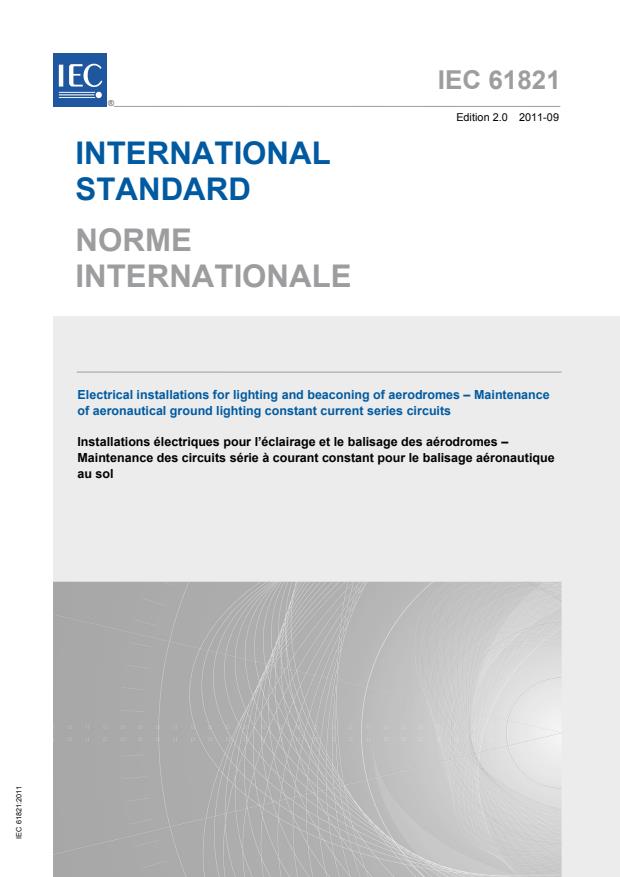
IEC 61821 ®
Edition 2.0 2011-09
INTERNATIONAL
STANDARD
NORME
INTERNATIONALE
Electrical installations for lighting and beaconing of aerodromes – Maintenance
of aeronautical ground lighting constant current series circuits
Installations électriques pour l’éclairage et le balisage des aérodromes –
Maintenance des circuits série à courant constant pour le balisage aéronautique
au sol
All rights reserved. Unless otherwise specified, no part of this publication may be reproduced or utilized in any form or by
any means, electronic or mechanical, including photocopying and microfilm, without permission in writing from either IEC or
IEC's member National Committee in the country of the requester.
If you have any questions about IEC copyright or have an enquiry about obtaining additional rights to this publication,
please contact the address below or your local IEC member National Committee for further information.
Droits de reproduction réservés. Sauf indication contraire, aucune partie de cette publication ne peut être reproduite
ni utilisée sous quelque forme que ce soit et par aucun procédé, électronique ou mécanique, y compris la photocopie
et les microfilms, sans l'accord écrit de la CEI ou du Comité national de la CEI du pays du demandeur.
Si vous avez des questions sur le copyright de la CEI ou si vous désirez obtenir des droits supplémentaires sur cette
publication, utilisez les coordonnées ci-après ou contactez le Comité national de la CEI de votre pays de résidence.
IEC Central Office
3, rue de Varembé
CH-1211 Geneva 20
Switzerland
Email: inmail@iec.ch
Web: www.iec.ch
About the IEC
The International Electrotechnical Commission (IEC) is the leading global organization that prepares and publishes
International Standards for all electrical, electronic and related technologies.
About IEC publications
The technical content of IEC publications is kept under constant review by the IEC. Please make sure that you have the
latest edition, a corrigenda or an amendment might have been published.
Catalogue of IEC publications: www.iec.ch/searchpub
The IEC on-line Catalogue enables you to search by a variety of criteria (reference number, text, technical committee,…).
It also gives information on projects, withdrawn and replaced publications.
IEC Just Published: www.iec.ch/online_news/justpub
Stay up to date on all new IEC publications. Just Published details twice a month all new publications released. Available
on-line and also by email.
Electropedia: www.electropedia.org
The world's leading online dictionary of electronic and electrical terms containing more than 20 000 terms and definitions
in English and French, with equivalent terms in additional languages. Also known as the International Electrotechnical
Vocabulary online.
Customer Service Centre: www.iec.ch/webstore/custserv
If you wish to give us your feedback on this publication or need further assistance, please visit the Customer Service
Centre FAQ or contact us:
Email: csc@iec.ch
Tel.: +41 22 919 02 11
Fax: +41 22 919 03 00
A propos de la CEI
La Commission Electrotechnique Internationale (CEI) est la première organisation mondiale qui élabore et publie des
normes internationales pour tout ce qui a trait à l'électricité, à l'électronique et aux technologies apparentées.
A propos des publications CEI
Le contenu technique des publications de la CEI est constamment revu. Veuillez vous assurer que vous possédez
l’édition la plus récente, un corrigendum ou amendement peut avoir été publié.
Catalogue des publications de la CEI: www.iec.ch/searchpub/cur_fut-f.htm
Le Catalogue en-ligne de la CEI vous permet d’effectuer des recherches en utilisant différents critères (numéro de référence,
texte, comité d’études,…). Il donne aussi des informations sur les projets et les publications retirées ou remplacées.
Just Published CEI: www.iec.ch/online_news/justpub
Restez informé sur les nouvelles publications de la CEI. Just Published détaille deux fois par mois les nouvelles
publications parues. Disponible en-ligne et aussi par email.
Electropedia: www.electropedia.org
Le premier dictionnaire en ligne au monde de termes électroniques et électriques. Il contient plus de 20 000 termes et
définitions en anglais et en français, ainsi que les termes équivalents dans les langues additionnelles. Egalement appelé
Vocabulaire Electrotechnique International en ligne.
Service Clients: www.iec.ch/webstore/custserv/custserv_entry-f.htm
Si vous désirez nous donner des commentaires sur cette publication ou si vous avez des questions, visitez le FAQ du
Service clients ou contactez-nous:
Email: csc@iec.ch
Tél.: +41 22 919 02 11
Fax: +41 22 919 03 00
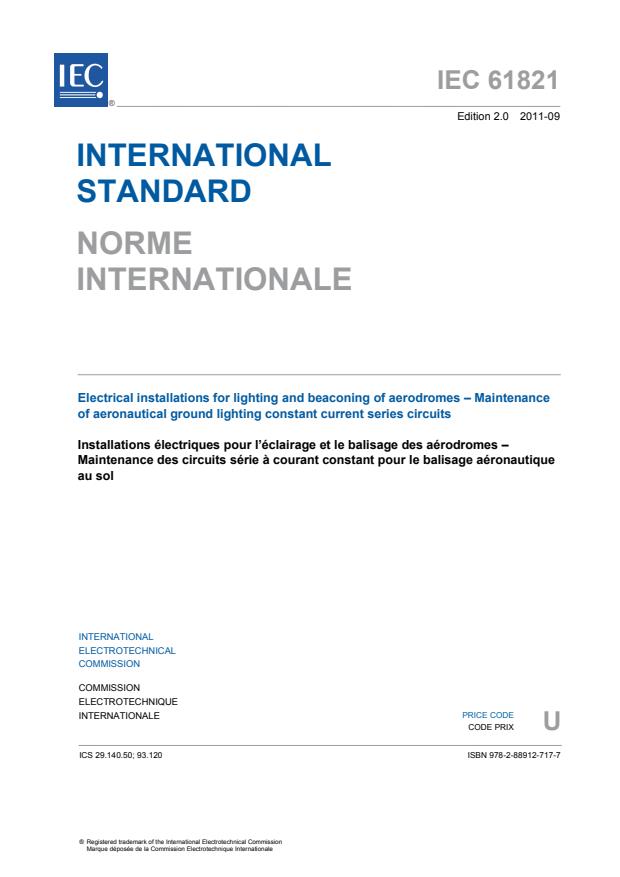
IEC 61821 ®
Edition 2.0 2011-09
INTERNATIONAL
STANDARD
NORME
INTERNATIONALE
Electrical installations for lighting and beaconing of aerodromes – Maintenance
of aeronautical ground lighting constant current series circuits
Installations électriques pour l’éclairage et le balisage des aérodromes –
Maintenance des circuits série à courant constant pour le balisage aéronautique
au sol
INTERNATIONAL
ELECTROTECHNICAL
COMMISSION
COMMISSION
ELECTROTECHNIQUE
PRICE CODE
INTERNATIONALE
CODE PRIX U
ICS 29.140.50; 93.120 ISBN 978-2-88912-717-7
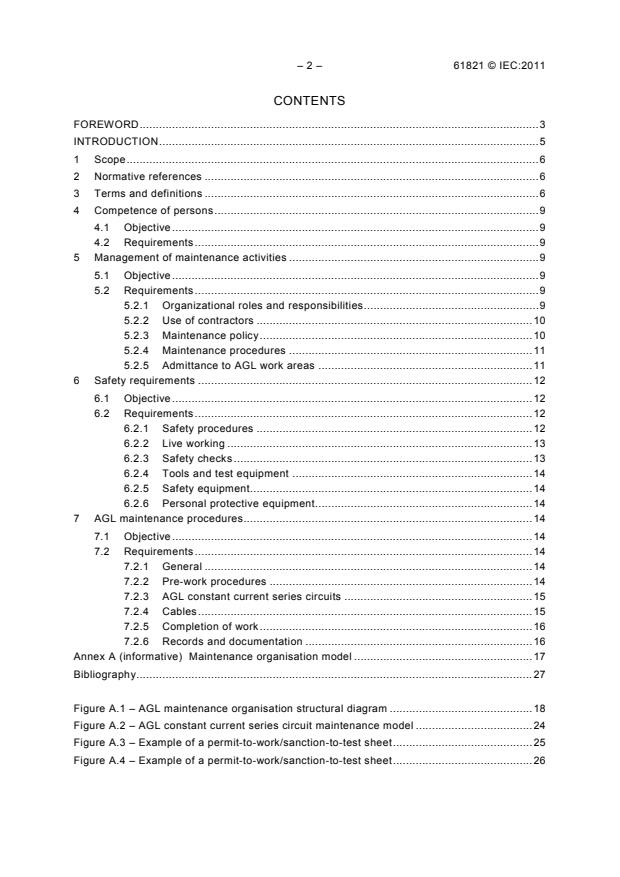
– 2 – 61821 © IEC:2011
CONTENTS
FOREWORD . 3
INTRODUCTION . 5
1 Scope . 6
2 Normative references . 6
3 Terms and definitions . 6
4 Competence of persons . 9
4.1 Objective . 9
4.2 Requirements . 9
5 Management of maintenance activities . 9
5.1 Objective . 9
5.2 Requirements . 9
5.2.1 Organizational roles and responsibilities . 9
5.2.2 Use of contractors . 10
5.2.3 Maintenance policy . 10
5.2.4 Maintenance procedures . 11
5.2.5 Admittance to AGL work areas . 11
6 Safety requirements . 12
6.1 Objective . 12
6.2 Requirements . 12
6.2.1 Safety procedures . 12
6.2.2 Live working . 13
6.2.3 Safety checks . 13
6.2.4 Tools and test equipment . 14
6.2.5 Safety equipment. 14
6.2.6 Personal protective equipment. 14
7 AGL maintenance procedures . 14
7.1 Objective . 14
7.2 Requirements . 14
7.2.1 General . 14
7.2.2 Pre-work procedures . 14
7.2.3 AGL constant current series circuits . 15
7.2.4 Cables . 15
7.2.5 Completion of work . 16
7.2.6 Records and documentation . 16
Annex A (informative) Maintenance organisation model . 17
Bibliography . 27
Figure A.1 – AGL maintenance organisation structural diagram . 18
Figure A.2 – AGL constant current series circuit maintenance model . 24
Figure A.3 – Example of a permit-to-work/sanction-to-test sheet . 25
Figure A.4 – Example of a permit-to-work/sanction-to-test sheet . 26
61821 © IEC:2011 –3 –
INTERNATIONAL ELECTROTECHNICAL COMMISSION
____________
ELECTRICAL INSTALLATIONS FOR LIGHTING
AND BEACONING OF AERODROMES –
MAINTENANCE OF AERONAUTICAL GROUND LIGHTING
CONSTANT CURRENT SERIES CIRCUITS
FOREWORD
1) The International Electrotechnical Commission (IEC) is a worldwide organization for standardization comprising
all national electrotechnical committees (IEC National Committees). The object of IEC is to promote
international co-operation on all questions concerning standardization in the electrical and electronic fields. To
this end and in addition to other activities, IEC publishes International Standards, Technical Specifications,
Technical Reports, Publicly Available Specifications (PAS) and Guides (hereafter referred to as “IEC
Publication(s)”). Their preparation is entrusted to technical committees; any IEC National Committee interested
in the subject dealt with may participate in this preparatory work. International, governmental and non-
governmental organizations liaising with the IEC also participate in this preparation. IEC collaborates closely
with the International Organization for Standardization (ISO) in accordance with conditions determined by
agreement between the two organizations.
2) The formal decisions or agreements of IEC on technical matters express, as nearly as possible, an international
consensus of opinion on the relevant subjects since each technical committee has representation from all
interested IEC National Committees.
3) IEC Publications have the form of recommendations for international use and are accepted by IEC National
Committees in that sense. While all reasonable efforts are made to ensure that the technical content of IEC
Publications is accurate, IEC cannot be held responsible for the way in which they are used or for any
misinterpretation by any end user.
4) In order to promote international uniformity, IEC National Committees undertake to apply IEC Publications
transparently to the maximum extent possible in their national and regional publications. Any divergence
between any IEC Publication and the corresponding national or regional publication shall be clearly indicated in
the latter.
5) IEC itself does not provide any attestation of conformity. Independent certification bodies provide conformity
assessment services and, in some areas, access to IEC marks of conformity. IEC is not responsible for any
services carried out by independent certification bodies.
6) All users should ensure that they have the latest edition of this publication.
7) No liability shall attach to IEC or its directors, employees, servants or agents including individual experts and
members of its technical committees and IEC National Committees for any personal injury, property damage or
other damage of any nature whatsoever, whether direct or indirect, or for costs (including legal fees) and
expenses arising out of the publication, use of, or reliance upon, this IEC Publication or any other IEC
Publications.
8) Attention is drawn to the Normative references cited in this publication. Use of the referenced publications is
indispensable for the correct application of this publication.
9) Attention is drawn to the possibility that some of the elements of this IEC Publication may be the subject of
patent rights. IEC shall not be held responsible for identifying any or all such patent rights.
International Standard IEC 61821 has been prepared by IEC technical committee 97:
Electrical installations for lighting and beaconing of aerodromes.
This second edition cancels and replaces the first edition published in 2002. It is a technical
revision.
This edition includes the following significant technical changes with respect to the previous
edition:
a) addition of references to normative references;
b) addition of notes in Clauses 5, 6 and 7;
c) modification of pre-work procedures in item e) of 7.2.2.
– 4 – 61821 © IEC:2011
The text of this standard is based on the following documents:
FDIS Report on voting
97/153/FDIS 97/154/RVD
Full information on the voting for the approval of this standard can be found in the report on
voting indicated in the above table.
This publication has been drafted in accordance with the ISO/IEC Directives, Part 2.
The committee has decided that the contents of this publication will remain unchanged until
the stability date indicated on the IEC web site under "http://webstore.iec.ch" in the data
related to the specific publication. At this date, the publication will be
• reconfirmed,
• withdrawn,
• replaced by a revised edition, or
• amended.
61821 © IEC:2011 –5 –
INTRODUCTION
This International Standard contains the management, safety and procedural requirements
specific to the maintenance of an aeronautical ground lighting (AGL) constant current series
circuit and has taken into consideration existing national standards, requirements and
practices. The maintenance activities are required to ensure that the AGL constant current
series circuit continues to meet the operational requirements and minimize the occurrence of
operational failures.
To conform to this International Standard it should be demonstrated to the relevant bodies
that the requirements have been satisfied and therefore that the clause objective(s) has (have)
been met.
NOTE Examples of relevant bodies would include the following:
• certification and licensing authorities;
• safety regulators;
• notified bodies for international or European directives;
• national standards bodies.
– 6 – 61821 © IEC:2011
ELECTRICAL INSTALLATIONS FOR LIGHTING
AND BEACONING OF AERODROMES –
MAINTENANCE OF AERONAUTICAL GROUND LIGHTING
CONSTANT CURRENT SERIES CIRCUITS
1 Scope
This International Standard applies to the maintenance of AGL constant current series circuits.
This International Standard
• covers constant current series circuits for AGL installed at aerodromes and heliports;
• concentrates on providing the safety requirements for the maintenance of an AGL
constant current series circuit. It is recognized that AGL constant current series circuits of
different design characteristics and parameters are in existence;
• is mainly concerned with safety to persons by specifying the rules and fundamental
principles for the maintenance of AGL constant current series circuits;
• is not intended to apply to AGL primary series circuits supplied directly from a mains
constant voltage source;
• is not intended to be used for public street lighting, roadway lighting or any other
installation requiring the use of constant current series circuits.
2 Normative references
The following referenced documents are indispensable for the application of this document.
For dated references, only the edition cited applies. For undated references, the latest edition
of the referenced document (including any amendments) applies.
IEC 60903, Live working – Gloves of insulating material
3 Terms and definitions
For the purposes of this document, the following terms and definitions apply.
3.1
aerodrome authority
organization accountable for the operational safety and security of persons, aircraft
operations and facilities at an aerodrome
NOTE Temporally the occupational safety for third party personal, contracted for AGL work on non-operational
areas, can be delegated to the third party contractor if the evidence of professional skills, knowledge of the
behavior rules and the separation to the airport operation area is given and documented.
3.2
AGL constant current series circuit
apparatus configured as an electrical circuit designed to produce and operate with a constant
current, independent of specified load variations, in order to provide a specified light for
aeronautical purposes
3.3
AGL operator
person responsible for the control of the AGL to permit the safe movement of aircraft
61821 © IEC:2011 –7 –
3.4
caution sign
non-metallic safety sign attached to equipment conveying a warning against interference with
such equipment
3.5
constant current regulator
CCR
apparatus which produces a current output at a constant r.m.s. value independent of varia-
tions in the constant current series circuit load, input voltage and service conditions as
specified
3.6
contractor
organization or person(s) given a written order to provide a service or undertake specified
work
3.7
dead
free from any electrical connection to a source of potential difference and from electric charge;
not having a potential different from that of the earth
3.8
earthed
connected to the general mass of earth in such a manner as to ensure at all times an
immediate discharge of electrical energy without harm
3.9
electrical equipment
anything used, intended to be used or installed for use, to generate, provide, transmit, trans-
form, rectify, convert, conduct, distributes, control, store, measure or use electrical energy
3.10
harm
physical injury or damage to the health of people either directly, or indirectly, as a result of
damage to property or to the environment
[ISO/IEC Guide 51, 3.3, modified]
3.11
hazard
potential source of harm
NOTE The term includes hazards to persons arising within a short time scale (for example, fire and explosion)
and also those that have a long-term effect on a person’s health (for example, release of a toxic substance).
[ISO/IEC Guide 51, 3.5, modified]
3.12
hazardous event
occurrence, with possible hazardous consequences, arising as the result of a hazardous
condition
3.13
hazard sign
non-metallic safety sign that conveys a warning against risk of harm
– 8 – 61821 © IEC:2011
3.14
isolate
disconnect and separate electrical equipment from the normal source(s) of electrical energy in
such a way that the disconnection and separation is secure
3.15
live
electrically connected to a source of electricity or which has acquired a charge by other
means
3.16
maintenance
act of diagnosing and physically repairing, or preventing, equipment failures
3.17
personal protective equipment
equipment used to protect persons from harm in the working environment
NOTE Personal protective equipment includes such items as special tools, protective clothing, insulating
screening, safety harnesses and safety signs.
3.18
prove dead
demonstrate with the use of test equipment that no electrical potential liable to cause harm is
present
3.19
risk
combination of the probability of occurrence of harm and the severity of that harm
[ISO/IEC Guide 51, 3.2]
3.20
risk assessment
1. systematic quantitative assessment of the magnitude of the threat to safety induced by the
accumulation of controlled and unresolved residual hazards;
2. integrated analysis of the risks inherent in a product, system or facility and their signi-
ficance in an appropriate context
3.21
test equipment
equipment to undertake particular tests, that is suitable for the use for which it is provided,
that is maintained in a condition suitable for that use, and that is properly used
3.22
test/testing (of electrical equipment)
1. providing a sequence of operations or the measuring of electrical characteristics of live
electrical equipment (for example, diagnostic testing of faulty equipment);
2. applying voltages, currents or signals for the purposes of providing insulation, continuity or
other characteristic of isolated electrical equipment (for example, before a permanent
electrical installation is energised from the normal source(s) of electrical energy)
3.23
work/working (on electrical equipment)
installing, dismantling, assembling, maintaining, testing or repairing of electrical equipment
61821 © IEC:2011 –9 –
4 Competence of persons
4.1 Objective
The objective of the requirements of this clause is to ensure that persons who have
responsibility for any activity, or are directly engaged in the maintenance of AGL constant
current series circuits are competent to discharge those duties or perform those tasks.
NOTE It is recommended that the appropriate administration or aerodrome authority encourage the development
of a formal and structured competency training programme(s). The training programme(s) should consist of multiple
tiers that enhance progressively a person’s skills and ensure a recognised level of competency for those persons
who have satisfactorily completed the programme(s).
4.2 Requirements
In accordance with national legislation, all persons involved in any activity, including manage-
ment and maintenance activities, shall have the appropriate and verifiable training, technical
knowledge, experience and qualifications relevant to the specific duties they have to perform.
In particular, where involved in work on constant current series circuits, they shall be
knowledgeable of the specific risks and the safety procedures involved in the work. The
training, experience and qualifications of all persons involved in any activity shall be justified
taking into account all the relevant competence factors. The justification shall be recorded in
appropriate documentation.
NOTE The following competence factors should be addressed when assessing and justifying the competence of
persons carrying out their duties:
• engineering appropriate to the application area;
• engineering appropriate to the technology (for example, mechanical, electrical/electronic/software engineering);
• safety engineering appropriate to the technology;
• knowledge of the legal and safety regulatory framework;
• knowledge of the operational aspects related to the AGL system at the aerodrome;
• the consequences in the event of a failure of a constant current series circuit;
• the consequences of failure to adhere to safety procedures when working on constant current series circuits;
• the novelty of the design, design procedures or application;
• previous experience relevant to the specific duties to be performed and the technology being employed;
• relevance of qualifications to the specific duties performed.
5 Management of maintenance activities
NOTE Additional informative guidance material for management of maintenance activities is included in Annex A.
5.1 Objective
The objective of the requirements of this clause is to detail the roles and responsibilities of
those personnel engaged in maintenance activities on or near AGL constant current series
circuits and the procedures to ensure that safety are addressed.
5.2 Requirements
5.2.1 Organizational roles and responsibilities
The aerodrome authority shall appoint one or more named persons to manage, supervise or
undertake specific maintenance tasks. Those persons shall be identified on any applicable
record or other documentation associated with the task. All persons involved in work on the
AGL shall be aware of
• their role and responsibilities;
• their duties and how to perform those duties;
• the procedures to be followed;
– 10 – 61821 © IEC:2011
• contingency working arrangements.
The content of this clause is a minimum requirement.
NOTE IEC/TS 62143 contains details of requirements for the safety management of an AGL system at an
aerodrome.
5.2.2 Use of contractors
The aerodrome authority retains full accountability under these requirements for all work
undertaken on an AGL constant current series circuit by a contractor. This accountability shall
include where the AGL constant current series circuit, or part of it, is to be under the control
of a contractor. The aerodrome authority shall ensure that all other organisations, including
the users and operators of the AGL and other applicable aerodrome facilities, are notified
prior to the commencement of the work and the procedures used. Contractors and other non-
aerodrome employees shall follow the safety rules and procedures provided by the aerodrome
authority (see 5.2.4).
5.2.3 Maintenance policy
5.2.3.1 Concept
A maintenance policy shall be produced and implemented. The maintenance policy shall
include the following aspects:
• the maintenance philosophy, that includes and takes account of
– the maintenance objectives;
– the operational requirements;
– the maintenance resources;
• a maintenance schedule and procedures (see 5.2.4), which includes
– planned, controlled, conditional and corrective maintenance programmes;
– post-maintenance activities;
– the modification or upgrading of equipment;
• reference to the maintenance procedures (see 5.2.4);
• reference to specific safety procedures (see 6.2.1);
• the management of records and documentation (see 7.2.6);
• the provision of spares, tools, test and safety equipment (see 6.2.4 and 6.2.5);
• inspections (see 7.2);
• provision for the review and amendment of the maintenance policy.
NOTE Maintenance activities can be described as
• planned, where prescribed tasks are carried out on a routine basis;
• controlled, where an analysis of the equipment is carried out in order to minimize the amount of planned
maintenance required;
• conditional, where the maintenance requirements have changed during the life of the equipment;
• corrective, in order to restore equipment to the required operational state.
5.2.3.2 Operational aspects
The maintenance of AGL equipment shall consider the objectives of aerodrome operations
and address the impact on such operations whilst maintenance activities are being carried out.
NOTE For example, the following should be considered:
• the withdrawal of operational facilities and the closing of movement areas to aircraft operations prior to works;
61821 © IEC:2011 –11 –
• the return of operational facilities and movement areas when operationally necessary even though the works
may not be completed;
• the raising of a notice to airmen (NOTAM) where work will affect the availability of operational facilities;
• procedures for entering and being recalled from active operational areas;
• precautions to prevent the possibility of foreign object damage (FOD) to aircraft by maintenance (particularly
vehicles) and excavating plant;
• procedures for communication with the AGL operator before, during and after works.
5.2.4 Maintenance procedures
5.2.4.1 Procedures manual
Maintenance procedures that instruct on the correct and safe method of maintenance shall be
provided for each maintenance activity that is to be undertaken on the AGL. The maintenance
procedures shall be contained in a suitable document (for example, an AGL operation and
maintenance plan, see IEC/TS 62143) and shall be provided and used at all times. A copy of
the maintenance procedures shall be made available to all AGL maintenance personnel and
any contractors' representative(s). They shall read and understand the maintenance
procedures and their implication to both themselves and others. Ignorance of the procedures
shall not be accepted as an excuse for neglect of responsible action or failure to implement
them. The aerodrome authority shall keep an appropriately controlled record of this action.
Any questions of safety shall be raised with the aerodrome authority who shall have the
matter investigated and satisfactorily resolved before the applicable work commences.
In all appropriate work areas, there shall be access to the following items:
• a copy of the maintenance procedures;
• instructions and details of procedures designed to protect personnel;
• applicable safety equipment;
• all relevant and appropriate drawings of the equipment and its identification and location;
• all relevant service manuals;
• local safety and operational procedures.
5.2.4.2 Authorization procedures
The aerodrome authority shall determine which activities require authorization, who is able to
give the authorization, how the authorization, including written permission, is to be obtained,
and all other safety procedures associated with the activity. One method, a safe system of
work involving the issuance of permits/sanctions, is illustrated in Annex A. The authorization
procedures shall be outlined explicitly in a suitable document.
5.2.5 Admittance to AGL work areas
When entering an AGL indoor work area, all persons shall sign a logbook. The logbook shall
be located in the work area.
NOTE 1 Such work areas may include sub-stations, switchrooms, plant and machinery rooms, AGL control
centres, diesel generator rooms and electrical workshops.
NOTE 2 The logbook should contain the following information:
• time of entry;
• name and signature of all persons present;
• reason for visit;
• permit/sanction serial number (if applicable, see 5.2.4.2 and Annex A);
• brief detail of the work to be carried out;
• time of exit.
– 12 – 61821 © IEC:2011
6 Safety requirements
NOTE Additional informative guidance material for management of maintenance activities which have impact on
safety to personnel engaged in maintenance activities is included in Annex A.
6.1 Objective
The objective of the requirements of this clause is to detail the measures to ensure
operational safety and safety to personnel engaged in maintenance activities on or near AGL
constant current series circuits.
6.2 Requirements
6.2.1 Safety procedures
The aerodrome authority shall perform a risk assessment of all work to be performed on AGL
constant current series circuits. A risk assessment shall include, inter alia, the determination
of the required manning level to complete the work safely. Care shall be taken to ensure that
maintenance equipment and other materials do not present a hazard to aircraft. The
completed risk assessments shall be contained in a suitable document and retained by the
aerodrome authority. They should be reviewed and updated periodically or whenever
necessary, for example, due to a hazardous event.
Safety procedures shall be developed that take into account the completed risk assessment
for the work and shall consider
• that work shall not be performed on live electrical conductors or equipment, except where
special procedures shall be implemented to prevent harm (see 6.2.2);
• that, where required, authorization to perform work or testing on AGL electrical equipment
shall be obtained prior to that work commencing and that the authorization shall remain
valid for the duration of the work (see 5.2.4.2 and Annex A);
• that power shall always be assumed to be on and electrical equipment is live until the true
condition is determined (see 7.2.2);
• that, unless determined otherwise by a risk assessment, at least two persons shall be
assigned to carry out maintenance work on AGL electrical equipment;
• that maintenance procedures shall begin only after a visual inspection has been made and
possible hazards have been identified, evaluated in a risk assessment and recorded
(see 7.2.2);
• that a specific safety training for personnel is provided;
• that a safety protection device is intended to prevent hazards. The deliberate discon-
nection of such device shall only be authorized in accordance with specific safety
procedures (see 6.2.3.2);
• the use of safety signs and instructions (see 6.2.3.3);
• the availability of earth terminals and other safety facilities (see 6.2.3.4);
• that some electrical equipment is exposed to weather and moisture and may develop
electrical shock hazards through damage from lightning or insulation deterioration from
exposure (see 6.2.3.5);
• that all tools and test equipment shall be appropriate for the task (see 6.2.4);
• the use of appropriate safety equipment (see 6.2.5);
• the periodic inspection and/or calibration of tools, test and safety equipment (see 6.2.4
and 6.2.5);
• that electrical equipment shall not be returned to operational service without verifying that
it is functioning correctly and that all the maintenance activities have been satisfactorily
completed (see 7.2.5).
61821 © IEC:2011 –13 –
6.2.2 Live working
No work of any kind shall be performed on live AGL constant current series circuits unless the
aerodrome authority has undertaken a risk assessment and provided procedures that have
been assessed by that authority as safe. In this case, all practical precautions to prevent
harm shall be taken.
Fault finding or testing on live electrical equipment shall only be undertaken when it is
unreasonable for the electrical equipment to be made dead. Any subsequent repair shall not
be performed on live electrical equipment.
6.2.3 Safety checks
6.2.3.1 Securing the work area
Electrical equipment covers shall be replaced and doors closed whenever electrical
equipment is left unattended. If electrical equipment door locks are provided they shall be left
locked with keys made available for authorized use. Any electrical equipment in the vicinity of
the work in progress that cannot be made dead shall be identified and appropriate
precautions shall be taken to prevent any additional hazard.
6.2.3.2 Safety protection devices
Fault diagnosis may require defeating interlocks or the removal of covers to give access to
live electrical equipment (see 6.2.2). On such occasions testing shall be limited to the use of
appropriate test equipment and shall follow a formalized procedure. This procedure may
include a written checklist, agreed routines or any other precautions deemed necessary to
maintain safety. Where interlocks have been defeated or covers removed for test purposes,
the interlocks shall be re-instated and covers replaced at the earliest opportunity. The safety
protection devices shall be re-set, tested and verified as operating correctly before the
electrical equipment is returned to operational service.
6.2.3.3 Safety signs
The working area shall be screened off by suitable barriers and indicated by appropriate signs.
Caution signs shall be affixed to all switchgear controlling the electrical equipment which has
been made dead and on which work is proceeding. Hazard signs shall also be attached on, or
adjacent to, live electrical equipment and at the limits of the area in which work may be
carried out. In all cases a safety or job tag shall be securely attached at the point of isolation
giving the name of the person who carried out the isolation procedure, essential contact
telephone number(s) and date and time of isolation. If any test equipment or electrical
equipment under test cannot be placed within the screened area, it shall be separately
screened. Any safety signs that are not in use shall be stored in the appropriate place. A sign
or placard, giving details of emergency resuscitation in the event of electric shock and first aid,
shall be displayed in AGL indoor work areas where persons may be at risk of electric shock.
6.2.3.4 Earthing facilities
Earth connections shall be installed and maintained in conformance with the installation
instructions. Earth connections, including devices for providing the temporary connection of
an earth, shall be tested and the measurement recorded on a regular basis.
NOTE This test should take into account seasonal variations in the soil and should be performed on a nine-month
cycle.
6.2.3.5 Proving circuit is dead
Where necessary (see 6.2.2), appropriate measures shall be taken to assure that the circuit
on which work is to be performed is dead. The circuit should be earthed during the time taken
to do the work (see 7.2.2 e)).
– 14 – 61821 © IEC:2011
NOTE A constant current series circuit may be live even when no voltage is detected at the test point.
6.2.3.6 Environmental factors
Electrical equipment that is normally covered but has to be exposed as a necessary result of
the maintenance activities shall be protected from water and other undesirable elements.
Work in exposed areas shall take account of adverse weather conditions, flora and fauna. No
work on an AGL constant current series circuit shall take place in the presence of lightning.
6.2.4 Tools and test equipment
Appropriate tools and test equipment shall be used at all times. All test equipment shall be
calibrated and be in good working order.
6.2.5 Safety equipment
Safety equipment shall be provided, worn and used wherever necessary. Adequate training
in the use, safe keeping and inspection of safety equipment shall be given to the user.
Before and after each occasion of use, the user shall inspect safety equipment for visible
defects and any suspect item shall be withdrawn and replaced. Periodic inspections shall be
recorded in a suitable document.
6.2.6 Personal protective equipment
Where required (see 6.2.1 and 6.2.2) rubber boots, insulating gloves, insulating mats and
other appropriate personal protective equipment shall be readily available at all times.
Insulating gloves shall be tested in accordance with IEC 60903 and shall be indelibly marked
with the date of the test. Insulating gloves tested more than 12 months previously shall not be
used and shall either be mutilated to prevent re-use or returned for testing.
NOTE Where insulating gloves are to be used for replacing lamps, potential heat hazards should be taken into
consideration.
7 AGL maintenance procedures
NOTE Additional informative guidance material for management of maintenance activities which have impact on
safety to personnel engaged in maintenance activities is included in Annex A.
7.1 Objective
The objective of the requirements of this clause is to detail the procedures to ensure
operational safety and safety to personnel engaged in maintenance activities on or near AGL
constant current series circuits.
7.2 Requirements
7.2.1 General
Where appropriate, manufacturer's recommendations shall be used for the maintenance of
specific electrical equipment including CCRs, AGL series transformers, and light fittings.
Defective electrical equipment shall be removed from service and appropriately marked.
7.2.2 Pre-work procedures
The following procedures shall be carried out prior to any work commencing:
a) where necessary, permission to commence work shall be obtained from the AGL operator
and/or an authorization shall be issued (see 5.2.4.2);
b) a pre-work visual inspection shall be carried out prior to commencing work in order to
61821 © IEC:2011 –15 –
• locate and identify equipment, including safety devices;
• locate applicable documentation (see 7.2.6);
• locate tools, test and safety equipment;
• identify any potential hazards;
c) permanent and temporary earth connections shall be checked (see 6.2.3.4) and applied
where necessary;
d) where necessary, safety signs shall be placed in the correct position;
e) where necessary (see 6.2.2), the electrical equipment to be worked on shall be electrically
isolated by the following procedure;
i) the relevant AGL electrical equipment shall be positively identified;
ii) the remote control of AGL equipment shall be disabled;
iii) the input power to all relevant CCRs shall be removed and secured. An appropriate
method of preventing the re-energising of circuits or electrical equipment that is under
maintenance shall be incorporated. To secure against re-energisation of power the
operating mechanism shall be either lockable, or be in a secure area;
iv) all applicable electrical equipment shall be proved dead by using appropriate current
and voltage test equipment. The test equipment shall be proved operative before and
after the test;
v) the primary series circuit shall be disconnected from the CCR output terminals using
an appropriate disconnector. The conductors at the open ends of the primary series
circuit shall be shorted together and earthed;
vi) all disconnectors shall be securely locked in an electrically isolated and earthed
condition.
NOTE 1 The use of a safety key or mechanical interlock system is an effective method of preventing unauthorized
re-energisation of electrical equipment.
NOTE 2 For testing purposes an earth may be temporarily removed.
7.2.3 AGL constant current series circuits
Tests for the commissioning of a new constant current series circuit installation and
operational tests for specific AGL electrical equipment are included in the applicable national
and IEC standards. The procedures and tests described in these standards shall be followed
where appropriate to the maintenance policy. Frequent checks, as set by the aerodrome
authority, of the series circuit insulation resistance shall be undertaken. If a significant
difference from the last recorded value is measured or a marked deterioration trend is noticed,
the cause shall be identified and any problem rectified.
NOTE Examples of IEC standards regarding AGL electrical equipment for constant current series circuits are
IEC 61822 and IEC 61823 which contain detailed information on constant current regulators and AGL series
transformers respectively.
Earth connections that have been applied for the purpose of performing maintenance may be
temporarily removed if necessary to perform specific tests. The earth connections shall only
be disconnected whilst those tests are being performed and shall be reconnected upon
completion of the tests.
7.2.4 Cables
Cables shall be positively identified, isolated and proved dead before cutting or disconnection.
Whenever practical, cables that are no longer in use shall be positively identified, proven
dead using appropriate current and voltage test equipment and removed. The test equipment
shall be verified before and after the test. Cables that cannot be removed immediately shall
be appropria
...
기사 제목: IEC 61821:2011 - 해외공항의 조명 및 비커닝을 위한 전기 설비 - 항공 지상 조명 고정전류 직렬 회로의 유지보수 기사 내용: IEC 61821:2011은 항공 비커닝 고정전류 직렬 회로의 유지보수에 적용됩니다. 이 국제 표준은 다음과 같은 내용을 다룹니다: - 공항 및 헬리포트에 설치된 항공 비커닝 고정전류 직렬 회로를 다룹니다. - 다양한 디자인 특성과 매개 변수를 가진 항공 비커닝 고정전류 직렬 회로에 대한 안전 요구사항을 제공합니다. - 항공 비커닝 고정전류 직렬 회로의 유지보수를 위한 규칙과 기본 원칙을 명시함으로써 인명 안전에 중점을 둡니다. - 본 국제 표준은 공급로부터 직접적으로 주전압을 받는 항공 비커닝 기본 직렬 회로에는 적용되지 않습니다. - 공공길 조명, 도로 조명 또는 기타 상수 전류 직렬 회로를 사용하는 설치에는 적용되지 않습니다. 이 두 번째 판은 2002년에 발행된 첫 번째 판을 취소하고 대체하는 기술적 개정판입니다. 이번 판은 다음과 같은 중요한 기술적 변경 사항을 포함합니다: a) 인용 참고 문헌에 대한 참고 추가 b) 5, 6 및 7조에 참고 사항 추가 c) 7.2.2의 e) 항목에서 선행 작업 절차 수정
記事タイトル:IEC 61821:2011 - 空港の照明とビーコニングのための電気設備-航空地上灯火一定電流直列配線の保守 記事内容:IEC 61821:2011は、航空地上灯火の一定電流直列配線の保守に適用されます。この国際規格は以下の内容を詳述しています: - 空港およびヘリポートに設置される航空地上灯火の一定電流直列配線に焦点が当てられています。 - 異なる設計特性やパラメータを持つ航空地上灯火の一定電流直列配線の安全要求事項を取り扱っています。 - 航空地上灯火の一定電流直列配線の保守において、人の安全を確保するためのルールと基本原則を指定しています。 - 本規格は、直接電源の定格電圧から供給される航空地上灯火の主要な直列配線には適用されません。 - 公共の街路照明や道路照明、および他の一定電流直列配線を必要とする施設には適用されません。 この第2版は、2002年に発行された初版を取り消し、置き換える技術的な改訂版です。第2版には、以下の重要な技術的変更が含まれています: a) 引用規格への参照追加 b) 第5、6、7条に注釈の追加 c) 7.2.2のe)項目における前処理手順の変更
The article discusses IEC 61821:2011, a standard that applies to the maintenance of constant current series circuits used for aerodrome lighting. The standard focuses on providing safety requirements for maintaining these circuits and is not intended for use in other installations such as street or roadway lighting. The second edition of the standard includes technical changes and additions to references and notes in various clauses.
Questions, Comments and Discussion
Ask us and Technical Secretary will try to provide an answer. You can facilitate discussion about the standard in here.
Loading comments...