

IEC TS 62878-2-3:2015
(Main)Device embedded substrate - Part 2-3: Guidelines - Design guide
General Information
- Abstract
IEC TS 62878-2-3:2015 describes the design guide of device embedded substrates. The design guide of device embedded substrate is essentially the same as that of various electronic circuit boards. This part of IEC 62878 enables a thorough understanding of circuit design, structure design, board design, board manufacturing, jisso (assembly processes) and tests of products. It is applicable to device embedded substrates fabricated by use of organic base material, which include for example active or passive devices, discrete components formed in the fabrication process of electronic wiring board, and sheet formed components.
- Status
- Published
- Publication Date
- 26-Mar-2015
- Technical Committee
- TC 91 - Electronics assembly technology
- Drafting Committee
- WG 6 - TC 91/WG 6
- Current Stage
- PPUB - Publication issued
- Start Date
- 27-Mar-2015
- Completion Date
- 15-Mar-2015
Overview
IEC TS 62878-2-3:2015 is an international technical specification published by the International Electrotechnical Commission (IEC) providing comprehensive design guidelines for device embedded substrates (DES). Device embedded substrates are advanced electronic circuit boards with embedded discrete active and passive devices within organic base materials. This part of IEC 62878 offers crucial guidance on circuit design, structural layout, manufacturing, assembly (known as jisso), and testing principles for DES, enabling engineers and manufacturers to optimize design and production processes.
The standard plays a vital role in establishing a common understanding for industry players by addressing the key aspects involved in embedding devices, including electrical connections such as vias, conductor plating, and conductive printing. However, it specifically excludes re-distribution layers (RDL) and certain electronic modules defined by IEC 62421.
Key Topics
Design Principles for Device Embedded Substrates
The document outlines design considerations similar to traditional electronic circuit boards but tailored for embedded device integration. It covers layer definitions, conductor spacing at terminals, and surface specifications on both top and bottom surfaces of the substrate.Structure and Layer Definitions
IEC TS 62878-2-3 elaborates on the multi-layer architecture of device embedded substrates, including pad and via connections. It clarifies dielectric gaps, layer gaps, and interconnection positions essential for reliable substrate design.Base and Embedding Conditions
The specification details the necessary conditions for preparing substrates and embedding devices, offering recommendations for assembly techniques and materials used to ensure quality and performance.Assembly Processes (Jisso)
Guidance on embedding discrete components during substrate fabrication is provided, discussing optimal methodologies to integrate devices effectively without compromising substrate integrity.Design Specification Templates
The standard provides templates and graphical indications for device embedded substrate design specifications, ensuring consistent documentation and clear communication among stakeholders.
Applications
IEC TS 62878-2-3:2015 serves as a critical resource for industries involved in:
Electronic Circuit Board Manufacturing
Assisting PCB designers and manufacturers in embedding active and passive devices within substrates for enhanced miniaturization and functionality.Consumer Electronics and Telecommunications
Enabling compact and high-performance substrate design essential for smartphones, tablets, and high-frequency communication devices.Automotive and Industrial Electronics
Providing design methodologies that meet high reliability and environmental robustness requirements for embedded substrate technologies.Research & Development in Electronics Assembly
Facilitating innovation in electronic packaging by promoting a thorough understanding of structural and design parameters of device embedded substrates.
Related Standards
For comprehensive understanding and practical implementation, IEC TS 62878-2-3 is used alongside the following standards:
IEC 62878-1-1 – Test methods for device embedded substrates; for verifying quality and performance through defined testing procedures.
IEC TS 62878-2-1 – General description of device embedded substrate technology; foundational knowledge for the series.
IEC TS 62878-2-4 – Test element groups specifications; detailing the test structures used for process and performance evaluation.
IEC 60194 – Printed board design, manufacture, and assembly – Terms and definitions; essential for consistent terminology.
IEC 62421 – Defines electronic modules excluded by IEC 62878 series; relevant for understanding scope boundaries.
Conclusion
IEC TS 62878-2-3:2015 is an essential design guide standard for professionals engaged in the development, manufacturing, and assembly of device embedded substrates. By providing a detailed framework on structural design, embedding practices, and testing considerations, it supports electronic industries striving for miniaturization, integration, and enhanced substrate reliability.
Adhering to this IEC technical specification ensures that electronic circuits with embedded devices meet international best practices, thereby contributing to innovative, compact, and high-performance electronics solutions worldwide.
Keywords: Device embedded substrate design, IEC TS 62878-2-3, embedded devices, substrate design guide, electronic circuit board standards, PCB embedded components, jisso assembly processes, organic base material substrate, embedded passive devices, IEC standards for electronics.
Frequently Asked Questions
IEC TS 62878-2-3:2015 is a technical specification published by the International Electrotechnical Commission (IEC). Its full title is "Device embedded substrate - Part 2-3: Guidelines - Design guide". This standard covers: IEC TS 62878-2-3:2015 describes the design guide of device embedded substrates. The design guide of device embedded substrate is essentially the same as that of various electronic circuit boards. This part of IEC 62878 enables a thorough understanding of circuit design, structure design, board design, board manufacturing, jisso (assembly processes) and tests of products. It is applicable to device embedded substrates fabricated by use of organic base material, which include for example active or passive devices, discrete components formed in the fabrication process of electronic wiring board, and sheet formed components.
IEC TS 62878-2-3:2015 describes the design guide of device embedded substrates. The design guide of device embedded substrate is essentially the same as that of various electronic circuit boards. This part of IEC 62878 enables a thorough understanding of circuit design, structure design, board design, board manufacturing, jisso (assembly processes) and tests of products. It is applicable to device embedded substrates fabricated by use of organic base material, which include for example active or passive devices, discrete components formed in the fabrication process of electronic wiring board, and sheet formed components.
IEC TS 62878-2-3:2015 is classified under the following ICS (International Classification for Standards) categories: 31.180 - Printed circuits and boards; 31.190 - Electronic component assemblies. The ICS classification helps identify the subject area and facilitates finding related standards.
IEC TS 62878-2-3:2015 is available in PDF format for immediate download after purchase. The document can be added to your cart and obtained through the secure checkout process. Digital delivery ensures instant access to the complete standard document.
Standards Content (Sample)
IEC TS 62878-2-3 ®
Edition 1.0 2015-03
TECHNICAL
SPECIFICATION
SPECIFICATION
TECHNIQUE
colour
inside
Device embedded substrate –
Part 2-3: Guidelines – Design guide
Substrat avec appareil(s) intégré(s) –
Partie 2-3: Directives – Guide de conception
All rights reserved. Unless otherwise specified, no part of this publication may be reproduced or utilized in any form
or by any means, electronic or mechanical, including photocopying and microfilm, without permission in writing from
either IEC or IEC's member National Committee in the country of the requester. If you have any questions about IEC
copyright or have an enquiry about obtaining additional rights to this publication, please contact the address below or
your local IEC member National Committee for further information.
Droits de reproduction réservés. Sauf indication contraire, aucune partie de cette publication ne peut être reproduite
ni utilisée sous quelque forme que ce soit et par aucun procédé, électronique ou mécanique, y compris la photocopie
et les microfilms, sans l'accord écrit de l'IEC ou du Comité national de l'IEC du pays du demandeur. Si vous avez des
questions sur le copyright de l'IEC ou si vous désirez obtenir des droits supplémentaires sur cette publication, utilisez
les coordonnées ci-après ou contactez le Comité national de l'IEC de votre pays de résidence.
IEC Central Office Tel.: +41 22 919 02 11
3, rue de Varembé Fax: +41 22 919 03 00
CH-1211 Geneva 20 info@iec.ch
Switzerland www.iec.ch
About the IEC
The International Electrotechnical Commission (IEC) is the leading global organization that prepares and publishes
International Standards for all electrical, electronic and related technologies.
About IEC publications
The technical content of IEC publications is kept under constant review by the IEC. Please make sure that you have the
latest edition, a corrigenda or an amendment might have been published.
IEC Catalogue - webstore.iec.ch/catalogue Electropedia - www.electropedia.org
The stand-alone application for consulting the entire The world's leading online dictionary of electronic and
bibliographical information on IEC International Standards, electrical terms containing more than 30 000 terms and
Technical Specifications, Technical Reports and other definitions in English and French, with equivalent terms in 15
documents. Available for PC, Mac OS, Android Tablets and additional languages. Also known as the International
iPad. Electrotechnical Vocabulary (IEV) online.
IEC publications search - www.iec.ch/searchpub IEC Glossary - std.iec.ch/glossary
The advanced search enables to find IEC publications by a More than 60 000 electrotechnical terminology entries in
variety of criteria (reference number, text, technical English and French extracted from the Terms and Definitions
committee,…). It also gives information on projects, replaced clause of IEC publications issued since 2002. Some entries
and withdrawn publications. have been collected from earlier publications of IEC TC 37,
77, 86 and CISPR.
IEC Just Published - webstore.iec.ch/justpublished
Stay up to date on all new IEC publications. Just Published IEC Customer Service Centre - webstore.iec.ch/csc
details all new publications released. Available online and If you wish to give us your feedback on this publication or
also once a month by email. need further assistance, please contact the Customer Service
Centre: csc@iec.ch.
A propos de l'IEC
La Commission Electrotechnique Internationale (IEC) est la première organisation mondiale qui élabore et publie des
Normes internationales pour tout ce qui a trait à l'électricité, à l'électronique et aux technologies apparentées.
A propos des publications IEC
Le contenu technique des publications IEC est constamment revu. Veuillez vous assurer que vous possédez l’édition la
plus récente, un corrigendum ou amendement peut avoir été publié.
Catalogue IEC - webstore.iec.ch/catalogue Electropedia - www.electropedia.org
Application autonome pour consulter tous les renseignements
Le premier dictionnaire en ligne de termes électroniques et
bibliographiques sur les Normes internationales,
électriques. Il contient plus de 30 000 termes et définitions en
Spécifications techniques, Rapports techniques et autres
anglais et en français, ainsi que les termes équivalents dans
documents de l'IEC. Disponible pour PC, Mac OS, tablettes
15 langues additionnelles. Egalement appelé Vocabulaire
Android et iPad.
Electrotechnique International (IEV) en ligne.
Recherche de publications IEC - www.iec.ch/searchpub
Glossaire IEC - std.iec.ch/glossary
La recherche avancée permet de trouver des publications IEC Plus de 60 000 entrées terminologiques électrotechniques, en
en utilisant différents critères (numéro de référence, texte, anglais et en français, extraites des articles Termes et
comité d’études,…). Elle donne aussi des informations sur les Définitions des publications IEC parues depuis 2002. Plus
projets et les publications remplacées ou retirées. certaines entrées antérieures extraites des publications des
CE 37, 77, 86 et CISPR de l'IEC.
IEC Just Published - webstore.iec.ch/justpublished
Service Clients - webstore.iec.ch/csc
Restez informé sur les nouvelles publications IEC. Just
Published détaille les nouvelles publications parues. Si vous désirez nous donner des commentaires sur cette
Disponible en ligne et aussi une fois par mois par email. publication ou si vous avez des questions contactez-nous:
csc@iec.ch.
IEC TS 62878-2-3 ®
Edition 1.0 2015-03
TECHNICAL
SPECIFICATION
SPECIFICATION
TECHNIQUE
colour
inside
Device embedded substrate –
Part 2-3: Guidelines – Design guide
Substrat avec appareil(s) intégré(s) –
Partie 2-3: Directives – Guide de conception
INTERNATIONAL
ELECTROTECHNICAL
COMMISSION
COMMISSION
ELECTROTECHNIQUE
INTERNATIONALE
ICS 31.180; 31.190 ISBN 978-2-8322-2403-8
– 2 – IEC TS 62878-2-3:2015 © IEC 2015
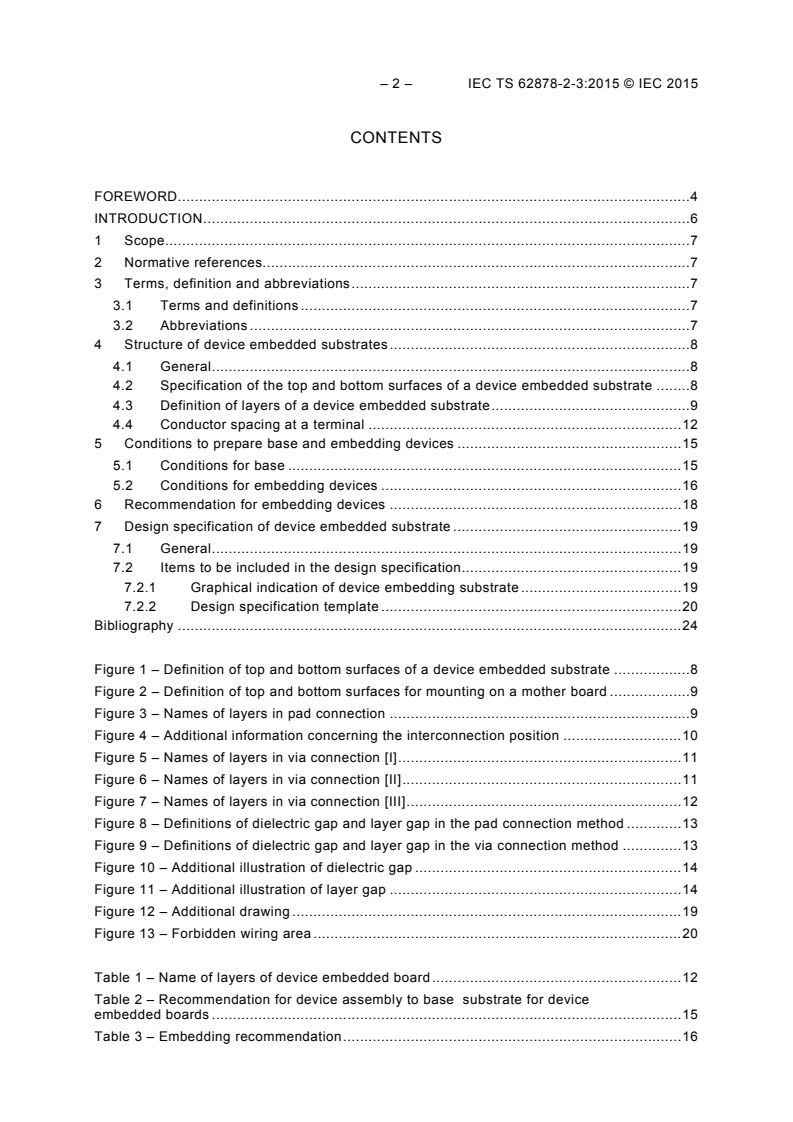
CONTENTS
FOREWORD . 4
INTRODUCTION . 6
1 Scope . 7
2 Normative references. 7
3 Terms, definition and abbreviations . 7
3.1 Terms and definitions . 7
3.2 Abbreviations . 7
4 Structure of device embedded substrates . 8
4.1 General . 8
4.2 Specification of the top and bottom surfaces of a device embedded substrate . 8
4.3 Definition of layers of a device embedded substrate . 9
4.4 Conductor spacing at a terminal . 12
5 Conditions to prepare base and embedding devices . 15
5.1 Conditions for base . 15
5.2 Conditions for embedding devices . 16
6 Recommendation for embedding devices . 18
7 Design specification of device embedded substrate . 19
7.1 General . 19
7.2 Items to be included in the design specification . 19
7.2.1 Graphical indication of device embedding substrate . 19
7.2.2 Design specification template . 20
Bibliography . 24
Figure 1 – Definition of top and bottom surfaces of a device embedded substrate . 8
Figure 2 – Definition of top and bottom surfaces for mounting on a mother board . 9
Figure 3 – Names of layers in pad connection . 9
Figure 4 – Additional information concerning the interconnection position . 10
Figure 5 – Names of layers in via connection [I] . 11
Figure 6 – Names of layers in via connection [II] . 11
Figure 7 – Names of layers in via connection [III] . 12
Figure 8 – Definitions of dielectric gap and layer gap in the pad connection method . 13
Figure 9 – Definitions of dielectric gap and layer gap in the via connection method . 13
Figure 10 – Additional illustration of dielectric gap . 14
Figure 11 – Additional illustration of layer gap . 14
Figure 12 – Additional drawing . 19
Figure 13 – Forbidden wiring area . 20
Table 1 – Name of layers of device embedded board . 12
Table 2 – Recommendation for device assembly to base substrate for device
embedded boards . 15
Table 3 – Embedding recommendation . 16
– 3 – IEC TS 62878-2-3:2015 © IEC 2015
Table 4 – Mounting methods of semiconductor devices . 17
Table 5 – Embedding device . 18
Table 6 – Specification of device embedded substrate 1 . 21
Table 7 – Specification of device embedded substrate 2 . 22
Table 8 – Specification of device embedded substrate 3 . 23
– 4 – IEC TS 62878-2-3:2015 © IEC 2015
INTERNATIONAL ELECTROTECHNICAL COMMISSION
____________
DEVICE EMBEDDED SUBSTRATE –
Part 2-3: Guidelines – Design guide
FOREWORD
1) The International Electrotechnical Commission (IEC) is a worldwide organization for standardization comprising
all national electrotechnical committees (IEC National Committees). The object of IEC is to promote
international co-operation on all questions concerning standardization in the electrical and electronic fields. To
this end and in addition to other activities, IEC publishes International Standards, Technical Specifications,
Technical Reports, Publicly Available Specifications (PAS) and Guides (hereafter referred to as “IEC
Publication(s)”). Their preparation is entrusted to technical committees; any IEC National Committee interested
in the subject dealt with may participate in this preparatory work. International, governmental and non-
governmental organizations liaising with the IEC also participate in this preparation. IEC collaborates closely
with the International Organization for Standardization (ISO) in accordance with conditions determined by
agreement between the two organizations.
2) The formal decisions or agreements of IEC on technical matters express, as nearly as possible, an international
consensus of opinion on the relevant subjects since each technical committee has representation from all
interested IEC National Committees.
3) IEC Publications have the form of recommendations for international use and are accepted by IEC National
Committees in that sense. While all reasonable efforts are made to ensure that the technical content of IEC
Publications is accurate, IEC cannot be held responsible for the way in which they are used or for any
misinterpretation by any end user.
4) In order to promote international uniformity, IEC National Committees undertake to apply IEC Publications
transparently to the maximum extent possible in their national and regional publications. Any divergence
between any IEC Publication and the corresponding national or regional publication shall be clearly indicated in
the latter.
5) IEC itself does not provide any attestation of conformity. Independent certification bodies provide conformity
assessment services and, in some areas, access to IEC marks of conformity. IEC is not responsible for any
services carried out by independent certification bodies.
6) All users should ensure that they have the latest edition of this publication.
7) No liability shall attach to IEC or its directors, employees, servants or agents including individual experts and
members of its technical committees and IEC National Committees for any personal injury, property damage or
other damage of any nature whatsoever, whether direct or indirect, or for costs (including legal fees) and
expenses arising out of the publication, use of, or reliance upon, this IEC Publication or any other IEC
Publications.
8) Attention is drawn to the Normative references cited in this publication. Use of the referenced publications is
indispensable for the correct application of this publication.
9) Attention is drawn to the possibility that some of the elements of this IEC Publication may be the subject of
patent rights. IEC shall not be held responsible for identifying any or all such patent rights.
The main task of IEC technical committees is to prepare International Standards. In
exceptional circumstances, a technical committee may propose the publication of a Technical
Specification when
• the required support cannot be obtained for the publication of an International Standard,
despite repeated efforts, or
• the subject is still under technical development or where, for any other reason, there is the
future but no immediate possibility of an agreement on an International Standard.
Technical Specifications are subject to review within three years of publication to decide
whether they can be transformed into International Standards.
IEC TS 62878-2-3, which is a Technical Specification, has been prepared by IEC technical
committee 91: Electronics assembly technology.
– 5 – IEC TS 62878-2-3:2015 © IEC 2015
The text of this Technical Specification is based on the following documents:
Enquiry draft Report on voting
91/1143/DTS 91/1164A/RVC
Full information on the voting for the approval of this Technical Specification can be found in
the report on voting indicated in the above table.
A list of all parts in the IEC 62878 series, published under the general title Device embedded
substrate, can be found on the IEC website.
This publication has been drafted in accordance with the ISO/IEC Directives, Part 2.
The committee has decided that the contents of this publication will remain unchanged until
the stability date indicated on the IEC website under "http://webstore.iec.ch" in the data
related to the specific publication. At this date, the publication will be
• transformed into an International standard,
• reconfirmed,
• withdrawn,
• replaced by a revised edition, or
• amended.
IMPORTANT – The 'colour inside' logo on the cover page of this publication indicates
that it contains colours which are considered to be useful for the correct
understanding of its contents. Users should therefore print this document using a
colour printer.
– 6 – IEC TS 62878-2-3:2015 © IEC 2015
INTRODUCTION
This part of IEC 62878 provides guidance with respect to device embedded substrate,
fabricated by embedding discrete active and passive electronic devices into one or multiple
inner layers of a substrate with electric connections by means of vias, conductor plating,
conductive paste, and printing. Within the IEC 62878 series,
• IEC 62878-1-1 specifies the test methods,
• IEC TS 62878-2-1 gives a general description of the technology,
• IEC TS 62878-2-3, provides guidance on design, and
• IEC TS 62878-2-4 specifies the test element groups.
The device embedded substrate may be used as a substrate to mount SMDs to form
electronic circuits, as conductor and insulator layers may be formed after embedding
electronic devices.
The purpose of the IEC 62878 series is to achieve a common understanding with respect to
structures, test methods, design and fabrication processes and the use of the device
embedded substrate in industry.
– 7 – IEC TS 62878-2-3:2015 © IEC 2015
DEVICE EMBEDDED SUBSTRATE –
Part 2-3: Guidelines – Design guide
1 Scope
This part of IEC 62878 describes the design guide of device embedded substrates.
The design guide of device embedded substrate is essentially the same as that of various
electronic circuit boards. This part of IEC 62878 enables a thorough understanding of circuit
design, structure design, board design, board manufacturing, jisso (assembly processes) and
tests of products.
This part of IEC 62878 is applicable to device embedded substrates fabricated by use of
organic base material, which include for example active or passive devices, discrete
components formed in the fabrication process of electronic wiring board, and sheet formed
components.
The IEC 62878 series neither applies to the re-distribution layer (RDL) nor to the electronic
modules defined as an M-type business model in IEC 62421.
2 Normative references
The following documents, in whole or in part, are normatively referenced in this document and
are indispensable for its application. For dated references, only the edition cited applies. For
undated references, the latest edition of the referenced document (including any
amendments) applies.
IEC 60194, Printed board design, manufacture and assembly – Terms and definitions
3 Terms, definition and abbreviations
3.1 Terms and definitions
For the purposes of this document, the terms and definitions given in IEC 60194 apply.
3.2 Abbreviations
AABUS as agreed between user and supplier
BGA ball grid array
IPD integrated passive device
LGA land grid array
LSI large scale integration
MEMS micro electro mechanical systems
OSP organic solderability preservative
SMD surface mount device
TAB tape automated bonding
WLP wafer level package
– 8 – IEC TS 62878-2-3:2015 © IEC 2015
4 Structure of device embedded substrates
4.1 General
The name of each part of a device embedded substrate is specified in Clause 4 to assist
technical understanding of the structure and to avoid misinterpretation by engineers working
in the relevant industry sectors.
4.2 Specification of the top and bottom surfaces of a device embedded substrate
The definition of the top and bottom surfaces of a device embedded substrate depends on the
number of devices mounted on the surface of the substrate, as shown in Figure 1. The
surface on which more components are mounted is the top surface. If a substrate is mounted
on a printed wiring board (hereafter referred to as mother board), the surface of the substrate
connecting to the wiring board is defined as the bottom surface even if it contains more
input/output terminals (pads) (see Figure 2). If the design of the top and bottom surfaces has
been AABUS, this agreement takes priority, even if it differs from the definition stated in this
part of IEC 62878.
IEC
Figure 1 – Definition of top and bottom surfaces of a device embedded substrate
– 9 – IEC TS 62878-2-3:2015 © IEC 2015
IEC
Figure 2 – Definition of top and bottom surfaces for mounting on a mother board
4.3 Definition of layers of a device embedded substrate
Names and symbols of layers in a device embedded board are illustrated in Figure 3. Each
layer is numbered as L1, L2 to L6 (in case of 6 layers) from the top surface. The number
indicates the order of the layer with respect to the top surface.
C
A
L1
L2
L3
B
L4
L5
L6
IEC
D
Key
A Embedded component C Top surface
B Base D Bottom surface
Figure 3 – Names of layers in pad connection
In the case of via connection, the position of connecting terminals of the embedded device is
different from the surrounding layer number. The component symbol and connecting
position(s) are defined as illustrated in Figure 4 in order to clarify the interconnecting
positions of the embedded device and of its electrical terminals with respect to construction
design, pattern design, board fabrication and jisso (assembly).
It is recommended to use the component symbols and names as shown in a circuit diagram to
use 2 to 4 indications. The position of interconnection in the case of die-bonding or mounting
– 10 – IEC TS 62878-2-3:2015 © IEC 2015
of a device embedded device may be expressed using another name in addition to the name
of the layer in which the device is embedded.
The surface of a device is upward facing. Use upward (U) when connecting terminals are in
the upward facing surface, and downward (D) when the terminals are in the downward facing
surface.
A three digit number is used if multiple components are embedded and/or multiple connection
terminals are in the same layer. The left side number indicates the interconnecting layer
number and the right side number indicates the layer position of the embedded component. If
there are multiple layers involved, numbers 1, 2 indicate the layers from the top for upward
and numbers 1, 2 indicate the layers from the bottom for downward. The second number may
be omitted if there is only one embedded component in a layer. See the example in Figure 4.
Figure 4 shows additional information on the interconnection position. The active device is
mounted on the L2 layer and connected to the first layer with upward direction. In this case
the name of the interconnection layer is expressed as L2-U11. The last digit 1 indicates the
number of the embedded component. Passive components mounted on the L5 layer are
connected to L6 with downward direction. In this case, the name of the interconnection layer
is expressed as L5-D61.
A virtual layer is used as a virtual conductor layer and as the connecting points. The terminal
connection design of an embedded device is carried out by first establishing the connection
and hole machining data A and B, then the connection and hole machining data C and D for
L2 and L5 (in the case of the above structure). The terminal setting may be omitted if a via
connection and the positions of embedded device terminals and the conduction layer are the
same.
H
J
B
A
E
L1
F=L2-U11
L2
L3
D
L4
L5
G=L5-D61
L6
C
B
K
I
IEC
A Embedded active device G Name of the layer between L5 and L6
B Connecting terminal H Connection and machining data from L1 to a
virtual layer (L2-U11)
C Embedded passive device I Connection and machining data from L6 to a
virtual layer (L5-D61)
D Base J Connection and machining data from L1 to
L2
E Terminal position K Connection and machining data from L6 to
L5
F Name of the layer between L1 and L2
Figure 4 – Additional information concerning the interconnection position
Figure 5 shows the interconnection position. Active device (xxxx) is mounted on the L2 layer
and connected to the first layer with upward direction. In this case, the name of the
interconnection position is expressed as xxxx-L2-U11. Passive components (yyyy) mounted
– 11 – IEC TS 62878-2-3:2015 © IEC 2015
on the L5 layer are connected to L6 with downward direction. In this case, the name of the
interconnection position is expressed as yyyy-L5-D61.
A
L1
L2-U11
L2
L3
C
L4
L5
L5-D61
L6
B
IEC
A Embedded active device C Base
B Embedded passive device
Figure 5 – Names of layers in via connection [I]
Figure 6 shows a chip-stacked case. Active device 2 (xxx2) is mounted on the L2 layer and
active device 1 (xxx1) is stacked on active device 2. Both are connected to the L1 layer with
upward direction. In this case the name of the interconnection position of active device 2 is
expressed as xxx2-L2-U122. The name of the interconnection position of active device 1 is
expressed as xxx1-L2-U121. The second digit from the right (2) shows the number of the
embedded device.
A
B
L1
L2-U121
L2-U122
L2
L3
D
L4
L5
L5-D61
L6
C
IEC
A Embedded active device 1 C Embedded passive device
B Embedded active device 2 D Base
Figure 6 – Names of layers in via connection [II]
Figure 7 shows the interconnection position of an active device having multilayer connecting
pads. Active device (xxxx) is mounted and connected to the L5 layer and pads on the other
side are connected to the L1 layer with upward direction. Therefore, in this case, the name of
the interconnection position of the active device is expressed as xxxx-L5-U11.
– 12 – IEC TS 62878-2-3:2015 © IEC 2015
IEC
A Embedded active device
B Base
C Conductor layer in embedding layer
Figure 7 – Names of layers in via connection [III]
The content of Figure 4 toFigure 7 is summarized in Table 1.
Table 1 – Name of layers of device embedded board
Embedded device Embedding and connection of embedded device
No. of
Example
Component Terminal
components
Device Layer Layer
number direction
No. Layer
Active - A12 - L2 - U 1 1 Omit
Figure 4
Passive - 1 - L5 - D 6 1 Omit
Active - A13 - L2 - U 1 1 Omit
Figure 5
Passive - 2 - L5 - D 6 1 Omit
Active - A13 - L2 - U 1 2 1
IPD - 4 - L2 - U 1 2 2
Figure 6
Capacit - 1 - L5 - D 6 1 Omit
or
- 12 - L2 - U 1 1 Omit
IPD,
Figure 7
etc.
- B1 - L6 - D 6 1 Omit
Information on embedded components is necessary in embedded board design.
For example, in Figure 4 the interconnection position of active device A12 is expressed as A12-L2-U11.
4.4 Conductor spacing at a terminal
Subclause 4.4 defines the insulation layer thickness, the conductor spacing and the distance
between electrode and conductor spacing at a terminal. Conductor spacing is hereafter
referred to as electrode.
The insulation layer thickness and the distance between each conductive layer are defined
with respect to the position of each layer, as follows:
a) The insulation layer thickness is defined as the layer separating the conductors. The
thickness is not the thickness of each layer to be laminated but the thickness of the actual
insulation layer of the substrate.
b) The conductor spacing is defined as the distance between conductors formed on one layer.
c) The spacing between the electrode and conductor is the thickness of the insulator
between the terminals of the embedding device and the conductor layer to be connected.
– 13 – IEC TS 62878-2-3:2015 © IEC 2015
d) The following terms are used to indicate each distance:
1) insulation layer thickness DG1 (dielectric gap);
2) spacing between conductor layers LG1 (layer gap);
3) spacing between terminal and conductor EG11 (device embedding gap).
The number used in the indication is the number of layers. The left number in 3) designates
the conductor layer and the number on the right shows the step (first, second, etc.) of multi-
device embedding into the substrate. See 4.3 for the definition of steps (layers).
Figure 8 and Figure 9 show definition of layers of a device embedded substrate for pad and
via connections. Additional remarks are added to Figure 10 and Figure 11 for dielectric gap,
layer gap and device embedding gap.
TTTererermmmiiinalnalnal EEEmmmbebebedded devdded devdded deviiiccceee
L1L1L1
LGLGLG111
DGDGDG111
L2L2L2
LGLGLG222
DGDGDG222
L3L3L3
LGLGLG333 DGDGDG333
L4L4L4
DGDGDG444
LGLGLG444
L5L5L5
DGDGDG555
LGLGLG555
L6L6L6
IEC
Figure 8 – Definitions of dielectric gap and layer gap in the pad connection method
IEC
Figure 9 – Definitions of dielectric gap and layer gap in the via connection method
– 14 – IEC TS 62878-2-3:2015 © IEC 2015
Figure 10 indicates structure of insulation layer prior to the lamination. The active device is
embedded in the insulation layer DG1. DG51 indicates the minimum thickness of the
insulation layer in DG5.
IEC
Figure 10 – Additional illustration of dielectric gap
Figure 11 shows conductor gap and electrode/connector gap. EG11 indicates the insulation
gap between non-attached pads of the embedded active device to the conductor of the outer-
layer. EG41 indicates the insulation gap between L4 and L5.
IEC
Figure 11 – Additional illustration of layer gap
– 15 – IEC TS 62878-2-3:2015 © IEC 2015
5 Conditions to prepare base and embedding devices
5.1 Conditions for base
Base board and assembly conditions are given in Table 2.
Table 2 – Recommendation for device assembly to base
substrate for device embedded boards
Item Condition Remarks
Base Base material Organic: FR-4, FR-5, BT resin, polyimide, PPE, Copper foil carrier,
PTFE metal heat fin for
heat radiation, film
Board structure Single sided, double sided, multilayer, build-up
type carrier,
multilayer, single-sided flexible, double-sided
silicon interposer
flexible, multilayer flexible, electronic circuit
substrate
Number of layers 1 layer, 2 layers, …, arbitrary number of layers
Copper foil
5 µm, 9 µm, 12 µm, 18 µm, 35 µm, 70 µm
Insulator > 10 µm
Maximum size Variable based on
610 mm × 510 mm
the capability of
Minimum size 340 mm × 250 mm
die bonder and/or
chip mounter
Embedded layer Insulation material Prepreg such as FR-4, FR-5, BT resin, A cut-off may be
polyimide, PPE, PTFE (B stage type) required for a thick
embedding device
Resin such as FR-4, FR-5, BT resin, polyimide,
etc.
Sealing resin used for semiconductor packages
Others
Number of layers 1 layer, 2 layers, …, arbitrary number of layers
Copper foil 5 µm, 9 µm, 12 µm, 18 µm, 35 µm, 70 µm
Board size Depends on the base size
Condition Die bonder A carrier may be
Maximum: 330 mm × 250 mm × 2,5 mm
necessary if the
Minimum: 50 mm × 50 mm × 0,5 mm
thickness is less
than 0,3 mm
Mounter
Maximum: 510 mm × 460 mm × 4,0 mm
Minimum: 50 mm × 50 mm × 0,3 mm
Fiducial mark Fiducial mark shall be in accordance with
customers' process capabilities
Position accuracy To be agreed by customer based materials and
process capabilities
Condition for Die bonder
Maximum: 25 mm × 25 mm × 0,5 mm
sheet components
Minimum: 0,25 mm × 0,25 mm × 0,1 mm
Mounter
Maximum: 24 mm × 24 mm × 6,5 mm
Minimum: 0,4 mm × 0,2 mm × 0,12 mm
Thermal resistance Withstand for 120 min at 180 °C
Resistance to 3 MPa to 4 MPa
pressure
Resistance to To be agreed by customer based materials and
chemical solvent process capabilities
The above assembly recommendations are for reference purposes for the committee drafting the standard for
device embedding substrate. Actual recommendations shall be AABUS.
Pad bonding Via bonding
– 16 – IEC TS 62878-2-3:2015 © IEC 2015
5.2 Conditions for embedding devices
Work panel size, panel thickness and embedding condition are shown in Table 3 when
automatic device embedding equipment is used.
Table 3 – Embedding recommendation
Assembly Device Connection Direction Panel size Thickness Fiducial
a
(to mm mm
mark
embedded
Max. Min. Max. Min.
terminals)
WB 267×90 90×15 0,9 0,1 ―
Die
Bare die Up
bonding
TAB ― ― ― ― ―
US 330×250 50×50 2,5 0,5 *1
330×250 50×50 2,5 0,5 *1
C4 *4
4,0 0,3 *2
510×460 50×50
GBS
Mounting Bare die FC Down
ESC,
ESC5
330×250 50×50 2,5 0,5 *1
ACF(P)
NCF(P)
Others ― ― ― ― ―
WLP
Reflow
Down
Rectangular
Resin
chip
bonding
Mounting 4,0 0,3 *2
510×460 50×50
Rod ―
Module
Reflow Down
MEMS
Bare die
Die
310×215 50×30 3,0 0,1 *3
bonding
WLP
Copper
plating
Mounting Rectangular
Up
Conductive
chip
paste
4,0 0,3 *2
510×460 50×50
Module
MEMS
The above assembly recommendations are for reference purposes for the committee drafting the standard for
device embedded substrate. Actual recommendations shall be AABUS.
NOTE *4 (C4): on upper layer for terminal pitch ≧ 0,3 mm, on lower layer for terminal pitch > 0.3 mm.
a
Size and shape of fiducial mark:
Size — *1: 0,25 mm to 0,8 mm; *2: 0,5 mm to 1.6 mm; *3: 0,2 mm to 1,6 mm
Shape — circle, cross, square
– 17 – IEC TS 62878-2-3:2015 © IEC 2015
Table 4 shows the embedding methods of semiconductor devices and electronic devices.
Table 4 – Mounting methods of semiconductor devices
Method Schematic diagram Abbrevi- Name Explanation
ation
Metal US Ultra sonic Ultrasonic energy is applied
UUllttrrasasound cound cononnecnecttiionon
UUndernderffiillll
bonding bonding between semiconductor
terminal (bump) and board
electrode to metal bond and
then underfill thermosetting
resin for mechanical
reinforcement. Gold is often
used for the bumps and
connecting pads of the
board.
C4 Controlled Reflow solder bumps LSI
Solder bump, reflow soldering
collapse chip with high temperature solder
connection and underfill resin after
cleaning the joints. Solder
pre-coat, gold plating, OSP
are used.
GBS Gold bump LSI with Au bumps are
AAu bumu bump,p, r refefllowow ssololderderiingng
soldering pressed to board with solder
pre-coated pads and heated
to bond the junctions, then
underfill to mechanical
reinforcement curing
ESC5 Epoxy Use solder powder mixed
RResesiin wn wiitth sh sololderder po powwderder
thermosetting adhesive and
encapsulated
solder press and heat to bond the
connection 5th device to board. Gold plating
or OSP are used for the pads
of board.
ESC Epoxy Thermosetting resin is used
AAu bumu bump,p, s sololderder pr pree--ccoatoat
encapsulated between LSI bumps and
solder solder pre-coated board
connection pads. Press and heat to
establish electrical
interconnection.
Compression NCF (P) Non conductive Thermosetting resin is used
AAu bumu bump prp presesssed ced conneconnecttiionon
bonding film (paste) between LSI Au bumps and
board pads. Press and heat
to establish electrical
interconnection. Gold plating
is usually used for pads on
board.
RResesiin wn wiitth ch conduconducttiivve e
ACF (P) Anisotropic Thermosetting resin mixed
mmeettalal powpowderder
conductive film with conductive powder is
(paste) applied to the connecting
electrodes and then pressed
and heated to obtain
electrical connection. Au
plating is usually used for
pads on board.
Reflow — Soldering Bonding by reflow soldering.
SSololderder pas pastte re refefllooww
It is necessary to wash out
all flux used in reflow
soldering.
Pad bonding Via bonding
– 18 – IEC TS 62878-2-3:2015 © IEC 2015
Method Schematic diagram Initial Name Explanation
— Solder-resin Use solder powder mixed
RResesiin wn wiitth sh sololderder po powwderder
bonding adhesive and reflow to bond
the device to board.
Resin
RResesiin wn wiitth h — Conductive Use conductive thermosetting
adhesive bonding adhesive and cure the resin
cconduconducttiivve pe powowderder
after mounting a device on a
board to attain electrical
conduction
6 Recommendation for embedding devices
Conditions for embedding device are given in Table 5 and shall be AABUS in actual
application.
Table 5 – Embedding device
Assembly Device Connection Component size
Terminal
(l×w×h)
direction (to
mm
mounting
face)
max. min.
WB Up 25×25×0,5 0,25×0,25×0,1
Die
Bare die
bonding
TAB Up
US Down 10×10×0,5 3,0×3,0×0,1
C4 *4 Down
GBS Down
Mounting Bare die FC
ESC, ESC5 Down 20×20×0,5 1,0×1,0×0,1
ACF(P) Down
NCF(P) Down
Others Down
Reflow
WLP Down 24×24×6,5 0,4×0,2×0,12
Resin bonding
Rectangular Reflow
Down
62×45 0,4×0,2
Resin bonding
Mounting
Rod Reflow
― 62×45 16×08
Resin bonding
Module
Reflow Down
24×24×6,5 0,4×0,2×0,12
MEMS
Copper plating
Bare die Up 25×25×0,5 0,25×0,25×0,1
Conductive paste
Die
bonding
Copper plating
WLP Up 25×25×0,5 0,25×0,25×0,1
Conductive paste
Copper plating
Mounting Rectangular Up
62×45 0,4×0,2
Conductive paste
The above assembly recommendations are for reference purposes for the committee drafting the standard for
device embedded substrate. Actual recommendations shall be AABUS.
– 19 – IEC TS 62878-2-3:2015 © IEC 2015
7 Design specification of device embedded substrate
7.1 General
In general, the term “design” has broad meanings. In order to avoid misunderstanding and
confusion, it is recommended to include the follow items in the design specification:
a) circuit design;
b) structure design;
c) device embedding board design;
d) circuit pattern design.
7.2 Items to be included in the design specification
7.2.1 Graphical indication of device embedding substrate
The following indications shall be stated:
a) Indication of external form of device embedded substrate, of design drawing and of CAD
data is as follows. A perspective drawing seen from the top or bottom surface is used.
State if the drawing is seen from top or bottom.
Example: A top perspective or bottom perspective drawing is shown in Figure 12.
It is recommended to clarify the position of the relevant layer in the cross section drawing.
PPererssppececttiivve ve viiewew f frromom t toop (p (LL1)1)
[[LL11]]
L1L1L1
L2L2L2---U1U1U1111
[[LL22]]
L2L2L2
[[LL33]]
L3L3L3
L4L4L4
[[LL44]]
L5L5L5
[[LL55]]
L5L5L5---D6D6D6111
L6L6L6
[[LL66]]
IEC
Figure 12 – Additional drawing
b) List of parts of device embedded substrate and items to be stated:
1) device name, device number, name of manufacturer;
2) possibility of embedding (if not possible, embedding inside of substrate or surface
mounting, etc.);
3) table of parts of device embedded substrate and its structure.
c) Organization and structure of device embedded substrate:
1) entire organization and structure of device embedded substrate;
2) number of layers and types of electronic circuit board;
3) thickness of each conductor layer (copper foil + copper plating, etc.);
4) distance between insulating layers, and between the conductor and insulating layers;
– 20 – IEC TS 62878-2-3:2015 © IEC 2015
5) position of layer where device is to be embedded;
6) forbidden area(s) for wiring in each layer as illustrated in Figure 13;
7) thickness of the layer to embedded device(s).
d) Specification of device embedded substrate:
1) size and thickness of the substrate;
2) treatment to the surface where the device is not embedded (embedding on one side
only);
3) methods of embedding and connection to the device;
4) surface treatment to conductor surface (solder flux, gold plating, etc.).
e) Embedding:
1) die bonding;
2) methods of mounting and interconnection;
3) special treatment:
• underfill;
• resin mold;
• potting;
• others.
IEC
Figure 13 – Forbidden wiring area
f) Specification of device embedding:
1) embedding (resin embedding, stacking, etc.);
2) embedding material (resin, prepreg, etc.);
3) embedding conditions (heating, temperature, pressure, etc.);
4) mechanical loading condition.
Embedding condition shall be AABUS.
g) Design specification of electronic circuit board (pattern design).
The design principle of conductor gap, via diameter, via land diameter, etc. is basically the
same as for regular PWB. Details of design specification are to be AABUS.
7.2.2 Design specification template
Table 6 to Table 8 show the template of a design specification.
Table 6 is an example of a specification of a device embedded substrate.
– 21 – IEC TS 62878-2-3:2015 © IEC 2015
Table 6 – Specification of device embedded substrate 1
List of embedded devices
No. Device Name Device # Manufacturer Manufacturer Specification of Remarks
embedding device
Shall Yes No Or
Case 1 Memory
D-RAM MIC-002 TM-DRAM02 T ○
IC
Case 2 Stacked Chip C
CC-003 CCK-5V10 M ○
capacitor
Case 3 Stacked Electrolytic Low heat
DC-004 DCK-5V200 P ○
capacitor C resistance
Device embedded substrate – Construction and structure
Layer # 6 Base 4 Device
Dielectric
Layer and its thickness Layer gap embedded
gap
Type Build-up layer
gap
Embe
Conductor
N° dding
Embedding layer L2、L5
µm
layer
Lay t t t
Name Name Name
er µm µm µm
Construction and structure
Copper Copper
foil plating
- - - - - -
1 L1 12 20 -
DG1 138 LG1 100 EG11 40
2 L2 18 20 ○
DG2 73 LG2 40 - -
3 L3 18 15 -
DG3 80 LG3 80 - -
4 L4 18 15 -
DG4 73 LG4 40 EG41 40
5 L5 18 20 ○
DG-5 138 LG5 100 EG61 40
NOTE Magnifications are
different for vertical and 6 L6 12 20 -
- - - - - -
horizontal directions.
Substrate thickness (exclude solder resist)
0,57
mm
Table 7and Table 8 are examples of specifications of device embedded substrate
– 22 – IEC TS 62878-2-3:2015 © IEC 2015
Table 7 – Specification of device embedded substrate 2
Specification of device embedded substrate
Placement of embedded device and condition NO Item Specification
1 Device Layers 4 layers
FFididuucciaial ml maarrkk
SSpecpeciiffiiccatatiionon
embedded
ofof eaeacch sh seeccttiionon
Size
W: 250 mm × L: 320 mm
ofof eaeacch sh seeccttiionon
substrate
Thickness t = 0,2 mm
2 Embedding surface Double/single side
3 Treatment of back □ with pattern formation
surface
□ without pattern
in single-side embedding
formation
4 Embedding method □ Die bonding
□ Mounting
□ Others
5 Interconnection □ Via connection (Cu
plating)
□ Cu plating
□ Conductive paste
□ Others
FFididuucciaial ml maarrkk
□ Pad connection
FFororbibiddedden arn areea a
ofof t thhe se sheetheet FFididuucciaial hl hoolele
□ Cu plating
ffoorr as asssememblblyy
□ Conductive paste
□ Others
□ Others
6 Solder resist □ Yes □ No
7 Surface treatment □ Flux
□ Anti-rust treatment
□ Other
8 Reference hole □ Yes □ No
9 Fiducial mark □ Yes □ No
10 Bending after ±0,5
embedding %
11 Others
– 23 – IEC TS 62878-2-3:2015 © IEC 2015
Table 8 – Specification of device embedded substrate 3
Specification of device embedded substrate
Construction of device embedding and condition No. Item Specification
1 Structure 1 Assembly □ Die bonding
□ Adhesives
□ Others
□ Mounting
□ Soldering
□ Conductive paste
□ Others
□ Special
...