

IEC 62563-2:2021
(Main)Medical electrical equipment - Medical image display systems - Part 2: Acceptance and constancy tests for medical image displays
General Information
- Abstract
IEC 62563-2:2021 establishes the performance CRITERIA and test frequencies for the ACCEPTANCE TESTS and CONSTANCY TESTS. The evaluation methods are defined in IEC 62563-1. The scope of this document is directed to practical tests that can be visually evaluated or measured using basic test equipment. This document applies to medical IMAGE DISPLAY SYSTEMS, which can display monochrome image information in the form of greyscale values on colour and greyscale IMAGE DISPLAY SYSTEMS. This document does not apply to information displays and to displays used solely for control of technical settings of all medical information.
- Status
- Published
- Publication Date
- 09-Nov-2021
- Technical Committee
- SC 62B - Medical imaging equipment, software, and systems
- Drafting Committee
- WG 51 - TC 62/SC 62B/WG 51
- Current Stage
- PPUB - Publication issued
- Start Date
- 10-Nov-2021
- Completion Date
- 19-Nov-2021
Overview
IEC 62563-2:2021 is an international standard developed by the International Electrotechnical Commission (IEC) focused on medical electrical equipment, specifically medical image display systems. This part 2 document establishes the acceptance and constancy tests for medical image displays, defining performance criteria and recommended test frequencies. It complements IEC 62563-1, which specifies the evaluation methods for these tests.
The scope covers image display systems that present monochrome (greyscale) image information, whether on monochrome or color displays. Importantly, it excludes displays used solely for technical control settings or simple information displays.
This standard supports healthcare providers and equipment installers by offering practical test procedures that can be performed onsite using basic test equipment or visual assessment to ensure display system quality and reliability.
Key Topics
Acceptance Tests
- Performed on medical image display systems after installation or major modifications
- Verify compliance with image quality and performance standards before clinical use
- Include visual and quantitative evaluation items with clear acceptance criteria
Constancy Tests
- Conducted periodically to monitor performance stability over time
- Ensure ongoing compliance and detect degradation of medical image displays
- Support proactive maintenance and quality assurance in clinical environments
Performance Criteria
- Define minimum acceptable standards for display luminance, contrast, resolution, and image fidelity
- Enable objective pass/fail decisions during acceptance and constancy testing
Test Frequencies
- Specified intervals for performing constancy tests based on clinical use and display type
- Help maintain consistent image quality for diagnostic accuracy
Visual and Quantitative Testing Methods
- Visual tests assess image parameters that can be reliably evaluated by trained observers
- Quantitative tests use basic measurement tools for physical parameters such as luminance and contrast
Applications
Medical Imaging Facilities
Hospitals, clinics, and diagnostic centers use IEC 62563-2 to ensure that medical image displays deliver high-quality images essential for reliable diagnosis and treatment planning.Installation and Maintenance Teams
Personnel installing or servicing medical imaging equipment employ the standard to perform acceptance checks and routine constancy tests, aligning practices with international standards.Quality Assurance Programs
Clinical engineers and quality managers integrate IEC 62563-2 testing protocols to maintain image display performance, reducing the risk of diagnostic errors due to poor display quality.Regulatory Compliance
Manufacturers and healthcare providers can reference the standard to meet national and international regulatory requirements for medical image display systems, facilitating certification and accreditation.
Related Standards
IEC 62563-1: Specifies detailed evaluation methods, prerequisites, tools, and equipment used to perform acceptance and constancy tests on medical image displays.
IEC 60601 Series: Covers general safety and performance requirements for medical electrical equipment, including certain aspects relevant to display devices.
ISO 13485: Addresses quality management systems for medical devices, complementing technical standards with management process controls.
DICOM Standards: Define medical image formats and communication protocols, often interfacing with display systems which must comply with IEC 62563-2 for output quality.
Keywords: IEC 62563-2, medical image display systems, acceptance test, constancy test, performance criteria, medical electrical equipment, image quality, diagnostic displays, medical imaging standards, display quality assurance, healthcare equipment testing.
Get Certified
Connect with accredited certification bodies for this standard

BSI Group
BSI (British Standards Institution) is the business standards company that helps organizations make excellence a habit.

TÜV Rheinland
TÜV Rheinland is a leading international provider of technical services.

TÜV SÜD
TÜV SÜD is a trusted partner of choice for safety, security and sustainability solutions.
Sponsored listings
Frequently Asked Questions
IEC 62563-2:2021 is a standard published by the International Electrotechnical Commission (IEC). Its full title is "Medical electrical equipment - Medical image display systems - Part 2: Acceptance and constancy tests for medical image displays". This standard covers: IEC 62563-2:2021 establishes the performance CRITERIA and test frequencies for the ACCEPTANCE TESTS and CONSTANCY TESTS. The evaluation methods are defined in IEC 62563-1. The scope of this document is directed to practical tests that can be visually evaluated or measured using basic test equipment. This document applies to medical IMAGE DISPLAY SYSTEMS, which can display monochrome image information in the form of greyscale values on colour and greyscale IMAGE DISPLAY SYSTEMS. This document does not apply to information displays and to displays used solely for control of technical settings of all medical information.
IEC 62563-2:2021 establishes the performance CRITERIA and test frequencies for the ACCEPTANCE TESTS and CONSTANCY TESTS. The evaluation methods are defined in IEC 62563-1. The scope of this document is directed to practical tests that can be visually evaluated or measured using basic test equipment. This document applies to medical IMAGE DISPLAY SYSTEMS, which can display monochrome image information in the form of greyscale values on colour and greyscale IMAGE DISPLAY SYSTEMS. This document does not apply to information displays and to displays used solely for control of technical settings of all medical information.
IEC 62563-2:2021 is classified under the following ICS (International Classification for Standards) categories: 11.040.55 - Diagnostic equipment; 31.120 - Electronic display devices. The ICS classification helps identify the subject area and facilitates finding related standards.
IEC 62563-2:2021 is available in PDF format for immediate download after purchase. The document can be added to your cart and obtained through the secure checkout process. Digital delivery ensures instant access to the complete standard document.
Standards Content (Sample)
IEC 62563-2 ®
Edition 1.0 2021-11
INTERNATIONAL
STANDARD
NORME
INTERNATIONALE
Medical electrical equipment – Medical image display systems –
Part 2: Acceptance and constancy tests for medical image displays
Appareils électromédicaux – Systèmes d’imagerie médicale –
Partie 2: Essais d’acceptation et de constance des systèmes d’imagerie
médicale
All rights reserved. Unless otherwise specified, no part of this publication may be reproduced or utilized in any form
or by any means, electronic or mechanical, including photocopying and microfilm, without permission in writing from
either IEC or IEC's member National Committee in the country of the requester. If you have any questions about IEC
copyright or have an enquiry about obtaining additional rights to this publication, please contact the address below or
your local IEC member National Committee for further information.
Droits de reproduction réservés. Sauf indication contraire, aucune partie de cette publication ne peut être reproduite ni
utilisée sous quelque forme que ce soit et par aucun procédé, électronique ou mécanique, y compris la photocopie et
les microfilms, sans l'accord écrit de l'IEC ou du Comité national de l'IEC du pays du demandeur. Si vous avez des
questions sur le copyright de l'IEC ou si vous désirez obtenir des droits supplémentaires sur cette publication, utilisez
les coordonnées ci-après ou contactez le Comité national de l'IEC de votre pays de résidence.
IEC Central Office Tel.: +41 22 919 02 11
3, rue de Varembé info@iec.ch
CH-1211 Geneva 20 www.iec.ch
Switzerland
About the IEC
The International Electrotechnical Commission (IEC) is the leading global organization that prepares and publishes
International Standards for all electrical, electronic and related technologies.
About IEC publications
The technical content of IEC publications is kept under constant review by the IEC. Please make sure that you have the
latest edition, a corrigendum or an amendment might have been published.
IEC publications search - webstore.iec.ch/advsearchform IEC online collection - oc.iec.ch
The advanced search enables to find IEC publications by a Discover our powerful search engine and read freely all the
variety of criteria (reference number, text, technical publications previews. With a subscription you will always have
committee, …). It also gives information on projects, replaced access to up to date content tailored to your needs.
and withdrawn publications.
Electropedia - www.electropedia.org
IEC Just Published - webstore.iec.ch/justpublished
The world's leading online dictionary on electrotechnology,
Stay up to date on all new IEC publications. Just Published
containing more than 22 000 terminological entries in English
details all new publications released. Available online and once
and French, with equivalent terms in 18 additional languages.
a month by email.
Also known as the International Electrotechnical Vocabulary
(IEV) online.
IEC Customer Service Centre - webstore.iec.ch/csc
If you wish to give us your feedback on this publication or need
further assistance, please contact the Customer Service
Centre: sales@iec.ch.
A propos de l'IEC
La Commission Electrotechnique Internationale (IEC) est la première organisation mondiale qui élabore et publie des
Normes internationales pour tout ce qui a trait à l'électricité, à l'électronique et aux technologies apparentées.
A propos des publications IEC
Le contenu technique des publications IEC est constamment revu. Veuillez vous assurer que vous possédez l’édition la
plus récente, un corrigendum ou amendement peut avoir été publié.
Recherche de publications IEC - Découvrez notre puissant moteur de recherche et consultez
webstore.iec.ch/advsearchform gratuitement tous les aperçus des publications. Avec un
La recherche avancée permet de trouver des publications IEC abonnement, vous aurez toujours accès à un contenu à jour
en utilisant différents critères (numéro de référence, texte, adapté à vos besoins.
comité d’études, …). Elle donne aussi des informations sur les
projets et les publications remplacées ou retirées. Electropedia - www.electropedia.org
Le premier dictionnaire d'électrotechnologie en ligne au monde,
IEC Just Published - webstore.iec.ch/justpublished
avec plus de 22 000 articles terminologiques en anglais et en
Restez informé sur les nouvelles publications IEC. Just
français, ainsi que les termes équivalents dans 16 langues
Published détaille les nouvelles publications parues.
additionnelles. Egalement appelé Vocabulaire
Disponible en ligne et une fois par mois par email.
Electrotechnique International (IEV) en ligne.
Service Clients - webstore.iec.ch/csc
Si vous désirez nous donner des commentaires sur cette
publication ou si vous avez des questions contactez-nous:
sales@iec.ch.
IEC online collection - oc.iec.ch
IEC 62563-2 ®
Edition 1.0 2021-11
INTERNATIONAL
STANDARD
NORME
INTERNATIONALE
Medical electrical equipment – Medical image display systems –
Part 2: Acceptance and constancy tests for medical image displays
Appareils électromédicaux – Systèmes d’imagerie médicale –
Partie 2: Essais d’acceptation et de constance des systèmes d’imagerie
médicale
INTERNATIONAL
ELECTROTECHNICAL
COMMISSION
COMMISSION
ELECTROTECHNIQUE
INTERNATIONALE
ICS 11.040.55; 31.120 ISBN 978-2-8322-1039-8
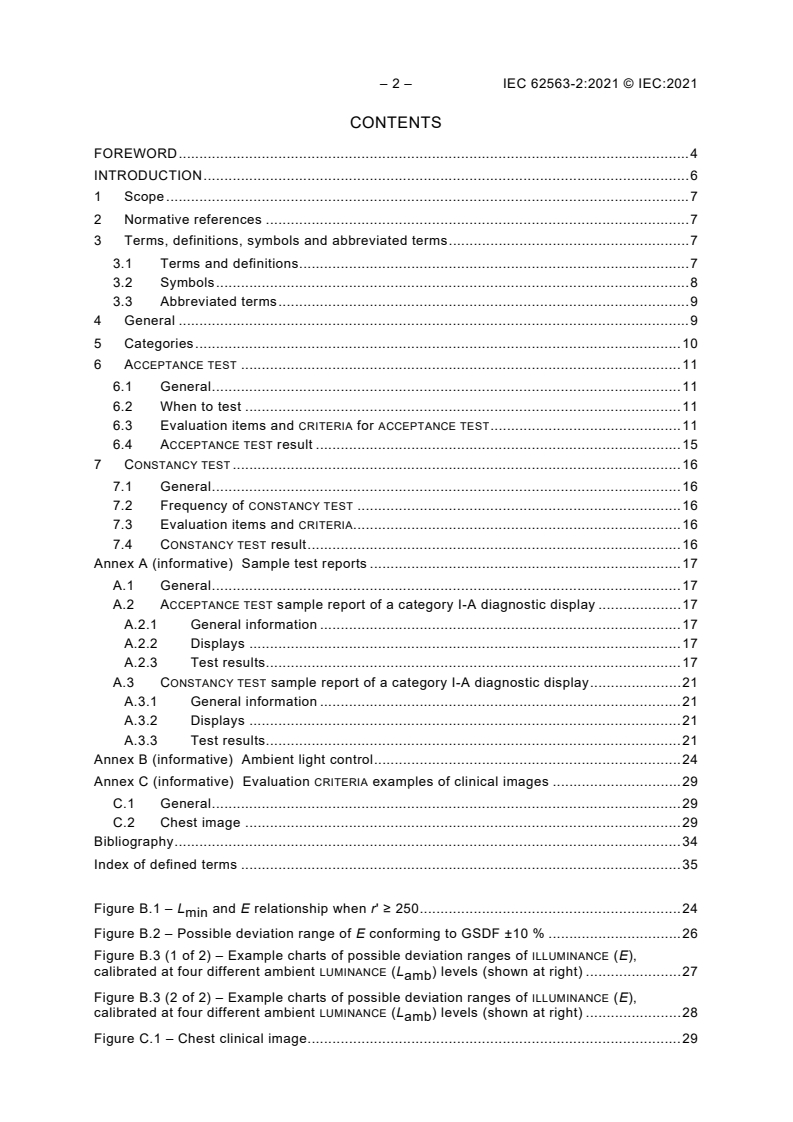
– 2 – IEC 62563-2:2021 © IEC:2021
CONTENTS
FOREWORD . 4
INTRODUCTION . 6
1 Scope . 7
2 Normative references . 7
3 Terms, definitions, symbols and abbreviated terms . 7
3.1 Terms and definitions . 7
3.2 Symbols . 8
3.3 Abbreviated terms . 9
4 General . 9
5 Categories . 10
6 ACCEPTANCE TEST . 11
6.1 General . 11
6.2 When to test . 11
6.3 Evaluation items and CRITERIA for ACCEPTANCE TEST . 11
6.4 ACCEPTANCE TEST result . 15
7 CONSTANCY TEST . 16
7.1 General . 16
7.2 Frequency of CONSTANCY TEST . 16
7.3 Evaluation items and CRITERIA . 16
7.4 CONSTANCY TEST result . 16
Annex A (informative) Sample test reports . 17
A.1 General . 17
A.2 ACCEPTANCE TEST sample report of a category I-A diagnostic display . 17
A.2.1 General information . 17
A.2.2 Displays . 17
A.2.3 Test results. 17
A.3 CONSTANCY TEST sample report of a category I-A diagnostic display . 21
A.3.1 General information . 21
A.3.2 Displays . 21
A.3.3 Test results. 21
Annex B (informative) Ambient light control . 24
Annex C (informative) Evaluation CRITERIA examples of clinical images . 29
C.1 General . 29
C.2 Chest image . 29
Bibliography . 34
Index of defined terms . 35
Figure B.1 – L and E relationship when r' ≥ 250 . 24
min
Figure B.2 – Possible deviation range of E conforming to GSDF ±10 % . 26
Figure B.3 (1 of 2) – Example charts of possible deviation ranges of ILLUMINANCE (E),
calibrated at four different ambient LUMINANCE (L ) levels (shown at right) . 27
amb
Figure B.3 (2 of 2) – Example charts of possible deviation ranges of ILLUMINANCE (E),
calibrated at four different ambient LUMINANCE (L ) levels (shown at right) . 28
amb
Figure C.1 – Chest clinical image . 29
Figure C.2 – Visually sharp reproduction of the vessel from hilum to peripheral area . 30
Figure C.3 – Visibility of vessels under retro-cardiac area and under diaphragm . 30
Figure C.4 – Visually sharp reproduction of trachea and proximal bronchia . 31
Figure C.5 – Distinct reproduction of frame of spine, lateral protrusion, and spinous
process . 31
Figure C.6 – Distinct reproduction of edge of heart . 31
Figure C.7 – Excellent graininess (no artefacts or significant noise) of thorax and
underarm soft tissue . 32
Figure C.8 – Distinct reproduction of the border of rib and peripheral lung, border of
lower edge of lung . 33
Table 1 – Overview to the definitions of physical parameters . 8
Table 2 – Tests and TEST ITEMs for quantitative evaluation . 11
Table 3 – Tests and TEST ITEMs for visual evaluation . 13
Table 4 – Quantitative acceptance and CONSTANCY TESTs . 14
Table 5 – Visual acceptance and CONSTANCY TESTs . 15
– 4 – IEC 62563-2:2021 © IEC:2021
INTERNATIONAL ELECTROTECHNICAL COMMISSION
____________
MEDICAL ELECTRICAL EQUIPMENT –
MEDICAL IMAGE DISPLAY SYSTEMS –
Part 2: Acceptance and constancy tests
for medical image displays
FOREWORD
1) The International Electrotechnical Commission (IEC) is a worldwide organization for standardization comprising
all national electrotechnical committees (IEC National Committees). The object of IEC is to promote international
co-operation on all questions concerning standardization in the electrical and electronic fields. To this end and
in addition to other activities, IEC publishes International Standards, Technical Specifications, Technical Reports,
Publicly Available Specifications (PAS) and Guides (hereafter referred to as “IEC Publication(s)”). Their
preparation is entrusted to technical committees; any IEC National Committee interested in the subject dealt with
may participate in this preparatory work. International, governmental and non-governmental organizations liaising
with the IEC also participate in this preparation. IEC collaborates closely with the International Organization for
Standardization (ISO) in accordance with conditions determined by agreement between the two organizations.
2) The formal decisions or agreements of IEC on technical matters express, as nearly as possible, an international
consensus of opinion on the relevant subjects since each technical committee has representation from all
interested IEC National Committees.
3) IEC Publications have the form of recommendations for international use and are accepted by IEC National
Committees in that sense. While all reasonable efforts are made to ensure that the technical content of IEC
Publications is accurate, IEC cannot be held responsible for the way in which they are used or for any
misinterpretation by any end user.
4) In order to promote international uniformity, IEC National Committees undertake to apply IEC Publications
transparently to the maximum extent possible in their national and regional publications. Any divergence between
any IEC Publication and the corresponding national or regional publication shall be clearly indicated in the latter.
5) IEC itself does not provide any attestation of conformity. Independent certification bodies provide conformity
assessment services and, in some areas, access to IEC marks of conformity. IEC is not responsible for any
services carried out by independent certification bodies.
6) All users should ensure that they have the latest edition of this publication.
7) No liability shall attach to IEC or its directors, employees, servants or agents including individual experts and
members of its technical committees and IEC National Committees for any personal injury, property damage or
other damage of any nature whatsoever, whether direct or indirect, or for costs (including legal fees) and
expenses arising out of the publication, use of, or reliance upon, this IEC Publication or any other IEC
Publications.
8) Attention is drawn to the Normative references cited in this publication. Use of the referenced publications is
indispensable for the correct application of this publication.
9) Attention is drawn to the possibility that some of the elements of this IEC Publication may be the subject of patent
rights. IEC shall not be held responsible for identifying any or all such patent rights.
IEC 62563-2 has been prepared by subcommittee 62B: Diagnostic imaging equipment, of IEC
technical committee 62: Electrical equipment in medical practice.
The text of this International Standard is based on the following documents:
Draft Report on voting
62B/1254/FDIS 62B/1262/RVD
Full information on the voting for its approval can be found in the report on voting indicated in
the above table.
The language used for the development of this International Standard is English.
This document was drafted in accordance with ISO/IEC Directives, Part 2, and developed in
accordance with ISO/IEC Directives, Part 1 and ISO/IEC Directives, IEC Supplement, available
at www.iec.ch/members_experts/refdocs. The main document types developed by IEC are
described in greater detail at www.iec.ch/standardsdev/publications.
In this document, the following print types are used:
– requirements and definitions: roman type;
– informative material appearing outside of tables, such as notes, examples and references: in smaller type.
Normative text of tables is also in a smaller type;
– TERMS DEFINED IN CLAUSE 3 OF THIS INTERNATIONAL STANDARD, OR AS NOTED: SMALL CAPITALS.
A list of all parts in the IEC 62563 series, published under the general title Medical electrical
equipment – Medical image display systems, can be found on the IEC website.
The committee has decided that the contents of this document will remain unchanged until the
stability date indicated on the IEC website under webstore.iec.ch in the data related to the
specific document. At this date, the document will be
• reconfirmed,
• withdrawn,
• replaced by a revised edition, or
• amended.
– 6 – IEC 62563-2:2021 © IEC:2021
INTRODUCTION
This document defines ACCEPTANCE and CONSTANCY TESTS for medical image displays. It defines
TEST ITEMS for the ACCEPTANCE and CONSTANCY TESTS, as well as the performance CRITERIA and
the test frequency for each TEST ITEM, elements of the measurement method related to an image
quality parameter in an IMAGE DISPLAY SYSTEM. The evaluation methods of the TEST ITEMS are
not described in this document; rather, evaluation methods, along with prerequisites, equipment
and tools for the TEST ITEMS, are defined in IEC 62563-1.
ACCEPTANCE and CONSTANCY TESTS are performed on site at the installation facility. An
ACCEPTANCE TEST is carried out after a new IMAGE DISPLAY SYSTEM has been installed or major
modifications have been made to the existing IMAGE DISPLAY SYSTEM. Since an IMAGE DISPLAY
SYSTEM can degrade over time, CONSTANCY TESTS are carried out periodically to verify that the
performance is maintained.
This document describes appropriate TEST ITEMS and CRITERIA that are considered appropriate
as an international standard based on survey of quality control testing standards and guidelines
across the world. Although other existing standards and guidelines have been defined by other
standard organizations and can be given priority over this document, national authorities are
encouraged to adopt or harmonize to this document.
MEDICAL ELECTRICAL EQUIPMENT –
MEDICAL IMAGE DISPLAY SYSTEMS –
Part 2: Acceptance and constancy tests
for medical image displays
1 Scope
This part of IEC 62563 establishes the performance CRITERIA and test frequencies for the
ACCEPTANCE TESTS and CONSTANCY TESTS. The evaluation methods are defined in IEC 62563-1.
The scope of this document is directed to practical tests that can be visually evaluated or
measured using basic test equipment. This document applies to medical IMAGE DISPLAY SYSTEMS,
which can display monochrome image information in the form of greyscale values on colour and
greyscale IMAGE DISPLAY SYSTEMS. This document does not apply to information displays and to
displays used solely for control of technical settings of all medical information.
2 Normative references
The following documents are referred to in the text in such a way that some or all of their content
constitutes requirements of this document. For dated references, only the edition cited applies.
For undated references, the latest edition of the referenced document (including any
amendments) applies.
IEC TR 60788:2004, Medical electrical equipment – Glossary of defined terms
IEC 62563-1:2009, Medical electrical equipment – Medical image display systems – Part 1:
Evaluation methods
IEC 62563-1:2009/AMD1:2016
3 Terms, definitions, symbols and abbreviated terms
3.1 Terms and definitions
For the purposes of this document, the terms and definitions in IEC TR 60788:2004,
IEC 62563-1:2009/AMD1:2016 and the following apply.
ISO and IEC maintain terminological databases for use in standardization at the following
addresses:
• IEC Electropedia: available at http://www.electropedia.org/
• ISO Online browsing platform: available at http://www.iso.org/obp
3.1.1
ACCEPTANCE TEST
test carried out after equipment has been installed or major modifications have been made to
existing equipment to verify compliance with manufacturer's specifications or requirements
3.1.2
CONSTANCY TEST
test carried out to confirm that the functional performance of equipment meets established
CRITERIA and to enable the early recognition of changes in the properties of components of the
equipment
– 8 – IEC 62563-2:2021 © IEC:2021
3.1.3
LUMINANCE STABILIZER
embedded functionality of IMAGE DISPLAY SYSTEM which detects LUMINANCE deviation of light
source by sensor (e.g. at bootup, degradation over time, or temperature change) caused by the
IMAGE DISPLAY SYSTEM characteristics itself or its environments and adjusts light source
LUMINANCE
automatically to stabilize display
3.1.4
CRITERIA
acceptable deviation or limit defined for each test described in this document for the results of
an ACCEPTANCE or a CONSTANCY TEST which signal a conforming performance of the equipment
tested
3.1.5
TEST ITEM
element of the measurement method related to an image quality parameter in an IMAGE DISPLAY
SYSTEM
3.1.6
RESPONSIBLE ORGANIZATION
entity accountable for the use and maintenance of a medical electrical (ME) equipment or a
medical electrical (ME) system
[SOURCE: IEC 60601-1:2005, 3.101]
3.2 Symbols
The symbols of physical parameters described in IEC 62563-1 are listed in Table 1. All
measurements referred to in Table 1 are in the centre of the IMAGE DISPLAY DEVICE; LUMINANCE
can also be measured at other locations according to the methodologies described in this
document.
Table 1 – Overview to the definitions of physical parameters
Symbol Mathematically derived Definition and explanation
L LUMINANCE generated by the ambient light on the surface of an
amb
IMAGE DISPLAY DEVICE when the IMAGE DISPLAY DEVICE is off.
L Minimum LUMINANCE generated by an IMAGE DISPLAY DEVICE at
min
DIGITAL DRIVING LEVEL (DDL) = 0 measured at the centre of the
screen. It includes VEILING GLARE specific to TEST PATTERN used
for measurement. It is measured with ambient light totally
switched off (ambient ILLUMINANCE lower than 5 lux at the face of
the IMAGE DISPLAY).
L Maximum LUMINANCE generated by an IMAGE DISPLAY DEVICE at
max
DIGITAL DRIVING LEVEL (DDL) = max. measured at the centre of the
screen. It includes VEILING GLARE specific to TEST PATTERN used
for measurement. It is measured with ambient light totally
switched off (ambient ILLUMINANCE lower than 5 lux at the face of
the IMAGE DISPLAY).
L′ L + L LUMINANCE that shall be perceived by the human eye at the
min min amb
centre of the screen at DIGITAL DRIVING LEVEL (DDL) = 0. It
contains VEILING GLARE and L .
amb
L + L LUMINANCE produced by the IMAGE DISPLAY DEVICE that shall be
L′
max amb
max
perceived by the human eye at the maximum DIGITAL DRIVING
LEVEL (DDL) measured at the centre of the screen. It contains
VEILING GLARE and L .
amb
L’ Target LUMINANCE at maximum DIGITAL DRIVING LEVEL (DDL) being
target
the IMAGE DISPLAY DEVICE vendor recommended value or the
value used during calibration (including the ambient light
contribution).
Symbol Mathematically derived Definition and explanation
ΔL’ (L' – L' )/L' [%] Percentage of difference from L’ and measured actual L’
max max target target target max
at maximum DDL.
a L /L’ Safety factor
amb min
R Diffuse reflection coefficient (provided by manufacturer with a
d
specific measurement method, ideally following the methods
described in [1] using a CIE standard illuminant A and an
aperture size 20 % to 30 % larger than the diameter of the
LUMINANCE meter).
r' L′ /L′ LUMINANCE ratio of an IMAGE DISPLAY DEVICE containing VEILING
max min
GLARE and ambient LUMINANCE.
E ILLUMINANCE
2 2 1/2
Δu'v' Distance between two points (u ,v ) and (u ,v ) in u'-v' space.
((u ’-u ’) + (v ’-v ’) )
1 1 2 2
1 2 1 2
3.3 Abbreviated terms
CT computed tomography
DDL digital driving level
DICOM digital imaging and communication in medicine
GSDF greyscale standard display function
LCD liquid crystal display
MR magnetic resonance
QC quality control
4 General
In IMAGE DISPLAY SYSTEMS, every individual component can limit or reduce the image quality of
the system. Therefore, it is necessary to adopt suitable measures for quality monitoring. If IMAGE
DISPLAY SYSTEMS are correctly adjusted and maintained, these devices can consistently
generate similar images.
Simple test equipment is used (LUMINANCE meter, TEST IMAGES) with PRECISION appropriate for
a test. Before a test, all test equipment shall be checked for its functioning according to the
MAGE DISPLAY DEVICE should be placed in a likely clinical position
manufacturer’s specifications. I
while performing the measurements.
According to Clause 5, IMAGE DISPLAY DEVICES shall be categorized, and ACCEPTANCE TEST and
CONSTANCY TEST shall be performed respectively. ACCEPTANCE TEST shall be performed after a
new IMAGE DISPLAY SYSTEMS installation or major modification of an existing IMAGE DISPLAY
SYSTEM. The CONSTANCY TEST shall be performed periodically to confirm that the performance
is maintained.
The results of ACCEPTANCE and CONSTANCY TESTING shall be recorded. If the test did not meet
the CRITERIA, immediate response (e.g., as recommended by the IMAGE DISPLAY DEVICE
manufacturer) such as repair service, re-calibration, or replace of IMAGE DISPLAY DEVICE (s) shall
be performed. It is optimal to manage systems properly and not fail the tests. If tests fail,
analysis of results or more frequent testing is advisable. Testing conditions, test instruments,
TEST PATTERNS and evaluation methods are defined in IEC 62563-1. Annex A shows a sample
ACCEPTANCE and CONSTANCY TEST report.
___________
Numbers in square brackets refer to the Bibliography.
– 10 – IEC 62563-2:2021 © IEC:2021
5 Categories
IMAGE DISPLAY DEVICES shall be categorized in three categories: I, II and III. Category I is further
categorized in 2 subcategories: I-A and I-B.
The following application categories and subcategories are defined.
Category I-A: IMAGE DISPLAY DEVICE which has at least a 2 048 × 2 048 pixel array size and
a GSDF LUMINANCE response. This category is recommended if consistent
visibility of subtle contrast and finest detail is required for accurate diagnosis.
Application examples include mammography and digital breast
tomosynthesis.
Category I-B: IMAGE DISPLAY DEVICE which has at least a 1 024 × 1 024 pixel array size and
a GSDF LUMINANCE response. This category is recommended if consistent
visibility of low contrast and fine detail is required for the clinical application.
Application examples include images such as chest X-ray, CT and MR, and
breast biopsy.
Category II: IMAGE DISPLAY DEVICE which has a GSDF LUMINANCE response. This category
is recommended if consistent visibility of contrast is required for the clinical
image viewing application. Application examples include acquisition and
viewing workstations, ultrasound, angiography and fluoroscopy.
Category III: IMAGE DISPLAY DEVICE which has a defined LUMINANCE response function other
than GSDF. This category is recommended if quality assured visibility of
contrast is required for the clinical image viewing application. Application
examples include acquisition and viewing workstations, ultrasound,
angiography and fluoroscopy.
The application examples given for each of these categories and subcategories are not
normative. Before performing an ACCEPTANCE TEST, clinical institutions or physicians shall
decide in which category and subcategory a specific IMAGE DISPLAY DEVICE is categorized taking
possible regionally applicable regulations into account and the IMAGE DISPLAY DEVICE
manufacturer’s information.
If an IMAGE DISPLAY DEVICE is used for multiple applications, its application category shall be
determined on its most stringent application.
The above application categories and subcategories are defined based on the IMAGE DISPLAY
DEVICE technologies currently used in medical IMAGE DISPLAY SYSTEMS. It is possible that newer
technology IMAGE DISPLAY DEVICES do not fit into one of the above application categories; in this
case, the clinical institution or physician shall define an appropriate application categorization
system and QC program.
These categories and subcategories are based on IMAGE DISPLAY DEVICE performance only;
however, the entire IMAGE DISPLAY SYSTEM shall be considered. Clinical institutions or physicians
shall ascertain if all other IMAGE DISPLAY SYSTEM components besides the IMAGE DISPLAY DEVICES
are suitable for the application.
In some cases, in addition to the examples given in the category descriptions, category II and
category III IMAGE DISPLAY DEVICES can be part of systems that include diagnostic procedures.
For category III IMAGE DISPLAY DEVICES, various types of LUMINANCE responses are currently
used depending on the application, and it is difficult to define a set of QC tests applicable for
all possible LUMINANCE responses. In this case, the IMAGE DISPLAY SYSTEM shall conform with
the QC test(s) defined by the manufacturer or RESPONSIBLE ORGANIZATION.
6 ACCEPTANCE TEST
6.1 General
Based on the category decided by physicians or medical institution, an ACCEPTANCE TEST shall
be performed after a new IMAGE DISPLAY SYSTEM or a new IMAGE DISPLAY DEVICE is installed, or
after major modifications to the existing IMAGE DISPLAY SYSTEM or IMAGE DISPLAY DEVICE. The
test shall be performed in the actually-used environment, including placement and ambient
lighting, after calibration if needed. Follow instructions on test preparations according to
Clause 4, Clause 5 and Clause 6 of IEC 62563-1:2009.
6.2 When to test
When an IMAGE DISPLAY SYSTEM or an IMAGE DISPLAY DEVICE is installed or following any major
modification, testing shall be performed before using them. Major modifications include:
– change on category for IMAGE DISPLAY DEVICE;
– major component replacement which affects the quality of IMAGE DISPLAY DEVICE (e.g. LCD
panel) due to repair; contact the manufacturer for the impact;
– major modification of the IMAGE DISPLAY DEVICE (e.g. maximum LUMINANCE, minimum
LUMINANCE, or LUMINANCE response);
– change of the installed location (e.g. installed room) or ambient light setting; See Annex B
for more details how to control ambient light;
– change to IMAGE DISPLAY SYSTEM which affects the image quality (e.g. change of the display
controller or driver software); contact the manufacturer for the impact.
The RESPONSIBLE ORGANIZATION shall check the test result and shall take appropriate actions if
needed.
6.3 Evaluation items and CRITERIA for ACCEPTANCE TEST
Table 2 and Table 3 show quantitative and visual test and its TEST ITEMS for ACCEPTANCE TEST.
Table 4 and Table 5 show CRITERIA by categories. Evaluation methods are based on
IEC 62563‑1.
Table 2 – Tests and TEST ITEMs for quantitative evaluation
IEC 62563-1:2009 and
TEST ITEM TEST PATTERN Description
IEC 62563‑1:2009/
AMD1:2016
7.4.1 Basic LUMINANCE Minimum r' TG18-LN-01,- Confirm the LUMINANCE ratio r'
evaluation 18, BN-01,-18 (= L' /L' ) is equal or more than
max min
specified CRITERIA.
L /L' relationship TG18-LN-01, Confirm that the minimum value of L' or
amb min min
BN-01
the maximum value of L satisfies the
amb
requirement on the safety factor "a", which
defines the relationship L and L' .
amb min
Tolerance of ΔL' TG18-LN-18, Confirm a deviation from L' to L' is
max target max
BN-18
equal or less than CRITERIA.
Minimum of L' TG18-LN-18, Confirm L’ is equal or more than
max max
BN-18
CRITERIA.
7.4.3 LUMINANCE GSDF tolerance limit TG18-LN-01 Confirm GSDF tolerance evaluated by
response evaluation to 18, BN-01 contrast response is equal or less than the
to 18 CRITERIA. Compute contrast response from
measured 18 grey levels and obtain
deviation from expected value. See 7.4.3
in IEC 62563-1:2009 for calculation.
– 12 – IEC 62563-2:2021 © IEC:2021
IEC 62563-1:2009 and TEST ITEM TEST PATTERN Description
IEC 62563‑1:2009/
AMD1:2016
7.4.4 LUMINANCE Tolerance of multiple TG18-LN-18, The maximum LUMINANCE deviation is
evaluation of multiple displays (LUMINANCE) BN-18 calculated as a percent difference between
displays the highest and lowest LUMINANCE values
relative to their lowest value,
100 × (L – L )/L [%]
highest lowest lowest
Confirm this value is equal to or less than
CRITERIA.
7.4.5 Chromaticity Tolerance of TG18-UNL80 Using a colour meter, measure the (u',v')
uniformity evaluation chromaticity uniformity colour coordinates at the centre and at the
four corners of the screen and compute the
distance Δu'v', as the maximum distance in
u'-v' space between any possible pairs of
(u', v') points. Confirm this value is equal
to or less than CRITERIA.
7.4.6 Chromaticity Tolerance of multiple TG18-UNL80 If multiple IMAGE DISPLAY DEVICES are
evaluation across displays associated with the same IMAGE DISPLAY
multiple displays (chromaticity) SYSTEM the (u’, v’) chromaticity in the
centre of every IMAGE DISPLAY DEVICE shall
be compared. Compute the distance Δu'v',
as the maximum distance in u'-v' space
between any possible pair of central
measurements as
2 2 1/2
Δu'v' = ((u ’-u ’) + (v ’-v ’) ) .
1 2 1 2
If this distance Δu'v' is calculated to more
than two IMAGE DISPLAY DEVICES, the two
with the biggest (u’,v’) distance shall be
used in line with IEC 62563-1.
Confirm this value is equal to or less than
the CRITERIA.
7.4.7 LUMINANCE Tolerance of UMINANCE uniformity within the IMAGE
TG18-UNL80 L
uniformity evaluation LUMINANCE uniformity DISPLAY DEVICE.
The deviation amongst measured
LUMINANCE at centre and four corners as
200 × (L – L )/(L + L )
highest lowest highest lowest
[%]
Confirm this value is equal to or less than
CRITERIA.
the
7.4.9 Greyscale Tolerance of greyscale TG18-LN-01 Chromaticity amongst greyscales. With
chromaticity evaluation chromaticity to 18, BN-01 only the measurements corresponding to
to 18 recorded LUMINANCE values higher than or
equal to 5 cd/m , the distances in the u'-v'
space with respect to the measurement at
full white are computed as:
2 2 1/2
Δu ' v ' = ((u ’-u ’) + (v ’-v ’) )
i i i 18 i 18
Confirm this value is equal to or less than
the CRITERIA.
Table 3 – Tests and TEST ITEMs for visual evaluation
IEC 62563-1 and TEST ITEM TEST PATTERN Description
IEC 62563‑1:2009/
AMD1:2016
7.3.2 Overall image Visual check of line- TG18-QC or Make sure that the high contrast line-pair
quality evaluation pair (high) OIQ patterns at the centre and four corners are
all detectable.
Visual check of line- Make sure that the 2-pixel width low-
pair (low/2pixel) contrast line-pair patterns at the centre
and four corners are all detectable.
Visual check of 5 % Make sure that that 5 % and 95 % patches
and 95 % patches are clearly detectable.
Visual check of Detect all designated characters in the
characters designated areas.
Visual check of white- Borders are clearly visible (and no trailing
black observed) both white-to-black and black-
to-white transitions.
Visual check of 16 All 16 LUMINANCE patches are clearly
LUMINANCE patches distinguishable.
Visual check of Make sure that the ramp bars are
greyscale continuous and monotonic.
Visual check of Make sure that all borders are visible and
lines are straight in the ACTIVE AREA OF
borders/straight
IMAGE DISPLAY DEVICE.
Visual check of Make sure that the pattern is centred in the
centring ACTIVE AREA OF IMAGE DISPLAY DEVICE.
Visual check of Evaluate the overall appearance of the
FLICKER TEST PATTERN, and confirm no FLICKER
affecting diagnosis or referencing
observed.
Visual check of noise Evaluate the overall appearance of the
TEST PATTERN, and confirm no noise
affecting diagnosis or referencing
observed.
Visual check of video Evaluate the overall appearance of the
artefacts TEST PATTERN and confirm no video
artefacts affecting diagnosis or referencing
observed.
7.3.3 Greyscale Visual check of TG18-MP Confirm sufficient grayscale resolution
resolution evaluation greyscale resolution based on 8- and 10-bit markers.
7.3.5 LUMINANCE Visual check of TG18-UN80 Confirm the display does not have
uniformity evaluation LUMINANCE uniformity LUMINANCE non-uniformities that affects
diagnosis or referencing.
7.3.6 Chromaticity Visual check of colour TG18-UN80 Confirm there are no significant colour
evaluation uniformity differences within an IMAGE DISPLAY DEVICE
that affects diagnosis or referencing.
Visual check of colour TG18-UN80 Confirm there are no significant colour
uniformity amongst differences that affects diagnosis or
multiple displays referencing, amongst multiple IMAGE
DISPLAY DEVICES of the same type
associated with a particular IMAGE DISPLAY
SYSTEM.
7.3.7 Pixel faults Counting pixel faults TG18-UN10 Confirm the number of type A pixel faults
evaluation (type A) are equal or less than CRITERIA. The
CRITERIA are described as a number per
1 M pixels (per 1 024 × 1 024 rounded to
an integer).
CLINICAL Show specified CLINICAL REFERENCE
7.3.11 Clinical evaluation Clinical image efficacy
REFERENCE IMAGE(S) and confirm there are no
IMAGES problems for diagnosis. This CLINICAL
REFERENCE IMAGE can be specified in a
facility or can be used ones specified by
authorities.
Examples of evaluation CRITERIA of
CLINICAL REFERENCE IMAGES are provided in
Annex C.
– 14 – IEC 62563-2:2021 © IEC:2021
Table 4 – Quantitative acceptance and CONSTANCY TESTs
a
Category I-A Category I-B Category II Category III Acceptance (A)/
TEST ITEM
Constancy (C)
(GSDF) (GSDF) (GSDF) (Other than
GSDF)
Minimum r' ≥ 350 ≥ 250 ≥ 100 ≥ 100 A and C
b
≤ 0,6 ≤ 0,6 - - A and C
L /L’ (a) relationship
amb min
2 c
≥ 450 ≥ 350 ≥ 150 ≥ 150 A and C
L' (cd/m )
max
e
LUMINANCE response GSDF GSDF GSDF A and C
conformance tolerance tolerance tolerance
≤ ±10 % ≤ ±10 % ≤ ±20 %
Tolerance of multiple displays ≤ 10 ≤ 10 ≤ 20 ≤ 20 A and C
(LUMINANCE) (%)
- d - d
Tolerance of chromaticity ≤ 0,010 ≤ 0,010 A
uniformity Δ(u’, v’)
- d - d
Tolerance of multiple displays ≤ 0,010 ≤ 0,010 A
chromaticity Δ(u’, v’)
Tolerance of LUMINANCE ≤ 20 ≤ 20 ≤ 30 ≤ 30 A
uniformity (%)
- d - d
Tolerance of greyscale ≤ 0,010 ≤ 0,010 A
chromaticity Δ(u’, v’)
Key
- Not required.
a
See Table 2 for descriptions.
b
If the room illumination conditions are stable and the ambient contribution to the display LUMINANCE is
considered in the LUMINANCE response calibration, then the safety factor is not mandatory. An L ≥ 0,5 cd/m
min
is recommended. For reference: L ≥ L (1/a – 1) or L ≤ L (a/(1 – a)). See Annex B for more details
min amb amb min
about ambient light control.
c
If the clinical institution specifies a target L’ , then the deviation from the specified L’ shall be 10 % or
max max
less.
d
Chromaticity shall be evaluated if diagnostic activities would be exercised on that IMAGE DISPLAY DEVICE. In that
case, ≤ 0,015 shall be appropriate.
e
Refer to the manufacturer’s QC protocol.
Table 5 – Visual acceptance and CONSTANCY TESTs
a
Category I-A Category I-B Category II Category III
TEST ITEM
Visual check of line-pair (high)
🗹🗹 🗹🗹 🗹🗹 🗹🗹
Visual check of line-pair - -
🗹🗹 🗹🗹
(low/2pixel)
b
Visual check of 5 % and 95 %
🗹🗹 🗹🗹 🗹🗹 🗹🗹
patches
b
Visual check of characters White/grey/black: White/grey: White/grey:
🗹🗹
QUALITY CONTROL QUALITY CONTROL QUALITY CONTROL
Black: Black:
QUALITY CONTRO QUALITY CONT
Visual check of white-black
🗹🗹 🗹🗹 🗹🗹 🗹🗹
b
Visual check of 16 LUMINANCE
🗹🗹 🗹🗹 🗹🗹 🗹🗹
patches
b
Visual check of greyscale
🗹🗹 🗹🗹 🗹🗹 🗹🗹
Visual check of borders/straight
🗹🗹 🗹🗹 🗹🗹 🗹🗹
Visual check of centring
🗹🗹 🗹🗹 🗹🗹 🗹🗹
Visual check of FLICKER
🗹🗹 🗹🗹 🗹🗹 🗹🗹
Visual check of noise
🗹🗹 🗹🗹 🗹🗹 🗹🗹
Visual check of video artefacts
🗹🗹 🗹🗹 🗹🗹 🗹🗹
c c c c
Visual check of greyscale
🗹🗹 🗹🗹 🗹🗹 🗹🗹
resolution
d d d d
Visual check of LUMINANCE
🗹🗹 🗹🗹 🗹🗹 🗹🗹
uniformity
d d d e d e
Visual check of colour uniformity
🗹🗹 🗹🗹 - -
d d d e d e
Visual check of colour uniformity
🗹🗹 🗹🗹 - -
on multiple displays
Counting pixel faults (type A) ≤ 1 ≤ 3 - -
per million pixels
f f f f
Clinical image efficacy
Key
🗹🗹 Perform and pass test.
- Not required.
a
See Table 3 for descriptions.
b
Refer to the manufacturer’s QC protocol.
c
Greyscale transitions shall be confirmed on all the long horizontal markers. For "other than GSDF" and 10-bit
displays, refer to manufacturer's QC protocol.
d
If it is hard to judge whether non-uniformity in visual CONSTANCY TESTING is significant or not, perform
quantitative test. Refer to Table 4 for CRITERIA respectively when quantitative test.
e
Colour uniformity shall be evaluated if diagnostic activities is exercised on that IMAGE DISPLAY DEVICE.
f
Whether to perform this test or not, including its CRITERIA, shall be decided by a user.
6.4 ACCEPTANCE TEST result
Each test result shall be recorded, stored and kept available. If the test fails, test conditions
shall be evaluated including ambient light and configurations for the IMAGE DISPLAY SYSTEM, and
then perform the test again. If the test continues to fail, contact the system vendor or
manufacturer. Annex A shows a sample ACCEPTANCE TEST report.
– 16 – IEC 62563-2:2021 © IEC:2021
7 CONSTANCY TEST
7.1 General
Based on the category decided by physicians or medical institution, IMAGE DISPLAY SYSTEM or
IMAGE DISPLAY DEVICES tests shall be performed in accordance with this document. The tests
shall be performed in the actually-used environment, including placement and ambient lighting.
Follow instructions on test preparations according to Clause 4, Clause 5 and Clause 6 of
IEC 62563-1:2009.
7.2 Frequency of CONSTANCY TEST
Depending on the technology, the IMAGE DISPLAY DEVICE might degrade over time including
variations in LUMINANCE, chromaticity and uniformity. To ensure consistent performance,
CONSTANCY TEST shall be performed periodically. Based on the category, the following
quantitative tests shall be performed:
• minimum r';
• L /L’ (a) relationship;
amb min
• L' (cd/m );
max
• LUMINANCE response conformance;
• tolerance of multiple displays (LUMINANCE) (%).
CONSTANCY TESTING shall be performed with a frequency of
...