

IEC 60598-2-24:2026
(Main)Luminaires - Part 2-24: Particular requirements - Luminaires with limited surface temperatures
- Abstract
IEC 60598-2-24:2026 specifies requirements for luminaires for which limited surface temperatures are provided to counteract risks from combustible dusts (conductive or non‑conductive) or ignition of materials that can be deposited on luminaires. The luminaires are for use with electric light sources on supply voltages not exceeding 1 000 V. This document specifically excludes requirements for luminaires for use in explosive gas atmospheres and explosive dust atmospheres. This third edition cancels and replaces the second edition, published in 2013. This edition constitutes a technical revision.
This edition includes the following significant technical changes with respect to the previous edition:
a) the clause numbers and structure have been aligned with those of IEC 60598‑1;
b) improved terms and definitions;
c) more detailed classification of luminaires;
d) indication of luminaire mounting positions and use locations;
e) thermal protection of built-in controlgear and other built-in devices required.
- Status
- Published
- Publication Date
- 30-Sep-2026
- Technical Committee
- SC 34D - Luminaires
- Drafting Committee
- WG 1 - TC 34/SC 34D/WG 1
- Current Stage
- PPUB - Publication issued
- Start Date
- 01-Oct-2026
- Completion Date
- 23-Oct-2026
Buy Documents
IEC 60598-2-24:2026 - Luminaires - Part 2-24: Particular requirements - Luminaires with limited surface temperatures
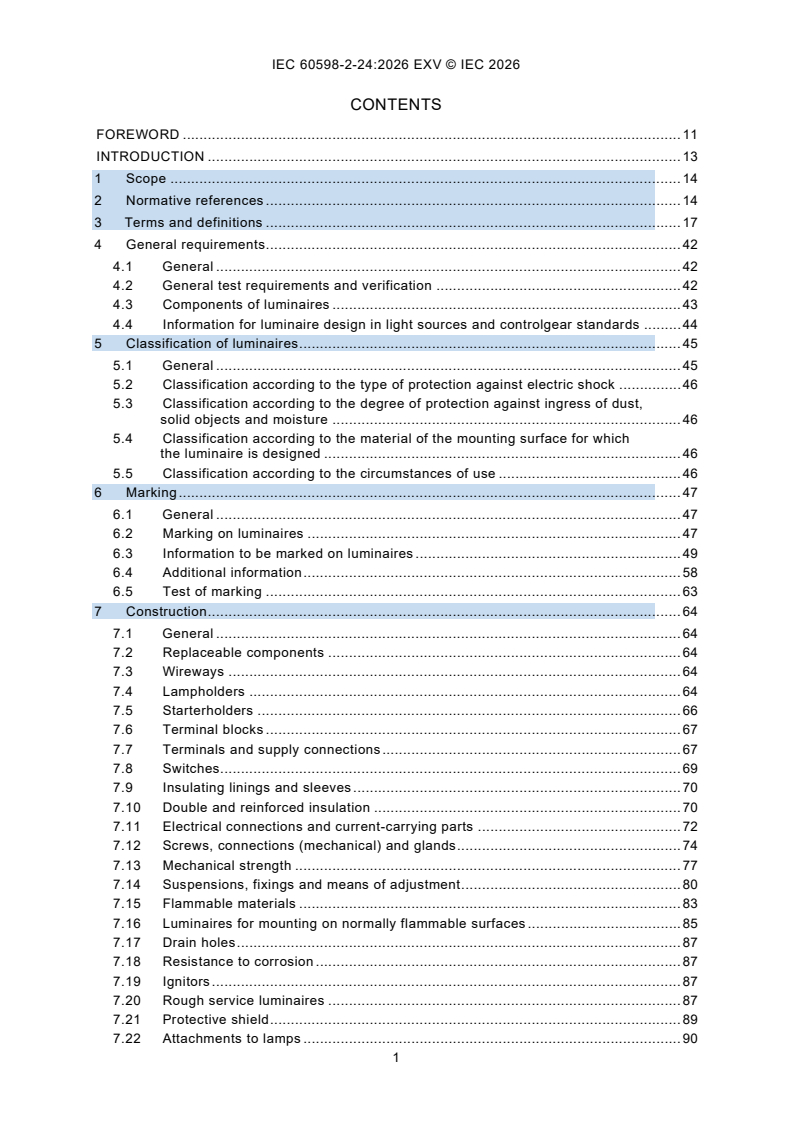
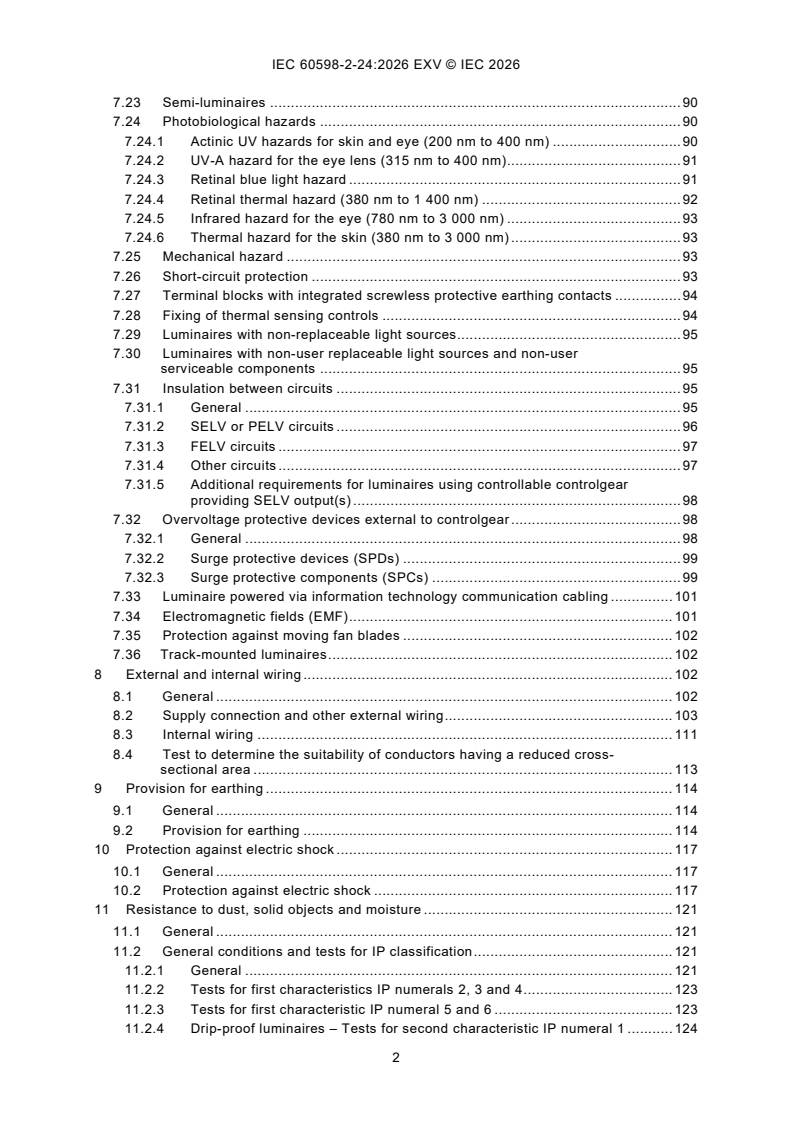
IEC 60598-2-24:2026 EXV - Luminaires - Part 2-24: Particular requirements - Luminaires with limited surface temperatures
IEC 60598-2-24:2026 - Luminaires - Partie 2-24: Exigences particulières - Luminaires à températures de surfaces limitées
IEC 60598-2-24:2026 is an IEC International Standard for luminaires with limited surface temperatures. It specifies requirements for luminaires used with electric light sources on supply voltages not exceeding 1 000 V, where controlled surface temperatures help reduce ignition risks from combustible dusts or materials deposited on the luminaire, and it excludes luminaires for explosive gas atmospheres and explosive dust atmospheres.
The standard is written for luminaire designers, manufacturers, test laboratories, and certifiers who need to verify that a product is suitable for this temperature-limited use case. In practice, it tells them what to classify, mark, construct, and test so the luminaire can be evaluated as a complete product.
What does IEC 60598-2-24:2026 specify?
IEC 60598-2-24:2026 sets particular requirements for luminaires whose limited surface temperatures are part of the protection concept against dust-related ignition risks and ignition of deposited materials. The document is organized into Clauses 1 to 17, with the core topics covering scope, references, terms, general requirements, classification, marking, construction, wiring, earthing, electric shock protection, ingress protection, insulation tests, creepage and clearance, endurance and thermal tests, heat/fire/tracking, and terminal requirements.
The annexes add test methods, calculation aids, and special cases for specific luminaire types and conditions.
| Annex | What it covers |
|---|---|
| A | Touch voltage limits, touch current limits, and compliance |
| B | Lamps used for thermal testing |
| D | Thermal testing details, including draught-proof enclosure and mounting surface |
| F | Corrosion-related test cabinet, solution, test piece, and procedure |
| G | Touch current and protective conductor current measurement |
| I | Temperature measurements of the luminaire and lampholders |
| K | Determination of creepage distances and clearances |
| L | Marking explanation for luminaires not suitable for normally flammable surfaces and insulation covering |
| P | Identification of a family or range of luminaires for type testing |
| Q | Overvoltage category III requirements |
| R | Additional test requirements for terminal blocks with integrated screwless protective earthing contact |
| S | Alternative thermal test for thermoplastic luminaires |
| U | Requirements for a PSE supplying a luminaire via communication cabling |
| W | Battery/EDLC-operated luminaires |
What are the key requirements of IEC 60598-2-24:2026?
Surface temperature control and thermal safety
IEC 60598-2-24:2026 is built around keeping luminaire surfaces within controlled temperature limits. Clause 7.101 requires an enclosure with IP5X protection, Clause 7.102 addresses the maximum permissible temperatures for surfaces, and Clause 7.103 requires built-in controlgear and other built-in devices to be thermally protected.
That matters because this standard is aimed at reducing ignition risk from dust or deposited material, so temperature control is not just a design detail - it is the main safety function.
Clause 14 adds the endurance and thermal tests that confirm the design under normal operation, abnormal operation, failed windings in controlgear, and fault conditions in controlgear or electronic devices. Annex D and Annex S give the related test arrangements and an alternative thermal test for thermoplastic luminaires.
Classification, marking, and installation information
Clause 5 classifies luminaires by protection against electric shock, ingress of dust, the material of the mounting surface, and the circumstances of use. This helps the manufacturer state the intended application clearly and helps the buyer or installer match the luminaire to the site conditions.
Clause 6 sets the marking and instruction content. The luminaire marking covers items such as origin, rated voltage, ambient temperature, protection class symbols, IP code, rated light source power, special lamp information, minimum distance from lighted objects, rough service, protective shield, ignition warnings, adjustment means, and, where relevant, blue light hazard and rated constant input voltage or current.
In practice, the marking tells the installer and user what lamps, controlgear, mounting position, and ambient conditions are acceptable. Clause 6.102 and 6.103 also require the instructions to state the intended locations and mounting positions, which is important when surface temperature behavior depends on orientation.
Construction, wiring, and earthing
Clauses 7 to 10 cover the physical and electrical build of the luminaire. They deal with replaceable components, lampholders, terminals, switches, insulating linings and sleeves, mechanical strength, suspensions and fixings, flammable materials, rough service luminaires, photobiological hazards, insulation between circuits, overvoltage protective devices, EMF, track-mounted luminaires, wiring, earthing, and protection against electric shock.
Clause 9 is especially important for class I luminaires because accessible metal parts must be connected to protective earthing. Clause 10 limits accessible hazardous live parts, and class III luminaires are accepted only for connection to a SELV or PELV source.
Clause 7.31 distinguishes SELV, PELV, FELV and other circuits, so designers need to separate control and supply circuits correctly. Clause 7.32 covers SPDs and SPCs, which matters where overvoltage protection is built into the luminaire.
Electrical, insulation, and environmental tests
Clause 11 covers resistance to dust, solid objects and moisture, including the IP tests and humidity test. Clause 12 covers insulation resistance, electric strength, touch current, protective conductor current, and electric burn. Clause 13 then sets creepage and clearance requirements using PTI and the overvoltage assumptions in Annex K and Tables 18 to 20.
These clauses matter because they define the minimum spacing, withstand voltages, and enclosure performance needed to keep live parts from becoming accessible or breaking down in service. For certification and type testing, these are some of the main pass-fail checkpoints.
Clause 15 covers resistance to heat, fire and tracking. It includes heat resistance, flame and ignition resistance, and tracking performance for insulating parts that retain current-carrying parts or, for other than ordinary luminaires, retain dangerous live parts.
Terminals and connections
Clauses 16 and 17 set the requirements for screw terminals and screwless terminals and electrical connections. They cover conductor sizes, clamping reliability, mechanical strength, corrosion resistance, contact resistance, and heating tests.
This section matters because many luminaire failures start at the connection point. The standard requires the terminals to accept the declared conductors without undue damage and to maintain safe electrical contact under mechanical and thermal stress.
What terms does IEC 60598-2-24:2026 define?
- Luminaire - An apparatus that distributes, filters, or transforms light and includes the parts needed to fix, protect, and connect the light sources to the supply.
- Ordinary luminaire - A luminaire that protects against accidental contact with hazardous live parts but has no special protection against dust, solid objects, or moisture.
- Fixed luminaire - A luminaire that is not easily moved, usually because removal needs a tool or because it is intended for use out of arm’s reach.
- Portable luminaire - A luminaire that can be moved easily from one place to another even while connected to the supply.
- Recessed luminaire - A luminaire intended to be fully or partly recessed into a mounting surface.
- Rated voltage - The supply voltage or voltages assigned to the luminaire by the manufacturer.
- Supply cord - The external flexible cable or cord fixed to the luminaire for supply purposes.
- Protective impedance device - A component or assembly whose impedance and construction limit steady-state touch current and electric charge to non-hazardous levels.
Who uses IEC 60598-2-24:2026?
IEC 60598-2-24:2026 is used by luminaire manufacturers, lighting product engineers, compliance and certification teams, and test laboratories. It is also useful for quality managers and buyers who need to specify a luminaire for dusty or contamination-prone environments where surface temperature is part of the safety decision.
Typical uses include product design reviews, type testing, selection of lamps and controlgear, marking checks, thermal verification, enclosure/IP assessment, and confirmation that wiring, earthing, and terminals meet the intended use.
What changed in IEC 60598-2-24:2026 from the previous edition?
IEC 60598-2-24:2026 is the third edition and replaces the second edition published in 2013. The scope notes it as a technical revision.
The stated technical changes are:
- clause numbers and structure aligned with IEC 60598-1
- improved terms and definitions
- more detailed classification of luminaires
- indication of luminaire mounting positions and use locations
- thermal protection of built-in controlgear and other built-in devices required
Which standards are used with IEC 60598-2-24:2026?
IEC 60598-2-24:2026 is used together with IEC 60598-1:2024, which provides the general requirements and tests for luminaires. The standard also names supporting documents for enclosure protection, lamps, controlgear, wiring, testing, symbols, batteries, surge protection, and photobiological safety.
Key references include:
- IEC 60598-1:2024 - general luminaire requirements and tests
- IEC 60529 - IP Code and enclosure degrees of protection
- IEC 61347-1 and IEC 61347 (all parts) - lamp controlgear safety
- IEC 60695-2-11 and IEC 60695-11-5 - glow-wire and needle-flame fire tests
- IEC 60990 and IEC 61032 - touch current measurement and test probes
- IEC 60664-4 and IEC 60112 - insulation coordination and tracking index
- IEC 62471-7 and IEC TR 62778 - photobiological safety and blue light hazard
- IEC 60227, IEC 60245, IEC 60320, IEC 61984, IEC 61558, IEC 61643-11, IEC 61643-331, IEC 62133-2, IEC 62391-1, IEC 62391-2, IEC 62680, ISO 3864-1, and ISO 7000 - cables, connectors, power supplies, surge protection, batteries, communication cabling, and safety symbols
What does the IEC 60598-2-24:2026 document contain?
IEC 60598-2-24:2026 contains the test and verification structure for a luminaire safety standard, including marking rules, construction requirements, wiring and earthing provisions, electric shock protection, IP and humidity tests, insulation and electric-strength tests, creepage and clearance rules, and thermal endurance testing. It also includes detailed annex material for lamp selection, temperature measurement, terminal-block testing, family identification, overvoltage category III, alternative thermal testing, PSE supply conditions, and battery/EDLC-operated luminaires.
For practical work, the document provides the test set-ups, measurement approaches, and compliance checks that laboratories and manufacturers use when validating a luminaire design. It also includes figures, tables, and annex procedures that support certification and design verification without leaving the luminaire-specific safety framework of Part 2-24.
Relations
- Effective Date
- 05-Sep-2023
Buy Documents
IEC 60598-2-24:2026 - Luminaires - Part 2-24: Particular requirements - Luminaires with limited surface temperatures
IEC 60598-2-24:2026 EXV - Luminaires - Part 2-24: Particular requirements - Luminaires with limited surface temperatures
IEC 60598-2-24:2026 - Luminaires - Partie 2-24: Exigences particulières - Luminaires à températures de surfaces limitées
Get Certified
Connect with accredited certification bodies for this standard

IMQ S.p.A. (Certification)
Italian electrical product certification.

SLG Prüf- und Zertifizierungs GmbH
German testing and certification body.

UL Solutions
Global safety science company with testing, inspection and certification.
Sponsored listings
Frequently Asked Questions
IEC 60598-2-24:2026 is a standard published by the International Electrotechnical Commission (IEC). Its full title is "Luminaires - Part 2-24: Particular requirements - Luminaires with limited surface temperatures". This standard covers: IEC 60598-2-24:2026 specifies requirements for luminaires for which limited surface temperatures are provided to counteract risks from combustible dusts (conductive or non‑conductive) or ignition of materials that can be deposited on luminaires. The luminaires are for use with electric light sources on supply voltages not exceeding 1 000 V. This document specifically excludes requirements for luminaires for use in explosive gas atmospheres and explosive dust atmospheres. This third edition cancels and replaces the second edition, published in 2013. This edition constitutes a technical revision. This edition includes the following significant technical changes with respect to the previous edition: a) the clause numbers and structure have been aligned with those of IEC 60598‑1; b) improved terms and definitions; c) more detailed classification of luminaires; d) indication of luminaire mounting positions and use locations; e) thermal protection of built-in controlgear and other built-in devices required.
IEC 60598-2-24:2026 specifies requirements for luminaires for which limited surface temperatures are provided to counteract risks from combustible dusts (conductive or non‑conductive) or ignition of materials that can be deposited on luminaires. The luminaires are for use with electric light sources on supply voltages not exceeding 1 000 V. This document specifically excludes requirements for luminaires for use in explosive gas atmospheres and explosive dust atmospheres. This third edition cancels and replaces the second edition, published in 2013. This edition constitutes a technical revision. This edition includes the following significant technical changes with respect to the previous edition: a) the clause numbers and structure have been aligned with those of IEC 60598‑1; b) improved terms and definitions; c) more detailed classification of luminaires; d) indication of luminaire mounting positions and use locations; e) thermal protection of built-in controlgear and other built-in devices required.
IEC 60598-2-24:2026 is classified under the following ICS (International Classification for Standards) categories: 29.140.40 - Luminaires. The ICS classification helps identify the subject area and facilitates finding related standards.
IEC 60598-2-24:2026 has the following relationships with other standards: It is inter standard links to IEC 60598-2-24:2013. Understanding these relationships helps ensure you are using the most current and applicable version of the standard.
IEC 60598-2-24:2026 is available in PDF format for immediate download after purchase. The document can be added to your cart and obtained through the secure checkout process. Digital delivery ensures instant access to the complete standard document.
Standards Content (Sample)
IEC 60598-2-24 ®
Edition 3.0 2026-10
INTERNATIONAL
STANDARD
Luminaires -
Part 2-24: Particular requirements - Luminaires with limited surface
temperatures
ICS 29.140.40 ISBN 978-2-8327-1511-6
All rights reserved. Unless otherwise specified, no part of this publication may be reproduced or utilized in any form or
by any means, electronic or mechanical, including photocopying and microfilm, without permission in writing from either
IEC or IEC's member National Committee in the country of the requester. If you have any questions about IEC copyright
or have an enquiry about obtaining additional rights to this publication, please contact the address below or your local
IEC member National Committee for further information.
IEC Secretariat Tel.: +41 22 919 02 11
3, rue de Varembé info@iec.ch
CH-1211 Geneva 20 www.iec.ch
Switzerland
About the IEC
The International Electrotechnical Commission (IEC) is the leading global organization that prepares and publishes
International Standards for all electrical, electronic and related technologies.
About IEC publications
The technical content of IEC publications is kept under constant review by the IEC. Please make sure that you have the
latest edition, a corrigendum or an amendment might have been published.
IEC publications search - IEC Products & Services Portal - products.iec.ch
webstore.iec.ch/advsearchform Discover our powerful search engine and read freely all the
The advanced search enables to find IEC publications by a publications previews, graphical symbols and the glossary.
variety of criteria (reference number, text, technical With a subscription you will always have access to up to date
committee, …). It also gives information on projects, content tailored to your needs.
replaced and withdrawn publications.
Electropedia - www.electropedia.org
The world's leading online dictionary on electrotechnology,
IEC Just Published - webstore.iec.ch/justpublished
Stay up to date on all new IEC publications. Just Published containing more than 22 500 terminological entries in English
details all new publications released. Available online and and French, with equivalent terms in 25 additional languages.
once a month by email. Also known as the International Electrotechnical Vocabulary
(IEV) online.
IEC Customer Service Centre - webstore.iec.ch/csc
If you wish to give us your feedback on this publication or
need further assistance, please contact the Customer
Service Centre: sales@iec.ch.
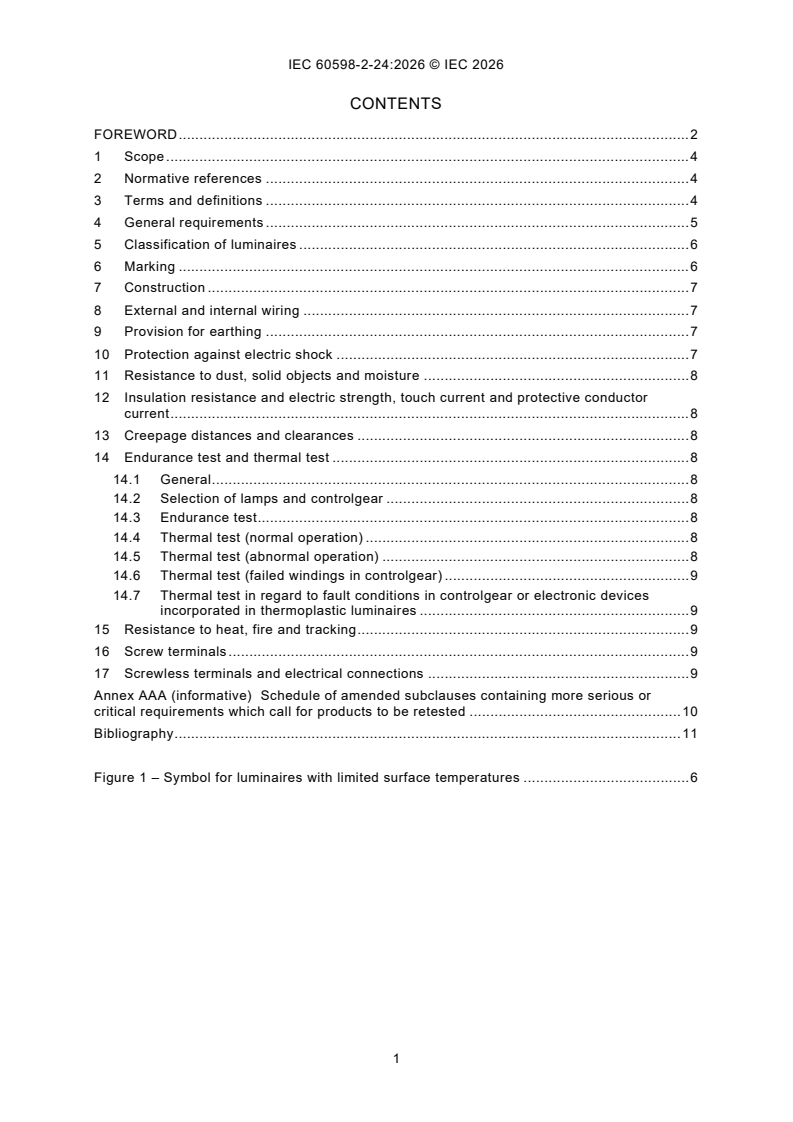
CONTENTS
FOREWORD . 2
1 Scope . 4
2 Normative references . 4
3 Terms and definitions . 4
4 General requirements . 5
5 Classification of luminaires . 6
6 Marking . 6
7 Construction . 7
8 External and internal wiring . 7
9 Provision for earthing . 7
10 Protection against electric shock . 7
11 Resistance to dust, solid objects and moisture . 8
12 Insulation resistance and electric strength, touch current and protective conductor
current . 8
13 Creepage distances and clearances . 8
14 Endurance test and thermal test . 8
14.1 General . 8
14.2 Selection of lamps and controlgear . 8
14.3 Endurance test . 8
14.4 Thermal test (normal operation) . 8
14.5 Thermal test (abnormal operation) . 8
14.6 Thermal test (failed windings in controlgear) . 9
14.7 Thermal test in regard to fault conditions in controlgear or electronic devices
incorporated in thermoplastic luminaires . 9
15 Resistance to heat, fire and tracking . 9
16 Screw terminals . 9
17 Screwless terminals and electrical connections . 9
Annex AAA (informative) Schedule of amended subclauses containing more serious or
critical requirements which call for products to be retested . 10
Bibliography . 11
Figure 1 – Symbol for luminaires with limited surface temperatures . 6
INTERNATIONAL ELECTROTECHNICAL COMMISSION
____________
Luminaires -
Part 2-24: Particular requirements -
Luminaires with limited surface temperatures
FOREWORD
1) The International Electrotechnical Commission (IEC) is a worldwide organization for standardization comprising
all national electrotechnical committees (IEC National Committees). The object of IEC is to promote international
co-operation on all questions concerning standardization in the electrical and electronic fields. To this end and
in addition to other activities, IEC publishes International Standards, Technical Specifications, Technical Reports,
Publicly Available Specifications (PAS) and Guides (hereafter referred to as “IEC Publication(s)”). Their
preparation is entrusted to technical committees; any IEC National Committee interested in the subject dealt with
may participate in this preparatory work. International, governmental and non-governmental organizations liaising
with the IEC also participate in this preparation. IEC collaborates closely with the International Organization for
Standardization (ISO) in accordance with conditions determined by agreement between the two organizations.
2) The formal decisions or agreements of IEC on technical matters express, as nearly as possible, an international
consensus of opinion on the relevant subjects since each technical committee has representation from all
interested IEC National Committees.
3) IEC Publications have the form of recommendations for international use and are accepted by IEC National
Committees in that sense. While all reasonable efforts are made to ensure that the technical content of IEC
Publications is accurate, IEC cannot be held responsible for the way in which they are used or for any
misinterpretation by any end user.
4) In order to promote international uniformity, IEC National Committees undertake to apply IEC Publications
transparently to the maximum extent possible in their national and regional publications. Any divergence between
any IEC Publication and the corresponding national or regional publication shall be clearly indicated in the latter.
5) IEC itself does not provide any attestation of conformity. Independent certification bodies provide conformity
assessment services and, in some areas, access to IEC marks of conformity. IEC is not responsible for any
services carried out by independent certification bodies.
6) All users should ensure that they have the latest edition of this publication.
7) No liability shall attach to IEC or its directors, employees, servants or agents including individual experts and
members of its technical committees and IEC National Committees for any personal injury, property damage or
other damage of any nature whatsoever, whether direct or indirect, or for costs (including legal fees) and
expenses arising out of the publication, use of, or reliance upon, this IEC Publication or any other IEC
Publications.
8) Attention is drawn to the Normative references cited in this publication. Use of the referenced publications is
indispensable for the correct application of this publication.
9) IEC draws attention to the possibility that the implementation of this document may involve the use of (a)
patent(s). IEC takes no position concerning the evidence, validity or applicability of any claimed patent rights in
respect thereof. As of the date of publication of this document, IEC had not received notice of (a) patent(s), which
may be required to implement this document. However, implementers are cautioned that this may not represent
the latest information, which may be obtained from the patent database available at https://patents.iec.ch. IEC
shall not be held responsible for identifying any or all such patent rights.
IEC 60598-2-24 has been prepared by subcommittee 34D: Luminaires, of IEC technical
committee 34: Lighting. It is an International Standard.
This third edition cancels and replaces the second edition, published in 2013. This edition
constitutes a technical revision.
This edition includes the following significant technical changes with respect to the previous
edition:
a) the clause numbers and structure have been aligned with those of IEC 60598-1;
b) improved terms and definitions;
c) more detailed classification of luminaires;
d) indication of luminaire mounting positions and use locations;
e) thermal protection of built-in controlgear and other built-in devices required.
The text of this International Standard is based on the following documents:
Draft Report on voting
34D/1819/FDIS 34D/1828/RVD
Full information on the voting for its approval can be found in the report on voting indicated in
the above table.
The language used for the development of this International Standard is English.
This document was drafted in accordance with ISO/IEC Directives, Part 2, and developed in
accordance with ISO/IEC Directives, Part 1 and ISO/IEC Directives, IEC Supplement, available
at www.iec.ch/members_experts/refdocs. The main document types developed by IEC are
described in greater detail at www.iec.ch/publications.
This document is to be used in conjunction with the latest edition of IEC 60598-1. It was
established on the basis of the tenth edition (2024) of that standard.
NOTE When "Part 1" is mentioned in this document, it refers to IEC 60598-1.
Where this document states "addition", "modification" or "replacement", the relevant text of
Part 1 is to be adapted accordingly.
Subclauses, additional to those in Part 1 are numbered starting from 101; supplementary
annexes are entitled AAA, AAB, etc.
A list of all parts in the IEC 60598 series, published under the general title Luminaires can be
found on the IEC website.
The committee has decided that the contents of this document will remain unchanged until the
stability date indicated on the IEC website under webstore.iec.ch in the d
...
IEC 60598-2-24 ®
Edition 3.0 2026-10
INTERNATIONAL
STANDARD
EXTENDED VERSION
This full version of IEC 60598-2-24:2026 includes the content of the references made
to IEC 60598-1:2024
Luminaires -
Part 2-24: Particular requirements - Luminaires with limited surface
temperatures
ICS 29.140.40 ISBN 978-2-8327-1550-5
All rights reserved. Unless otherwise specified, no part of this publication may be reproduced or utilized in any form or
by any means, electronic or mechanical, including photocopying and microfilm, without permission in writing from either
IEC or IEC's member National Committee in the country of the requester. If you have any questions about IEC copyright
or have an enquiry about obtaining additional rights to this publication, please contact the address below or your local
IEC member National Committee for further information.
IEC Secretariat Tel.: +41 22 919 02 11
3, rue de Varembé info@iec.ch
CH-1211 Geneva 20 www.iec.ch
Switzerland
About the IEC
The International Electrotechnical Commission (IEC) is the leading global organization that prepares and publishes
International Standards for all electrical, electronic and related technologies.
About IEC publications
The technical content of IEC publications is kept under constant review by the IEC. Please make sure that you have the
latest edition, a corrigendum or an amendment might have been published.
IEC publications search - IEC Products & Services Portal - products.iec.ch
webstore.iec.ch/advsearchform Discover our powerful search engine and read freely all the
The advanced search enables to find IEC publications by a publications previews, graphical symbols and the glossary.
variety of criteria (reference number, text, technical With a subscription you will always have access to up to date
committee, …). It also gives information on projects, content tailored to your needs.
replaced and withdrawn publications.
Electropedia - www.electropedia.org
The world's leading online dictionary on electrotechnology,
IEC Just Published - webstore.iec.ch/justpublished
Stay up to date on all new IEC publications. Just Published containing more than 22 500 terminological entries in English
details all new publications released. Available online and and French, with equivalent terms in 25 additional languages.
once a month by email. Also known as the International Electrotechnical Vocabulary
(IEV) online.
IEC Customer Service Centre - webstore.iec.ch/csc
If you wish to give us your feedback on this publication or
need further assistance, please contact the Customer
Service Centre: sales@iec.ch.
CONTENTS
FOREWORD . 11
INTRODUCTION . 13
1 Scope . 14
2 Normative references . 14
3 Terms and definitions . 17
4 General requirements . 42
4.1 General . 42
4.2 General test requirements and verification . 42
4.3 Components of luminaires . 43
4.4 Information for luminaire design in light sources and controlgear standards . 44
5 Classification of luminaires . 45
5.1 General . 45
5.2 Classification according to the type of protection against electric shock . 46
5.3 Classification according to the degree of protection against ingress of dust,
solid objects and moisture . 46
5.4 Classification according to the material of the mounting surface for which
the luminaire is designed . 46
5.5 Classification according to the circumstances of use . 46
6 Marking . 47
6.1 General . 47
6.2 Marking on luminaires . 47
6.3 Information to be marked on luminaires . 49
6.4 Additional information . 58
6.5 Test of marking . 63
7 Construction . 64
7.1 General . 64
7.2 Replaceable components . 64
7.3 Wireways . 64
7.4 Lampholders . 64
7.5 Starterholders . 66
7.6 Terminal blocks . 67
7.7 Terminals and supply connections . 67
7.8 Switches. 69
7.9 Insulating linings and sleeves . 70
7.10 Double and reinforced insulation . 70
7.11 Electrical connections and current-carrying parts . 72
7.12 Screws, connections (mechanical) and glands . 74
7.13 Mechanical strength . 77
7.14 Suspensions, fixings and means of adjustment . 80
7.15 Flammable materials . 83
7.16 Luminaires for mounting on normally flammable surfaces . 85
7.17 Drain holes . 87
7.18 Resistance to corrosion . 87
7.19 Ignitors . 87
7.20 Rough service luminaires . 87
7.21 Protective shield . 89
7.22 Attachments to lamps . 90
7.23 Semi-luminaires . 90
7.24 Photobiological hazards . 90
7.24.1 Actinic UV hazards for skin and eye (200 nm to 400 nm) . 90
7.24.2 UV-A hazard for the eye lens (315 nm to 400 nm) . 91
7.24.3 Retinal blue light hazard . 91
7.24.4 Retinal thermal hazard (380 nm to 1 400 nm) . 92
7.24.5 Infrared hazard for the eye (780 nm to 3 000 nm) . 93
7.24.6 Thermal hazard for the skin (380 nm to 3 000 nm) . 93
7.25 Mechanical hazard . 93
7.26 Short-circuit protection . 93
7.27 Terminal blocks with integrated screwless protective earthing contacts . 94
7.28 Fixing of thermal sensing controls . 94
7.29 Luminaires with non-replaceable light sources . 95
7.30 Luminaires with non-user replaceable light sources and non-user
serviceable components . 95
7.31 Insulation between circuits . 95
7.31.1 General . 95
7.31.2 SELV or PELV circuits . 96
7.31.3 FELV circuits . 97
7.31.4 Other circuits . 97
7.31.5 Additional requirements for luminaires using controllable controlgear
providing SELV output(s) . 98
7.32 Overvoltage protective devices external to controlgear . 98
7.32.1 General . 98
7.32.2 Surge protective devices (SPDs) . 99
7.32.3 Surge protective components (SPCs) . 99
7.33 Luminaire powered via information technology communication cabling . 101
7.34 Electromagnetic fields (EMF) . 101
7.35 Protection against moving fan blades . 102
7.36 Track-mounted luminaires . 102
8 External and internal wiring . 102
8.1 General . 102
8.2 Supply connection and other external wiring . 103
8.3 Internal wiring . 111
8.4 Test to determine the suitability of conductors having a reduced cross-
sectional area . 113
9 Provision for earthing . 114
9.1 General . 114
9.2 Provision for earthing . 114
10 Protection against electric shock . 117
10.1 General . 117
10.2 Protection against electric shock . 117
11 Resistance to dust, solid objects and moisture . 121
11.1 General . 121
11.2 General conditions and tests for IP classification . 121
11.2.1 General . 121
11.2.2 Tests for first characteristics IP numerals 2, 3 and 4 . 123
11.2.3 Tests for first characteristic IP numeral 5 and 6 . 123
11.2.4 Drip-proof luminaires – Tests for second characteristic IP numeral 1 . 124
11.2.5 Drip-proof luminaires – Tests for second characteristic IP numeral 2 . 125
11.2.6 Rain-proof luminaires – Tests for second characteristic IP numeral 3 . 125
11.2.7 Splash-proof luminaires – Tests for second characteristic IP numeral 4 . 126
11.2.8 Jet-proof luminaires – Tests for second characteristic IP numeral 5 . 126
11.2.9 Powerful jet-proof luminaires – Tests for second characteristic IP
numeral 6 . 127
11.2.10 Watertight luminaires – Tests for second characteristic IP numeral 7 . 127
11.2.11 Pressure watertight luminaires – Tests for second characteristic IP
numeral 8 . 128
11.2.12 High pressure and temperature water jet-proof luminaires – Tests for
second characteristic IP numeral 9 (80 °C) . 128
11.2.13 High pressure and cold water jet-proof luminaires – Tests for second
characteristic IP numeral 9 (15 °C) . 128
11.3 Humidity test . 128
12 Insulation resistance and electric strength, touch current and protective conductor
current . 129
12.1 General . 129
12.2 Insulation resistance and electric strength . 129
12.2.1 General . 129
12.2.2 Test – Insulation resistance . 130
12.2.3 Test – Electric strength . 131
12.3 Touch current, protective conductor current and electric burn . 133
13 Creepage distances and clearances . 134
13.1 General . 134
13.2 Requirements . 135
13.2.1 General . 135
13.2.2 Creepage distances . 136
13.2.3 Clearances . 137
14 Endurance test and thermal test . 139
14.1 General . 139
14.2 Selection of lamps and controlgear . 139
14.3 Endurance test . 140
14.3.1 General . 140
14.3.2 Test . 140
14.3.3 Compliance . 141
14.4 Thermal test (normal operation) . 141
14.4.1 General . 141
14.4.2 Test . 142
14.4.3 Compliance . 144
14.5 Thermal test (abnormal operation) . 147
14.5.1 General . 147
14.5.2 Test . 148
14.5.3 Compliance . 149
14.6 Thermal test (failed windings in controlgear) . 151
14.6.1 General . 151
14.6.2 Test for luminaires without thermal cut-outs . 151
14.6.3 Test for luminaires with temperature sensing controls . 152
14.7 Thermal test in regard to fault conditions in controlgear or electronic devices
incorporated in thermoplastic luminaires . 153
14.7.1 General . 153
14.7.2 Test for luminaires without temperature sensing controls . 154
14.7.3 Test for luminaires with temperature sensing controls internal or
external to the controlgear or transformer . 156
15 Resistance to heat, fire and tracking . 157
15.1 General . 157
15.2 Resistance to heat . 157
15.3 Resistance to flame and ignition . 158
15.4 Resistance to tracking . 158
16 Screw terminals . 159
16.1 General . 159
16.2 General requirements and basic principles . 165
16.3 Mechanical requirements and tests . 167
17 Screwless terminals and electrical connections . 171
17.1 General . 171
17.2 General requirements . 173
17.3 General instructions for tests . 175
17.3.1 Preparation of samples . 175
17.3.2 Test conductors . 175
17.3.3 Multi-conductor terminals . 175
17.3.4 Multi-way terminals . 175
17.3.5 Test quantities . 175
17.4 Terminal and connections for internal wiring . 175
17.4.1 Mechanical tests . 175
17.4.2 Electrical tests . 176
17.5 Terminals and connections for external wiring . 177
17.5.1 Conductors . 177
17.5.2 Mechanical tests . 178
17.5.3 Electrical tests . 179
Annex A (normative) Test to establish whether a conductive part can cause an
electric shock . 181
A.1 General . 181
A.2 Touch voltage limits . 181
A.3 Touch current limits . 181
A.4 Compliance . 181
Annex B (normative) Test lamps . 182
B.1 General . 182
B.2 Filament lamps within the scope of IEC 60432-1 and IEC 60432-2 . 182
B.2.1 Principal modes of heat transfer and lamps used for testing . 182
B.2.2 Filament test lamps . 183
B.3 Halogen lamps within the scope of IEC 60432-3 . 184
B.4 Tubular fluorescent and other discharge lamps . 184
B.5 LED modules within the scope of IEC 62031 . 184
Annex C (normative) Abnormal circuit conditions . 185
Annex D (normative) Thermal testing . 188
D.1 Draught-proof enclosure . 188
D.2 Mounting surface . 188
D.3 Alternative test procedure for adjustment of measured temperatures for
luminaire t rating(s) . 189
a
D.3.1 General . 189
D.3.2 Thermal test of normal operation for luminaires without temperature
sensing controls and where the rated ambient temperature t as
a
marked on the luminaire is higher than the ambient temperature in the
draught-proof enclosure . 189
Annex E (normative) Determination of winding temperature rises by the increase-in-
resistance method . 190
Annex F (normative) Test for resistance to stress corrosion of copper and copper
alloys . 191
F.1 Test cabinet . 191
F.2 Test solution . 191
F.3 Test piece . 191
F.4 Test procedure. 192
Annex G (normative) Measurement of touch current and protective conductor
current . 193
G.1 General . 193
G.2 Test conditions . 193
G.3 Test procedures . 193
G.4 Test measurements . 193
G.5 Test sequence . 195
Annex H (informative) Explanation of IP numbers for degrees of protection . 197
Annex I (informative) Temperature measurements . 199
I.1 Temperature measurements of the luminaire . 199
I.2 Temperature measurement of the insulation parts of lampholders . 200
Annex J (informative) Guidelines for good practice in luminaire design . 202
J.1 General . 202
J.2 Plastics in luminaires . 202
J.3 Rust resistance . 203
J.4 Corrosion resistance . 203
J.5 Chemically corrosive atmospheres . 204
J.6 Reflector design . 204
J.7 Components in different kinds of luminaires . 205
J.8 Recommendations for electromagnetic ballast protection for end of life
phenomenon of HID lamps . 205
J.9 Resistance against the effects of vibration . 205
J.10 Flammability of components . 206
J.11 Permanent magnets . 206
Annex K (normative) Determination of creepage distances and clearances . 208
Annex L (informative) Explanation of marking for luminaires that are not suitable for
mounting on normally flammable surfaces and covering with insulation materials . 209
L.1 General . 209
L.2 Protection against flame . 209
L.3 Protection against heat . 210
L.3.1 General . 210
L.3.2 Spacing . 210
L.3.3 Temperature measurements of mounting surface under abnormal or
failed ballast conditions . 210
L.4 Thermal protectors . 212
L.5 Deletion of the F mark requirements . 213
Annex M (normative) Absorption requirements for the protective shield to be fitted to
luminaires designed for metal halide lamps which emit a high level of UV radiation . 214
M.1 General . 214
M.2 Procedure A . 214
M.3 Procedure B . 215
Annex N (informative) Conformity testing during manufacture . 216
N.1 General . 216
N.2 Testing . 216
Annex O (normative) Schedule of amended subclauses containing more serious or
critical requirements which call for products to be retested . 218
Annex P (normative) Requirements for the identification of a family or range of
luminaires for type testing . 219
P.1 General . 219
P.2 Range or family of luminaires . 219
Annex Q (informative) Additional requirements for luminaires where a higher degree
of availability (overvoltage category III) may be requested . 220
Q.1 General . 220
Q.2 Requirements for overvoltage category III . 220
Annex R (normative) Additional test requirements for terminal blocks with integrated
screwless protective earthing contact for direct connection to the luminaire housing or
to parts of the body . 222
R.1 Additional requirements to 9.2.1. 222
R.1.1 Requirements for mechanical strength . 222
R.1.2 Test for terminal fixing . 222
R.1.3 Test for supporting plate . 222
R.2 Additional requirements to 9.2.3. 222
Annex S (normative) Alternative thermal test for thermoplastic luminaires . 224
S.1 General . 224
S.2 Thermal test in regard to fault conditions in controlgear or electronic devices
without temperature sensing controls in thermoplastic luminaires for
fluorescent lamps ≤ 70 W . 224
Annex T (normative) Requirements for insulation between live parts of circuits and
accessible conductive parts . 226
Annex U (informative) Information regarding power sourcing equipment powering
class III luminaires via information technology communication cabling . 228
U.1 General . 228
U.2 Insulation of the mains supply . 228
U.3 Electrical limits of a PSE . 228
Annex V (informative) Cross-references to the previous edition of IEC 60598-1 . 230
Annex W (normative) Battery/EDLC-operated luminaires . 233
W.1 General . 233
W.2 General test requirements and verification . 233
W.3 Marking . 235
W.3.1 General . 235
W.3.2 Luminaires with replaceable battery . 235
W.3.3 Coin and button batteries . 235
W.3.4 Other standardized batteries (e.g. AAA or AA) . 236
W.3.5 Luminaires with non-standardized replaceable rechargeable battery . 237
W.3.6 Luminaires with non-user replaceable battery/EDLC . 237
W.3.7 Luminaires with non-replaceable battery/EDLC . 238
W.3.8 Luminaires supplied by external dedicated power supply units . 238
W.3.9 Rechargeable luminaires other than ordinary . 238
W.3.10 Conditions for charging . 238
W.4 Construction . 239
W.4.1 General . 239
W.4.2 Small batteries (coins, button and other non-standardized batteries) . 239
W.4.3 Battery compartment fasteners for small batteries and other
standardized batteries (e.g. AAA or AA) . 240
W.4.4 Battery/EDLC chargers incorporated in luminaires . 240
W.4.5 Short-circuit protection . 240
W.4.6 Electrical parameters of the batteries operation . 241
W.4.7 Protection against overpressure for Li-ion batteries used in luminaires . 242
W.4.8 Protection against the consequence of failure of cells or EDLCs . 242
W.5 Protection against electric shock . 243
W.6 Endurance test and thermal test . 243
W.6.1 Endurance test . 243
W.6.2 Thermal test (normal operation) . 243
W.6.3 Thermal test (abnormal operation) . 244
W.6.4 Lithium-ion charging systems – Fault conditions . 245
Annex AAA (informative) Schedule of amended subclauses containing more serious
or critical requirements which call for products to be retested . 247
Bibliography . 248
Figure 1 – Example of "looping-in" (feed through) . 28
Figure 2 – Examples of "through wiring" . 28
Figure 3 – Example of electro-mechanical contact system with plug or socket
connection . 30
Figure 4 – AC supply . 49
Figure 5 – DC supply . 49
Figure 6 – DC and AC supply . 49
Figure 7 – Class II . 50
Figure 8 – Class III . 50
Figure 9 – Luminaire not suitable for direct mounting on normally flammable surfaces . 52
Figure 10 – High-pressure sodium lamps that require an external ignitor (to the lamp) . 52
Figure 11 – High-pressure sodium lamps having an internal starting device . 52
Figure 12 – Warning against the use of cool-beam lamps . 52
Figure 13 – Functional earthing . 53
Figure 14 – Protective earthing . 53
Figure 15 – Minimum distance from lighted objects (metres) . 54
Figure 16 – Rough service . 54
Figure 17 – Bowl mirror lamp . 54
Figure 18 – Replace any cracked protective shield . 55
Figure 19 – Test circuit for safety during insertion . 55
Figure 20 – Self-shielded lamp . 55
Figure 21 – Luminaires with internal fuses . 56
Figure 22 – Do not stare at the operating light source . 56
Figure 23 – Caution, risk of electric shock . 57
Figure 24 – Use of heat resistant supply cables, interconnecting cables or external
wiring . 58
Figure 25 – Pictogram for non-replaceable light source . 60
Figure 26 – Pictogram for non-user replaceable light source . 61
Figure 27 – Pictogram for replaceable light source . 61
Figure 28 – Pictogram for non-replaceable controlgear . 62
Figure 29 – Pictogram for non-user replaceable controlgear . 63
Figure 30 – Pictogram for replaceable controlgear . 63
Figure 1 – Symbol for luminaires with limited surface temperatures . 64
Figure 31 – Terminal block arrangement for installation test for luminaires with
connecting leads (tails) . 67
Figure 32 – Examples of self-tapping, thread-cutting and thread-forming screws . 73
Figure 33 – Illustration of the requirements of 7.15.1 . 84
Figure 34 – Apparatus for ball impact tests . 88
Figure 35 – Test chain . 94
Figure 36 – Example of permitted degree of soldering . 109
Figure 37 – Circuit for checking electrical contact between socket-outlet and plug . 110
Figure 38 – Test to determine the suitability of conductors having a reduced cross-
sectional area . 114
Figure 39 – Example of a thread-forming screw used in a groove of a metallic material . 115
Figure 40 – Apparatus for proving protection against dust . 124
Figure 41 – Apparatus for testing protection against rain and splashing . 125
Figure 42 – Nozzle for spray test . 127
Figure 43 – Illustration of creepage and clearance measurements at a supply terminal . 136
Figure 44 – Test circuit fo
...
IEC 60598-2-24 ®
Edition 3.0 2026-10
NORME
INTERNATIONALE
Luminaires -
Partie 2-24: Exigences particulières - Luminaires à températures de surfaces
limitées
ICS 29.140.40 ISBN 978-2-8327-1511-6
Droits de reproduction réservés. Sauf indication contraire, aucune partie de cette publication ne peut être reproduite ni
utilisée sous quelque forme que ce soit et par aucun procédé, électronique ou mécanique, y compris la photocopie et
les microfilms, sans l'accord écrit de l'IEC ou du Comité national de l'IEC du pays du demandeur. Si vous avez des
questions sur le copyright de l'IEC ou si vous désirez obtenir des droits supplémentaires sur cette publication, utilisez
les coordonnées ci-après ou contactez le Comité national de l'IEC de votre pays de résidence.
IEC Secretariat Tel.: +41 22 919 02 11
3, rue de Varembé info@iec.ch
CH-1211 Geneva 20 www.iec.ch
Switzerland
A propos de l'IEC
La Commission Electrotechnique Internationale (IEC) est la première organisation mondiale qui élabore et publie des
Normes internationales pour tout ce qui a trait à l'électricité, à l'électronique et aux technologies apparentées.
A propos des publications IEC
Le contenu technique des publications IEC est constamment revu. Veuillez vous assurer que vous possédez l’édition la
plus récente, un corrigendum ou amendement peut avoir été publié.
Recherche de publications IEC - IEC Products & Services Portal - products.iec.ch
webstore.iec.ch/advsearchform Découvrez notre puissant moteur de recherche et consultez
La recherche avancée permet de trouver des publications gratuitement tous les aperçus des publications, symboles
IEC en utilisant différents critères (numéro de référence, graphiques et le glossaire. Avec un abonnement, vous aurez
texte, comité d’études, …). Elle donne aussi des toujours accès à un contenu à jour adapté à vos besoins.
informations sur les projets et les publications remplacées
ou retirées. Electropedia - www.electropedia.org
Le premier dictionnaire d'électrotechnologie en ligne au
IEC Just Published - webstore.iec.ch/justpublished monde, avec plus de 22 500 articles terminologiques en
Restez informé sur les nouvelles publications IEC. Just anglais et en français, ainsi que les termes équivalents
dans 25 langues additionnelles. Egalement appelé
Published détaille les nouvelles publications parues.
Disponible en ligne et une fois par mois par email. Vocabulaire Electrotechnique International (IEV) en ligne.
Service Clients - webstore.iec.ch/csc
Si vous désirez nous donner des commentaires sur cette
publication ou si vous avez des questions contactez-
nous: sales@iec.ch.
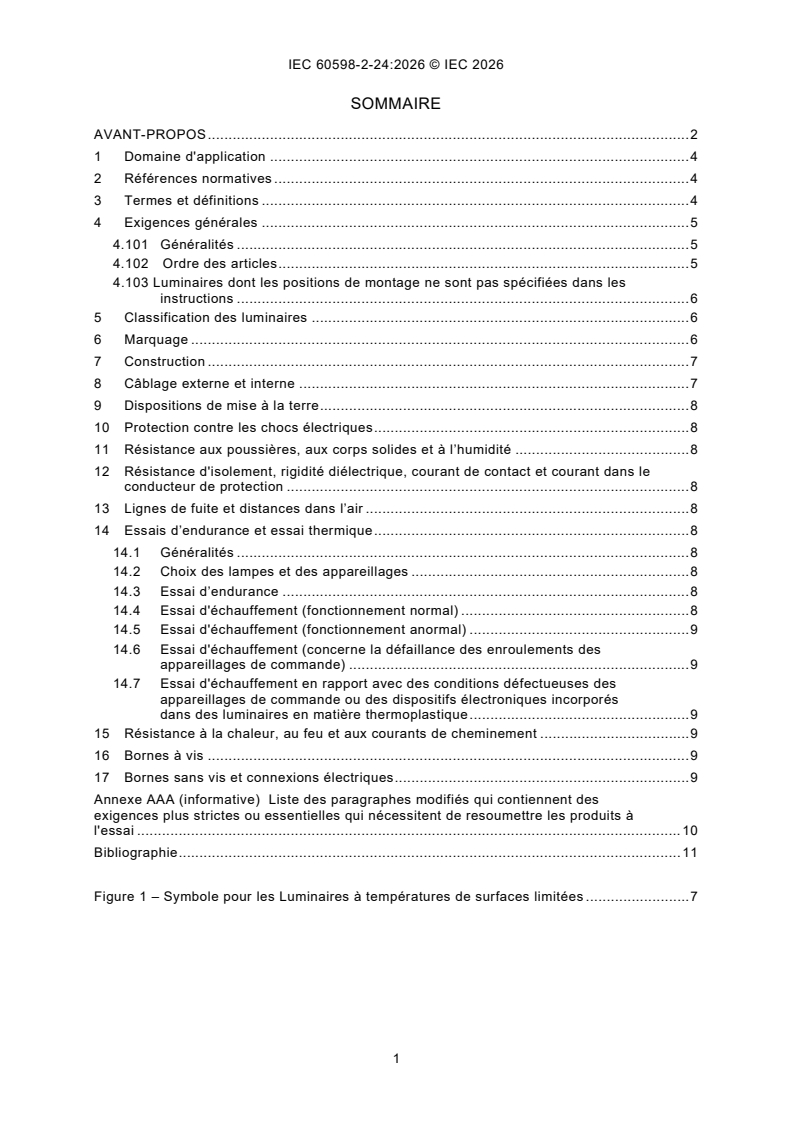
SOMMAIRE
AVANT-PROPOS . 2
1 Domaine d'application . 4
2 Références normatives . 4
3 Termes et définitions . 4
4 Exigences générales . 5
4.101 Généralités . 5
4.102 Ordre des articles . 5
4.103 Luminaires dont les positions de montage ne sont pas spécifiées dans les
instructions . 6
5 Classification des luminaires . 6
6 Marquage . 6
7 Construction . 7
8 Câblage externe et interne . 7
9 Dispositions de mise à la terre . 8
10 Protection contre les chocs électriques . 8
11 Résistance aux poussières, aux corps solides et à l’humidité . 8
12 Résistance d'isolement, rigidité diélectrique, courant de contact et courant dans le
conducteur de protection . 8
13 Lignes de fuite et distances dans l’air . 8
14 Essais d’endurance et essai thermique . 8
14.1 Généralités . 8
14.2 Choix des lampes et des appareillages . 8
14.3 Essai d’endurance . 8
14.4 Essai d'échauffement (fonctionnement normal) . 8
14.5 Essai d'échauffement (fonctionnement anormal) . 9
14.6 Essai d'échauffement (concerne la défaillance des enroulements des
appareillages de commande) . 9
14.7 Essai d'échauffement en rapport avec des conditions défectueuses des
appareillages de commande ou des dispositifs électroniques incorporés
dans des luminaires en matière thermoplastique . 9
15 Résistance à la chaleur, au feu et aux courants de cheminement . 9
16 Bornes à vis . 9
17 Bornes sans vis et connexions électriques . 9
Annexe AAA (informative) Liste des paragraphes modifiés qui contiennent des
exigences plus strictes ou essentielles qui nécessitent de resoumettre les produits à
l'essai . 10
Bibliographie . 11
Figure 1 – Symbole pour les Luminaires à températures de surfaces limitées . 7
COMMISSION ÉLECTROTECHNIQUE INTERNATIONALE
____________
Luminaires -
Partie 2-24: Exigences particulières -
Luminaires à températures de surfaces limitées
AVANT-PROPOS
1) La Commission Électrotechnique Internationale (IEC) est une organisation mondiale de normalisation composée
de l'ensemble des comités électrotechniques nationaux (Comités nationaux de l'IEC). L'IEC a pour objet de
favoriser la coopération internationale pour toutes les questions de normalisation dans les domaines de
l'électricité et de l'électronique. À cet effet, l'IEC – entre autres activités – publie des Normes internationales,
des Spécifications techniques, des Rapports techniques, des Spécifications accessibles au public (PAS) et des
Guides (ci-après dénommés "Publication(s) de l'IEC"). Leur élaboration est confiée à des comités d'études, aux
travaux desquels tout Comité national intéressé par le sujet traité peut participer. Les organisations
internationales, gouvernementales et non gouvernementales, en liaison avec l'IEC, participent également aux
travaux. L'IEC collabore étroitement avec l'Organisation Internationale de Normalisation (ISO), selon des
conditions fixées par accord entre les deux organisations.
2) Les décisions ou accords officiels de l'IEC concernant les questions techniques représentent, dans la mesure du
possible, un accord international sur les sujets étudiés, étant donné que les Comités nationaux de l'IEC intéressés
sont représentés dans chaque comité d'études.
3) Les Publications de l'IEC se présentent sous la forme de recommandations internationales et sont agréées
comme telles par les Comités nationaux de l'IEC. Tous les efforts raisonnables sont entrepris afin que l'IEC
s'assure de l'exactitude du contenu technique de ses publications; l'IEC ne peut pas être tenue responsable de
l'éventuelle mauvaise utilisation ou interprétation qui en est faite par un quelconque utilisateur final.
4) Dans le but d'encourager l'uniformité internationale, les Comités nationaux de l'IEC s'engagent, dans toute la
mesure possible, à appliquer de façon transparente les Publications de l'IEC dans leurs publications nationales
et régionales. Toutes divergences entre toutes Publications de l'IEC et toutes publications nationales ou
régionales correspondantes doivent être indiquées en termes clairs dans ces dernières.
5) L'IEC elle-même ne fournit aucune attestation de conformité. Des organismes de certification indépendants
fournissent des services d'évaluation de conformité et, dans certains secteurs, accèdent aux marques de
conformité de l'IEC. L'IEC n'est responsable d'aucun des services effectués par les organismes de certification
indépendants.
6) Tous les utilisateurs doivent s'assurer qu'ils sont en possession de la dernière édition de cette publication.
7) Aucune responsabilité ne doit être imputée à l'IEC, à ses administrateurs, employés, auxiliaires ou mandataires,
y compris ses experts particuliers et les membres de ses comités d'études et des Comités nationaux de l'IEC,
pour tout préjudice causé en cas de dommages corporels et matériels, ou de tout autre dommage de quelque
nature que ce soit, directe ou indirecte, ou pour supporter les coûts (y compris les frais de justice) et les dépenses
découlant de la publication ou de l'utilisation de cette Publication de l'IEC ou de toute autre Publication de l'IEC,
ou au crédit qui lui est accordé.
8) L’attention est attirée sur les références normatives citées dans cette publication. L'utilisation de publications
référencées est obligatoire pour une application correcte de la présente publication.
9) L'IEC attire l'attention sur le fait que la mise en application du présent document peut entraîner l'utilisation d'un
ou de plusieurs brevets. L'IEC ne prend pas position quant à la preuve, à la validité et à l'applicabilité de tout
droit de brevet revendiqué à cet égard. À la date de publication du présent document, l'IEC n'a pas reçu
notification qu'un ou plusieurs brevets pouvaient être nécessaires à sa mise en application. Toutefois, il y a lieu
d'avertir les responsables de la mise en application du présent document que des informations plus récentes
sont susceptibles de figurer dans la base de données de brevets, disponible à l'adresse https://patents.iec.ch.
L'IEC ne saurait être tenue pour responsable de ne pas avoir identifié de tels droits de brevets.
L’IEC 60598-2-24 a été établie par le sous-comité 34D: Luminaires, du comité d'études 34 de
l'IEC: Éclairage. Il s'agit d'une Norme internationale.
Cette troisième édition annule et remplace la deuxième édition parue en 2013. Cette édition
constitue une révision technique.
Cette édition inclut les modifications techniques significatives suivantes par rapport à l'édition
précédente:
a) alignement de la numérotation des articles et de la structure sur l'IEC 60598-1;
b) amélioration des termes et définitions;
c) classification plus détaillée des luminaires;
d) indication des positions de montage et des emplacements d'utilisation des luminaires;
e) protection thermique exigée pour les appareillages de commande de lampes incorporés et
les autres dispositifs incorporés.
Le texte de cette Norme internationale est issu des documents suivants:
Projet Rapport de vote
34D/1819/FDIS 34D/1828/RVD
Le rapport de vote indiqué dans le tableau ci-dessus donne toute information sur le vote ayant
abouti à son approbation.
La langue employée pour l'élaboration de cette Norme internationale est l'anglais.
Ce document a été rédigé selon les Directives ISO/IEC, Partie 2, il a été développé selon les
Directives ISO/IEC, Partie 1 et les Directives ISO/IEC, Supplément IEC, disponibles sous
www.iec.ch/members_experts/refdocs. Les principaux types de documents développés par
l'IEC sont décrits plus en détail sous www.iec.ch/publications.
Le présent document doit être utilisé conjointement avec la dernière édition de l'IEC 60598-1.
Elle a été établie sur la base de la dixième édition (2024) de cette norme.
NOTE L’expression "Partie 1" utilisée dans le présent document fait référence à l’IEC 60598-1.
Lorsque le présent document spécifie "addition", "modification" ou "remplacement", le texte
correspondant de la Partie 1 doit être adapté en conséquence.
Les paragraphes qui s'ajoutent à ceux de la Partie 1 sont numérotés à partir de 101; les annexes
qui sont ajoutées sont désignées AAA, AAB, etc.
Une liste de toutes les parties de la série IEC 60598, publiées sous le titre général Luminaires,
se trouve sur le site web de l’IEC.
Le comité a décidé que le contenu de ce document ne sera pas modifié avant la date de stabilité
indiquée sur le site web de l'IEC sous webstore.iec.ch dans les données relatives au document
recherché. À cette date, le document sera
– reconduit,
– supprimé, ou
– révisé.
1 Domaine d'application
La présente partie de l'IEC 60598, spécifie les exigences applicab
...