

IEC 61526:2010
(Main)Radiation protection instrumentation - Measurement of personal dose equivalents Hp(10) and Hp(0,07) for X, gamma, neutron and beta radiations - Direct reading personal dose equivalent meters
General Information
- Abstract
IEC 61526:2010 specifies general characteristics, general test procedures, radiation characteristics as well as electrical, mechanical, safety and environmental characteristics. The only requirements specified for associated readout systems are those which affect its accuracy of readout of the personal dose equivalent and alarm settings and those which concern the influence of the reader on the dosemeter. This new edition includes the following significant technical changes with regard to the previous one:
- improved determination of constancy of the dose response and statistical fluctuations;
- abolition of classes of personal dose equivalent meters in relation to retention of stored information;
- inclusion of usage categories of personal dosemeters.
- Status
- Published
- Publication Date
- 21-Jul-2010
- Technical Committee
- SC 45B - Radiation protection instrumentation
- Drafting Committee
- WG 8 - TC 45/SC 45B/WG 8
- Current Stage
- DELPUB - Deleted Publication
- Start Date
- 27-Mar-2024
- Completion Date
- 09-Apr-2020
Buy Documents
IEC 61526:2010 - Radiation protection instrumentation - Measurement of personal dose equivalents Hp(10) and Hp(0,07) for X, gamma, neutron and beta radiations - Direct reading personal dose equivalent meters Released:7/22/2010
Overview
IEC 61526:2010 is an international standard issued by the International Electrotechnical Commission (IEC) focused on radiation protection instrumentation. It specifically covers the measurement of personal dose equivalents Hp(10) and Hp(0.07) for X-ray, gamma, neutron, and beta radiations using direct reading personal dose equivalent meters. These instruments are critical for ensuring occupational safety in radiation environments by providing accurate personal dose monitoring.
This third edition of IEC 61526 incorporates significant technical updates including improved methods for determining dose response stability and statistical fluctuations, removal of classification based on stored information retention, and the introduction of new usage categories for personal dosemeters.
Key Topics
General and mechanical characteristics: Covers size, mass, casing, and switch requirements for dosemeters to ensure durability and ease of use in varied radiation protection scenarios.
Radiation characteristics: Specifies performance parameters related to dose response, energy, and angular dependence for X, gamma, neutron, and beta radiations to guarantee reliable and consistent dose monitoring.
Electrical and environmental requirements: Includes tests and specifications related to power supply reliability, ambient temperature, humidity, pressure, sealing, and storage, ensuring function under diverse operational environments.
Electromagnetic compatibility (EMC): Establishes rigorous tests for electrostatic discharge, radiated fields, conducted disturbances, magnetic fields, and voltage interruptions to protect accurate dose readings in electrically noisy environments.
Alarm functions: Defines requirements for dose equivalent and dose rate alarms, focusing on response times and accuracy to prompt timely protective action for radiation workers.
Testing procedures and performance evaluations: Provides detailed normative test methods for influence quantities, overload conditions, retention of dose readings, additivity, and statistical fluctuations to verify conformance with the standard.
Usage categories and direct reading systems: Classifies personal dosemeters by their application and addresses associated readout systems to ensure the accuracy of displayed personal dose equivalents and alarm settings.
Applications
IEC 61526:2010 applies to radiation protection professionals and industries where X, gamma, neutron, and beta radiation exposure is a concern. Typical applications include:
Nuclear power plants: Monitoring radiation doses for plant operators and maintenance personnel.
Medical and healthcare: Personal dosimetry for radiologists, nuclear medicine staff, and radiotherapy technicians to limit occupational exposure.
Industrial radiography: Ensuring safety of operators working with industrial X-ray sources.
Research laboratories: Personal dose measurement in facilities using radioactive materials or particle accelerators.
Emergency response and safety services: Rapid dose evaluation for personnel involved in radiation accident scenarios.
Implementing this standard helps organizations comply with regulatory limits on radiation exposure, maintains safety, and improves confidence in dose assessment through robust, tested instrumentation.
Related Standards
IEC 61526:2010 complements other international standards concerning radiation protection dosimetry and instrumentation, including:
ISO 4037 - X and gamma reference radiation for calibrating dosemeters and doserate meters.
ISO 14146 - Performance and testing of dosemeters for radiation workers.
IEC 61010 - Safety requirements for electrical equipment used for measurement, control, and laboratory use.
IEC 62387 - Personal dosimetry related to passive and active devices.
These standards, together with IEC 61526, form a comprehensive framework ensuring accuracy, reliability, and safety in personal radiation dose monitoring.
Keywords: IEC 61526:2010, personal dose equivalent meters, radiation protection instrumentation, Hp(10), Hp(0.07), X-ray, gamma radiation, neutron radiation, beta radiation, direct reading dosemeters, personal dosimetry standards, occupational radiation safety, electromagnetic compatibility, radiation dose alarms.
Relations
- Effective Date
- 25-Aug-2026
- Effective Date
- 05-Sep-2023
- Effective Date
- 05-Sep-2023
Buy Documents
IEC 61526:2010 - Radiation protection instrumentation - Measurement of personal dose equivalents Hp(10) and Hp(0,07) for X, gamma, neutron and beta radiations - Direct reading personal dose equivalent meters Released:7/22/2010
Get Certified
Connect with accredited certification bodies for this standard

CIS Institut d.o.o.
Personal Protective Equipment (PPE) certification body. Notified Body NB-2890 for EU Regulation 2016/425 PPE.

Kiwa BDA Testing
Building and construction product certification.
Kmetijski inštitut Slovenije
Agricultural Institute of Slovenia. Soil testing, plant health, agricultural product analysis.
Sponsored listings
Frequently Asked Questions
IEC 61526:2010 is a standard published by the International Electrotechnical Commission (IEC). Its full title is "Radiation protection instrumentation - Measurement of personal dose equivalents Hp(10) and Hp(0,07) for X, gamma, neutron and beta radiations - Direct reading personal dose equivalent meters". This standard covers: IEC 61526:2010 specifies general characteristics, general test procedures, radiation characteristics as well as electrical, mechanical, safety and environmental characteristics. The only requirements specified for associated readout systems are those which affect its accuracy of readout of the personal dose equivalent and alarm settings and those which concern the influence of the reader on the dosemeter. This new edition includes the following significant technical changes with regard to the previous one: - improved determination of constancy of the dose response and statistical fluctuations; - abolition of classes of personal dose equivalent meters in relation to retention of stored information; - inclusion of usage categories of personal dosemeters.
IEC 61526:2010 specifies general characteristics, general test procedures, radiation characteristics as well as electrical, mechanical, safety and environmental characteristics. The only requirements specified for associated readout systems are those which affect its accuracy of readout of the personal dose equivalent and alarm settings and those which concern the influence of the reader on the dosemeter. This new edition includes the following significant technical changes with regard to the previous one: - improved determination of constancy of the dose response and statistical fluctuations; - abolition of classes of personal dose equivalent meters in relation to retention of stored information; - inclusion of usage categories of personal dosemeters.
IEC 61526:2010 is classified under the following ICS (International Classification for Standards) categories: 13.280 - Radiation protection. The ICS classification helps identify the subject area and facilitates finding related standards.
IEC 61526:2010 has the following relationships with other standards: It is inter standard links to EN ISO 15382:2017, IEC 61526:2024, IEC 61526:2005. Understanding these relationships helps ensure you are using the most current and applicable version of the standard.
IEC 61526:2010 is available in PDF format for immediate download after purchase. The document can be added to your cart and obtained through the secure checkout process. Digital delivery ensures instant access to the complete standard document.
Standards Content (Sample)
IEC 61526 ®
Edition 3.0 2010-07
INTERNATIONAL
STANDARD
NORME
INTERNATIONALE
Radiation protection instrumentation – Measurement of personal dose
equivalents H (10) and H (0,07) for X, gamma, neutron and beta radiations –
p p
Direct reading personal dose equivalent meters
Instrumentation pour la radioprotection – Mesure des équivalents de dose
individuels H (10) et H (0,07) pour les rayonnements X, gamma, neutron et
p p
bêta – Appareils de mesure à lecture directe de l’équivalent de dose individuel
All rights reserved. Unless otherwise specified, no part of this publication may be reproduced or utilized in any form or by
any means, electronic or mechanical, including photocopying and microfilm, without permission in writing from either IEC or
IEC's member National Committee in the country of the requester.
If you have any questions about IEC copyright or have an enquiry about obtaining additional rights to this publication,
please contact the address below or your local IEC member National Committee for further information.
Droits de reproduction réservés. Sauf indication contraire, aucune partie de cette publication ne peut être reproduite
ni utilisée sous quelque forme que ce soit et par aucun procédé, électronique ou mécanique, y compris la photocopie
et les microfilms, sans l'accord écrit de la CEI ou du Comité national de la CEI du pays du demandeur.
Si vous avez des questions sur le copyright de la CEI ou si vous désirez obtenir des droits supplémentaires sur cette
publication, utilisez les coordonnées ci-après ou contactez le Comité national de la CEI de votre pays de résidence.
IEC Central Office
3, rue de Varembé
CH-1211 Geneva 20
Switzerland
Email: inmail@iec.ch
Web: www.iec.ch
About the IEC
The International Electrotechnical Commission (IEC) is the leading global organization that prepares and publishes
International Standards for all electrical, electronic and related technologies.
About IEC publications
The technical content of IEC publications is kept under constant review by the IEC. Please make sure that you have the
latest edition, a corrigenda or an amendment might have been published.
ƒ Catalogue of IEC publications: www.iec.ch/searchpub
The IEC on-line Catalogue enables you to search by a variety of criteria (reference number, text, technical committee,…).
It also gives information on projects, withdrawn and replaced publications.
ƒ IEC Just Published: www.iec.ch/online_news/justpub
Stay up to date on all new IEC publications. Just Published details twice a month all new publications released. Available
on-line and also by email.
ƒ Electropedia: www.electropedia.org
The world's leading online dictionary of electronic and electrical terms containing more than 20 000 terms and definitions
in English and French, with equivalent terms in additional languages. Also known as the International Electrotechnical
Vocabulary online.
ƒ Customer Service Centre: www.iec.ch/webstore/custserv
If you wish to give us your feedback on this publication or need further assistance, please visit the Customer Service
Centre FAQ or contact us:
Email: csc@iec.ch
Tel.: +41 22 919 02 11
Fax: +41 22 919 03 00
A propos de la CEI
La Commission Electrotechnique Internationale (CEI) est la première organisation mondiale qui élabore et publie des
normes internationales pour tout ce qui a trait à l'électricité, à l'électronique et aux technologies apparentées.
A propos des publications CEI
Le contenu technique des publications de la CEI est constamment revu. Veuillez vous assurer que vous possédez
l’édition la plus récente, un corrigendum ou amendement peut avoir été publié.
ƒ Catalogue des publications de la CEI: www.iec.ch/searchpub/cur_fut-f.htm
Le Catalogue en-ligne de la CEI vous permet d’effectuer des recherches en utilisant différents critères (numéro de référence,
texte, comité d’études,…). Il donne aussi des informations sur les projets et les publications retirées ou remplacées.
ƒ Just Published CEI: www.iec.ch/online_news/justpub
Restez informé sur les nouvelles publications de la CEI. Just Published détaille deux fois par mois les nouvelles
publications parues. Disponible en-ligne et aussi par email.
ƒ Electropedia: www.electropedia.org
Le premier dictionnaire en ligne au monde de termes électroniques et électriques. Il contient plus de 20 000 termes et
définitions en anglais et en français, ainsi que les termes équivalents dans les langues additionnelles. Egalement appelé
Vocabulaire Electrotechnique International en ligne.
ƒ Service Clients: www.iec.ch/webstore/custserv/custserv_entry-f.htm
Si vous désirez nous donner des commentaires sur cette publication ou si vous avez des questions, visitez le FAQ du
Service clients ou contactez-nous:
Email: csc@iec.ch
Tél.: +41 22 919 02 11
Fax: +41 22 919 03 00
IEC 61526 ®
Edition 3.0 2010-07
INTERNATIONAL
STANDARD
NORME
INTERNATIONALE
Radiation protection instrumentation – Measurement of personal dose
equivalents H (10) and H (0,07) for X, gamma, neutron and beta radiations –
p p
Direct reading personal dose equivalent meters
Instrumentation pour la radioprotection – Mesure des équivalents de dose
individuels H (10) et H (0,07) pour les rayonnements X, gamma, neutron et
p p
bêta – Appareils de mesure à lecture directe de l’équivalent de dose individuel
INTERNATIONAL
ELECTROTECHNICAL
COMMISSION
COMMISSION
ELECTROTECHNIQUE
PRICE CODE
INTERNATIONALE
XA
CODE PRIX
ICS 13.280 ISBN 978-2-88912-063-5
– 2 – 61526 © IEC:2010
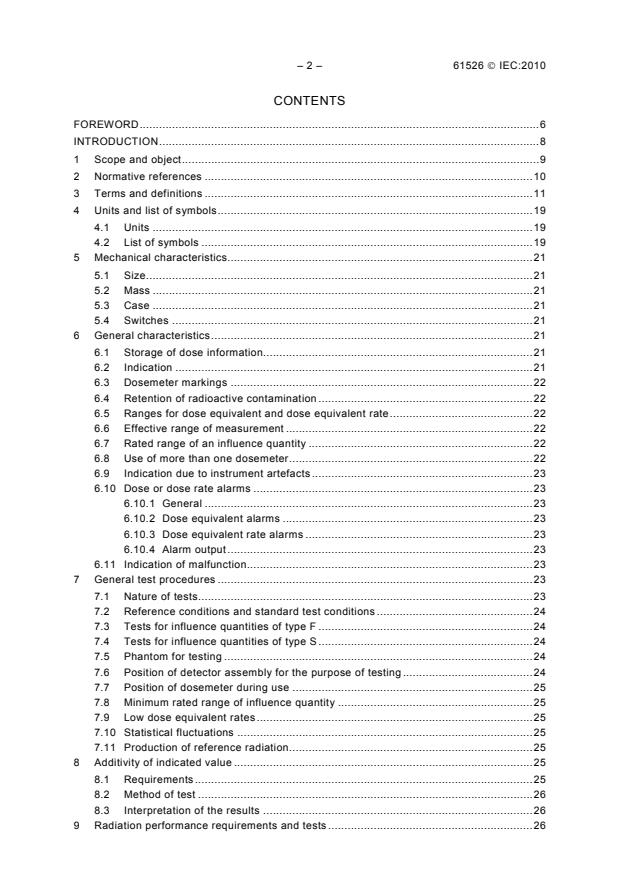
CONTENTS
FOREWORD.6
INTRODUCTION.8
1 Scope and object.9
2 Normative references .10
3 Terms and definitions .11
4 Units and list of symbols.19
4.1 Units .19
4.2 List of symbols .19
5 Mechanical characteristics.21
5.1 Size.21
5.2 Mass .21
5.3 Case .21
5.4 Switches .21
6 General characteristics.21
6.1 Storage of dose information.21
6.2 Indication .21
6.3 Dosemeter markings .22
6.4 Retention of radioactive contamination .22
6.5 Ranges for dose equivalent and dose equivalent rate.22
6.6 Effective range of measurement .22
6.7 Rated range of an influence quantity .22
6.8 Use of more than one dosemeter.22
6.9 Indication due to instrument artefacts .23
6.10 Dose or dose rate alarms .23
6.10.1 General .23
6.10.2 Dose equivalent alarms .23
6.10.3 Dose equivalent rate alarms .23
6.10.4 Alarm output.23
6.11 Indication of malfunction.23
7 General test procedures .23
7.1 Nature of tests.23
7.2 Reference conditions and standard test conditions .24
7.3 Tests for influence quantities of type F .24
7.4 Tests for influence quantities of type S.24
7.5 Phantom for testing .24
7.6 Position of detector assembly for the purpose of testing .24
7.7 Position of dosemeter during use .25
7.8 Minimum rated range of influence quantity .25
7.9 Low dose equivalent rates.25
7.10 Statistical fluctuations .25
7.11 Production of reference radiation.25
8 Additivity of indicated value .25
8.1 Requirements.25
8.2 Method of test .26
8.3 Interpretation of the results .26
9 Radiation performance requirements and tests .26
61526 © IEC:2010 – 3 –
9.1 General .26
9.2 Consideration of the uncertainty of the conventional quantity value .27
9.3 Constancy of the dose response, dose rate dependence and statistical
fluctuations.27
9.3.1 General .27
9.3.2 Requirements .27
9.3.3 Method of test using sources .27
9.3.4 Interpretation of the results of the test using sources.28
9.3.5 Method of test for photon dosemeters using natural radiation .28
9.3.6 Interpretation of the results of the test using natural radiation.28
9.4 Variation of the response due to photon radiation energy and angle of
incidence.29
p
&
9.4.1 Measurement quantity H (0,07) or H (0,07) .29
p
p
&
9.4.2 Measurement quantity H (10) or H (10) .29
p
9.5 Variation of the response due to neutron radiation energy and angle of
incidence.30
p
&
9.5.1 Measurement quantity H (10) or H (10) .30
p
9.6 Variation of the response due to beta radiation energy and angle of
incidence.31
0,07
p
&
()
9.6.1 Measurement quantity H (0,07) or H .31
p
p
&
()
9.6.2 Measurement quantity H (10) or H .32
p
9.7 Retention of dose equivalent reading .32
9.7.1 General .32
9.7.2 Requirements .33
9.7.3 Method of test and interpretation of the results .33
9.8 Overload characteristics .33
9.8.1 General .33
9.8.2 Requirements .33
9.8.3 Method of test and interpretation of the results .33
9.9 Alarm .34
9.9.1 General .34
9.9.2 Response time for dose equivalent rate indication and alarm.34
9.9.3 Accuracy of dose equivalent alarm .35
9.9.4 Accuracy of dose equivalent rate alarm .35
9.10 Model function.36
10 Electrical and environmental performance requirements and tests.36
10.1 General .36
10.2 Power supplies.36
10.2.1 General requirements .36
10.2.2 Specific primary batteries requirements .36
10.2.3 Specific secondary batteries requirements.37
10.2.4 Method of test and interpretation of the results (primary and
secondary batteries) .37
10.3 Ambient temperature .38
10.3.1 Requirements .38
10.3.2 Method of test and interpretation of the results .39
10.4 Relative humidity.39
10.4.1 Requirements .39
– 4 – 61526 © IEC:2010
10.4.2 Method of test and interpretation of the results .40
10.5 Atmospheric pressure.40
10.6 Sealing.40
10.7 Storage .40
11 Electromagnetic performance requirements and tests.40
11.1 General .40
11.2 Electrostatic discharge .41
11.2.1 Requirements .41
11.2.2 Test method and interpretation of the results .41
11.3 Radiated electromagnetic fields.41
11.3.1 Requirements .41
11.3.2 Test method and interpretation of the results .41
11.4 Conducted disturbances induced by fast transients or bursts.42
11.4.1 Requirements .42
11.4.2 Method of test and interpretation of the results .42
11.5 Conducted disturbances induced by surges.42
11.5.1 Requirements .42
11.5.2 Method of test and interpretation of the results .42
11.6 Conducted disturbances induced by radio-frequencies .42
11.6.1 Requirements .42
11.6.2 Method of test and interpretation of the results .42
11.7 50 Hz/60 Hz magnetic field.43
11.7.1 Requirements .43
11.7.2 Method of test and interpretation of the results .43
11.8 Voltage dips and short interruptions .43
11.8.1 Requirements .43
11.8.2 Method of test and interpretation of the results .43
12 Mechanical performance, requirements and tests .43
12.1 General .43
12.2 Drop test .43
12.2.1 Requirements .43
12.2.2 Method of test and interpretation of the results .43
12.3 Vibration test.44
12.3.1 Requirements .44
12.3.2 Method of test and interpretation of the results .44
12.4 Microphonics test .44
12.4.1 Requirements .44
12.4.2 Method of test and interpretation of the results .44
13 Uncertainty.44
14 Documentation .45
14.1 Type test report.45
14.2 Certificate .45
15 Operation and maintenance manual .45
Annex A (normative) Statistical fluctuations .54
Annex B (informative) Procedure to determine the variation of the relative response
due to radiation energy and angle of radiation incidence.56
Annex C (informative) Usage categories of personal dosemeters.58
Bibliography.59
61526 © IEC:2010 – 5 –
Table 1 – Symbols (and abbreviated terms) .19
Table 2 – Values of c and c for w different dose values and n indications for each
1 2
dose value .47
Table 3 – Reference conditions and standard test conditions .48
Table 4 – Radiation characteristics of H (0,07) dosemeters for X, gamma and beta
p
radiation .49
Table 5 – Radiation characteristics of H (10) dosemeters for X and gamma radiation .50
p
Table 6 – Radiation characteristics of H (10) dosemeters for neutron radiation.51
p
Table 7 – Electrical and environmental characteristics of dosemeters .52
Table 8 – Electromagnetic disturbance characteristics of dosemeters .53
Table 9 – Mechanical disturbances characteristics of dosemeters.53
Table A.1 – Number of instrument readings required to detect true differences (95 %
145H55
confidence level) between two sets of instrument readings on the same instrumentT.
Table C.1 – Usage categories of personal dosemeters .146H58
– 6 – 61526 © IEC:2010
INTERNATIONAL ELECTROTECHNICAL COMMISSION
____________
RADIATION PROTECTION INSTRUMENTATION –
MEASUREMENT OF PERSONAL DOSE EQUIVALENTS H (10)
p
AND H (0,07) for X, GAMMA, NEUTRON AND BETA RADIATIONS –
p
DIRECT READING PERSONAL DOSE EQUIVALENT METERS
FOREWORD
1) The International Electrotechnical Commission (IEC) is a worldwide organization for standardization comprising
all national electrotechnical committees (IEC National Committees). The object of IEC is to promote
international co-operation on all questions concerning standardization in the electrical and electronic fields. To
this end and in addition to other activities, IEC publishes International Standards, Technical Specifications,
Technical Reports, Publicly Available Specifications (PAS) and Guides (hereafter referred to as “IEC
Publication(s)”). Their preparation is entrusted to technical committees; any IEC National Committee interested
in the subject dealt with may participate in this preparatory work. International, governmental and non-
governmental organizations liaising with the IEC also participate in this preparation. IEC collaborates closely
with the International Organization for Standardization (ISO) in accordance with conditions determined by
agreement between the two organizations.
2) The formal decisions or agreements of IEC on technical matters express, as nearly as possible, an international
consensus of opinion on the relevant subjects since each technical committee has representation from all
interested IEC National Committees.
3) IEC Publications have the form of recommendations for international use and are accepted by IEC National
Committees in that sense. While all reasonable efforts are made to ensure that the technical content of IEC
Publications is accurate, IEC cannot be held responsible for the way in which they are used or for any
misinterpretation by any end user.
4) In order to promote international uniformity, IEC National Committees undertake to apply IEC Publications
transparently to the maximum extent possible in their national and regional publications. Any divergence
between any IEC Publication and the corresponding national or regional publication shall be clearly indicated in
the latter.
5) IEC itself does not provide any attestation of conformity. Independent certification bodies provide conformity
assessment services and, in some areas, access to IEC marks of conformity. IEC is not responsible for any
services carried out by independent certification bodies.
6) All users should ensure that they have the latest edition of this publication.
7) No liability shall attach to IEC or its directors, employees, servants or agents including individual experts and
members of its technical committees and IEC National Committees for any personal injury, property damage or
other damage of any nature whatsoever, whether direct or indirect, or for costs (including legal fees) and
expenses arising out of the publication, use of, or reliance upon, this IEC Publication or any other IEC
Publications.
8) Attention is drawn to the Normative references cited in this publication. Use of the referenced publications is
indispensable for the correct application of this publication.
9) Attention is drawn to the possibility that some of the elements of this IEC Publication may be the subject of
patent rights. IEC shall not be held responsible for identifying any or all such patent rights.
International Standard IEC 61526 has been prepared by subcommittee 45B: Radiation
protection instrumentation, of IEC technical committee 45: Nuclear instrumentation.
This third edition cancels and replaces the second edition published in 2005. This edition
constitutes a technical revision. This edition includes the following significant technical
changes with regard to the previous edition:
– Inclusion of terms and definitions from ISO/IEC Guide 99:2007 (VIM:2008).
– Full consistency with IEC/TR 62461:2006 “Radiation protection instrumentation – Deter-
mination of uncertainty in measurement”.
– Improved determination of constancy of the dose response and statistical fluctuations.
– Abolition of classes of personal dose equivalent meters in relation to retention of stored
information.
– Inclusion of usage categories of personal dosemeters in Annex C.
61526 © IEC:2010 – 7 –
The text of this standard is based on the following documents:
FDIS Report on voting
45B/648/FDIS 45B/666/RVD
Full information on the voting for the approval of this standard can be found in the report on
voting indicated in the above table.
This publication has been drafted in accordance with the ISO/IEC Directives, Part 2.
The committee has decided that the contents of this publication will remain unchanged until
the stability date indicated on the IEC web site under "http://webstore.iec.ch" in the data
related to the specific publication. At this date, the publication will be
• reconfirmed,
• withdrawn,
• replaced by a revised edition, or
• amended.
– 8 – 61526 © IEC:2010
INTRODUCTION
This International Standard applies to active, direct reading personal dose equivalent meters
and monitors used for measuring the personal dose equivalents H (10) and H (0,07) for X,
p p
gamma, neutron and beta radiations.
&
For the personal dose equivalent H (10) or the personal dose equivalent rate H ()10 and for
p p
X and gamma radiations, two minimum rated ranges for the photon energy are given. The first
from 20 keV to 150 keV is for workplaces where low energy X-rays are used, e.g., in medical
diagnostic, the second from 80 keV to 1,5 MeV is for workplaces where high energy X-rays
and/or gamma sources are used, e.g., in industry. For neutron radiation the minimum rated
range of neutron energy is from 0,025 eV (thermal neutrons) to 5 MeV. The rated ranges can
be extended to all energies covered by the respective standards for reference radiation fields.
For the personal dose equivalent H (0,07) and for X and gamma radiations, a minimum rated
p
range for the photon energy from 20 keV to 150 keV is given and for beta radiation, the
minimal rated range is from 0,2 MeV to 0,8 MeV. The rated ranges can be extended to all
energies covered by the respective standards for reference radiation fields.
Examples of extended rated ranges are given in Annex C.
In some applications, for example, at a nuclear reactor installation where 6 MeV photon radi-
ation is present, measurement of personal dose equivalent (rate) H (10) for photon energies
p
up to 10 MeV should be required. In some other applications, measurement of H (10) down to
p
10 keV should be required.
For personal dose equivalent meters, requirements for measuring the dose quantities H (10)
p
& &
and H (0,07) and for monitoring of the dose rate quantities H ()10 and H()0,07 are given.
p p
p
The measurement of these dose rate quantities is an option for personal dose equivalent
meters.
Establishments in some countries may wish to use this type of personal dose equivalent
meter as the dosemeter to provide the dose of record by an approved dosimetry service.
61526 © IEC:2010 – 9 –
RADIATION PROTECTION INSTRUMENTATION –
MEASUREMENT OF PERSONAL DOSE EQUIVALENTS H (10)
p
AND H (0,07) for X, GAMMA, NEUTRON AND BETA RADIATIONS –
p
DIRECT READING PERSONAL DOSE EQUIVALENT METERS
1 Scope and object
This International Standard applies to personal dose equivalent meters with the following
characteristics:
a) They are worn on the trunk or the extremities of the body.
b) They measure the personal dose equivalents H (10) and H (0,07) from external X and
p p
gamma, neutron and beta radiations, and may measure the personal dose equivalent rates
& &
H ()10 and H()0,07 .
p p
c) They have a digital indication.
d) They may have alarm functions for the personal dose equivalents or personal dose
equivalent rates.
This standard is therefore applicable to the measurement of the following combinations of
dose quantities (including the respective dose rates) and radiation
1) H (10) and H (0,07) from X and gamma radiations;
p p
2) H (10) and H (0,07) from X, gamma and beta radiations;
p p
3) H (10) from X and gamma radiations;
p
4) H (10) from neutron radiations;
p
5) H (10) from X, gamma and neutron radiations;
p
6) H (0,07) from X, gamma and beta radiations.
p
NOTE 1 When reference is made in this standard to ”dose”, this is meant to indicate personal dose equivalent,
unless otherwise stated.
NOTE 2 When reference is made in this standard to ”dosemeter”, this is meant to include all personal dose
equivalent meters, unless otherwise stated.
This standard specifies requirements for the dosemeter and, if supplied, for its associated
readout system.
This standard specifies, for the dosemeters described above, general characteristics, general
test procedures, radiation characteristics as well as electrical, mechanical, safety and envi-
ronmental characteristics. The only requirements specified for associated readout systems
are those which affect its accuracy of readout of the personal dose equivalent and alarm
settings and those which concern the influence of the reader on the dosemeter.
This standard also specifies in Annex C usage categories with respect to different measuring
capabilities.
This standard does not cover special requirements for accident or emergency dosimetry
although the dosemeters may be used for this purpose. The standard does not apply to
dosemeters used for measurement of pulsed radiation, such as radiation emanating from most
medical diagnostic X-ray facilities, linear accelerators or similar equipment.
– 10 – 61526 © IEC:2010
2 Normative references
The following referenced documents are indispensable for the application of this document.
For dated references, only the edition cited applies. For undated references, the latest edition
of the referenced document (including any amendments) applies.
IEC 60050-393:2003, International Electrotechnical Vocabulary (IEV) – Part 393: Nuclear
instrumentation – Physical phenomena and basic concepts
IEC 60050-394:2007, International Electrotechnical Vocabulary (IEV) – Part 394: Nuclear
instrumentation – Instruments, systems, equipment and detectors
IEC 60068-2-31:2008, Environmental testing – Part 2-31: Tests – Test Ec: Rough handling
shocks, primarily for equipment-type specimens
IEC 60086-1:2006, Primary batteries – Part 1: General
IEC 60086-2:2006, Primary batteries – Part 2: Physical and electrical specifications
IEC 60359:2001, Electrical and electronic measurement equipment – Expression of
performance
IEC 60529:1989, Degrees of protection provided by enclosures (IP Code)
Amendment 1 (1999) 1F1F0F
IEC 61000-4-2:2008, Electromagnetic compatibility (EMC) – Part 4-2: Testing and
measurement techniques – Electrostatic discharge immunity test
IEC 61000-4-3:2008, Electromagnetic compatibility (EMC) – Part 4-3: Testing and measurement
techniques – Radiated, radio-frequency, electromagnetic field immunity test
IEC 61000-4-4:2004, Electromagnetic compatibility (EMC) – Part 4-4: Testing and measure-
ment techniques – Electrical fast transient/burst immunity test
IEC 61000-4-5:2005, Electromagnetic compatibility (EMC) – Part 4-5: Testing and
measurement techniques – Surge immunity test
IEC 61000-4-6:2008, Electromagnetic compatibility (EMC) – Part 4-6: Testing and measurement
techniques – Immunity to conducted disturbances, induced by radio-frequency fields
IEC 61000-4-8:2009, Electromagnetic compatibility (EMC) – Part 4-8: Testing and measurement
techniques – Power frequency magnetic field immunity test
IEC 61000-4-11:2004, Electromagnetic compatibility (EMC) – Part 4-11: Testing and
measurement techniques – Voltage dips, short interruptions and voltage variations immunity
tests
IEC 61000-6-2:2005, Electromagnetic compatibility (EMC) – Part 6-2: Generic standards –
Immunity for industrial environments
IEC 61187:1993, Electrical and electronic measuring equipment – Documentation
IEC/TR 62461:2006, Radiation protection instrumentation – Determination of uncertainty in
measurement
———————
1 There exists a consolidated edition (2.1) which includes IEC 60529 (1989) and its Amendment 1 (1999).
61526 © IEC:2010 – 11 –
ISO/IEC Guide 98-3:2008, Uncertainty of measurement – Part 3: Guide to the expression of
uncertainty in measurement (GUM:1995)
ISO/IEC Guide 98-3:2008/Suppl.1:2008, Propagation of distributions using a Monte Carlo
method and Corr.1 (2009)
ISO 4037-1:1996, X and gamma reference radiation for calibrating dosemeters and doserate
meters and for determining their response as a function of photon energy – Part 1: Radiation
characteristics and production methods
ISO 4037-2:1997, X and gamma reference radiation for calibrating dosemeters and doserate
meters and for determining their response as a function of photon energy – Part 2: Dosimetry
for radiation protection over the energy ranges from 8 keV to 1,3 MeV and 4 MeV to 9 MeV
ISO 4037-3:1999, X and gamma reference radiation for calibrating dosemeters and doserate
meters and for determining their response as a function of photon energy – Part 3: Calibration
of area and personal dosemeters and the measurement of their response as a function of
energy and angle of incidence
ISO 4037-4:2004, X and gamma reference radiation for calibrating dosemeters and doserate
meters and for determining their response as a function of photon energy – Part 4: Calibration
of area and personal dosemeters in low energy X reference radiation fields
ISO 6980-1:2006, Nuclear energy – Reference beta-particle radiation – Part 1: Method of
production
ISO 6980-2:2004, Nuclear energy – Reference beta-particle radiation – Part 2: Calibration
fundamentals related to basic quantities characterizing the radiation field
ISO 6980-3:2006, Nuclear energy – Reference beta-particle radiation – Part 3: Calibration of
area and personal dosemeters and the determination of their response as a function of beta
radiation energy and angle of incidence
ISO 8529-1:2001, Reference neutron radiations – Part 1: Characteristics and methods of
production
ISO 8529-2:2000, Reference neutron radiations – Part 2: Calibration fundamentals of
radiation protection devices related to the basic quantities characterizing the radiation field
ISO 8529-3:1998, Reference neutron radiations – Part 3: Calibration of area and personal
dosemeters and determination of response as a function of energy and angle of incidence
ISO 12789-1:2008, Reference radiation fields – Simulated workplace neutron fields – Part 1:
Characteristics and methods of production
ISO 12789-2:2008, Reference radiation fields – Simulated workplace neutron fields – Part 2:
Calibration fundamentals related to the basic quantities
ICRU report 51:1993, Quantities and units in radiation protection dosimetry
3 Terms and definitions
For the purposes of this document, the terms and definitions given in IEC 60050-393,
IEC 60050-394, IEC 60359 and ICRU Report 51, as well as the following terms and
definitions, apply.
– 12 – 61526 © IEC:2010
3.1
acceptance test
contractual test to prove to the customer that the device meets certain conditions of its
specification
[IEV 394-20-09; IEV 151-16-23; IEV 394-40-05]
3.2
calibration (for the purpose of this standard)
quantitative determination of the reference calibration factor, N , and the correction for non-
constant response, r , under a controlled set of standard test conditions for which all the m
n
relative response values, r , are unity and all the l deviations, D , are zero
q p
3.3
calibration factor
N
quotient of the conventional true value of a quantity, H , and the indicated value, G , at the
r r
point of test for a specified reference radiation under specified reference conditions. It is
expressed as
H
r
N =
G
r
NOTE 1 (See ISO 4037-3) The calibration factor N is dimensionless when the instrument indicates the quantity to
be measured. A dosemeter indicating the conventional quantity value correctly has the calibration factor of one.
NOTE 2 (See ISO 4037-3) The reciprocal of the calibration factor is equal to the response under reference
conditions. In contrast to the calibration factor, which refers to the reference conditions only, the response refers to
any condition prevailing at the time of measurement.
NOTE 3 (See ISO 4037-3) The value of the calibration factor may vary with the magnitude of the quantity to be
measured. In such cases, a dosemeter is said to have a non-constant response.
3.4
coefficient of variation
ratio of the standard deviation s to the arithmetic mean x of a set of n measurements x given
i
by the following formula:
n
s 1 1
()
v = = x − x
∑ i
x x n − 1
i =1
[IEV 394-40-14]
3.5
combined standard measurement uncertainty
combined standard uncertainty
u
c
standard measurement uncertainty that is obtained using the individual standard measure-
ment uncertainties associated with the input quantities in a measurement model
NOTE In case of correlations of input quantities in a measurement model, covariances must also be taken into
account when calculating the combined standard measurement uncertainty; see also ISO/IEC Guide 98-
3:2008,2.3.4.
[ISO/IEC Guide 98-3:2008, 2.31]
61526 © IEC:2010 – 13 –
3.6
conventional quantity value
conventional value of a quantity
conventional value
quantity value attributed by agreement to a quantity for a given purpose
NOTE 1 The term “conventional true quantity value” is sometimes used for this concept, but its use is
discouraged.
NOTE 2 Sometimes a conventional quantity value is an estimate of a true quantity value.
NOTE 3 A conventional quantity value is generally accepted as being associated with a suitably small measure-
ment uncertainty, which might be zero.
[ISO/IEC Guide 98-3:2008, 2.12]
NOTE 4 In this standard the quantity is the dose equivalent (rate).
3.7
correction for non-constant response
r
n
quotient of the response, R, under specified conditions where only the quantity to be
measured is varied and the reference response, R . It is expressed as
R
r =
n
R
NOTE For an instrument with constant response, r is equal to one.
n
3.8
detector assembly
assembly of a radiation detector and the associated components needed for the calibration or
the determination of the response
NOTE The calibration result is only valid for this detector assembly.
EXAMPLE A personal dosemeter is to be calibrated using a phantom. The combination of personal dosemeter
and phantom and possibly further reading instruments and cables comprise one detector assembly.
[ISO/DIS 29661, 3.1.10]
3.9
deviation
D
difference between the indicated values for the same value of the measurand of a dose
equivalent (rate) meter, when an influence quantity assumes, successively, two different
values
[IEV 311-07-03, modified]
D = G – G
r
where G is the indicated value under the effect of an influence quantity and
G is the indicated value under reference conditions.
r
NOTE 1 The original term in IEV 311-07-03 reads “variation (due to an influence quantity)”. In order not to
confuse variation (of the indicated value) and variation of the response, in this standard, the term is called
“deviation”.
NOTE 2 The deviation can be positive or negative resulting in an increase or a decrease of the indicated value,
respectively.
NOTE 3 The deviation is of special importance for influence quantities of type S.
– 14 – 61526 © IEC:2010
3.10
effective range of measurement
range of values of the quantity to be measured over which the performance of a dosemeter
meets the requirements of this standard
[IEV 394-20-16, modified]
3.11
expanded measurement uncertainty
expanded uncertainty
U
product of a combined standard measurement uncertainty and a factor larger than the number
one
NOTE 1 The factor depends upon the type of probability distribution of the output quantity in a measurement model
and on the selected coverage probability.
NOTE 2 The term “factor” in this definition refers to a coverage factor.
NOTE 3 Expanded measurement uncertainty is termed “overall uncertainty” in paragraph 5 of Recommendation
INC-1 (1980) (see the GUM) and simply “uncertainty” in IEC doc
...