

IEC 60404-7:2019
(Main)Magnetic materials - Part 7: Method of measurement of the coercivity (up to 160 kA/m) of magnetic materials in an open magnetic circuit
General Information
- Abstract
IEC 60404-7:2019 specifies a method of measurement of the coercivity of magnetic materials in an open magnetic circuit. This document is applicable to all magnetic materials with coercivities from 0,2 A/m to 160 kA/m.
This edition includes the following significant technical changes with respect to the previous edition:
Clause 1: The scope includes a more detailed description of the magnetic materials which applies to this standard;
Clause 4: Figure 2 – circuit diagram for methods A and B was simplified and the fluxgate probes inside the solenoid have been added;
Clause 7: Compensation for the earth’s magnetic field and for static and dynamic magnetic noise fields has been added;
Clause 8: Magnetic shielding of the measuring region has been added;
9.2.2: The measuring methods for local and integral measurement of the flux in the test specimen have been separated and the limitations in size and shape of the test specimen have been considered.
9:3: The method C with a VSM (Vibrating Sample Magnetometer) has been moved from 9.3 to the Annex B.
The term "complex shaped test specimen" has been replaced in several clauses by "test specimen different from ellipsoids".
The character of Annex A has been changed from “informative” to “normative”.
- Status
- Published
- Publication Date
- 15-Jan-2019
- Technical Committee
- TC 68 - Magnetic alloys and steels
- Drafting Committee
- WG 2 - TC 68/WG 2
- Current Stage
- PPUB - Publication issued
- Start Date
- 16-Jan-2019
- Completion Date
- 14-Jan-2019
Overview
IEC 60404-7:2019 is an international standard issued by the International Electrotechnical Commission (IEC) that specifies a standardized method for measuring the coercivity of magnetic materials in an open magnetic circuit. This document applies to magnetic materials with coercivities ranging from 0.2 A/m to 160 kA/m, encompassing a broad spectrum of magnetic alloys including amorphous alloys, nanocrystalline alloys, soft magnetic crystalline materials (such as Fe, FeSi-, CoFe-, and FeNi-based alloys), soft ferrites, hard metals, and semi-hard magnetic alloys like FeCoTiAl, FeCoV, FeCrCo, and AlNiCo alloys.
The 2019 edition introduces critical updates to improve measurement accuracy and broaden applicability, including enhanced compensation for environmental magnetic noise and detailed handling of test specimens with various shapes.
Keywords: IEC 60404-7, magnetic materials, coercivity measurement, open magnetic circuit, magnetic alloys, magnetic testing standards, coercive field strength.
Key Topics
Scope and Applicability:
Applies to all magnetic materials with coercivity values between 0.2 A/m and 160 kA/m. Special procedures are outlined for materials with low coercivities (<40 A/m) and non-ellipsoidal test specimen shapes.Measurement Principle:
The standard details methods to measure coercivity, defined as the coercive field strength when magnetic flux density or polarization is reduced from saturation to zero, using an open magnetic circuit setup.Measurement Methods:
The document includes multiple methods:- Method A and B - Employ flux sensing probes such as Hall probes or differential fluxgate probes inside the solenoid, with methods separated for local and integral flux measurements.
- Method C - Uses a Vibrating Sample Magnetometer (VSM), now described in Annex B, offering an alternative measurement technique.
Technical Enhancements:
Updates feature:- Simplified circuit diagrams with added fluxgate probes inside the solenoid for enhanced measurement precision.
- Compensation techniques for Earth’s magnetic field and mitigation of static and dynamic magnetic noise for greater accuracy.
- Magnetic shielding of the measurement region to minimize external magnetic interference.
- Clear differentiation between measurements for local flux and integral flux in specimens, including considerations for specimen size and shape.
- Revised terminology replacing "complex shaped test specimen" with "test specimen different from ellipsoids" for clarity.
Test Specimen Requirements:
Provisions advise on specimen form factors, with specific attention to shapes that influence flux measurement, as well as special precautions when testing materials with low coercivity or high electrical conductivity.
Applications
IEC 60404-7:2019 serves as a fundamental reference for laboratories, manufacturers, and researchers engaged in:
- Accurate characterization of magnetic properties in advanced materials used in electronics, electrical machinery, sensors, and magnetic storage devices.
- Quality control and conformity testing of magnetic alloys and composites in industrial production.
- Research and development environments evaluating new magnetic materials or coatings, ensuring compliance with globally recognized measurement protocols.
- Facilitating consistency in coercivity measurement for magnetic materials used in power generation, transformers, and telecommunications.
The standard's comprehensive approach to noise compensation and specimen handling extends applicability to diverse materials and complex testing environments, ensuring reliable coercivity data essential for magnetic design and engineering.
Related Standards
IEC 60404-7:2019 is part of the broader IEC 60404 series on magnetic materials and is closely related to:
- IEC 60404 (general series): Covers magnetic material testing methods and terminology.
- Other parts of IEC 60404 series addressing specific material types or magnetic properties such as permeability, remanence, and hysteresis.
- ISO and IEC Electropedia - For standardized definitions and terminology related to electromagnetic and magnetic materials.
- Industry-specific standards that may reference IEC 60404-7 as a benchmark for coercivity testing and magnetic material qualification.
For those implementing IEC 60404-7, staying current with the latest editions and complementary standards in magnetic materials ensures best practices and conformity in material characterization.
For accurate coercivity measurement in magnetic materials, IEC 60404-7:2019 provides essential guidance, promoting precision, repeatability, and harmonization in the global electrotechnical community.
Get Certified
Connect with accredited certification bodies for this standard

IMQ S.p.A. (Certification)
Italian electrical product certification.

SLG Prüf- und Zertifizierungs GmbH
German testing and certification body.

UL Solutions
Global safety science company with testing, inspection and certification.
Sponsored listings
Frequently Asked Questions
IEC 60404-7:2019 is a standard published by the International Electrotechnical Commission (IEC). Its full title is "Magnetic materials - Part 7: Method of measurement of the coercivity (up to 160 kA/m) of magnetic materials in an open magnetic circuit". This standard covers: IEC 60404-7:2019 specifies a method of measurement of the coercivity of magnetic materials in an open magnetic circuit. This document is applicable to all magnetic materials with coercivities from 0,2 A/m to 160 kA/m. This edition includes the following significant technical changes with respect to the previous edition: Clause 1: The scope includes a more detailed description of the magnetic materials which applies to this standard; Clause 4: Figure 2 – circuit diagram for methods A and B was simplified and the fluxgate probes inside the solenoid have been added; Clause 7: Compensation for the earth’s magnetic field and for static and dynamic magnetic noise fields has been added; Clause 8: Magnetic shielding of the measuring region has been added; 9.2.2: The measuring methods for local and integral measurement of the flux in the test specimen have been separated and the limitations in size and shape of the test specimen have been considered. 9:3: The method C with a VSM (Vibrating Sample Magnetometer) has been moved from 9.3 to the Annex B. The term "complex shaped test specimen" has been replaced in several clauses by "test specimen different from ellipsoids". The character of Annex A has been changed from “informative” to “normative”.
IEC 60404-7:2019 specifies a method of measurement of the coercivity of magnetic materials in an open magnetic circuit. This document is applicable to all magnetic materials with coercivities from 0,2 A/m to 160 kA/m. This edition includes the following significant technical changes with respect to the previous edition: Clause 1: The scope includes a more detailed description of the magnetic materials which applies to this standard; Clause 4: Figure 2 – circuit diagram for methods A and B was simplified and the fluxgate probes inside the solenoid have been added; Clause 7: Compensation for the earth’s magnetic field and for static and dynamic magnetic noise fields has been added; Clause 8: Magnetic shielding of the measuring region has been added; 9.2.2: The measuring methods for local and integral measurement of the flux in the test specimen have been separated and the limitations in size and shape of the test specimen have been considered. 9:3: The method C with a VSM (Vibrating Sample Magnetometer) has been moved from 9.3 to the Annex B. The term "complex shaped test specimen" has been replaced in several clauses by "test specimen different from ellipsoids". The character of Annex A has been changed from “informative” to “normative”.
IEC 60404-7:2019 is classified under the following ICS (International Classification for Standards) categories: 17.220.20 - Measurement of electrical and magnetic quantities; 29.030 - Magnetic materials. The ICS classification helps identify the subject area and facilitates finding related standards.
IEC 60404-7:2019 is available in PDF format for immediate download after purchase. The document can be added to your cart and obtained through the secure checkout process. Digital delivery ensures instant access to the complete standard document.
Standards Content (Sample)
IEC 60404-7 ®
Edition 2.0 2019-01
INTERNATIONAL
STANDARD
NORME
INTERNATIONALE
Magnetic materials –
Part 7: Method of measurement of the coercivity (up to 160 kA/m) of magnetic
materials in an open magnetic circuit
Matériaux magnétiques –
Partie 7: Méthode de mesure de la coercitivité (jusqu'à 160 kA/m) des matériaux
magnétiques en circuit magnétique ouvert
All rights reserved. Unless otherwise specified, no part of this publication may be reproduced or utilized in any form
or by any means, electronic or mechanical, including photocopying and microfilm, without permission in writing from
either IEC or IEC's member National Committee in the country of the requester. If you have any questions about IEC
copyright or have an enquiry about obtaining additional rights to this publication, please contact the address below or
your local IEC member National Committee for further information.
Droits de reproduction réservés. Sauf indication contraire, aucune partie de cette publication ne peut être reproduite
ni utilisée sous quelque forme que ce soit et par aucun procédé, électronique ou mécanique, y compris la photocopie
et les microfilms, sans l'accord écrit de l'IEC ou du Comité national de l'IEC du pays du demandeur. Si vous avez des
questions sur le copyright de l'IEC ou si vous désirez obtenir des droits supplémentaires sur cette publication, utilisez
les coordonnées ci-après ou contactez le Comité national de l'IEC de votre pays de résidence.
IEC Central Office Tel.: +41 22 919 02 11
3, rue de Varembé info@iec.ch
CH-1211 Geneva 20 www.iec.ch
Switzerland
About the IEC
The International Electrotechnical Commission (IEC) is the leading global organization that prepares and publishes
International Standards for all electrical, electronic and related technologies.
About IEC publications
The technical content of IEC publications is kept under constant review by the IEC. Please make sure that you have the
latest edition, a corrigendum or an amendment might have been published.
IEC publications search - webstore.iec.ch/advsearchform Electropedia - www.electropedia.org
The advanced search enables to find IEC publications by a The world's leading online dictionary on electrotechnology,
variety of criteria (reference number, text, technical containing more than 22 000 terminological entries in English
committee,…). It also gives information on projects, replaced and French, with equivalent terms in 16 additional languages.
and withdrawn publications. Also known as the International Electrotechnical Vocabulary
(IEV) online.
IEC Just Published - webstore.iec.ch/justpublished
Stay up to date on all new IEC publications. Just Published IEC Glossary - std.iec.ch/glossary
details all new publications released. Available online and 67 000 electrotechnical terminology entries in English and
once a month by email. French extracted from the Terms and Definitions clause of
IEC publications issued since 2002. Some entries have been
IEC Customer Service Centre - webstore.iec.ch/csc collected from earlier publications of IEC TC 37, 77, 86 and
If you wish to give us your feedback on this publication or CISPR.
need further assistance, please contact the Customer Service
Centre: sales@iec.ch.
A propos de l'IEC
La Commission Electrotechnique Internationale (IEC) est la première organisation mondiale qui élabore et publie des
Normes internationales pour tout ce qui a trait à l'électricité, à l'électronique et aux technologies apparentées.
A propos des publications IEC
Le contenu technique des publications IEC est constamment revu. Veuillez vous assurer que vous possédez l’édition la
plus récente, un corrigendum ou amendement peut avoir été publié.
Recherche de publications IEC - Electropedia - www.electropedia.org
webstore.iec.ch/advsearchform Le premier dictionnaire d'électrotechnologie en ligne au
La recherche avancée permet de trouver des publications IEC monde, avec plus de 22 000 articles terminologiques en
en utilisant différents critères (numéro de référence, texte, anglais et en français, ainsi que les termes équivalents dans
comité d’études,…). Elle donne aussi des informations sur les 16 langues additionnelles. Egalement appelé Vocabulaire
projets et les publications remplacées ou retirées. Electrotechnique International (IEV) en ligne.
IEC Just Published - webstore.iec.ch/justpublished Glossaire IEC - std.iec.ch/glossary
Restez informé sur les nouvelles publications IEC. Just 67 000 entrées terminologiques électrotechniques, en anglais
Published détaille les nouvelles publications parues. et en français, extraites des articles Termes et Définitions des
Disponible en ligne et une fois par mois par email. publications IEC parues depuis 2002. Plus certaines entrées
antérieures extraites des publications des CE 37, 77, 86 et
Service Clients - webstore.iec.ch/csc CISPR de l'IEC.
Si vous désirez nous donner des commentaires sur cette
publication ou si vous avez des questions contactez-nous:
sales@iec.ch.
IEC 60404-7 ®
Edition 2.0 2019-01
INTERNATIONAL
STANDARD
NORME
INTERNATIONALE
Magnetic materials –
Part 7: Method of measurement of the coercivity (up to 160 kA/m) of magnetic
materials in an open magnetic circuit
Matériaux magnétiques –
Partie 7: Méthode de mesure de la coercitivité (jusqu'à 160 kA/m) des matériaux
magnétiques en circuit magnétique ouvert
INTERNATIONAL
ELECTROTECHNICAL
COMMISSION
COMMISSION
ELECTROTECHNIQUE
INTERNATIONALE
ICS 29.030; 17.220.20 ISBN 978-2-8322-6385-3
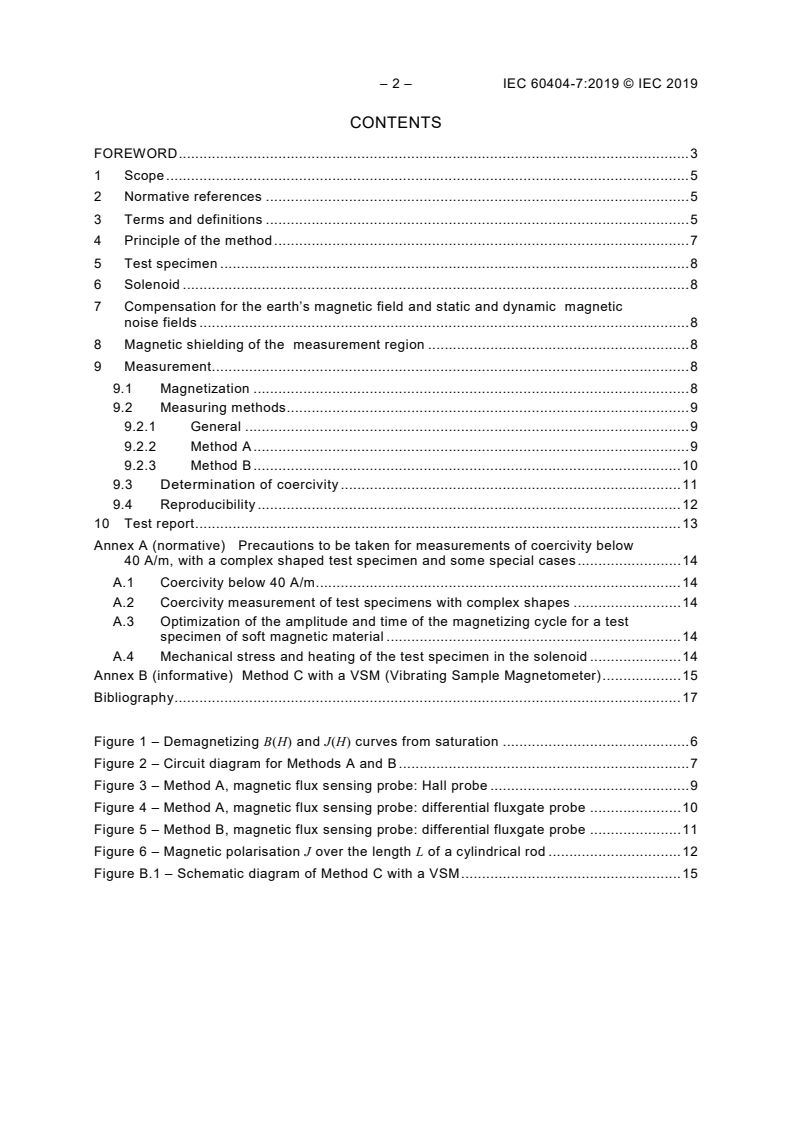
– 2 – IEC 60404-7:2019 © IEC 2019
CONTENTS
FOREWORD . 3
1 Scope . 5
2 Normative references . 5
3 Terms and definitions . 5
4 Principle of the method . 7
5 Test specimen . 8
6 Solenoid . 8
7 Compensation for the earth’s magnetic field and static and dynamic magnetic
noise fields . 8
8 Magnetic shielding of the measurement region . 8
9 Measurement . 8
9.1 Magnetization . 8
9.2 Measuring methods . 9
9.2.1 General . 9
9.2.2 Method A . 9
9.2.3 Method B . 10
9.3 Determination of coercivity . 11
9.4 Reproducibility . 12
10 Test report . 13
Annex A (normative) Precautions to be taken for measurements of coercivity below
40 A/m, with a complex shaped test specimen and some special cases . 14
A.1 Coercivity below 40 A/m . 14
A.2 Coercivity measurement of test specimens with complex shapes . 14
A.3 Optimization of the amplitude and time of the magnetizing cycle for a test
specimen of soft magnetic material . 14
A.4 Mechanical stress and heating of the test specimen in the solenoid . 14
Annex B (informative) Method C with a VSM (Vibrating Sample Magnetometer) . 15
Bibliography . 17
Figure 1 – Demagnetizing B(H) and J(H) curves from saturation . 6
Figure 2 – Circuit diagram for Methods A and B . 7
Figure 3 – Method A, magnetic flux sensing probe: Hall probe . 9
Figure 4 – Method A, magnetic flux sensing probe: differential fluxgate probe . 10
Figure 5 – Method B, magnetic flux sensing probe: differential fluxgate probe . 11
Figure 6 – Magnetic polarisation J over the length L of a cylindrical rod . 12
Figure B.1 – Schematic diagram of Method C with a VSM . 15
INTERNATIONAL ELECTROTECHNICAL COMMISSION
____________
MAGNETIC MATERIALS –
Part 7: Method of measurement of the coercivity (up to 160 kA/m) of
magnetic materials in an open magnetic circuit
FOREWORD
1) The International Electrotechnical Commission (IEC) is a worldwide organization for standardization comprising
all national electrotechnical committees (IEC National Committees). The object of IEC is to promote
international co-operation on all questions concerning standardization in the electrical and electronic fields. To
this end and in addition to other activities, IEC publishes International Standards, Technical Specifications,
Technical Reports, Publicly Available Specifications (PAS) and Guides (hereafter referred to as “IEC
Publication(s)”). Their preparation is entrusted to technical committees; any IEC National Committee interested
in the subject dealt with may participate in this preparatory work. International, governmental and non-
governmental organizations liaising with the IEC also participate in this preparation. IEC collaborates closely
with the International Organization for Standardization (ISO) in accordance with conditions determined by
agreement between the two organizations.
2) The formal decisions or agreements of IEC on technical matters express, as nearly as possible, an international
consensus of opinion on the relevant subjects since each technical committee has representation from all
interested IEC National Committees.
3) IEC Publications have the form of recommendations for international use and are accepted by IEC National
Committees in that sense. While all reasonable efforts are made to ensure that the technical content of IEC
Publications is accurate, IEC cannot be held responsible for the way in which they are used or for any
misinterpretation by any end user.
4) In order to promote international uniformity, IEC National Committees undertake to apply IEC Publications
transparently to the maximum extent possible in their national and regional publications. Any divergence
between any IEC Publication and the corresponding national or regional publication shall be clearly indicated in
the latter.
5) IEC itself does not provide any attestation of conformity. Independent certification bodies provide conformity
assessment services and, in some areas, access to IEC marks of conformity. IEC is not responsible for any
services carried out by independent certification bodies.
6) All users should ensure that they have the latest edition of this publication.
7) No liability shall attach to IEC or its directors, employees, servants or agents including individual experts and
members of its technical committees and IEC National Committees for any personal injury, property damage or
other damage of any nature whatsoever, whether direct or indirect, or for costs (including legal fees) and
expenses arising out of the publication, use of, or reliance upon, this IEC Publication or any other IEC
Publications.
8) Attention is drawn to the Normative references cited in this publication. Use of the referenced publications is
indispensable for the correct application of this publication.
9) Attention is drawn to the possibility that some of the elements of this IEC Publication may be the subject of
patent rights. IEC shall not be held responsible for identifying any or all such patent rights.
International Standard IEC 60404-9 has been prepared by IEC technical committee 68:
Magnetic alloys and steels.
This second edition cancels and replaces the first published in 1982. This edition constitutes
a technical revision.
This edition includes the following significant technical changes with respect to the previous
edition:
a) Clause 1: The scope includes a more detailed description of the magnetic materials which
applies to this standard;
b) Clause 4: Figure 2 – circuit diagram for methods A and B was simplified and the fluxgate
probes inside the solenoid have been added;
c) Clause 7: Compensation for the earth’s magnetic field and for static and dynamic
magnetic noise fields has been added;
– 4 – IEC 60404-7:2019 © IEC 2019
d) Clause 8: Magnetic shielding of the measuring region has been added;
e) 9.2.2: The measuring methods for local and integral measurement of the flux in the test
specimen have been separated and the limitations in size and shape of the test specimen
have been considered.
f) 9:3: The method C with a VSM (Vibrating Sample Magnetometer) has been moved from
9.3 to the Annex B.
g) The term "complex shaped test specimen" has been replaced in several clauses by "test
specimen different from ellipsoids".
h) The character of Annex A has been changed from “informative” to “normative”.
The text of this International Standard is based on the following documents:
CDV Report on voting
68/596/CDV 68/608A/RVC
Full information on the voting for the approval of this International Standard can be found in
the report on voting indicated in the above table.
This document has been drafted in accordance with the ISO/IEC Directives, Part 2.
A list of all parts in the IEC 60404 series, published under the general title Magnetic materials,
can be found on the IEC website.
The committee has decided that the contents of this document will remain unchanged until the
stability date indicated on the IEC website under "http://webstore.iec.ch" in the data related to
the specific document. At this date, the document will be
• reconfirmed,
• withdrawn,
• replaced by a revised edition, or
• amended.
MAGNETIC MATERIALS –
Part 7: Method of measurement of the coercivity (up to 160 kA/m) of
magnetic materials in an open magnetic circuit
1 Scope
This part of IEC 60404 specifies a method of measurement of the coercivity of magnetic
materials in an open magnetic circuit.
This document is applicable to all magnetic materials with coercivities from 0,2 A/m to
160 kA/m.
NOTE Examples of magnetic materials covered by this document are amorphous alloys, nanocrystalline alloys, all
softmagnetic crystalline materials (e.g. Fe, FeSi-, CoFe- and FeNi-alloys), soft ferrites, hard metals, semi-hard
magnetic alloys (e.g. FeCoTiAl-, FeCoV-, FeCrCo- and AlNiCo-alloys) [1] .
Special precautions are to be taken in measuring coercivities below 40 A/m, in materials with
high conductivity and in test specimens which have a shape different from ellipsoids (see
Annex A).
2 Normative references
The following documents are referred to in the text in such a way that some or all of their
content constitutes requirements of this document. For dated references, only the edition
cited applies. For undated references, the latest edition of the referenced document (including
any amendments) applies.
There are no normative references in this document.
3 Terms and definitions
For the purpose of this document, the following terms and definitions apply.
ISO and IEC maintain terminological databases for use in standardization at the following
addresses:
• IEC Electropedia: available at http://www.electropedia.org/
• ISO Online browsing platform: available at http://www.iso.org/obp
3.1
coercivity H
cJ
value of the coercive field strength in a material when the magnetic flux density, magnetic
polarization or magnetization is brought from saturation by a monotonically changing magnetic
field to zero
Note 1 to entry: The parameter that is varied should be stated, and the appropriate symbol used as follows: H
cB
for the coercivity relating to the magnetic flux density, H for the coercivity relating to the magnetic polarization,
cJ
H for the coercivity relating to the magnetization. The first two symbols supersede H and H respectively.
cM cB cJ
—————————
Numbers in square brackets refer to the Bibliography.
– 6 – IEC 60404-7:2019 © IEC 2019
3.2
demagnetize
to reduce the magnetic flux density of a magnetized material along the demagnetization curve
Note 1 to entry: The coercivities H and H are respectively discriminated depending on the hysteresis loop
cB cJ
being defined in the B = f(H) or J = f(H) system (see Figure 1). It can be shown that, for materials of
high-differential permeability in the region B = 0, the difference between the coercivity H and the coercivity H is
cJ cB
negligible since:
∆H
1 µ
H = H −
cB cJ 0
∆B
(1)
where
H coercivity relating to the magnetic flux density, in amperes per metre;
cB
H coercivity relating to the magnetic polarization, in amperes per metre;
cJ
ΔB incremental change in magnetic flux density (at B = 0), in teslas;
ΔH corresponding change in magnetic field strength, in amperes per metre;
-7
µ magnetic constant (4π x 10 in henrys per metre).
o
Key
B magnetic flux density, in teslas
J magnetic polarization, in teslas
H magnetic field strength, in amperes per metre
B remanent flux density in, teslas
r
B flux density in air in, teslas
J remanent magnetic polarization, in teslas
r
J saturation magnetic polarization, in teslas
s
Figure 1 – Demagnetizing B(H) and J(H) curves from saturation
4 Principle of the method
If a magnetic test specimen is placed in a uniform and unidirectional magnetic field then it will
distort this magnetic field unless a condition that no flux (additional to that previously carried
by the air space it now occupies) enters or emerges from the test specimen. This condition
represents a state of complete demagnetization which occurs when a demagnetizing coercive
magnetic field strength is applied to the test specimen such that the magnetic polarization is
zero [2].
The test specimen is magnetized to saturation (J ) and then the magnetic field is reduced
s
smoothly without interruption to zero (J ). Afterwards the polarity of the magnetic field is
r
reversed and a demagnetizing field is increased until the magnetic polarization of the test
specimen is zero. The applied magnetic field strength required to achieve this condition is
measured and defined as the coercivity H of the test specimen (see Figure 1).
cJ
A magnetic flux sensing probe enables the detection of the condition of no distortion of a
uniform magnetic field by the test specimen and provides the means for determining the
coercivity.
For this measurement, the test specimen and the magnetic flux sensing probes are placed in
an open magnetic circuit in the uniform and unidirectional magnetic field of a solenoid. The
flux sensing probe should be placed as follows:
a) inside the solenoid, close to the end of the test specimen (Method A – Hall probe,
see Figure 3), or
b) inside the solenoid, at a distance from the test specimen, depending on the size and
permeability of the test specimen (Method A – differential fluxgate probe, see Figure 4), or
c) outside the solenoid (Method B – differential fluxgate probe, see Figure 5).
The solenoid and measuring equipment shall be connected as shown in Figure 2.
NOTE There is an alternative way to use an axially vibrating search coil as magnetic sensing probe like
Method A [3].
Figure 2 – Circuit diagram for Methods A and B
Alternatively, the test specimen is placed at the centre of the gap of an electromagnet as in
Method C, see Annex B.
– 8 – IEC 60404-7:2019 © IEC 2019
5 Test specimen
The shape and the dimensions of the test specimen may be varied provided that they meet
the following conditions:
a) the test specimen can be placed inside the solenoid so that its major axis is coincident
with the axis of the solenoid;
b) the test specimen can be magnetized to saturation.
NOTE For the effects of shape and non-uniform magnetic properties of the test specimen refer to 9.2.2 and 9.3.
6 Solenoid
The magnetic field in the solenoid shall have the following specifications:
a) the magnetic field strength in the solenoid over the volume of the test specimen shall not
vary by more than ±0,5 %;
b) an AC ripple of the magnetic field strength in the solenoid shall be less than ±0,5 % of the
magnetic field strength.
7 Compensation for the earth’s magnetic field and static and dynamic
magnetic noise fields
The measurement of the coercivity of a test specimen of soft magnetic material can be
distorted by the earth’s magnetic field and by external static and dynamic magnetic noise
fields. Compensation for these can be achieved either by:
a) a suitable compensation system for the earth’s magnetic field [4] or a magnetic shield
placed around the measurement region, or
b) the magnetic flux sensing probe for the measurement of the stray magnetic field of the test
specimen is a differential fluxgate probe to suppress an influence of these uniform
external magnetic fields (see Figures 4 and 5).
8 Magnetic shielding of the measurement region
The magnetic shielding shall be constructed from a high magnetic permeability material [1].
Any influence from the magnetic shielding on the magnetic field in the measurement region
has to be compensated for.
After magnetizing the test specimen to saturation, the magnetic shielding must be completely
demagnetized from the point of the magnetic remanence, to avoid light magnetizing of the test
specimen by the residual field of the magnetic shielding. This residual magnetic field from the
magnetic shielding inside the solenoid has to be smaller than 5 % of the measured stray
magnetic field of the test specimen in the magnetic remanence. The demagnetizing field of
the magnetic shielding shall not affect the test specimen, magnetically.
9 Measurement
9.1 Magnetization
The test specimen is magnetized to saturation in:
a) the solenoid of the coercivity measuring device as in Method A and Method B, or
b) a separate device which can be, for example, a system with a permanent magnet or an
electromagnet, or a pulsed magnetizing coil.
Saturation is considered to be achieved when an increase of 50 % in the magnetizing field
strength gives an increase in the coercivity of less than 1 %.
The saturation field shall be held long enough, usually 0,5 s, to ensure complete penetration
of the material.
Magnetic materials having a low coercivity and a high electrical conductivity require a
reduction of the magnetizing field from saturation to zero to be conducted very smoothly
without interruptions. This is to avoid eddy currents in the test specimen, which demagnetize
the test specimen and lead to a too low coercivity. The magnetizing field decay from magnetic
saturation to zero shall be adjustable between 1 s and 40 s, depending on the magnetic
permeability, electrical conductivity and thickness of the test specimen.
9.2 Measuring methods
9.2.1 General
Two methods, A and B, can be used for the detection of a state of zero magnetic polarization
in the test specimen during the demagnetization.
The magnetic field strength in the solenoid shall be measured with an accuracy equal to or
better than ±0,5 %.
9.2.2 Method A
This method is based on the use of either:
a) a magnetic flux sensing probe with a Hall probe placed near the end of the test specimen
with its measurement axis at 90° to the axis of the solenoid (see Figure 3). The Hall probe
shall be positioned off the axis and in the homogeneous region of the solenoid to give
good sensitivity for the stray magnetic field of the test specimen and to suppress the
sensitivity for the magnetic field of the solenoid at the same time, or
Key
1 solenoid
2 test specimen
3 Hall probe
Figure 3 – Method A, magnetic flux sensing probe: Hall probe
– 10 – IEC 60404-7:2019 © IEC 2019
b) a magnetic flux sensing probe with a differential fluxgate probe consisting of two single
fluxgate sensors connected in series opposition, placed inside the solenoid. The distance
between the fluxgate probes and the end of the test specimen is variable (see note
below), depending on the size and permeability of the test specimen (see Figure 4). This
is an integral measurement of the stray magnetic field divergence over the length of the
test specimen, where the distance between the test specimen and the fluxgate probes is
longer than the length of the test specimen. The distance between the test specimen and
the fluxgate probes is a reasonable compromise between signal strength and the integral
stray magnetic field measuring effect. By this differential method, the influence of uniform
external magnetic fields is amply compensated for.
NOTE Practical experience in the measurement of very small and/or very soft magnetic materials determine the
distance between the fluxgate probes and the test specimen of between 10 mm and 40 mm.
Magnetic flux sensing probes which measure the stray magnetic field of the test specimen at
a very small distance from the test specimen, set limitations on the test specimen geometries.
These systems have errors which are relevant to the shapes of the test specimen which are
different from ellipsoids (see Figure 6) and to non-uniform magnetic properties over the
volume of the test specimen.
Key
1 solenoid
2 test specimen
3 differential fluxgate probe consisting of two single fluxgate sensors connected in series opposition
Figure 4 – Method A, magnetic flux sensing probe: differential fluxgate probe
9.2.3 Method B
This method is based on the use of a differential fluxgate probe consisting of two single
fluxgate sensors, connected in series opposition, placed outside the solenoid. This is an
integral measurement of the stray magnetic field of the test specimen (see Figure 5).
Key
1 solenoid
2 test specimen
3 differential fluxgate probe consisting of two single fluxgate sensors connected in series opposition
Figure 5 – Method B, magnetic flux sensing probe: differential fluxgate probe
By this differential method, the influence of uniform external magnetic fields is amply
compensated for. The axis of the differential fluxgate probe is positioned at 90° to the
magnetic field of the solenoid to measure only the stray magnetic field of the test specimen.
The large distance between the two single fluxgate sensors and the test specimen requires a
high sensitivity of the fluxgate probes, usually 0,5 nT. They measure the integral of stray
magnetic field divergence over the length of test specimen. The same condition applies to the
magnetic inhomogeneity over the volume of the test specimen.
9.3 Determination of coercivity
The solenoid, in which the test specimen is placed, is connected to a variable DC current
supply. The test specimen is magnetized to saturation and then the magnetic field is reduced
smoothly without interrupting to zero. The demagnetizing current through the solenoid shall be
increased continuously and slowly to the point at which no stray magnetic field of the test
specimen is detected.
The value of this demagnetizing current shall be measured with a digital voltmeter connected
across a shunt resistor (see Figure 2) giving an accuracy equal to or better than 0,5 %.
The current shall be measured for each of the two directions of the demagnetizing field of the
solenoid.
The value of the coercivity shall be calculated from the relationship:
H = kI
cJ
(2)
where
H is the coercivity, in amperes per metre (A/m);
cJ
I is the mean value of the two currents of opposite polarity, in amperes (A);
k is magnetic field strength to current ratio for the solenoid, in per metre (1/m).
– 12 – IEC 60404-7:2019 © IEC 2019
When method A is used, the measurement shall be made for each end of the test specimen,
the value of the coercivity being taken as the mean of the two measurements. Test specimens
which have a non-ellipsoidal shape or with inhomogeneous magnetic properties shall
generally be measured at each end.
For materials having a coercivity greater than 1 kA/m, it is not necessary to make
measurements for two directions of the magnetic field.
NOTE Method A is a localized measurement whereas Methods B and C (see Annex B) are integrated
measurements. Therefore the results cannot be the same for a magnetic inhomogeneous test specimen or for a
test specimen which has a non-ellipsoidal shape (see Figure 6).
Key
1 magnetic polarization J is zero at the ends of the rod; corresponding to Method A with local flux
measurement
2 sum of the magnetic polarization J is zero over the length of the rod; corresponding to Method B and C with
integral flux measurement
3 magnetic polarization J is zero at the centre of the rod
4 the test specimen as a cylindrical rod
Figure 6 – Magnetic polarisation J over the length L of a cylindrical rod
9.4 Reproducibility
Provided the foregoing procedures are carried out and the material has a uniform magnetic
polarization, the reproducibility of the determination of the coercivity normally expected is less
than:
– ±10 % for coercivities from 0,2 A/m up to 5 A/m;
– ±5 % for coercivities up to 50 A/m;
– ±2 % for coercivities up to 1 kA/m;
– ±1 % for coercivities up to 160 kA/m.
However, this reproducibility can be affected by non-uniform magnetic properties and the non-
ellipsoidal shape of the test specimen.
10 Test report
The test report shall contain, as necessary:
– type and condition of the material;
– the shape and dimensions of the test specimen;
– the method of magnetizing to saturation;
– the measuring method and device used;
– the calculated value of the coercivity H ;
cJ
– the test temperature;
– the date of the test.
– 14 – IEC 60404-7:2019 © IEC 2019
Annex A
(normative)
Precautions to be taken for measurements of coercivity below 40 A/m,
with a complex shaped test specimen and some special cases
A.1 Coercivity below 40 A/m
For materials having a coercivity below 40 A/m, the following precautions shall be observed:
a) the measuring apparatus shall be set up in an environment free from strong magnetic
fields and remote from masses of magnetic material;
b) the ambient magnetic field shall be compensated for or the equipment shall be shielded to
reduce the value of the field to below 0,5 A/m;
c) care shall be taken to avoid the introduction of internal mechanical stresses during and
after preparation of the test specimens;
d) when using a Hall probe to measure coercivity below 10 A/m, it shall be checked that the
magnetic field due to the Hall probe bias current does not affect the measurement.
A.2 Coercivity measurement of test specimens with complex shapes
The measurement of a complex shaped test specimen, different from ellipsoids, is only
possible with an integral measurement according Method B. The influence of the complex
shape on the coercivity can be further minimized by using the mean value from the two
coercivity measurements on both ends of the test specimen.
A.3 Optimization of the amplitude and time of the magnetizing cycle for a test
specimen of soft magnetic material
These two parameters can be optimized as a too high a magnetization amplitude heats up the
solenoid and a too short a time produces eddy currents in the test specimen with high
electrical conductivity.
The procedure of the optimization can be as follows:
Gradually reduce the magnetization amplitude from 200 kA/m to approximately 25 kA/m in
decrements of 10 kA/m and perform an H measurement at each step at a constant
cJ
magnetization time of 40 s. If the H value drops by more than 2 %, the minimum value for
cJ
the magnetization amplitude is achieved. To guarantee the state of saturation, the determined
minimum magnetization amplitude should be increased by 20 %.
Reduce the magnetization time from 40 s to 1 s in decrements of 5 s to 10 s and perform an
H measurement at each step to the previously determined minimum magnetization
cJ
value drops by more than 2 %, the minimum value for the
amplitude (+20 %). If the H
cJ
magnetization time is achieved. To obtain an optimized state of test, the determined minimum
magnetization time should be increased by 20 %.
A.4 Mechanical stress and heating of the test specimen in the solenoid
During the measurement the test specimen shall not be stressed either mechanically or
thermally since both may change the coercivity. The temperature of the test specimen shall be
maintained within 23 °C ± 5 °C during the measurement of coercivity. If the test specimen
becomes heated in the solenoid, it shall be air cooled in the solenoid.
Annex B
(informative)
Method C with a VSM (Vibrating Sample Magnetometer)
The Method C with a VSM (Vibrating Sample Magnetometer) [5], [6] is used for the
measurement of the coercivity of magnetic materials in an open magnetic circuit. The
difference between Method A and Method B is the magnetizing circuit. Instead of a solenoid
an electromagnet with yokes is used and the measuring range of the coercivity is limited to a
minimum of 2 kA/m.
In a VSM, a test specimen is located within suitably placed search coils, and is made to
undergo sinusoidal motion, i.e., mechanically vertical vibrated. The resulting magnetic flux
variations induce an alternating voltage in the search coils that is proportional to the magnetic
moment of the test specimen. The magnetic field is generated by an electromagnet [5], [6].
The magnetic field at which zero alternating voltage, induced in the search coils by the
polarization of the test specimen, is detected (see Figure B.1), represents the coercivity of the
sample.
The VSM should be calibrated with a known standard test specimen of the same size and
shape as the test specimen to be measured.
Key
1 search coils
2 vertical vibrating test specimen holder
3 electromagnet pole pieces
4 test specimen
Figure B.1 – Schematic diagram of Method C with a VSM
– 16 – IEC 60404-7:2019 © IEC 2019
The measurement with the VSM is an integral measurement of the stray magnetic field of the
test specimen, when the volume of the test specimen is in the homogeneous region of the
search coils and in the centre region of the search coils. The VSM is only applicable to small
test specimens (e.g. 5 mm x 5 mm x 5 mm).
Bibliography
[1] Rainer Hilzinger, Werner Rodewald, Magnetic Materials – Fundamentals, Products,
Properties, Applications -, VAC 2013, ISBN-10: 3895783528
[2] H. Czichos, T. Saito, L. Smith, Springer Handbook of Materials Measurement Methods,
[3] EN 10330-2015: Method of measurement of the coercivity of magnetic materials in an
open magnetic circuit
[4] Heiko Ahlers, Design of transversal earth magnetic field compensating coil systems
and their comparision with conventional systems, PTB -Mitteilungen 109, pp. 131-137,
[5] S. Foner, Versatile and Sensitive Vibration-Sample Magnetometer, vol.30, no.7,
pp. 548-557, 1959
[6] IEC TR 62797, International comparison of measurements of the magnetic moment
using vibrating sample magnetometers (VSM) and superconducting quantum
interference device (SQUID) magnetometers
___________
– 18 – IEC 60404-7:2019 © IEC 2019
SOMMAIRE
AVANT-PROPOS . 19
1 Domaine d'application . 21
2 Références normatives . 21
3 Termes et définitions . 21
4 Principe de la méthode . 23
5 Eprouvette d'essai . 24
6 Solénoïde . 24
7 Compensation du champ magnétique terrestre et des champs magnétiques
parasites statiques et dynamiques . 24
8 Blindage magnétique de la zone de mesure . 24
9 Mesurage . 25
9.1 Aimantation . 25
9.2 Méthodes de mesure . 25
9.2.1 Généralités . 25
9.2.2 Méthode A . 25
9.2.3 Méthode B . 27
9.3 Mesurage de la coercitivité . 27
9.4 Reproductibilité . 28
10 Rapport d'essai . 29
Annexe A (normative) Précautions à prendre pour le mesurage de la coercitivité au-
dessous de 40 A/m, avec une éprouvette de forme complexe et certains cas
particuliers. 30
A.1 Coercitivité au-dessous de 40 A/m . 30
A.2 Mesurage de la coercitivité des éprouvettes de formes complexes . 30
A.3 Optimisation de l'amplitude et du temps du cycle d'aimantation pour une
éprouvette du matériau magnétique doux . 30
A.4 Contrainte mécanique et échauffement de l'éprouvette dans le solénoïde . 31
Annexe B (informative) Méthode C avec un VSM (magnétomètre à échantillon vibrant) . 32
Bibliographie . 34
Figure 1 – Courbes de désaimantation B(H) et J(H) depuis la saturation . 22
Figure 2 – Schéma du circuit pour les Méthodes A et B . 23
Figure 3 – Méthode A, sonde sensible au flux magnétique: sonde de Hall . 26
Figure 4 – Méthode A, sonde sensible au flux magnétique: sonde différentielle de flux
à seuil . 26
Figure 5 – Méthode B, sonde sensible au flux magnétique: sonde différentielle de flux
à seuil . 27
Figure 6 – Polarisation magnétique J sur la longueur L d'une tige cylindrique . 28
Figure B.1 – Schéma de la Méthode C avec un VSM . 32
COMMISSION ÉLECTROTECHNIQUE INTERNATIONALE
____________
MATÉRIAUX MAGNÉTIQUES –
Partie 7: Méthode de mesure de la coercitivité (jusqu'à 160 kA/m) des
matériaux magnétiques en circuit magnétique ouvert
AVANT-PROPOS
1) La Commission Electrotechnique Internationale (IEC) est une organisation mondiale de normalisation
composée de l'ensemble des comités électrotechniques nationaux (Comités nationaux de l'IEC). L'IEC a pour
objet de favoriser la coopération internationale pour toutes les questions de normalisation dans les domaines
de l'électricité et de l'électronique. A cet effet, l'IEC – entre autres activités – publie des Normes internationales,
des Spécifications techniques, des Rapports techniques, des Spécifications accessibles au public (PAS) et des
Guides (ci-après dénommés "Publication(s) de l'IEC"). Leur élaboration est confiée à des comités d'études, aux
travaux desquels tout Comité national intéressé par le sujet traité peut participer. Les organisations
internationales, gouvernementales et non gouvernementales, en liaison avec l'IEC, participent également aux
travaux. L'IEC collabore étroitement avec l'Organisation Internationale de Normalisation (ISO), selon des
conditions fixées par accord entre les deux organisations.
2) Les décisions ou accords officiels de l'IEC concernant les questions techniques représentent, dans la mesure
du possible, un accord international sur les sujets étudiés, étant donné que les Comités nationaux de l'IEC
intéressés sont représentés dans chaque comité d'études.
3) Les Publications de l'IEC se présentent sous la forme de recommandations internationales et sont agréées
comme telles par les Comités nationaux de l'IEC. Tous les efforts raisonnables sont entrepris afin que l'IEC
s'assure de l'exactitude du contenu t
...