

IEC 61760-4:2026
(Main)Surface mounting technology - Part 4: Classification, packaging, labelling and handling of moisture sensitive devices
- Abstract
IEC 61760-4:2026 specifies the classification of moisture sensitive device into moisture sensitivity level related to soldering heat, and provisions for packaging, labelling and handling. It extends the classification and packaging methods to such components, where currently existing standards are not required or not appropriate. For such cases, this document introduces additional moisture sensitivity levels and an alternative method for packaging. This document applies to devices intended for reflow soldering, like surface mount devices, including specific through-hole devices (where the device supplier has specifically documented support for reflow soldering), but not to semiconductor devices, and devices for flow (wave) soldering.
NOTE Background of this document and its relation to currently existing standards, e.g. IEC 60749‑20 or J-STD-020F and J-STD-033, are described in the Introduction.
This edition includes the following significant technical changes with respect to the previous edition:
a) The content is updated to cover the classification conditions given in the new editions of J-STD-020F and IEC 60068-2-58.
- Status
- Published
- Publication Date
- 27-May-2026
- Technical Committee
- TC 91 - Electronics assembly technology
- Drafting Committee
- WG 1 - TC 91/WG 1
- Current Stage
- PPUB - Publication issued
- Start Date
- 28-May-2026
- Completion Date
- 19-Jun-2026
Buy Documents
IEC 61760-4:2026 - Surface mounting technology - Part 4: Classification, packaging, labelling and handling of moisture sensitive devices
REDLINE IEC 61760-4:2026 RLV - Surface mounting technology - Part 4: Classification, packaging, labelling and handling of moisture sensitive devices
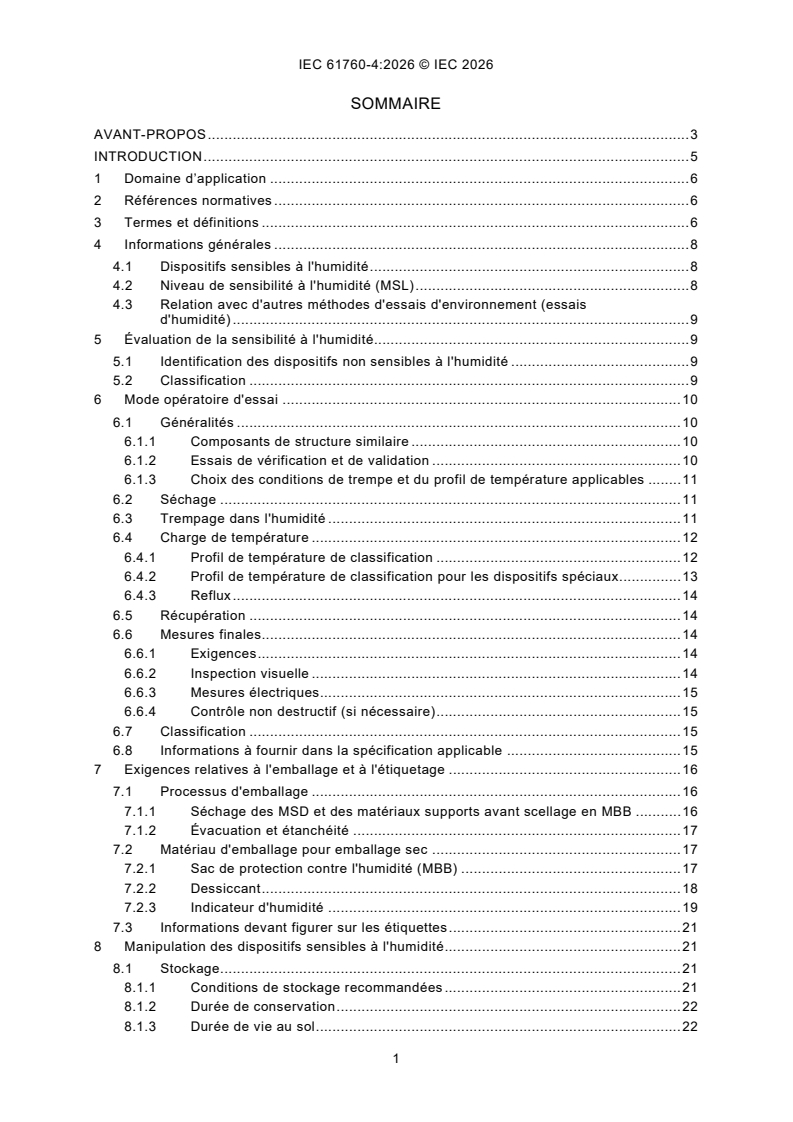
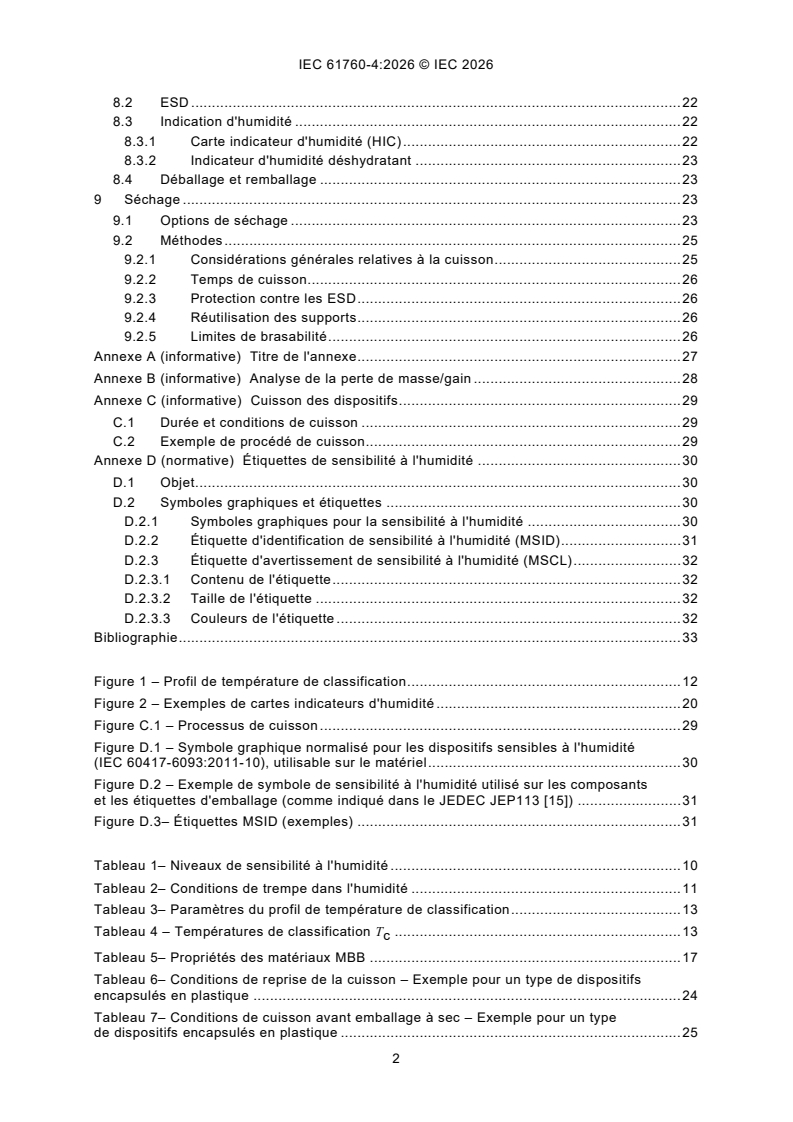
IEC 61760-4:2026 - Technologie de montage en surface - Partie 4: Classification, emballage, étiquetage et manipulation des dispositifs sensibles a l'humidité
IEC 61760-4:2026 is an International Standard from IEC on surface mounting technology. It specifies how moisture sensitive devices are classified by moisture sensitivity level for soldering heat, and how they are packaged, labelled, stored, handled and dried before reflow soldering. It is written for surface mount devices and certain through-hole devices that the supplier has documented for reflow soldering, not for semiconductor devices or devices for flow (wave) soldering.
What does IEC 61760-4:2026 specify?
IEC 61760-4:2026 defines a moisture sensitivity classification scheme and the related packaging, labelling and handling provisions for moisture sensitive devices. It extends classification and packaging methods to device types where existing standards are not required or not suitable, and introduces additional moisture sensitivity levels and an alternative dry-pack method.
The document is organized into:
- Clause 4: general information on moisture sensitivity and the meaning of MSL
- Clause 5: assessment and classification, including the non-moisture sensitive level N
- Clause 6: test procedure for classification
- Clause 7: packaging and labelling requirements
- Clause 8: storage, humidity indication, unpacking and re-packing
- Clause 9: drying methods and bakeout considerations
- Annexes A to D for assemblies, mass/gain loss analysis, baking examples, and labels
| Annex | What it covers |
|---|---|
| Annex A | Moisture sensitivity of assemblies |
| Annex B | Mass/gain loss analysis |
| Annex C | Baking of devices and an example baking process |
| Annex D | Moisture sensitivity labels and graphical symbols |
What are the key requirements of IEC 61760-4:2026?
Classification is based on moisture sensitivity level and reflow soldering heat
IEC 61760-4:2026 classifies devices by moisture sensitivity level (MSL) according to their response to moisture followed by soldering heat. Clause 5 says non-moisture sensitive devices can be identified by design and material analysis and designated level N, while Clause 6 defines the test route for devices that are moisture sensitive.
In practice, this tells a supplier or buyer whether a part can be handled as a standard dry component or whether it needs controlled packaging, limited floor life, and pre-bake steps before reflow.
The test sequence is drying, moisture soak, temperature load, recovery, then final inspection
Clause 6 requires a defined sequence: drying, moisture soak, temperature load, recovery, and final measurements. The specimen is baked before the soak, then subjected to soak conditions selected from Table 2, then to the classification temperature profile in Figure 1 and Tables 3 and 4, followed by recovery under standard atmospheric conditions from IEC 60068-1.
This matters because the classification is not based on humidity alone. It checks whether moisture absorbed before soldering can cause damage during reflow, which is the actual manufacturing risk.
Classification uses defined soak conditions and reflow cycles
Clause 6.4 requires three reflow cycles under the appropriate classification profile. The profile limits heating and cooling gradients and ties the classification temperature to the solder process and package type. For special devices, the standard allows the profiles from IEC 60068-2-58:2015 Table 7, or other agreed profiles in the relevant specification.
For users, this means the classification must match the way the device is actually assembled. For suppliers, it means the relevant specification needs to state the profile and any agreed deviations.
Pass or fail is decided by inspection and electrical checks
Clause 6.6 requires visual inspection, electrical measurements, and, if required, non-destructive inspection. Visual inspection focuses on cracks, delamination, swelling, warpage, bulging and dimensional changes. Clause 6.7 states that if one or more test samples fail at final measurements, the package does not pass that level.
This is important in practice because the standard is looking for package damage that can show up only after moisture and heat exposure. The inspection criteria protect assembly yield and field reliability.
Packaging uses moisture barrier bags, desiccant and humidity indication
Clause 7 defines the dry-pack approach. Devices are packed in a moisture barrier bag (MBB), with desiccant and humidity indication. The standard distinguishes MBB Type 1 and Type 2 by water vapour transmission rate (WVTR), and links desiccant quantity to bag size, WVTR and intended shelf life.
For the user, this means packaging is not just for shipping - it is part of the protection strategy that maintains shelf life and controls exposure before soldering.
Labels must show the key handling information
Annex D and Clause 7.3 require moisture sensitivity labelling. The moisture sensitivity caution label (MSCL) on the MBB carries the MSL, shelf life in the sealed bag, the peak body top surface temperature used for classification, floor life at 30 °C and 60 % RH, and the bag seal date. The moisture sensitivity identification label (MSID) identifies containers holding moisture sensitive devices.
This helps production, stores and receiving staff see how long the bag can remain open and whether the parts still need baking.
Storage, floor life and drying are controlled to preserve solderability
Clause 8 gives storage conditions, shelf life and floor life guidance. Clause 9 gives drying options and bakeout conditions, including re-bake after excessive exposure and baking before dry pack. The standard also limits high-temperature baking time to reduce oxidation and solderability loss.
In practice, this is the part that supports shop-floor decisions: whether parts can still be used as received, whether they need re-bake, and how long they may remain outside the bag before reflow.
What terms does IEC 61760-4:2026 define?
- moisture sensitive device (MSD) - A device that can suffer electrical or mechanical degradation during soldering because absorbed moisture vaporizes.
- moisture sensitivity level (MSL) - A rating that shows how susceptible a device is to moisture damage during reflow soldering.
- moisture barrier bag (MBB) - A bag designed to limit water vapour transmission and protect moisture sensitive devices in dry pack.
- manufacturer’s exposure time (MET) - The maximum time after baking before the component must be sealed, including allowed distributor opening time where applicable.
- floor life - The allowable time a device may stay in normal room conditions after opening the MBB and before reflow.
- shelf life - The time a product can remain in its original packaging under specified storage, transport and handling conditions while quality remains acceptable.
- humidity indicator card (HIC) - A card with moisture-sensitive dots that change colour when the indicated relative humidity is exceeded.
- water vapour transmission rate (WVTR) - The measure used to specify how much moisture can pass through the MBB material.
Who uses IEC 61760-4:2026?
IEC 61760-4:2026 is used by component manufacturers, distributors, electronics assemblers, and quality or reliability engineers who need a shared method for classifying and handling moisture sensitive parts. It is also relevant to buyers and supply-chain teams who set packaging and storage expectations, and to test laboratories that perform moisture sensitivity classification.
In practice, it is used for product qualification, incoming goods control, packaging design, dry-pack preparation, labelling, storage rules, and rework or baking decisions before reflow soldering.
What changed in IEC 61760-4:2026 from the previous edition?
IEC 61760-4:2026 is the second edition. It cancels and replaces the first edition published in 2015 and Amendment 1:2018.
The significant technical change stated for this edition is that the content has been updated to cover the classification conditions given in the new editions of J-STD-020F and IEC 60068-2-58.
Which standards are used with IEC 61760-4:2026?
- IEC 60068-1:2013 - Gives the standard atmospheric conditions used for recovery and general environmental-testing guidance.
- IEC 60068-2-58:2015 and IEC 60068-2-58 - Provide solderability and soldering-heat test methods and, for special devices, alternative temperature profiles.
- IEC 61760-2 - Gives the storage conditions referenced for moisture sensitive devices.
- IEC 61340-5-1 - Provides guidance for electrostatic discharge (ESD) protection during handling.
- IEC 60417:2025 DB:2025 - Provides the standardized graphical symbol for moisture sensitive devices.
- JEDEC JEP113 - Provides symbol and label examples used for moisture sensitive devices.
- J-STD-020F - Supplies the moisture/reflow sensitivity classification conditions that this standard aligns with and extends.
- J-STD-033 - Covers handling, packaging, shipping and use of moisture/reflow sensitive surface mount devices.
- IEC 60749-20 - Is cited as background for plastic encapsulated semiconductors, which helps explain the scope of this part.
What does the IEC 61760-4:2026 document contain?
IEC 61760-4:2026 contains the classification tables, soak conditions, and temperature profiles used to assess moisture sensitivity. It also includes package-related data such as MBB material properties, HIC requirements, and example re-bake and baking conditions.
The document provides:
- Figure 1 for the classification temperature profile
- Figure 2 for examples of humidity indicator cards
- Figure C.1 for an example baking process
- Figures D.1 to D.3 for symbols and label examples
- Tables 1 to 7 covering MSL levels, soak conditions, classification temperatures, MBB properties, and baking conditions
- Formulae for calculating desiccant mass and related packaging design values
Annex B gives a practical mass/gain loss analysis method for evaluating absorption and desorption. Annex D gives the label content and symbol set used to identify moisture sensitive devices and their handling precautions.
Relations
- Effective Date
- 20-Sep-2024
- Effective Date
- 12-Apr-2024
Buy Documents
IEC 61760-4:2026 - Surface mounting technology - Part 4: Classification, packaging, labelling and handling of moisture sensitive devices
REDLINE IEC 61760-4:2026 RLV - Surface mounting technology - Part 4: Classification, packaging, labelling and handling of moisture sensitive devices
IEC 61760-4:2026 - Technologie de montage en surface - Partie 4: Classification, emballage, étiquetage et manipulation des dispositifs sensibles a l'humidité
Frequently Asked Questions
IEC 61760-4:2026 is a standard published by the International Electrotechnical Commission (IEC). Its full title is "Surface mounting technology - Part 4: Classification, packaging, labelling and handling of moisture sensitive devices". This standard covers: IEC 61760-4:2026 specifies the classification of moisture sensitive device into moisture sensitivity level related to soldering heat, and provisions for packaging, labelling and handling. It extends the classification and packaging methods to such components, where currently existing standards are not required or not appropriate. For such cases, this document introduces additional moisture sensitivity levels and an alternative method for packaging. This document applies to devices intended for reflow soldering, like surface mount devices, including specific through-hole devices (where the device supplier has specifically documented support for reflow soldering), but not to semiconductor devices, and devices for flow (wave) soldering. NOTE Background of this document and its relation to currently existing standards, e.g. IEC 60749‑20 or J-STD-020F and J-STD-033, are described in the Introduction. This edition includes the following significant technical changes with respect to the previous edition: a) The content is updated to cover the classification conditions given in the new editions of J-STD-020F and IEC 60068-2-58.
IEC 61760-4:2026 specifies the classification of moisture sensitive device into moisture sensitivity level related to soldering heat, and provisions for packaging, labelling and handling. It extends the classification and packaging methods to such components, where currently existing standards are not required or not appropriate. For such cases, this document introduces additional moisture sensitivity levels and an alternative method for packaging. This document applies to devices intended for reflow soldering, like surface mount devices, including specific through-hole devices (where the device supplier has specifically documented support for reflow soldering), but not to semiconductor devices, and devices for flow (wave) soldering. NOTE Background of this document and its relation to currently existing standards, e.g. IEC 60749‑20 or J-STD-020F and J-STD-033, are described in the Introduction. This edition includes the following significant technical changes with respect to the previous edition: a) The content is updated to cover the classification conditions given in the new editions of J-STD-020F and IEC 60068-2-58.
IEC 61760-4:2026 is classified under the following ICS (International Classification for Standards) categories: 31.190 - Electronic component assemblies. The ICS classification helps identify the subject area and facilitates finding related standards.
IEC 61760-4:2026 has the following relationships with other standards: It is inter standard links to IEC 61760-4:2015/AMD1:2018, IEC 61760-4:2015. Understanding these relationships helps ensure you are using the most current and applicable version of the standard.
IEC 61760-4:2026 is available in PDF format for immediate download after purchase. The document can be added to your cart and obtained through the secure checkout process. Digital delivery ensures instant access to the complete standard document.
Standards Content (Sample)
IEC 61760-4 ®
Edition 2.0 2026-05
INTERNATIONAL
STANDARD
Surface mounting technology -
Part 4: Classification, packaging, labelling and handling of moisture sensitive
devices
ICS 31.190 ISBN 978-2-8327-1256-6
All rights reserved. Unless otherwise specified, no part of this publication may be reproduced or utilized in any form or
by any means, electronic or mechanical, including photocopying and microfilm, without permission in writing from either
IEC or IEC's member National Committee in the country of the requester. If you have any questions about IEC copyright
or have an enquiry about obtaining additional rights to this publication, please contact the address below or your local
IEC member National Committee for further information.
IEC Secretariat Tel.: +41 22 919 02 11
3, rue de Varembé info@iec.ch
CH-1211 Geneva 20 www.iec.ch
Switzerland
About the IEC
The International Electrotechnical Commission (IEC) is the leading global organization that prepares and publishes
International Standards for all electrical, electronic and related technologies.
About IEC publications
The technical content of IEC publications is kept under constant review by the IEC. Please make sure that you have the
latest edition, a corrigendum or an amendment might have been published.
IEC publications search - IEC Products & Services Portal - products.iec.ch
webstore.iec.ch/advsearchform Discover our powerful search engine and read freely all the
The advanced search enables to find IEC publications by a publications previews, graphical symbols and the glossary.
variety of criteria (reference number, text, technical With a subscription you will always have access to up to date
committee, …). It also gives information on projects, content tailored to your needs.
replaced and withdrawn publications.
Electropedia - www.electropedia.org
The world's leading online dictionary on electrotechnology,
IEC Just Published - webstore.iec.ch/justpublished
Stay up to date on all new IEC publications. Just Published containing more than 22 500 terminological entries in English
details all new publications released. Available online and and French, with equivalent terms in 25 additional languages.
once a month by email. Also known as the International Electrotechnical Vocabulary
(IEV) online.
IEC Customer Service Centre - webstore.iec.ch/csc
If you wish to give us your feedback on this publication or
need further assistance, please contact the Customer
Service Centre: sales@iec.ch.
CONTENTS
FOREWORD . 3
INTRODUCTION . 5
1 Scope . 6
2 Normative references . 6
3 Terms and definitions . 6
4 General information . 8
4.1 Moisture sensitive devices . 8
4.2 Moisture sensitivity level (MSL) . 8
4.3 Relation to other environmental test methods (humidity tests) . 8
5 Assessment of moisture sensitivity . 9
5.1 Identification of non-moisture sensitive devices . 9
5.2 Classification . 9
6 Test procedure . 10
6.1 General . 10
6.1.1 Structurally similar components . 10
6.1.2 Verification and validation tests . 10
6.1.3 Selection of applicable soak conditions and temperature profile . 10
6.2 Drying . 10
6.3 Moisture soak . 10
6.4 Temperature load. 11
6.4.1 Classification temperature profile . 11
6.4.2 Classification temperature profile for special devices . 12
6.4.3 Reflow . 12
6.5 Recovery . 13
6.6 Final measurements. 13
6.6.1 Requirements . 13
6.6.2 Visual inspection . 13
6.6.3 Electrical measurements . 14
6.6.4 Non-destructive inspection (if required) . 14
6.7 Classification . 14
6.8 Information to be given in the relevant specification . 14
7 Requirements to packaging and labelling . 14
7.1 Packaging process . 14
7.1.1 Drying of MSDs and carrier materials before being sealed in MBBs . 14
7.1.2 Evacuation and sealing . 15
7.2 Packaging material for dry pack . 15
7.2.1 Moisture barrier bag (MBB) . 15
7.2.2 Desiccant . 16
7.2.3 Humidity indicator . 18
7.3 Information to be given on labels . 18
8 Handling of moisture sensitive devices . 19
8.1 Storage . 19
8.1.1 Recommended storage conditions . 19
8.1.2 Shelf life . 19
8.1.3 Floor life . 20
8.2 ESD . 20
8.3 Humidity indication. 20
8.3.1 Humidity indicator card (HIC) . 20
8.3.2 Moisture indicating desiccant . 21
8.4 Unpacking and re-packing. 21
9 Drying . 21
9.1 Drying options . 21
9.2 Methods . 22
9.2.1 General considerations for baking . 22
9.2.2 Bakeout times . 23
9.2.3 ESD protection . 23
9.2.4 Reuse of carriers . 23
9.2.5 Solderability limitations . 23
Annex A (informative) Moisture sensitivity of assemblies . 24
Annex B (informative) Mass/gain loss analysis . 25
Annex C (informative) Baking of devices . 26
C.1 Baking time and conditions . 26
C.2 Example of a baking process . 26
Annex D (normative) Moisture sensitivity labels . 27
D.1 Object . 27
D.2 Graphical symbols and labels . 27
D.2.1 Graphical symbols for moisture sensitivity . 27
D.2.2 Moisture sensitivity identification label (MSID) . 28
D.2.3 Moisture sensitivity caution label (MSCL) . 28
Bibliography . 30
Figure 1 – Classification temperature profile . 11
Figure 2 – Examples of humidity indicator cards . 18
Figure C.1 – Baking process . 26
Figure D.1 – Standardized graphical symbol for Moisture sensitive devices (IEC 60417-
6093:2011-10), for use on equipment . 27
Figure D.2 – Example of a moisture sensitivity symbol used on components and
packaging labels (as seen in JEDEC JEP113 [15]). 28
Figure D.3 – MSID labels (examples) . 28
Table 1 – Moisture sensitivity levels . 9
Table 2 – Moisture soak conditions . 10
Table 3 – Parameters of the classification temperature profile . 12
Table 4 – Classification temperatures T . 12
c
Table 5 – MBB material properties . 16
Table 6 – Conditions for re-bake – Example for one type of plastic encapsulated
devices . 21
Table 7 – Conditions for baking prior to dry pack – Example for one type of plastic
encapsulated devices . 22
INTERNATIONAL ELECTROTECHNICAL COMMISSION
____________
Surface mounting technology -
Part 4: Classification, packaging, labelling and handling of moisture
sensitive devices
FOREWORD
1) The International Electrotechnical Commission (IEC) is a worldwide organization for standardization comprising
all national electrotechnical committees (IEC National Committees). The object of IEC is to promote international
co-operation on all questions concerning standardization in the electrical and electronic fields. To this end and
in addition to other activities, IEC publishes International Standards, Technical Specifications, Technical Reports,
Publicly Available Specifications (PAS) and Guides (hereafter referred to as "IEC Publication(s)"). Their
preparation is entrusted to technical committees; any IEC National Committee interested in the subject dealt with
may participate in this preparatory work. International, governmental and non-governmental organizations liaising
with the IEC also participate in this preparation. IEC collaborates closely with the International Organization for
Standardization (ISO) in accordance with conditions determined by agreement between the two organizations.
2) The formal decisions or agreements of IEC on technical matters express, as nearly as possible, an international
consensus of opinion on the relevant subjects since each technical committee has representation from all
interested IEC National Committees.
3) IEC Publications have the form of recommendations for international use and are accepted by IEC National
Committees in that sense. While all reasonable efforts are made to ensure that the technical content of IEC
Publications is accurate, IEC cannot be held responsible for the way in which they are used or for any
misinterpretation by any end user.
4) In order to promote international uniformity, IEC National Committees undertake to apply IEC Publications
transparently to the maximum extent possible in their national and regional publications. Any divergence between
any IEC Publication and the corresponding national or regional publication shall be clearly indicated in the latter.
5) IEC itself does not provide any attestation of conformity. Independent certification bodies provide conformity
assessment services and, in some areas, access to IEC marks of conformity. IEC is not responsible for any
services carried out by independent certification bodies.
6) All users should ensure that they have the latest edition of this publication.
7) No liability shall attach to IEC or its directors, employees, servants or agents including individual experts and
members of its technical committees and IEC National Committees for any personal injury, property damage or
other damage of any nature whatsoever, whether direct or indirect, or for costs (including legal fees) and
expenses arising out of the publication, use of, or reliance upon, this IEC Publication or any other IEC
Publications.
8) Attention is drawn to the Normative references cited in this publication. Use of the referenced publications is
indispensable for the correct application of this publication.
9) IEC draws attention to the possibility that the implementation of this document may involve the use of (a) patent(s).
IEC takes no position concerning the evidence, validity or applicability of any claimed patent rights in respect
thereof. As of the date of publication of this document, IEC had not received notice of (a) patent(s), which may
be required to implement this document. However, implementers are cautioned that this may not represent the
latest information, which may be obtained from the patent database available at https://patents.iec.ch. IEC shall
not be held responsible for identifying any or all such patent rights.
IEC 61760-4 has been prepared by IEC technical committee 91: Electronics assembly
technology. It is an International Standard.
This second edition cancels and replaces the first edition published in 2015 and
Amendment 1:2018. This edition constitutes a technical revision.
This edition includes the following significant technical changes with respect to the previous
edition:
a) The content is updated to cover the classification conditions given in the new editions of J-
STD-020F and IEC 60068-2-58.
The text of this International Standard is based on the following documents:
FDIS Report on voting
91/2101/FDIS 91/2111/RVD
Full information on the voting for its approval can be found in the report on voting indicated in
the above table.
The language used for the development of this International Standard is English.
This document was drafted in accordance with ISO/IEC Directives, Part 2, and developed in
accordance with ISO/IEC Directives, Part 1 and ISO/IEC Directives, IEC Supplement, available
at www.iec.ch/members_experts/refdocs. The main document types developed by IEC are
described in greater detail at www.iec.ch/publications.
A list of all parts in the IEC 61760, published under the general title Surface mounting
technology, can be found on the IEC website.
The committee has decided that the contents of this document will remain unchanged until the
stability date indicated on the IEC website under webstore.iec.ch in the data related to the
specific document. At this date, the document will be
– reconfirmed,
– withdrawn, or
– revised.
INTRODUCTION
Due to the higher temperature profiles of reflow soldering processes using tin-silver-copper
alloys or other lead-free solder alloys with higher melting temperatures than Sn-Pb eutectic
solder, the sensitivity of components against soldering heat, when being exposed to moisture
before soldering, becomes an increasingly important factor.
The currently existing standards describing the moisture sensitivity classification of devices are
applicable for plastic encapsulated semiconductors and similar solid state packages (e.g. IEC
60749-20 [1]), but not for other types of components.
This part of IEC 61760 also extends the classification and packaging methods as described in
J-STD-020F [2] and J-STD-033 [3]. It is intended to be used for such type of components, where
J-STD-020F [2] and J-STD-033 [3] are not required or not appropriate.
It is important to note that moisture sensitivity levels existing in both J-STD-020F [2] and this
document are equivalent.
1 Scope
This part of IEC 61760 specifies the classification of moisture sensitive device into moisture
sensitivity level related to soldering heat, and provisions for packaging, labelling and handling.
It extends the classification and packaging methods to such components, where currently
existing standards are not required or not appropriate. For such cases, this document
introduces additional moisture sensitivity levels and an alternative method for packaging.
This document applies to devices intended for reflow soldering, like surface mount devices,
including specific through-hole devices (where the device supplier has specifically documented
support for reflow soldering), but not to
– semiconductor devices,
– devices for flow (wave) soldering.
NOTE Background of this document and its relation to currently existing standards, e.g. IEC 60749-20 [1] or
J-STD-020F [2] and J-STD-033 [3], are described in the Introduction.
2 Normative references
The following documents are referred to in the text in such a way that some or all of their content
constitutes requirements of this document. For dated references, only the edition cited applies.
For undated references, the latest edition of the referenced document (including any
amendments) applies.
IEC 60068-1:2013, Environmental testing - Part 1: General and guidance
3 Terms and definitions
For the purposes of this document, the following terms and definitions apply.
ISO and IEC maintain terminology databases for use in standardization at the following
addresses:
– IEC Electropedia: available at https://www.electropedia.org/
– ISO Online browsing platform: available at https://www.iso.org/obp
3.1
moisture sensitive device
MSD
device where during soldering the evaporation of absorbed moisture is likely to deteriorate its
electrical or mechanical performance compared to what is given in the relevant specification
Note 1 to entry: This note applies to the French language only.
3.2
moisture sensitivity level
MSL
rating indicating a device’s susceptibility to damage due to absorbed moisture when subjected
to reflow soldering
Note 1 to entry: This note applies to the French language only.
3.3
moisture barrier bag
MBB
bag designed to restrict the transmission of water vapour and used to pack moisture sensitive
devices (3.1)
Note 1 to entry: This note applies to the French language only.
3.4
manufacturer’s exposure time
MET
maximum time after baking that the component manufacturer requires to process components
prior to sealing of the bag
Note 1 to entry: The manufacturer’s exposure time also includes the maximum time allowed at the distributor in
order to keep the bag open to split up its content into smaller shipments.
Note 2 to entry: This note applies to the French language only.
3.5
floor life
allowable time for a device or semi-finished assembly to be exposed to normal room
environment humidity and temperature after removal from a moisture barrier bag (3.3) or
storage chamber and before a solder reflow process
3.6
shelf life
recommendation of time that products can be stored in the original packaging, during which the
defined quality of the goods remains acceptable under specified conditions of transportation,
storage and handling
3.7
active desiccant
absorbent material used to maintain a low relative humidity
3.8
moisture indicating desiccant
desiccant whose colour (hue) changes perceptibly, when a certain relative humidity is exceeded
Note 1 to entry: Typically a colour change due to a moisture indicating desiccant is from blue to pink, when the
change from dry state to wet state is detected.
3.9
humidity indicator card
HIC
card on which a moisture sensitive chemical is printed such that it changes colour from dry to
wet when the indicated relative humidity is exceeded
Note 1 to entry: This note applies to the French language only.
3.10
water vapour transmission rate
WVTR
measure of the permeability of a plastic film material to moisture, used to specify a moisture
barrier bag (3.3) for dry packing
Note 1 to entry: This note applies to the French language only.
4 General information
4.1 Moisture sensitive devices
Certain materials, plastic polymers and fillers are hygroscopic and can absorb moisture
dependent on time and the storage environment. Absorbed moisture will vaporize during rapid
heating in the solder reflow process, generating
– pressure in the material,
– deformation,
– swelling,
– delamination,
– cracking,
– degradation of inner connection.
The penetration of moisture into the absorbing material is generally caused through exposure
to the ambient air. Moisture absorption or moisture penetrating into cavities can lead to moisture
concentrations in the device which are high enough to cause cracking or delamination to the
device during the soldering process (e.g. “popcorn phenomenon”), which can adversely affect
reliability.
NOTE “Popcorn phenomenon” defines internal stress causes the package to bulge and then crack with an audible
“pop”.
Moisture can also influence the bonding strength of adhesives, sealings, encapsulants, plastics
with galvanic coating, etc.
Moisture exposure also can induce the transport of ionic contaminations into the device, thereby
increasing the potential for circuit failure due to corrosion.
Hence it is necessary to dry moisture sensitive devices , to seal them in a moisture barrier bag
and to remove them immediately prior to soldering onto the circuit board. The permissible time,
from the opening of the moisture barrier bag until the final soldering process, that a device can
remain unprotected in an environment with a level of humidity approximating to real-world
conditions (e.g. 30 °C/60 % RH) is a measure of the sensitivity of the device to ambient
humidity. This amount of time is called floor life.
4.2 Moisture sensitivity level (MSL)
The moisture sensitivity level (MSL) is determined at the classification temperature, which is
set above practical soldering temperatures. The actual soldering temperature measured at the
top surface of the component therefore shall be less than the classification temperature.
Packaging, storage, floor life and pre-treatment of moisture sensitive devices before being
subjected to reflow soldering processes are identified by the MSL (see Clause 5 and Table 1).
The method for classification of devices into MSL is described in Clause 6.
4.3 Relation to other environmental test methods (humidity tests)
In humidity tests, for example as in IEC 60068-2-78 [4], devices are tested either in unmounted
or in mounted condition (e.g. soldered to a test board). These tests detect the influence of
adsorbed or absorbed moisture to the performance of the device (e.g. electrical characteristics,
corrosion effects), but cannot detect the influence of absorbed moisture to the sensitivity against
heat stresses of the soldering processes.
The target of the test method described in this document is to test the resistance of devices
against the soldering heat in combination with the humidity load as preconditioning process.
Other effects of humidity, like deterioration of electrical characteristics or isolation properties,
are not covered by this document and shall be tested separately.
5 Assessment of moisture sensitivity
5.1 Identification of non-moisture sensitive devices
Non-moisture sensitive devices shall be identified by analysis of design and materials of devices
depending on whether they can absorb humidity, or humidity can penetrate into cavities. If the
materials apparently do not absorb humidity, the devices can be declared by the manufacturer
as non-moisture sensitive.
Such non-moisture sensitive devices shall be designated as level “N”. There are no
requirements for non-moisture sensitive devices .
5.2 Classification
The procedure to classify moisture sensitive devices into MSL is described in Clause 6. The
devices are classified at the appropriate classification temperature selected from Table 3 and
Table 4. See Annex A for the classification of semi-finished assemblies.
The recommended procedure is to start testing at the lowest moisture sensitivity level, which
the evaluation package is reasonably expected to pass (based on knowledge of other similar
evaluation packages).
If suppliers and users agree, components can be classified at temperatures other than those
in Table 4.
If the conditions in Table 1 or Table 2 are not suitable for a specific product, other conditions
can be applied according to the agreement between users and suppliers.
Table 1 – Moisture sensitivity levels
LEVEL floor life Floor life shelf life Protective packaging Desicca Humidity
time condition nt indicator
(reference
condition)
1 a ≤30 °C/85 % RH 12 months No requirement
or as
2 a ≤30 °C/60 % RH b No Optional
specified
1 year MBB type 1 , <60 % RH in
c
by the
MBB no pre-drying
supplier
C2a 4 weeks ≤30 °C/60 % RH b Yes c
MBB type 1 , <30 % RH in Yes
MBB no pre-drying
2a b
MBB type 2 , <10 % RH
in MBB pre-drying
C3 168 h ≤30 °C/60 % RH b Yes c
MBB type 1 , <30 % RH in Yes
MBB no pre-drying
3 b
MBB type 2 , <10 % RH
in MBB pre-drying
4 72 h ≤30 °C/60 % RH b Yes c
MBB type 2 , <10 % RH Yes
in MBB pre-drying
5 48 h ≤30 °C/60 % RH c Yes c
MBB type 2 , <10 % RH Yes
in MBB pre-drying
LEVEL floor life Floor life shelf life Protective packaging Desicca Humidity
time condition nt indicator
(reference
condition)
The floor life can be longer if the environmental conditions are less severe than the reference condition, or
shorter, if more severe.
Extended shelf life can be agreed upon, but requires recalculation of the amount of desiccant.
a
The sum of keeping time at floor and storage time should not exceed the maximum storage period as specified
by the supplier.
b
The required shelf life and humidity in packed condition shall be assured by the amount of the desiccant,
calculated by the use of water vapour transmission rate (WVTR) of the applied MBB. For the description of
MBB type, see Table 5.
c
Humidity indicator can be HIC or moisture indicating desiccant.
6 Test procedure
6.1 General
6.1.1 Structurally similar components
Classification may be performed for a group of structurally similar components. Information
about structural similarity shall be given in the relevant specification.
6.1.2 Verification and validation tests
The relevant specification shall describe the minimum number of specimens to be tested. The
minimum number should be at least 11 pieces.
NOTE A sample of 11 pieces tested with an acceptance number zero represents a Lot Tolerance Percent Defective
(LTPD) of 20 % with a confidence level (C.L.) of 90 %. See ISO 2859-1 [5] for further information.
6.1.3 Selection of applicable soak conditions and temperature profile
The soak conditions related to the MSL shall be selected from Table 2, the applicable
temperature profile for classification (Figure 1) from Table 3 and Table 4.
6.2 Drying
The specimen shall be baked at 125 °C ± 5 °C for at least 24 h, unless otherwise specified in
the relevant specification.
However, alternative baking conditions may be applied, when confirmed by the mass gain or
loss analysis as described in Annex B.
6.3 Moisture soak
Table 2 – Moisture soak conditions
LEVEL Soak time (h) a Alternative
Soak condition
1 (168 +5/−0) (85 ± 2) °C, (85 ± 5) % RH (336 +5/−0) h; (85 ± 2) °C, (60 ± 5) % RH
2 (168 +5/−0) (85 ± 2) °C, (60 ± 5) % RH –
C2a (168 +5/−0) (85 ± 2) °C, (30 ± 5) % RH, –
followed by followed by (30 ± 2) °C,
(672 +5/−0) (60 ± 5) % RH
2a (696 + 5/−0) (30 ± 2) °C, (60 ± 5) % RH
C3 (168 +5/−0) (85 ± 2) °C, (30 ± 5) % RH,
followed by followed by (30 ± 2) °C,
(168 +5/−0) (60 ± 5) % RH
LEVEL Soak time (h) a Alternative
Soak condition
3 (192 +5/−0) (30 ± 2) °C, (60 ± 5) % RH
4 (96 +2/−0) (30 ± 2) °C, (60 ± 5) % RH
5 (72 +2/−0)
In levels C2a and C3, the first stage of soak condition corresponds to shelf life (≤30 °C, ≤30 % RH, one year) in
the MBB type 1. The second stage of soak condition corresponds to floor life (as in IEC 60749-20 [1]).
a
Soak conditions according to J-STD-020F [2]. Alternatively accelerated equivalent soak conditions from
Table 4 in J-STD-020F [2] may be applied in case the activation energy is confirmed by the manufacturer.
6.4 Temperature load
6.4.1 Classification temperature profile
Key
Minimum preheating temperature
T
Maximum preheating temperature
T
Liquidus temperature
T
Classification temperature
T
c
Preheating duration
t
Time at liquidus
t
t Time within (T – 5 °C)
3 c
t Time to T
4 c
a Temperature gradient of the increasing slope
b Preheat area
c Temperature gradient of the decreasing slope
The temperature gradient of the increasing slope shall not exceed 3 K/s and the temperature
gradient of the decreasing slope shall not exceed 6 K/s.
Figure 1 – Classification temperature profile
Table 3 – Parameters of the classification temperature profile
Solder Sn-Pb (or equivalent) SnAgCu (or equivalent) Sn-Bi (or equivalent)
process
100 °C 150 °C 100 °C
T
150 °C 200 °C 120 °C
T
(60 to 120) s (60 to 120) s (30 to 90) s
t
183 °C 217 °C 139 °C
T
(60 to 150) s (60 to 150) s (60 to 150) s
t
20 s 30 s 20 s
t
See Table 4
T
c
≤6 min ≤8 min ≤4 min
t
Table 4 – Classification temperatures T
c
Solder process Package
Classification temperature T for package volume
c
thickness
3 3 3
<350 mm 350 mm to >2 000 mm
2 000 mm
mm °C °C °C
SnPb (or <2,5 235 220 220
equivalent)
≥2,5 220 220 220
SnAgCu (or <1,6 260 260 260
equivalent)
1,6 to 2,5 260 250 245
>2,5 250 245 245
>2,5 plus high not applicable b b
230 230
a
thermal capacity
Sn-Bi (or All package thickness and volume: 190
equivalent)
[LTS]
a
This condition may be applied for devices with high thermal mass, where peak package temperature does not
reach 245 °C when soldered with a profile typical to soldering processes using SnAgCu alloy solder, or for
very temperature sensitive devices. The peak package temperature is measured at the device surface or any
other point specified in the relevant specification.
b
T measured at the device terminal or solder joint shall achieve the minimum temperature and time necessary
c
for a specific solder alloy to form a solder joint.
6.4.2 Classification temperature profile for special devices
When the classification temperature profiles of Table 3 and Table 4 are not applicable to a
device (e.g. components with high thermal mass or thermal sensitivity) the temperature profiles
in IEC 60068-2-58:2015 [6], Table 7, can be used. Other profiles may be specified in the
relevant specification according to the agreement between user and supplier. For information
see also J-STD 075A [7].
6.4.3 Reflow
The sample shall be subjected to 3 cycles of the appropriate reflow conditions as defined in
Figure 1, Table 3 and Table 4, starting in a time interval of 15 min to 4 h after removal from the
temperature/humidity chamber. The recovery period between two successive cycles shall be
the time it takes until the temperature of the specimen drops below 50 °C.
If the timing between removal from climatic test chamber and initial reflow cannot be met, the
parts shall be rebaked and resoaked according to 6.2 and 6.3.
All temperatures refer to the centre of the package, measured on the package body surface
that is facing up during assembly reflow (for example live-bug orientation).
For users, Tc shall not exceed the classification temperature in Table 4. For suppliers Tc shall
be equal to or exceed the classification temperature in Table 4.
NOTE 1 The temperature profile defined in Figure 1, Table 3 and Table 4 is comparable to the test conditions and
severities specified in IEC 60068-2-58 [8]. Thus, the temperature load used for testing resistance to soldering heat
per each individual reflow treatment and for moisture sensitivity is equivalent.
NOTE 2 The temperature profile defined in Figure 1, Table 3 and Table 4conforms with Figure 1 and Table 5 of
J-STD-020F [2], which allow wider tolerances of, for example, peak temperature compared to the prescription given
in this document.
6.5 Recovery
The specimen shall be stored under the standard atmospheric conditions for measurements
and test as given in IEC 60068-1:2013, (15 to 35) °C, (25 to 75) % RH for the time given in the
relevant specification.
6.6 Final measurements
6.6.1 Requirements
A component is considered to pass that level of moisture sensitivity if it passes the requirements
of 6.6.2 and 6.6.3, and if required, the non-destructive inspection of 6.6.4.
6.6.2 Visual inspection
Visual inspection shall be performed after the test. Special attention shall be paid to external
cracks and swelling which will be looked for under a magnification of 40×.
A device shall be considered as failure if it exhibits any of the following:
a) external crack visible using 40× optical microscope;
b) internal crack or delamination that intersects internal connections;
c) internal crack or delamination extending from any terminal to any other internal element
relevant for the function of the device;
d) internal crack or delamination extending more than 2/3 the distance from any internal
element relevant for the function of the device to the outside of the package;
e) changes in package body flatness caused by warpage, swelling or bulging invisible to the
naked eye;
f) dimensions out of specification.
Hot temperature warpage may be specified for multi-pin devices. If parts meet in hot condition
coplanarity and stand-off dimensions as specified at room temperature, they shall be
considered passing.
The relevant specification may prescribe additional inspection criteria.
If internal cracks are detected by non-destructive inspection in 6.6.4, they are considered a
failure or verified good using polished cross sections through the identified site.
For packages known to be sensitive to vertical cracks, it is recommended that polished cross
sections be used to confirm the non-existence of near vertical cracks within the mould
compound or encapsulant.
6.6.3 Electrical measurements
Electrical measurements on all devices shall be performed as required by the relevant
specification, e.g. datasheet, detail specifications, etc.
6.6.4 Non-destructive inspection (if required)
If required by the relevant specification, non-destructive inspection (e.g. x-ray computed
tomography, scanning acoustic microscopy, etc.) shall be performed.
6.7 Classification
If one or more devices in the test sample fail at final measurements, the package shall be
considered not to have passed the tested level.
If a device does not pass level 5, it is classified as extremely moisture sensitive and dry pack
will not provide adequate protection. If such devices are shipped, the customer shall be advised
of its classification. The supplier shall also include a warning label with the devices indicating
that those either shall be socket mounted, or baked dry within a time given on the label before
reflow soldering.
6.8 Information to be given in the relevant specification
The following details shall be specified in the relevant specification:
a) MSL and classification temperature profile;
b) reject criteria, including non-destructive inspection criteria, in addition to those from 6.6.2
to 6.6.4;
c) any preconditioning requirements different to those given in 6.2 and 6.3.
7 Requirements to packaging and labelling
7.1 Packaging process
7.1.1 Drying of MSDs and carrier materials before being sealed in MBBs
7.1.1.1 Requirements – Levels 2, C2a and C3
Packing of the MSDs into MBBs shall be carried out under environmental conditions below
30 °C/60 % RH, within one week after moulding, burn-in, baking or other heating process.
The manufacturer’s exposure time (MET) is not specified.
MBBs may be opened for a short period of time, e.g less than 1 h, and re-closed provided, if
present, that the HIC indicates a humidity of less than 30 % RH and provided that the desiccant
is replaced with fresh desiccant. When the MBB is next opened, as long as the HIC indicates
below 30 % RH, the duration time of the previous MBB ’s opening may be disregarded. Thus, if
the HIC indicates below 30 % RH when MBB is opened, the floor life is not dependent on the
duration time of MBBs opening.
7.1.1.2 Drying requirements – Levels 2a, 3, 4 or 5
MSDs classified as levels 2a, 3, 4, or 5 shall be dried according to Clause 9 prior to being
sealed in MBBs. The period between drying and sealing shall not exceed the MET less the time
allowed for distributors to open the bags and repack parts. If the supplier’s actual MET is more
than the default 24 h, then the actual time shall be used. If the distributor practice is to repack
the MBBs with active desiccant, then it is not necessary to subtract this time from the MET.
Heating processes such as moulding, burn-in or baking can be regarded as pre-drying. If the
MSDs are stored in the low humidity controlled conditions until packaging into MBBs, MET can
be extended.
7.1.1.3 Drying requirements – Carrier materials
The materials from which carriers such as trays, tubes, reels, etc. are made can affect the
desiccant capacity when placed in the MBB . Therefore, the effect of these materials shall be
compensated for by baking or, if required, adding additional desiccant in the MBB to ensure the
shelf life of the devices (see 8.1.2).
7.1.1.4 Drying requirements – Other
Suppliers may use the drying effect of normal in-line processes such as post mould cure,
marking cure, and burn-in to reduce the baking time. An equivalency evaluation is
recommended to ensure that high-temperature processing maintains moisture mass gain to an
acceptable level. The total mass gain for the device at the time it is sealed in the MBB shall not
exceed the moisture gain of that device starting dry and then being exposed to 30 °C and 60 %
RH for MET less the time for distributors.
7.1.1.5 Excess time between baking and packing
If the allowable time between baking and packing is exceeded, the devices shall be re-dried in
accordance with 9.1.
7.1.2 Evacuation and sealing
It is not necessary for Type 1 packaging for MSL levels 2, C2a and C3 to be evacuated.
For MBB only: the intimate packaging, e.g. reel, tray, tube may be evacuated and sealed to fix
intimate packaging, desiccant and HIC.
Partially or lightly evacuate to reduce the volume. The bag should not be completely evacuated
since this will reduce the effectiveness of the desiccant.
For better visual check it can be preferred to have a stronger vacuum, as long as no damage
of devices occurs. Observe the product to see if there is any air leakage, too tight or too loose
packing.
Dry gas packaging (optional).
Evacuate to 50 hPa and fill up the bag with dry pure nitrogen or dry air. This process should be
repeated five times to achieve a 99 % pure atmosphere in the MBB.
7.2 Packaging material for dry pack
7.2.1 Moisture barrier bag (MBB)
The moisture barrier bag can be subject to standard requirements for flexibility, electrostatic
discharge (ESD) protection (see for example IEC 61760-5-1), mechanical strength, and
puncture resistance. The bags shall be heat sealable. The water vapour transmission rate is
measured using relevant national standards governing water vapour transmission rate through
plastic film and sheeting using a modulated infrared sensor (see for example ASTM D 570 [9],
MIL-PRF-131J [10], or ISO 62 [11]).
Table 5 shows the recommended WVTR for MBB of Type 1 and Type 2 after flex testing in
accordance with relevant national standards governing flex durability of flexible barrier
materials.
...
IEC 61760-4 ®
Edition 2.0 2026-05
INTERNATIONAL
STANDARD
REDLINE VERSION
Surface mounting technology -
Part 4: Classification, packaging, labelling and handling of moisture sensitive
devices
ICS 31.190 ISBN 978-2-8327-1282-5
All rights reserved. Unless otherwise specified, no part of this publication may be reproduced or utilized in any form or
by any means, electronic or mechanical, including photocopying and microfilm, without permission in writing from either
IEC or IEC's member National Committee in the country of the requester. If you have any questions about IEC copyright
or have an enquiry about obtaining additional rights to this publication, please contact the address below or your local
IEC member National Committee for further information.
IEC Secretariat Tel.: +41 22 919 02 11
3, rue de Varembé info@iec.ch
CH-1211 Geneva 20 www.iec.ch
Switzerland
About the IEC
The International Electrotechnical Commission (IEC) is the leading global organization that prepares and publishes
International Standards for all electrical, electronic and related technologies.
About IEC publications
The technical content of IEC publications is kept under constant review by the IEC. Please make sure that you have the
latest edition, a corrigendum or an amendment might have been published.
IEC publications search - IEC Products & Services Portal - products.iec.ch
webstore.iec.ch/advsearchform Discover our powerful search engine and read freely all the
The advanced search enables to find IEC publications by a publications previews, graphical symbols and the glossary.
variety of criteria (reference number, text, technical With a subscription you will always have access to up to date
committee, …). It also gives information on projects, content tailored to your needs.
replaced and withdrawn publications.
Electropedia - www.electropedia.org
The world's leading online dictionary on electrotechnology,
IEC Just Published - webstore.iec.ch/justpublished
Stay up to date on all new IEC publications. Just Published containing more than 22 500 terminological entries in English
details all new publications released. Available online and and French, with equivalent terms in 25 additional languages.
once a month by email. Also known as the International Electrotechnical Vocabulary
(IEV) online.
IEC Customer Service Centre - webstore.iec.ch/csc
If you wish to give us your feedback on this publication or
need further assistance, please contact the Customer
Service Centre: sales@iec.ch.
CONTENTS
FOREWORD . 3
INTRODUCTION . 1
1 Scope . 6
2 Normative references . 6
3 Terms and definitions . 6
4 General information . 8
4.1 Moisture sensitive devices . 8
4.2 Moisture sensitivity level (MSL) . 8
4.3 Relation to other environmental test methods (humidity tests) . 9
5 Assessment of moisture sensitivity . 9
5.1 Identification of non-moisture sensitive devices . 9
5.2 Classification . 9
6 Test procedure . 10
6.1 General . 10
6.1.1 Structurally similar components . 10
6.1.2 Verification and validation tests . 10
6.1.3 Selection of applicable soak conditions and temperature profile . 10
6.2 Drying . 10
6.3 Moisture soak . 11
6.4 Temperature load. 11
6.4.1 Classification temperature profile . 11
6.4.2 Classification temperature profile for special devices . 13
6.4.3 Reflow . 13
6.5 Recovery . 14
6.6 Final measurements. 14
6.6.1 Requirements . 14
6.6.2 Visual inspection . 14
6.6.3 Electrical measurements . 15
6.6.4 Non-destructive inspection (if required) . 15
6.7 Classification . 15
6.8 Information to be given in the relevant specification . 15
7 Requirements to packaging and labelling . 15
7.1 Packaging process . 15
7.1.1 Drying of MSDs and carrier materials before being sealed in MBBs . 15
7.1.2 Evacuation and sealing . 16
7.2 Packaging material for dry pack . 16
7.2.1 Moisture barrier bag (MBB) . 16
7.2.2 Desiccant . 17
7.2.3 Humidity indicator . 19
7.3 Information to be given on labels . 19
8 Handling of moisture sensitive devices . 20
8.1 Storage . 20
8.1.1 Recommended storage conditions . 20
8.1.2 Shelf life . 20
8.1.3 Floor life . 21
8.2 ESD . 21
8.3 Humidity indication. 21
8.3.1 Humidity indicator card (HIC) . 21
8.3.2 Moisture indicating desiccant . 22
8.4 Unpacking and re-packing. 22
9 Drying . 22
9.1 Drying options . 22
9.2 Methods . 23
9.2.1 General considerations for baking . 23
9.2.2 Bakeout times . 24
9.2.3 ESD protection . 24
9.2.4 Reuse of carriers . 24
9.2.5 Solderability limitations . 24
Annex A (informative) Moisture sensitivity of assemblies . 25
Annex B (informative) Mass/gain loss analysis . 26
Annex C (informative) Baking of devices . 27
C.1 Baking time and conditions . 27
C.2 Example of a baking process . 27
Annex D (normative) Moisture sensitivity labels . 28
D.1 Object . 28
D.2 Graphical symbols and labels . 28
D.2.1 Graphical symbols for moisture sensitivity . 28
D.2.2 Moisture sensitivity identification label (MSID) . 29
D.2.3 Moisture sensitivity caution label (MSCL) . 29
Bibliography . 31
Figure 1 – Classification temperature profile . 12
Figure 2 – Examples of humidity indicator cards . 19
Figure C.1 – Baking process . 27
Figure D.1 – Standardized graphical symbol for Moisture sensitive devices (IEC 60417-
6093:2011-10), for use on equipment . 28
Figure D.2 – Alternative moisture sensitivity symbol (also in market use) Example of a
moisture sensitivity symbol used on components and packaging labels (as seen in
JEDEC JEP113 [15]) . 29
Figure D.3 – MSID labels (examples) . 29
Table 1 – Moisture sensitivity levels . 10
Table 2 – Moisture soak conditions . 11
Table 3 – Parameters of the classification temperature profile . 13
Table 4 – Classification temperatures T . 13
c
Table 5 – MBB material properties . 17
Table 6 – Conditions for re-bake – Example for one type of plastic encapsulated
devices . 22
Table 7 – Conditions for baking prior to dry pack – Example for one type of plastic
encapsulated devices . 23
INTERNATIONAL ELECTROTECHNICAL COMMISSION
____________
Surface mounting technology -
Part 4: Classification, packaging, labelling and handling of moisture
sensitive devices
FOREWORD
1) The International Electrotechnical Commission (IEC) is a worldwide organization for standardization comprising
all national electrotechnical committees (IEC National Committees). The object of IEC is to promote international
co-operation on all questions concerning standardization in the electrical and electronic fields. To this end and
in addition to other activities, IEC publishes International Standards, Technical Specifications, Technical Reports,
Publicly Available Specifications (PAS) and Guides (hereafter referred to as "IEC Publication(s)"). Their
preparation is entrusted to technical committees; any IEC National Committee interested in the subject dealt with
may participate in this preparatory work. International, governmental and non-governmental organizations liaising
with the IEC also participate in this preparation. IEC collaborates closely with the International Organization for
Standardization (ISO) in accordance with conditions determined by agreement between the two organizations.
2) The formal decisions or agreements of IEC on technical matters express, as nearly as possible, an international
consensus of opinion on the relevant subjects since each technical committee has representation from all
interested IEC National Committees.
3) IEC Publications have the form of recommendations for international use and are accepted by IEC National
Committees in that sense. While all reasonable efforts are made to ensure that the technical content of IEC
Publications is accurate, IEC cannot be held responsible for the way in which they are used or for any
misinterpretation by any end user.
4) In order to promote international uniformity, IEC National Committees undertake to apply IEC Publications
transparently to the maximum extent possible in their national and regional publications. Any divergence between
any IEC Publication and the corresponding national or regional publication shall be clearly indicated in the latter.
5) IEC itself does not provide any attestation of conformity. Independent certification bodies provide conformity
assessment services and, in some areas, access to IEC marks of conformity. IEC is not responsible for any
services carried out by independent certification bodies.
6) All users should ensure that they have the latest edition of this publication.
7) No liability shall attach to IEC or its directors, employees, servants or agents including individual experts and
members of its technical committees and IEC National Committees for any personal injury, property damage or
other damage of any nature whatsoever, whether direct or indirect, or for costs (including legal fees) and
expenses arising out of the publication, use of, or reliance upon, this IEC Publication or any other IEC
Publications.
8) Attention is drawn to the Normative references cited in this publication. Use of the referenced publications is
indispensable for the correct application of this publication.
9) IEC draws attention to the possibility that the implementation of this document may involve the use of (a) patent(s).
IEC takes no position concerning the evidence, validity or applicability of any claimed patent rights in respect
thereof. As of the date of publication of this document, IEC had not received notice of (a) patent(s), which may
be required to implement this document. However, implementers are cautioned that this may not represent the
latest information, which may be obtained from the patent database available at https://patents.iec.ch. IEC shall
not be held responsible for identifying any or all such patent rights.
This redline version of the official IEC Standard allows the user to identify the changes made
to the previous edition IEC 61760-4:2015+AMD1:2018 CSV. A vertical bar appears in the
margin wherever a change has been made. Additions are in green text, deletions are in
strikethrough red text.
IEC 61760-4 has been prepared by IEC technical committee 91: Electronics assembly
technology. It is an International Standard.
This second edition cancels and replaces the first edition published in 2015 and
Amendment 1:2018. This edition constitutes a technical revision.
This edition includes the following significant technical changes with respect to the previous
edition:
a) The content is updated to cover the classification conditions given in the new editions of J-
STD-020F and IEC 60068-2-58.
The text of this International Standard is based on the following documents:
FDIS Report on voting
91/2101/FDIS 91/2111/RVD
Full information on the voting for its approval can be found in the report on voting indicated in
the above table.
The language used for the development of this International Standard is English.
This document was drafted in accordance with ISO/IEC Directives, Part 2, and developed in
accordance with ISO/IEC Directives, Part 1 and ISO/IEC Directives, IEC Supplement, available
at www.iec.ch/members_experts/refdocs. The main document types developed by IEC are
described in greater detail at www.iec.ch/publications.
A list of all parts in the IEC 61760, published under the general title Surface mounting
technology, can be found on the IEC website.
The committee has decided that the contents of this document will remain unchanged until the
stability date indicated on the IEC website under webstore.iec.ch in the data related to the
specific document. At this date, the document will be
– reconfirmed,
– withdrawn, or
– revised.
INTRODUCTION
Due to the higher temperature profiles of reflow soldering processes using tin-silver-copper
alloys or other lead-free solder alloys with higher melting temperatures than Sn-Pb eutectic
solder, the sensitivity of components against soldering heat, when being exposed to moisture
before soldering, becomes an increasingly important factor.
The currently existing standards describing the moisture sensitivity classification of devices are
applicable for plastic encapsulated semiconductors and similar solid state packages (e.g. IEC
60749-20 [1]), but not for other types of components.
This part of IEC 61760 also extends the classification and packaging methods as described in
J-STD-020F [2] and J-STD-033 [3]. It is intended to be used for such type of components, where
J-STD-020F [2] and J-STD-033 [3] are not required or not appropriate.
It is important to note that moisture sensitivity levels existing in both J-STD-020F [2] and this
document are equivalent.
1 Scope
This part of IEC 61760 specifies the classification of moisture sensitive device into moisture
sensitivity level related to soldering heat, and provisions for packaging, labelling and handling.
It extends the classification and packaging methods to such components, where currently
existing standards are not required or not appropriate. For such cases, this document
introduces additional moisture sensitivity levels and an alternative method for packaging.
This document applies to devices intended for reflow soldering, like surface mount devices,
including specific through-hole devices (where the device supplier has specifically documented
support for reflow soldering), but not to
– semiconductor devices,
– devices for flow (wave) soldering.
NOTE Background of this document and its relation to currently existing standards, e.g. IEC 60749-20 [1] or
J-STD-020F [2] and J-STD-033 [3], are described in the Introduction.
2 Normative references
The following documents are referred to in the text in such a way that some or all of their content
constitutes requirements of this document. For dated references, only the edition cited applies.
For undated references, the latest edition of the referenced document (including any
amendments) applies.
IEC 60068-1:2013, Environmental testing - Part 1: General and guidance
IEC 60749-20, Semiconductor devices – Mechanical and climatic test methods – Part 20:
Resistance of plastic encapsulated SMDs to the combined effect of moisture and soldering heat
IEC 61340-5-1, Electrostatics – Part 5-1: Protection of electronic devices from electrostatic
phenomena – General requirements
IEC 61760-2, Surface mounting technology – Part 2: Transportation and storage conditions of
surface mounting devices (SMD) – Application guide
IPC/JEDEC J-STD-020E, January 2015, Moisture/Reflow Sensitivity Classification for
Nonhermetic Solid State Surface Mount Devices
3 Terms and definitions
For the purposes of this document, the following terms and definitions apply.
ISO and IEC maintain terminology databases for use in standardization at the following
addresses:
– IEC Electropedia: available at https://www.electropedia.org/
– ISO Online browsing platform: available at https://www.iso.org/obp
3.1
moisture sensitive device
MSD
device where during soldering the evaporation of absorbed moisture is likely to deteriorate its
electrical or mechanical performance compared to what is given in the relevant specification
Note 1 to entry: This note applies to the French language only.
3.2
moisture sensitivity level
MSL
rating indicating a device’s susceptibility to damage due to absorbed moisture when subjected
to reflow soldering
Note 1 to entry: This note applies to the French language only.
3.3
moisture barrier bag
MBB
bag designed to restrict the transmission of water vapour and used to pack moisture sensitive
devices (3.1)
Note 1 to entry: This note applies to the French language only.
3.4
manufacturer’s exposure time
MET
maximum time after baking that the component manufacturer requires to process components
prior to sealing of the bag
Note 1 to entry: The manufacturer’s exposure time also includes the maximum time allowed at the distributor in
order to keep the bag open to split up its content into smaller shipments.
Note 2 to entry: This note applies to the French language only.
3.5
floor life
allowable time for a device or semi-finished assembly to be exposed to normal room
environment humidity and temperature after removal from a moisture barrier bag (3.3) or
storage chamber and before a solder reflow process
3.6
shelf life
recommendation of time that products can be stored in the original packaging, during which the
defined quality of the goods remains acceptable under specified conditions of transportation,
storage and handling
3.7
active desiccant
absorbent material used to maintain a low relative humidity
3.8
unit of desiccant
amount of active desiccant that will absorb a minimum of 2,85 g of water vapour at 25 °C and
a relative humidity of 20 % within 24 h
3.8
moisture indicating desiccant
desiccant whose colour (hue) changes perceptibly, when a certain relative humidity is exceeded
Note 1 to entry: Typically a colour change due to a moisture indicating desiccant is from blue to pink, when the
change from dry state to wet state is detected.
3.9
humidity indicator card
HIC
card on which a moisture sensitive chemical is printed such that it changes colour from dry to
wet when the indicated relative humidity is exceeded
Note 1 to entry: This note applies to the French language only.
3.10
water vapour transmission rate
WVTR
measure of the permeability of a plastic film material to moisture, used to specify a moisture
barrier bag (3.3) for dry packing
Note 1 to entry: This note applies to the French language only.
4 General information
4.1 Moisture sensitive devices
Certain materials, plastic polymers and fillers are hygroscopic and can absorb moisture
dependent on time and the storage environment. Absorbed moisture will vaporize during rapid
heating in the solder reflow process, generating
– pressure in the material,
– deformation,
– swelling,
– delamination,
– cracking,
– degradation of inner connection.
The penetration of moisture into the absorbing material is generally caused through exposure
to the ambient air. Moisture absorption or moisture penetrating into cavities can lead to moisture
concentrations in the device which are high enough to cause cracking and/or delamination to
the device during the soldering process (e.g. “popcorn phenomenon”), which may can adversely
affect reliability.
NOTE “Popcorn phenomenon” defines internal stress causes the package to bulge and then crack with an audible
“pop”.
Moisture can also influence the bonding strength of adhesives, sealings, encapsulants, plastics
with galvanic coating, etc.
Moisture exposure also can induce the transport of ionic contaminations into the device, thereby
increasing the potential for circuit failure due to corrosion.
Hence it is necessary to dry moisture sensitive devices , to seal them in a moisture barrier bag
and only to remove them immediately prior to soldering onto the PCB circuit board. The
permissible time, from the opening of the moisture barrier bag until the final soldering process,
that a device can remain unprotected in an environment with a level of humidity approximating
to real-world conditions (e.g. 30 °C/60 % RH) is a measure of the sensitivity of the device to
ambient humidity. This amount of time is called floor life.
4.2 Moisture sensitivity level (MSL)
The moisture sensitivity level (MSL) is determined at the classification temperature, which is
set above practical soldering temperatures. The actual soldering temperature measured at the
top surface of the component therefore shall be less than the classification temperature.
Packaging, storage, floor life and pre-treatment of moisture sensitive devices before being
subjected to reflow soldering processes are identified by the MSL (see Clause 5 and Table 1).
The method for classification of devices into MSL is described in Clause 6.
4.3 Relation to other environmental test methods (humidity tests)
In humidity tests, for example as in IEC 60068-2-78 [4], devices are testedeither in unmounted
or in mounted condition (e.g. soldered to a test board). These tests detect the influence of
adsorbed or absorbed moisture to the performance of the device (e.g. electrical characteristics,
corrosion effects), but cannot detect the influence of absorbed moisture to the sensitivity against
heat stresses of the soldering processes.
The target of the test method described in this document is to test the resistance of devices
against the soldering heat in combination with the humidity load as preconditioning process.
Other effects of humidity, like deterioration of electrical characteristics or isolation properties,
are not covered by this document and need to shall be tested separately.
5 Assessment of moisture sensitivity
5.1 Identification of non-moisture sensitive devices
Non-moisture sensitive devices shall be identified by analysis of design and materials of devices
depending on whether they can absorb humidity, or humidity can penetrate into cavities. If the
materials apparently do not absorb humidity, the devices may can be declared by the
manufacturer as non-moisture sensitive.
Such non-moisture sensitive devices shall be designated as level “N”. There are no
requirements for non-moisture sensitive devices .
5.2 Classification
The procedure to classify moisture sensitive devices into MSL is described in Clause 6. The
devices are classified at the appropriate classification temperature selected from Table 3 and
Table 4. See Annex A for the classification of semi-finished assemblies.
The recommended procedure is to start testing at the lowest moisture sensitivity level, which
the evaluation package is reasonably expected to pass (based on knowledge of other similar
evaluation packages).
If suppliers and users agree, components can be classified at temperatures other than those
in Table 4.
If the conditions in Table 1 or Table 2 are not suitable for a specific product, other conditions
can be applied according to the agreement between users and suppliers.
Table 1 – Moisture sensitivity levels
LEVEL floor life Floor life shelf life Protective packaging Desicca Humidity
time condition nt indicator
(reference
condition)
12 months
1 a ≤30 °C/85 % RH No requirement
or as
2 a ≤30 °C/60 % RH b No Optional
specified
1 year MBB type 1 , <60 % RH in
c
by the
MBB no pre-drying
supplier
C2a 4 weeks ≤30 °C/60 % RH b Yes c
MBB type 1 , <30 % RH in Yes
MBB no pre-drying
2a b
MBB type 2 , <10 % RH
in MBB pre-drying
C3 168 h ≤30 °C/60 % RH b Yes c
MBB type 1 , <30 % RH in Yes
MBB no pre-drying
3 b
MBB type 2 , <10 % RH
in MBB pre-drying
4 72 h ≤30 °C/60 % RH b Yes c
MBB type 2 , <10 % RH Yes
in MBB pre-drying
5 48 h ≤30 °C/60 % RH bc Yes c
MBB type 2 , <10 % RH Yes
in MBB pre-drying
The floor life can be longer if the environmental conditions are less severe than the reference condition, or
shorter, if more severe.
Extended shelf life can be agreed upon, but needs requires recalculation of the amount of desiccant.
a
The sum of keeping time at floor and storage time should not exceed the maximum storage period as specified
by the supplier.
b
The required shelf life and humidity in packed condition shall be assured by the amount of the desiccant,
calculated by the use of water vapour transmission rate (WVTR) of the applied MBB. For the description of
MBB type, see Table 5.
c
Humidity indicator can be HIC or moisture indicating desiccant.
6 Test procedure
6.1 General
6.1.1 Structurally similar components
Classification may be performed for a group of structurally similar components. Information
about structural similarity shall be given in the relevant specification.
6.1.2 Verification and validation tests
The relevant specification shall describe the minimum number of specimens to be tested. The
minimum number should be at least 11 pieces.
NOTE A sample of 11 pieces tested with an acceptance number zero represents a Lot Tolerance Percent Defective
(LTPD) of 20 % with a confidence level (C.L.) of 90 %. See ISO 2859-1 [5] for further information.
6.1.3 Selection of applicable soak conditions and temperature profile
The soak conditions related to the MSL shall be selected from Table 2, the applicable
temperature profile for classification (Figure 1) from Table 3 and Table 4.
6.2 Drying
The specimen shall be baked at 125 °C ± 5 °C for at least 24 h, unless otherwise specified in
the relevant specification.
However, alternative baking conditions can may be applied, when confirmed by the mass gain
or loss analysis as described in Annex B.
6.3 Moisture soak
Table 2 – Moisture soak conditions
LEVEL Soak time (h) a Alternative
Soak condition
1 (168 +5/−0) (85 ± 2) °C, (85 ± 5) % RH (336 +5/−0) h; (85 ± 2) °C, (60 ± 5) % RH
2 (168 +5/−0) (85 ± 2) °C, (60 ± 5) % RH –
C2a (168 +5/−0) (85 ± 2) °C, (30 ± 5) % RH, –
followed by followed by (30 ± 2) °C,
(672 +5/−0) (60 ± 5) % RH
2a (696 + 5/−0) (30 ± 2) °C, (60 ± 5) % RH
C3 (168 +5/−0) (85 ± 2) °C, (30 ± 5) % RH,
followed by followed by (30 ± 2) °C,
(168 +5/−0) (60 ± 5) % RH
3 (192 +5/−0) (30 ± 2) °C, (60 ± 5) % RH
4 (96 +2/−0) (30 ± 2) °C, (60 ± 5) % RH
5 (72 +2/−0)
In levels C2a and C3, the first stage of soak condition corresponds to shelf life (≤30 °C, ≤30 % RH, one year) in
the MBB type 1. The second stage of soak condition corresponds to floor life (as in IEC 60749-20 [1]).
a
Soak conditions according to IPC/JEDEC J-STD-020E J-STD-020F [2]. Alternatively accelerated equivalent
soak conditions from Table 5-1 in J-STD-020E Table 4 in J-STD-020F [2] may be applied in case the activation
energy is confirmed by the manufacturer.
6.4 Temperature load
6.4.1 Classification temperature profile
Key
T Minimum preheating temperature
Maximum preheating temperature
T
Liquidus temperature
T
Classification temperature
T
c
Preheating duration
t
Time at liquidus
t
t Time within (T – 5 °C)
3 c
t Time to T
4 c
a Temperature gradient of the increasing slope
b Preheat area
c Temperature gradient of the decreasing slope
The temperature gradient of the increasing slope shall not exceed 3 K/s and the temperature
gradient of the decreasing slope shall not exceed 6 K/s.
Figure 1 – Classification temperature profile
Table 3 – Parameters of the classification temperature profile
Solder Sn-Pb (or equivalent) SnAgCu (or equivalent) Sn-Bi (or equivalent)
process
100 °C 150 °C 100 °C
T
150 °C 200 °C 120 °C
T
(60 to 120) s (60 to 120) s (30 to 90) s
t
183 °C 217 °C 139 °C
T
(60 to 150) s (60 to 150) s (60 to 150) s
t
20 s 30 s 20 s
t
See Table 4
T
c
≤6 min ≤8 min ≤4 min
t
Table 4 – Classification temperatures T
c
Solder process Package
Classification temperature T for package volume
c
thickness
3 3 3
<350 mm 350 mm to >2 000 mm
2 000 mm
mm °C °C °C
SnPb (or <2,5 235 220 220
equivalent)
≥2,5 220 220 220
SnAgCu (or <1,6 260 260 260
equivalent)
1,6 to 2,5 260 250 245
>2,5 250 245 245
>2,5 plus high not applicable b b
230 230
a
thermal capacity
Sn-Bi (or All package thickness and volume: 190
equivalent)
[LTS]
a
This condition may be applied for devices with high thermal mass, where peak package temperature does not
reach 245 °C when soldered with a profile typical to soldering processes using SnAgCu alloy solder, or for
very temperature sensitive devices. The peak package temperature is measured at the device surface or any
other point specified in the relevant specification.
b
T measured at the device terminal or solder joint shall achieve the minimum temperature and time necessary
c
for a specific solder alloy to form a solder joint.
6.4.2 Classification temperature profile for special devices
When the classification temperature profiles of Table 3 and Table 4 are not applicable to a
device (e.g. components with high thermal mass and/or thermal sensitivity) the temperature
profiles in IEC 60068-2-58:2015 [6], Table 7, can be used. Other profiles may be specified in
the relevant specification according to the agreement between user and supplier. For
information see J-STD-075:2008 also J-STD 075A [7].
6.4.3 Reflow
The sample shall be subjected to 3 cycles of the appropriate reflow conditions as defined in
Figure 1, Table 3 and Table 4, starting in a time interval between of 15 min to 4 h after removal
from the temperature/humidity chamber. The recovery period between two successive cycles
shall be the time it takes until the temperature of the specimen drops below 50 °C.
If the timing between removal from the temperature/humidity climatic test chamber and initial
reflow cannot be met, the parts shall be rebaked and resoaked according to 6.2 and 6.3.
All temperatures refer to the centre of the package, measured on the package body surface
that is facing up during assembly reflow (for example live-bug orientation).
For users, Tc shall not exceed the classification temperature in Table 4. For suppliers Tc shall
be equal to or exceed the classification temperature in Table 4.
NOTE 1 The temperature profile defined in Figure 1, Table 3 and Table 4 is the same as comparable to the test
conditions and severities specified in IEC 60068-2-58 [8]. Thus, the temperature load used for testing resistance to
soldering heat per each individual reflow treatment and for moisture sensitivity is equivalent.
NOTE 2 The temperature profile defined in Figure 1, Table 3 and Table 4conforms with Figure 5-1 and Table 5-2
of J-STD-020E J-STD-020F [2], which allow wider tolerances of, for example, peak temperature compared to the
prescription given in this document.
6.5 Recovery
The specimen shall be stored under the standard atmospheric conditions for measurements
and test as given in IEC 60068-1:2013, (15 to 35) °C, (25 to 75) % RH for the time given in the
relevant specification.
6.6 Final measurements
6.6.1 Requirements
A component is considered to pass that level of moisture sensitivity if it passes the requirements
of 6.6.2 and 6.6.3, and if required, the non-destructive inspection of 6.6.4.
6.6.2 Visual inspection
Visual inspection shall be performed after the test. Special attention shall be paid to external
cracks and swelling which will be looked for under a magnification of 40×.
A device shall be considered as failure if it exhibits any of the following:
a) external crack visible using 40× optical microscope;
b) internal crack or delamination that intersects internal connections;
c) internal crack or delamination extending from any terminal to any other internal element
relevant for the function of the device;
d) internal crack or delamination extending more than 2/3 the distance from any internal
element relevant for the function of the device to the outside of the package;
e) changes in package body flatness caused by warpage, swelling or bulging invisible to the
naked eye;
f) dimensions out of specification.
Hot temperature warpage may be specified for multi-pin devices. If parts meet in hot condition
coplanarity and stand-off dimensions as specified at room temperature, they shall be
considered passing.
The relevant specification may prescribe additional inspection criteria.
If internal cracks are detected by non-destructive inspection in 6.6.4, they are considered a
failure or verified good using polished cross sections through the identified site.
For packages known to be sensitive to vertical cracks, it is recommended that polished cross
sections be used to confirm the non-existence of near vertical cracks within the mould
compound or encapsulant.
6.6.3 Electrical measurements
Electrical measurements on all devices shall be performed as required by the relevant
specification, e.g. datasheet, detail specifications, etc.
6.6.4 Non-destructive inspection (if required)
If required by the relevant specification, non-destructive inspection (e.g. x-ray computed
tomography, scanning acoustic microscopy, etc.) shall be performed.
6.7 Classification
If one or more devices in the test sample fail at final measurements, the package shall be
considered not to have passed the tested level.
If a device does not pass level 5, it is classified as extremely moisture sensitive and dry pack
will not provide adequate protection. If such devices are shipped, the customer shall be advised
of its classification. The supplier shall also include a warning label with the devices indicating
that those either shall be socket mounted, or baked dry within a time given on the label before
reflow soldering.
6.8 Information to be given in the relevant specification
The following details shall be specified in the relevant specification:
a) MSL and classification temperature profile;
b) reject criteria, including non-destructive inspection criteria, in addition to those from 6.6.2
to 6.6.4;
c) any preconditioning requirements different to those given in 6.2 and 6.3.
7 Requirements to packaging and labelling
7.1 Packaging process
7.1.1 Drying of MSDs and carrier materials before being sealed in MBBs
7.1.1.1 Requirements – Levels 2, C2a and C3
Packing of the MSDs into MBBs shall be carried out under environmental conditions below
30 °C/60 % RH, within one week after moulding, burn-in, baking or other heating process.
The manufacturer’s exposure time (MET) is not specified.
MBBs may be opened for a short period of time, e.g less than 1 h, and re-closed provided, if
present, that the HIC indicates a humidity of less than 30 % RH and provided that the desiccant
is replaced with fresh desiccant. When the MBB is next opened, as long as the HIC indicates
below 30 % RH, the duration time of the previous MBB ’s opening may be disregarded. Thus, if
the HIC indicates below 30 % RH when MBB is opened, the floor life is not dependent on the
duration time of MBBs opening.
7.1.1.2 Drying requirements – Levels 2a, 3, 4 or 5
MSDs classified as levels 2a, 3, 4, or 5 shall be dried according to Clause 9 prior to being
sealed in MBBs. The period between drying and sealing shall not exceed the MET less the time
allowed for distributors to open the bags and repack parts. If the supplier’s actual MET is more
than the default 24 h, then the actual time shall be used. If the distributor practice is to repack
the MBBs with active desiccant, then it is not necessary to subtract this time from the MET.
Heating processes such as moulding, burn-in or baking can be regarded as pre-drying. If the
MSDs are stored in the low humidity controlled conditions until packaging into MBBs, MET can
be extended.
7.1.1.3 Drying requirements – Carrier materials
The materials from which carriers such as trays, tubes, reels, etc. are made can affect the
desiccant capacity when placed in the MBB . Therefore, the effect of these materials shall be
compensated for by baking or, if required, adding additional desiccant in the MBB to ensure the
shelf life of the devices (see 8.1.2).
7.1.1.4 Drying requirements – Other
Suppliers may use the drying effect of normal in-line processes such as post mould cure,
marking cure, and burn-in to reduce the baking time. An equivalency evaluation is
recommended to ensure that high-temperature processing maintains moisture mass gain to an
acceptable level. The total mass gain for the device at the time it is sealed in the MBB shall not
exceed the moisture gain of that device starting dry and then being exposed to 30 °C and 60 %
RH for MET less the time for distributors.
7.1.1.5 Excess time between baking and packing
If the allowable time between baking and packing is exceeded, the devices shall be re-dried in
accordance with 9.1.
7.1.2 Evacuation and sealing
It is not necessary for Type 1 packaging for MSL levels 2, C2a and C3 to be evacuated.
For MBB only: the intimate packaging, e.g. reel, tray, tube may be evacuated and sealed to fix
intimate packaging, desiccant and HIC.
Partially or lightly evacuate to reduce the volume. The bag should not be c
...
IEC 61760-4 ®
Edition 2.0 2026-05
NORME
INTERNATIONALE
Technologie de montage en surface -
Partie 4: Classification, emballage, étiquetage et manipulation des dispositifs
sensibles à l'humidité
ICS 31.190 ISBN 978-2-8327-1256-6
Droits de reproduction réservés. Sauf indication contraire, aucune partie de cette publication ne peut être reproduite ni
utilisée sous quelque forme que ce soit et par aucun procédé, électronique ou mécanique, y compris la photocopie et
les microfilms, sans l'accord écrit de l'IEC ou du Comité national de l'IEC du pays du demandeur. Si vous avez des
questions sur le copyright de l'IEC ou si vous désirez obtenir des droits supplémentaires sur cette publication, utilisez
les coordonnées ci-après ou contactez le Comité national de l'IEC de votre pays de résidence.
IEC Secretariat Tel.: +41 22 919 02 11
3, rue de Varembé info@iec.ch
CH-1211 Geneva 20 www.iec.ch
Switzerland
A propos de l'IEC
La Commission Electrotechnique Internationale (IEC) est la première organisation mondiale qui élabore et publie des
Normes internationales pour tout ce qui a trait à l'électricité, à l'électronique et aux technologies apparentées.
A propos des publications IEC
Le contenu technique des publications IEC est constamment revu. Veuillez vous assurer que vous possédez l’édition la
plus récente, un corrigendum ou amendement peut avoir été publié.
Recherche de publications IEC - IEC Products & Services Portal - products.iec.ch
webstore.iec.ch/advsearchform Découvrez notre puissant moteur de recherche et consultez
La recherche avancée permet de trouver des publications gratuitement tous les aperçus des publications, symboles
IEC en utilisant différents critères (numéro de référence, graphiques et le glossaire. Avec un abonnement, vous aurez
texte, comité d’études, …). Elle donne aussi des toujours accès à un contenu à jour adapté à vos besoins.
informations sur les projets et les publications remplacées
ou retirées. Electropedia - www.electropedia.org
Le premier dictionnaire d'électrotechnologie en ligne au
IEC Just Published - webstore.iec.ch/justpublished monde, avec plus de 22 500 articles terminologiques en
Restez informé sur les nouvelles publications IEC. Just anglais et en français, ainsi que les termes équivalents
dans 25 langues additionnelles. Egalement appelé
Published détaille les nouvelles publications parues.
Disponible en ligne et une fois par mois par email. Vocabulaire Electrotechnique International (IEV) en ligne.
Service Clients - webstore.iec.ch/csc
Si vous désirez nous donner des commentaires sur cette
publication ou si vous avez des questions contactez-
nous: sales@iec.ch.
SOMMAIRE
AVANT-PROPOS . 3
INTRODUCTION . 5
1 Domaine d’application . 6
2 Références normatives . 6
3 Termes et définitions . 6
4 Informations générales . 8
4.1 Dispositifs sensibles à l'humidité . 8
4.2 Niveau de sensibilité à l'humidité (MSL) . 8
4.3 Relation avec d'autres méthodes d'essais d'environnement (essais
d'humidité) . 9
5 Évaluation de la sensibilité à l'humidité. 9
5.1 Identification des dispositifs non sensibles à l'humidité . 9
5.2 Classification . 9
6 Mode opératoire d'essai . 10
6.1 Généralités . 10
6.1.1 Composants de structure similaire . 10
6.1.2 Essais de vérification et de validation . 10
6.1.3 Choix des conditions de trempe et du profil de température applicables . 11
6.2 Séchage . 11
6.3 Trempage dans l'humidité . 11
6.4 Charge de température . 12
6.4.1 Profil de température de classification . 12
6.4.2 Profil de température de classification pour les dispositifs spéciaux. 13
6.4.3 Reflux . 14
6.5 Récupération . 14
6.6 Mesures finales. 14
6.6.1 Exigences . 14
6.6.2 Inspection visuelle . 14
6.6.3 Mesures électriques. 15
6.6.4 Contrôle non destructif (si nécessaire) . 15
6.7 Classification . 15
6.8 Informations à fournir dans la spécification applicable . 15
7 Exigences relatives à l'emballage et à l'étiquetage . 16
7.1 Processus d'emballage . 16
7.1.1 Séchage des MSD et des matériaux supports avant scellage en MBB . 16
7.1.2 Évacuation et étanchéité . 17
7.2 Matériau d'emballage pour emballage sec . 17
7.2.1 Sac de protection contre l'humidité (MBB) . 17
7.2.2 Dessiccant . 18
7.2.3 Indicateur d'humidité . 19
7.3 Informations devant figurer sur les étiquettes . 21
8 Manipulation des dispositifs sensibles à l'humidité . 21
8.1 Stockage. 21
8.1.1 Conditions de stockage recommandées . 21
8.1.2 Durée de conservation . 22
8.1.3 Durée de vie au sol . 22
8.2 ESD . 22
8.3 Indication d'humidité . 22
8.3.1 Carte indicateur d'humidité (HIC) . 22
8.3.2 Indicateur d'humidité déshydratant . 23
8.4 Déballage et remballage . 23
9 Séchage . 23
9.1 Options de séchage . 23
9.2 Méthodes . 25
9.2.1 Considérations générales relatives à la cuisson . 25
9.2.2 Temps de cuisson . 26
9.2.3 Protection contre les ESD . 26
9.2.4 Réutilisation des supports . 26
9.2.5 Limites de brasabilité . 26
Annexe A (informative) Titre de l'annexe . 27
Annexe B (informative) Analyse de la perte de masse/gain . 28
Annexe C (informative) Cuisson des dispositifs . 29
C.1 Durée et conditions de cuisson . 29
C.2 Exemple de procédé de cuisson . 29
Annexe D (normative) Étiquettes de sensibilité à l'humidité . 30
D.1 Objet . 30
D.2 Symboles graphiques et étiquettes . 30
D.2.1 Symboles graphiques pour la sensibilité à l'humidité . 30
D.2.2 Étiquette d'identification de sensibilité à l'humidité (MSID) . 31
D.2.3 Étiquette d'avertissement de sensibilité à l'humidité (MSCL) . 32
D.2.3.1 Contenu de l'étiquette . 32
D.2.3.2 Taille de l'étiquette . 32
D.2.3.3 Couleurs de l'étiquette . 32
Bibliographie . 33
Figure 1 – Profil de température de classification . 12
Figure 2 – Exemples de cartes indicateurs d'humidité . 20
Figure C.1 – Processus de cuisson . 29
Figure D.1 – Symbole graphique normalisé pour les dispositifs sensibles à l'humidité
(IEC 60417-6093:2011-10), utilisable sur le matériel . 30
Figure D.2 – Exemple de symbole de sensibilité à l'humidité utilisé sur les composants
et les étiquettes d'emballage (comme indiqué dans le JEDEC JEP113 [15]) . 31
Figure D.3– Étiquettes MSID (exemples) . 31
Tableau 1– Niveaux de sensibilité à l'humidité . 10
Tableau 2– Conditions de trempe dans l'humidité . 11
Tableau 3– Paramètres du profil de température de classification . 13
Tableau 4 – Températures de classification T . 13
c
Tableau 5– Propriétés des matériaux MBB . 17
Tableau 6– Conditions de reprise de la cuisson – Exemple pour un type de dispositifs
encapsulés en plastique . 24
Tableau 7– Conditions de cuisson avant emballage à sec – Exemple pour un type
de dispositifs encapsulés en plastique . 25
COMMISSION ÉLECTROTECHNIQUE INTERNATIONALE
____________
Technologie de montage en surface -
Partie 4: Classification, emballage, étiquetage et manipulation des
dispositifs sensibles à l'humidité
AVANT-PROPOS
1) La Commission électrotechnique internationale (IEC) est une organisation mondiale de normalisation composée
de tous les comités électrotechniques nationaux (Comités nationaux IEC). L’IEC a pour objet de favoriser la
coopération internationale pour toutes les questions de normalisation dans les domaines de l'électricité et de
l'électronique. À cet effet, l'IEC, entre autres activités, publie des Normes internationales, des Spécifications
techniques, des Rapports techniques, des Spécifications accessibles au public (PAS) et des Guides (ci-après
dénommés « Publication(s) IEC »)"). Leur élaboration est confiée à des comités d'études, aux travaux desquels
tout Comité national intéressé par le sujet traité peut participer. Les organisations internationales,
gouvernementales et non gouvernementales, en liaison avec l’IEC, participent également aux travaux. L’IEC
collabore étroitement avec l'Organisation Internationale de Normalisation (ISO), selon des conditions fixées
par accord entre les deux organisations.
2) Les décisions ou accords officiels de l'IEC sur les questions techniques expriment, dans la mesure du possible,
un consensus international sur les sujets pertinents, étant donné que chaque comité technique est représenté
par tous les Comités nationaux de l'IEC intéressés.
3) Les Publications IEC se présentent sous la forme de recommandations internationales et sont acceptées par les
Comités nationaux de l'IEC en ce sens. Tous les efforts raisonnables sont entrepris afin que l’IEC s'assure de
l'exactitude du contenu technique de ses publications; l’IEC ne peut pas être tenue responsable de l'éventuelle
mauvaise utilisation ou interprétation qui en est faite par un quelconque utilisateur final.
4) Afin de promouvoir l'uniformité internationale, les Comités nationaux de l'IEC s'engagent à appliquer les
Publications de l'IEC de manière transparente, dans toute la mesure possible, dans leurs publications nationales
et régionales. Toutes divergences entre toutes Publications de l’IEC et toutes publications nationales ou
régionales correspondantes doivent être indiquées en termes clairs dans ces dernières.
5) l'IEC elle-même ne fournit aucune attestation de conformité. Des organismes de certification indépendants
fournissent des services d'évaluation de conformité et, dans certains secteurs, accèdent aux marques de
conformité de l’IEC. L’IEC n'est responsable d'aucun des services effectués par les organismes de certification
indépendants.
6) Il convient que tous les utilisateurs s'assurent d'avoir la dernière édition de la présente publication.
7) Aucune responsabilité ne doit être imputée à l’IEC ou à ses administrateurs, employés, préposés ou mandataires,
y compris les experts individuels et les membres de ses comités techniques et des Comités nationaux de l’IEC,
pour tout préjudice corporel, dommage matériel ou autre dommage de quelque nature que ce soit, direct ou
indirect, ou pour les coûts (y compris les frais de justice) et les dépenses découlant de la publication, de
l’utilisation ou de la confiance accordée à la présente Publication de l’IEC ou à toute autre Publication de l’IEC.
8) L'attention est attirée sur les références normatives citées dans la présente publication. L'utilisation de
publications référencées est obligatoire pour une application correcte de la présente publication.
9) L'IEC attire l'attention sur le fait que la mise en œuvre du présent document peut impliquer l'utilisation d'un ou de
plusieurs brevets. L'IEC ne prend pas position quant à la preuve, à la validité ou à l'applicabilité des droits de
propriété revendiqués à cet égard. À la date de publication du présent document, l'IEC n'avait pas reçu
notification d'un ou de plusieurs brevets qui pourraient être nécessaires à sa mise en application. Toutefois, les
responsables de la mise en œuvre sont avertis que cela peut ne pas représenter les informations les plus
récentes, qui peuvent être obtenues à partir de la base de données sur les brevets disponible à l'adresse
https://patents.iec.ch. L’IEC ne saurait être tenue pour responsable de l’identification de ces droits de brevet.
L'IEC 61760-4 a été établie par le comité d'études 91 de l'IEC: Technique d'assemblage
électronique. Il s'agit d'une Norme internationale.
Cette deuxième édition annule et remplace la première édition parue en 2015 et
l'Amendement 1:2018. Cette édition constitue une révision technique.
Cette édition inclut modifications techniques significatives suivantes par rapport à l'édition
précédente:
a) Le contenu est mis à jour pour couvrir les conditions de classification données
dans les nouvelles éditions de la J-STD-020F et de l'IEC 60068-2-58.
Le texte de cette Norme internationale est issu des documents suivants:
FDIS Rapport de vote
91/2101/FDIS 91/2111/RVD
Le rapport de vote indiqué dans le tableau ci-dessus donne toute information sur le vote ayant
abouti à son approbation.
La version française de cette norme n'a pas été soumise au vote.
La langue employée pour l'élaboration de cette Norme internationale est l'anglais.
Ce document a été rédigé selon les Directives ISO/IEC, Partie 2, il a été développé selon
les Directives ISO/IEC, Partie 1 et les Directives ISO/IEC, Supplément IEC, disponibles
sous www.iec.ch/members_experts/refdocs. Les principaux types de documents développés
par l'IEC sont décrits plus en détail sous www.iec.ch/publications.
Une liste de toutes les parties de l'IEC 61760, publiées sous le titre général Technologie
de montage en surface, peut être consultée sur le site web de l'IEC.
Le comité a décidé que le contenu de ce document ne sera pas modifié avant la date de stabilité
indiquée sur le site web de l'IEC sous webstore.iec.ch dans les données relatives au document
recherché. À cette date, le document sera
– reconduit,
– retirée, ou
– révisé.
INTRODUCTION
En raison des profils de température plus élevés des procédés de brasage par refusion utilisant
des alliages étain-argent-cuivre ou d'autres alliages de brasure sans plomb
avec des températures de fusion plus élevées que la brasure eutectique Sn-Pb, la sensibilité
des composants à la chaleur de brasage, lorsqu'ils sont exposés à l'humidité avant le brasage,
devient un facteur de plus en plus important.
Les normes actuelles décrivant la classification de sensibilité à l'humidité des dispositifs sont
applicables aux semi-conducteurs encapsulés en plastique et aux boîtiers semi-conducteurs
similaires (par exemple, IEC 60749‑20 [1]), mais pas aux autres types de composants.
La présente partie de l'IEC 61760 élargit également la classification et les méthodes
d'emballage décrites dans la J-STD-020F [2] et la J-STD-033 [3]. Il est destiné à être utilisé
pour ce type de composants, lorsque J-STD-020F [2] et J-STD-033 [3] ne sont pas exigés ou
ne sont pas appropriés.
Il est important de noter que les niveaux de sensibilité à l'humidité (3.2) existants
dans la J-STD-020F [2] et dans le présent document sont équivalents.
1 Domaine d’application
La présente partie de l'IEC 61760 spécifie la classification du dispositif sensible à l'humidité
(3.1) en niveau de sensibilité à l'humidité (3.2) relatif à la chaleur de brasage, et les dispositions
relatives à l'emballage, à l'étiquetage et à la manipulation.
Elle étend la classification et les méthodes d'emballage à ces composants, lorsque les normes
existantes ne sont pas requises ou ne sont pas appropriées. Dans de tels cas, le présent
document introduit des niveaux supplémentaires de sensibilité à l'humidité et une méthode
alternative d'emballage.
Le présent document s'applique aux dispositifs destinés au brasage par refusion, tels que
les dispositifs pour montage en surface, y compris les dispositifs spécifiques à trous traversants
(lorsque le fournisseur du dispositif dispose d'un support spécifiquement documenté
pour le brasage par refusion), mais pas aux dispositifs suivants
– dispositifs à semiconducteurs,
– dispositifs de brasage par flux (à la vague).
NOTE Le contexte du présent document et sa relation avec les normes existantes, par exemple l'IEC 60749‑20 [1]
ou la J-STD-020F [2] et la J-STD-033 [3], sont décrits dans l'Introduction.
2 Références normatives
Les documents suivants sont cités dans le texte de sorte qu'ils constituent, pour tout ou partie
de leur contenu, des exigences du présent document. Pour les références datées, seule
l’édition citée s’applique. Pour les références non datées, la dernière édition du document de
référence s'applique (y compris les éventuels amendements).
IEC 60068-1, Essais d'environnement - Partie 1: Généralités et lignes directrices
3 Termes et définitions
Pour les besoins du présent document, les termes et définitions suivants s'appliquent.
L’ISO et l’IEC tiennent à jour des bases de données terminologiques destinées à être utilisées
en normalisation, consultables aux adresses suivantes:
– IEC Electropedia: disponible à l'adresse https://www.electropedia.org/
– ISO Online browsing platform: disponible à l'adresse https://www.iso.org/obp
3.1
dispositif sensible à l'humidité
MSD
dispositif dans lequel, pendant le brasage, l'évaporation de l'humidité absorbée est susceptible
de détériorer ses performances électriques ou mécaniques par rapport à ce qui est indiqué
dans la spécification applicable
Note 1 à l'article: Cette note s'applique uniquement à la langue française.
3.2
niveau de sensibilité à l'humidité
MSL
valeur assignée indiquant la sensibilité d'un dispositif aux dommages dus à l'humidité absorbée
lorsqu'il est soumis à un brasage par refusion
Note 1 à l'article: Cette note s'applique uniquement à la langue française.
3.3
sac de protection contre l'humidité
MBB
sac conçu pour limiter la transmission de la vapeur d'eau et utilisé pour emballer les dispositifs
sensibles à l'humidité (3.1)
Note 1 à l'article: Cette note s'applique uniquement à la langue française.
3.4
temps d'exposition du fabricant
MET
durée maximale après cuisson requise par le fabricant de composants pour traiter
les composants avant le scellement du sac
Note 1 à l'article: La durée d'exposition du fabricant inclut également la durée maximale autorisée au niveau
du distributeur afin de maintenir le sac ouvert pour diviser son contenu en plus petites expéditions.
Note 2 à l'article: Cette note s'applique uniquement à la langue française.
3.5
durée de vie
temps admissible pour qu'un dispositif ou un assemblage semi-fini soit exposé à l'humidité et
à la température normales de l'environnement ambiant après avoir été retiré d'un sac barrière
contre l'humidité (3.3) ou d'une chambre de stockage et avant un processus de refusion
de la brasure
3.6
durée de conservation
recommandation de durée pendant laquelle les produits peuvent être stockés
dans leur emballage d'origine, pendant laquelle la qualité définie des marchandises reste
acceptable dans des conditions spécifiées de transport, de stockage et de manutention
3.7
déshydratant actif
matériau absorbant utilisé pour maintenir une faible humidité relative
3.8
déshydratant indicateur d'humidité
déshydratant dont la couleur (teinte) change de manière perceptible, lorsqu'une certaine
humidité relative est dépassée
Note 1 à l'article: Généralement, un changement de couleur dû à un déshydratant indicateur d'humidité est de bleu
à rose, lorsque le changement de l'état sec à l'état humide est détecté.
3.9
carte indicateur d'humidité
HIC
carte sur laquelle un produit chimique sensible à l'humidité est imprimé de telle sorte qu'il passe
de sec à humide lorsque l'humidité relative indiquée est dépassée
Note 1 à l'article: Cette note s'applique uniquement à la langue française.
3.10
vitesse de transmission de la vapeur d'eau
WVTR
mesure de la perméabilité à l'humidité d'un matériau en film plastique, utilisée pour spécifier
un sac barrière contre l'humidité (3.3) pour l'emballage à sec
Note 1 à l'article: Cette note s'applique uniquement à la langue française.
4 Informations générales
4.1 Dispositifs sensibles à l'humidité
Certains matériaux, polymères plastiques et charges sont hygroscopiques et peuvent absorber
l'humidité en fonction du temps et de l'environnement de stockage. L'humidité absorbée
s'évapore pendant le chauffage rapide pendant le processus de refusion de la brasure, générant
– pression dans le matériau,
– déformation,
– gonflement,
– délamination,
– fissuration,
– dégradation de la connexion interne.
La pénétration d'humidité dans le matériau absorbant est généralement provoquée
par l'exposition à l'air ambiant. L'absorption d'humidité ou la pénétration d'humidité
dans les cavités peut conduire à des concentrations en humidité dans le dispositif suffisamment
élevées pour provoquer une fissuration ou une délamination du dispositif pendant le processus
de brasage (par exemple, « phénomène pop-corn »), ce qui peut affecter négativement
la fiabilité.
NOTE Le « phénomène pop-corn » définit une contrainte interne qui provoque un gonflement de l'emballage, puis
une fissuration avec un « pop » sonore.
L'humidité peut également influer sur la force d'adhérence des adhésifs, des joints d'étanchéité,
des encapsulants, des plastiques avec revêtement galvanique, etc.
L'exposition à l'humidité peut également induire le transport de contaminations ioniques
dans le dispositif, augmentant ainsi le risque de défaillance du circuit due à la corrosion.
Il est donc nécessaire de sécher les dispositifs sensibles à l'humidité (3.1), de les sceller
dans un sac de protection contre l'humidité (3.3) et de les retirer immédiatement avant
de les braser sur la carte de circuit imprimé. Le temps admissible, entre l'ouverture du sac de
protection contre l'humidité (3.3) et le processus de brasage final, pendant lequel un dispositif
peut rester non protégé dans un environnement dont le niveau d'humidité se rapproche
des conditions réelles (par exemple, 30 °C/60 % HR) est une mesure de la sensibilité
du dispositif à l'humidité ambiante. Cette durée est appelée durée de vie au sol (3.5).
4.2 Niveau de sensibilité à l'humidité (MSL)
Le niveau de sensibilité à l'humidité (3.2) (MSL) est déterminé à la température
de classification, qui est fixée au-dessus des températures de brasage pratiques.
La température de brasage réelle mesurée à la surface supérieure du composant doit donc être
inférieure à la température de classification.
L'emballage, le stockage, la durée de vie au sol (3.5) et le prétraitement des dispositifs
sensibles à l'humidité (3.1) avant d'être soumis aux processus de brasage par refusion
sont identifiés par la LSM (3.2) (voir Article 5 et Tableau 1).
La méthode de classification des dispositifs en MSL (3.2) est décrite à l'Article 6.
4.3 Relation avec d'autres méthodes d'essais d'environnement (essais d'humidité)
Lors des essais d'humidité, par exemple comme dans l'IEC 60068‑2‑78 [4], les dispositifs
sont soumis à essai soit non montés, soit montés (par exemple, soudés sur une carte d'essai).
Ces essais détectent l'influence de l'humidité adsorbée ou absorbée sur les performances
du dispositif (par exemple, caractéristiques électriques, effets de corrosion), mais ne peuvent
pas détecter l'influence de l'humidité absorbée sur la sensibilité aux contraintes thermiques
des processus de brasage.
L'objectif de la méthode d'essai décrite dans le présent document est de soumettre à essai la
résistance des dispositifs à la chaleur de brasage en combinaison avec la charge d'humidité
comme procédé de préconditionnement.
D'autres effets de l'humidité, tels que la détérioration des caractéristiques électriques ou des
propriétés d'isolation, ne sont pas couverts par le présent document et doivent être soumis à
essai séparément.
5 Évaluation de la sensibilité à l'humidité
5.1 Identification des dispositifs non sensibles à l'humidité
Les dispositifs non sensibles à l'humidité doivent être identifiés par analyse de la conception et
des matériaux des dispositifs selon qu'ils peuvent absorber l'humidité ou selon que l'humidité
peut pénétrer dans les cavités. Si les matériaux n'absorbent apparemment pas l'humidité,
les dispositifs peuvent être déclarés par le fabricant comme non sensibles à l'humidité.
Ces dispositifs non sensibles à l'humidité doivent être désignés comme étant de niveau « N ».
Il n'existe pas d'exigences pour les dispositifs non sensibles à l'humidité.
5.2 Classification
Le mode opératoire de classification des dispositifs sensibles à l'humidité (3.1) en MSL (3.2)
est décrit à l'Article 6. Les dispositifs sont classés à la température de classification appropriée
choisie dans les Tableaux 3 et 4. Voir l'Annexe A pour la classification des ensembles
semi-finis.
Le mode opératoire recommandé consiste à commencer l'essai au niveau de sensibilité
à l'humidité le plus bas (3.2), que l'ensemble d'évaluation est raisonnablement censé satisfaire
(d'après la connaissance d'autres ensembles d'évaluation similaires).
Si les fournisseurs et les utilisateurs sont d'accord, les composants peuvent être classés
à des températures autres que celles indiquées dans le Tableau 4.
Si les conditions du Tableau 1 ou du Tableau 2 ne conviennent pas à un produit spécifique,
d'autres conditions peuvent être appliquées conformément à l'accord entre les utilisateurs et
les fournisseurs.
Tableau 1– Niveaux de sensibilité à l'humidité
NIVEAU durée de Durée de vie au durée de Emballage de Dessiccan Indicateu
vie au sol (3.5) conservat protection t r
sol (3.5) condition ion (3.6) d'humidi
durée (condition de té
référence)
1 a ≤30 °C/85 % HR 12 mois ou Aucune exigence
comme
b
2 a ≤30 °C/60 % HR No Facultatif
spécifié MBB (3.3) type 1 ,
1 an
c
par le <60 % HR dans MBB
fournisseu (3.3) pas de préséchage
r
b c
C2a 4 ≤30 °C/60 % HR Oui
MBB (3.3) type 1 , Oui
semaines
<30 % HR dans MBB
(3.3) pas de préséchage
b
2a
MBB (3.3) type 2 ,
<10 % HR dans MBB
(3.3) préséchage
b c
C3 168 h ≤30 °C/60 % HR Oui
MBB (3.3) type 1 , Oui
<30 % HR dans MBB
(3.3) pas de préséchage
b
MBB (3.3) type 2 ,
<10 % HR dans MBB
(3.3) préséchage
b c
4 72 h ≤30 °C/60 % HR Oui
MBB (3.3) type 2 , Oui
<10 % HR dans MBB
(3.3) préséchage
c c
5 48 h ≤30 °C/60 % HR Oui
MBB (3.3) type 2 , Oui
<10 % HR dans MBB
(3.3) préséchage
La durée de vie au sol (3.5) peut être plus longue si les conditions d'environnement sont moins sévères que la
condition de référence, ou plus courte si elles sont plus sévères.
Une durée de conservation prolongée (3.6) peut faire l'objet d'un accord, mais nécessite de recalculer la quantité
de déshydratant.
A
Il convient que la somme du temps de stockage au sol et du temps de stockage ne dépasse pas la période
de stockage maximale spécifiée par le fournisseur.
b
La durée de conservation exigée (3.6) et l'humidité en condition de remplissage doivent être assurées
par la quantité de déshydratant, calculée en utilisant le taux de transmission de la vapeur d'eau (3.10) (WVTR)
du MBB appliqué (3.3). Pour la description du type MBB (3.3), voir le Tableau 5.
c
Indicateur d'humidité: HIC (3.9) ou déshydratant indicateur d'humidité (3.8).
6 Mode opératoire d'essai
6.1 Généralités
6.1.1 Composants de structure similaire
La classification peut être effectuée pour un groupe de composants de structure similaire.
Des informations sur la similitude structurelle doivent être données dans la spécification
applicable.
6.1.2 Essais de vérification et de validation
La spécification applicable doit décrire le nombre minimal d'éprouvettes à soumettre à essai.
Il convient que le nombre minimal soit d'au moins 11 pièces.
NOTE Un échantillon de 11 pièces soumises à essai avec un nombre d'acceptation nul représente un pourcentage
de tolérance du lot (LTPD) défectueux de 20 % avec un niveau de confiance (C.L.) de 90 %. Voir l'ISO 2859‑1 [5]
pour plus d'informations.
6.1.3 Choix des conditions de trempe et du profil de température applicables
Les conditions d'immersion liées à la LSM (3.2) doivent être choisies dans le Tableau 2, le profil
de température applicable pour la classification (Figure 1) dans le Tableau 3 et le Tableau 4.
6.2 Séchage
Sauf spécification contraire dans la spécification applicable, l'éprouvette doit être cuite à
125 °C ± 5 °C pendant au moins 24 h.
Toutefois, d'autres conditions de cuisson peuvent être appliquées, si elles sont confirmées
par l'analyse du gain ou de la perte de masse décrite à l'Annexe B.
6.3 Trempage dans l'humidité
Tableau 2– Conditions de trempe dans l'humidité
NIVEAU Temps a Alternative
Condition d'immersion
d'immersion (h)
1 (168 +5/−0) (85 ± 2) °C, (85 ± 5) % HR (336 +5/−0) h; (85 ± 2) °C, (60 ± 5) % HR
2 (168 +5/−0) (85 ± 2) °C, (60 ± 5) % HR –
C2a (168 +5/−0) suivi (85 ± 2) °C, (30 ± 5) % HR, puis –
de (672 +5/−0) (30 ± 2) °C, (60 ± 5) % HR
2a (696 + 5/−0) (30 ± 2) °C, (60 ± 5) % HR
C3 (168 +5/−0) suivi (85 ± 2) °C, (30 ± 5) % HR, puis
de (168 +5/−0) (30 ± 2) °C, (60 ± 5) % HR
3 (192 +5/−0) (30 ± 2) °C, (60 ± 5) % HR
4 (96 +2/−0) (30 ± 2) °C, (60 ± 5) % HR
5 (72 +2/−0)
Dans les niveaux C2a et C3, la première étape de la condition de trempage correspond à la durée de conservation
(3.6) (≤30 °C, ≤30 % HR, un an) dans le MBB (3.3) type 1. La deuxième étape de l'état d'immersion correspond à
la durée de vie au sol (3.5) (comme dans l'IEC 60749‑20 [1]).
a
Conditions de trempage selon la J-STD-020F [2]. Des conditions de trempe équivalentes accélérées du
Tableau 4 de la J-STD-020F [2] peuvent également être appliquées si l'énergie d'activation est confirmée
par le fabricant.
6.4 Charge de température
6.4.1 Profil de température de classification
Légende
T Température minimale de préchauffage
T Température maximale de préchauffage
T Température du liquide
Température de classification
Tc
t Durée de préchauffage
t Temps au liquidus
t Temps compris entre ( – 5 °C)
3 Tc
t Temps jusqu'à
4 Tc
a Gradient de température de la pente croissante
b Zone de préchauffage
c Gradient de température de la pente décroissante
Le gradient de température de la pente croissante ne doit pas dépasser 3 K/s et le gradient
de température de la pente décroissante ne doit pas dépasser 6 K/s.
Figure 1 – Profil de température de classification
Tableau 3– Paramètres du profil de température de classification
Procédé de Sn-Pb (ou équivalent) SnAgCu (ou équivalent) Sn-Bi (ou équivalent)
brasage
T 100 °C 150 °C 100 °C
T 150 °C 200 °C 120 °C
t (60 à 120) s (60 à 120) s (30 à 90) s
T 183 °C 217 °C 139 °C
t (60 à 150) s (60 à 150) s (60 à 150) s
t 20 s 30 s 20 s
T Voir Tableau 4
c
t ≤6 min ≤8 min ≤4 min
Tableau 4 – Températures de classification T
c
Procédé de Epaisseur du Température de classification pour le volume du boîtier
Tc
brasage boîtier
3 3 3
<350 mm 350 mm à 2 000 >2 000 mm
mm
mm °C °C °C
SnPb (ou <2,5 235 220 220
équivalent)
≥ 2,5 220 220 220
SnAgCu (ou <1,6 260 260 260
équivalent)
1,6 à 2,5 260 250 245
>2,5 250 245 245
b b
>2,5 plus capacité non applicable
230 230
a
thermique élevée
Sn-Bi (ou Épaisseur et volume de l'emballage: 190
équivalent)
[LTS]
a
Cette condition peut être appliquée aux dispositifs ayant une masse thermique élevée, pour lesquels
la température maximale du boîtier n'atteint pas 245 °C lorsqu'il est brasé avec un profil typique des procédés
de brasage utilisant une brasure en alliage SnAgCu, ou pour les dispositifs très sensibles à la température.
La température maximale de l'emballage est mesurée à la surface du dispositif ou en tout autre point spécifié
dans la spécification applicable.
b
T mesuré au niveau de la borne du dispositif ou du joint de brasure doit atteindre la température et le temps
c
minimaux nécessaires pour qu'un alliage de brasure spécifique forme un joint de brasure.
6.4.2 Profil de température de classification pour les dispositifs spéciaux
Lorsque les profils de température de classification du Tableau 3 et du Tableau 4
ne sont pas applicables à un dispositif (par exemple, composants ayant une masse thermique
ou une sensibilité thermique élevée), les profils de température de l'IEC 60068-2-58:2015 [6],
Tableau 7, peuvent être utilisés. D'autres profils peuvent être spécifiés dans la spécification
applicable conformément à l'accord entre l'utilisateur et le fournisseur. Pour plus d'informations,
voir également J-STD 075A [7].
6.4.3 Reflux
L'échantillon doit être soumis à 3 cycles des conditions de refusion appropriées définies
à la Figure 1, au Tableau 3 et au Tableau 4, en commençant dans un intervalle de temps de 15
min à 4 h après le retrait de l'enceinte de température/humidité. La période de rétablissement
entre deux cycles successifs doit être le temps nécessaire pour que la température
de l'éprouvette chute en dessous de 50 °C.
Si le temps écoulé entre le retrait de la chambre d'essai climatique et le reflux initial ne peut pas
être respecté, les parties doivent être à nouveau sectionnées et trempées conformément à 6.2
et 6.3.
Toutes les températures se rapportent au centre de l'emballage, mesurées sur la surface
du corps de l'emballage qui est tournée vers le haut pendant la refusion de l'assemblage
(par exemple, orientation live-bug).
Pour les utilisateurs, Tc ne doit pas dépasser la température de classification du Tableau 4.
Pour les fournisseurs, Tc doit être égal ou supérieur à la température de classification
du Tableau 4.
NOTE 1 Le profil de température défini à la Figure 1, dans le Tableau 3 et dans le Tableau 4 est comparable
aux conditions d'essai et aux sévérités spécifiées dans l'IEC 60068-2-58 [8]. Ainsi, la charge thermique utilisée
pour l'essai de résistance à la chaleur de brasage pour chaque traitement de refusion individuel et pour la sensibilité
à l'humidité est équivalente.
NOTE 2 Le profil de température défini à la Figure 1, dans le Tableau 3 et dans le Tableau 4 est conforme à la
Figure 1 et au Tableau 5 de la J-STD-020F [2], qui permettent des tolérances plus larges, par exemple, pour la
température de crête par rapport à la prescription donnée dans le présent document.
6.5 Récupération
L'éprouvette doit être stockée dans les conditions atmosphériques normales de mesurage et
d'essai indiquées dans l'IEC 60068-1, (15 à 35) °C, (25 à 75) % HR pendant la durée indiquée
dans la spécification applicable.
6.6 Mesures finales
6.6.1 Exigences
Un composant est considéré comme satisfaisant à ce niveau de sensibilité à l'humidité
s'il satisfait aux exigences de 6.6.2 et 6.6.3, et si nécessaire, au contrôle non destructif
de 6.6.4.
6.6.2 Inspection visuelle
Une inspection visuelle doit être effectuée après l'essai. Une attention particulière doit être
prêtée aux fissures externes et au gonflement qui seront recherchés sous un grossissement
de 40×.
Un dispositif doit être considéré comme défaillant s'il présente l'un des éléments suivants:
a) fissure externe visible à l'aide d'un microscope optique 40×;
b) fissure interne ou délamination qui coupe les connexions internes;
c) fissure interne ou délamination s'étendant de toute borne à tout autre élément interne
pertinent pour le fonctionnement du dispositif;
d) fissure interne ou délamination s'étendant sur plus des 2/3 de la distance entre tout élément
interne pertinent pour le fonctionnement du dispositif et l'extérieur de l'emballage;
e) modifications de la planéité du corps de l'emballage provoquées par un gauchissement,
un gonflement ou un gonflement invisible à l'œil nu;
f) dimensions hors spécification.
Le gauchissement dû à la température chaude peut être spécifié pour les dispositifs
multibroches. Si les parties satisfont aux dimensions de coplanarité et d'écartement à chaud
spécifiées à température ambiante, elles doivent être considérées comme passantes.
La spécification applicable peut prescrire des critères de contrôle supplémentaires.
Si des fissures internes sont détectées par examen non destructif en 6.6.4,
elles sont considérées comme une défaillance ou un bien vérifié en utilisant des sections
efficaces polies à travers le site identifié.
Pour les boîtiers connus pour être sensibles aux fissures verticales, il est recommandé d'utiliser
des sections polies pour confirmer l'absence de fissures quasi verticales dans le composé
du moule ou l'encapsulant.
6.6.3 Mesures électriques
Les mesures électriques sur tous les dispositifs doivent être effectuées comme exigé
par la spécification applicable, par exemple fiche technique, spécifications particulières, etc.
6.6.4 Contrôle non destructif (si nécessaire)
Si la spécification applicable l'exige, un contrôle non destructif (par exemple, tomographie
informatisée à rayons X, microscopie acoustique à balayage, etc.) doit être effectué.
6.7 Classification
Si un ou plusieurs dispositifs de l'échantillon pour essai échouent lors des mesures finales,
l'emballage doit être considéré comme n'ayant pas satisfait au niveau d'essai.
Si un dispositif ne satisfait pas au niveau 5, il est classé comme extrêmement sensible
à l'humidité et l'emballage sec ne fournira pas une protection adéquate. Si de tels dispositifs
sont expédiés, le client doit être informé de leur classification. Le fournisseur doit également
inclure une étiquette d'avertissement avec les dispositifs indiquant que ceux-ci doivent être
soit montés sur un socle, soit cuits à sec dans un délai donné sur l'étiquette avant le brasage
par refusion.
6.8 Informations à fournir dans la spécification applicable
Les détails suivants doivent être spécifiés dans la spécification applicable:
a) MSL (3.2) et profil de température de classification;
b) les critères de rejet,
...