

IEC 60851-4:1996/AMD2:2005
(Amendment)Amendment 2 - Winding wires - Test methods - Part 4: Chemical properties
General Information
- Abstract
- Status
- Published
- Publication Date
- 26-Jan-2005
- Technical Committee
- TC 55 - Winding wires
- Drafting Committee
- WG 1 - TC 55/WG 1
- Current Stage
- DELPUB - Deleted Publication
- Start Date
- 06-Jul-2016
- Completion Date
- 28-Aug-2026
Overview
IEC 60851-4:1996/AMD2:2005 is an essential amendment to the international standard outlining test methods for winding wires, with a focus on chemical properties. Issued by the International Electrotechnical Commission (IEC), this amendment updates and refines procedures for evaluating the chemical resistance and performance of enamelled winding wires, including both round and rectangular types. By specifying standardized test methods, this amendment helps ensure that winding wires-used widely in electrical machines and transformers-conform to high-quality, reliable performance standards globally.
Key Topics
Resistance to Solvents
Updates testing procedures for enamelled wires (nominal conductor diameter over 0.250 mm) to assess their solvent resistance. The method measures pencil hardness after solvent exposure, ensuring coatings withstand cleaning agents and other chemicals.Resistance to Refrigerants
Defines how resistance is evaluated by measuring the mass of extractable matter and breakdown voltage post-exposure to refrigerants. Special attention is given to selecting ozone-friendly chemicals and maintaining safe operating conditions.Solderability Testing
Clarifies safety requirements (chemical and thermal hazards) and equipment used for assessing the solderability of enamelled and bunched wires. The examination area is specified based on wire diameter, and the process ensures consistent, repeatable assessments.Resistance to Hydrolysis and Transformer Oil
Provides comprehensive specimen preparation and test instructions for evaluating the durability of wire coatings in hot, oily, and humid environments to simulate transformer and motor operating conditions.Specimen Preparation and Reporting
Details logical preparation, handling, and measurement of test samples to guarantee accurate, repeatable results. Reporting requirements emphasize traceability and data integrity.
Applications
Quality Assurance in Manufacturing
Manufacturers of winding wires use the IEC 60851-4 standard to verify chemical resistance and durability during production. This supports compliance with client requirements and regulations, particularly in safety-critical electrical applications.Electrical Machine and Transformer Production
The test methods detailed in this amendment are crucial for producers of motors, transformers, and coils, allowing them to select and validate insulation systems that guarantee long service life and safety under chemical stress.Supplier and Customer Agreements
The amendment stipulates that choices of refrigerants and cleaning agents for testing should be agreed upon between suppliers and customers, improving transparency and customization of product evaluation.Environmental and Safety Compliance
Highlighting the need for ozone-friendly chemicals and adherence to proper safety procedures (especially concerning lead use), the amendment supports reduced environmental impact and personnel safety in laboratories and factories.
Related Standards
IEC 60851 Series
- IEC 60851-3: Covers test methods for mechanical properties of winding wires.
- IEC 60851-5: Focuses on testing electrical properties such as breakdown voltage.
Other Relevant IEC Standards
- IEC 60317 Series: Specifies types of winding wires and their requirements.
- IEC 60172: Addresses methods for determining wire dimensions.
This amendment is a critical reference for professionals involved in winding wire production, testing, and quality control, ensuring compliance with up-to-date international best practices for chemical property testing. By following IEC 60851-4:1996/AMD2:2005, organizations can confidently meet product reliability, safety, and environmental standards required in modern electrotechnical applications.
Relations
- Effective Date
- 05-Sep-2023
- Effective Date
- 05-Sep-2023
Get Certified
Connect with accredited certification bodies for this standard

IMQ S.p.A. (Certification)
Italian electrical product certification.

SLG Prüf- und Zertifizierungs GmbH
German testing and certification body.

UL Solutions
Global safety science company with testing, inspection and certification.
Sponsored listings
Frequently Asked Questions
IEC 60851-4:1996/AMD2:2005 is a standard published by the International Electrotechnical Commission (IEC). Its full title is "Amendment 2 - Winding wires - Test methods - Part 4: Chemical properties". This standard covers: Amendment 2 - Winding wires - Test methods - Part 4: Chemical properties
Amendment 2 - Winding wires - Test methods - Part 4: Chemical properties
IEC 60851-4:1996/AMD2:2005 is classified under the following ICS (International Classification for Standards) categories: 29.060.10 - Wires. The ICS classification helps identify the subject area and facilitates finding related standards.
IEC 60851-4:1996/AMD2:2005 has the following relationships with other standards: It is inter standard links to IEC 60851-4:1996, IEC 60851-4:2016. Understanding these relationships helps ensure you are using the most current and applicable version of the standard.
IEC 60851-4:1996/AMD2:2005 is available in PDF format for immediate download after purchase. The document can be added to your cart and obtained through the secure checkout process. Digital delivery ensures instant access to the complete standard document.
Standards Content (Sample)
NORME CEI
INTERNATIONALE IEC
60851-4
INTERNATIONAL
STANDARD
AMENDEMENT 2
AMENDMENT 2
2005-01
Amendement 2
Fils de bobinage – Méthodes d'essai –
Partie 4:
Propriétés chimiques
Amendment 2
Winding wires – Test methods –
Part 4:
Chemical properties
IEC 2005 Droits de reproduction réservés Copyright - all rights reserved
International Electrotechnical Commission, 3, rue de Varembé, PO Box 131, CH-1211 Geneva 20, Switzerland
Telephone: +41 22 919 02 11 Telefax: +41 22 919 03 00 E-mail: inmail@iec.ch Web: www.iec.ch
CODE PRIX
Commission Electrotechnique Internationale J
PRICE CODE
International Electrotechnical Commission
Международная Электротехническая Комиссия
Pour prix, voir catalogue en vigueur
For price, see current catalogue
– 2 – 60851-4 Amend. 2 CEI:2005
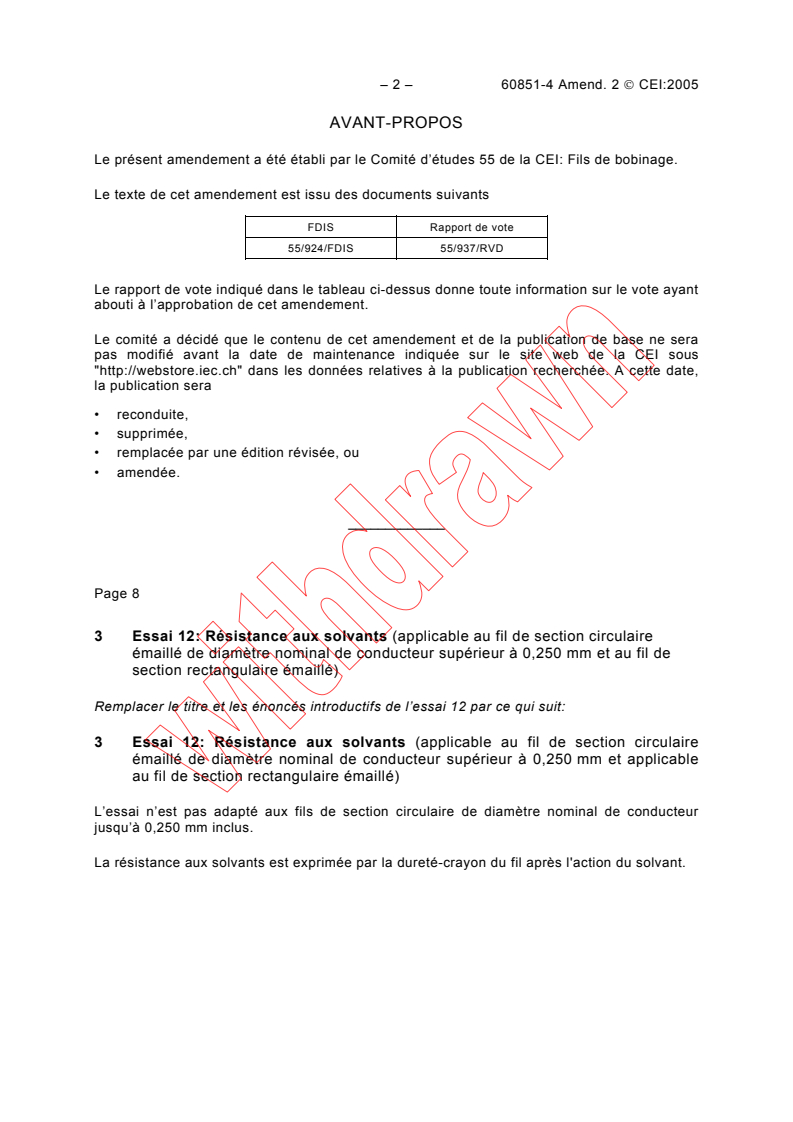
AVANT-PROPOS
Le présent amendement a été établi par le Comité d’études 55 de la CEI: Fils de bobinage.
Le texte de cet amendement est issu des documents suivants
FDIS Rapport de vote
55/924/FDIS 55/937/RVD
Le rapport de vote indiqué dans le tableau ci-dessus donne toute information sur le vote ayant
abouti à l’approbation de cet amendement.
Le comité a décidé que le contenu de cet amendement et de la publication de base ne sera
pas modifié avant la date de maintenance indiquée sur le site web de la CEI sous
"http://webstore.iec.ch" dans les données relatives à la publication recherchée. A cette date,
la publication sera
• reconduite,
• supprimée,
• remplacée par une édition révisée, ou
• amendée.
_____________
Page 8
3 Essai 12: Résistance aux solvants (applicable au fil de section circulaire
émaillé de diamètre nominal de conducteur supérieur à 0,250 mm et au fil de
section rectangulaire émaillé)
Remplacer le titre et les énoncés introductifs de l’essai 12 par ce qui suit:
3 Essai 12: Résistance aux solvants (applicable au fil de section circulaire
émaillé de diamètre nominal de conducteur supérieur à 0,250 mm et applicable
au fil de section rectangulaire émaillé)
L’essai n’est pas adapté aux fils de section circulaire de diamètre nominal de conducteur
jusqu’à 0,250 mm inclus.
La résistance aux solvants est exprimée par la dureté-crayon du fil après l'action du solvant.
60851-4 Amend. 2 IEC:2005 – 3 –
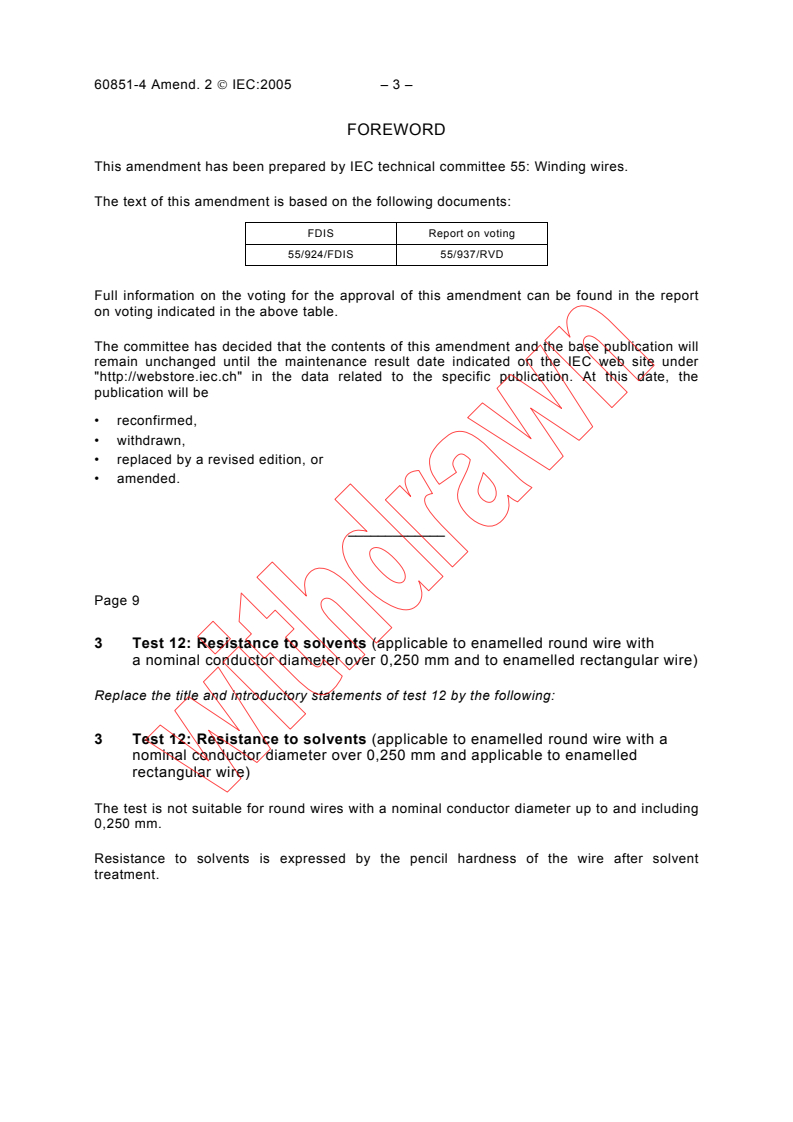
FOREWORD
This amendment has been prepared by IEC technical committee 55: Winding wires.
The text of this amendment is based on the following documents:
FDIS Report on voting
55/924/FDIS 55/937/RVD
Full information on the voting for the approval of this amendment can be found in the report
on voting indicated in the above table.
The committee has decided that the contents of this amendment and the base publication will
remain unchanged until the maintenance result date indicated on the IEC web site under
"http://webstore.iec.ch" in the data related to the specific publication. At this date, the
publication will be
• reconfirmed,
• withdrawn,
• replaced by a revised edition, or
• amended.
_____________
Page 9
3 Test 12: Resistance to solvents (applicable to enamelled round wire with
a nominal conductor diameter over 0,250 mm and to enamelled rectangular wire)
Replace the title and introductory statements of test 12 by the following:
3 Test 12: Resistance to solvents (applicable to enamelled round wire with a
nominal conductor diameter over 0,250 mm and applicable to enamelled
rectangular wire)
The test is not suitable for round wires with a nominal conductor diameter up to and including
0,250 mm.
Resistance to solvents is expressed by the pencil hardness of the wire after solvent
treatment.
– 4 – 60851-4 Amend. 2 CEI:2005
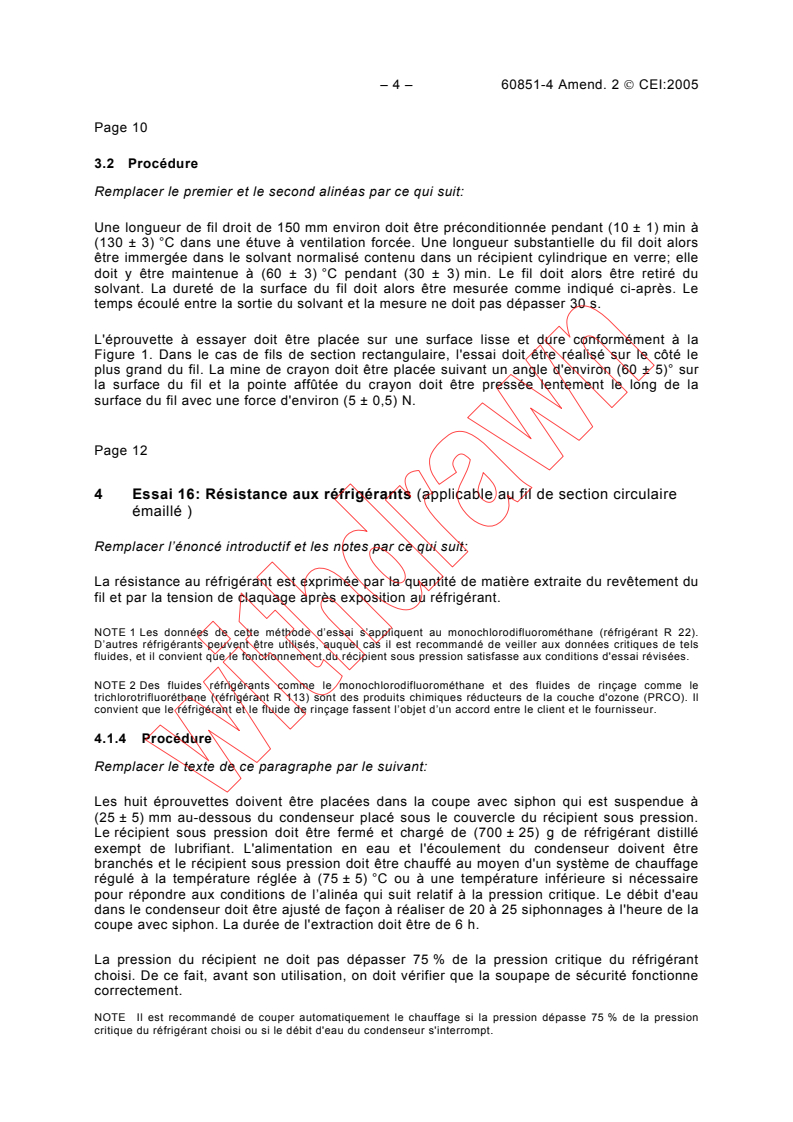
Page 10
3.2 Procédure
Remplacer le premier et le second alinéas par ce qui suit:
Une longueur de fil droit de 150 mm environ doit être préconditionnée pendant (10 ± 1) min à
(130 ± 3) °C dans une étuve à ventilation forcée. Une longueur substantielle du fil doit alors
être immergée dans le solvant normalisé contenu dans un récipient cylindrique en verre; elle
doit y être maintenue à (60 ± 3) °C pendant (30 ± 3) min. Le fil doit alors être retiré du
solvant. La dureté de la surface du fil doit alors être mesurée comme indiqué ci-après. Le
temps écoulé entre la sortie du solvant et la mesure ne doit pas dépasser 30 s.
L'éprouvette à essayer doit être placée sur une surface lisse et dure conformément à la
Figure 1. Dans le cas de fils de section rectangulaire, l'essai doit être réalisé sur le côté le
plus grand du fil. La mine de crayon doit être placée suivant un angle d'environ (60 ± 5)° sur
la surface du fil et la pointe affûtée du crayon doit être pressée lentement le long de la
surface du fil avec une force d'environ (5 ± 0,5) N.
Page 12
4 Essai 16: Résistance aux réfrigérants (applicable au fil de section circulaire
émaillé )
Remplacer l’énoncé introductif et les notes par ce qui suit:
La résistance au réfrigérant est exprimée par la quantité de matière extraite du revêtement du
fil et par la tension de claquage après exposition au réfrigérant.
NOTE 1 Les données de cette méthode d’essai s’appliquent au monochlorodifluorométhane (réfrigérant R 22).
D’autres réfrigérants peuvent être utilisés, auquel cas il est recommandé de veiller aux données critiques de tels
fluides, et il convient que le fonctionnement du récipient sous pression satisfasse aux conditions d'essai révisées.
NOTE 2 Des fluides réfrigérants comme le monochlorodifluorométhane et des fluides de rinçage comme le
trichlorotrifluoréthane (réfrigérant R 113) sont des produits chimiques réducteurs de la couche d'ozone (PRCO). Il
convient que le réfrigérant et le fluide de rinçage fassent l’objet d’un accord entre le client et le fournisseur.
4.1.4 Procédure
Remplacer le texte de ce paragraphe par le suivant:
Les huit éprouvettes doivent être placées dans la coupe avec siphon qui est suspendue à
(25 ± 5) mm au-dessous du condenseur placé sous le couvercle du récipient sous pression.
Le récipient sous pression doit être fermé et chargé de (700 ± 25) g de réfrigérant distillé
exempt de lubrifiant. L'alimentation en eau et l'écoulement du condenseur doivent être
branchés et le récipient sous pression doit être chauffé au moyen d'un système de chauffage
régulé à la température réglée à (75 ± 5) °C ou à une température inférieure si nécessaire
pour répondre aux conditions de l’alinéa qui suit relatif à la pression critique. Le débit d'eau
dans le condenseur doit être ajusté de façon à réaliser de 20 à 25 siphonnages à l'heure de la
coupe avec siphon. La durée de l'extraction doit être de 6 h.
La pression du récipient ne doit pas dépasser 75 % de la pression critique du réfrigérant
choisi. De ce fait, avant son utilisation, on doit vérifier que la soupape de sécurité fonctionne
correctement.
NOTE Il est recommandé de couper automatiquement le chauffage si la pression dépasse 75 % de la pression
critique du réfrigérant choisi ou si le débit d'eau du condenseur s'interrompt.
60851-4 Amend. 2 IEC:2005 – 5 –
Page 11
3.2 Procedure
Replace the first two paragraphs by the following:
A straight piece of wire, approximately 150 mm in length, shall be preconditioned for
(10 ± 1) min at (130 ± 3) °C in an oven with forced air circulation. A substantial length of the
wire shall then be immersed in standard solvent contained in a glass cylinder and shall be
maintained therein at a temperature of (60 ± 3) °C for a period of (30 ± 3) min. The wire shall
then be removed from the solvent. The hardness of the wire surface shall then be determined
in the following manner within a period of 30 s after removal from the solvent.
The specimen to be tested shall be laid on a smooth hard surface according to Figure 1. In
the case of rectangular wires, the test shall be carried out on the largest side of the wire. The
pencil shall be placed on the surface of the wire at an angle of approximately (60 ± 5)° and
the sharpened edge shall be pressed slowly along the surface of the wire with a force of
approximately (5 ± 0,5) N.
Page 13
4 Test 16: Resistance to refrigerants (applicable to enamelled round wire)
Replace the introductory statement and notes by the following:
Resistance to refrigerant is expressed by the quantity of matter extracted from the coating of
the wire and by the breakdown voltage after exposure to a refrigerant.
NOTE 1 The data in this test method apply to monochlorodifluoromethane (refrigerant R 22). Other refrigerants
may be used, in which case the critical data for such fluid should be observed and operation of the pressure vessel
should comply with the revised test conditions.
NOTE 2 Refrigerants like monochlorodifluoromethane and rinsing fluids like trichlorotrifluorethane (refrigerant
R 113) are ozone depleting chemicals (ODC). Refrigerant and rinsing fluid should be agreed upon between
customer and supplier.
4.1.4 Procedure
Replace the text of this subclause by the following:
The eight specimens shall be placed in the siphon cup, which is suspended (25 ± 5) mm
below the condenser coil on the pressure vessel cover. The pressure vessel shall be
assembled and charged with (700 ± 25) g of distilled refrigerant free from lubricant. The
condenser water supply and drain line shall be connected and the pressure vessel shall be
heated by means of a controlled heating system with the temperature set to (75 ± 5) °C or a
lower temperature if required to comply with the conditions of the following paragraph relating
to critical pressure. The water flowing through the condenser shall be adjusted to maintain a
reflux rate of 20 to 25 discharges per hour from the siphon cup. The extraction period shall
be 6 h.
The pressure in the vessel shall not exceed 75 % of the critical pressure of the refrigerant
chosen. Therefore, prior to use, the over-pressure control valve shall be checked to ensure its
proper functioning.
NOTE It is recommended that the heating system be automatically deactivated if the pressure exceeds 75 % of
the critical pressure of the refrigerant chosen or if the water flow through the condenser coil is interrupted.
– 6 – 60851-4 Amend. 2 CEI:2005
A la fin du temps d'extraction, le récipient sous pression doit être refroidi. Le réfrigérant doit
être retiré du récipient sous pression et récupéré en utilisant des moyens adaptés tels qu’un
compresseur frigorifique et un système de récupération. On doit alors faire tomber la pression
et ouvrir le récipient.
Pour les opérations suivantes, le fluide de rinçage doit être distillé avant utilisation.
Les éprouvettes et la coupe avec siphon doivent être rincées avec le fluide de rinçage agréé,
le produit de rinçage est versé dans le récipient sous pression, les parois du récipient sous
pression sont nettoyées à l'aide de deux rinçages successifs de 100 ml de fluide de rinçage.
Le fluide doit alors être évaporé jusqu'à (5 ± 1) mm du fond du récipient sous pression et
récupéré de manière sûre.
L’échantillon de liquide doit être transféré dans une capsule d'aluminium préalablement
séchée et tarée. Le récipient sous pression doit être rincé avec 15 ml de fluide de rinçage, qui
est transféré dans la capsule, puis évaporé jusqu’à siccité à (150 ± 3) °C pendant 60 à
65 min. La capsule doit ensuite être refroidie à la température ambiante dans un
dessiccateur. La capsule d'aluminium avec le résidu doit être pesée à 0,0001 g près. La tare
de la capsule est soustraite du résultat. La différence est la masse de résidu totale M de
matière extraite pour les huit éprouvettes.
L'isolant des bobinages doit être retiré à l'aide d'un moyen chimique approprié qui n'affecte pas
le conducteur, et les conducteurs nus doivent être séchés à (150 ± 3) °C pendant (15 ± 1) min
et refroidis à la température ambiante dans un dessiccateur. Les huit bobinages doivent être
pesés ensemble à 0,0001 g près et leur masse est la masse totale du conducteur M .
Page 14
4.1.5 Résultats
Remplacer le dernier alinéa par le texte suivant:
Un essai doit être réalisé. On doit noter les masses M , M , M , le réfrigérant, le fluide de
1 2 3
rinçage, la température et la pression du récipient, ainsi que le pourcentage de matière
extraite.
Page 16
4.2.3 Résultats
La correction ne concerne que le texte anglais.
60851-4 Amend. 2 IEC:2005 – 7 –
At the end of the extraction period the pressure vessel shall be cooled. The refrigerant shall
be removed from the pressure vessel and recovered using suitable means such as a
refrigerant compressor and recovery system. The pressure shall be released and the pressure
vessel opened.
For the following operations, the rinsing fluid shall be distilled before use.
The specimens and siphon cup shall be rinsed with the agreed rinsing fluid, the rinse poured
into the pressure vessel and the walls of the pressure vessel washed with two successive
rinses each of 100 ml of rinsing fluid. The fluid shall then be evaporated to (5 ± 1) mm from
the bottom of the pressure vessel and recovered in a safe manner.
The liquid sample shall be transferred to a pre-dried tared aluminium weighing dish and the
pressure vessel rinsed with 15 ml of rinsing fluid, which is transferred to the dish and then
evaporated to dryness at (150 ± 3) °C for 60 to 65 min. The weighing dish shall then be
cooled to room temperature in a desiccator. The dish with the residue shall be weighed to the
nearest 0,0001 g and the original tared mass of the same dish subtracted. The difference is
the total residue mass M of the matter extracted from the eight specimens.
The insulation on the coils shall be removed by suitable chemical means not affecting the
conductor and the bare conductors shall be dried at (150 ± 3) °C for (15 ± 1) min and cooled
to room temperature in a desiccator. They shall be weighed to the nearest 0,0001 g and the
mass of the eight conductors together is the total conductor mass M .
Page 15
4.1.5 Result
Replace the last sentence by the following:
One test shall be made. The masses M , M , M , the refrigerant, rinsing fluid, temperature,
1 2 3
pressure of the pressure vessel and the percentage extractable matter shall be reported.
Page 17
4.2.3 Result
Replace the existing sentence by the following:
Five specimens shall be tested. The five individual values shall be reported.
– 8 – 60851-4 Amend. 2 CEI:2005
5 Essai 17: Brasabilité (applicable au fil de section circulaire émaillé et au fil
toronné)
Ajouter, après le premier alinéa, ce qui suit:
Avertissement de sécurité: Danger chimique – Le plomb a été reconnu, par les organismes
réglementaires, comme étant une substance dangereuse. Les principales voies d’exposition
sont l’inhalation et l’ingestion. Il faut que les informations contenues dans la Fiche de donnée
de sécurité (FDS) concernant le plomb, l’étain, le diluant et l’alcool soient respectées pendant
l’utilisation, la manipulation et la destruction de ces produits. Une ventilation adéquate ou une
extraction forcée des vapeurs du bain de brasure et des produits issus des différents isolants
soudables peut être nécessaire pour satisfaire aux règlements sur l’environnement.
Avertissement de sécurité: Danger thermique – Des précautions doivent être prises durant
l’extraction des échantillons en essai du bain de brasure pour éviter des brûlures de la peau.
5.2 Spécimen
Remplacer le titre et le texte existants de ce paragraphe par ce qui suit:
5.2 Equipement
L'équipement suivant doit être utilisé:
– Un bain de brasure à température régulée d'un volume suffisant pour en maintenir la
température constante quand l'éprouvette est immergée à la température spécifiée dans la
norme appropriée. La composition de la brasure doit être d'un rapport de masse de
60 parties d'étain pour 40 parties de plomb. Toutes les impuretés qui se créent doivent
être enlevées de la surface de la brasure avant chaque essai; la température doit être
réglable à ±5 °C de la température de la spécification appropriée.
– Tout support adapté qui laisse le fil libre pendant au moins (35 ± 5) mm entre les points
d'appui (voir la Figure 4). Le matériau utilisé pour le support ne doit pas contaminer le
bain de brasure. Les dimensions du support ne doivent pas modifier sensiblement la
température du bain de brasure pendant l'immersion.
NOTE Une contamination de la brasure par l'oxydation ou la présence de cuivre peut affecter les résultats.
Page 18
5.3 Procédure
Remplacer le texte de la seconde phrase du premier alinéa comme suit:
L'extrémité inférieure doit être abaissée à (35 ± 5) mm au-dessous de la surface du bain.
Remplacer le second alinéa par le suivant:
La surface du fil étamé doit être examinée avec un grossissement de 6X à 10X. Dans le cas
de fil de diamètre nominal du conducteur jusqu'à 0,100 mm inclus, l'examen doit être limité à
la partie libre de (25 ± 2,5) mm au centre entre les appuis. Dans le cas de fil de diamètre
nominal du conducteur supérieur 0,100 mm et de fil toronné, l’examen doit être limité aux
15 mm i
...