

IEC TS 62997:2017
(Main)Industrial electroheating and electromagnetic processing equipment - Evaluation of hazards caused by magnetic nearfields from 1 Hz to 6 MHz
General Information
- Abstract
IEC/TS 62997:2017(E) specifies the characteristics of external magnetic nearfields, computations of and requirements on induced electric fields in body tissues in the frequency range from 1 Hz to 6 MHz with respect to induced electric shock phenomena, for electroheating (EH) based treatment technologies and for electromagnetic processing of materials (EPM). The phenomena include specific absorption rates with time integration.
- Status
- Published
- Publication Date
- 14-Jun-2017
- Technical Committee
- TC 27 - Industrial electroheating and electromagnetic processing
- Drafting Committee
- MT 33 - TC 27/MT 33
- Current Stage
- PPUB - Publication issued
- Start Date
- 15-Jun-2017
- Completion Date
- 05-Jul-2017
Buy Documents
IEC TS 62997:2017 - Industrial electroheating and electromagnetic processing equipment - Evaluation of hazards caused by magnetic nearfields from 1 Hz to 6 MHz Released:6/15/2017
Overview
IEC TS 62997:2017 provides guidance for evaluating hazards from magnetic nearfields in industrial electroheating (EH) and electromagnetic processing of materials (EPM). The technical specification covers the frequency range 1 Hz to 6 MHz and specifies how to characterise external magnetic nearfields, compute induced electric fields in body tissues, and assess specific absorption rates (SAR) including time integration. It is intended to manage induced electric shock phenomena and tissue overheating risks associated with industrial electromagnetic equipment.
Key topics and technical requirements
- Scope and definitions: Terminology, quantities and units for magnetic nearfield assessment (1 Hz–6 MHz).
- Basic relationships: Formulas and principles to determine in situ induced electric field strengths and coupling factors.
- Immediate nerve and muscle reaction controls:
- Methods such as Conductor Geometry and Current Restriction (CGCR).
- Volunteer test methods (several variants including similarity-based and elevated-current approaches).
- Use of magnetic nearfield reference levels (RLs) where applicable.
- Tissue overheating and SAR: Requirements for time-integrated SAR assessments (e.g., 6-minute integration and shorter times for fingers/hands).
- Numerical computations: Guidance on FDTD/FEM modelling, handling inaccuracies, uncertainties and applying safety factors.
- Verification approaches: When simple B-field measurements are sufficient versus when modelling or volunteer tests are required.
- Risk classification and marking: Risk groups, warning labels and practical examples of marking for equipment.
- Supporting annexes: Analytical calculations, reference bodypart models and dielectric properties, FDTD modelling case studies (Helmholtz coils, straight conductors), and frequency upscaling considerations.
Practical applications and users
IEC TS 62997:2017 is practical for:
- Manufacturers and designers of industrial electroheating and electromagnetic processing equipment who need to design for electromagnetic safety.
- Test laboratories and compliance engineers performing B-field, induced E-field and SAR assessments.
- Occupational health & safety specialists and plant engineers implementing risk controls, warning markings and safe operating procedures.
- Regulatory bodies and certifiers referencing standardised approaches for evaluating magnetic nearfield hazards.
- Modelling specialists applying FDTD/FEM numerical methods to predict in situ fields and validate mitigation measures.
Related standards
- References and comparisons are made to international exposure guidelines such as ICNIRP, IEEE standards and the EU 2013/35/EU framework (see Annex A for a survey of basic restrictions and reference levels).
Keywords: IEC TS 62997:2017, magnetic nearfields, electroheating safety, electromagnetic processing, induced electric field, SAR, CGCR method, volunteer test, FDTD modelling, industrial electromagnetic equipment.
Buy Documents
IEC TS 62997:2017 - Industrial electroheating and electromagnetic processing equipment - Evaluation of hazards caused by magnetic nearfields from 1 Hz to 6 MHz Released:6/15/2017
Get Certified
Connect with accredited certification bodies for this standard

DVS-ZERT GmbH
German welding certification society.
IMP NDT d.o.o.
Non-destructive testing services. Radiography, ultrasonic, magnetic particle, penetrant, visual inspection.
Inštitut za kovinske materiale in tehnologije
Institute of Metals and Technology. Materials testing, metallurgical analysis, NDT.
Sponsored listings
Frequently Asked Questions
IEC TS 62997:2017 is a technical specification published by the International Electrotechnical Commission (IEC). Its full title is "Industrial electroheating and electromagnetic processing equipment - Evaluation of hazards caused by magnetic nearfields from 1 Hz to 6 MHz". This standard covers: IEC/TS 62997:2017(E) specifies the characteristics of external magnetic nearfields, computations of and requirements on induced electric fields in body tissues in the frequency range from 1 Hz to 6 MHz with respect to induced electric shock phenomena, for electroheating (EH) based treatment technologies and for electromagnetic processing of materials (EPM). The phenomena include specific absorption rates with time integration.
IEC/TS 62997:2017(E) specifies the characteristics of external magnetic nearfields, computations of and requirements on induced electric fields in body tissues in the frequency range from 1 Hz to 6 MHz with respect to induced electric shock phenomena, for electroheating (EH) based treatment technologies and for electromagnetic processing of materials (EPM). The phenomena include specific absorption rates with time integration.
IEC TS 62997:2017 is classified under the following ICS (International Classification for Standards) categories: 17.220.20 - Measurement of electrical and magnetic quantities; 19.080 - Electrical and electronic testing; 25.180.10 - Electric furnaces. The ICS classification helps identify the subject area and facilitates finding related standards.
IEC TS 62997:2017 is available in PDF format for immediate download after purchase. The document can be added to your cart and obtained through the secure checkout process. Digital delivery ensures instant access to the complete standard document.
Standards Content (Sample)
IEC TS 62997 ®
Edition 1.0 2017-06
TECHNICAL
SPECIFICATION
colour
inside
Industrial electroheating and electromagnetic processing equipment –
Evaluation of hazards caused by magnetic nearfields from 1 Hz to 6 MHz
All rights reserved. Unless otherwise specified, no part of this publication may be reproduced or utilized in any form
or by any means, electronic or mechanical, including photocopying and microfilm, without permission in writing from
either IEC or IEC's member National Committee in the country of the requester. If you have any questions about IEC
copyright or have an enquiry about obtaining additional rights to this publication, please contact the address below or
your local IEC member National Committee for further information.
IEC Central Office Tel.: +41 22 919 02 11
3, rue de Varembé Fax: +41 22 919 03 00
CH-1211 Geneva 20 info@iec.ch
Switzerland www.iec.ch
About the IEC
The International Electrotechnical Commission (IEC) is the leading global organization that prepares and publishes
International Standards for all electrical, electronic and related technologies.
About IEC publications
The technical content of IEC publications is kept under constant review by the IEC. Please make sure that you have the
latest edition, a corrigenda or an amendment might have been published.
IEC Catalogue - webstore.iec.ch/catalogue Electropedia - www.electropedia.org
The stand-alone application for consulting the entire The world's leading online dictionary of electronic and
bibliographical information on IEC International Standards, electrical terms containing 20 000 terms and definitions in
Technical Specifications, Technical Reports and other English and French, with equivalent terms in 16 additional
documents. Available for PC, Mac OS, Android Tablets and languages. Also known as the International Electrotechnical
iPad. Vocabulary (IEV) online.
IEC publications search - www.iec.ch/searchpub IEC Glossary - std.iec.ch/glossary
The advanced search enables to find IEC publications by a 65 000 electrotechnical terminology entries in English and
variety of criteria (reference number, text, technical French extracted from the Terms and Definitions clause of
committee,…). It also gives information on projects, replaced IEC publications issued since 2002. Some entries have been
and withdrawn publications. collected from earlier publications of IEC TC 37, 77, 86 and
CISPR.
IEC Just Published - webstore.iec.ch/justpublished
Stay up to date on all new IEC publications. Just Published IEC Customer Service Centre - webstore.iec.ch/csc
details all new publications released. Available online and If you wish to give us your feedback on this publication or
also once a month by email. need further assistance, please contact the Customer Service
Centre: csc@iec.ch.
IEC TS 62997 ®
Edition 1.0 2017-06
TECHNICAL
SPECIFICATION
colour
inside
Industrial electroheating and electromagnetic processing equipment –
Evaluation of hazards caused by magnetic nearfields from 1 Hz to 6 MHz
INTERNATIONAL
ELECTROTECHNICAL
COMMISSION
ICS 25.180.10 ISBN 978-2-8322-4449-4
– 2 – IEC TS 62997:2017 © IEC 2017
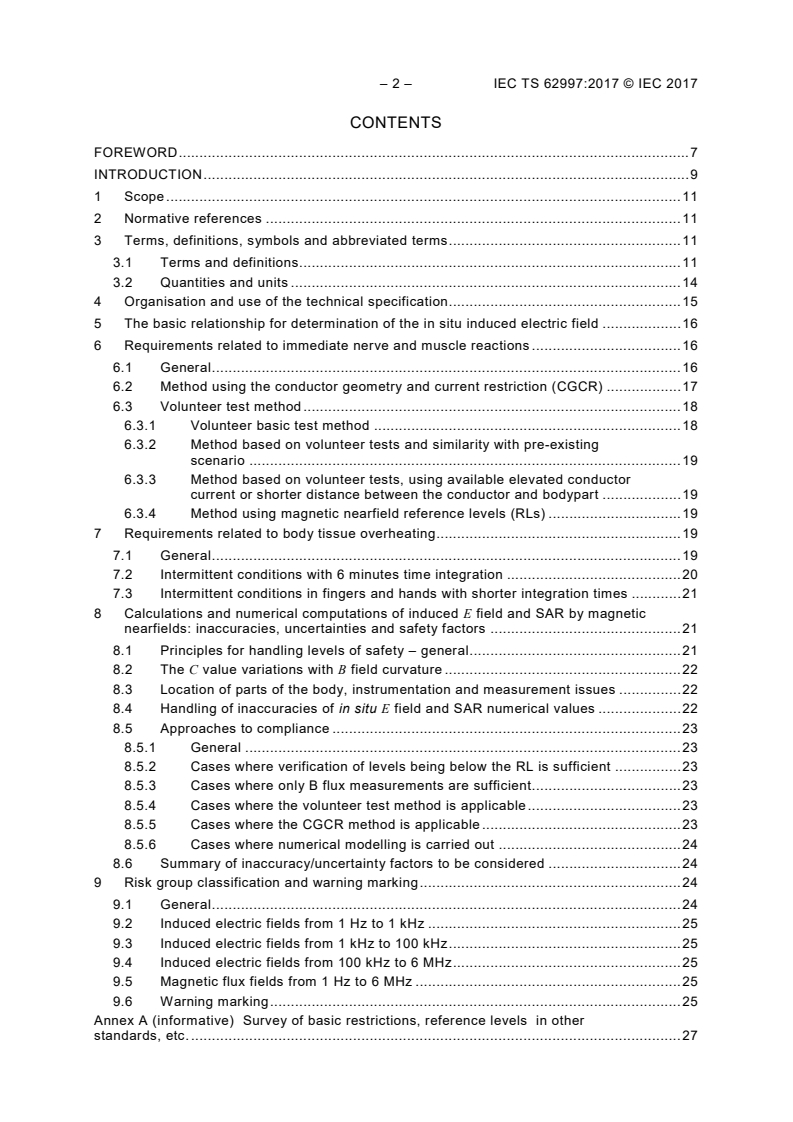
CONTENTS
FOREWORD . 7
INTRODUCTION . 9
1 Scope . 11
2 Normative references . 11
3 Terms, definitions, symbols and abbreviated terms . 11
3.1 Terms and definitions . 11
3.2 Quantities and units . 14
4 Organisation and use of the technical specification . 15
5 The basic relationship for determination of the in situ induced electric field . 16
6 Requirements related to immediate nerve and muscle reactions . 16
6.1 General . 16
6.2 Method using the conductor geometry and current restriction (CGCR) . 17
6.3 Volunteer test method . 18
6.3.1 Volunteer basic test method . 18
6.3.2 Method based on volunteer tests and similarity with pre-existing
scenario . 19
6.3.3 Method based on volunteer tests, using available elevated conductor
current or shorter distance between the conductor and bodypart . 19
6.3.4 Method using magnetic nearfield reference levels (RLs) . 19
7 Requirements related to body tissue overheating . 19
7.1 General . 19
7.2 Intermittent conditions with 6 minutes time integration . 20
7.3 Intermittent conditions in fingers and hands with shorter integration times . 21
8 Calculations and numerical computations of induced E field and SAR by magnetic
nearfields: inaccuracies, uncertainties and safety factors . 21
8.1 Principles for handling levels of safety – general . 21
8.2 The C value variations with B field curvature . 22
8.3 Location of parts of the body, instrumentation and measurement issues . 22
8.4 Handling of inaccuracies of in situ E field and SAR numerical values . 22
8.5 Approaches to compliance . 23
8.5.1 General . 23
8.5.2 Cases where verification of levels being below the RL is sufficient . 23
8.5.3 Cases where only B flux measurements are sufficient . 23
8.5.4 Cases where the volunteer test method is applicable . 23
8.5.5 Cases where the CGCR method is applicable . 23
8.5.6 Cases where numerical modelling is carried out . 24
8.6 Summary of inaccuracy/uncertainty factors to be considered . 24
9 Risk group classification and warning marking . 24
9.1 General . 24
9.2 Induced electric fields from 1 Hz to 1 kHz . 25
9.3 Induced electric fields from 1 kHz to 100 kHz . 25
9.4 Induced electric fields from 100 kHz to 6 MHz . 25
9.5 Magnetic flux fields from 1 Hz to 6 MHz . 25
9.6 Warning marking . 25
Annex A (informative) Survey of basic restrictions, reference levels in other
standards, etc. . 27
A.1 Basic restrictions – general and deviations . 27
A.2 The coupling values C in ICNIRP guidelines and IEEE standards . 27
A.3 Basic restrictions – immediate nerve and muscle reactions . 28
A.4 Basic restrictions – specific absorption rates (SAR) . 29
A.5 Reference levels – external magnetic B field . 29
Annex B (normative) Analytical calculations of magnetically induced internal E field
phenomena . 30
B.1 Some basic formulas – magnetic fields and Laws of Nature . 30
B.2 Induced field deposition in tissues by magnetic nearfields . 31
B.3 Coupling of a homogeneous B field to homogeneous objects with simple
geometries . 31
B.4 Starting points for numerical modelling . 32
B.4.1 Relevant bodyparts . 32
B.4.2 The use of external B field and internal power density in numerical
modelling . 32
Annex C (normative) Reference objects representing parts of the body: tissue
conductivities . 33
C.1 Reference bodyparts . 33
C.1.1 General . 33
C.1.2 The wrist/arm models . 33
C.1.3 The hand model with tight fingers . 33
C.1.4 The hand model with spread-out fingers . 33
C.1.5 The finger model. 33
C.2 Dielectric properties of human tissues . 33
C.2.1 General data for assessments . 33
C.2.2 Inner parts of the body . 34
C.2.3 Skin data . 34
Annex D (informative) Results of numerical modelling with objects in a Helmholtz coil
and at a long straight conductor . 35
D.1 General and a large Helmholtz coil scenario with a diameter 200 mm sphere
– FDTD 3D modelling . 35
D.2 Other reference objects in the Helmholtz coil – FDTD 3D modelling . 36
D.2.1 The scenario . 36
D.2.2 Numerical modelling results with smaller spheres . 36
D.2.3 Numerical results with other objects . 37
Annex E (informative) Numerical FDTD modelling with objects at a long straight wire
conductor . 38
E.1 Scenario and general information . 38
E.2 Two 200 mm diameter spheres . 39
E.3 The hand model with tight fingers at different distances from the wire –
FDTD modelling . 40
E.3.1 General information and scenario . 40
E.3.2 Modelling results – power deposition patterns . 40
E.4 The hand model with tight fingers at 100 mm from the wire – Flux® 12 FEM
modelling . 42
E.5 Coupling data and analysis for the hand model with tight fingers above the
wire – FDTD modelling . 42
E.6 Coupling data and analysis for the wrist/arm model above the wire . 43
Annex F (informative) Numerical modelling and volunteer experiments with the hand
models at a coil. 45
F.1 General and on the B field amplitude . 45
– 4 – IEC TS 62997:2017 © IEC 2017
F.2 The hand model with tight fingers 2 mm, 4 mm, 6 mm and 50 mm above the
coil and with its right side above the coil axis – FDTD modelling . 46
F.2.1 The scenario . 46
F.2.2 Modelling results . 47
F.3 The hand model with tight fingers 6 mm above the coil and with variable
position in the x direction – FDTD modelling . 51
F.4 The hand model with spread-out fingers, 6 mm straight above the coil –
FDTD modelling . 51
F.5 The hand model with tight fingers near a coil with metallic workload – FDTD
modelling . 52
F.6 The finger model 2 mm above the coil – FDTD numerical modelling . 54
F.6.1 The scenarios . 54
F.6.2 Modelling results . 54
F.7 Analysis of the FDTD modelling results . 56
F.7.1 General . 56
F.7.2 With the hand model . 56
F.7.3 With the finger model . 56
F.8 Volunteer studies . 56
F.8.1 General . 56
F.8.2 Calculations of the induced electric field strength in F.7.1 . 57
F.9 Comparisons with conventional electric shock effects by contact current . 57
F.10 Conclusions from the data in Annexes E and F . 58
F.10.1 Coupling factor C data in relation to reference object geometries and
magnetic flux characteristics without workload . 58
F.10.2 Coupling factor C modifications by workloads . 58
F.10.3 Rationales for the CGCR basic value with the volunteer method . 58
Annex G (informative) Some examples of CGCR values of a hand near conductors as
function of frequency, conductor current and configuration . 60
G.1 Frequency and conductor current relationships: adopted CGCR value . 60
G.2 A hand above a thin wire . 60
G.3 A hand above a coil . 61
Annex H (informative) Frequency upscaling with numerical modelling . 64
H.1 General and energy penetration depth . 64
H.2 Actual penetration depth data . 64
H.3 The penetration depth issue of representativity with frequency upscaling . 65
H.4 Separation of the internal power density caused by direct capacitive
coupling, and that caused by the external magnetic field . 65
H.5 The frequency upscaling procedures . 66
H.5.1 General . 66
H.5.2 Choices of conductivity and control procedures . 66
Bibliography . 68
Figure 1 – Examples of warning marking . 26
Figure A.1 – ICNIRP, IEEE and 2013/35/EU basic restrictions (RMS) . 28
Figure D.1 – The z-directed magnetic field momentaneous maximal amplitude in the
central y plane of the Helmholtz coil with the conductive 200 mm diameter sphere . 36
Figure D.2 – The power density patterns in the central y plane (left) and central z
(equatorial) plane of the 200 mm diameter sphere . 36
Figure D.3 – The power density patterns in the central z plane of the reference
objects, with maximal C values in m . 37
Figure E.1 – Long straight wire scenario . 38
Figure E.2 – Power deposition patterns in the central z planes of the two spheres at
–1
10 mm and 20 mm away from the sphere axis; σ = 20 Sm . 39
Figure E.3 – Power deposition pattern in the central y plane of the sphere at 10 mm
–1
distance from the wire axis; σ = 20 Sm . 39
Figure E.4 – Scenario with the hand model above the wire axis . 40
Figure E.5 – Power density in the hand model 2,5 mm above the wire axis . 40
Figure E.6 – Power density in the hand model 14 mm above the wire axis . 41
Figure E.7 – Power density in the hand model 100 mm above the wire axis . 41
Figure E.8 – Current density in the central cross section of the hand model at 9 mm
from the wire – Flux® 12 FEM modelling . 42
Figure E.9 – Wrist/arm model above a long straight wire . 43
Figure E.10 – Linear power density (left, power scaling) and electric field amplitude (linear
scale) in the x plane of wrist/arm model 10 mm straight above a long straight wire . 43
Figure F.1 – Illustration of the B field at a single turn coil, with the coil centre at the
left margin of the image – Flux® 12 FEM modelling . 45
Figure F.2 – Hand above the coil scenario . 46
Figure F.3 – Power density pattern in the central vertical plane and in the bottom 1 mm
layer of the hand model, z = 2 mm above the top of the coil; a = –51 mm . 47
Figure F.4 – Power density pattern in the central vertical plane and in the bottom 1 mm
layer of the hand model, z = 4 mm; a = –51 mm . 47
Figure F.5 – Power density pattern in the central vertical plane and in the bottom
1 mm layer of the hand model, z = 50 mm; a = –51 mm . 48
Figure F.6 – The ±x-directed (left image) and ±y-directed momentaneous maximal E
field at the hand underside, z = 4 mm; a = –51 mm . 49
Figure F.7 – The local power density pattern of the condition in Figure F.3, showing the
1 mm × 1 mm voxel size and the 5 mm integration region 2 mm above the hand
underside . 50
Figure F.8 – The local y-directed momentaneous maximal electric field pattern of the
condition in Figure F.3, showing the 1 mm × 1 mm voxel size and the 5 mm
integration region 2 mm above the hand underside . 50
Figure F.9 – The power density pattern in the hand model centred above the coil and
6 mm above it; left image: bottom region, right image: 10 mm up . 51
Figure F.10 – The hand model with spread-out fingers located 6 mm straight above
the coil (left); relative power densities at the height of maximum power density
between fingers (right) . 51
Figure F.11 – The hand model 6 mm above the coil and a 100 mm diameter metallic
workload in the coil . 52
Figure F.12 – Quiver plot of the magnetic (H) field amplitude in logarithmic scaling, in
the scenario in Figure F.11 with a non-magnetic (left) and magnetic (right) workload . 52
Figure F.13 – The power density pattern in the central vertical cross section in the
hand scenario in Figure F.11 . 53
Figure F.14 – The power density in the central vertical cross section of the hand as in
the scenario in Figure F.11, but 50 mm above the coil; with no workload (left) and with
permeable metallic workload (right) . 53
Figure F.15 – The two finger positions above the coil; left = y-directed finger. 54
Figure F.16 – Power density maximum pattern in the y-directed 17 mm diameter finger
model . 54
Figure F.17 – Power density maximum pattern in the x-directed 17 mm diameter finger
model . 55
– 6 – IEC TS 62997:2017 © IEC 2017
Figure F.18 – Momentaneous maximal electric field maximum pattern in the x-directed
17 mm diameter finger model . 55
Figure F.19 – Plastic plate above the coil . 57
–1
Figure G.1 – Allowed RMS current at 11 kHz, based on CGCR = 40 Vm . 60
Figure G.2 – CGCR coil currents at 11 kHz for the hand model with the side at the coil
axis, at various heights above the coil . 62
Figure G.3 – CGCR coil currents at 11 kHz for the hand model at 6 mm above the coil
with different sideways positions . 63
Table C.1 – Examples of dielectric data of human tissues at normal body temperature . 34
Table E.1 – Coupling factors for the hand model with tight fingers at various heights
above the wire axis . 42
Table G.1 – Coupling factors and allowed coil currents at 11 kHz for the hand model
with the side at the coil axis, at various heights above the coil . 61
Table G.2 – Coupling factors and allowed coil currents at 11 kHz for the hand model
at 6 mm above the coil with different sideways positions . 62
INTERNATIONAL ELECTROTECHNICAL COMMISSION
____________
INDUSTRIAL ELECTROHEATING AND
ELECTROMAGNETIC PROCESSING EQUIPMENT –
Evaluation of hazards caused by magnetic nearfields
from 1 Hz to 6 MHz
FOREWORD
1) The International Electrotechnical Commission (IEC) is a worldwide organization for standardization comprising
all national electrotechnical committees (IEC National Committees). The object of IEC is to promote
international co-operation on all questions concerning standardization in the electrical and electronic fields. To
this end and in addition to other activities, IEC publishes International Standards, Technical Specifications,
Technical Reports, Publicly Available Specifications (PAS) and Guides (hereafter referred to as “IEC
Publication(s)”). Their preparation is entrusted to technical committees; any IEC National Committee interested
in the subject dealt with may participate in this preparatory work. International, governmental and non-
governmental organizations liaising with the IEC also participate in this preparation. IEC collaborates closely
with the International Organization for Standardization (ISO) in accordance with conditions determined by
agreement between the two organizations.
2) The formal decisions or agreements of IEC on technical matters express, as nearly as possible, an international
consensus of opinion on the relevant subjects since each technical committee has representation from all
interested IEC National Committees.
3) IEC Publications have the form of recommendations for international use and are accepted by IEC National
Committees in that sense. While all reasonable efforts are made to ensure that the technical content of IEC
Publications is accurate, IEC cannot be held responsible for the way in which they are used or for any
misinterpretation by any end user.
4) In order to promote international uniformity, IEC National Committees undertake to apply IEC Publications
transparently to the maximum extent possible in their national and regional publications. Any divergence
between any IEC Publication and the corresponding national or regional publication shall be clearly indicated in
the latter.
5) IEC itself does not provide any attestation of conformity. Independent certification bodies provide conformity
assessment services and, in some areas, access to IEC marks of conformity. IEC is not responsible for any
services carried out by independent certification bodies.
6) All users should ensure that they have the latest edition of this publication.
7) No liability shall attach to IEC or its directors, employees, servants or agents including individual experts and
members of its technical committees and IEC National Committees for any personal injury, property damage or
other damage of any nature whatsoever, whether direct or indirect, or for costs (including legal fees) and
expenses arising out of the publication, use of, or reliance upon, this IEC Publication or any other IEC
Publications.
8) Attention is drawn to the Normative references cited in this publication. Use of the referenced publications is
indispensable for the correct application of this publication.
9) Attention is drawn to the possibility that some of the elements of this IEC Publication may be the subject of
patent rights. IEC shall not be held responsible for identifying any or all such patent rights.
The main task of IEC technical committees is to prepare International Standards. In
exceptional circumstances, a technical committee may propose the publication of a technical
specification when
• the required support cannot be obtained for the publication of an International Standard,
despite repeated efforts, or
• the subject is still under technical development or where, for any other reason, there is the
future but no immediate possibility of an agreement on an International Standard.
Technical specifications are subject to review within three years of publication to decide
whether they can be transformed into International Standards.
IEC TS 62997, which is a technical specification, has been prepared by IEC technical
committee 27: Industrial electroheating and electromagnetic processing.
– 8 – IEC TS 62997:2017 © IEC 2017
The text of this technical specification is based on the following documents:
Enquiry draft Report on voting
27/1000A/DTS 27/1007/RVDTS
Full information on the voting for the approval of this technical specification can be found in
the report on voting indicated in the above table.
This document has been drafted in accordance with the ISO/IEC Directives, Part 2.
In this technical specification, the following print types are used:
• terms used throughout this specification which have been defined in Clause 3: in bold
type.
The committee has decided that the contents of this document will remain unchanged until the
stability date indicated on the IEC website under "http://webstore.iec.ch" in the data related to
the specific document. At this date, the document will be
• reconfirmed,
• withdrawn,
• replaced by a revised edition, or
• amended.
A bilingual version of this publication may be issued at a later date.
IMPORTANT – The 'colour inside' logo on the cover page of this publication indicates
that it contains colours which are considered to be useful for the correct
understanding of its contents. Users should therefore print this document using a
colour printer.
INTRODUCTION
An external alternating magnetic flux can induce electric fields inside the human body. Such
induced fields constitute an important category of possible hazards. This technical
specification deals with the sub-category of non-radiating magnetic nearfields in the frequency
range between 1 Hz and 6 MHz being the source of the induced electric fields. The primary
focus is on technical applications in industrial electroheating and electromagnetic processing
installations and equipment, with the applicable safety standards in the IEC 60519 series.
IEC 62110:2009 deals with measurement procedures applicable to the characterisation of
magnetic and electric field levels with regard to public exposure. IEC 62822-2:2016 provides
assessments of exposure restrictions for electric arc welding equipment from 0 Hz to
300 GHz. There is, however, no other IEC standard or technical specification covering more
general kinds of equipment and hazard assessments in the range of up to 6 MHz.
Magnetic field hazards are dependent on the source characteristics, including such without
and with magnetic materials in the source circuit or workload. Such materials enhancing the
magnetic flux density are required for creating an induced electric shock hazard below some
few kHz. Static magnetic fields can cause other hazards than those by conventionally induced
electric fields and are dealt with in IEC 60519-1:2015. The lower frequency limit in this
technical specification is therefore 1 Hz.
NOTE A parallel IEC technical specification IEC TS 62996 is developed by IEC TC 27, to cover touch and
contact currents and voltages in the frequency range 1 kHz to 6 MHz. It also includes measurements of
capacitively coupled currents through the body. Touch and contact currents and voltages at lower frequencies are
covered by IEC 61140:2016.
The upper frequency limit 6 MHz is chosen, since
• higher frequencies are not expected to be employed by internal frequency converters for
DC voltage transformation in equipment;
• the free space wavelength of 6 MHz is 50 m, which results in wave phenomena that
essentially do not exist in or at parts of the human body which have less than 10 %
characteristic dimensions of this;
• the power penetration depth limitation by the equivalent complex permittivity of body
tissues has not yet set in at 6 MHz, so the magnetic flux completely penetrates the parts
of the body under study with no shielding effects, resulting in an overall simpler and linear
frequency dependence of the induced electric fields;
• the equivalent complex permittivity of the parts of the body under study is typically so high
in this frequency range that external electric fields are efficiently hindered from entering
the part of the body and causing internal electric fields – as a consequence, the
separation of capacitively coupled and induced electric fields is therefore strong;
• processing frequencies below 6 MHz are typically low impedance; higher impedance
dielectric heating has its lowest ISM frequency at 6,8 MHz, being dealt with in
IEC 60519-9:2005.
Electromagnetic exposure is commonly defined to occur whenever and wherever a person is
subjected to electric, magnetic or electromagnetic fields, and the allowed acceptable levels of
exposure are usually specified by national radiation protection or worker protection agencies
in the framework of health and safety regulations addressing the user of equipment. Since
different sources of information on the associated safety requirements exist and these
sources tend to apply quite different safety margins, there are unfortunately significant
discrepancies among their levels of the in principle pathophysiologically based so-called basic
restrictions.
___________
Under preparation. Stage at the time of publication: IEC/CDTS 62996:2016.
– 10 – IEC TS 62997:2017 © IEC 2017
When the source is well defined and is the basis for calculations and computations, the
technical treatment of emission is preferred to the consideration of exposure. That is the case
in this technical specification, also since the external magnetic nearfield is not modified by the
presence of the part of the body nearby. Furthermore, the resulting induced and potentially
hazardous internal electric fields depend on the size, shape and orientation of the part of the
body in relation to the source, and on the spatial characteristics of the field. Since the induced
electric field by magnetic nearfields is directed essentially parallel to the bodypart surface,
whereas it is perpendicular for contact current fields, the hazard criteria applied in this
technical specification differ from those in some standards.
This technical specification provides complete information for assessments.
The treatment of magnetic nearfields as defined in this technical specification deals with
discontinuous presence of the operator in the nearfield, as well as intermittent operation.
Cases which do result in shorter term higher body tissue temperature rise in very small tissue
volumes are also dealt with in this technical specification. The information and requirements
are thus useful for other similar cases in science and industry.
As to measurement procedures and equipment, IEC 60519-1:2015 provides an overview.
IEC TC 106 has published standards which provide guidance for situations where the source
of the magnetic field and the exposed person are typically further apart than in the situations
addressed in this technical specification. As a consequence, those standards tend to define
magnetic field sensors neither well suited for measurements very close to current-carrying
conductors nor on magnetic fields which vary considerably over the region where the nearest
part of the body being submitted to the emission is located.
IEC 62822-2:2016 developed by IEC TC 26 deals with the reduction of the coupling from
magnetic nearfields compared with homogeneous fields, as does this technical specification,
but in somewhat different ways.
Hazard estimations related to magnetic nearfields pose problems with the use of some
existing exposure standards, either by an exaggerated safety margin of the so-called
reference levels, or by complicated and expensive numerical modelling in applying the so-
called basic restrictions. The methods in this technical specification reduce costs to industry
by being simple and direct. They are also realistic, in particular since the number of reported
accidents or incidents caused by magnetic nearfields as addressed in this technical
specification are exceptionally few in relation to the occurrence of strong such fields in
industry.
This technical specification specifies a volunteer test method for assessments of perception of
immediate muscle and nerve reactions in fingers and hands at frequencies below 100 kHz. A
first argument is that the test ends at the perception level when the person’s finger or hand
slowly approaches the current-carrying conductor without contacting it, and a distance is
measured. There is no risk of harm, unlike with medical tests using volunteers, which require
ethical permits, etc. A second argument is that the computational alternative in cases with
intricate conductor geometries and possible magnetic materials in the source circuit or
workload is highly complicated and therefore expensive, requiring numerical modelling since
measurements of the magnetic nearfield is virtually impossible and the induced electric field
depends on the positioning of the finger or hand. A third argument is that realistic data are
immediately obtained and typically result in the safety distance in most cases being very short
and therefore easy to control.
INDUSTRIAL ELECTROHEATING AND
ELECTROMAGNETIC PROCESSING EQUIPMENT –
Evaluation of hazards caused by magnetic nearfields
from 1 Hz to 6 MHz
1 Scope
This IEC technical specification specifies the characteristics of external magnetic nearfields,
computations of and requirements on induced electric fields in body tissues in the frequency
range from 1 Hz to 6 MHz with respect to induced electric shock phenomena, for
electroheating (EH) based treatment technologies and for electromagnetic processing of
materials (EPM). The phenomena include specific absorption rates with time integration.
NOTE The overall safety requirements for the various types of equipment and installations for electroheating or
electromagnetic processing in general result from the joint application of the General Requirements specified in
IEC 60519-1:2015 and Particular Requirements covering specific types of installations or equipment. This technical
specification complements the General Requirements and applies to internal frequency converters for creating high
or low DC voltages, and to processing frequencies.
Induced electric shock phenomena dealt with in this technical specification are caused by the
alternating magnetic nearfield external to a current-carrying conductor or permeable object,
inducing an electric field in a part of the body in the vicinity of the conductor.
Relaxed criteria compared with the general basic restrictions for exposure apply. Simplified
hazard assessment procedures apply for situations when only fingers, hands and/or
extremities are in the magnetic nearfield.
This technical specification does not apply to equipment within the scope of IEC 60519-9. i.e.
equipment or installations for high frequency dielectric heating.
2 Normative references
The following documents are referred to in the text in such a way that some or all of their
content constitutes requirements of this document. For dated references, only the edition
cited applies. For undated references, the latest edition of the referenced document (including
any amendments) applies.
IEC 60417, Graphical symbols for use on equipment (available at http://www.graphical-
symbols.info/equipment)
IEC 60519-1:2015, Safety in installations for electroheating and electromagnetic processing –
Part 1: General requirements
3 Terms, definitions, symbols and abbreviated terms
3.1 Terms and definitions
For the purposes of this document, the terms and definitions given in IEC 60519-1:2015 and
the following apply.
ISO and IEC maintain terminological databases for use in standardization at the following
addresses:
– 12 – IEC TS 62997:2017 © IEC 2017
• IEC Electropedia: available at http://www.electropedia.org/;
• ISO Online browsing platform: available at http://www.iso.org/obp.
NOTE 1 General definitions are given in IEC 60050, the International Electrotechnical Vocabulary. Terms relating
to industrial electroheating are defined in IEC 60050-841.
NOTE 2 Some of the definitions in this clause differ somewhat to those in standards and guidelines, as well as
between these. Definitions in this Technical Specification are bolded in the text and several of them have
explanatory notes in this clause.
3.1.1
aversion
experience that is disliked but can be accepted for a short time before voluntary withdrawal
Note 1 to entry: Reactions to aversive stimuli are consciously controlled, as opposed to reactions to pain which
causes harm and can normally not be controlled.
Note 2 to entry: Typical quotients of internal electric fields between aversion and perception in the Hz to kHz
range is about 2; see IEC TS 62996:– covering touch and contact currents and voltages in the frequency range
from 1 kHz to 6 MHz.
3.1.2
basic restrictions
BR
restrictions on in situ (i.e. internal) electric fields or specific absorption rates (SAR) or power
densities with time and spatial averaging or integration, resulting from a part of or the whole
body being subjected to an external alternating electric (E) field, magnetic (B) flux or
electromagnetic field, and that are intended to be based directly on resulting established
pathophysiological effects
Note 1 to entry: The term exposure is avoided since it has many, even contradictory, meanings. As a
consequence, the defined term is not generally applicable outside the scope of this technical specification; see
Note 3 to entry.
Note 2 to entry: Basic restrictions have a safety margin to harm.
Note 3 t
...