

IEC PAS 61400-60:2026
(Main)Wind energy generation systems - Part 60: Validation of computational models
- Abstract
IEC PAS 61400-60:2026 will be applied to existing models already in use within the wind energy sector, as well as to future models (and updates of models) that will be used within the wind energy sector. As such, this document does not set specific requirements to model accuracy and precision but aims to transparently establish the performance of models in terms of accuracy and precision, both for the intended use as covered by measurements as well as the predictive capability of the model.
This document (and all documents under IEC PAS 61400-60 (all parts) aims at model validation but not model development. Specifically, this document further defines the model validation requirements in the following standards and operational documents:
- IEC 61400-1:2019,
- IEC 61400-5:2020,
- IEC 61400-27-2:2020,
- OD-501:2018 [2],
- OD-501:2022 [3],
- IECRE Clarification sheet CSH022 Ed 2.0
- Status
- Published
- Publication Date
- 05-Oct-2026
- Technical Committee
- TC 88 - Wind energy generation systems
- Current Stage
- PPUB - Publication issued
- Start Date
- 06-Oct-2026
- Completion Date
- 30-Oct-2026

IEC PAS 61400-60:2026 is a Publicly Available Specification from the International Electrotechnical Commission (IEC) for wind energy generation systems. It defines how to validate computational models for the wind energy sector by setting a common approach for model identification, intended use, uncertainty, validation metrics, and reporting. It is aimed at people who need to show, in a traceable way, what a model can predict and with what uncertainty.
What does IEC PAS 61400-60:2026 specify?
IEC PAS 61400-60:2026 specifies a generic model validation framework for existing models, updated models, and future models used in the wind energy sector. It focuses on validation, not model development, and it is meant to be used with technology-area-specific documents and relevant wind energy standards.
The document is organized into clauses 1 to 5 plus four annexes.
| Annex | What it covers |
|---|---|
| Annex A | Generic model verification and validation process |
| Annex B | Establishing a functional model |
| Annex C | Functional modelling example |
| Annex D | Model re-validation process |
Clause 4 explains the overall validation concept and how technology-area documents fit into the series. Clause 5 sets the requirements for model identification, intended use, uncertainty handling, validation, re-validation, and reporting.
What are the key requirements of IEC PAS 61400-60:2026?
IEC PAS 61400-60:2026 requires a model to be defined clearly, validated against measured data, and reported in a way that lets others follow the reasoning. The document treats the model as a black box and checks whether its outputs match reality for a documented intended use.
Model verification comes first
Clause 5.1 requires model verification, including code verification and calculation verification, before any validation work starts. In practice, the validated model must already have evidence that the implementation matches the mathematical model and that numerical issues have been checked.
The model, its version, and its intended use must be defined
Clause 5.2.1 requires the model to be described as a functional model with a context diagram, flow specification, and interface description. Inputs must be identified, marked as under or outside operator control, and given uncertainties where relevant. The model version, software settings, and any engineering change management also have to be documented so the validation applies to one specific version and configuration.
Clause 5.2.2 requires the intended use to be defined as a set of parameters with ranges. This matters because the validation result only applies to the documented operating and design space, and the intended use can be split into subsets if different uncertainty values are justified.
Uncertainty is part of the validation result
Clause 5.3 requires measurement uncertainty and model uncertainty to be considered together when deciding whether the model is valid. The document groups model uncertainty into physical, environmental, numerical, operator, model-form, and other contributions. In practice, this means the validation report must show where the uncertainty comes from, not only the final comparison result.
Clause 5.4 requires post-processing of measured data and model results to be documented and its effect on uncertainty to be assessed. This is important when filtering, reprocessing, or converting data before comparison, because those steps can change the uncertainty budget.
Validation is based on measured evidence and a defined metric
Clause 5.5.3 says full validation for the probably safe prediction domain (PrSD) is based on measurements. The document allows two ways to judge validity:
- a bottom-up metric, where differences between model and measurement must be explainable by combined uncertainty
- a top-down metric, where the validated model must stay within a predefined uncertainty or maximum difference
This is the core decision step for declaring a model valid. The report must state which metric was used and, for the top-down case, the applied limits.
Extrapolation is limited
Clause 5.5.4 allows optional validation for the possibly safe prediction domain (PoSD), where no direct measurements are available and extrapolation is used. The document limits extrapolation for each intended-use parameter and requires an argument that the physics do not change across the extrapolated range. For readers, this means PoSD results need stronger justification than direct-measurement validation.
Re-validation and reporting are formalized
Clause 5.5.5 and Annex D cover re-validation when a model changes after it has already been validated. Re-validation stays tied to the same intended use and the same previous full validation, and it can compare a new version against an earlier version of the same model.
Clauses 5.6.2 and 5.6.3 specify what the validation report must contain, including the test reports used, uncertainty inputs, post-processing, metric choice, coverage of intended use, conclusions for PrSD and PoSD, and any deviations from the PAS. In practice, the report should be detailed enough to reproduce the validation work.
What terms does IEC PAS 61400-60:2026 define?
- accuracy and precision - A way to describe the discrepancy between experimental results and model or co-simulation results; accuracy is the average discrepancy and precision is its spread.
- intended use - The specific purpose for which the model’s predictive capability is documented, expressed as a set of parameters and ranges.
- model validation - The process of determining how well a model represents the real world for its intended use.
- probably safe prediction domain (PrSD) - The part of the intended-use area that is covered by measurements and for which the model’s uncertainty is known.
- possibly safe prediction domain (PoSD) - The nearby part of the intended-use area outside direct measurement coverage where uncertainty can still be assigned by extrapolation.
- most likely dangerous prediction domain (DaPD) - The part of the intended-use area outside measurement coverage where uncertainty cannot reasonably be assigned.
- uncertainty quantification - The process of identifying uncertainties in modelling or measurement and determining their effect on outputs or outcomes.
Who uses IEC PAS 61400-60:2026?
IEC PAS 61400-60:2026 is used by model owners, model operators, and model builders in the wind energy sector. It also matters to validation teams, quality managers, and certification or assessment staff who need traceable evidence for model performance.
Typical tasks include validating models for product design, siting, grid compliance, loads, power performance, noise, blade behaviour, gearbox modelling, and wind power plant studies. The document is especially useful when a model needs to be shown valid for a defined parameter range, a defined software version, and a defined uncertainty level.
Which standards are used with IEC PAS 61400-60:2026?
| Standard or document | What it contributes |
|---|---|
| IEC 61400-1:2019 | Design requirements used as a key reference for wind turbine validation context |
| IEC 61400-5:2020 | Wind turbine blade requirements relevant to blade-related model validation |
| IEC 61400-11:2012/AMD1:2018 | Acoustic noise measurement techniques |
| IEC 61400-12-1:2022 | Power performance measurements and measurement uncertainty for validation |
| IEC 61400-13:2015/AMD1:2021 | Mechanical loads measurement techniques |
| IEC 61400-27-2:2020 | Electrical simulation models and model validation |
| ISO/IEC Guide 98-3:2008 and Suppl 1 | Guidance for uncertainty of measurement and Monte Carlo propagation |
| ISO/IEC/IEEE 15288:2023 | Engineering change management and life cycle process context |
| IECRE Clarification sheet CSH022 Ed 2.0 | Clarification used in the validation framework |
| OD-501:2018 and OD-501:2022 | Type and Component Certification Scheme references named by the document |
| IEC 61400 (all parts) | The wider wind energy standards family used alongside this PAS |
| IEC PAS 61400-60 (all parts) | The series of validation documents for different technology areas |
| IEC PAS 61400-60-1 | Companion part in preparation for loads and power performance simulation models |
What does the IEC PAS 61400-60:2026 document contain?
IEC PAS 61400-60:2026 contains a generic process for verification and validation, a functional modelling method, and a re-validation process. It also includes figures that show intended use versus predictability, the validation workflow, the functional model structure, and the re-validation flow.
Clause 5 includes the practical comparison of model and measurement uncertainty, plus the reporting items needed for full validation and re-validation. Annex B adds context diagrams, flow diagrams, and the function-flow logic used to define the model under validation. Annex C gives a worked functional-modelling example, which helps readers understand how the method is applied without making the document specific to one wind-energy use case.
Get Certified
Connect with accredited certification bodies for this standard

DNV
DNV is an independent assurance and risk management provider.

Lloyd's Register
Lloyd's Register is a global professional services organisation specialising in engineering and technology.
DNV Energy Systems
Energy and renewable energy certification.
Sponsored listings
Frequently Asked Questions
IEC PAS 61400-60:2026 is a technical specification published by the International Electrotechnical Commission (IEC). Its full title is "Wind energy generation systems - Part 60: Validation of computational models". This standard covers: IEC PAS 61400-60:2026 will be applied to existing models already in use within the wind energy sector, as well as to future models (and updates of models) that will be used within the wind energy sector. As such, this document does not set specific requirements to model accuracy and precision but aims to transparently establish the performance of models in terms of accuracy and precision, both for the intended use as covered by measurements as well as the predictive capability of the model. This document (and all documents under IEC PAS 61400-60 (all parts) aims at model validation but not model development. Specifically, this document further defines the model validation requirements in the following standards and operational documents: - IEC 61400-1:2019, - IEC 61400-5:2020, - IEC 61400-27-2:2020, - OD-501:2018 [2], - OD-501:2022 [3], - IECRE Clarification sheet CSH022 Ed 2.0
IEC PAS 61400-60:2026 will be applied to existing models already in use within the wind energy sector, as well as to future models (and updates of models) that will be used within the wind energy sector. As such, this document does not set specific requirements to model accuracy and precision but aims to transparently establish the performance of models in terms of accuracy and precision, both for the intended use as covered by measurements as well as the predictive capability of the model. This document (and all documents under IEC PAS 61400-60 (all parts) aims at model validation but not model development. Specifically, this document further defines the model validation requirements in the following standards and operational documents: - IEC 61400-1:2019, - IEC 61400-5:2020, - IEC 61400-27-2:2020, - OD-501:2018 [2], - OD-501:2022 [3], - IECRE Clarification sheet CSH022 Ed 2.0
IEC PAS 61400-60:2026 is classified under the following ICS (International Classification for Standards) categories: 27.180 - Wind turbine energy systems. The ICS classification helps identify the subject area and facilitates finding related standards.
IEC PAS 61400-60:2026 is available in PDF format for immediate download after purchase. The document can be added to your cart and obtained through the secure checkout process. Digital delivery ensures instant access to the complete standard document.
Standards Content (Sample)
IEC PAS 61400-60 ®
Edition 1.0 2026-10
PUBLICLY AVAILABLE
SPECIFICATION
Wind energy generation systems -
Part 60: Validation of computational models
ICS 27.180 ISBN 978-2-8327-1525-3
All rights reserved. Unless otherwise specified, no part of this publication may be reproduced or utilized in any form or
by any means, electronic or mechanical, including photocopying and microfilm, without permission in writing from either
IEC or IEC's member National Committee in the country of the requester. If you have any questions about IEC copyright
or have an enquiry about obtaining additional rights to this publication, please contact the address below or your local
IEC member National Committee for further information.
IEC Secretariat Tel.: +41 22 919 02 11
3, rue de Varembé info@iec.ch
CH-1211 Geneva 20 www.iec.ch
Switzerland
About the IEC
The International Electrotechnical Commission (IEC) is the leading global organization that prepares and publishes
International Standards for all electrical, electronic and related technologies.
About IEC publications
The technical content of IEC publications is kept under constant review by the IEC. Please make sure that you have the
latest edition, a corrigendum or an amendment might have been published.
IEC publications search - IEC Products & Services Portal - products.iec.ch
webstore.iec.ch/advsearchform Discover our powerful search engine and read freely all the
The advanced search enables to find IEC publications by a publications previews, graphical symbols and the glossary.
variety of criteria (reference number, text, technical With a subscription you will always have access to up to date
committee, …). It also gives information on projects, content tailored to your needs.
replaced and withdrawn publications.
Electropedia - www.electropedia.org
The world's leading online dictionary on electrotechnology,
IEC Just Published - webstore.iec.ch/justpublished
Stay up to date on all new IEC publications. Just Published containing more than 22 500 terminological entries in English
details all new publications released. Available online and and French, with equivalent terms in 25 additional languages.
once a month by email. Also known as the International Electrotechnical Vocabulary
(IEV) online.
IEC Customer Service Centre - webstore.iec.ch/csc
If you wish to give us your feedback on this publication or
need further assistance, please contact the Customer
Service Centre: sales@iec.ch.
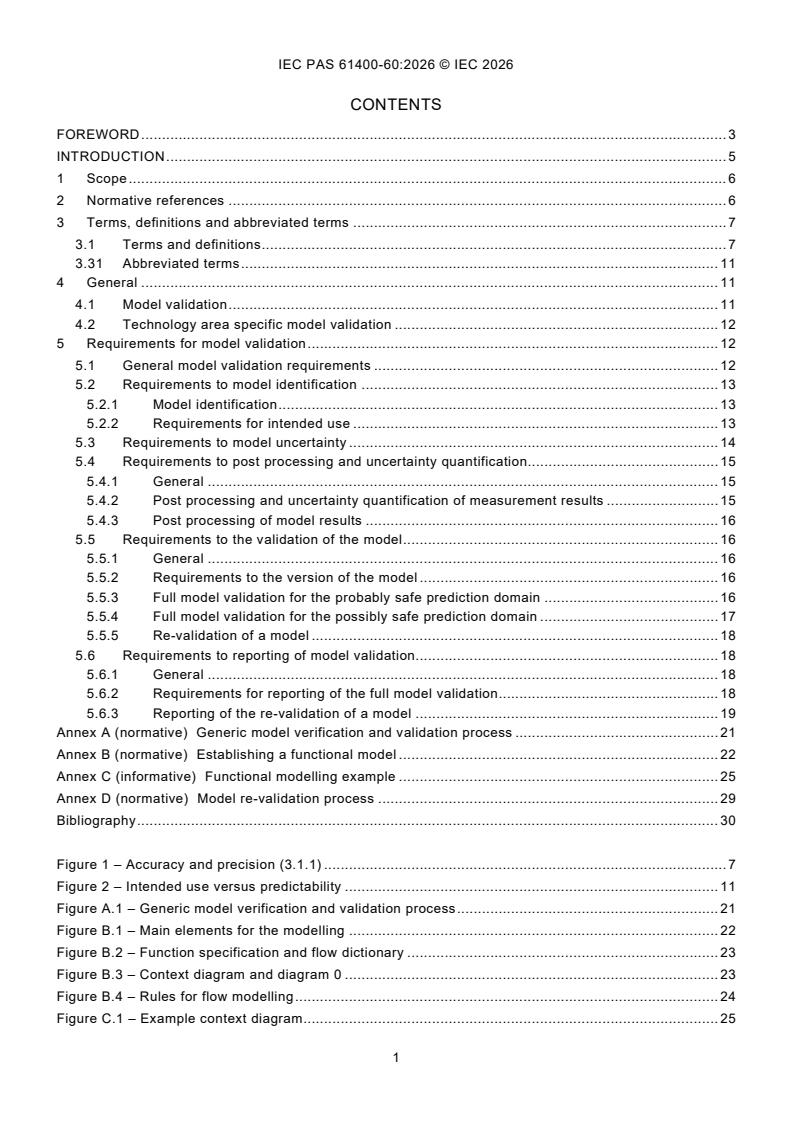
CONTENTS
FOREWORD . 3
INTRODUCTION . 5
1 Scope . 6
2 Normative references . 6
3 Terms, definitions and abbreviated terms . 7
3.1 Terms and definitions . 7
3.31 Abbreviated terms . 11
4 General . 11
4.1 Model validation . 11
4.2 Technology area specific model validation . 12
5 Requirements for model validation . 12
5.1 General model validation requirements . 12
5.2 Requirements to model identification . 13
5.2.1 Model identification . 13
5.2.2 Requirements for intended use . 13
5.3 Requirements to model uncertainty . 14
5.4 Requirements to post processing and uncertainty quantification. 15
5.4.1 General . 15
5.4.2 Post processing and uncertainty quantification of measurement results . 15
5.4.3 Post processing of model results . 16
5.5 Requirements to the validation of the model . 16
5.5.1 General . 16
5.5.2 Requirements to the version of the model . 16
5.5.3 Full model validation for the probably safe prediction domain . 16
5.5.4 Full model validation for the possibly safe prediction domain . 17
5.5.5 Re-validation of a model . 18
5.6 Requirements to reporting of model validation. 18
5.6.1 General . 18
5.6.2 Requirements for reporting of the full model validation . 18
5.6.3 Reporting of the re-validation of a model . 19
Annex A (normative) Generic model verification and validation process . 21
Annex B (normative) Establishing a functional model . 22
Annex C (informative) Functional modelling example . 25
Annex D (normative) Model re-validation process . 29
Bibliography . 30
Figure 1 – Accuracy and precision (3.1.1) . 7
Figure 2 – Intended use versus predictability . 11
Figure A.1 – Generic model verification and validation process . 21
Figure B.1 – Main elements for the modelling . 22
Figure B.2 – Function specification and flow dictionary . 23
Figure B.3 – Context diagram and diagram 0 . 23
Figure B.4 – Rules for flow modelling . 24
Figure C.1 – Example context diagram . 25
Figure C.2 – Example diagram 0 . 26
Figure C.3 – Example diagram 5 . 27
Figure C.4 – Set of function flow diagrams . 28
Figure D.1 – Model re-validation process . 29
INTERNATIONAL ELECTROTECHNICAL COMMISSION
____________
Wind energy generation systems -
Part 60: Validation of computational models
FOREWORD
1) The International Electrotechnical Commission (IEC) is a worldwide organization for standardization comprising all national
electrotechnical committees (IEC National Committees). The object of IEC is to promote international co-operation on all
questions concerning standardization in the electrical and electronic fields. To this end and in addition to other activities, IEC
publishes International Standards, Technical Specifications, Technical Reports, Publicly Available Specifications (PAS) and
Guides (hereafter referred to as “IEC Publication(s)”). Their preparation is entrusted to technical committees; any IEC National
Committee interested in the subject dealt with may participate in this preparatory work. International, governmental and non-
governmental organizations liaising with the IEC also participate in this preparation. IEC collaborates closely with the
International Organization for Standardization (ISO) in accordance with conditions determined by agreement between the two
organizations.
2) The formal decisions or agreements of IEC on technical matters express, as nearly as possible, an international consensus of
opinion on the relevant subjects since each technical committee has representation from all interested IEC National Committees.
3) IEC Publications have the form of recommendations for international use and are accepted by IEC National Committees in that
sense. While all reasonable efforts are made to ensure that the technical content of IEC Publications is accurate, IEC cannot
be held responsible for the way in which they are used or for any misinterpretation by any end user.
4) In order to promote international uniformity, IEC National Committees undertake to apply IEC Publications transparently to the
maximum extent possible in their national and regional publications. Any divergence between any IEC Publication and the
corresponding national or regional publication shall be clearly indicated in the latter.
5) IEC itself does not provide any attestation of conformity. Independent certification bodies provide conformity assessment services
and, in some areas, access to IEC marks of conformity. IEC is not responsible for any services carried out by independent
certification bodies.
6) All users should ensure that they have the latest edition of this publication.
7) No liability shall attach to IEC or its directors, employees, servants or agents including individual experts and members of its
technical committees and IEC National Committees for any personal injury, property damage or other damage of any nature
whatsoever, whether direct or indirect, or for costs (including legal fees) and expenses arising out of the publication, use of, or
reliance upon, this IEC Publication or any other IEC Publications.
8) Attention is drawn to the Normative references cited in this publication. Use of the referenced publications is indispensable for
the correct application of this publication.
9) IEC draws attention to the possibility that the implementation of this document may involve the use of (a) patent(s). IEC takes
no position concerning the evidence, validity or applicability of any claimed patent rights in respect thereof. As of the date of
publication of this document, IEC had not received notice of (a) patent(s), which may be required to implement this document.
However, implementers are cautioned that this may not represent the latest information, which may be obtained from the patent
database available at https://patents.iec.ch. IEC shall not be held responsible for identifying any or all such patent rights.
IEC PAS 61400-60 was prepared by IEC technical committee 88: Wind energy generation systems. It is a
Publicly Available Specification.
The text of this Publicly Available Specification is based on the following documents:
Draft Report on voting
88/1164/DPAS 88/1206/RVDPAS
Full information on the voting for its approval can be found in the report on voting indicated in the above
table.
The language used for the development of this Publicly Available Specification is English.
This document was drafted in accordance with ISO/IEC Directives, Part 2, and developed in accordance
with ISO/IEC Directives, Part 1 and ISO/IEC Directives, IEC Supplement, [and the ISO/IEC Directives, JTC
1 Supplement] available at www.iec.ch/members_experts/refdocs. The main document types developed by
IEC are described in greater detail at www.iec.ch/publications.
A list of all parts of the IEC 61400 series, under the general title: Wind energy generation systems, can be
found on the IEC website.
The committee has decided that the contents of this document will remain unchanged until the stability date
indicated on the IEC website under webstore.iec.ch in the data related to the specific document. At this
date, the document will be
– reconfirmed,
– withdrawn, or
– revised.
NOTE In accordance with ISO/IEC Directives, Part 1, IEC PASs are automatically withdrawn after 4 years.
INTRODUCTION
The wind energy industry has experienced significant growth over the past 30 years. Computational models
have already been used for a long time and the use of these models both for product design, siting, grid
compliance and other areas of the wind energy industry is still increasing. In 2018, the need for a more
transparent and data-driven statistical approach was recognized within the industry, which has ultimately
led to the establishment of the documents under IEC PAS 61400-60 (all parts). These documents are used
in conjunction with relevant design and measurement standards.
IEC PAS 61400-60 consists of the following parts, under the general title Model Validation of computational
models for the use within the wind energy industry.
– IEC PAS 61400-60: Validation of computational models
– IEC PAS 61400-60-1 [1]: Validation of computations models for loads and power performance.
Further parts (or updates to these parts) are foreseen for the specific model validation process for other
technology areas, such as offshore loads modelling, and site energy assessment modelling is expected to
follow.
___________
Under preparation. Stage at the time of publication IEC PAS/CD 61400-60-1:2025.
1 Scope
It is the purpose of this document that it will be applied to existing models already in use within the wind
energy sector, as well as to future models (and updates of models) that will be used within the wind energy
sector. As such, this document does not set specific requirements to model accuracy and precision but
aims to transparently establish the performance of models in terms of accuracy and precision, both for the
intended use as covered by measurements as well as the predictive capability of the model.
This document (and all documents under IEC PAS 61400-60 (all parts) aims at model validation but not
model development.
Specifically, this document further defines the model validation requirements in the following standards and
operational documents:
IEC 61400-1:2019,
IEC 61400-5:2020,
IEC 61400-27-2:2020,
OD-501:2018 [2],
OD-501:2022 [3],
IECRE Clarification sheet CSH022 Ed 2.0[1]
2 Normative references
The following documents are referred to in the text in such a way that some or all of their content constitutes
requirements of this document. For dated references, only the edition cited applies. For undated references,
the latest edition of the referenced document (including any amendments) applies.
IEC 61400-1:2019, Wind energy generation systems - Part 1: Design requirements
IEC 61400-5:2020, Wind energy generation systems - Part 5: Wind turbine blades
IEC 61400-11:2012/AMD1:2018, Amendment 1 - Wind turbines - Part 11: Acoustic noise measurement
techniques
IEC 61400-12-1:2022, Wind energy generation systems - Part 12-1: Power performance measurements of
electricity producing wind turbines
IEC 61400-13:2015/AMD1:2021, Amendment 1 - Wind turbines - Part 13: Measurement of mechanical loads
IEC 61400-27-2:2020, Wind energy generation systems - Part 27-2: Electrical simulation models - Model
validation
ISO/IEC Guide 98-3:2008, Uncertainty of measurement - Part 3: Guide to the expression of uncertainty in
measurement (GUM:1995)
ISO/IEC Guide 98-3:2008/Suppl 1:2008, Uncertainty of measurement - Part 3: Guide to the expression of
uncertainty in measurement (GUM:1995) - Supplement 1: Propagation of distributions using a Monte Carlo
method
ISO/IEC/IEEE 15288:2023, Systems and software engineering - System life cycle processes
EN IEC 61400-1:2019, Wind energy generation systems - Part 1: Design requirements
IEC 61400 (all parts), Wind energy generation systems
IEC PAS 61400-60 (all parts), Validation of computational models
IECRE Clarification sheet CSH022 Ed 2.0
3 Terms, definitions and abbreviated terms
For the purposes of this document, the following terms and definitions apply.
ISO and IEC maintain terminology databases for use in standardization at the following addresses:
– IEC Electropedia: available at https://www.electropedia.org/
– ISO Online browsing platform: available at https://www.iso.org/obp
3.1 Terms and definitions
3.2
accuracy and precision
formulation or metric for characterising the discrepancy between experimental results on one side and
model output (3.1.11) and/or co-simulation results (3.1.5) on the other side
Figure 1 – Accuracy and precision (3.1.1)
Note 1 to entry: The accuracy is defined as the average discrepancy and the precision is defined as a standard deviation of the
discrepancy.
3.3
ceteris paribus
all other things being equal
Note 1 to entry: See Ceteris paribus - Wikipedia.
3.4
engineering change management
process of requesting, determining attainability, planning, implementing, and evaluating of changes to a
system, its main goals being to support the processing and traceability of changes to an interconnected set
of factors
3.5
computational model
numerical implementation (often expressed as computer code) of a mathematical model (3.1.8) which uses
defined inputs to predict defined outputs
Note 1 to entry: The model (3.1.9) can be a model (3.1.9) for a specific application, but it can also be a product specific
parametrisation in a software tool (3.1.25), where the parametrisation is specific for the wind industry but the overall software tool
(3.1.25) is not.
3.6
co-simulation results
model (3.1.9) outputs where the model (3.1.9) is provided with a time series of measurements in order to
produce a time series of a new parameter(s) (which has/have also been measured) in order for the
modelling of this/these parameter(s) to be validated
Note 1 to entry: As an example, a co-simulation can be the modelled power output of a wind turbine, based on the measured wind
conditions and where the power also is one of the measured parameters.
3.7
experimental data
raw or processed observations (measurements) normally obtained by performing an experiment according
to a measurement standard of IEC 61400 (all parts)
3.8
intended use
for the technology area (3.1.26) of interest, the specific purpose for which the predictive capability of the
model (3.1.9) is to be documented
Note 1 to entry: This purpose is documented as a set of parameters and a range for each of the parameters. This includes
parameters that describe the environment (turbulence, shear, etc.), parameters describing the design of the turbine (hub height,
blade length, rated power, etc.), model parameters (3.1.16) (including model (3.1.9) processing parameters) and measurement
processing parameters.
3.9
mathematical model
specification of the mathematical descriptions of the mechanics of the topic being modelled
Note 1 to entry: In the mathematical model (3.1.8), principles of mechanics, material behaviour, interface properties, loads and
boundary conditions are cast into equations and mathematical statements.
3.10
model
computational model (3.1.4), unless otherwise specified
3.11
model input
inputs to the model (3.1.9) as per the model (3.1.9) definition
3.12
model output
output that the model (3.1.9) produces, some or all of which will be subject to model validation (3.1.17)
3.13
model results
output that the model (3.1.9) produces, some or all of which will be subject to model validation (3.1.17)
Note 1 to entry: See model output (3.1.11).
3.14
model operator
specific person(s) that operates the model (3.1.9) to achieve a specific model output (3.1.11) on behalf of
the model owner (3.1.14)
3.15
model owner
organization (or individual) that owns a model (3.1.9) (or a license to a model (3.1.9)) and indicates a need
to get that model (3.1.9) validated
3.16
model builder
organization that develops the model (3.1.9)
Note 1 to entry: Given the discussion in 5.5.5, a model (3.1.9) (as a product specific parametrisation / customisation in a software
tool (3.1.25)) can have two organisations as model builder.
3.17
model parameters
software settings of the model (3.1.9), including parameter values and model (3.1.9) (execution) arguments,
that affect operation of the model (3.1.9)
3.18
model validation
process of determining the degree to which a model (3.1.9) is an accurate representation of the real world
from the perspective of the intended uses of the model (3.1.9)
3.19
model results for validation
model (3.1.9) outputs obtained, when providing the model (3.1.9) with data from measurements, where
measurements of the output channel of the physical model (3.1.20) are also available
3.20
model verification
process of determining that a model (3.1.9) accurately represents the underlying mathematical model
(3.1.8) and its solution
Note 1 to entry: This can also include e.g. computational mesh strategy and enforcement of boundary conditions. Verification
intends to find programming errors and estimate numerical errors.
3.21
physical model
physical representation that is being modelled
Note 1 to entry: Given the scope of this document this will often be a wind turbine (for example for loads, power performance
modelling and simulation models for grid connection), a wind power plant (for example for siting and simulation models for grid
connection) or a part of a wind turbine (for gearbox and blade models).
3.22
probably safe prediction domain
that part of the intended-use area that is covered by measurements and where the model (3.1.9) predictions
have a known uncertainty (3.1.27)
3.23
possibly safe prediction domain
that part of the intended-use area that is no longer covered by measurements but so close to the "probably
safe prediction domain (3.1.21)" that the model (3.1.9) can be assigned an uncertainty (3.1.27) based on
extrapolation of the measurements
3.24
most likely dangerous prediction domain
that part of the intended-use area where that is not covered by measurements and where the model (3.1.9)
predictions cannot reasonably be assigned an uncertainty (3.1.27); either because the underlying physics
changes or because the required extrapolation is across a too-large range
3.25
software package
set of related programs for a particular task, licensed, sold and used as a single unit
Note 1 to entry: Although worded differently, this is the same as the “code” definition.
3.26
software tool
set of related programs for a particular task, licensed, sold and used as a single unit
Note 1 to entry: See software package (3.1.24).
3.27
technology area
distinct area of modelling technology, such that a different technical document is required to describe the
technical aspects of the model validation (3.1.17) process for that area
Note 1 to entry: Examples of such technology areas are: power performance and loads, simulation models for grid connection,
siting models, noise models, blade models, gearbox models, etc.
3.28
uncertainty
potential deficiency in any phase or activity of the modelling, computation or experimentation process that
is due to inherent variability or lack of knowledge
Note 1 to entry: Uncertainty as used to establish model (3.1.9) uncertainty follows the stipulations of the ISO/IEC Guide 98-3:2008
including ISO/IEC Guide 98-3:2008/Suppl 1:2008 to the extent that these can be meaningfully interpreted for and applied to a model
(3.1.9). The uncertainty is a combination of precision and accuracy.
3.29
uncertainty quantification
process of characterising all uncertainties in the model (3.1.9) or the experiment and of quantifying their
effect on the model output (3.1.11) or experimental outcomes
3.30
valid model
computational model (3.1.4) that has been validated using the guidance in this document and meeting the
requirements set in this document
3.31 Abbreviated terms
The following abbreviations are used in this document:
CSH IECRE clarification sheet
NASA National Aeronautics and Space Administration
ASME American Society of Mechanical Engineers
GUM Guide to the Expression of uncertainty in measurement, see ISO/IEC
Guide 98-3:2008 and ISO/IEC Guide 98-3:2008/Suppl 1:2008
PoSD possibly safe prediction domain
PrSD probably safe prediction domain
DaPD most likely dangerous prediction domain
TI turbulence intensity
m metres
4 General
4.1 Model validation
The goal of validation is to determine the predictive capability of a computational model for its intended
use. The NASA report [4] includes a useful graphical representation:
Source: NASA/TP-2016-219422 [4], Figure 1.
Figure 2 – Intended use versus predictability
The green, blue and red areas shall be interpreted as a two-dimensional representation of a (normally)
multi-dimensional definition of "intended use". Measurements will normally be carried out in a part of the
"intended use" area, whereas the model will often be used also somewhat outside this area. The validation
aims to quantify the uncertainty also beyond the green area so that the green, blue and red areas can be
separated based on an understanding of the accuracy of the model output(s). For the red area, the model
uncertainty will normally either be unknown, unquantifiable, or unacceptably high.
Model validation will normally be done involving various stakeholders, such as the model owner, model
operator, and/or the model builder. Depending on who is involved in the model validation work will determine
the amount of model details that are available. Therefore, the models that will be validated will be
considered "black box" models . This means that the model validation focusses on the comparison of the
output of the models with relevant measured data and aims to avoid the following:
– discussions about whether a specific numerical approach that can be used in a model is the correct one
– specific requirements for the accuracy and precision of the model; however, the validation of a loads
model can include a check of whether the model accuracy and precision still fit within the safety factors
as established in IEC 61400-1:2019.
This generic model validation document shall be used in conjunction with one of the technology area
specific documents as per 4.2 that are included in the IEC PAS 61400-60 (all parts) documents.
The model shall be defined as per 5.2 of this document, which includes the identification of the model
version. The model validation is specific for one (1) version of the model. In order to validate the model, at
least one model output shall be selected for model validation. The model will only be considered valid for
the specific output(s) for which the model has been validated.
The outcome of a successful model validation process is "valid model".
4.2 Technology area specific model validation
The further parts of IEC PAS 61400-60 (all parts) covering other technology areas or other model validation
relevant standards in IEC 61400 (all parts) shall include:
– The minimum set of parameters that constitute intended use for that technology area, as well as the
minimum range for each parameter.
– The measurement standards that shall be followed to establish a measured set of data for use in model
validation and the required processing of the measured data for the specific model validation process.
For a specific model validation process, the measurement requirements can exceed the specifications
given in the applicable standard (e.g. number/ type of sensors and measurement load cases).
– The specific definition of the total model uncertainty for the validated model across the intended use.
– The specific definition of the hypothesis testing required to conclude if the model can be considered
valid or not and/or the definition of the top-down validation metric (as per 5.5.3, list item b)) including
the applied limits.
The further parts of this IEC PAS 61400-60 (all parts) series of documents covering specific technology
areas can include in their documents the following:
– Further explanation of the mathematical description of how to post-process the model output and/or the
measured data, and how to compare the measured data and the modelled data. Such further explanation
can be provided both as normative guidance or as informative guidance.
The further parts of this IEC PAS 61400-60 (all parts) series of documents covering specific technology
areas shall not contradict any of the stipulations in this document.
5 Requirements for model validation
5.1 General model validation requirements
Given the process described in Annex A, the general requirements to validate a model are as follows:
a) Model verification, including code verification and calculation verification, shall be done and documented
before model validation. Methodology for model verification is further discussed in ASME V&V 10:2019
[5], Chapter 4, as well as [4] Chapters 1, 2 , 3 and 4.
and can be based on multiple data sets as
b) Model validation shall be based on experimental data
described in multiple test reports. Experimental data based on co-simulation results is preferred. If co-
simulation results are not possible then model results for validation can be used.
c) Simulation results and experimental data shall be required to have an assessment of uncertainty in
order to be considered meaningful. (Uncertainty in this bullet refers to the uncertainty in Annex A
identified as "Post processing and uncertainty quantification" both on the modelling side as well as on
the physical model /measurements side).
___________
The same data used to create / tune / parametrize the model shall not be used for validation.
d) Validation is specific to a particular model for a particular intended use; the intended use shall be defined
and documented.
e) Validation (when using the bottom-up metric as per 5.5.3, list item a)) shall include hypothesis testing
and can include other mathematical/statistical methods. The various sources of uncertainty (including
the experimental uncertainty) shall be reported and considered when drawing conclusions on the validity
of a model. If the top-down metric is used (as per 5.5.3, list item b)), the definition of the validation
requirement shall be included in the report, including the limits applied.
f) Model validation shall result in a statement of the uncertainty of the model prediction for a defined
“intended use”. This uncertainty can vary across the intended use, as long as it is quantified.
g) The intended use can be split into multiple subsets and a model validation done for each of the subsets.
The possible advantage of this is that a different model uncertainty can be established for the different
subsets.
5.2 Requirements to model identification
5.2.1 Model identification
The model shall be defined as a functional model as per Annex B. The model shall be defined by a context
diagram with accompanying flow specification and interface description [6]. Additionally, a level-1 diagram
(see also Annex B) can be defined [6].
The model inputs shall be specified and for each input indicated if they are within the control of the model
operator or outside the control of the model operator. The inputs to the model also shall indicate the
uncertainty of the inputs (to the extent that there is uncertainty). Definition of uncertainty as well as
propagation of uncertainty is defined as per the ISO/IEC Guide 98-3:2008.
The inputs to the model shall be distinguished between measured inputs (which always shall have a defined
uncertainty) and other model inputs (including operator inputs on the software settings that affect how the
model behaves). The software settings cannot be modelled as being outside the System-of-interest. Other
inputs (such as measured inputs) can be modelled as being outside the System-of-interest. An example of
such a measured input are the aerodynamic parameters which characterize a wind turbine blade and which
are sometimes used when simulating wind turbine behaviour.
The outputs of the model shall also include the uncertainty of the outputs. Definition of uncertainty as well
as propagation of uncertainty are defined by ISO/IEC Guide 98-3:2008.
The definition of the model shall include a specific version number in case the model is implemented as
software code. To the extent that the model is a unique product parametrisation within a software tool, both
the parametrisation as well as the software tool shall be identified through a specific version number.
Documentation shall be provided to show that the software code for the model is under engineering change
management as per ISO/IEC/IEEE 15288:2023, 6.3.5.3. The model/software settings (if appropriate) shall
be part of the definition of the model; running the same model version with different software settings can
potentially lead to significant changes in the output.
Some models require data for tuning and/or training. Such data shall not be used for model validation.
Evidence shall be provided that the model validation only used data which has not been used for tuning
and/or training of the model.
Deviations between the model used for validation and the model used for design evaluation shall be
avoided; in the case that minor deviations occur, these shall be documented and their impact assessed and
reported.
5.2.2 Requirements for intended use
Together with the definition of the model, also the intended use shall be defined. In Figure 2, the intended
use is reflected as a two-dimensional area; in reality most models will have an N-dimensional area that will
define the intended use. The intended use would normally be defined at the start of the model validation
process and can be updated throughout the model validation process until the model has been validated.
The uncertainty that the model can achieve will normally depend on the definition of the intended use: the
larger the intended use that is defined, the higher the resulting model uncertainty will tend to be. This means
that a balance shall be found between the size of the intended use and the acceptable model uncertainty
that can be attributed to the defined intended use. This can be done in an iterative process as per Annex
A, the final resulting intended use has a related model uncertainty that is satisfactory.
The definition of the intended use is made by defining a set of parameters describing the external conditions
that are relevant for the model as well as the design parameters that are relevant for the model. For each
of these parameters, a range shall be provided as a minimum and maximum value.
As an example for power performance model validation: wind speed, turbulence and shear are possible
parameters to define the external influences on the power performance, whereas rated power level, rotor
diameter, rotational speed, pitch control and blade shape are examples of design parameters that influence
performance and hence can be used to define intended use.
For each of the technology areas as per 4.2, a technology specific document shall provide (amongst others)
the minimum set of parameters that are required to define intended use.
It is acceptable to define sub-sets of the intended use and assign different uncertainty values to each of
the subsets, as long as all the subsets cover the whole area that is defined by the intended use.
5.3 Requirements to model uncertainty
To conclude on model validity comparison of the measurement and model uncertainty against the actual
deviations as seen between model results and measurement results is required.
The model validation is to evaluate the deviations between model results and measurement results given
a (sufficiently) in depth understanding of both the measurement uncertainties and model uncertainties.
The measurement uncertainty will normally be handled in the related measurement standard (such as
the power performance measurement standard IEC 61400-12-1:2022; the mechanical loads measurement
standard IEC 61400-13:2015/AMD1:2021; or the acoustic noise measurement standard IEC 61400-
11:2012/AMD1:2018.
Since still many of the definitions and the mathematical treatments are appropriate for model side, ISO/IEC
Guide 98-3:2008 will be based for the model uncertainty assessment on the guidance of this document to
the extent applicable, although the Guide was not written for the modelling;
We aim (and therefore we will assume) that measurement uncertainty and model uncertainty are mutually
independent and hence:
2 2
(1)
𝑢𝑢 =�(𝑢𝑢 ) +(𝑢𝑢 )
combined model measurement
where
u
is the combined uncertainty of the model and the measurements;
combined
u
is the uncertainty assigned to the model results;
model
u
is the uncertainty assigned to the measurement results as per the
measurement
relevant measurement standard. If no measurement standard is
available, this uncertainty can be based on the guidance from from
the relevant technology specific areas as per 4.2.
Please note that it is often a challenge to ensure that model and measurement uncertainties are
independent and hence sufficient care shall be used to ensure such independence as best as possible.
The model uncertainty will often depend on the specific model and hence will be treated within one of the
technology area specific documents as per 4.2. There are sufficient similarities across models that we
provide the following governance generically for all types of computational models:
2 2 2 2 2 2
𝑢𝑢 = (𝑢𝑢 ) +(𝑢𝑢 ) +(𝑢𝑢 ) +(𝑢𝑢 ) +(𝑢𝑢 ) +(𝑢𝑢 ) (2)
�
model phys env num oper mf other
where
u
is the uncertainty assigned to the model results;
model
u
is the uncertainty in the input parameters of the model related to the
phys
physical parameters of the physical object being modelled;
u
is the uncertainty in the input parameters of the model related to the
env
environment the wind turbine or power plant is operating in;
u
is the uncertainty related to the numerical solution limitation used in
num
the computational model, such as convergence limits, a non-infinite
taylor series, rounding error (including intermediate rounding),
numerical accuracy related to choice of variables, etc.;
u
is the uncertainty related to the reproducibility of model results by
oper
different skilled operators (as can be estimated from a Gauge R&R
study);
u
is the uncertainty related to the form of the model as defined in the
mf
paper "Model form uncertainty quantification in turbulent combustion
simulations: peer models" from [7] M.E. Mueller et al, Combustion
and Flame, 2017;
u
is the uncertainty related to any other uncertainty contributions
other
relevant for the specific type of model, as per the technology area
specific document (see 4.2).
Some of the above uncertainty contributions for the model uncertainty can be set to zero.
5.4 Requirements to post processing and uncertainty quantification
5.4.1 General
In this subclause, requirements to post processing and uncertainty quantification are provided for both
paths as per Annex A.
5.4.2 Post processing and uncertainty quantification of measurement results
The test reports and related data used for model validation shall be evaluated as part of the model validation
report. The uncertainty assessment of the measured data shall be evaluated and can be corrected based
on the guidance in the latest version of the measurement standard.
Any post-processing of the measured data shall be reported and it's influence on the uncertainty of the
measured data shall be assessed and reported.
If the measurement standard does not have a normative uncertainty calculation, it shall be assessed if an
uncertainty component shall be added to reflect the additional variance caused by not having a normative
uncertainty calculation.
___________
"Some" can include "all".
As the model validation can be based on multiple data sets as reported in multiple test reports, it can be
beneficial to re-assess the measurement uncertainty for each report. This can be the case if various test
reports are based on different editions of the same measurement standard and there is a preference to
establish the uncertainty for each test report on the latest version of the test report.
5.4.3 Post processing of model results
Any post-processing of the model output either manually or by another (software) tool than the model itself
shall be documented and the influence on model uncertainty shall be assessed and documented.
5.5 Requirements to the validation of the model
5.5.1 General
In this subclause, requirements are provided for the decision step in Figure A.1 . Acceptable uncertainty
across the defined intended use?".
5.5.2 Requirements to the version of the model
Please note that with the definitions in this document, a model can be written for a specific application
within the wind industry (one example is Flex5); however, models can also be a product (type) specific
parametrisation / customisation in a
...