

IEC TS 61400-28-2:2026
(Main)Wind energy generation systems - Part 28‑2: Decommissioning and preparation for recycling
- Abstract
IEC TS 61400‑28-2:2026 addresses the decommissioning and preparation for recycling of wind turbines.
This scope includes all the tasks and on-site considerations of the different process steps, from the beginning of the dismantling phase, material preparation and arrangement, and preparation for shipment to re-using or recycling facilities. Wind turbines in the context of this document include blades, hubs, nacelles, towers, foundations, generators, gearboxes, cables, electrical equipment, transformers, and any other equipment that can be dismantled from wind turbines and not listed before.
The purpose of this document is to define the framework conditions of decommissioning and preparation for recycling of wind turbines, which includes the tasks and considerations of each of the steps of the process. The objective is to provide basic high-level information on the sustainable and efficient decommissioning and dismantling arrangements for wind turbines.
This document can be used by manufacturers, asset owners, governments, operators, recyclers and personnel involved in the decommissioning and preparation for recycling of wind turbines.
- Status
- Published
- Publication Date
- 13-Oct-2026
- Technical Committee
- TC 88 - Wind energy generation systems
- Drafting Committee
- PT 61400-28-2 - Decommissioning and preparation for recycling
- Current Stage
- PPUB - Publication issued - 60 Publication
- Start Date
- 14-Oct-2026
- Due Date
- 25-Sep-2026
- Completion Date
- 25-Sep-2026
IEC TS 61400-28-2:2026 is an IEC Technical Specification for wind energy generation systems that sets out decommissioning and preparation for recycling of wind turbines. It covers the on-site steps from dismantling through material preparation, storage, and shipment for reuse or recycling, and it is written for manufacturers, asset owners, governments, operators, recyclers, and the personnel who carry out the work.
What does IEC TS 61400-28-2:2026 specify?
IEC TS 61400-28-2:2026 specifies the framework for decommissioning wind turbines and preparing their parts and materials for circular use. The scope covers the tasks and on-site considerations from the start of dismantling through material arrangement and shipment to re-using or recycling facilities.
The standard applies to wind turbine parts such as blades, hubs, nacelles, towers, foundations, generators, gearboxes, cables, electrical equipment, transformers, and other dismantled equipment. It does not cover offshore wind farms, balance of wind plants, or the actual re-use or recycling methods themselves.
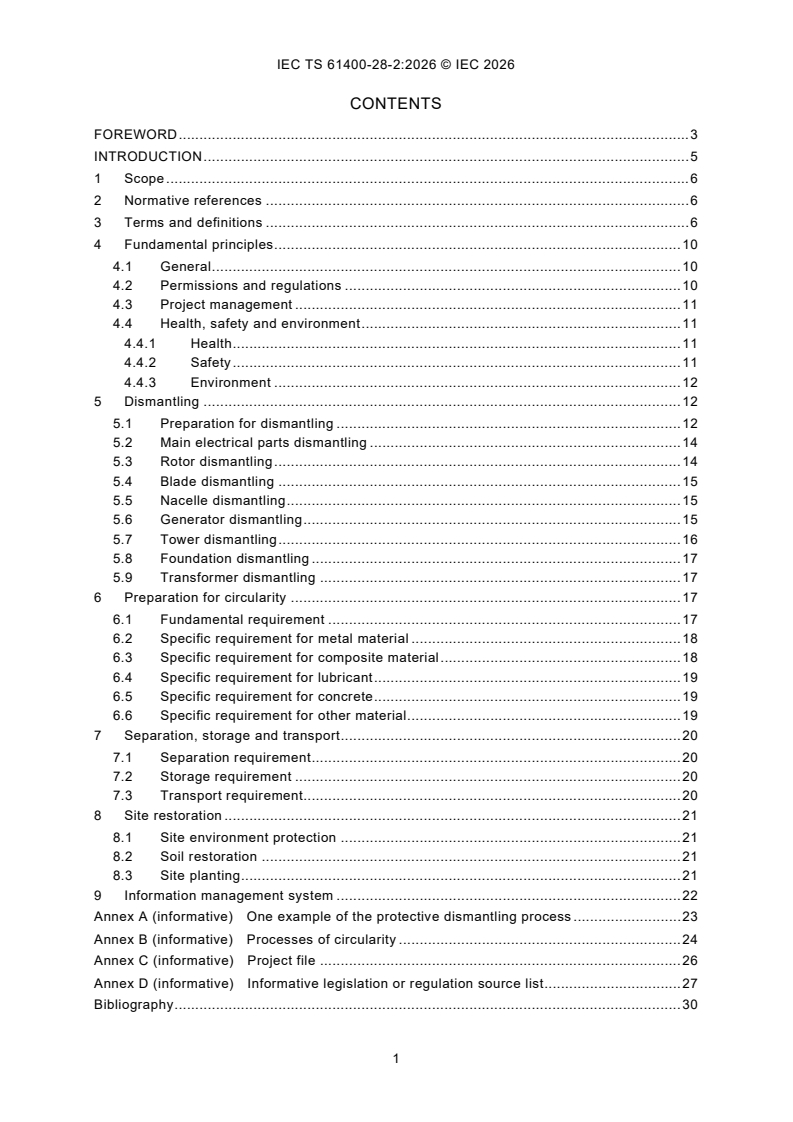
The document is organized into scope, normative references, terms and definitions, fundamental principles, dismantling, preparation for circularity, separation/storage/transport, site restoration, and an information management system.
| Annex | What it covers |
|---|---|
| Annex A | One example of the protective dismantling process |
| Annex B | Processes of circularity |
| Annex C | Project file |
| Annex D | Informative legislation or regulation source list |
What are the key requirements of IEC TS 61400-28-2:2026?
IEC TS 61400-28-2:2026 requires a controlled, documented process that prioritizes resource recovery, protects people and the site, and keeps the destination of dismantled materials traceable. In practice, the standard treats decommissioning as a project with planning, execution, acceptance, and records.
Fundamental principles, permits, and project control
Clause 4 requires participants to maximize resource utilization and prioritize reuse, repurpose, recycling, and recovery of dismantled components and materials. It also calls for environmental controls to reduce dust, noise, wastewater, waste lubricants, and other impacts, with monitoring and continual improvement where needed.
Clause 4.2 and 4.3 require the work to be carried out under the right permissions, qualifications, and project plans. The decommissioning plan should cover safety, contingency, dismantling, storage, transport, circularity, and site restoration, so the job is managed from planning to acceptance rather than handled as isolated tasks.
Health, safety, and environment
Clause 4.4 requires training, qualifications, personal protective equipment, hazard identification, and warning signs before work starts. It also requires approved safety planning, lockout-tagout for electrical, mechanical, and hydraulic parts, crane and lifting control, and stopping work in adverse weather.
The practical effect is that the turbine must be fully isolated, hazards must be identified in advance, and on-site conditions must stay within the limits of the lifting and safety plans. The clause also links safety and personal protection to IEC TS 61400-30:2023, crane and lifting requirements to IEC 61400-1, and safe stopping arrangements to ISO 13857:2019.
Dismantling sequence and method selection
Clause 5 sets the dismantling sequence and the checks needed before removal. The standard emphasizes disconnecting and de-energizing the turbine, inspecting the structure and its condition, and generally dismantling from the top down and from attached parts toward the main body.
A key requirement in Clause 5.1.12 is that destructive or protective dismantling methods must be chosen through a documented assessment of personnel safety, technical feasibility, environmental impact, and economic viability. In practice, this means the method is selected case by case, not by habit.
The subclauses then give specific controls for main electrical parts, rotor, blades, nacelle, generator, tower, foundation, and transformer. Common practical points include cable identification, keeping components secured during lowering, controlling lubricants and coolants, and using safe distances around cranes and towers.
Preparing parts for circularity
Clause 6 places circularity in a defined order: reuse, repurpose, recycling, then energy recovery, with harmless disposal for what cannot be recovered. It also gives priority to further use in the wind industry before considering other industries.
The standard requires performance and reliability testing, economic and social benefit analysis, and traceability across the process chain. For material control, Clause 6 separates requirements for metal material, composite material, lubricant, concrete, and other material.
This matters in practice because the project team must sort materials early, decide whether they can return to service, and document the route for each stream. Clause 6.1.6 also calls for a traceability system that can calculate recycling rates, with EN 45555:2019 used for the recycling rate approach.
Separation, storage, transport, site restoration, and records
Clause 7 requires dismantled equipment and waste to be classified, collected, and stored according to their function and storage needs. Hazardous waste must be handled separately by specialized equipment and authorized qualified disposal parties, while storage areas need fire protection, spill prevention, clear access, and suitable positioning for large components.
Clause 7.3 requires transport arrangements based on road surveys, dimensions, weights, and securing needs, with covered or enclosed vehicles where needed to prevent collision, leakage, or spillage. Clause 8 then requires the site to be cleaned, backfilled, compacted, and restored, with planting matched to the original conditions and without invasive species.
Clause 9 requires an information management system that tracks material information, process control information, and destination information. In practice, this creates a project record that can support verification after the job is finished.
What terms does IEC TS 61400-28-2:2026 define?
- Decommissioning - the administrative and technical actions taken to remove some or all regulatory controls from a facility.
- Dismantling - the disassembly and removal of a structure, system, or component during decommissioning.
- Circularity - the degree of alignment with the principles for a circular economy.
- Reuse - putting a product or its components back into use for the same purpose at end-of-life.
- Repurpose - using a product or its components for a role they were not originally designed to perform.
- Recycling - processing waste materials for the original purpose or for other purposes, excluding energy recovery.
- Recovery - processing waste material for the original purpose or for other purposes, including energy recovery.
- End-of-life - the point at which a product or component is taken out of the current use stage.
Who uses IEC TS 61400-28-2:2026?
IEC TS 61400-28-2:2026 is used by manufacturers, asset owners, governments, operators, recyclers, and personnel involved in decommissioning wind turbines. In practice, it supports project managers, HSE staff, site supervisors, and logistics teams who need to plan permits, dismantling, storage, transport, site restoration, and documentation.
It is also relevant to organizations that assess whether removed components can be reused, repurposed, recycled, recovered, or sent for harmless disposal.
Which standards are used with IEC TS 61400-28-2:2026?
IEC TS 61400-28-2:2026 uses several standards to support safety, environmental control, and circularity work:
- IEC 61400-1 - design requirements and lifting-related requirements referenced for crane operations.
- IEC TS 61400-28:2025 - through-life management and life extension context for wind power assets.
- IEC TS 61400-30:2023 - safety principles used for personal protection, fire protection, risk reduction, and contingency planning.
- IEC Guide 109:2012 - guidance for environmental aspects in electrotechnical product standards.
- ISO 13315-1:2024 - principles used for the end-of-life phase of concrete.
- ISO 13857:2019 - safety distances used when securing machinery after work.
- ISO 22450:2020 - information for recycling rare earth elements.
The body of the document also cites EN 45555:2019 for recyclability and recoverability assessment, and ISO 16290:2013 in Annex B for technology readiness level assessment.
What does the IEC TS 61400-28-2:2026 document contain?
IEC TS 61400-28-2:2026 contains clauses on planning, HSE controls, dismantling methods, circularity preparation, storage, transport, site restoration, and information management. It also includes a structured terms-and-definitions section and normative references that connect the document to wind turbine design, safety, environmental, and recycling standards.
Annex A gives an example of a protective dismantling process, including transformer placement cases. Annex B provides a circularity flow and a table of evaluation factors for reuse, repurpose, recycling, recovery, and disposal decisions.
Annex C lists the project file contents, including site data, layouts, equipment lists, technical documents, restrictions, and circularity records. Annex D collects informative legislation and regulation links from several countries for users who need jurisdiction-specific guidance.
Get Certified
Connect with accredited certification bodies for this standard

DNV
DNV is an independent assurance and risk management provider.

Lloyd's Register
Lloyd's Register is a global professional services organisation specialising in engineering and technology.
DNV Energy Systems
Energy and renewable energy certification.
Sponsored listings
Frequently Asked Questions
IEC TS 61400-28-2:2026 is a technical specification published by the International Electrotechnical Commission (IEC). Its full title is "Wind energy generation systems - Part 28‑2: Decommissioning and preparation for recycling". This standard covers: IEC TS 61400‑28-2:2026 addresses the decommissioning and preparation for recycling of wind turbines. This scope includes all the tasks and on-site considerations of the different process steps, from the beginning of the dismantling phase, material preparation and arrangement, and preparation for shipment to re-using or recycling facilities. Wind turbines in the context of this document include blades, hubs, nacelles, towers, foundations, generators, gearboxes, cables, electrical equipment, transformers, and any other equipment that can be dismantled from wind turbines and not listed before. The purpose of this document is to define the framework conditions of decommissioning and preparation for recycling of wind turbines, which includes the tasks and considerations of each of the steps of the process. The objective is to provide basic high-level information on the sustainable and efficient decommissioning and dismantling arrangements for wind turbines. This document can be used by manufacturers, asset owners, governments, operators, recyclers and personnel involved in the decommissioning and preparation for recycling of wind turbines.
IEC TS 61400‑28-2:2026 addresses the decommissioning and preparation for recycling of wind turbines. This scope includes all the tasks and on-site considerations of the different process steps, from the beginning of the dismantling phase, material preparation and arrangement, and preparation for shipment to re-using or recycling facilities. Wind turbines in the context of this document include blades, hubs, nacelles, towers, foundations, generators, gearboxes, cables, electrical equipment, transformers, and any other equipment that can be dismantled from wind turbines and not listed before. The purpose of this document is to define the framework conditions of decommissioning and preparation for recycling of wind turbines, which includes the tasks and considerations of each of the steps of the process. The objective is to provide basic high-level information on the sustainable and efficient decommissioning and dismantling arrangements for wind turbines. This document can be used by manufacturers, asset owners, governments, operators, recyclers and personnel involved in the decommissioning and preparation for recycling of wind turbines.
IEC TS 61400-28-2:2026 is classified under the following ICS (International Classification for Standards) categories: 27.180 - Wind turbine energy systems. The ICS classification helps identify the subject area and facilitates finding related standards.
IEC TS 61400-28-2:2026 is available in PDF format for immediate download after purchase. The document can be added to your cart and obtained through the secure checkout process. Digital delivery ensures instant access to the complete standard document.
Standards Content (Sample)
Contents
- 1 Scope
- 2 Normative references
- 3 Terms and definitions
- 3.1 decommissioning
- 3.2 recycling
- 3.3 component
- 3.4 recovery
- 3.5 repurpose
- 3.6 reuse
- 3.7 dismantling
- 3.8 hazard
- 3.9 waste treatment
- 3.10 circularity
- 3.11 restoration
- 3.12 site
- 3.13 storage
- 3.14 contingency plan
- 3.15 risk
- 3.16 protective measure
- 3.17 environmental impact
- 3.18 disassembly
- 3.19 excavation
- 3.20 social benefit
- 3.21 disposal
- 3.22 composite material
- 3.23 collection
- 3.24 end-of-life
- 3.25 refurbish
- 3.26 planting
- 3.27 cost/benefit analysis
- 4 Fundamental principles
- 4.1 General
- 4.2 Permissions and regulations
- 4.3 Project management
- 4.4 Health, safety and environment
- 5 Dismantling
- 5.1 Preparation for dismantling
- 5.2 Main electrical parts dismantling
- 5.3 Rotor dismantling
- 5.4 Blade dismantling
- 5.5 Nacelle dismantling
- 5.6 Generator dismantling
- 5.7 Tower dismantling
- 5.8 Foundation dismantling
- 5.9 Transformer dismantling
- 6 Preparation for circularity
- 6.1 Fundamental requirement
- 6.2 Specific requirement for metal material
- 6.3 Specific requirement for composite material
- 6.4 Specific requirement for lubricant
- 6.5 Specific requirement for concrete
- 6.6 Specific requirement for other material
- 7 Separation, storage and transport
- 7.1 Separation requirement
- 7.2 Storage requirement
- 7.3 Transport requirement
- 8 Site restoration
- 8.1 Site environment protection
- 8.2 Soil restoration
- 8.3 Site planting
- 9 Information management system
- 9.1 Participants engaged in activities under the scope of this document should follow at all
- 9.2 The content of the information system can include but is not limited to material
- Annex A
- Annex B
- Annex C
- 1 Hydrological, meteorological, and geological data of the site
- 3 Wind plant layout plan for dismantling including all builds or areas for temporary
- 4 Wind turbine hoisting layout plan
- 5 Network diagram and construction progress plan
- 6 List of main construction equipment to be used
- 7 List of testing instruments and equipment
- 8 Information checklist, including the material composition and the masses, weight
- 9 Technical documents and drawings
- 10 Building specifications
- 11 Operation and maintenance activities record
- 12 Existing restrictions, limitations, conditions, obligations, local regulation and law
- Annex D
- Bibliography
INTRODUCTION The purpose of this document is to define the framework conditions of decommissioning and preparation for recycling of wind turbines, which includes the tasks and considerations of each of the steps of the process. The objective is to provide basic high-level information on the sustainable and efficient decommissioning and dismantling arrangements for wind turbines. This document can be used by manufacturers, asset owners, governments, operators, recyclers and personnel involved in the decommissioning and preparation for recycling of wind turbines.
1 Scope
The scope of this part of IEC TS 61400-28-2 is the decommissioning and preparation for recycling of wind turbines.
This scope includes all the tasks and on-site considerations of the different process steps, from the beginning of the dismantling phase, material preparation and arrangement, and preparation for shipment to re-using or recycling facilities. Wind turbines in the context of this document include blades, hubs, nacelles, towers, foundations, generators, gearboxes, cables, electrical equipment, transformers, and any other equipment that can be dismantled from wind turbines and not listed before.
This document does not cover the offshore wind farms, balance of wind plants or actual re-use or recycling methods, which will be an industry on its own and driven by its own legal, environmental and economic forces. Balance of wind plants here includes roads, drainage, cabling to substation and grid, maintenance/spare part facility, civil and electrical substation or meteorological mast.
2 Normative references
The following documents are referred to in the text in such a way that some or all of their content constitutes requirements of this document. For dated references, only the edition cited applies. For undated references, the latest edition of the referenced document (including any amendments) applies.
IEC 61400-1, Wind energy generation systems - Part 1: Design requirements IEC TS 61400-28:2025, Through-life management and life extension of wind power assets IEC TS 61400-30:2023, Safety of wind turbine generators - General principles for design IEC Guide 109:2012, Environmental aspects - Inclusion in electrotechnical product standards ISO 13315-1:2024, Environmental management for concrete and concrete structures - Part 1:
General principles ISO 13857:2019, Safety of machinery - Safety distances to prevent hazard zones being reached by upper and lower limbs ISO 22450:2020, Recycling of rare earth elements - Requirements for providing information on industrial waste and end-of-life products
3 Terms and definitions
For the purposes of this document, the following terms and definitions apply. ISO and IEC maintain terminology databases for use in standardization at the following addresses:
- IEC Electropedia: available at https://www.electropedia.org/
- ISO Online browsing platform: available at https://www.iso.org/obp
3.1 decommissioning
administrative and technical actions taken to allow the removal of some or all of the regulatory controls from a facility [SOURCE: IEC 60050-395:2014, 395-08-28, modified – Notes to entry have been deleted.]
3.2 recycling
processing of waste materials for the original purpose or for other purposes, excluding energy recovery [SOURCE: ISO 472:2013, 2.1706]
3.3 component
constituent part of equipment that cannot be physically divided into smaller parts without losing its character [SOURCE: ISO 8887-2:2023, 3.6, modified – Note 1 to entry has been deleted.]
3.4 recovery
processing waste material for the original purpose or for other purposes, including energy recovery [SOURCE: ISO 472:2013, 2.1704]
3.5 repurpose
utilize a product or its components in a role that it was not originally designed to perform [SOURCE: ISO 8887-2:2023, 3.32, modified – Notes to entry have been deleted.]
3.6 reuse
operation by which a product or its components are put back into use for the same purpose at end-of-life [SOURCE: ISO 8887-2:2023, 3.33, modified – Note 1 to entry has been deleted.]
3.7 dismantling
disassembly and removal of any structure, system or component during decommissioning [SOURCE: IEC 60050-395:2014, 395-08-30, modified – Notes to entry have been deleted.]
3.8 hazard
potential source of harm [SOURCE: ISO/IEC Guide 51:2014, 3.4]
3.9 waste treatment
operations intended to benefit safety and/or economy by changing the characteristics of the waste [SOURCE: ISO 12749-3:2024, 3.6.8, modified – Notes to entry have been deleted.]
3.10 circularity
degree of alignment with the principles for a circular economy [SOURCE: ISO 59020:2024, 3.1.3]
3.11 restoration
bringing an item back to its original appearance or state [SOURCE: ISO 6707-1:2020, 3.5.1.39]
3.12 site
area of land or water where construction work or other development is undertaken [SOURCE: ISO 6707-1:2020, 3.1.1.5]
3.13 storage
safekeeping of goods in a depository [SOURCE: ISO/TS 22002-5:2019, 3.14]
3.14 contingency plan
emergency response and disaster recovery strategy for an unplanned event [SOURCE: ISO 24419-1:2023, 3.10]
3.15 risk
combination of the probability of occurrence of harm and the severity of that harm [SOURCE: IEC 60050-903:2013, 903-01-07, modified – Note 1 to entry has been deleted.]
3.16 protective measure
measure intended to achieve risk reduction [SOURCE: ISO 13849-1:2015, 3.1.27]
3.17 environmental impact
change to the environment, whether adverse or beneficial, including possible consequences, wholly or partially resulting from an organization`s environmental aspects [SOURCE: ISO 14031:2021, 3.2.4]
3.18 disassembly
taking apart of an assembled product into constituent materials and/or components [SOURCE: ISO 8887-2:2023, 3.10]
3.19 excavation
result of digging, lifting, and removing earth, fill, or other material from the ground [SOURCE: ISO 6707-1:2020, 3.1.2.2]
3.20 social benefit
improved aesthetics, ecosystem services, new employment and capacity building, revitalized regional areas and healthier communities [SOURCE: ISO 24419-1:2023, 3.9]
3.21 disposal
any operation which is not recovery even where the operation has, as a secondary consequence, the reclamation of substances or energy [SOURCE: ISO 8887-2:2023, 3.11]
3.22 composite material
combination of materials different in composition or form on a macro scale [SOURCE: ISO 10786:2025, 3.10, modified – Notes to entry have been deleted.]
3.23 collection
logistical process of moving wind turbine components from its source to a place where it can be recovered Note 1 to entry: Domain of application has been changed from "plastics waste" to "wind turbine components". [SOURCE: ISO 472:2013, 2.1682, modified – "plastics waste" has been replaced by "wind turbine components", Note 1 to entry has been added.]
3.24 end-of-life
point at which a product or component is taken out of the current use stage [SOURCE: ISO 8887-2:2023, 3.12]
3.25 refurbish
restore an item, during its expected service life, to a useful condition for the same purpose with at least similar quality and performance characteristics [SOURCE: ISO 59004:2024, 3.5.18]
3.26 planting
putting trees or seedlings into the ground at their growing positions [SOURCE: ISO 6814:2009, 2.1.7]
3.27 cost/benefit analysis
analysis contributing to decision-making on whether to adopt a project or a plan by quantifying and comparing its costs and benefits [SOURCE: ISO 13824:2020, 3.2]
4 Fundamental principles
4.1 General
4.1.1 Participants shall aim to maximize resource utilization, prioritizing the reuse, repurpose, recycling and recovery of dismantled components and materials.
4.1.2 Operational activities shall be managed to minimize environmental impact, including
the mitigation of dust, noise, wastewater, and waste lubricants. Measures shall be taken to protect existing vegetation. Non-recyclable waste shall be disposed of through established waste management channels.
4.1.3 Participants should investigate and attempt to select highly productive, advanced, energy-saving, water-saving, low-consumption, low-carbon and environmentally friendly equipment, tools, techniques and technologies to carry out the decommissioning of wind power generation equipment.
4.1.4 Participants engaged in the activities under the scope of this document shall, at all
stages, aim to select and adopt environmental protection-related technologies and equipment in terms of environmental protection to effectively control all types of environmental impact generated in their activities. Participants shall also monitor, measure, analyse, and evaluate the effects of the measures taken to control the environmental impacts and make continuous improvements if needed.
4.1.5 Participants should assess the technical solutions and environmental impact control
measures of the equipment identified for destructive, partially destructive, and non-destructive dismantling or dismantling operations based on the subsequent determination of reuse, repurpose, recycling, recovery of dismantled equipment and components. 4.1.6 Participants shall have the business qualifications and special operation qualifications, including business licenses with clear business scope and qualification documents. Only qualified personnel are allowed to start all the work.
4.1.7 Participants shall determine the decommissioning plan based on the properties of the
dismantled parts and materials, market demand, cost, and availability.
4.2 Permissions and regulations
4.2.1 Official building permits checklist including but not limited to land use permits, including wind turbine location, access route, cable route, crane driving permits, road closures permits, special and heavy components transport permits, transmission system operator permits, concerning the grid connection, wind turbine owner or operator permits, local authorities permits, including soil, water, noise, light regulations, waste management permits, local latest technical norms, specifications, guidelines, directives.
4.2.2 Participants shall implement an environmental management system that ensures the
whole process of harmless treatment of toxic and hazardous substances is monitored and recorded.
4.2.3 Some informative national legislation or regulation links are listed in Annex D.
4.3 Project management
4.3.1 The decommissioning project can consist of several phases: planning phase, tendering
and awarding phase, implementation work phase, acceptance phase.
4.3.2 In the planning phase, project scope including decommissioning, dismantling and
circularity scope should be determined. Existing restrictions, limitations and obligations shall be checked. Decommissioning plan including safety plan, contingency plan, dismantling plan, storage and transportation plan, preparation plan for circularity, site restoration plan and other necessary plan shall be made, checked and approved.
4.3.3 In the implementation work phase, the preparation condition shall be checked. The
personnel safety shall be checked. Facilities, tools and equipment shall be checked for normal operation. The dismantling can be implemented as in Clause 5. The preparation for circularity can be implemented as in Clause 6. The separation, storage and transportation can be implemented as in Clause 7. The site restoration can be implemented as in Clause 8.
4.3.4 In the acceptance phase, project performance acceptance can be carried out. The
documentation file should be finished and the site work can be inspected to the planned level.
4.4 Health, safety and environment
4.4.1 Health
4.4.1.1 Participants shall provide professional training or verify professional training has
been completed for personnel engaged in the activities under the scope of this document, personnel shall be allowed to operate only after obtaining the appropriate qualifications, the personal protective equipment shall be provided for them. When possible, personnel should be appointed to manage the decommissioning project on a full-time or part-time basis.
4.4.1.2 Personnel with occupational contraindications shall not enter the site to engage in
related work.
4.4.1.3 Prior to commencing the system decommissioning, all hazardous materials shall be
identified and then a handling and disposal plan shall be developed for each identified hazardous material. Identify and analyse occupational factors. Effective measures shall be formulated and organized to mitigate occupational health hazards such as noise, dust pollution, toxic and hazardous waste, and water pollution.
4.4.1.4 For workplaces that can cause occupational hazards, warning signs and
corresponding instructions shall be set up in appropriate positions.
4.4.2 Safety
4.4.2.1 The safety plan for the decommissioning project shall be approved before
implementation. When changes occur during the dismantling process, corresponding approval shall be followed. The dismantling project shall be carried out in accordance with the decommissioning and safety plan. Personal protection, working conditions, fire protection, risk reduction and contingency plan shall be in accordance with IEC TS 61400-30:2023.
4.4.2.2 Crane assembly area safety plans including local soil property and available access
routes should be documented and followed. Hoists and lifting requirements shall be in accordance with IEC 61400-1; personnel safety for operators shall be ensured during all crane operations involving personnel working at height.
4.4.2.3 The hazardous areas shall be designated at the site, warning lines and safety
warning signs shall be set up, and dedicated personnel shall be assigned to supervise. All lockout-tagout procedure(s) for electrical mechanical and hydraulic components shall be followed.
4.4.2.4 The dismantling project should establish a fire management system and deliver hot
work permits, lifting operation safety systems, confined space operation safety systems, and temporary construction electricity systems. Reasonable and effective preventive measures shall be taken to prevent safety accidents from occurring in response to on-site safety hazards according to IEC TS 61400-30:2023.
4.4.2.5 When encountering adverse weather conditions such as heavy rain, snow, fog, or
wind speed that are not in adequation with the lifting plan or construction safety, site operations shall not be allowed.
4.4.2.6 After the construction is completed or suspended on the day, the mechanical
equipment shall be parked in a safe position and safety measures shall be taken for the mechanical equipment in accordance with ISO 13857:2019.
4.4.3 Environment
4.4.3.1 Measures to control environmental impacts such as, but not limited to, water
conservation, dust control, waste management and noise reduction shall be taken during the whole process. Environmental impacts shall be considered and taken into account according to IEC Guide 109:2012.
4.4.3.2 Incineration or landfilling of waste should not be allowed on the site.
4.4.3.3 After the project is completed, the site should be returned to the state it was prior to
turbine installation. Disturbed areas should be covered, hardened, or greened. Temporarily occupied venues should be vacated and restored to their original appearance in a timely manner. 4.4.3.4 Corresponding protective measures should be taken for the surrounding greenery, and cutting down or damaging trees and vegetation should be avoided when possible.
5 Dismantling
5.1 Preparation for dismantling
5.1.1 The principle is first to focus on the upper part removing the attached parts first and
then the main body. After the upper part has been removed, the down part is then removed.
5.1.2 The road access for the decommissioning project shall be reviewed based on the
original wind farm road plan, the parameters of the wind turbines and large equipment transportation vehicles, combined with terrain and geological data. If they do not meet the requirements, road reconstruction shall be carried out adopting methods that require minimal alteration.
5.1.3 If the dismantling area is surrounded by power, gas, water lines, special attention shall
be included in the dismantling plan.
5.1.4 Based on the site condition, the area for rotor dismantling, lifting and placing shall be
checked to see if these areas are compacted and flat. If the location is near lakes or rivers, the dismantling plan should consider drainage of water. Methods should be adopted that require minimal alteration of the area.
5.1.5 The position of the nacelle shall be checked for dismantling before disconnecting the
wind turbine from the grid considering the crane operation.
5.1.6 The wind turbine shall be disconnected from the grid, operation shall be carried out
only after confirming that the wind turbine is disconnected from the grid and completely deenergized. 5.1.7 Dismantling tools and lifting machineries shall be inspected prior to use each day.
5.1.8 Before dismantling, the structural component and assembly relationship shall be
inspected. Any potential environmental impact and hazardous dismantling operations shall be identified and corresponding effective measures shall be undertaken to ensure safety and environmental protection.
5.1.9 Before dismantling, a comprehensive inspection of the wind turbine generator system
shall be conducted to identify any failure status of its components (including brittle fracture, fatigue fracture, deformation, incompleteness, wear, and corrosion). After identifying and/or predicting the failure status, the dismantling plan shall be developed which includes the analysis of the stress location, stress relief plan and post-stress relief plan. A stress relief safety risk assessment and preventive measures shall also be considered.
5.1.10 For dismantling that affects the whole structural safety, reinforcement shall be carried
out before dismantling.
5.1.11 The dismantling process can be based on the wind turbine installation instructions. Normally the process of dismantling is the reverse of installation. One example of the protective dismantling process is given in Annex A, which is informative, and not to be exhaustive. For another kind of dismantling (such as collapsed, fire damaged, destructive, limited space, waterside), the process is highly dependent on the different specific cases.
5.1.12 The selection of destructive or protective dismantling methods for wind turbine
components shall be based on a documented assessment of personnel safety, technical feasibility, potential environmental impacts, and economic viability.
5.1.13 Blasting and dismantling of foundation/entire wind turbine/hybrid tower shall fully
consider the calculation of blasting vibration on surrounding unstable factors or foundations close to buildings or infrastructures. Arrange the blasting points and location of explosives ensures the safety of the surrounding environment. Post-blasting debris shall be cleared to allow for site remediation. Oils shall be controlled before and after blasting to avoid polluting surrounding soil and underground water.
...