

IEC TR 63449:2023
(Main)Dynamic metadata high dynamic range impacts on TV power consumption
General Information
- Abstract
IEC TR 63449:2023 presents a study of the impact of high dynamic range (HDR) technologies with "dynamic metadata" on TV luminance and power consumption. It compares the power consumption of content with dynamic metadata to the same content without dynamic metadata. Non-dynamic "static metadata" HDR technologies such as HDR10 and non-metadata HDR such as HLG, were previously studied in IEC TR 63274:2021.
This document also reviews the current HDR TV market and analyses existing HDR TV power measurement methods and considerations for any changes to those power measurement standards.
While this document studies the results of content that include Dolby Vision® and HDR10+ dynamic metadata, any comparison of these two technologies is outside of the scope of this document.
- Status
- Published
- Publication Date
- 02-May-2023
- Drafting Committee
- PT 100-24 - TC 100/TA 19/PT 100-24
- Current Stage
- PPUB - Publication issued
- Start Date
- 03-May-2023
- Completion Date
- 05-May-2023
Overview
IEC TR 63449:2023 - Dynamic metadata high dynamic range impacts on TV power consumption is a Technical Report from the IEC that studies how HDR video formats using dynamic metadata affect TV luminance behavior and energy use. The report compares the same content delivered with and without dynamic metadata, reviews the current HDR TV market, and analyses existing HDR TV power measurement methods and considerations for updating those methods. The study covers content encoded with dynamic metadata technologies such as Dolby Vision® and HDR10+, but does not provide a head-to-head comparison of those two systems.
Key topics covered
- Dynamic metadata HDR fundamentals - how dynamic metadata informs tone-mapping and enables per-scene or per-frame luminance optimization compared with static metadata (e.g., HDR10) or non‑metadata HDR (e.g., HLG).
- Power and luminance measurements - laboratory testing methods and multi‑phase experiments (Phase I–III) used to assess the impact of dynamic metadata on TV power consumption and screen-average luminance (APL/APL′).
- Market analysis - snapshot of consumer availability and adoption of dynamic metadata HDR in contemporary televisions.
- Measurement method considerations - review of current power measurement standards and suggestions for adapting test content and procedures to capture dynamic metadata effects.
- Terminology and metrics - definitions and use of metrics such as APL, APL′, CLL/MaxCLL, colour gamut and colour volume relevant to HDR power testing.
Practical applications and who should use this standard
IEC TR 63449 is valuable for professionals who need to understand or measure the energy implications of HDR playback:
- TV manufacturers and display engineers - to validate power-performance trade-offs when implementing dynamic metadata tone-mapping.
- Test laboratories and certification bodies - to develop representative test clips and update measurement protocols for more accurate energy labelling.
- Regulators and energy-efficiency program managers - to inform policy and standards for TV energy consumption that consider HDR dynamics.
- Content creators and streaming services - to understand how dynamic metadata delivery may affect consumer devices’ power use.
- Standards developers and academics - as an evidence base when revising measurement standards or researching HDR system effects.
Related standards
- IEC TR 63274:2021 - study of power consumption for static metadata HDR and HLG.
- References used in definitions and test contexts include ITU‑R BT.2100, IEC 62977‑2‑1, and ISO/IEC TR 23091‑4 (as cited in the report).
This report helps stakeholders adapt testing, product design and policy to the real-world energy behaviour of modern HDR TVs that use dynamic metadata.
Get Certified
Connect with accredited certification bodies for this standard

ANCE
Mexican certification and testing association.

Intertek Slovenia
Intertek testing, inspection, and certification services in Slovenia.

LNE (Laboratoire National de Métrologie et d'Essais)
French national laboratory for metrology and testing.
Sponsored listings
Frequently Asked Questions
IEC TR 63449:2023 is a technical report published by the International Electrotechnical Commission (IEC). Its full title is "Dynamic metadata high dynamic range impacts on TV power consumption". This standard covers: IEC TR 63449:2023 presents a study of the impact of high dynamic range (HDR) technologies with "dynamic metadata" on TV luminance and power consumption. It compares the power consumption of content with dynamic metadata to the same content without dynamic metadata. Non-dynamic "static metadata" HDR technologies such as HDR10 and non-metadata HDR such as HLG, were previously studied in IEC TR 63274:2021. This document also reviews the current HDR TV market and analyses existing HDR TV power measurement methods and considerations for any changes to those power measurement standards. While this document studies the results of content that include Dolby Vision® and HDR10+ dynamic metadata, any comparison of these two technologies is outside of the scope of this document.
IEC TR 63449:2023 presents a study of the impact of high dynamic range (HDR) technologies with "dynamic metadata" on TV luminance and power consumption. It compares the power consumption of content with dynamic metadata to the same content without dynamic metadata. Non-dynamic "static metadata" HDR technologies such as HDR10 and non-metadata HDR such as HLG, were previously studied in IEC TR 63274:2021. This document also reviews the current HDR TV market and analyses existing HDR TV power measurement methods and considerations for any changes to those power measurement standards. While this document studies the results of content that include Dolby Vision® and HDR10+ dynamic metadata, any comparison of these two technologies is outside of the scope of this document.
IEC TR 63449:2023 is classified under the following ICS (International Classification for Standards) categories: 33.160.40 - Video systems. The ICS classification helps identify the subject area and facilitates finding related standards.
IEC TR 63449:2023 is available in PDF format for immediate download after purchase. The document can be added to your cart and obtained through the secure checkout process. Digital delivery ensures instant access to the complete standard document.
Standards Content (Sample)
IEC TR 63449 ®
Edition 1.0 2023-05
TECHNICAL
REPORT
colour
inside
Dynamic metadata high dynamic range impacts on TV power consumption
All rights reserved. Unless otherwise specified, no part of this publication may be reproduced or utilized in any form
or by any means, electronic or mechanical, including photocopying and microfilm, without permission in writing from
either IEC or IEC's member National Committee in the country of the requester. If you have any questions about IEC
copyright or have an enquiry about obtaining additional rights to this publication, please contact the address below or
your local IEC member National Committee for further information.
IEC Secretariat Tel.: +41 22 919 02 11
3, rue de Varembé info@iec.ch
CH-1211 Geneva 20 www.iec.ch
Switzerland
About the IEC
The International Electrotechnical Commission (IEC) is the leading global organization that prepares and publishes
International Standards for all electrical, electronic and related technologies.
About IEC publications
The technical content of IEC publications is kept under constant review by the IEC. Please make sure that you have the
latest edition, a corrigendum or an amendment might have been published.
IEC publications search - webstore.iec.ch/advsearchform IEC Products & Services Portal - products.iec.ch
The advanced search enables to find IEC publications by a Discover our powerful search engine and read freely all the
variety of criteria (reference number, text, technical publications previews. With a subscription you will always have
committee, …). It also gives information on projects, replaced access to up to date content tailored to your needs.
and withdrawn publications.
Electropedia - www.electropedia.org
IEC Just Published - webstore.iec.ch/justpublished
The world's leading online dictionary on electrotechnology,
Stay up to date on all new IEC publications. Just Published
containing more than 22 300 terminological entries in English
details all new publications released. Available online and once
and French, with equivalent terms in 19 additional languages.
a month by email.
Also known as the International Electrotechnical Vocabulary
(IEV) online.
IEC Customer Service Centre - webstore.iec.ch/csc
If you wish to give us your feedback on this publication or need
further assistance, please contact the Customer Service
Centre: sales@iec.ch.
IEC TR 63449 ®
Edition 1.0 2023-05
TECHNICAL
REPORT
colour
inside
Dynamic metadata high dynamic range impacts on TV power consumption
INTERNATIONAL
ELECTROTECHNICAL
COMMISSION
ICS 33.160.40 ISBN 978-2-8322-6849-0
– 2 – IEC TR 63449:2023 © IEC 2023
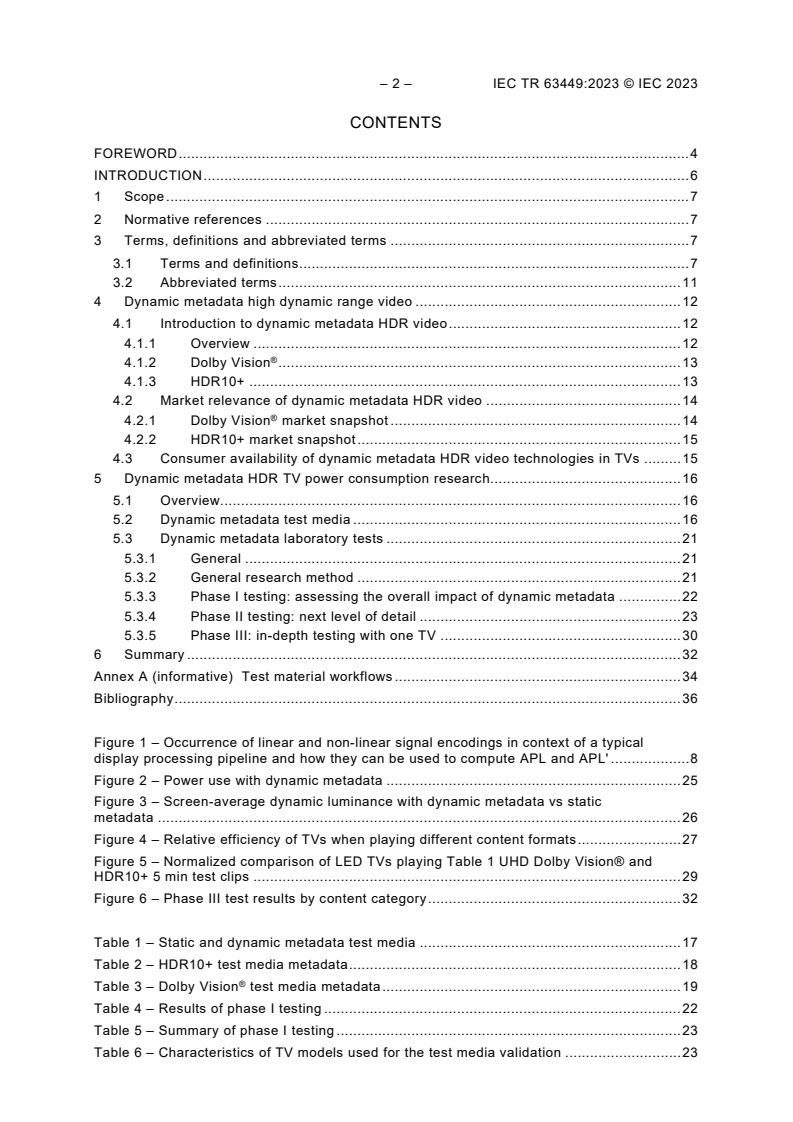
CONTENTS
FOREWORD . 4
INTRODUCTION . 6
1 Scope . 7
2 Normative references . 7
3 Terms, definitions and abbreviated terms . 7
3.1 Terms and definitions . 7
3.2 Abbreviated terms . 11
4 Dynamic metadata high dynamic range video . 12
4.1 Introduction to dynamic metadata HDR video . 12
4.1.1 Overview . 12 ®
4.1.2 Dolby Vision . 13
4.1.3 HDR10+ . 13
4.2 Market relevance of dynamic metadata HDR video . 14 ®
4.2.1 Dolby Vision market snapshot . 14
4.2.2 HDR10+ market snapshot . 15
4.3 Consumer availability of dynamic metadata HDR video technologies in TVs . 15
5 Dynamic metadata HDR TV power consumption research. 16
5.1 Overview. 16
5.2 Dynamic metadata test media . 16
5.3 Dynamic metadata laboratory tests . 21
5.3.1 General . 21
5.3.2 General research method . 21
5.3.3 Phase I testing: assessing the overall impact of dynamic metadata . 22
5.3.4 Phase II testing: next level of detail . 23
5.3.5 Phase III: in-depth testing with one TV . 30
6 Summary . 32
Annex A (informative) Test material workflows . 34
Bibliography . 36
Figure 1 – Occurrence of linear and non-linear signal encodings in context of a typical
display processing pipeline and how they can be used to compute APL and APL' . 8
Figure 2 – Power use with dynamic metadata . 25
Figure 3 – Screen-average dynamic luminance with dynamic metadata vs static
metadata . 26
Figure 4 – Relative efficiency of TVs when playing different content formats . 27
Figure 5 – Normalized comparison of LED TVs playing Table 1 UHD Dolby Vision® and
HDR10+ 5 min test clips . 29
Figure 6 – Phase III test results by content category . 32
Table 1 – Static and dynamic metadata test media . 17
Table 2 – HDR10+ test media metadata . 18 ®
Table 3 – Dolby Vision test media metadata . 19
Table 4 – Results of phase I testing . 22
Table 5 – Summary of phase I testing . 23
Table 6 – Characteristics of TV models used for the test media validation . 23
Table 7 – 4K real-world content used for tests . 24
Table 8 – Phase II: real world content (streamed movies/series) . 24
Table 9 – Phase III: HDR10+ and SDR using non-test clips . 30
Table 10 – Phase III: test clips only . 30
Table 11 – Phase III test results. 31
Table A.1 – Workflow details . 35
– 4 – IEC TR 63449:2023 © IEC 2023
INTERNATIONAL ELECTROTECHNICAL COMMISSION
____________
DYNAMIC METADATA HIGH DYNAMIC RANGE
IMPACTS ON TV POWER CONSUMPTION
FOREWORD
1) The International Electrotechnical Commission (IEC) is a worldwide organization for standardization comprising
all national electrotechnical committees (IEC National Committees). The object of IEC is to promote international
co-operation on all questions concerning standardization in the electrical and electronic fields. To this end and
in addition to other activities, IEC publishes International Standards, Technical Specifications, Technical Reports,
Publicly Available Specifications (PAS) and Guides (hereafter referred to as "IEC Publication(s)"). Their
preparation is entrusted to technical committees; any IEC National Committee interested in the subject dealt with
may participate in this preparatory work. International, governmental and non-governmental organizations liaising
with the IEC also participate in this preparation. IEC collaborates closely with the International Organization for
Standardization (ISO) in accordance with conditions determined by agreement between the two organizations.
2) The formal decisions or agreements of IEC on technical matters express, as nearly as possible, an international
consensus of opinion on the relevant subjects since each technical committee has representation from all
interested IEC National Committees.
3) IEC Publications have the form of recommendations for international use and are accepted by IEC National
Committees in that sense. While all reasonable efforts are made to ensure that the technical content of IEC
Publications is accurate, IEC cannot be held responsible for the way in which they are used or for any
misinterpretation by any end user.
4) In order to promote international uniformity, IEC National Committees undertake to apply IEC Publications
transparently to the maximum extent possible in their national and regional publications. Any divergence between
any IEC Publication and the corresponding national or regional publication shall be clearly indicated in the latter.
5) IEC itself does not provide any attestation of conformity. Independent certification bodies provide conformity
assessment services and, in some areas, access to IEC marks of conformity. IEC is not responsible for any
services carried out by independent certification bodies.
6) All users should ensure that they have the latest edition of this publication.
7) No liability shall attach to IEC or its directors, employees, servants or agents including individual experts and
members of its technical committees and IEC National Committees for any personal injury, property damage or
other damage of any nature whatsoever, whether direct or indirect, or for costs (including legal fees) and
expenses arising out of the publication, use of, or reliance upon, this IEC Publication or any other IEC
Publications.
8) Attention is drawn to the Normative references cited in this publication. Use of the referenced publications is
indispensable for the correct application of this publication.
9) Attention is drawn to the possibility that some of the elements of this IEC Publication may be the subject of patent
rights. IEC shall not be held responsible for identifying any or all such patent rights.
IEC TR 63449 has been prepared by Technical Area 19: Environmental and energy aspects for
multimedia systems and equipment, of IEC technical committee 100: Audio, video and
multimedia systems and equipment. It is a Technical Report.
The text of this Technical Report is based on the following documents:
Draft Report on voting
100/3862/DTR 100/3886/RVDTR
Full information on the voting for its approval can be found in the report on voting indicated in
the above table.
The language used for the development of this Technical Report is English.
This document was drafted in accordance with ISO/IEC Directives, Part 2, and developed in
accordance with ISO/IEC Directives, Part 1 and ISO/IEC Directives, IEC Supplement, available
at www.iec.ch/members_experts/refdocs. The main document types developed by IEC are
described in greater detail at www.iec.ch/standardsdev/publications.
The committee has decided that the contents of this document will remain unchanged until the
stability date indicated on the IEC website under webstore.iec.ch in the data related to the
specific document. At this date, the document will be
• reconfirmed,
• withdrawn,
• replaced by a revised edition, or
• amended.
IMPORTANT – The "colour inside" logo on the cover page of this document indicates
that it contains colours which are considered to be useful for the correct understanding
of its contents. Users should therefore print this document using a colour printer.
– 6 – IEC TR 63449:2023 © IEC 2023
INTRODUCTION
HDR technologies affect the entire video ecosystem from production and processing, through
to distribution and presentation. HDR-capable television sets typically have higher peak
luminance and better low-luminance capabilities than non-HDR TVs and can take advantage of
HDR video signals which typically represent scenes with much higher luminance and more
detailed low-luminance levels than was possible in traditional analogue and digital non-HDR
video systems.
As the luminance range of an HDR signal might not match the luminance range capabilities of
the display device, the signal must be adjusted before being displayed. This luminance
adjustment is called tone-mapping and is implemented as a processing step in the TV. The tone
mapping process can be improved with metadata, which describes the properties of the content
to be displayed.
Dynamic metadata based HDR tone-mapping approaches and behaviours are seeing an ever-
increasing application in consumer televisions; however, representative standardized test
content for measurement of the power consumption impact of those technologies on televisions
is not available. To prepare objective test materials (video clips), a study of power and
luminance behaviour was conducted, the results of which are described in Clauses 5 and 6.
This document assesses the impact of dynamic HDR on TV luminance and power consumption
using two technologies currently in deployment.
A small sample of TVs that supported the two technologies were studied using "representative"
content prepared by PT100-24 members. Test results show that dynamic metadata HDR
content, delivered to a dynamic metadata capable TV, can provide pictures with even greater
dynamic range (higher peak luminance and more detailed luminance levels with wider colour
gamut) than static HDR at the same or lower TV power consumption versus static HDR or SDR
content delivered to that same TV.
DYNAMIC METADATA HIGH DYNAMIC RANGE
IMPACTS ON TV POWER CONSUMPTION
1 Scope
This document presents a study of the impact of high dynamic range (HDR) technologies with
"dynamic metadata" on TV luminance and power consumption. It compares the power
consumption of content with dynamic metadata to the same content without dynamic metadata.
Non-dynamic "static metadata" HDR technologies such as HDR10 and non-metadata HDR such
as HLG, were previously studied in IEC TR 63274:2021.
This document also reviews the current HDR TV market and analyses existing HDR TV power
measurement methods and considerations for any changes to those power measurement
standards. ®
While this document studies the results of content that include Dolby Vision and HDR10+
dynamic metadata, any comparison of these two technologies is outside of the scope of this
document.
2 Normative references
There are no normative references in this document.
3 Terms, definitions and abbreviated terms
For the purposes of this document, the following terms and definitions apply.
ISO and IEC maintain terminological databases for use in standardization at the following
addresses:
• IEC Electropedia: available at https://www.electropedia.org/
• ISO Online browsing platform: available at https://www.iso.org/obp
3.1 Terms and definitions
3.1.1
average picture level
APL
average level of all the pixels of a single video signal frame in the linear luminance domain
EXAMPLE Display equipment such as television sets or computer monitors that internally use linear encoding after
undoing the non-linearity of the input signal.
[SOURCE: IEC TR 63274:2021, 3.1.10]
– 8 – IEC TR 63449:2023 © IEC 2023
3.1.2
average picture level based on non-linear input signal
APL′
average level of all pixels of a single video signal frame in the non-linear luminance domain
EXAMPLE Display equipment such as television sets or computer monitor receive input signals that encode
luminance in a non-linear way. Examples for such non-linear encoding are PQ or HLG EOTFs (ITU-R BT.2100).
Note 1 to entry: APL′ is defined as a percentage of the range between reference black and reference white level.
Note 2 to entry: This is not a measure of the linear signal that might be available inside of some display equipment
and delivered to the display device. The external and internal video signals are shown in Figure 1.
[SOURCE: IEC TR 63274:2021, 3.1.11]
Figure 1 – Occurrence of linear and non-linear signal encodings in context of a typical
display processing pipeline and how they can be used to compute APL and APL'
3.1.3
colour gamut
maximum area of chromaticity reproducible by a display
[SOURCE: IEC 62977-2-1:2021, 3.1.5, modified – "area" deleted from term]
3.1.4
colour volume
three-dimensional space of all colours and intensities that a device or signal can reproduce or
convey
[SOURCE: ISO/IEC TR 23091-4:2021, 3.6, modified – "three-dimensional" added to definition]
3.1.5
content light level
CLL
integer static HDR metadata value defining the luminance of any single pixel within an encoded
HDR video sequence
Note 1 to entry: The CLL is provided in candelas per square metre (cd/m ).
3.1.6
maximum content light level
MaxCLL
integer static HDR metadata value defining the maximum luminance of any single pixel within
an encoded HDR video sequence
Note 1 to entry: The MaxCLL is provided in candelas per square metre (cd/m ).
Note 2 to entry: CTA-861 provides further explanation.
3.1.7
dynamic metadata
metadata that can be different for different portions of the image essence
[SOURCE: SMPTE ST 2094-1:2016, 4.6]
3.1.8
electro-optical transfer function
EOTF
mathematical function for transferring an electrical signal into a desired optical signal
EXAMPLE EOTFs are typically non-linear and monotonic and aim to incorporate behaviour of the human visual
system, e.g. on a display device. Some are absolute, addressing luminance values directly, while others are of
relative nature.
[SOURCE: IEC TR 63274:2021, 3.1.1]
3.1.9
frame average light level
FALL
integer static HDR metadata value defining the average luminance for all pixels of any single
frame within an encoded HDR video sequence
Note 1 to entry: The FALL is provided in candelas per square metre (cd/m ).
3.1.10
maximum frame average light level
MaxFALL
integer static HDR metadata value defining the maximum average luminance for all pixels of
any single frame within an encoded HDR video sequence
Note 1 to entry: The MaxFALL is provided in candelas per square metre (cd/m ).
Note 2 to entry: CTA-861 provides further explanation.
3.1.11
high definition
HD
spatial video resolution ranging from 1 280 × 720 to 1 920 × 1 080
[SOURCE: IEC TR 63274:2021, 3.1.6]
3.1.12
high dynamic range video
HDR video
capability of components in a video pipeline to capture, process, transport or display luminance
levels and tone gradations that exceed capabilities of conventional SDR imaging pipelines
components
Note 1 to entry: An HDR video signal typically uses a greater bit depth, luminance and colour volume than standard
dynamic range (SDR) video. It also typically utilizes different tone curves such as perceptual quantizer (PQ) as
specified in SMPTE ST 2084 or hybrid log gamma (HLG) specified in ITU-R BT.2100 instead of gamma, as used with
SDR. When the HDR video signal is rendered on an HDR display, it is possible to see greater luminance ranges and
wider colour gamuts.
Note 2 to entry: HDR video can provide an enhanced viewer experience and can more accurately reproduce scenes
that include, within the same image, dark areas and bright highlights, such as emissive light sources and reflections.
2 2
The luminance range of an HDR image is typically constrained between 0,005 cd/m to 4 000 cd/m .
[SOURCE: IEC TR 63274:2021, 3.1.2, modified – The last sentence of Note 2 to entry has been
added.]
– 10 – IEC TR 63449:2023 © IEC 2023
3.1.13
hybrid log-gamma
HLG
one set of HDR transfer functions offering a degree of backwards compatibility to SDR by more
closely matching the previously established television transfer curves
Note 1 to entry: Sets of transfer functions related to HDR signals are specified in Rec. ITU-R BT.2100-1.
Note 2 to entry: HLG is used both as a description of a dedicated transfer function and as a video format name.
[SOURCE: IEC 62087-2:2023, 3.1.9, modified – Added 'to SDR'.]
3.1.14
image-related metadata
identifiers describing intrinsic image properties in form of both static metadata valid throughout
the content and dynamic metadata for frame-specific image parameters
EXAMPLE 1 Minimum and maximum luminance, average picture level, properties of the grading display.
EXAMPLE 2 HDR image related static metadata are MaxCLL and MaxFall as specified in CTA-861-G, section 6.9.1
and Appendix P, sections P.1 and P.2 for algorithms to calculate each.
EXAMPLE 3 Dynamic metadata is utilized by Dolby Vision® (SMPTE ST 2094-10) and HDR10+
(SMPTE ST 2094-40).
Note 1 to entry: They can be used as recommendations and guidance for image rendering and display.
[SOURCE: IEC TR 63274:2021, 3.1.9]
3.1.15
perceptual quantizer
PQ
one set of HDR transfer functions addressing a very wide range of absolute luminance levels
for a given bit depth using a non-linear transfer function that is finely tuned to match the
sensitivity of the human visual system
Note 1 to entry: Sets of transfer functions related to HDR signals are specified in Rec. ITU-R BT.2100-1.
[SOURCE: ISO/IEC TR 23008-15:2018, 3.8, modified – In the definition, "brightness" has been
replaced with "luminance".]
3.1.16
signal identification metadata
identifiers describing the properties of an image stream
EXAMPLE Format, resolution, colour space, chroma subsampling, bit-depth, image compression, image transport.
[SOURCE: IEC TR 63274:2021, 3.1.8]
3.1.17
standard dynamic range video
SDR video
capability of components in a video pipeline to capture, process, transport or display luminance
levels and tone gradations that can be characterized by the dynamic range, colour rendering
and tone gradation capabilities essentially compatible with cathode ray tube (CRT) displays
EXAMPLE ITU-R BT.709 /BT.1886 and IEC 61966-2-1 (sRGB).
2 2
Note 1 to entry: The luminance range of an SDR image is typically constrained between 0,1 cd/m to 100 cd/m .
[SOURCE: IEC TR 63274:2021, 3.1.3]
3.1.18
television set
TV
equipment for the reception and display of television broadcast and similar services for
terrestrial, cable, satellite and broadband network transmission of analogue and/or digital
signals
Note 1 to entry: A television set can include additional functions that are not required for its primary function.
[SOURCE: IEC 62087-3:2023, 3.1.1]
3.1.19
ultra high definition
UHD
Ultra HD
spatial video resolution above 1 920 × 1 080
[SOURCE: IEC TR 63274:2021, 3.1.7]
3.1.20
wide colour gamut
WCG
colour space that covers a larger percentage of visible colours compared to the sRGB/Rec.
ITU-R BT.709 colour space
EXAMPLE ITU-R BT.2020 is considered to provide WCG while BT.709 does not.
[SOURCE: IEC TR 63274:2021, 3.1.4]
3.2 Abbreviated terms
ARC audio return channel
ATSC Advanced Television Systems Committee
BDP Blu-ray™ disc player
CIE International Commission on Illumination (Commission Internationale de
l'Éclairage)
CLASP non-profit organisation supporting the development and implementation of
policies and programs to improve the energy and environmental performance
of appliances and equipment we use every day (formally known as
Collaborative Labelling and Standards Program)
CRT cathode ray tube
CTA Consumer Technology Association (formerly Consumer Electronics
Association)
®3
DV Dolby Vision
FPS frames per second
___________
Blu-ray™, Blu-ray Disc™ and Ultra HD Blu-ray™ are trademarks of the Blu-ray Disc Association. This information
is given for the convenience of users of this document and does not constitute an endorsement by IEC of the
product named. Equivalent products may be used if they can be shown to lead to the same results.
CLASP, https://www.clasp.ngo/
3 ® ®
Dolby and Dolby Vision are trademarks of Dolby Laboratories, Inc. This information is given for the convenience
of users of this document and does not constitute an endorsement by IEC of the product named. Equivalent
products may be used if they can be shown to lead to the same results.
– 12 – IEC TR 63449:2023 © IEC 2023
® 4
HDMI High-Definition Multimedia Interface
HDR10 HDR10 media profile
HDR10+ HDR10+ media profile
HEVC high-efficiency video coding
Hz hertz
ITU-R International Telecommunication Union, Radiocommunication Sector
NABA North American Broadcasters Association
NEEA Northwest Energy Efficiency Alliance
OTT over-the-top
PCL Pacific Crest Labs
SMPTE Society of Motion Picture and Television Engineers
sRGB standard Red Green Blue colour space specified in IEC 61966-2-1:1999
TV television set
4 Dynamic metadata high dynamic range video
4.1 Introduction to dynamic metadata HDR video
4.1.1 Overview
Older video creation, broadcast and television receiver technologies, collectively called
"Standard Dynamic Range" (SDR) for the purposes of this technical report, do not provide
images that accurately represent the light distribution and detail of real-world scenes .
Significant technological progress in video content creation, distribution and displays now
permit consumers to receive and display almost life-like programming by adding several key
aspects missing from older SDR technologies. Specifically:
– higher pixel counts (up from 1 920 × 1 080 image pixels Full HD to UHD with 3 840 × 2 160
or more image pixels);
– higher image frame rates (up from a maximum of 60 Hz to 120 Hz or more);
– greater dynamic range (image peak brightness up to 10 000 cd/m );
– wider colour gamut embracing more of the CIE 1931 (x, y) chromaticity space vs the
common limit to ITU-R BT.709 colour primaries with SDR images.
Roughly a decade ago, HDR technologies entered the market. Since then, many consumers
have been enjoying video content offering much of the key aspects described above in a form
this report refers to as "static metadata HDR". Static metadata in this report's context means
that for a given "static metadata" HDR video programme, the content author provides ancillary
data along with the programme. This data describes several characteristics of the video which
___________
4 ® ®
HDMI and HDMI High-Definition Multimedia Interface are trademarks of HDMI Licensing Administrator, Inc.
This information is given for the convenience of users of this document and does not constitute an endorsement
by IEC of the product named. Equivalent products may be used if they can be shown to lead to the same results.
HDR10 is an open standard HDR media profile announced in August 2015 by the Consumer Technology
Association. This information is given for the convenience of users of this document and does not constitute an
endorsement by IEC of the product named. Equivalent products may be used if they can be shown to lead to the
same results.
HDR10+ is a trademark of HDR10+ Technologies, LLC. This information is given for the convenience of users of
this document and does not constitute an endorsement by IEC of the product named. Equivalent products may
be used if they can be shown to lead to the same results.
Pacific Crest Labs, https://www.pacificcrestlabs.com/
‘Real-world’ refers to physically accurate representations of light distribution as well as spatial and temporal detail
that are captured e.g., by a camera but also includes artistically created or adjusted content.
for example represent the peak luminance, minimum luminance, and colour gamut of the entire
programme. The receiver can only make a single set of tone-mapping adjustments based on
this information, which then remains constant or 'static' throughout the display of the full
programme. A previously published technical report, IEC TR 63274:2021, discussed static
metadata HDR technologies and their impact on television energy use.
In addition to static metadata, another metadata approach is available in the market which this
report refers to as "dynamic metadata HDR". Dynamic metadata in this report's context refers
to metadata provided by the content author on a frame-by-frame or scene-by-scene basis which
allows video production and television receivers to make adjustments frame-by-frame when
processing and displaying such programmes. This has several benefits to the content author's
creative needs and provides useful information allowing a receiver to display the content
author's intended rendering of that programme more accurately.
Subclauses 4.1.2 and 4.1.3 detail the main properties of the two "dynamic metadata HDR" ®
formats Dolby Vision and HDR10+ considered by this Technical Report.
NOTE There are other dynamic HDR technologies such as SL-HDR2 (ETSI TS 103 433-2), SL-HDR3
(ETSI TS 103 433-3) and HDR Vivid which were not evaluated as content and televisions employing those
technologies were not globally available. ®
4.1.2 Dolby Vision ®
Dolby Vision is a commercial imaging format created by Dolby Laboratories, Inc. This format
enables a modular ecosystem that provides an extensive set of implementations and methods
to facilitate imaging features such as HDR. These features are implemented in a wide range of
soft and hardware products used with image capture, processing, and display, both in the
consumer and professional market segments. This includes many of today's TVs. ®
On a foundational level, the Dolby Vision image signal uses the PQ EOTF (SMPTE ST 2084)
with a quantization granularity of up to 12 bits, but the HLG EOTF is also supported through
compatibility profiles. To support accurate and perceptually meaningful transformations such ®
as mapping the current content scene to a TV's capabilities, individual Dolby Vision enabled
devices can rely on comprehensive image-related metadata. This metadata offers several
distinct parameters supporting how the image signal is encoded, decoded, mapped, rendered,
and ultimate appears within input, processing, and output scenarios. ®
One metadata type of Dolby Vision is frame accurate dynamic metadata, derived from
statistical analysis of the content imagery. This facilitates the preservation of the creative intent,
independent of the target display capabilities (see SMPTE ST 2094-10 for more details). In
addition to computational analysis, manual creative input can be assigned to the dynamic ®
metadata through Dolby Vision Trim Passes, which give content creators the opportunity to
adjust the colour volume mapping to their exact requirements and preference. ®
To guarantee the accurate interpretation of the aforementioned metadata, Dolby Vision offers ®
a dedicated colour volume-mapping engine that is implemented in Dolby Vision enabled
devices. This mapping engine can in many cases also facilitate real-time adjustments to guide
the HDR tone mapping, e.g., taking into account the display reflectivity and surrounding
illumination in the viewing environment.
4.1.3 HDR10+
HDR10+ is a royalty-free HDR format with a certification, logo and licensing program by
HDR10+ Technologies, LLC, a joint venture between Panasonic Corporation and Samsung
Electronics.
– 14 – IEC TR 63449:2023 © IEC 2023
It uses dynamic metadata as opposed to static (i.e. single value set established for a specific
item of content) metadata used by standard HDR10. The use of dynamic metadata means that
HDR10+ can change each frame's parameters, therefore frames are treated separately by their
own set of brightness, colour and contrast values. Additionally, HDR10+ can signal a maximum
luminance of 10 000 cd/m . It is an open format meaning it can be modified and deployed by
organisations other than HDR10+ LLC stakeholders. The certification and logo licencing
programme is royalty-free with some associated annual administrative fees as described on the
LLC website.
HDR10+ technology includes:
• EOTF (Electro-Optical Function): SMPTE ST 2084 (PQ)
• Chroma subsampling: 4:2:0 (compression format)
• Resolution: agnostic (2K/4K/8K, etc.)
• Bit representation: 10-bit or more (up to 16-bit)
• Colour space: ITU-R BT.2020
• Pixel representation: up to 10 000 cd/m
• Metadata (Required): Mastering Display Colour Volume Metadata (SMPTE ST
2086)
• Metadata (optional): MaxCLL, MaxFALL
• HDR10+ is applicable for HEVC, AV1, VVC and VP9 compatibility via WebM as well as any
codec that supports ITU-T T.35 metadata.
NOTE 1 VVC (Versatile Video Coding), also known as H.266, ISO/IEC 23090-3, and MPEG-I Part 3, is a licence-
based video compression standard developed by ISO/IEC JTC 1/SC 29 (MPEG).
NOTE 2 VP9 is an open and royalty-free video coding format developed by Google and stated as the WebM Project's
next-generation open video codec.
NOTE 3 WebM is an open, royalty-free, media file format for the web, developed by The WebM Project.
It is fully backward compatible with HDR10. HDR10+ dynamic metadata may be added to any
HDR10 content.
4.2 Market relevance of dynamic metadata HDR video ®
4.2.1 Dolby Vision market snapshot ®
Dolby Vision is available through and used by (as of summer 2021):
• majority of HDR capable televisions;
• many Blu-ray™ and streaming set-top-boxes;
• variety of desktop, laptop and notebook computers;
• several manufacturers' gaming platforms, smartphones and mobile devices;
• numerous content creators and service providers;
• best-in-class leading video edit suite software providers;
• over 100 postproduction companies;
• hundreds of theatrical releases in 2020 and 2021.
Dolby Vision® is available for thousands of movies and TV episodes on Blu-ray™, via OTT
providers and user-generated (UGC) content on major platforms.
4.2.2 HDR10+ market snapshot
HDR10+ is available through and used by (as of mid-2021):
• 28 content companies and service providers;
• 19 TV, projector, smartphone and notebook manufacturers;
• over 5 000 certified device models;
• 19 source device manufacturers and streaming platforms – BDP/set-top box/video
recorders/projector, etc.;
• 22 SoC manufacturers;
• hundreds of millions of HDR10+-capable television sets shipped since 2018;
• over 30 video toolchain manufacturers and postproduction companies;
• HDR10+ Technologies LLC certification and logo program for the technology has 130
participating companies as of March 2022.
HDR10+ is available in 54 Blu-ray™ titles, numerous movies and episodic series via OTT
providers, and a large amount of user-generated content (UGC) on YouTube uploaded from
Android handsets and 3rd party HDR video makers.
4.3 Consumer availability of dynamic metadata HDR video technologies in TVs
While difficult to get an accurate tally of exactly how many dynamic metadata capable HDR TVs
are in consumer's homes worldwide, the CTA's 23rd Annual U.S. Ownership and Market
Potential Study (July 2021) provides an indication of consumer adoption of HDR TVs in the U.S.
It should be noted that CTA's report does not cover the full 2021 calendar year and therefore
the numbers provided here are estimates. In addition, CTA's study does not differentiate
between static metadata HDR TVs and dynamic metadata HDR capable TVs. For reference,
the relevant numbers from CTA's U.S. study are shown below:
• Total U.S. population = 328 million [U.S. Census Bureau December 2020]
• Total U.S. occupied housing units = 120 million [U.S. Census Bureau December 2020]
• Total U.S. TV households = 109 million [per CTA over 91 % of homes own a TV]
• Ownership of 4K UHD TVs (2021 est.) = 57 million units [per CTA over 50 % of TV
households]
• Ownership of HDR TVs (2021 estimate) = 34 million units [per CTA over 30 % of TV
households]
The North American Broadcasters Association (NABA) published its study and HDR
Recommendation Overview (August 2021) which noted virtually all Smart TVs support both
HDR10 and HLG. The study also reported that current HDR content production consists of
HDR10 which is widely used for feature films and scripted TV content, while HLG is widely used
for sports and other live production.
The NABA study also noted that U.S. broadcasters, cable operators and streaming providers ®
use HDR10 and "optional" dynamic metadata (Dolby Vision and HDR10+) content. However,
the study did not compare the different HDR technologies in terms of percentage of programmes
broadcast, but did note that video streaming, where HDR content is more prevalent, is
increasing in U.S. viewing habits, and among streaming capable homes, accounts for as much
as 25 % of total TV usage.
The NABA report concludes with a recommendation: "That systems based on an underlying
PQ-based HDR transfer function (SMPTE ST 2084) with optional static (SMPTE ST 2086)
and/or dynamic metadata (SMPTE ST 2094) be used for ATSC 3.0 program emission in North
America."
– 16 – IEC TR 63449:2023 © IEC 2023
In Germany, the Deutsche TV-Plattform, an association of private and public organisations
involved in digital media, provides a database of UHD devices supporting HDR10, HLG, Dolby
Vision® and HDR10+. German data for 2021/Q1 – Q3 UHD TV sales (ZVEI, Deutsche TV
Platform, GfK) showed 98 % of UHD TVs support at least one HDR format and 77 % of UHD
TVs support at least one dynamic HDR format (either Dolby Vision® or HDR10+).
5 Dynamic metadata HDR TV power consumption research
5.1 Overview
As both the content and the consumer TV landscape is shifting towards dynamic HDR use,
investigations in this document are focused on:
1) understanding how TV power and luminance responds to dynamic metadata content
available today as this content is largely limited to movies and series available through
9 10
streaming services like Amazon Prime / Amazon Instant Video , NETFLIX and on Blu-
ray™ discs;
2) characterizing the impact of test media developed by 2050 Partners and colour graded by
their professional feature film digital mastering subcontractor, Company 3 , to represent
dynamic metadata video after the expected transition of broadcast content to include
dynamic metadata.
Because many uncertainties remain in how dynamic metadata will progress in terms of
technology, compatibility, content provider, distribution network practices, and market adoption,
this report and its data represent a snapshot in time the project team used to increase its
understanding of the ecosystem. Since the dynamic metadata HDR ecosystem is still evolving,
the report's data might not be useful in answering questions policymakers might have related
to this topic.
Subclause 5.2 describes the dynamic metadata test media developed by the project team to
represent future broadcast content with dynamic metadata for the purpose of laboratory tests
using current dynamic metadata capable televisions. Subclause 5.3 explains the methods,
findings, and conclusions of that research, which focused on understanding the power and
luminance impacts of both dynamic metadata test media and real-world content.
5.2 Dynamic metadata test media
As the basis for dynamic metadata test content, the project team chose to use the same raw
video content captured by CLASP for the purpose of developing HDR test materials and on
which the IEC HDR10 test media, proposed for IEC 62087-2:2023 was based. This content was
created by a team of experts on professional equipment. Company 3 judged this content as
high quality and suitable for this project's intended purpose.
___________
Amazon, Amazon Prime, Amazon Prime Video and Amazon Instant Video are trademark of Amazon.com, Inc.
This information is given for the convenience of users of this document and does not constitute an endorsement
by IEC of the product named. Equivalent products may be used if they can be shown to lead to the same results.
NETFLIX is a trademark of Netflix, Inc. This information is given for the convenience of users of this document
and does not constitute an endorsement by IEC of the product named. Equivalent products may be used if they
can be shown to lead to the same results.
2050 Partners, Inc., https://www.2050partners.com/.
Company 3 and CO3 are trademarks and service marks of Company 3 / Method Inc. This information is given for
the convenience of users of this document and does not constitute an endorsement by IEC of the product named.
Equivalent products may be used if they can be shown to lead to the same results.
The following instructions were provided to Company 3 to create the dynamic metadata test
media:
• Use the provisionally approved IEC 62087-2:2023 static metadata HDR10 test media as
shown in Table 1 below.
• Apply the same edits, tone mapping and workflow Company 3 typically does for Dolby
Vision® and HDR10+ clients to the above IEC 62087-2:2023 HDR10 static metadata test
media to yield new Dolby Vision® and HDR10+ dynamic test media that meet the
requirements in Table 1 below. Annex A provides information on the test material workflows.
• Add a 10-second countdown timer over ITU-R BT.2111 colour bars to identify start of test
sequence.
Table 1 – Static and dynamic metadata test media
Type Resolution Frame rate Encoder Container Audio
IEC static
AAC, 1 kHz sine
metadata 3 840 × 2 160 59,94p HEVC MP4
wave, −18 dB
HDR10
AAC, 1 kHz sine
Dolby Vision® 3 840 × 2 160 59,94p HEVC MP4
wave, −18 dB
AAC, 1 kHz sine
HDR10+ 3 840 × 2 160 59,94p HEVC MP4
wave, −18 dB
The names of the three test media, in the same order as shown
...