


IEC 60966-3:2008
(Main)Radio frequency and coaxial cable assemblies - Part 3: Sectional specification for semi-flexible coaxial cable assemblies
General Information
- Abstract
IEC 60966-3:2008 is a sectional specification that relates to semi-flexible coaxial cable assemblies operating in the transverse electromagnetic mode (TEM). It establishes uniform requirements for testing the electrical, mechanical and climatic properties of flexible cable assemblies composed of flexible coaxial cables and coaxial connectors. The major change with respect to the second edition is a better definition of the tests to be performed.
This publication is to be read in conjunction with IEC 60966-1:1999
- Status
- Published
- Publication Date
- 20-Oct-2008
- Technical Committee
- TC 46 - Cables, wires, waveguides, RF connectors, RF and microwave passive components and accessories
- Drafting Committee
- MT 60966 - TC 46/MT 60966
- Current Stage
- DELPUB - Deleted Publication
- Start Date
- 30-Oct-2023
- Completion Date
- 29-Oct-2021
Buy Documents
IEC 60966-3:2008 - Radio frequency and coaxial cable assemblies - Part 3: Sectional specification for semi-flexible coaxial cable assemblies Released:10/21/2008

IEC 60966-3:2008 - Radio frequency and coaxial cable assemblies - Part 3: Sectional specification for semi-flexible coaxial cable assemblies Released:10/21/2008
Overview
IEC 60966-3:2008 is the sectional specification for semi-flexible coaxial cable assemblies used in radio frequency (RF) applications operating in the transverse electromagnetic mode (TEM). It defines uniform requirements and test procedures for finished assemblies (cable + connectors) to verify electrical, mechanical and climatic performance. This third edition refines and clarifies the tests to be performed and is intended to be read in conjunction with IEC 60966-1:1999 (generic specification).
Key topics and technical requirements
- Scope and definition: Applies to finished semi‑flexible coaxial cable assemblies; specifications apply to the assembled unit rather than separate parts. Length is measured between connector reference planes; default tolerances are ±1% (≥300 mm) or ±3 mm (<300 mm).
- Design and materials: Cables should conform to IEC 60096-2 or IEC 61196; connectors to IEC 61169 where applicable. Material details are provided in the detailed specification.
- Marking and packaging: Requirements for assembly identification, end caps and optional markers when specified in the detail specification.
- Quality assessment: Uses IEC quality assessment principles and sampling plans (e.g., IEC QC/IEC 60000 series references).
- Electrical tests:
- Reflection/return-loss and preferred parameter presentation (A = −20 log r). VSWR or reflection factor may also be specified.
- Insertion loss stability: not applicable to semi‑flexible assemblies.
- Phase-difference limits between matched assemblies are measured per detail specification.
- Screening effectiveness / transfer impedance: preferred maximum values at 30 MHz - 30 μΩ/m, 300 μΩ/m, or 3 mΩ/m (as specified).
- Dielectric/withstand voltage tests performed at sea level unless higher altitude specified; preferred pressure values: 86 kPa (sea level), 25 kPa (10 km), 4.4 kPa (20 km).
- Mechanical and environmental tests:
- Vibration (test Fc of IEC 60068-2-6) with three orthogonal axes; continuity monitored and interruptions must not exceed 1 µs. Post-test insertion/return loss must remain within specified limits.
- Flexure and flexing-endurance tests are not applicable to semi‑flexible assemblies.
- Additional bump and shock tests when specified.
Applications and who uses it
- Manufacturers of RF cable assemblies and coaxial cable assembly suppliers use IEC 60966-3:2008 to define product construction, test schedules and acceptance criteria.
- Test laboratories and quality managers adopt the standard for electrical verification (return loss, VSWR), screening effectiveness and environmental qualification.
- Systems integrators and procurement/specification engineers reference the standard when ordering semi‑flexible coaxial assemblies for telecom, broadcast, aerospace and industrial RF systems where TEM-mode performance and environmental robustness are required.
Related standards
- IEC 60966-1:1999 (Generic specification - mandatory companion)
- IEC 60068-2-6 (Vibration test Fc)
- IEC 60096-2 / IEC 61196 (Cable specifications)
- IEC 61169 (RF connectors)
Keywords: IEC 60966-3:2008, semi-flexible coaxial cable assemblies, RF cable assemblies, TEM mode, return loss, VSWR, transfer impedance, vibration test, IEC standard.
Relations
- Effective Date
- 05-Sep-2023
- Effective Date
- 05-Sep-2023
Buy Documents
IEC 60966-3:2008 - Radio frequency and coaxial cable assemblies - Part 3: Sectional specification for semi-flexible coaxial cable assemblies Released:10/21/2008
IEC 60966-3:2008 - Radio frequency and coaxial cable assemblies - Part 3: Sectional specification for semi-flexible coaxial cable assemblies Released:10/21/2008
Get Certified
Connect with accredited certification bodies for this standard

ANCE
Mexican certification and testing association.

Intertek Slovenia
Intertek testing, inspection, and certification services in Slovenia.

LNE (Laboratoire National de Métrologie et d'Essais)
French national laboratory for metrology and testing.
Sponsored listings
Frequently Asked Questions
IEC 60966-3:2008 is a standard published by the International Electrotechnical Commission (IEC). Its full title is "Radio frequency and coaxial cable assemblies - Part 3: Sectional specification for semi-flexible coaxial cable assemblies". This standard covers: IEC 60966-3:2008 is a sectional specification that relates to semi-flexible coaxial cable assemblies operating in the transverse electromagnetic mode (TEM). It establishes uniform requirements for testing the electrical, mechanical and climatic properties of flexible cable assemblies composed of flexible coaxial cables and coaxial connectors. The major change with respect to the second edition is a better definition of the tests to be performed. This publication is to be read in conjunction with IEC 60966-1:1999
IEC 60966-3:2008 is a sectional specification that relates to semi-flexible coaxial cable assemblies operating in the transverse electromagnetic mode (TEM). It establishes uniform requirements for testing the electrical, mechanical and climatic properties of flexible cable assemblies composed of flexible coaxial cables and coaxial connectors. The major change with respect to the second edition is a better definition of the tests to be performed. This publication is to be read in conjunction with IEC 60966-1:1999
IEC 60966-3:2008 is classified under the following ICS (International Classification for Standards) categories: 33.120.10 - Coaxial cables. Waveguides. The ICS classification helps identify the subject area and facilitates finding related standards.
IEC 60966-3:2008 has the following relationships with other standards: It is inter standard links to IEC 60966-3:2003, IEC 60966-3:2023. Understanding these relationships helps ensure you are using the most current and applicable version of the standard.
IEC 60966-3:2008 is available in PDF format for immediate download after purchase. The document can be added to your cart and obtained through the secure checkout process. Digital delivery ensures instant access to the complete standard document.
Standards Content (Sample)
IEC 60966-3
Edition 3.0 2008-10
INTERNATIONAL
STANDARD
Radio frequency and coaxial cable assemblies –
Part 3: Sectional specification for semi-flexible coaxial cable assemblies
All rights reserved. Unless otherwise specified, no part of this publication may be reproduced or utilized in any form
or by any means, electronic or mechanical, including photocopying and microfilm, without permission in writing from
either IEC or IEC's member National Committee in the country of the requester.
If you have any questions about IEC copyright or have an enquiry about obtaining additional rights to this publication,
please contact the address below or your local IEC member National Committee for further information.
IEC Central Office
3, rue de Varembé
CH-1211 Geneva 20
Switzerland
Email: inmail@iec.ch
Web: www.iec.ch
About the IEC
The International Electrotechnical Commission (IEC) is the leading global organization that prepares and publishes
International Standards for all electrical, electronic and related technologies.
About IEC publications
The technical content of IEC publications is kept under constant review by the IEC. Please make sure that you have the
latest edition, a corrigenda or an amendment might have been published.
ƒ Catalogue of IEC publications: www.iec.ch/searchpub
The IEC on-line Catalogue enables you to search by a variety of criteria (reference number, text, technical committee,…).
It also gives information on projects, withdrawn and replaced publications.
ƒ IEC Just Published: www.iec.ch/online_news/justpub
Stay up to date on all new IEC publications. Just Published details twice a month all new publications released. Available
on-line and also by email.
ƒ Electropedia: www.electropedia.org
The world's leading online dictionary of electronic and electrical terms containing more than 20 000 terms and definitions
in English and French, with equivalent terms in additional languages. Also known as the International Electrotechnical
Vocabulary online.
ƒ Customer Service Centre: www.iec.ch/webstore/custserv
If you wish to give us your feedback on this publication or need further assistance, please visit the Customer Service
Centre FAQ or contact us:
Email: csc@iec.ch
Tel.: +41 22 919 02 11
Fax: +41 22 919 03 00
IEC 60966-3
Edition 3.0 2008-10
INTERNATIONAL
STANDARD
Radio frequency and coaxial cable assemblies –
Part 3: Sectional specification for semi-flexible coaxial cable assemblies
INTERNATIONAL
ELECTROTECHNICAL
COMMISSION
PRICE CODE
R
ICS 33.120.10 ISBN 978-2-88910-360-7
– 2 – 60966-3 © IEC:2008(E)
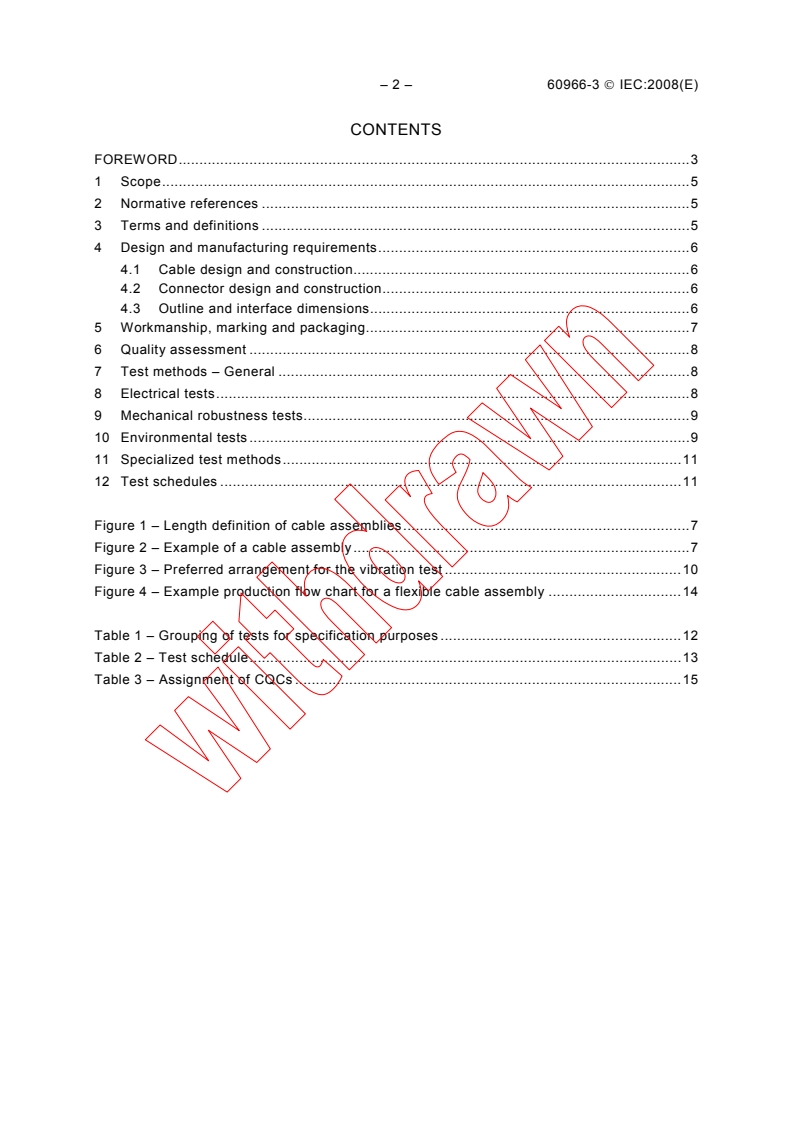
CONTENTS
FOREWORD.3
1 Scope.5
2 Normative references .5
3 Terms and definitions .5
4 Design and manufacturing requirements.6
4.1 Cable design and construction.6
4.2 Connector design and construction.6
4.3 Outline and interface dimensions.6
5 Workmanship, marking and packaging.7
6 Quality assessment .8
7 Test methods – General .8
8 Electrical tests.8
9 Mechanical robustness tests.9
10 Environmental tests .9
11 Specialized test methods.11
12 Test schedules .11
Figure 1 – Length definition of cable assemblies.7
Figure 2 – Example of a cable assembly.7
Figure 3 – Preferred arrangement for the vibration test .10
Figure 4 – Example production flow chart for a flexible cable assembly .14
Table 1 – Grouping of tests for specification purposes .12
Table 2 – Test schedule.13
Table 3 – Assignment of CQCs .15
60966-3 © IEC:2008(E) – 3 –
INTERNATIONAL ELECTROTECHNICAL COMMISSION
____________
RADIO FREQUENCY AND COAXIAL CABLE ASSEMBLIES –
Part 3: Sectional specification for semi-flexible
coaxial cable assemblies
FOREWORD
1) The International Electrotechnical Commission (IEC) is a worldwide organization for standardization comprising
all national electrotechnical committees (IEC National Committees). The object of IEC is to promote
international co-operation on all questions concerning standardization in the electrical and electronic fields. To
this end and in addition to other activities, IEC publishes International Standards, Technical Specifications,
Technical Reports, Publicly Available Specifications (PAS) and Guides (hereafter referred to as “IEC
Publication(s)”). Their preparation is entrusted to technical committees; any IEC National Committee interested
in the subject dealt with may participate in this preparatory work. International, governmental and non-
governmental organizations liaising with the IEC also participate in this preparation. IEC collaborates closely
with the International Organization for Standardization (ISO) in accordance with conditions determined by
agreement between the two organizations.
2) The formal decisions or agreements of IEC on technical matters express, as nearly as possible, an international
consensus of opinion on the relevant subjects since each technical committee has representation from all
interested IEC National Committees.
3) IEC Publications have the form of recommendations for international use and are accepted by IEC National
Committees in that sense. While all reasonable efforts are made to ensure that the technical content of IEC
Publications is accurate, IEC cannot be held responsible for the way in which they are used or for any
misinterpretation by any end user.
4) In order to promote international uniformity, IEC National Committees undertake to apply IEC Publications
transparently to the maximum extent possible in their national and regional publications. Any divergence
between any IEC Publication and the corresponding national or regional publication shall be clearly indicated in
the latter.
5) IEC provides no marking procedure to indicate its approval and cannot be rendered responsible for any
equipment declared to be in conformity with an IEC Publication.
6) All users should ensure that they have the latest edition of this publication.
7) No liability shall attach to IEC or its directors, employees, servants or agents including individual experts and
members of its technical committees and IEC National Committees for any personal injury, property damage or
other damage of any nature whatsoever, whether direct or indirect, or for costs (including legal fees) and
expenses arising out of the publication, use of, or reliance upon, this IEC Publication or any other IEC
Publications.
8) Attention is drawn to the Normative references cited in this publication. Use of the referenced publications is
indispensable for the correct application of this publication.
9) Attention is drawn to the possibility that some of the elements of this IEC Publication may be the subject of
patent rights. IEC shall not be held responsible for identifying any or all such patent rights.
International Standard IEC 60966-3 has been prepared by IEC technical committee 46: Cables,
wires, waveguides, R.F. connectors, R.F. and microwave passive components and
accessories.
This third edition cancels and replaces the second edition published in 2003. It constitutes a
technical revision.
The major change with respect to the second edition is a better definition of the tests to be
performed.
This sectional specification is to be read in conjunction with the second edition of
IEC 60966-1 (1999). It contains the same clauses as that of IEC 60966-1 and completes or
amends them when required. When a clause of IEC 60966-1 does not appear in this standard,
it applies as it is in IEC 60966-1. When this standard states "addition", "modification" or
"replacement", the relevant text in Part 1 is to be adapted accordingly.
– 4 – 60966-3 © IEC:2008(E)
The text of this standard is based on the following documents:
CDV Report on voting
46/264/CDV 46/297/RVC
Full information on the voting for the approval of this standard can be found in the report on
voting indicated in the above table.
This publication has been drafted in accordance with the ISO/IEC Directives, Part 2.
A list of all parts of the IEC 60966 series, under the general title: Radio frequency and coaxial
cable assemblies, can be found on the IEC website.
The committee has decided that the contents of this publication will remain unchanged until
the maintenance result date indicated on the IEC web site under "http://webstore.iec.ch" in
the data related to the specific publication. At this date, the publication will be
• reconfirmed,
• withdrawn,
• replaced by a revised edition, or
• amended.
A bilingual version of this publication may be issued at a later date.
60966-3 © IEC:2008(E) – 5 –
RADIO FREQUENCY AND COAXIAL CABLE ASSEMBLIES –
Part 3: Sectional specification for semi-flexible
coaxial cable assemblies
1 Scope
This part of IEC 60966 is a sectional specification that relates to semi-flexible coaxial cable
assemblies operating in the transverse electromagnetic mode (TEM). It establishes uniform
requirements for testing the electrical, mechanical and climatic properties of flexible cable
assemblies composed of flexible coaxial cables and coaxial connectors.
NOTE 1 For the purposes of this sectional specification, a cable assembly is always regarded as an integral unit.
All specifications apply to the finished assembly and not to individual and non-assembled parts thereof.
NOTE 2 This sectional specification should be supplemented with detail specifications giving additional details as
required by the particular application. This application will not necessarily require all tests.
2 Normative references
The following referenced documents are indispensable for the application of this document.
For dated references, only the edition cited applies. For undated references, the latest edition
of the referenced document (including any amendments) applies.
IEC 60068-2-6, Environmental testing – Part 2-6: Tests − Test Fc: Vibration (sinusoidal)
IEC 60096-2, Radio-frequency cables – Part 2: Relevant cable specifications
IEC 60410, Sampling plans and procedures for inspection by attributes
IEC 60966-1:1999, Radio frequency and coaxial cable assemblies – Part 1: Generic
specification – General requirements and test methods
IEC 61169 (all parts), Radio-frequency connectors
IEC 61196 (all parts), Coaxial communication cables
IEC QC 001002 (all parts), IEC Quality Assessment System for Electronic Components
(IECQ) – Rules of procedure
ISO 9000, Quality management systems – Fundamentals and vocabulary
3 Terms and definitions
For the purposes of this document, the terms and definitions given in IEC 60966-1 apply.
– 6 – 60966-3 © IEC:2008(E)
4 Design and manufacturing requirements
Clause 4 of IEC 60966-1 is applicable except as follows.
Replacement:
4.1 Cable design and construction
Cables should conform to IEC 60096-2 or IEC 61196. Where cable designs deviating from
these publications are required, they shall comply with the requirements of the detail
specification.
If required, the manufacturer may use additional protective tubing or cable deviating from
IEC 61196 in order to comply with the requirements of the detail specification.
The materials used in the cable shall be given as engineering information in the detail
specification.
4.2 Connector design and construction
Connectors should conform to IEC 61169. Where connector designs deviating from IEC 61169
are required, the interface should conform to the relevant part of IEC 61169 where available
and shall comply with the requirements of the detail specification.
The materials used in the connector shall be given as engineering information in the detail
specification.
4.3 Outline and interface dimensions
The outline and interface dimensions shall be in accordance with the detail specification of
the cable assembly.
The length, unless otherwise specified in the detail specification, is defined as between the
reference planes of the connectors. In case of right angle connectors, the length applies to
the axis of the connectors (see Figure 1).
If not indicated in the detail specification, the length tolerance shall be ±1 % for cables equal
to, or longer than, 300 mm and ±3 mm for cables shorter than 300 mm.
60966-3 © IEC:2008(E) – 7 –
Length
IEC 1761/08
Figure 1 – Length definition of cable assemblies
5 Workmanship, marking and packaging
Clause 5 of IEC 60966-1 is applicable, except as follows.
5.2 Marking
Addition:
Cable assemblies made in accordance with this sectional specification comprise a section of
cable and two connectors. When specified in the detail specification, the assembly may
additionally include markers for identification of the assembly and interconnecting ends. End
caps and other accessories may also be specified (see Figure 2).
NOTE Occasionally, the cable assembly will comprise only a cable and one connector.
Flexible cable
a a a
Marking end 1 Identification Marking end 2
Connector 1 Connector 2
IEC 1762/08
a
When specified.
Figure 2 – Example of a cable assembly
----------------
...
IEC 60966-3 ®
Edition 3.0 2008-10
INTERNATIONAL
STANDARD
NORME
INTERNATIONALE
colour
inside
Radio frequency and coaxial cable assemblies –
Part 3: Sectional specification for semi-flexible coaxial cable assemblies
Cordons coaxiaux et cordons pour fréquences radioélectriques –
Partie 3: Spécification intermédiaire relative aux cordons coaxiaux semi-flexibles
All rights reserved. Unless otherwise specified, no part of this publication may be reproduced or utilized in any form
or by any means, electronic or mechanical, including photocopying and microfilm, without permission in writing from
either IEC or IEC's member National Committee in the country of the requester. If you have any questions about IEC
copyright or have an enquiry about obtaining additional rights to this publication, please contact the address below or
your local IEC member National Committee for further information.
Droits de reproduction réservés. Sauf indication contraire, aucune partie de cette publication ne peut être reproduite
ni utilisée sous quelque forme que ce soit et par aucun procédé, électronique ou mécanique, y compris la photocopie
et les microfilms, sans l'accord écrit de l'IEC ou du Comité national de l'IEC du pays du demandeur. Si vous avez des
questions sur le copyright de l'IEC ou si vous désirez obtenir des droits supplémentaires sur cette publication, utilisez
les coordonnées ci-après ou contactez le Comité national de l'IEC de votre pays de résidence.
IEC Central Office Tel.: +41 22 919 02 11
3, rue de Varembé Fax: +41 22 919 03 00
CH-1211 Geneva 20 info@iec.ch
Switzerland www.iec.ch
About the IEC
The International Electrotechnical Commission (IEC) is the leading global organization that prepares and publishes
International Standards for all electrical, electronic and related technologies.
About IEC publications
The technical content of IEC publications is kept under constant review by the IEC. Please make sure that you have the
latest edition, a corrigenda or an amendment might have been published.
IEC Catalogue - webstore.iec.ch/catalogue Electropedia - www.electropedia.org
The stand-alone application for consulting the entire The world's leading online dictionary of electronic and
bibliographical information on IEC International Standards, electrical terms containing more than 30 000 terms and
Technical Specifications, Technical Reports and other definitions in English and French, with equivalent terms in 14
documents. Available for PC, Mac OS, Android Tablets and additional languages. Also known as the International
iPad. Electrotechnical Vocabulary (IEV) online.
IEC publications search - www.iec.ch/searchpub IEC Glossary - std.iec.ch/glossary
The advanced search enables to find IEC publications by a More than 55 000 electrotechnical terminology entries in
variety of criteria (reference number, text, technical English and French extracted from the Terms and Definitions
committee,…). It also gives information on projects, replaced clause of IEC publications issued since 2002. Some entries
and withdrawn publications. have been collected from earlier publications of IEC TC 37,
77, 86 and CISPR.
IEC Just Published - webstore.iec.ch/justpublished
Stay up to date on all new IEC publications. Just Published IEC Customer Service Centre - webstore.iec.ch/csc
details all new publications released. Available online and If you wish to give us your feedback on this publication or
also once a month by email. need further assistance, please contact the Customer Service
Centre: csc@iec.ch.
A propos de l'IEC
La Commission Electrotechnique Internationale (IEC) est la première organisation mondiale qui élabore et publie des
Normes internationales pour tout ce qui a trait à l'électricité, à l'électronique et aux technologies apparentées.
A propos des publications IEC
Le contenu technique des publications IEC est constamment revu. Veuillez vous assurer que vous possédez l’édition la
plus récente, un corrigendum ou amendement peut avoir été publié.
Catalogue IEC - webstore.iec.ch/catalogue Electropedia - www.electropedia.org
Application autonome pour consulter tous les renseignements
Le premier dictionnaire en ligne de termes électroniques et
bibliographiques sur les Normes internationales,
électriques. Il contient plus de 30 000 termes et définitions en
Spécifications techniques, Rapports techniques et autres
anglais et en français, ainsi que les termes équivalents dans
documents de l'IEC. Disponible pour PC, Mac OS, tablettes
14 langues additionnelles. Egalement appelé Vocabulaire
Android et iPad.
Electrotechnique International (IEV) en ligne.
Recherche de publications IEC - www.iec.ch/searchpub
Glossaire IEC - std.iec.ch/glossary
La recherche avancée permet de trouver des publications IEC Plus de 55 000 entrées terminologiques électrotechniques, en
en utilisant différents critères (numéro de référence, texte, anglais et en français, extraites des articles Termes et
comité d’études,…). Elle donne aussi des informations sur les Définitions des publications IEC parues depuis 2002. Plus
projets et les publications remplacées ou retirées. certaines entrées antérieures extraites des publications des
CE 37, 77, 86 et CISPR de l'IEC.
IEC Just Published - webstore.iec.ch/justpublished
Service Clients - webstore.iec.ch/csc
Restez informé sur les nouvelles publications IEC. Just
Published détaille les nouvelles publications parues. Si vous désirez nous donner des commentaires sur cette
Disponible en ligne et aussi une fois par mois par email. publication ou si vous avez des questions contactez-nous:
csc@iec.ch.
IEC 60966-3 ®
Edition 3.0 2008-10
INTERNATIONAL
STANDARD
NORME
INTERNATIONALE
colour
inside
Radio frequency and coaxial cable assemblies –
Part 3: Sectional specification for semi-flexible coaxial cable assemblies
Cordons coaxiaux et cordons pour fréquences radioélectriques –
Partie 3: Spécification intermédiaire relative aux cordons coaxiaux semi-flexibles
INTERNATIONAL
ELECTROTECHNICAL
COMMISSION
COMMISSION
ELECTROTECHNIQUE
PRICE CODE
INTERNATIONALE
CODE PRIX R
ICS 33.120.10 ISBN 978-2-8322-1357-5
– 2 – 60966-3 IEC:2008
CONTENTS
FOREWORD . 3
1 Scope . 5
2 Normative references . 5
3 Terms and definitions . 5
4 Design and manufacturing requirements . 6
4.1 Cable design and construction. 6
4.2 Connector design and construction . 6
4.3 Outline and interface dimensions. 6
5 Workmanship, marking and packaging . 7
6 Quality assessment . 8
7 Test methods – General . 8
8 Electrical tests . 8
9 Mechanical robustness tests . 9
10 Environmental tests . 9
11 Specialized test methods . 11
12 Test schedules . 11
Figure 1 – Length definition of cable assemblies . 7
Figure 2 – Example of a cable assembly . 7
Figure 3 – Preferred arrangement for the vibration test . 10
Figure 4 – Example production flow chart for a flexible cable assembly . 14
Table 1 – Grouping of tests for specification purposes . 12
Table 2 – Test schedule . 13
Table 3 – Assignment of CQCs . 15
60966-3 IEC:2008 – 3 –
INTERNATIONAL ELECTROTECHNICAL COMMISSION
____________
RADIO FREQUENCY AND COAXIAL CABLE ASSEMBLIES –
Part 3: Sectional specification for semi-flexible
coaxial cable assemblies
FOREWORD
1) The International Electrotechnical Commission (IEC) is a worldwide organization for standardization comprising
all national electrotechnical committees (IEC National Committees). The object of IEC is to promote
international co-operation on all questions concerning standardization in the electrical and electronic fields. To
this end and in addition to other activities, IEC publishes International Standards, Technical Specifications,
Technical Reports, Publicly Available Specifications (PAS) and Guides (hereafter referred to as “IEC
Publication(s)”). Their preparation is entrusted to technical committees; any IEC National Committee interested
in the subject dealt with may participate in this preparatory work. International, governmental and non-
governmental organizations liaising with the IEC also participate in this preparation. IEC collaborates closely
with the International Organization for Standardization (ISO) in accordance with conditions determined by
agreement between the two organizations.
2) The formal decisions or agreements of IEC on technical matters express, as nearly as possible, an international
consensus of opinion on the relevant subjects since each technical committee has representation from all
interested IEC National Committees.
3) IEC Publications have the form of recommendations for international use and are accepted by IEC National
Committees in that sense. While all reasonable efforts are made to ensure that the technical content of IEC
Publications is accurate, IEC cannot be held responsible for the way in which they are used or for any
misinterpretation by any end user.
4) In order to promote international uniformity, IEC National Committees undertake to apply IEC Publications
transparently to the maximum extent possible in their national and regional publications. Any divergence
between any IEC Publication and the corresponding national or regional publication shall be clearly indicated in
the latter.
5) IEC provides no marking procedure to indicate its approval and cannot be rendered responsible for any
equipment declared to be in conformity with an IEC Publication.
6) All users should ensure that they have the latest edition of this publication.
7) No liability shall attach to IEC or its directors, employees, servants or agents including individual experts and
members of its technical committees and IEC National Committees for any personal injury, property damage or
other damage of any nature whatsoever, whether direct or indirect, or for costs (including legal fees) and
expenses arising out of the publication, use of, or reliance upon, this IEC Publication or any other IEC
Publications.
8) Attention is drawn to the Normative references cited in this publication. Use of the referenced publications is
indispensable for the correct application of this publication.
9) Attention is drawn to the possibility that some of the elements of this IEC Publication may be the subject of
patent rights. IEC shall not be held responsible for identifying any or all such patent rights.
International Standard IEC 60966-3 has been prepared by IEC technical committee 46:
Cables, wires, waveguides, R.F. connectors, R.F. and microwave passive components and
accessories.
This bilingual version (2014-01) corresponds to the monolingual English version, published in
2008-10.
This third edition cancels and replaces the second edition published in 2003. It constitutes a
technical revision.
The major change with respect to the second edition is a better definition of the tests to be
performed.
This sectional specification is to be read in conjunction with the second edition of
IEC 60966-1 (1999). It contains the same clauses as that of IEC 60966-1 and completes or
amends them when required. When a clause of IEC 60966-1 does not appear in this standard,
– 4 – 60966-3 IEC:2008
it applies as it is in IEC 60966-1. When this standard states "addition", "modification" or
"replacement", the relevant text in Part 1 is to be adapted accordingly.
The text of this standard is based on the following documents:
CDV Report on voting
46/264/CDV 46/297/RVC
Full information on the voting for the approval of this standard can be found in the report on
voting indicated in the above table.
The French version of this standard has not been voted upon.
This publication has been drafted in accordance with the ISO/IEC Directives, Part 2.
A list of all parts of the IEC 60966 series, under the general title: Radio frequency and coaxial
cable assemblies, can be found on the IEC website.
The committee has decided that the contents of this publication will remain unchanged until
the maintenance result date indicated on the IEC web site under "http://webstore.iec.ch" in
the data related to the specific publication. At this date, the publication will be
• reconfirmed,
• withdrawn,
• replaced by a revised edition, or
• amended.
IMPORTANT – The 'colour inside' logo on the cover page of this publication indicates
that it contains colours which are considered to be useful for the correct
understanding of its contents. Users should therefore print this document using a
colour printer.
60966-3 IEC:2008 – 5 –
RADIO FREQUENCY AND COAXIAL CABLE ASSEMBLIES –
Part 3: Sectional specification for semi-flexible
coaxial cable assemblies
1 Scope
This part of IEC 60966 is a sectional specification that relates to semi-flexible coaxial cable
assemblies operating in the transverse electromagnetic mode (TEM). It establishes uniform
requirements for testing the electrical, mechanical and climatic properties of flexible cable
assemblies composed of flexible coaxial cables and coaxial connectors.
NOTE 1 For the purposes of this sectional specification, a cable assembly is always regarded as an integral unit.
All specifications apply to the finished assembly and not to individual and non-assembled parts thereof.
NOTE 2 This sectional specification should be supplemented with detail specifications giving additional details as
required by the particular application. This application will not necessarily require all tests.
2 Normative references
The following referenced documents are indispensable for the application of this document.
For dated references, only the edition cited applies. For undated references, the latest edition
of the referenced document (including any amendments) applies.
IEC 60068-2-6, Environmental testing – Part 2-6: Tests − Test Fc: Vibration (sinusoidal)
IEC 60096-2, Radio-frequency cables – Part 2: Relevant cable specifications
IEC 60410, Sampling plans and procedures for inspection by attributes
IEC 60966-1:1999, Radio frequency and coaxial cable assemblies – Part 1: Generic
specification – General requirements and test methods
IEC 61169 (all parts), Radio-frequency connectors
IEC 61196 (all parts), Coaxial communication cables
IEC QC 001002 (all parts), IEC Quality Assessment System for Electronic Components
(IECQ) – Rules of procedure
ISO 9000, Quality management systems – Fundamentals and vocabulary
3 Terms and definitions
For the purposes of this document, the terms and definitions given in IEC 60966-1 apply.
– 6 – 60966-3 IEC:2008
4 Design and manufacturing requirements
Clause 4 of IEC 60966-1 is applicable except as follows.
Replacement:
4.1 Cable design and construction
Cables should conform to IEC 60096-2 or IEC 61196. Where cable designs deviating from
these publications are required, they shall comply with the requirements of the detail
specification.
If required, the manufacturer may use additional protective tubing or cable deviating from
IEC 61196 in order to comply with the requirements of the detail specification.
The materials used in the cable shall be given as engineering information in the detail
specification.
4.2 Connector design and construction
Connectors should conform to IEC 61169. Where connector designs deviating from IEC 61169
are required, the interface should conform to the relevant part of IEC 61169 where available
and shall comply with the requirements of the detail specification.
The materials used in the connector shall be given as engineering information in the detail
specification.
4.3 Outline and interface dimensions
The outline and interface dimensions shall be in accordance with the detail specification of
the cable assembly.
The length, unless otherwise specified in the detail specification, is defined as between the
reference planes of the connectors. In case of right angle connectors, the length applies to
the axis of the connectors (see Figure 1).
If not indicated in the detail specification, the length tolerance shall be ±1 % for cables equal
to, or longer than, 300 mm and ±3 mm for cables shorter than 300 mm.
60966-3 IEC:2008 – 7 –
Length
IEC 1761/08
Figure 1 – Length definition of cable assemblies
5 Workmanship, marking and packaging
Clause 5 of IEC 60966-1 is applicable, except as follows.
5.2 Marking
Addition:
Cable assemblies made in accordance with this sectional specification comprise a section of
cable and two connectors. When specified in the detail specification, the assembly may
additionally include markers for identification of the assembly and interconnecting ends. End
caps and other accessories may also be specified (see Figure 2).
NOTE Occasionally, the cable assembly will comprise only a cable and one connector.
Flexible cable
a a a
Marking end 1 Identification Marking end 2
Connector 1 Connector 2
IEC 1762/08
a
When specified.
Figure 2 – Example of a cable assembly
– 8 – 60966-3 IEC:2008
6 Quality assessment
Clause 6 of IEC 60966-1 applies.
7 Test methods – General
Clause 7 of IEC 60966-1 applies.
8 Electrical tests
Clause 8 of IEC 60966-1 is applicable, except as follows.
8.1.4 Information to be given in the detail specification
Addition:
While the parameter return loss (A ) is preferred, the reflection factor (r) or the VSWR (voltage
r
standing wave ratio) may be specified
where
A = −20 log r
r 10
and
1+ r
VSWR =
1− r
8.4 Insertion loss stability
Replacement:
This test is not applicable to semi-flexible coaxial assemblies.
8.7.1 Object
Modification:
To measure the difference between two or more cable assemblies. The phase difference shall
not exceed the limits specified in the relevant detail specification.
If more than two cable assemblies belong to a matched set, the reference cable shall be
clearly marked.
8.9 Screening effectiveness
Replacement:
8.9.1 Requirements
The transfer impedance shall be below the specified limit.
When the test is performed at 30 MHz, the detail specification should indicate one of the
preferred maximum values as follows:
60966-3 IEC:2008 – 9 –
– 30 μΩ/m;
– 300 μΩ/m;
– 3 mΩ/m.
8.9.2 Information to be given in the detail specification
The following information is to be given:
a) mounting details of the cable assembly under test;
b) limit of the transfer impedance.
8.10.3 Information to be given in the detail specification
Replacement:
The following information is to be given:
a) test voltage;
b) any special requirements.
If not indicated in the detail specification, the test shall be carried out at sea-level.
Additionally, high altitude may be required by the detail specification. Preferred values are:
– sea-level: 86 kPa to 106 kPa;
– 10 km: 25 kPa;
– 20 km: 4,4 kPa.
9 Mechanical robustness tests
Clause 9 of IEC 60966-1 is applicable except as follows:
9.2 Flexure
Replacement:
This test is not applicable to semi-flexible coaxial assemblies.
Flexing endurance
9.3
Replacement:
This test is not applicable to semi-flexible coaxial assemblies.
10 Environmental tests
Clause 10 of IEC 60966-1 is applicable except as follows.
10.2 Vibration, bumps and shock
Replacement:
10.2.1 Vibration
10.2.1.1 Procedure
The tests shall be carried out in accordance with test Fc of IEC 60068-2-6.
– 10 – 60966-3 IEC:2008
The vibration severity shall be chosen from D.2.1 of IEC 60966-1, unless otherwise indicated
in the detail specification.
Fixed
Vibrating plate
To measuring
instrumentation
IEC 1763/08
Figure 3 – Preferred arrangement for the vibration test
The preferred arrangement for the vibration test is described in Figure 3. The cable portion of
the cable assembly shall be vibrated in each of three perpendicular directions, one of which
shall be parallel to the common axis of the connectors. The continuity of the inner and outer
conductors shall be monitored during the test.
10.2.1.2 Requirements
There shall be no evidence of cracking, breaking or loosening of parts of a component and
there shall be no current discontinuity in excess of 1 µs.
After the test, the insertion loss and return loss shall not exceed the specified limits.
10.2.1.3 Information to be given in the detail specification
The following information is to be given:
a) mounting and fixing details of the cable assembly;
NOTE The length of the cable in relation to its diameter, between the mounting plate and the fixed plate, is an
important variable. The fixed plate should be rigid.
b) profile and severity parameters for vibration. These should include duration, frequency
and acceleration or displacement.
10.2.2 Bumps
This test shall be specified, if necessary, in the detail specification. For the recommended
severities, see D.2.2 of IEC 60966-1.
10.2.3 Shock
This test shall be specified, if necessary, in the detail specification. For the recommended
severities, see D.2.3 of IEC 60966-1.
10.3.1 Procedure
Addition:
The test severities indicated in D.2.4 of IEC 60966-1 are preferred.
60966-3 IEC:2008 – 11 –
10.4.1 Procedure
Addition:
See D.2.5 of IEC 60966-1 for test severities.
10.5.1 Procedure
Addition:
See D.2.6 of IEC 60966-1 for test severities.
11 Specialized test methods
Clause 11 of IEC 60966-1 applies.
12 Test schedules
Clause 12 of IEC 60966-1 is applicable except as follows.
Replacement:
12.1 General
In addition to the electrical, mechanical and environmental test requirements, the detail
specification shall indicate the tests to be performed with the corresponding inspection levels,
acceptance quality levels and periodicities. Whenever possible, in the place of individual
tests, complete test groups from Table 1 shall be specified, for example, Eb, Ep, Vt.
– 12 – 60966-3 IEC:2008
Table 1 – Grouping of tests for specification purposes
Recommended grouping of tests Recommended severities
Group Subclause Tests Periodicity IL AQL n c Notes
Ba
7.2 Visual inspection Lot-by-lot S3 4.0
7.3 Dimensions inspection Lot-by-lot S3 4.0
Eh 8.1 Reflection properties Lot-by-lot II 1.0
8.3 Insertion loss Lot-by-lot II 1.0
Eb 8.10 Voltage proof Lot-by-lot II 1.0
8.11 Insulation resistance Lot-by-lot II 1.0
8.12 Inner and outer conductor Lot-by-lot II 1.0
continuity
Ez 8.2 Uniformity of impedance Lot-by-lot II 1.0
Ep 8.5 Propagation time Lot-by-lot 100 % 2
8.6 Stability of electrical length 1 year S3 4.0
8.7 Phase difference Lot-by-lot 100 % 2
8.8 Phase variation with temperature 3 years * 3 0 1
Ee 8.9 Screening effectiveness 3 years * – 3 0
Mn
9.1 Tensile test 3 years * – 3 0 1
9.4 Cable assembly crushing 3 years *
9.5 Torque 3 years *
9.6 Multiple bending 3 years *
Recommended grouping of tests Recommended severities
Group Subclause Tests Periodicity IL AQL n c Notes
Vv 10.2 Vibration, bumps and shock 3 years * – 3 0
Vc 10.3 Climatic sequence 3 years * – 3 0
Vt 10.4 Damp heat, steady state 3 years * –
10.5 Rapid change of temperature 3 years * –
Solvents and contaminating
10.6 1 year * –
fluids
1 year * –
Salt mist and sulphur dioxide
10.8
Vf 10.7 Water immersion 3 years * –
10.9 Dust tests 3 years * –
10.10 Flammability 3 years * –
n is the number of samples to be tested;
c is the acceptance criterion;
IL is the inspection level according to IEC 60410;
AQL is the acceptable quality level according to IEC 60410.
NOTE 1 If the manufacturer wishes to replace these tests by analogous tests made on the connectors and the
cable separately, he should demonstrate to the customer that the tests are such that the requirements of the detail
specification will have been met at the final stage of inspection (modification of IEC QC 001002 and 12.3.4 of the
present document).
NOTE 2 Only one of the tests 8.5 or 8.7 should be specified.
* This periodic test shall be completed on a CQC (capability qualifying component) defined between the customer
and his supplier.
60966-3 IEC:2008 – 13 –
12.2 Qualification approval procedure
The recommended qualification test schedule is given in Table 2.
Table 2 – Test schedule
Group Subclause Tests Specimens
1 2 3 4 5 6
7.2 Visual inspection
Ba X X X X X X
7.3 Dimensions inspection
8.1 Reflection properties
Eh 8.3 Insertion loss X X X X X X
8.10 Voltage proof
Eb 8.11 Insulation resistance X X X X X X
8.12 Inner and outer conductor continuity
Ez 8.2 Uniformity of impedance X X
Ep 8.5 Propagation time X X
8.6 Stability of electrical length
8.7 Phase difference
8.8 Phase variation with temperature
Ee 8.9 Screening effectiveness X
9.1 Tensile test X
9.4 Cable assembly crushing X
Mn
9.5 Torque X
9.6 Multiple bending X
Vv 10.2 Vibration, bumps and shock X
Vc 10.3 Climatic sequence X X
Vt
10.4 Damp heat, steady state
10.5 Rapid change of temperature
10.6 Solvents and contaminating fluids
10.8 Salt mist and sulphur doixide
10.7 Water immersion
Vf
10.9 Dust tests
10.10 Flammability
12.3 Capability approval procedures
12.3.1 General
The purpose of the subclauses below is to give some guidance for the choice of CQCs.
The guidance is given by an example flow chart (see Figure 4 with applicable CQCs for
processes and boundaries (see Table 3)).
– 14 – 60966-3 IEC:2008
The actual CQCs used shall be specified in the CM (capability manual) (see E.3.2 of
IEC 60966-1).
12.3.2 Example production flow chart for a flexible cable assembly
Design
Purchasing Cable manufacturing Connector manufacturing
Inspection
Cable preparation Connector preparation Marking preparation
(including armour)
Assembly
Testing
Packaging and shipment
IEC 1764/08
Figure 4 – Example production flow chart for a flexible cable assembly
60966-3 IEC:2008 – 15 –
12.3.3 Assignment of CQCs
Table 3 – Assignment of CQCs
Design The design shall lie within the
boundaries which are verified by the
boundary CQCs
Purchasing Verified by audits against ISO 9000
Cable manufacturing CQCs according to the relevant
cable specification
Connectors manufacturing CQCs according to the relevant
connector specification
Inspection CQC No. aaa Right-angle connector
CQC No. bbb Highest frequency cable
CQC No. ccc Piece parts
Cable preparation CQC No. ddd
Connector preparation CQC No. eee
Marking preparation CQC No. fff
Assembling Inner conductor Process CQC No. ggg (soldering,
crimping, clamping)
Outer conductor Process CQC No. hhh (soldering,
crimping, clamping)
Additional armour Verified by boundary CQCs
Final testing Verified by audits against ISO 9000
and measurements on boundary
CQCs
Packaging and shipment Verified by audits against ISO 9000
12.3.4 Purpose of boundary CQCs
The purpose of boundary CQCs is, together, to give evidence of the claimed boundaries
against the subclauses in Table 1 and any other claimed characteristics.
The choice of CQCs shall take into account the interdependence of characteristics.
CQC No. aaa
The purpose of this CQC is to demonstrate the ability of the manufacturer to achieve
inspections on the connectors if they are not purchased with a compliance certificate against
either a capability approval or a qualification approval.
The CQC consists of the smallest right-angle connector for a cable assembly within the limits
of the capability approval.
– 16 – 60966-3 IEC:2008
Recommended test schedule for CQC No. aaa : Periodicity 1 year
– Dimensions inspection
– Surface finish (nature, thickness)
– Inner conductor retention
CQC No. bbb
The purpose of this CQC is to demonstrate the ability of the manufacturer to achieve
inspection on the cables if they are not purchased with a compliance certificate against either
a capability approval or a qualification approval.
This CQC consists of a standard length or the maximum length permitted for measurements of
the characteristics to the highest frequency limits declared in the CM.
Recommended test schedule for CQC No. bbb : Periodicity 1 year
– Characteristic impedance
– Return loss
– Attenuation
– Dimensions inspection
CQC No. ccc
The purpose of this CQC is to demonstrate the ability of the manufacturer to achieve
inspection on piece parts with respect to the characteristics that shall influence the
performances of the finished cable assembly.
The CQC should be a sensitive piece part intended to be used in a cable assembly.
The choice of this CQC and its test schedule shall be made in agreement between the
manufacturer and the NSI.
CQC No. ddd
The purpose of this CQC is to demonstrate the ability of the manufacturer to cut the cable and
prepare the cable ends. This CQC should be a length of the most critical cable (i.e. the
smallest cable with wrapped, foam, or solid dielectric) declared in the CM.
Recommended test schedule for CQC No. ddd: Periodicity 1 year
– Visual inspection
– No cut mark or neck
– Not any groove
– Dimensions inspection
– Stripping dimensions
60966-3 IEC:2008 – 17 –
CQC No. eee
The purpose of this CQC is to demonstrate the ability of the manufacturer to achieve any
preparation (for example, degolding) on piece parts of connectors if declared in the CM.
This CQC consists of piece parts taken from CQC No. aaa.
The choice of this CQC and its test schedule shall be made in agreement between the
manufacturer and the NSI.
CQC No. fff
The purpose of this CQC is to demonstrate the ability of the manufacturer to obtain legible
and durable labels.
This CQC consists of the smallest sized text for all the technologies within the limits of the
capability approval as described in the CM.
Recommended test schedule for CQC No. fff Periodicity 1 year
– Dimensions inspection
– Legibility
– Resistance to solvents
– Abrasion
CQC No. ggg
The purpose of this CQC is to demonstrate the ability of the manufacturer to provide good
liaison between the inner conductor of the cable and that of the connector by any means as
declared in the CM.
This CQC consists of a piece of the smallest cable with a stranded inner conductor if any, to
which a relevant inner contact shall be attached by means of soldering or crimping, as
declared in the CM. In the case of soldering, the CM shall state how operators are trained and
educated.
Recommended test schedule for CQC No. ggg : Periodicity 1 year
– Tensile strength
– Contact resistance
– Visual inspection
CQC No. hhh
The purpose of this CQC is to demonstrate the ability of the manufacturer to provide a good
liaison between the outer conductor of the cable and that of the connector by any means as
declared in the CM.
– 18 – 60966-3 IEC:2008
This CQC consists of pieces of cable with each type of outer conductor as declared in the CM
on which a relevant outer contact shall be attached by means of soldering or crimping, as
declared in the CM. In the case of soldering, the CM shall state how operators are trained and
educated.
Recommended test schedule for CQC No. hhh: Periodicity 1 year
– Tensile strength
– Contact resistance
– Visual inspection
____________
– 20 – 60966-3 CEI:2008
SOMMAIRE
AVANT-PROPOS . 21
1 Domaine d'application . 23
2 Références normatives . 23
3 Termes et définitions . 23
4 Exigences de conception et de fabrication . 24
4.1 Conception et construction des câbles . 24
4.2 Conception et construction des connecteurs . 24
4.3 Dimensions d'encombrement et dimensions d’interface . 24
5 Fabrication, marquage et emballage . 25
6 Assurance de la qualité . 26
7 Méthodes d’essai – Généralités . 26
8 Essais électriques . 26
9 Essais de robustesse mécanique . 27
10 Essais d’environnement . 27
11 Méthodes d’essai spécialisées . 29
12 Programmes d’essais . 29
Figure 1 – Définition de la longueur des cordons . 25
Figure 2 – Exemple de cordon . 25
Figure 3 – Arrangement préférentiel pour l’essai de vibration . 28
Figure 4 – Exemple de schéma fonctionnel de production d’un cordon flexible . 32
Tableau 1 – Groupes d’essais pour les spécifications . 30
Tableau 2 – Programme d'essais . 31
Tableau 3 – Affectation des CQC . 33
60966-3 CEI:2008 – 21 –
COMMISSION ÉLECTROTECHNIQUE INTERNATIONALE
____________
CORDONS COAXIAUX ET CORDONS
POUR FRÉQUENCES RADIOÉLECTRIQUES –
Partie 3: Spécification intermédiaire relative
aux cordons coaxiaux semi-flexibles
AVANT-PROPOS
1) La Commission Electrotechnique Internationale (CEI) est une organisation mondiale de normalisation
composée de l'ensemble des comités électrotechniques nationaux (Comités nationaux de la CEI). La CEI a
pour objet de favoriser la coopération internationale pour toutes les questions de normalisation dans les
domaines de l'électricité et de l'électronique. A cet effet, la CEI – entre autres activités – publie des Normes
internationales, des Spécifications techniques, des Rapports techniques, des Spécifications accessibles au
public (PAS) et des Guides (ci-après dénommés "Publication(s) de la CEI"). Leur élaboration est confiée à des
comités d'études, aux travaux desquels tout Comité national intéressé par le sujet traité peut participer. Les
organisations internationales, gouvernementales et non gouvernementales, en liaison avec la CEI, participent
également aux travaux. La CEI collabore étroitement avec l'Organisation Internationale de Normalisation (ISO),
selon des conditions fixées par accord entre les deux organisations.
2) Les décisions ou accords officiels de la CEI concernant les questions techniques représentent, dans la mesure
du possible, un accord international sur les sujets étudiés, étant donné que les Comités nationaux de la CEI
intéressés sont représentés dans chaque comité d’études.
3) Les Publications de la CEI se présentent sous la forme de recommandations internationales et sont agréées
comme telles par les Comités nationaux de la CEI. Tous les efforts raisonnables sont entrepris afin que la CEI
s'assure de l'exactitude du contenu technique de ses publications; la CEI ne peut pas être tenue responsable
de l'éventuelle mauvaise utilisation ou interprétation qui en est faite par un quelconque utilisateur final.
4) Dans le but d'encourager l'uniformité internationale, les Comités nationaux de la CEI s'engagent, dans toute la
mesure possible, à appliquer de façon transparente les Publications de la CEI dans leurs publications
nationales et régionales. Toutes divergences entre toutes Publications de la CEI et toutes publications
nationales ou régionales correspondantes doivent être indiquées en termes clairs dans ces dernières.
5) La CEI n’a prévu aucune procédure de marquage valant indication d’approbation et n’engage pas sa
responsabilité pour les équipements déclarés conformes à une de ses Publications.
6) Tous les utilisateurs doivent s'assurer qu'ils sont en possession de la dernière édition de cette publication.
7) Aucune responsabilité ne doit être imputée à la CEI, à ses administrateurs, employés, auxiliaires ou
mandataires, y compris ses experts particuliers et les membres de ses comités d'études et des Comités
nationaux de la CEI, pour tout préjudice causé en cas de dommages corporels et matériels, ou de tout autre
dommage de quelque nature que ce soit, directe ou indirecte, ou pour supporter les coûts (y compris les frais
de justice) et les dépenses découlant de la publication ou de l'utilisation de cette Publication de la CEI ou de
toute autre Publication de la CEI, ou au crédit qui lui est accordé.
8) L'attention est attirée sur les références normatives citées dans cette publication. L'utilisation de publications
référencées est obligatoire pour une application correcte de la présente publication.
9) L’attention est attirée sur le fait que certains des éléments de la présente Publication de la CEI peuvent faire
l’objet de droits de brevet. La CEI ne saurait être tenue pour responsable de ne pas avoir identifié de tels droits
de brevets et de ne pas avoir signalé leur existence.
La Norme internationale CEI 60966-3 a été établie par le comité d’études 46 de la CEI: Câbles,
fils, guides d'ondes, connecteurs, composants passifs pour micro-onde et accessoires.
Cette troisième édition annule et remplace la deuxième édition publiée en 2003. Elle constitue
une révision technique.
Une meilleure définition des essais à réaliser constitue la modification majeure par rapport à
la deuxième édition.
La présente spécification intermédiaire doit être lue conjointement avec la deuxième édition
de la CEI 60966-1 (1999). Elle contient les mêmes articles que la CEI 60966-1 et les
complète ou les modifie lorsque cela est nécessaire. Lorsqu'un article de la CEI 60966-1
n'apparaît pas dans la présente norme, elle s'applique telle quelle dans la CEI 60966-1.
– 22 – 60966-3 CEI:2008
Lorsque la présente norme indique un "ajout", une "modification" ou un "remplacement", le
texte correspondant de la première partie doit être adapté en conséquence.
La présente version bilingue (2014-01) correspond à la version anglaise monolingue publiée
en 2008-10.
Le texte anglais de cette norme est issu des documents 46/264/CDV et 46/297/RVC.
Le rapport de vote 46/297/RVC donne toute information sur le vote ayant abouti à
l’approbation de cette norme.
La version française de cette norme n’a pas été soumise au vote.
Cette publication a été rédigée selon les Directives ISO/CEI, Partie 2.
Une liste de toutes les parties de la série CEI 60966, publiées sous le titre général Ensembles
de câbles coaxiaux et de câbles pour fréquences radioélectriques , peut être consultée sur
site web de la CEI.
Le comité a décidé que le contenu de cette publication ne sera pas modifié avant la date de
maintenance indiquée sur le site web de la CEI sous «http://webstore.iec.ch» dans les
données relatives à la publication recherchée. A cette date, la publication sera
• reconduite,
• supprimée,
• remplacée par une édition révisée, ou
• amendée.
Les travaux d'élaboration de la présente norme ont été conduits sur la base de projets
rédigés en anglais. Dans le cas d’une incompréhension possible de la version française, il
convient de se reporter à la version anglaise.
IMPORTANT – Le logo "colour inside" qui se trouve sur la page de couverture de cette
publication indique qu'elle contient des couleurs qui sont considérées comme utiles à
une bonne compréhension de son contenu. Les utilisateurs devraient, par conséquent,
imprimer cette publication en utilisant une imprimante couleur.
—————————
Le titre français de la série va devenir Cordons coaxiaux et cordons pour fréquences radioélectriques au fur
...