

IEC TR 62368-2:2019
(Main)Audio/video, information and communication technology equipment - Part 2: Explanatory information related to IEC 62368-1:2018
General Information
- Abstract
IEC TR 62368-2:2019 provides explanatory information related to IEC 62368-1. Only those subclauses considered to need further background reference information or explanation of their content to benefit the reader are included. Therefore, not all numbered subclauses are cited. Unless otherwise noted, all references are to clauses, subclauses, annexes, figures or tables located in IEC 62368-1:2018. This third edition updates the second edition of IEC 62368-2 published in 2014 to take into account changes made to IEC 62368-1:2014 as identified in the Foreword of IEC 62368-1:2018. This Technical Report is informative only. In case of a conflict between IEC 62368-1 and IEC TR 62368-2, the requirements in IEC 62368-1 prevail over this Technical Report.
Key words: Audio/Video, Safeguards, Information, Communication
- Status
- Published
- Publication Date
- 06-May-2019
- Technical Committee
- TC 108 - Safety of electronic equipment within the field of audio/video, information technology and communication technology
- Drafting Committee
- WG HBSDT - TC 108/WG HBSDT
- Current Stage
- DELPUB - Deleted Publication
- Start Date
- 03-Jul-2025
- Completion Date
- 28-Aug-2026
Buy Documents
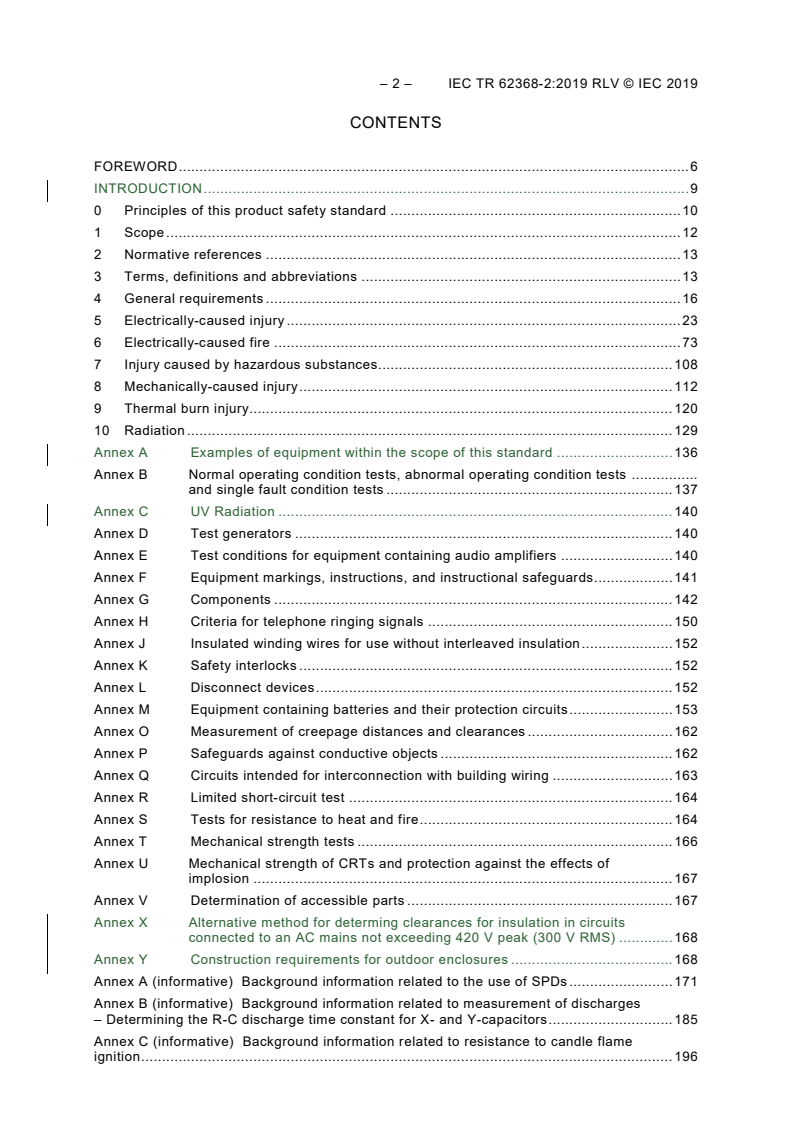
IEC TR 62368-2:2019 RLV - Audio/video, information and communication technology equipment - Part 2: Explanatory information related to IEC 62368-1:2018 Released:5/7/2019
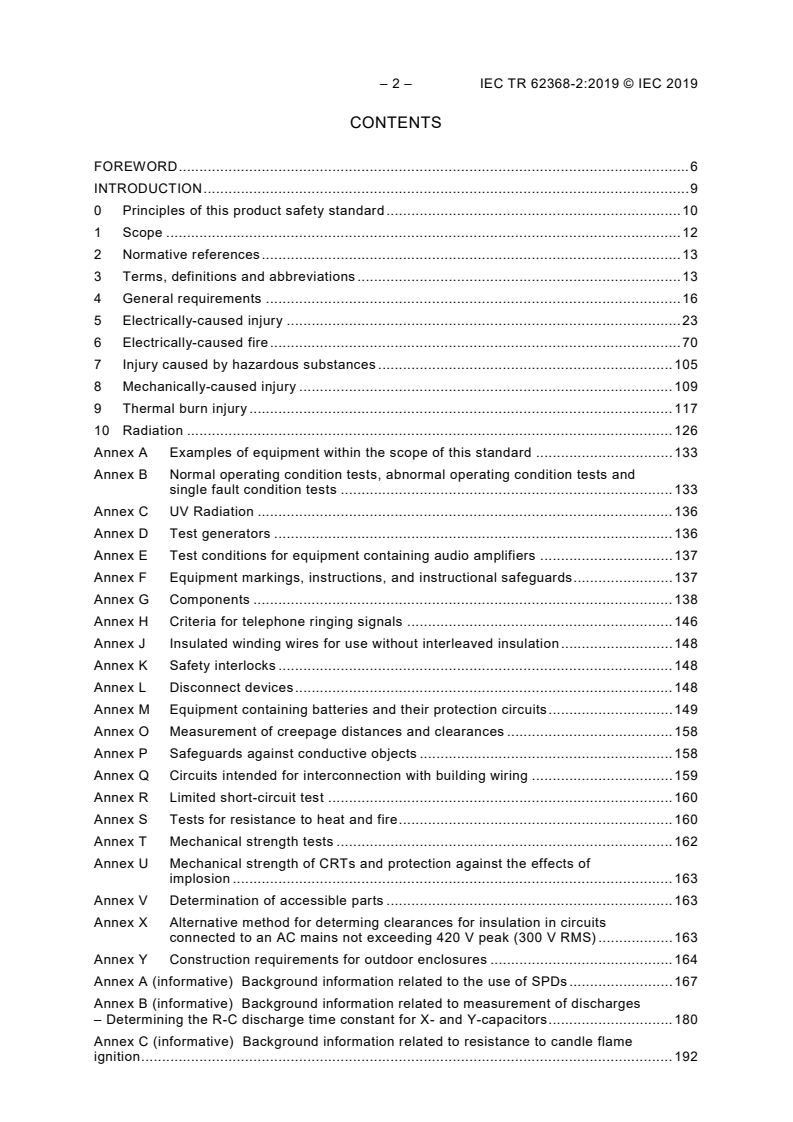
IEC TR 62368-2:2019 - Audio/video, information and communication technology equipment - Part 2: Explanatory information related to IEC 62368-1:2018 Released:5/7/2019
Overview
IEC TR 62368-2:2019 is an informative Technical Report published by the IEC that provides explanatory information and background guidance for the safety standard IEC 62368-1:2018. It is the third edition, updating the 2014 TR to reflect changes in the 2018 edition of IEC 62368-1. IEC TR 62368-2 does not add requirements; where a conflict exists, the mandatory requirements in IEC 62368-1 prevail. The report targets Audio/Video, Information and Communication Technology (AV/ICT) equipment and explains the intent and application of selected clauses to help users implement the hazard-based approach in IEC 62368-1.
Key Topics and Technical Guidance
The Technical Report focuses on subclauses that benefit from additional background or explanation and includes informative material on:
- Hazard-based safety engineering (HBSE) concepts and risk-reduction principles (illustrations and flowcharts).
- Electrically-caused injury: explanations of shock, touch-current, insulation, clearances and protective bonding.
- Electrically-caused fire: prevention, ignition likelihood reduction, and fire spread control; material flammability considerations.
- Hazardous substances: assessment and control measures for chemical risks.
- Mechanical hazards: safeguards against moving parts, structural strength and impact tests.
- Thermal burn and radiation risks: evaluation of hot surfaces, heating elements, optical and UV radiation.
- Test methods and examples: normal/abnormal/single-fault tests, test generators, and practical measurement guidance.
- Annex guidance: detailed informative annexes covering examples of equipment in scope, component considerations, battery protection, clearances/creepage measurement, fire resistance tests, mechanical strength tests, and instructions/markings.
Practical Applications - Who Uses This Standard
IEC TR 62368-2 is useful for:
- Product safety engineers and designers of audio/video and ICT equipment seeking interpretive guidance for IEC 62368-1.
- Test laboratories and compliance teams using the TR to understand test intent and examples.
- Regulatory authorities and certification bodies reviewing manufacturer documentation.
- Technical writers and training organizations preparing user instructions and safety documentation.
- Manufacturers implementing safeguards (electrical, thermal, mechanical, fire and chemical) and selecting appropriate test criteria.
Related Standards (if applicable)
- IEC 62368-1:2018 - normative standard for AV/ICT safety (requirements take precedence).
- References in the TR include other IEC/ISO guidance (e.g., IEC/TS 60479-1 on effects of current) and national/regional implementation documents where applicable.
Keywords: IEC TR 62368-2, IEC 62368-1, Audio/Video, Information and Communication Technology, safeguards, product safety, electrical safety, fire safety, battery protection.
Relations
- Effective Date
- 05-Sep-2023
- Effective Date
- 05-Sep-2023
Buy Documents
IEC TR 62368-2:2019 RLV - Audio/video, information and communication technology equipment - Part 2: Explanatory information related to IEC 62368-1:2018 Released:5/7/2019
IEC TR 62368-2:2019 - Audio/video, information and communication technology equipment - Part 2: Explanatory information related to IEC 62368-1:2018 Released:5/7/2019
Get Certified
Connect with accredited certification bodies for this standard

BSI Group
BSI (British Standards Institution) is the business standards company that helps organizations make excellence a habit.

NYCE
Mexican standards and certification body.

ANCE
Mexican certification and testing association.
Sponsored listings
Frequently Asked Questions
IEC TR 62368-2:2019 is a technical report published by the International Electrotechnical Commission (IEC). Its full title is "Audio/video, information and communication technology equipment - Part 2: Explanatory information related to IEC 62368-1:2018". This standard covers: IEC TR 62368-2:2019 provides explanatory information related to IEC 62368-1. Only those subclauses considered to need further background reference information or explanation of their content to benefit the reader are included. Therefore, not all numbered subclauses are cited. Unless otherwise noted, all references are to clauses, subclauses, annexes, figures or tables located in IEC 62368-1:2018. This third edition updates the second edition of IEC 62368-2 published in 2014 to take into account changes made to IEC 62368-1:2014 as identified in the Foreword of IEC 62368-1:2018. This Technical Report is informative only. In case of a conflict between IEC 62368-1 and IEC TR 62368-2, the requirements in IEC 62368-1 prevail over this Technical Report. Key words: Audio/Video, Safeguards, Information, Communication
IEC TR 62368-2:2019 provides explanatory information related to IEC 62368-1. Only those subclauses considered to need further background reference information or explanation of their content to benefit the reader are included. Therefore, not all numbered subclauses are cited. Unless otherwise noted, all references are to clauses, subclauses, annexes, figures or tables located in IEC 62368-1:2018. This third edition updates the second edition of IEC 62368-2 published in 2014 to take into account changes made to IEC 62368-1:2014 as identified in the Foreword of IEC 62368-1:2018. This Technical Report is informative only. In case of a conflict between IEC 62368-1 and IEC TR 62368-2, the requirements in IEC 62368-1 prevail over this Technical Report. Key words: Audio/Video, Safeguards, Information, Communication
IEC TR 62368-2:2019 is classified under the following ICS (International Classification for Standards) categories: 33.160.01 - Audio, video and audiovisual systems in general; 35.020 - Information technology (IT) in general. The ICS classification helps identify the subject area and facilitates finding related standards.
IEC TR 62368-2:2019 has the following relationships with other standards: It is inter standard links to IEC TR 62368-2:2015, IEC TR 62368-2:2025. Understanding these relationships helps ensure you are using the most current and applicable version of the standard.
IEC TR 62368-2:2019 is available in PDF format for immediate download after purchase. The document can be added to your cart and obtained through the secure checkout process. Digital delivery ensures instant access to the complete standard document.
Standards Content (Sample)
IEC TR 62368-2 ®
Edition 3.0 2019-05
REDLINE VERSION
TECHNICAL
REPORT
colour
inside
Audio/video, information and communication technology equipment –
Part 2: Explanatory information related to IEC 62368-1:20142018
All rights reserved. Unless otherwise specified, no part of this publication may be reproduced or utilized in any form
or by any means, electronic or mechanical, including photocopying and microfilm, without permission in writing from
either IEC or IEC's member National Committee in the country of the requester. If you have any questions about IEC
copyright or have an enquiry about obtaining additional rights to this publication, please contact the address below or
your local IEC member National Committee for further information.
IEC Central Office Tel.: +41 22 919 02 11
3, rue de Varembé info@iec.ch
CH-1211 Geneva 20 www.iec.ch
Switzerland
About the IEC
The International Electrotechnical Commission (IEC) is the leading global organization that prepares and publishes
International Standards for all electrical, electronic and related technologies.
About IEC publications
The technical content of IEC publications is kept under constant review by the IEC. Please make sure that you have the
latest edition, a corrigendum or an amendment might have been published.
IEC publications search - webstore.iec.ch/advsearchform Electropedia - www.electropedia.org
The advanced search enables to find IEC publications by a The world's leading online dictionary on electrotechnology,
variety of criteria (reference number, text, technical containing more than 22 000 terminological entries in English
committee,…). It also gives information on projects, replaced and French, with equivalent terms in 16 additional languages.
and withdrawn publications. Also known as the International Electrotechnical Vocabulary
(IEV) online.
IEC Just Published - webstore.iec.ch/justpublished
Stay up to date on all new IEC publications. Just Published IEC Glossary - std.iec.ch/glossary
details all new publications released. Available online and 67 000 electrotechnical terminology entries in English and
once a month by email. French extracted from the Terms and Definitions clause of
IEC publications issued since 2002. Some entries have been
IEC Customer Service Centre - webstore.iec.ch/csc collected from earlier publications of IEC TC 37, 77, 86 and
If you wish to give us your feedback on this publication or CISPR.
need further assistance, please contact the Customer Service
Centre: sales@iec.ch.
IEC TR 62368-2 ®
Edition 3.0 2019-05
REDLINE VERSION
TECHNICAL
REPORT
colour
inside
Audio/video, information and communication technology equipment –
Part 2: Explanatory information related to IEC 62368-1: 20142018
INTERNATIONAL
ELECTROTECHNICAL
COMMISSION
ICS 33.160.01; 35.020 ISBN 978-2-8322-6916-9
– 2 – IEC TR 62368-2:2019 RLV © IEC 2019
CONTENTS
FOREWORD . 6
INTRODUCTION . 9
0 Principles of this product safety standard . 10
1 Scope . 12
2 Normative references . 13
3 Terms, definitions and abbreviations . 13
4 General requirements . 16
5 Electrically-caused injury . 23
6 Electrically-caused fire . 73
7 Injury caused by hazardous substances. 108
8 Mechanically-caused injury . 112
9 Thermal burn injury. 120
10 Radiation . 129
Annex A Examples of equipment within the scope of this standard . 136
Annex B Normal operating condition tests, abnormal operating condition tests .
and single fault condition tests . 137
Annex C UV Radiation . 140
Annex D Test generators . 140
Annex E Test conditions for equipment containing audio amplifiers . 140
Annex F Equipment markings, instructions, and instructional safeguards . 141
Annex G Components . 142
Annex H Criteria for telephone ringing signals . 150
Annex J Insulated winding wires for use without interleaved insulation . 152
Annex K Safety interlocks . 152
Annex L Disconnect devices . 152
Annex M Equipment containing batteries and their protection circuits . 153
Annex O Measurement of creepage distances and clearances . 162
Annex P Safeguards against conductive objects . 162
Annex Q Circuits intended for interconnection with building wiring . 163
Annex R Limited short-circuit test . 164
Annex S Tests for resistance to heat and fire . 164
Annex T Mechanical strength tests . 166
Annex U Mechanical strength of CRTs and protection against the effects of
implosion . 167
Annex V Determination of accessible parts . 167
Annex X Alternative method for determing clearances for insulation in circuits
connected to an AC mains not exceeding 420 V peak (300 V RMS) . 168
Annex Y Construction requirements for outdoor enclosures . 168
Annex A (informative) Background information related to the use of SPDs . 171
Annex B (informative) Background information related to measurement of discharges
– Determining the R-C discharge time constant for X- and Y-capacitors . 185
Annex C (informative) Background information related to resistance to candle flame
ignition . 196
Bibliography . 197
Figure 1 – Risk reduction as given in ISO/IEC Guide 51. 11
Figure 2 – HBSE Process Chart . 12
Figure 3 – Protective bonding conductor as part of a safeguard . 15
Figure 4 – Safeguards for protecting an ordinary person . 19
Figure 5 – Safeguards for protecting an instructed person . 20
Figure 6 – Safeguards for protecting a skilled person . 20
Figure 7 – Flow chart showing the intent of the glass requirements . 22
Figure 8 – Conventional time/current zones of effects of AC currents (15 Hz to 100 Hz)
on persons for a current path corresponding to left hand to feet (see IEC/TS 60479-
1:2005, Figure 20) . 25
Figure 9 – Conventional time/current zones of effects of DC currents on persons for a
longitudinal upward current path (see IEC/TS 60479-1:2005, Figure 22) . 26
Figure 10 – Illustration that limits depend on both voltage and current . 27
Figure 11 – Illustration of working voltage . 41
Figure 12 – Illustration of transient voltages on paired conductor external circuits . 43
Figure 13 – Illustration of transient voltages on coaxial-cable external circuits . 44
Figure 14 – Basic and reinforced insulation in Table 15 14 of IEC 62368-1:20142018;
ratio reinforced to basic . 46
Figure 15 – Reinforced clearances according to Rule 1, Rule 2, and Table 15 14 . 48
Figure 16 – Example illustrating accessible internal wiring . 56
Figure 17 – Waveform on insulation without surge suppressors and no breakdown . 59
Figure 18 – Waveforms on insulation during breakdown without surge suppressors . 59
Figure 19 – Waveforms on insulation with surge suppressors in operation . 60
Figure 20 – Waveform on short-circuited surge suppressor and insulation . 60
Figure 21 – Example for an ES2 source . 62
Figure 22 – Example for an ES3 source . 62
Figure 23 – Overview of protective conductors . 64
Figure 24 – Example of a typical touch current measuring network . 67
Figure 25 – Touch current from a floating circuit . 69
Figure 26 – Touch current from an earthed circuit . 70
Figure 27 – Summation of touch currents in a PABX . 70
Figure 28 – Possible safeguards against electrically-caused fire . 78
Figure 29 – Fire clause flow chart . 81
Figure 30 – Prevent ignition flow chart . 86
Figure 31 – Control fire spread summary . 88
Figure 32 – Control fire spread PS2 . 89
Figure 33 – Control fire spread PS3 . 90
Figure 34 – Fire cone application to a large component . 99
Figure 35 – Flowchart demonstrating the hierarchy of hazard management . 111
Figure 36 – Model for chemical injury . 112
Figure 37 – Direction of forces to be applied . 117
Figure 38 – Model for a burn injury . 120
– 4 – IEC TR 62368-2:2019 RLV © IEC 2019
Figure 39 – Model for safeguards against thermal burn injury . 122
Figure 40 – Model for absence of a thermal hazard . 123
Figure 41 – Model for presence of a thermal hazard with a physical safeguard in place . 123
Figure 42 – Model for presence of a thermal hazard with behavioural safeguard
in place . 123
Figure 43 – Flowchart for evaluation of Image projectors (beamers) . 131
Figure 44 – Graphical representation of L ,T . 133
Aeq
Figure 45 – Overview of operating modes . 139
Figure 46 – Voltage-current characteristics (Typical data) . 143
Figure 47 – Example of IC current limiter circuit . 148
Figure 48 – Current limit curves . 151
Figure 49 – Example of a dummy battery circuit . 161
Figure 50 – Example of a circuit with two power sources. 164
Figure A.1 – Installation has poor earthing and bonding; equipment damaged
(from ITU-T K.66) . 172
Figure A.2 – Installation has poor earthing and bonding; using main earth bar for
protection against lightning strike (from ITU-T K.66) . 172
Figure A.3 – Installation with poor earthing and bonding, using a varistor and a GDT
for protection against a lightning strike . 173
Figure A.4 – Installation with poor earthing and bonding; equipment damaged (TV set) . 173
Figure A.5 – Safeguards . 174
Figure A.6 – Discharge stages . 178
Figure A.7 – Holdover . 179
Figure A.8 – Discharge . 180
Figure A.9 – Characteristics . 182
Figure A.10 – Follow on current pictures . 183
Figure B.1 – Typical EMC filter schematic . 185
Figure B.2 – 100 MΩ oscilloscope probes . 187
Figure B.3 – Combinations of EUT resistance and capacitance for 1-s time constant . 189
Figure B.4 – 240 V mains followed by capacitor discharge . 190
Figure B.5 – Time constant measurement schematic . 191
Figure B.6 – Worst-case measured time constant values for 100 MΩ and 10 MΩ probes . 195
Table 1 – General summary of required safeguards . 20
Table 2 – Time/current zones for AC 15 Hz to 100 Hz for hand to feet pathway (see
IEC/TS 60479-1:2005, Table 11) . 26
Table 3 – Time/current zones for DC for hand to feet pathway (see IEC/TS 60479-
1:2005, Table 13). 27
Table 4 – Limit values of accessible capacitance (threshold of pain) . 30
Table 5 – Total body resistances R for a current path hand to hand, DC, for large
T
surface areas of contact in dry condition . 33
Table 6 – Insulation requirements for external circuits . 43
Table 7 – Voltage drop across clearance and solid insulation in series . 50
Table 8 – Examples of application of various safeguards . 80
Table 9 – Basic safeguards against fire under normal operating conditions and
abnormal operating conditions . 82
Table 10 – Supplementary safeguards against fire under single fault conditions . 83
Table 11 – Method 1: Reduce the likelihood of ignition . 85
Table 12 – Method 2: Control fire spread . 94
Table 13 – Fire barrier and fire enclosure flammability requirements . 101
Table 14 – Summary – Fire enclosure and fire barrier material requirements . 105
Table 15 – Control of chemical hazards . 110
Table 16 – Overview of requirements for dose-based systems . 135
Table 17 – Safety of batteries and their cells – requirements (expanded information on
documents and scope) . 155
Table B.1 – 100- MΩ oscilloscope probes . 187
Table B.2 – Capacitor discharge . 188
Table B.3 – Maximum T values for combinations of R and C for
measured EUT EUT
T of 1 s . 194
EUT
– 6 – IEC TR 62368-2:2019 RLV © IEC 2019
INTERNATIONAL ELECTROTECHNICAL COMMISSION
____________
AUDIO/VIDEO, INFORMATION AND
COMMUNICATION TECHNOLOGY EQUIPMENT –
Part 2: Explanatory information related to IEC 62368-1:20142018
FOREWORD
1) The International Electrotechnical Commission (IEC) is a worldwide organization for standardization comprising
all national electrotechnical committees (IEC National Committees). The object of IEC is to promote
international co-operation on all questions concerning standardization in the electrical and electronic fields. To
this end and in addition to other activities, IEC publishes International Standards, Technical Specifications,
Technical Reports, Publicly Available Specifications (PAS) and Guides (hereafter referred to as “IEC
Publication(s)”). Their preparation is entrusted to technical committees; any IEC National Committee interested
in the subject dealt with may participate in this preparatory work. International, governmental and non-
governmental organizations liaising with the IEC also participate in this preparation. IEC collaborates closely
with the International Organization for Standardization (ISO) in accordance with conditions determined by
agreement between the two organizations.
2) The formal decisions or agreements of IEC on technical matters express, as nearly as possible, an international
consensus of opinion on the relevant subjects since each technical committee has representation from all
interested IEC National Committees.
3) IEC Publications have the form of recommendations for international use and are accepted by IEC National
Committees in that sense. While all reasonable efforts are made to ensure that the technical content of IEC
Publications is accurate, IEC cannot be held responsible for the way in which they are used or for any
misinterpretation by any end user.
4) In order to promote international uniformity, IEC National Committees undertake to apply IEC Publications
transparently to the maximum extent possible in their national and regional publications. Any divergence
between any IEC Publication and the corresponding national or regional publication shall be clearly indicated in
the latter.
5) IEC itself does not provide any attestation of conformity. Independent certification bodies provide conformity
assessment services and, in some areas, access to IEC marks of conformity. IEC is not responsible for any
services carried out by independent certification bodies.
6) All users should ensure that they have the latest edition of this publication.
7) No liability shall attach to IEC or its directors, employees, servants or agents including individual experts and
members of its technical committees and IEC National Committees for any personal injury, property damage or
other damage of any nature whatsoever, whether direct or indirect, or for costs (including legal fees) and
expenses arising out of the publication, use of, or reliance upon, this IEC Publication or any other IEC
Publications.
8) Attention is drawn to the Normative references cited in this publication. Use of the referenced publications is
indispensable for the correct application of this publication.
9) Attention is drawn to the possibility that some of the elements of this IEC Publication may be the subject of
patent rights. IEC shall not be held responsible for identifying any or all such patent rights.
This redline version of the official IEC Standard allows the user to identify the changes
made to the previous edition. A vertical bar appears in the margin wherever a change
has been made. Additions are in green text, deletions are in strikethrough red text.
The main task of IEC technical committees is to prepare International Standards. However, a
technical committee may propose the publication of a technical report when it has collected
data of a different kind from that which is normally published as an International Standard, for
example, "state of the art".
IEC 62368-2, which is a Technical Report, has been prepared by IEC technical committee
TC 108: Safety of electronic equipment within the field of audio/video, information technology
and communication technology.
This third edition updates the second edition of IEC 62368-2 published in 2014 to take into
account changes made to IEC 62368-1:2014 as identified in the Foreword of
IEC 62368-1:2018.
This Technical Report is informative only. In case of a conflict between IEC 62368-1 and IEC
TR 62368-2, the requirements in IEC 62368-1 prevail over this Technical Report.
The text of this technical report is based on the following documents:
Enquiry draft Report on voting
108/708/DTR 108/711/RVDTR
Full information on the voting for the approval of this technical report can be found in the
report on voting indicated in the above table.
In this document, the following print types are used:
– notes/explanatory matter: in smaller roman type;
– tables and figures that are included in the rationale have linked fields (shaded in grey if
“field shading” is active);
– terms that are defined in IEC 62368-1: in bold type.
In this document, where the term (HBSDT) is used, it stands for Hazard Based Standard
Development Team, which is the Working Group of IEC TC 108 responsible for the
development and maintenance of IEC 62368-1.
This publication has been drafted in accordance with the ISO/IEC Directives, Part 2.
A list of all parts of the IEC 62368 series can be found, under the general title Audio/video,
information and communication technology equipment, on the IEC website.
In this document, only those subclauses from IEC 62368-1 considered to need further
background reference information or explanation to benefit the reader in applying the relevant
requirements are included. Therefore, not all numbered subclauses are cited. Unless
otherwise noted, all references are to clauses, subclauses, annexes, figures or tables located
in IEC 62368-1:2018.
The entries in the document may have one or two of the following subheadings in addition to
the Rationale statement:
Source – where the source is known and is a document that is accessible to the general
public, a reference is provided.
Purpose – where there is a need and when it may prove helpful to the understanding of the
Rationale, we have added a Purpose statement.
– 8 – IEC TR 62368-2:2019 RLV © IEC 2019
The committee has decided that the contents of this publication will remain unchanged until
the stability date indicated on the IEC web site under "http://webstore.iec.ch" in the data
related to the specific publication. At this date, the publication will be
• reconfirmed,
• withdrawn,
• replaced by a revised edition, or
• amended.
IMPORTANT – The 'colour inside' logo on the cover page of this publication indicates
that it contains colours which are considered to be useful for the correct
understanding of its contents. Users should therefore print this document using a
colour printer.
INTRODUCTION
IEC 62368-1 is based on the principles of hazard-based safety engineering, which is a
different way of developing and specifying safety considerations than that of the current
practice. While this document is different from traditional IEC safety documents in its
approach and while it is believed that IEC 62368-1 provides a number of advantages, its
introduction and evolution are not intended to result in significant changes to the existing
safety philosophy that led to the development of the safety requirements contained in
IEC 60065 and IEC 60950-1. The predominant reason behind the creation of IEC 62368-1 is
to simplify the problems created by the merging of the technologies of ITE and CE. The
techniques used are novel, so a learning process is required and experience is needed in its
application. Consequently, the committee recommends that this edition of the document be
considered as an alternative to IEC 60065 or IEC 60950-1 at least over the recommended
transition period.
– 10 – IEC TR 62368-2:2019 RLV © IEC 2019
AUDIO/VIDEO, INFORMATION AND
COMMUNICATION TECHNOLOGY EQUIPMENT –
Part 2: Explanatory information related to IEC 62368-1:20142018
0 Principles of this product safety standard
Clause 0 is informational and provides a rationale for the normative clauses
of the document.
0.5.1 General
ISO/IEC Guide 51:2014, 6.3.5 states:
“When reducing risks the order of priority shall be as follows:
a) inherently safe design;
b) guards and protective devices;
c) information for end users.
Inherently safe design measures are the first and most important step in
the risk reduction process. This is because protective measures inherent to
the characteristics of the product or system are likely to remain effective,
whereas experience has shown that even well-designed guards and
protective devices can fail or be violated and information for use might not
be followed.
Guards and protective devices shall be used whenever an inherently safe
design measure does not reasonably make it possible either to remove
hazards or to sufficiently reduce risks. Complementary protective measures
involving additional equipment (for example, emergency stop equipment)
might have to be implemented.
The end user has a role to play in the risk reduction procedure by
complying with the information provided by the designer/supplier. However,
information for use shall not be a substitute for the correct application of
inherently safe design measures, guards or complementary protective
measures.”
In general, this principle is used in IEC 62368-1. The table below shows a
comparison between the hierarchy required in ISO/IEC Guide 51 and the
hierarchy used in IEC 62368-1:20142018:
ISO/IEC Guide 51 IEC 62368-1
a) inherently safe design 1. inherently safe design by limiting all energy
hazards to class 1
b) guards and protective devices 2. equipment safeguards
3. installation safeguards
4. personal safeguards
c) information for end users 5. behavioral safeguards
6. instructional safeguards
Risk assessment has been considered as part of the development of
IEC 62368-1 as indicated in the following from ISO/IEC Guide 51 (Figure 1)
in this document. See also the Hazard Based Safety Engineering (HBSE)
Process Flow (Figure 2) in this document that also provides additional
details for the above comparison.
Figure 1 – Risk reduction as given in ISO/IEC Guide 51
– 12 – IEC TR 62368-2:2019 RLV © IEC 2019
Figure 2 – HBSE Process Chart
0.5.7 Equipment safeguards during skilled person service conditions
Purpose: To explain the intent of requirements for providing safeguards against
involuntary reaction.
Rationale: By definition, a skilled person has the education and experience to identify
all class 3 energy sources to which he may be exposed. However, while
servicing one class 3 energy source in one location, a skilled person may
be exposed to another class 3 energy source in a different location.
In such a situation, either of two events is possible. First, something may
cause an involuntary reaction of the skilled person with the consequences
of contact with the class 3 energy source in the different location. Second,
the space in which the skilled person is located may be small and
cramped, and inadvertent contact with a class 3 energy source in the
different location may be likely.
In such situations, this document may require an equipment safeguard
solely for the protection of a skilled person while performing servicing
activity.
___________
1 Scope
Purpose: To identify the purpose and applicability of this document and the
exclusions from the scope.
Rationale: The scope excludes requirements for functional safety. Functional safety is
addressed in IEC 61508-1. Because the scope includes computers that
may control safety systems, functional safety requirements would
necessarily include requirements for computer processes and software.
The requirements provided in IEC 60950-23 could be modified and added
to IEC 62368 as another –X document. However, because of the hazard-
based nature of IEC 62368-1, the requirements from IEC 60950-23 have
been incorporated into the body of IEC 62368-1 and made more generic.
The intent of the addition of the IEC 60950-23 requirements is to maintain
the overall intent of the technical requirements from IEC 60950-23,
incorporate them into IEC 62368-1 following the overall format of
IEC 62368-1 and simplify and facilitate the application of these
requirements.
Robots traditionally are covered under the scopes of ISO documents,
typically maintained by ISO TC 299. ISO TC 299 has working groups for
personal care robots and service robots, and produces for example,
ISO 13482, Robots and robotic devices – Safety requirements for personal
care robots.
___________
2 Normative references
The list of normative references is a list of all documents that have a
normative reference to it in the body of the document. As such, referenced
documents are indispensable for the application of this document. For
dated references, only the edition cited applies. For undated references,
the latest edition of the referenced document (including any amendments)
applies.
Recently, there were some issues with test houses that wanted to use the
latest edition as soon as it was published. As this creates serious problems
for manufacturers, since they have no chance to prepare, it was felt that a
reasonable transition period should be taken into account. This is in line
with earlier decisions taken by the SMB that allow transition periods to be
mentioned in the foreword of the documents. Therefore IEC TC 108
decided to indicate this in the introduction of the normative references
clause, to instruct test houses to take into account any transition period,
effective date or date of withdrawal established for the document.
These documents are referenced, in whole, in part, or as alternative
requirements to the requirements contained in this document. Their use is
specified, where necessary, for the application of the requirements of this
document. The fact that a standard is mentioned in the list does not mean
that compliance with the document or parts of it are required.
___________
3 Terms, definitions and abbreviations
Rationale is provided for definitions that deviate from IEV definitions or
from pilot standard Basic or Group Safety publication definitions.
3.3.2.1 electrical enclosure
Source: IEC 60050-195:1998, 195-06-13
Purpose: To support the concept of safeguards as used in this document.
Rationale: The IEV definition is modified to use the term “safeguard” in place of the
word “protection”. The word “safeguard” identifies a physical “thing”
whereas the word “protection” identifies the act of protecting. This
document sets forth requirements for use of physical safeguards and
requirements for those safeguards. The safeguards provide “protection”
against injury from the equipment.
– 14 – IEC TR 62368-2:2019 RLV © IEC 2019
3.3.5.1 basic insulation
Source: IEC 60050-195:1998, 195-06-06
Purpose: To support the concept of safeguards as used in this document.
Rationale: The IEV definition is modified to use the term “safeguard” in place of the
word “protection”. The word “safeguard” identifies a physical “thing”
whereas the word “protection” identifies the act of protecting. This
document sets forth requirements for use of physical safeguards and
requirements for those safeguards. The safeguards provide “protection”
against injury from the equipment.
3.3.5.2 double insulation
Source: IEC 60050-195:1998, 195-06-08
Purpose: To support the concept of safeguards as used in this document.
Rationale: See 3.3.5.1, basic insulation.
3.3.5.56 solid insulation
Source: IEC 60664-1:2007, 3.4 IEC 60050-212:2015, 212-11-02
Purpose: To support the concept that safeguards are interposed between an energy
source and a body part.
Rationale: IEC 60664-1 defines insulation as material interposed between two
conductive parts. The IEC 60664-1 definition is modified by adding that
insulation is also “between a conductive part and a body part.” For safety
purposes, solid insulation is not only used between conductors, but is also
used between a conductor and a body part. For example, a Class II
equipment employs solid insulation in this manner.
3.3.5.67 supplementary insulation
Source: IEC 60050-195:1998, 195-06-07
Purpose: To support the concept of safeguards as used in this document.
Rationale: See 3.3.5.1, basic insulation.
3.3.6.79 restricted access area
Source: IEC 60050-195:1998, 195-04-04
Purpose: To use the concept of “instructed persons” and “skilled persons” as used
in this document.
Rationale: The IEV definition is modified to use the terms “instructed persons” and
“skilled persons” rather than “electrically instructed persons” and
“electrically skilled persons.”
3.3.7.87 reasonably foreseeable misuse
Source: ISO/IEC Guide 51:2014, 3.147
Rationale: Misuse depends on personal objectives, personal perception of the
equipment, and the possible use of the equipment (in a manner not
intended by the manufacturer) to accomplish those personal objectives.
Equipment within the scope of this document ranges from small handheld
equipment to large, permanently installed equipment. There is no
commonality among the equipment for readily predicting human behaviour
leading to misuse of the equipment and resultant injury. Where a possible
reasonably foreseeable misuse that may lead to an injury is not covered
by the requirements of the document, manufacturers are encouraged to
consider reasonably foreseeable misuse of equipment and provide
safeguards, as applicable, to prevent injury in the event of such misuse.
(Not all reasonably foreseeable misuse of equipment results in injury or
potential for injury.)
3.3.8.1 instructed person
Source: IEC 60050-826:2004, 826-18-02
Rationale: The IEV definition is modified to use the terms “energy sources”, “skilled
person”, and “precautionary safeguard”. The definition is made stronger
by using the term “instructed” rather than “advised”.
3.3.8.3 skilled person
Source: IEC 60050-826:2004, 826-18-01
Rationale: The IEV definition is modified to use the phrase “to reduce the likelihood
of”. IEC 62368-1 does, in general, tends not use the word “hazard”.
3.3.11.9 protective bonding conductor
Rationale: The protective bonding conductor, is not a complete safeguard, but a
component part of the earthing system safeguard. The protective
bonding conductor provides a fault current pathway from a part (insulated
from ES3 by basic insulation only) to the equipment protective earthing
terminal, see Figure 3 in this document.
Figure 3 – Protective bonding conductor as part of a safeguard
The parts required to be earthed via a protective bonding conductor are
those that have only basic insulation between the parts and ES3, and are
connected to accessible parts.
Only the fault current pathway is required to be a protective bonding
conductor. Other earthing connections of accessible conductive parts
can be by means of a functional earth conductor to the equipment PE
terminal or to a protective bonding conductor.
3.3.14.43 prospective touch voltage
Source: IEC 60050-195:1998, 195-05-09
– 16 – IEC TR 62368-2:2019 RLV © IEC 2019
Purpose: To properly identify electric shock energy source voltages.
Rationale: The IEV definition is modified to delete “animal”. The word “person” is also
deleted as all of the requirements in the document are with respect to
persons.
3.3.14.98 working voltage
Source: IEC 60664-1:2007, 3.5
Purpose: To distinguish between RMS. working voltage and the peak of the
working voltage.
Rationale: The IEC 60664-1 definition is modified to delete “RMS”. IEC 62368-1 uses
both RMS. working voltage and peak of the working voltage; each term
is defined.
3.3.15.2 class II construction
Source: IEC 60335-1:2010, 3.3.11
Purpose: Although the term is not used in the document, for completeness, it was
decided to retain this definition.
Rationale: The word “appliance” is changed to “equipment”.
____________
4 General requirements
Purpose: To explain how to investigate and determine whether or not safety is
involved.
Rationale: In order to establish whether or not safety is involved, the circuits and
construction are investigated to determine whether the consequences of
possible fault conditions would lead to an injury. Safety is involved if, as a
result of a single fault condition, the consequences of the fault lead to a
risk of injury.
If a fault condition should lead to a risk of injury, the part, material, or
device whose fault was simulated may comprise a safeguard.
Rationale is provided for questions regarding the omission of some
traditional requirements appearing in other safety documents. Rationale is
also provided for further explanation of new concepts and requirements in
this document.
Reasonable foreseeable misuse
Rationale: Apart from Annex M, this document does not specifically mention
foreseeable misuse or abnormal operating conditions. Nevertheless, the
requirements of the document cover many kinds of foreseeable misuse,
such as covering of ventilation openings, paper jams, stalled motors, etc.
functional insulation
Rationale: This document does not include requirements for functional insulation. By
its nature, functional insulation does not provide a safeguard function
against electric shock or electrically-caused fire and therefore may be
faulted. Obviously, not all functional insulations are faulted as this would
be prohibitively time-consuming. Sites for functional insulation faults
should be based upon physical examination of the equipment, and upon the
electrical schematic.
Note that basic insulation and reinforced insulation may also serve as
functional insulation, in which case the insulation is not faulted.
functional components
Rationale: This document does not include requirements for functional components.
By their nature, individual functional components do not provide a
safeguard function against electric shock, electrically-caused fire, thermal
injury, etc., and therefore may be candidates for fault testing. Obviously,
not all functional components are faulted as this would be prohibitively
time-consuming. Candidate components for fault testing should be based
upon physical examination of the equipment, upon the electrical schematic
diagrams, and whether a fault of that component might result in conditions
for electric shock, conditions for ignition and propagation of fire, conditions
for thermal injury, etc.
As with all single fault condition testing (Clause B.4), upon faulting of a
functional component, there shall not be any safety consequence (for
example, a benign consequence), or a basic safeguard, supplementary
safeguard , or reinforced safeguard shall remain effective.
In some cases, a pair of functional components may comprise a safeguard.
If the fault of one of the components in the pair is mitigated by the second
component, then the pair is designated as a double safeguard. For
example, if two diodes are employed in series to protect a battery from
reverse charge, then the pair comprises a double safeguard and the
components should be limited to the manufacturer and part number actually
tested. A second example is that of an X-capacitor and discharge resistor.
If the discharge resistor should fail open, then the X-capacitor will not be
discharged. Therefore, the X-capacitor value is not to exceed the ES2 limits
specified for a charged capacitor. Again, the two components com
...
IEC TR 62368-2 ®
Edition 3.0 2019-05
TECHNICAL
REPORT
RAPPORT
TECHNIQUE
colour
inside
Audio/video, information and communication technology equipment –
Part 2: Explanatory information related to IEC 62368-1:2018
Équipements des technologies de l'audio/vidéo, de l'information
et de la communication –
Partie 2: Précisions relatives à l'IEC 62368-1:2018
All rights reserved. Unless otherwise specified, no part of this publication may be reproduced or utilized in any form
or by any means, electronic or mechanical, including photocopying and microfilm, without permission in writing from
either IEC or IEC's member National Committee in the country of the requester. If you have any questions about IEC
copyright or have an enquiry about obtaining additional rights to this publication, please contact the address below or
your local IEC member National Committee for further information.
Droits de reproduction réservés. Sauf indication contraire, aucune partie de cette publication ne peut être reproduite ni
utilisée sous quelque forme que ce soit et par aucun procédé, électronique ou mécanique, y compris la photocopie et
les microfilms, sans l'accord écrit de l'IEC ou du Comité national de l'IEC du pays du demandeur. Si vous avez des
questions sur le copyright de l'IEC ou si vous désirez obtenir des droits supplémentaires sur cette publication, utilisez
les coordonnées ci-après ou contactez le Comité national de l'IEC de votre pays de résidence.
IEC Central Office Tel.: +41 22 919 02 11
3, rue de Varembé info@iec.ch
CH-1211 Geneva 20 www.iec.ch
Switzerland
About the IEC
The International Electrotechnical Commission (IEC) is the leading global organization that prepares and publishes
International Standards for all electrical, electronic and related technologies.
About IEC publications
The technical content of IEC publications is kept under constant review by the IEC. Please make sure that you have the
latest edition, a corrigendum or an amendment might have been published.
IEC publications search - webstore.iec.ch/advsearchform Electropedia - www.electropedia.org
The advanced search enables to find IEC publications by a The world's leading online dictionary on electrotechnology,
variety of criteria (reference number, text, technical containing more than 22 000 terminological entries in English
committee,…). It also gives information on projects, replaced and French, with equivalent terms in 16 additional languages.
and withdrawn publications. Also known as the International Electrotechnical Vocabulary
(IEV) online.
IEC Just Published - webstore.iec.ch/justpublished
Stay up to date on all new IEC publications. Just Published IEC Glossary - std.iec.ch/glossary
details all new publications released. Available online and once 67 000 electrotechnical terminology entries in English and
a month by email. French extracted from the Terms and Definitions clause of IEC
publications issued since 2002. Some entries have been
IEC Customer Service Centre - webstore.iec.ch/csc collected from earlier publications of IEC TC 37, 77, 86 and
If you wish to give us your feedback on this publication or need CISPR.
further assistance, please contact the Customer Service
Centre: sales@iec.ch.
A propos de l'IEC
La Commission Electrotechnique Internationale (IEC) est la première organisation mondiale qui élabore et publie des
Normes internationales pour tout ce qui a trait à l'électricité, à l'électronique et aux technologies apparentées.
A propos des publications IEC
Le contenu technique des publications IEC est constamment revu. Veuillez vous assurer que vous possédez l’édition la
plus récente, un corrigendum ou amendement peut avoir été publié.
Recherche de publications IEC - Le premier dictionnaire d'électrotechnologie en ligne au monde,
webstore.iec.ch/advsearchform avec plus de 22 000 articles terminologiques en anglais et en
La recherche avancée permet de trouver des publications IEC français, ainsi que les termes équivalents dans 16 langues
en utilisant différents critères (numéro de référence, texte, additionnelles. Egalement appelé Vocabulaire
comité d’études,…). Elle donne aussi des informations sur les Electrotechnique International (IEV) en ligne.
projets et les publications remplacées ou retirées.
Glossaire IEC - std.iec.ch/glossary
IEC Just Published - webstore.iec.ch/justpublished 67 000 entrées terminologiques électrotechniques, en anglais
Restez informé sur les nouvelles publications IEC. Just et en français, extraites des articles Termes et Définitions des
Published détaille les nouvelles publications parues. publications IEC parues depuis 2002. Plus certaines entrées
Disponible en ligne et une fois par mois par email. antérieures extraites des publications des CE 37, 77, 86 et
CISPR de l'IEC.
Service Clients - webstore.iec.ch/csc
Si vous désirez nous donner des commentaires sur cette
publication ou si vous avez des questions contactez-nous:
sales@iec.ch.
Electropedia - www.electropedia.org
IEC TR 62368-2 ®
Edition 3.0 2019-05
TECHNICAL
REPORT
RAPPORT
TECHNIQUE
colour
inside
Audio/video, information and communication technology equipment –
Part 2: Explanatory information related to IEC 62368-1:2018
Équipements des technologies de l'audio/vidéo, de l'information
et de la communication –
Partie 2: Précisions relatives à l'IEC 62368-1:2018
INTERNATIONAL
ELECTROTECHNICAL
COMMISSION
COMMISSION
ELECTROTECHNIQUE
INTERNATIONALE
ICS 33.160.01; 35.020 ISBN 978-2-8322-6716-5
– 2 – IEC TR 62368-2:2019 © IEC 2019
CONTENTS
FOREWORD . 6
INTRODUCTION . 9
0 Principles of this product safety standard . 10
1 Scope . 12
2 Normative references . 13
3 Terms, definitions and abbreviations . 13
4 General requirements . 16
5 Electrically-caused injury . 23
6 Electrically-caused fire . 70
7 Injury caused by hazardous substances . 105
8 Mechanically-caused injury . 109
9 Thermal burn injury . 117
10 Radiation . 126
Annex A Examples of equipment within the scope of this standard . 133
Annex B Normal operating condition tests, abnormal operating condition tests and
single fault condition tests . 133
Annex C UV Radiation . 136
Annex D Test generators . 136
Annex E Test conditions for equipment containing audio amplifiers . 137
Annex F Equipment markings, instructions, and instructional safeguards . 137
Annex G Components . 138
Annex H Criteria for telephone ringing signals . 146
Annex J Insulated winding wires for use without interleaved insulation . 148
Annex K Safety interlocks . 148
Annex L Disconnect devices . 148
Annex M Equipment containing batteries and their protection circuits . 149
Annex O Measurement of creepage distances and clearances . 158
Annex P Safeguards against conductive objects . 158
Annex Q Circuits intended for interconnection with building wiring . 159
Annex R Limited short-circuit test . 160
Annex S Tests for resistance to heat and fire . 160
Annex T Mechanical strength tests . 162
Annex U Mechanical strength of CRTs and protection against the effects of
implosion . 163
Annex V Determination of accessible parts . 163
Annex X Alternative method for determing clearances for insulation in circuits
connected to an AC mains not exceeding 420 V peak (300 V RMS) . 163
Annex Y Construction requirements for outdoor enclosures . 164
Annex A (informative) Background information related to the use of SPDs . 167
Annex B (informative) Background information related to measurement of discharges
– Determining the R-C discharge time constant for X- and Y-capacitors . 180
Annex C (informative) Background information related to resistance to candle flame
ignition . 192
Bibliography . 193
Figure 1 – Risk reduction as given in ISO/IEC Guide 51. 11
Figure 2 – HBSE Process Chart . 12
Figure 3 – Protective bonding conductor as part of a safeguard . 15
Figure 4 – Safeguards for protecting an ordinary person . 19
Figure 5 – Safeguards for protecting an instructed person . 19
Figure 6 – Safeguards for protecting a skilled person . 20
Figure 7 – Flow chart showing the intent of the glass requirements . 22
Figure 8 – Conventional time/current zones of effects of AC currents (15 Hz to 100 Hz)
on persons for a current path corresponding to left hand to feet (see IEC/TS 60479-
1:2005, Figure 20) . 25
Figure 9 – Conventional time/current zones of effects of DC currents on persons for a
longitudinal upward current path (see IEC/TS 60479-1:2005, Figure 22) . 26
Figure 10 – Illustration that limits depend on both voltage and current . 27
Figure 11 – Illustration of working voltage . 39
Figure 12 – Illustration of transient voltages on paired conductor external circuits . 41
Figure 13 – Illustration of transient voltages on coaxial-cable external circuits . 42
Figure 14 – Basic and reinforced insulation in Table 14 of IEC 62368-1:2018; ratio
reinforced to basic . 43
Figure 15 – Reinforced clearances according to Rule 1, Rule 2, and Table 14 . 45
Figure 16 – Example illustrating accessible internal wiring . 53
Figure 17 – Waveform on insulation without surge suppressors and no breakdown . 56
Figure 18 – Waveforms on insulation during breakdown without surge suppressors . 57
Figure 19 – Waveforms on insulation with surge suppressors in operation . 57
Figure 20 – Waveform on short-circuited surge suppressor and insulation . 57
Figure 21 – Example for an ES2 source . 59
Figure 22 – Example for an ES3 source . 59
Figure 23 – Overview of protective conductors . 61
Figure 24 – Example of a typical touch current measuring network . 64
Figure 25 – Touch current from a floating circuit . 66
Figure 26 – Touch current from an earthed circuit . 67
Figure 27 – Summation of touch currents in a PABX . 67
Figure 28 – Possible safeguards against electrically-caused fire . 75
Figure 29 – Fire clause flow chart . 78
Figure 30 – Prevent ignition flow chart . 83
Figure 31 – Control fire spread summary . 85
Figure 32 – Control fire spread PS2 . 86
Figure 33 – Control fire spread PS3 . 87
Figure 34 – Fire cone application to a large component . 96
Figure 35 – Flowchart demonstrating the hierarchy of hazard management . 108
Figure 36 – Model for chemical injury . 109
Figure 37 – Direction of forces to be applied . 114
Figure 38 – Model for a burn injury . 117
– 4 – IEC TR 62368-2:2019 © IEC 2019
Figure 39 – Model for safeguards against thermal burn injury . 119
Figure 40 – Model for absence of a thermal hazard . 120
Figure 41 – Model for presence of a thermal hazard with a physical safeguard in place . 120
Figure 42 – Model for presence of a thermal hazard with behavioural safeguard
in place . 120
Figure 43 – Flowchart for evaluation of Image projectors (beamers) . 128
Figure 44 – Graphical representation of L ,T . 130
Aeq
Figure 45 – Overview of operating modes . 135
Figure 46 – Voltage-current characteristics (Typical data) . 140
Figure 47 – Example of IC current limiter circuit . 144
Figure 48 – Current limit curves . 147
Figure 49 – Example of a dummy battery circuit . 157
Figure 50 – Example of a circuit with two power sources. 160
Figure A.1 – Installation has poor earthing and bonding; equipment damaged
(from ITU-T K.66) . 168
Figure A.2 – Installation has poor earthing and bonding; using main earth bar for
protection against lightning strike (from ITU-T K.66) . 168
Figure A.3 – Installation with poor earthing and bonding, using a varistor and a GDT
for protection against a lightning strike . 169
Figure A.4 – Installation with poor earthing and bonding; equipment damaged (TV set) . 169
Figure A.5 – Safeguards . 170
Figure A.6 – Discharge stages . 174
Figure A.7 – Holdover . 175
Figure A.8 – Discharge . 176
Figure A.9 – Characteristics . 177
Figure A.10 – Follow on current pictures . 178
Figure B.1 – Typical EMC filter schematic . 180
Figure B.2 – 100 MΩ oscilloscope probes . 182
Figure B.3 – Combinations of EUT resistance and capacitance for 1-s time constant . 184
Figure B.4 – 240 V mains followed by capacitor discharge . 186
Figure B.5 – Time constant measurement schematic . 187
Figure B.6 – Worst-case measured time constant values for 100 MΩ and 10 MΩ probes . 191
Table 1 – General summary of required safeguards . 20
Table 2 – Time/current zones for AC 15 Hz to 100 Hz for hand to feet pathway (see
IEC/TS 60479-1:2005, Table 11) . 26
Table 3 – Time/current zones for DC for hand to feet pathway (see IEC/TS 60479-
1:2005, Table 13). 27
Table 4 – Limit values of accessible capacitance (threshold of pain) . 30
Table 5 – Total body resistances R for a current path hand to hand, DC, for large
T
surface areas of contact in dry condition . 32
Table 6 – Insulation requirements for external circuits . 42
Table 7 – Voltage drop across clearance and solid insulation in series . 47
Table 8 – Examples of application of various safeguards . 77
Table 9 – Basic safeguards against fire under normal operating conditions and
abnormal operating conditions . 79
Table 10 – Supplementary safeguards against fire under single fault conditions . 80
Table 11 – Method 1: Reduce the likelihood of ignition . 82
Table 12 – Method 2: Control fire spread . 91
Table 13 – Fire barrier and fire enclosure flammability requirements . 98
Table 14 – Summary – Fire enclosure and fire barrier material requirements . 102
Table 15 – Control of chemical hazards . 107
Table 16 – Overview of requirements for dose-based systems . 132
Table 17 – Safety of batteries and their cells – requirements (expanded information on
documents and scope) . 151
Table B.1 – 100- MΩ oscilloscope probes . 182
Table B.2 – Capacitor discharge . 183
Table B.3 – Maximum T values for combinations of R and C for
measured EUT EUT
T of 1 s . 190
EUT
– 6 – IEC TR 62368-2:2019 © IEC 2019
INTERNATIONAL ELECTROTECHNICAL COMMISSION
____________
AUDIO/VIDEO, INFORMATION AND
COMMUNICATION TECHNOLOGY EQUIPMENT –
Part 2: Explanatory information related to IEC 62368-1:2018
FOREWORD
1) The International Electrotechnical Commission (IEC) is a worldwide organization for standardization comprising
all national electrotechnical committees (IEC National Committees). The object of IEC is to promote
international co-operation on all questions concerning standardization in the electrical and electronic fields. To
this end and in addition to other activities, IEC publishes International Standards, Technical Specifications,
Technical Reports, Publicly Available Specifications (PAS) and Guides (hereafter referred to as “IEC
Publication(s)”). Their preparation is entrusted to technical committees; any IEC National Committee interested
in the subject dealt with may participate in this preparatory work. International, governmental and non-
governmental organizations liaising with the IEC also participate in this preparation. IEC collaborates closely
with the International Organization for Standardization (ISO) in accordance with conditions determined by
agreement between the two organizations.
2) The formal decisions or agreements of IEC on technical matters express, as nearly as possible, an international
consensus of opinion on the relevant subjects since each technical committee has representation from all
interested IEC National Committees.
3) IEC Publications have the form of recommendations for international use and are accepted by IEC National
Committees in that sense. While all reasonable efforts are made to ensure that the technical content of IEC
Publications is accurate, IEC cannot be held responsible for the way in which they are used or for any
misinterpretation by any end user.
4) In order to promote international uniformity, IEC National Committees undertake to apply IEC Publications
transparently to the maximum extent possible in their national and regional publications. Any divergence
between any IEC Publication and the corresponding national or regional publication shall be clearly indicated in
the latter.
5) IEC itself does not provide any attestation of conformity. Independent certification bodies provide conformity
assessment services and, in some areas, access to IEC marks of conformity. IEC is not responsible for any
services carried out by independent certification bodies.
6) All users should ensure that they have the latest edition of this publication.
7) No liability shall attach to IEC or its directors, employees, servants or agents including individual experts and
members of its technical committees and IEC National Committees for any personal injury, property damage or
other damage of any nature whatsoever, whether direct or indirect, or for costs (including legal fees) and
expenses arising out of the publication, use of, or reliance upon, this IEC Publication or any other IEC
Publications.
8) Attention is drawn to the Normative references cited in this publication. Use of the referenced publications is
indispensable for the correct application of this publication.
9) Attention is drawn to the possibility that some of the elements of this IEC Publication may be the subject of
patent rights. IEC shall not be held responsible for identifying any or all such patent rights.
The main task of IEC technical committees is to prepare International Standards. However, a
technical committee may propose the publication of a technical report when it has collected
data of a different kind from that which is normally published as an International Standard, for
example, "state of the art".
IEC 62368-2, which is a Technical Report, has been prepared by IEC technical committee
TC 108: Safety of electronic equipment within the field of audio/video, information technology
and communication technology.
This third edition updates the second edition of IEC 62368-2 published in 2014 to take into
account changes made to IEC 62368-1:2014 as identified in the Foreword of
IEC 62368-1:2018.
This Technical Report is informative only. In case of a conflict between IEC 62368-1 and IEC
TR 62368-2, the requirements in IEC 62368-1 prevail over this Technical Report.
The text of this technical report is based on the following documents:
Enquiry draft Report on voting
108/708/DTR 108/711/RVDTR
Full information on the voting for the approval of this technical report can be found in the
report on voting indicated in the above table.
In this document, the following print types are used:
– notes/explanatory matter: in smaller roman type;
– tables and figures that are included in the rationale have linked fields (shaded in grey if
“field shading” is active);
– terms that are defined in IEC 62368-1: in bold type.
In this document, where the term (HBSDT) is used, it stands for Hazard Based Standard
Development Team, which is the Working Group of IEC TC 108 responsible for the
development and maintenance of IEC 62368-1.
This publication has been drafted in accordance with the ISO/IEC Directives, Part 2.
A list of all parts of the IEC 62368 series can be found, under the general title Audio/video,
information and communication technology equipment, on the IEC website.
In this document, only those subclauses from IEC 62368-1 considered to need further
background reference information or explanation to benefit the reader in applying the relevant
requirements are included. Therefore, not all numbered subclauses are cited. Unless
otherwise noted, all references are to clauses, subclauses, annexes, figures or tables located
in IEC 62368-1:2018.
The entries in the document may have one or two of the following subheadings in addition to
the Rationale statement:
Source – where the source is known and is a document that is accessible to the general
public, a reference is provided.
Purpose – where there is a need and when it may prove helpful to the understanding of the
Rationale, we have added a Purpose statement.
– 8 – IEC TR 62368-2:2019 © IEC 2019
The committee has decided that the contents of this publication will remain unchanged until
the stability date indicated on the IEC web site under "http://webstore.iec.ch" in the data
related to the specific publication. At this date, the publication will be
• reconfirmed,
• withdrawn,
• replaced by a revised edition, or
• amended.
IMPORTANT – The 'colour inside' logo on the cover page of this publication indicates
that it contains colours which are considered to be useful for the correct
understanding of its contents. Users should therefore print this document using a
colour printer.
INTRODUCTION
IEC 62368-1 is based on the principles of hazard-based safety engineering, which is a
different way of developing and specifying safety considerations than that of the current
practice. While this document is different from traditional IEC safety documents in its
approach and while it is believed that IEC 62368-1 provides a number of advantages, its
introduction and evolution are not intended to result in significant changes to the existing
safety philosophy that led to the development of the safety requirements contained in
IEC 60065 and IEC 60950-1. The predominant reason behind the creation of IEC 62368-1 is
to simplify the problems created by the merging of the technologies of ITE and CE. The
techniques used are novel, so a learning process is required and experience is needed in its
application. Consequently, the committee recommends that this edition of the document be
considered as an alternative to IEC 60065 or IEC 60950-1 at least over the recommended
transition period.
– 10 – IEC TR 62368-2:2019 © IEC 2019
AUDIO/VIDEO, INFORMATION AND
COMMUNICATION TECHNOLOGY EQUIPMENT –
Part 2: Explanatory information related to IEC 62368-1:2018
0 Principles of this product safety standard
Clause 0 is informational and provides a rationale for the normative clauses
of the document.
0.5.1 General
ISO/IEC Guide 51:2014, 6.3.5 states:
“When reducing risks the order of priority shall be as follows:
a) inherently safe design;
b) guards and protective devices;
c) information for end users.
Inherently safe design measures are the first and most important step in
the risk reduction process. This is because protective measures inherent to
the characteristics of the product or system are likely to remain effective,
whereas experience has shown that even well-designed guards and
protective devices can fail or be violated and information for use might not
be followed.
Guards and protective devices shall be used whenever an inherently safe
design measure does not reasonably make it possible either to remove
hazards or to sufficiently reduce risks. Complementary protective measures
involving additional equipment (for example, emergency stop equipment)
might have to be implemented.
The end user has a role to play in the risk reduction procedure by
complying with the information provided by the designer/supplier. However,
information for use shall not be a substitute for the correct application of
inherently safe design measures, guards or complementary protective
measures.”
In general, this principle is used in IEC 62368-1. The table below shows a
comparison between the hierarchy required in ISO/IEC Guide 51 and the
hierarchy used in IEC 62368-1:2018:
ISO/IEC Guide 51 IEC 62368-1
a) inherently safe design 1. inherently safe design by limiting all energy
hazards to class 1
b) guards and protective devices 2. equipment safeguards
3. installation safeguards
4. personal safeguards
c) information for end users 5. behavioral safeguards
6. instructional safeguards
Risk assessment has been considered as part of the development of
IEC 62368-1 as indicated in the following from ISO/IEC Guide 51 (Figure 1)
in this document. See also the Hazard Based Safety Engineering (HBSE)
Process Flow (Figure 2) in this document that also provides additional
details for the above comparison.
Figure 1 – Risk reduction as given in ISO/IEC Guide 51
– 12 – IEC TR 62368-2:2019 © IEC 2019
Figure 2 – HBSE Process Chart
0.5.7 Equipment safeguards during skilled person service conditions
Purpose: To explain the intent of requirements for providing safeguards against
involuntary reaction.
Rationale: By definition, a skilled person has the education and experience to identify
all class 3 energy sources to which he may be exposed. However, while
servicing one class 3 energy source in one location, a skilled person may
be exposed to another class 3 energy source in a different location.
In such a situation, either of two events is possible. First, something may
cause an involuntary reaction of the skilled person with the consequences
of contact with the class 3 energy source in the different location. Second,
the space in which the skilled person is located may be small and
cramped, and inadvertent contact with a class 3 energy source in the
different location may be likely.
In such situations, this document may require an equipment safeguard
solely for the protection of a skilled person while performing servicing
activity.
___________
1 Scope
Purpose: To identify the purpose and applicability of this document and the
exclusions from the scope.
Rationale: The scope excludes requirements for functional safety. Functional safety is
addressed in IEC 61508-1. Because the scope includes computers that
may control safety systems, functional safety requirements would
necessarily include requirements for computer processes and software.
The requirements provided in IEC 60950-23 could be modified and added
to IEC 62368 as another –X document. However, because of the hazard-
based nature of IEC 62368-1, the requirements from IEC 60950-23 have
been incorporated into the body of IEC 62368-1 and made more generic.
The intent of the addition of the IEC 60950-23 requirements is to maintain
the overall intent of the technical requirements from IEC 60950-23,
incorporate them into IEC 62368-1 following the overall format of
IEC 62368-1 and simplify and facilitate the application of these
requirements.
Robots traditionally are covered under the scopes of ISO documents,
typically maintained by ISO TC 299. ISO TC 299 has working groups for
personal care robots and service robots, and produces for example,
ISO 13482, Robots and robotic devices – Safety requirements for personal
care robots.
___________
2 Normative references
The list of normative references is a list of all documents that have a
normative reference to it in the body of the document. As such, referenced
documents are indispensable for the application of this document. For
dated references, only the edition cited applies. For undated references,
the latest edition of the referenced document (including any amendments)
applies.
Recently, there were some issues with test houses that wanted to use the
latest edition as soon as it was published. As this creates serious problems
for manufacturers, since they have no chance to prepare, it was felt that a
reasonable transition period should be taken into account. This is in line
with earlier decisions taken by the SMB that allow transition periods to be
mentioned in the foreword of the documents. Therefore IEC TC 108
decided to indicate this in the introduction of the normative references
clause, to instruct test houses to take into account any transition period,
effective date or date of withdrawal established for the document.
These documents are referenced, in whole, in part, or as alternative
requirements to the requirements contained in this document. Their use is
specified, where necessary, for the application of the requirements of this
document. The fact that a standard is mentioned in the list does not mean
that compliance with the document or parts of it are required.
___________
3 Terms, definitions and abbreviations
Rationale is provided for definitions that deviate from IEV definitions or
from Basic or Group Safety publication definitions.
3.3.2.1 electrical enclosure
Source: IEC 60050-195:1998, 195-06-13
Purpose: To support the concept of safeguards as used in this document.
Rationale: The IEV definition is modified to use the term “safeguard” in place of the
word “protection”. The word “safeguard” identifies a physical “thing”
whereas the word “protection” identifies the act of protecting. This
document sets forth requirements for use of physical safeguards and
requirements for those safeguards. The safeguards provide “protection”
against injury from the equipment.
– 14 – IEC TR 62368-2:2019 © IEC 2019
3.3.5.1 basic insulation
Source: IEC 60050-195:1998, 195-06-06
Purpose: To support the concept of safeguards as used in this document.
Rationale: The IEV definition is modified to use the term “safeguard” in place of the
word “protection”. The word “safeguard” identifies a physical “thing”
whereas the word “protection” identifies the act of protecting. This
document sets forth requirements for use of physical safeguards and
requirements for those safeguards. The safeguards provide “protection”
against injury from the equipment.
3.3.5.2 double insulation
Source: IEC 60050-195:1998, 195-06-08
Purpose: To support the concept of safeguards as used in this document.
Rationale: See 3.3.5.1, basic insulation.
3.3.5.6 solid insulation
Source: IEC 60050-212:2015, 212-11-02
3.3.5.7 supplementary insulation
Source: IEC 60050-195:1998, 195-06-07
Purpose: To support the concept of safeguards as used in this document.
Rationale: See 3.3.5.1, basic insulation.
3.3.6.9 restricted access area
Source: IEC 60050-195:1998, 195-04-04
Purpose: To use the concept of “instructed persons” and “skilled persons” as used
in this document.
Rationale: The IEV definition is modified to use the terms “instructed persons” and
“skilled persons” rather than “electrically instructed persons” and
“electrically skilled persons.”
3.3.7.7 reasonably foreseeable misuse
Source: ISO/IEC Guide 51:2014, 3.7
Rationale: Misuse depends on personal objectives, personal perception of the
equipment, and the possible use of the equipment (in a manner not
intended by the manufacturer) to accomplish those personal objectives.
Equipment within the scope of this document ranges from small handheld
equipment to large, permanently installed equipment. There is no
commonality among the equipment for readily predicting human behaviour
leading to misuse of the equipment and resultant injury. Where a possible
reasonably foreseeable misuse that may lead to an injury is not covered
by the requirements of the document, manufacturers are encouraged to
consider reasonably foreseeable misuse of equipment and provide
safeguards, as applicable, to prevent injury in the event of such misuse.
(Not all reasonably foreseeable misuse of equipment results in injury or
potential for injury.)
3.3.8.1 instructed person
Source: IEC 60050-826:2004, 826-18-02
Rationale: The IEV definition is modified to use the terms “energy sources”, “skilled
person”, and “precautionary safeguard”. The definition is made stronger
by using the term “instructed” rather than “advised”.
3.3.8.3 skilled person
Source: IEC 60050-826:2004, 826-18-01
Rationale: The IEV definition is modified to use the phrase “to reduce the likelihood
of”. IEC 62368-1, in general, tends not use the word “hazard”.
3.3.11.9 protective bonding conductor
Rationale: The protective bonding conductor, is not a complete safeguard, but a
component part of the earthing system safeguard. The protective
bonding conductor provides a fault current pathway from a part (insulated
from ES3 by basic insulation only) to the equipment protective earthing
terminal, see Figure 3 in this document.
Figure 3 – Protective bonding conductor as part of a safeguard
The parts required to be earthed via a protective bonding conductor are
those that have only basic insulation between the parts and ES3, and are
connected to accessible parts.
Only the fault current pathway is required to be a protective bonding
conductor. Other earthing connections of accessible conductive parts
can be by means of a functional earth conductor to the equipment PE
terminal or to a protective bonding conductor.
3.3.14.3 prospective touch voltage
Source: IEC 60050-195:1998, 195-05-09
Purpose: To properly identify electric shock energy source voltages.
Rationale: The IEV definition is modified to delete “animal”. The word “person” is also
deleted as all of the requirements in the document are with respect to
persons.
3.3.14.8 working voltage
Source: IEC 60664-1:2007, 3.5
Purpose: To distinguish between RMS. working voltage and the peak of the
working voltage.
Rationale: The IEC 60664-1 definition is modified to delete “RMS”. IEC 62368-1 uses
both RMS. working voltage and peak of the working voltage; each term
is defined.
– 16 – IEC TR 62368-2:2019 © IEC 2019
3.3.15.2 class II construction
Source: IEC 60335-1:2010, 3.3.11
Purpose: Although the term is not used in the document, for completeness, it was
decided to retain this definition.
Rationale: The word “appliance” is changed to “equipment”.
____________
4 General requirements
Purpose: To explain how to investigate and determine whether or not safety is
involved.
Rationale: In order to establish whether or not safety is involved, the circuits and
construction are investigated to determine whether the consequences of
possible fault conditions would lead to an injury. Safety is involved if, as a
result of a single fault condition, the consequences of the fault lead to a
risk of injury.
If a fault condition should lead to a risk of injury, the part, material, or
device whose fault was simulated may comprise a safeguard.
Rationale is provided for questions regarding the omission of some
traditional requirements appearing in other safety documents. Rationale is
also provided for further explanation of new concepts and requirements in
this document.
Reasonable foreseeable misuse
Rationale: Apart from Annex M, this document does not specifically mention
foreseeable misuse or abnormal operating conditions. Nevertheless, the
requirements of the document cover many kinds of foreseeable misuse,
such as covering of ventilation openings, paper jams, stalled motors, etc.
functional insulation
Rationale: This documentdoes not include requirements for functional insulation. By
its nature, functional insulation does not provide a safeguard function
against electric shock or electrically-caused fire and therefore may be
faulted. Obviously, not all functional insulations are faulted as this would
be prohibitively time-consuming. Sites for functional insulation faults
should be based upon physical examination of the equ
...