

IEC TS 63346-2-1:2026
(Main)Low-voltage auxiliary power systems - Part 2-1: Design criteria - General requirements
- Abstract
IEC TS 63346-2-1:2026 establishes the general principles for the design of low-voltage auxiliary power systems (APS) with nominal voltages below or equal to 1 kV AC and 1,5 kV DC, and nominal frequency up to and including 60 Hz, so as to provide safe and correct operation for the intended use.
This document applies to the design of low-voltage auxiliary systems for
- substations, which are part of an electrical system, confined to a given area, mainly including ends of transmission or distribution lines, electrical switchgear and controlgear, buildings and transformers,
- converter stations,
- hydropower stations, where the gravitational energy of water is converted into electricity, and
- thermal power stations, where the thermal energy is obtained by burning fossil fuels.
- Status
- Published
- Publication Date
- 28-Jun-2026
- Technical Committee
- PC 127 - Low-voltage auxiliary power systems for electric power stations and substations
- Drafting Committee
- WG 3 - PC 127/WG 3
- Current Stage
- PPUB - Publication issued
- Start Date
- 29-Jun-2026
- Completion Date
- 10-Jul-2026
IEC TS 63346-2-1:2026 is an IEC Technical Specification for the design of low-voltage auxiliary power systems (APS). It sets general design principles for APS used in substations, converter stations, hydropower stations and thermal power stations, so the auxiliary supply works safely and correctly for its intended use.
What does IEC TS 63346-2-1:2026 specify?
IEC TS 63346-2-1:2026 specifies the general design criteria for low-voltage APS with nominal voltages up to 1 kV AC and 1,5 kV DC, and nominal frequency up to and including 60 Hz. It is focused on station auxiliary power, not on the main power process equipment.
The scope covers:
- substations
- converter stations
- hydropower stations
- thermal power stations
The scope excludes APS for nuclear power stations, substations connected to nuclear power stations, traction substations and offshore substations.
The document is organized into:
- Clause 1 - Scope
- Clause 2 - Normative references
- Clause 3 - Terms and definitions
- Clause 4 - Basic requirements
- Clause 5 - Safety and protection requirements
- Clause 6 - System design
- Clause 7 - SCADA, measurement and online monitoring
Figures 1 and 2 give high-level block diagrams of typical AC and DC system configurations.
What are the key requirements of IEC TS 63346-2-1:2026?
IEC TS 63346-2-1:2026 is built around safety, reliability, redundancy and maintainability. In practice, it tells designers how to choose sources, earthing, protection, system schemes and monitoring for station auxiliary supplies.
Design principles
Clause 4.1 puts safety first and treats reliability as a major design characteristic. The APS should also allow future modification and expansion. For a project team, that means the design should protect personnel, avoid cascading failures and leave room for later refurbishment.
Operating conditions and external influences
Clause 4.2 requires operational conditions and external influences to follow IEC 60364-5-51:2005 and IEC 61936-1. The design has to match the actual site environment, so the external influences chosen for the APS must reflect the real installation conditions.
System configuration
Clause 4.3 requires the number and characteristics of power sources to match the loads, with extra sources where higher reliability is needed. It also requires earthing, conductor sizing, switchgear and wiring arrangements to align with the cited IEC standards. In practice, this drives the selection of cables, switchgear, redundancy and layout so the station can be operated and maintained safely.
AC systems
Clause 4.3.2 and Clause 6.1 cover AC APS design. Typical AC elements are the supply source, distribution board, load circuits and neutral earthing. The document points to auxiliary transformers or power voltage transformers as normal supply options, diesel generators as backup or emergency supply, and power converters as emergency supply, depending on the application.
DC systems
Clause 4.3.3 and Clause 6.2 cover DC APS design. The DC system is based on batteries, chargers, distribution boards, protective devices and monitoring. The battery and charger arrangement must keep the DC bus within the acceptable voltage window, supply loads continuously during AC interruption or charger failure, and be sized from load profile, margin, aging and temperature factors.
Safety, protection and monitoring
Clause 5 requires protection against transient and temporary overvoltage, voltage disturbances, thermal effects, internal arc faults and explosion-related hazards. Clause 7 requires measurement digitization, remote control, state visualization and online monitoring, including battery condition, earth fault detection and alarms. For users, that means the APS should not only be protected, but also observable and manageable from the station control system.
What terms does IEC TS 63346-2-1:2026 define?
IEC TS 63346-2-1:2026 uses the terms and definitions of IEC TS 63346-1-1. The abbreviations below are central to reading this part.
- APS - low-voltage auxiliary power systems used for station auxiliary supply.
- AC - alternating current, used for the station’s AC auxiliary system.
- DC - direct current, used for battery-based auxiliary supply and control power.
- SCADA - supervisory control and data acquisition, the station system for remote supervision and control.
- IT system - a DC earthing arrangement recommended for DC APS in this document.
- TN system - an earthing arrangement recommended here for telecommunications parts of the DC APS.
Who uses IEC TS 63346-2-1:2026?
IEC TS 63346-2-1:2026 is used by engineers who design station auxiliary power, protection and monitoring systems. It also supports utility and plant teams who specify, review or buy switchgear, batteries, chargers, cables and SCADA interfaces for substations and power stations.
Typical users include:
- electrical design engineers
- protection and control engineers
- SCADA and monitoring engineers
- substation and power-station operators
- asset managers, quality managers and technical buyers
Which standards are used with IEC TS 63346-2-1:2026?
IEC TS 63346-2-1:2026 relies on the IEC 60364 series for low-voltage installation principles, earthing, wiring, overcurrent, thermal protection and voltage-disturbance protection. It also uses IEC 60038 for standard voltages, IEC 60079-0 for explosive atmospheres, IEC 60909-0 and IEC 61660-1 for short-circuit current calculations, IEC 61439-1 and IEC 61439-2 for switchgear assemblies, IEC 60947-1 and IEC 60947-2 for switchgear and circuit-breakers, IEC 61643-12 for surge protective devices, IEC 61936-1 for power installations above 1 kV AC and 1,5 kV DC, and IEC TS 63346-1-1 for terminology.
What does the IEC TS 63346-2-1:2026 document contain?
IEC TS 63346-2-1:2026 contains design guidance for AC and DC auxiliary systems, including source selection, earthing, conductor sizing, protective devices, system schemes and load classification. It also includes requirements for overvoltage protection, thermal behavior, internal arc fault consideration and explosion-related safety measures.
The document gives high-level block diagrams for typical AC and DC configurations, and it links those configurations to load criticality and redundancy choices. It also includes guidance on SCADA, measurement and online monitoring so the auxiliary system can be supervised locally and remotely.
Its bibliography points readers to related material on power transformers, insulation coordination, arc-fault mitigation and overcurrent selectivity.
Get Certified
Connect with accredited certification bodies for this standard

IMQ S.p.A. (Certification)
Italian electrical product certification.

SLG Prüf- und Zertifizierungs GmbH
German testing and certification body.

UL Solutions
Global safety science company with testing, inspection and certification.
Sponsored listings
Frequently Asked Questions
IEC TS 63346-2-1:2026 is a technical specification published by the International Electrotechnical Commission (IEC). Its full title is "Low-voltage auxiliary power systems - Part 2-1: Design criteria - General requirements". This standard covers: IEC TS 63346-2-1:2026 establishes the general principles for the design of low-voltage auxiliary power systems (APS) with nominal voltages below or equal to 1 kV AC and 1,5 kV DC, and nominal frequency up to and including 60 Hz, so as to provide safe and correct operation for the intended use. This document applies to the design of low-voltage auxiliary systems for - substations, which are part of an electrical system, confined to a given area, mainly including ends of transmission or distribution lines, electrical switchgear and controlgear, buildings and transformers, - converter stations, - hydropower stations, where the gravitational energy of water is converted into electricity, and - thermal power stations, where the thermal energy is obtained by burning fossil fuels.
IEC TS 63346-2-1:2026 establishes the general principles for the design of low-voltage auxiliary power systems (APS) with nominal voltages below or equal to 1 kV AC and 1,5 kV DC, and nominal frequency up to and including 60 Hz, so as to provide safe and correct operation for the intended use. This document applies to the design of low-voltage auxiliary systems for - substations, which are part of an electrical system, confined to a given area, mainly including ends of transmission or distribution lines, electrical switchgear and controlgear, buildings and transformers, - converter stations, - hydropower stations, where the gravitational energy of water is converted into electricity, and - thermal power stations, where the thermal energy is obtained by burning fossil fuels.
IEC TS 63346-2-1:2026 is classified under the following ICS (International Classification for Standards) categories: 29.240 - Power transmission and distribution networks. The ICS classification helps identify the subject area and facilitates finding related standards.
IEC TS 63346-2-1:2026 is available in PDF format for immediate download after purchase. The document can be added to your cart and obtained through the secure checkout process. Digital delivery ensures instant access to the complete standard document.
Standards Content (Sample)
IEC TS 63346-2-1 ®
Edition 1.0 2026-06
TECHNICAL
SPECIFICATION
Low-voltage auxiliary power systems -
Part 2-1: Design criteria - General requirements
ICS 29.240 ISBN 978-2-8327-1303-7
All rights reserved. Unless otherwise specified, no part of this publication may be reproduced or utilized in any form or
by any means, electronic or mechanical, including photocopying and microfilm, without permission in writing from either
IEC or IEC's member National Committee in the country of the requester. If you have any questions about IEC copyright
or have an enquiry about obtaining additional rights to this publication, please contact the address below or your local
IEC member National Committee for further information.
IEC Secretariat Tel.: +41 22 919 02 11
3, rue de Varembé info@iec.ch
CH-1211 Geneva 20 www.iec.ch
Switzerland
About the IEC
The International Electrotechnical Commission (IEC) is the leading global organization that prepares and publishes
International Standards for all electrical, electronic and related technologies.
About IEC publications
The technical content of IEC publications is kept under constant review by the IEC. Please make sure that you have the
latest edition, a corrigendum or an amendment might have been published.
IEC publications search - IEC Products & Services Portal - products.iec.ch
webstore.iec.ch/advsearchform Discover our powerful search engine and read freely all the
The advanced search enables to find IEC publications by a publications previews, graphical symbols and the glossary.
variety of criteria (reference number, text, technical With a subscription you will always have access to up to date
committee, …). It also gives information on projects, content tailored to your needs.
replaced and withdrawn publications.
Electropedia - www.electropedia.org
The world's leading online dictionary on electrotechnology,
IEC Just Published - webstore.iec.ch/justpublished
Stay up to date on all new IEC publications. Just Published containing more than 22 500 terminological entries in English
details all new publications released. Available online and and French, with equivalent terms in 25 additional languages.
once a month by email. Also known as the International Electrotechnical Vocabulary
(IEV) online.
IEC Customer Service Centre - webstore.iec.ch/csc
If you wish to give us your feedback on this publication or
need further assistance, please contact the Customer
Service Centre: sales@iec.ch.
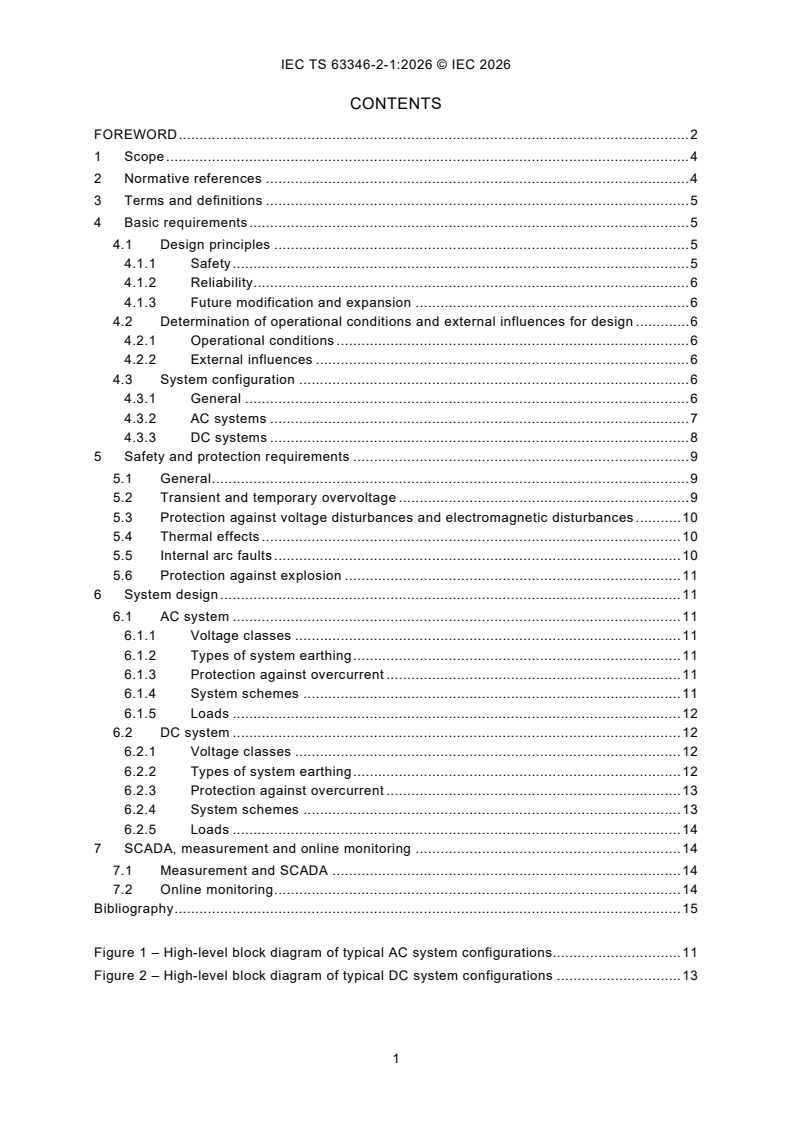
CONTENTS
FOREWORD . 2
1 Scope . 4
2 Normative references . 4
3 Terms and definitions . 5
4 Basic requirements . 5
4.1 Design principles . 5
4.1.1 Safety . 5
4.1.2 Reliability. 6
4.1.3 Future modification and expansion . 6
4.2 Determination of operational conditions and external influences for design . 6
4.2.1 Operational conditions . 6
4.2.2 External influences . 6
4.3 System configuration . 6
4.3.1 General . 6
4.3.2 AC systems . 7
4.3.3 DC systems . 8
5 Safety and protection requirements . 9
5.1 General . 9
5.2 Transient and temporary overvoltage . 9
5.3 Protection against voltage disturbances and electromagnetic disturbances . 10
5.4 Thermal effects . 10
5.5 Internal arc faults . 10
5.6 Protection against explosion . 11
6 System design . 11
6.1 AC system . 11
6.1.1 Voltage classes . 11
6.1.2 Types of system earthing . 11
6.1.3 Protection against overcurrent . 11
6.1.4 System schemes . 11
6.1.5 Loads . 12
6.2 DC system . 12
6.2.1 Voltage classes . 12
6.2.2 Types of system earthing . 12
6.2.3 Protection against overcurrent . 13
6.2.4 System schemes . 13
6.2.5 Loads . 14
7 SCADA, measurement and online monitoring . 14
7.1 Measurement and SCADA . 14
7.2 Online monitoring . 14
Bibliography . 15
Figure 1 – High-level block diagram of typical AC system configurations. 11
Figure 2 – High-level block diagram of typical DC system configurations . 13
INTERNATIONAL ELECTROTECHNICAL COMMISSION
____________
Low-voltage auxiliary power systems -
Part 2-1: Design criteria - General requirements
FOREWORD
1) The International Electrotechnical Commission (IEC) is a worldwide organization for standardization comprising
all national electrotechnical committees (IEC National Committees). The object of IEC is to promote international
co-operation on all questions concerning standardization in the electrical and electronic fields. To this end and
in addition to other activities, IEC publishes International Standards, Technical Specifications, Technical Reports,
Publicly Available Specifications (PAS) and Guides (hereafter referred to as “IEC Publication(s)”). Their
preparation is entrusted to technical committees; any IEC National Committee interested in the subject dealt with
may participate in this preparatory work. International, governmental and non-governmental organizations liaising
with the IEC also participate in this preparation. IEC collaborates closely with the International Organization for
Standardization (ISO) in accordance with conditions determined by agreement between the two organizations.
2) The formal decisions or agreements of IEC on technical matters express, as nearly as possible, an international
consensus of opinion on the relevant subjects since each technical committee has representation from all
interested IEC National Committees.
3) IEC Publications have the form of recommendations for international use and are accepted by IEC National
Committees in that sense. While all reasonable efforts are made to ensure that the technical content of IEC
Publications is accurate, IEC cannot be held responsible for the way in which they are used or for any
misinterpretation by any end user.
4) In order to promote international uniformity, IEC National Committees undertake to apply IEC Publications
transparently to the maximum extent possible in their national and regional publications. Any divergence between
any IEC Publication and the corresponding national or regional publication shall be clearly indicated in the latter.
5) IEC itself does not provide any attestation of conformity. Independent certification bodies provide conformity
assessment services and, in some areas, access to IEC marks of conformity. IEC is not responsible for any
services carried out by independent certification bodies.
6) All users should ensure that they have the latest edition of this publication.
7) No liability shall attach to IEC or its directors, employees, servants or agents including individual experts and
members of its technical committees and IEC National Committees for any personal injury, property damage or
other damage of any nature whatsoever, whether direct or indirect, or for costs (including legal fees) and
expenses arising out of the publication, use of, or reliance upon, this IEC Publication or any other IEC
Publications.
8) Attention is drawn to the Normative references cited in this publication. Use of the referenced publications is
indispensable for the correct application of this publication.
9) IEC draws attention to the possibility that the implementation of this document may involve the use of (a)
patent(s). IEC takes no position concerning the evidence, validity or applicability of any claimed patent rights in
respect thereof. As of the date of publication of this document, IEC had not received notice of (a) patent(s), which
may be required to implement this document. However, implementers are cautioned that this may not represent
the latest information, which may be obtained from the patent database available at https://patents.iec.ch. IEC
shall not be held responsible for identifying any or all such patent rights.
IEC TS 63346-2-1 has been prepared by IEC project committee 127: Low-voltage auxiliary
power systems for electric power stations and substations. It is a Technical Specification.
The text of this Technical Specification is based on the following documents:
Draft Report on voting
127/87/DTS 127/88/RVDTS
Full information on the voting for its approval can be found in the report on voting indicated in
the above table.
The language used for the development of this Technical Specification is English.
This document was drafted in accordance with ISO/IEC Directives, Part 2, and developed in
accordance with ISO/IEC Directives, Part 1 and ISO/IEC Directives, IEC Supplement, available
at www.iec.ch/members_experts/refdocs. The main document types developed by IEC are
described in greater detail at www.iec.ch/publications.
A list of all parts in the IEC 63346 series, published under the general title Low-voltage auxiliary
power systems, can be found on the IEC website.
The committee has decided that the contents of this document will remain unchanged until the
stability date indicated on the IEC website under webstore.iec.ch in the data related to the
specific document. At this date, the document will be
– reconfirmed,
– withdrawn, or
– revised.
1 Scope
This part of IEC 63346 establishes the general principles for the design of low-voltage auxiliary
power systems (APS) with nominal voltages below or equal to 1 kV AC and 1,5 kV DC, and
nominal frequency up to and including 60 Hz, so as to provide safe and correct operation for
the intended use.
This document applies to the design of low-voltage auxiliary systems for
– substations, which are part of an electrical system, confined to a given area, mainly including
ends of transmission or distribution lines, electrical switchgear and controlgear, buildings
and transformers,
– converter stations,
– hydropower stations, where the gravitational energy of water is converted into electricity,
and
– thermal power stations, where the thermal energy is obtained by burning fossil fuels.
This document does not apply to the design of low-voltage auxiliary power systems of the
following:
– nuclear power stations, which have extremely high safety requirements and special loads,
such as nuclear measurement systems and protection systems;
– substations connecting a nuclear power station to the grid and its associated LV APS
integrated with the nuclear power station;
– traction substation, which have different power supply requirements, such as unbalanced
load power supply;
– offshore substations, for which it is important to take into account factors such as waves,
typhoons and salt spray, which have different requirements for power supply and equipment
selection.
2 Normative references
The following documents are referred to in the text in such a way that some or all of their content
constitutes requirements of this document. For dated references, only the edition cited applies.
For undated references, the latest edition of the referenced document (including any
amendments) applies.
IEC 60038:2009, IEC standard voltages
IEC 60079-0, Explosive atmospheres - Part 0: Equipment - General requirements
IEC 60364 (all parts), Low-voltage electrical installations
IEC 60364-1:2025, Low-voltage electrical installations - Part 1: Fundamental principles,
assessment of general characteristics and definitions
IEC 60364-4-42, Low-voltage electrical installations - Part 4-42: Protection for safety -
Protection against thermal effects
IEC 60364-4-43, Low-voltage electrical installations - Part 4-43: Protection for safety -
Protection against overcurrent
IEC 60364-4-44, Low-voltage electrical installations - Part 4-44: Protection for safety -
Protection against voltage disturbances and electromagnetic disturbances
IEC 60364-5-51:2005, Electrical installations of buildings - Part 5-51: Selection and erection of
electrical equipment - Common rules
IEC 60364-5-52, Low-voltage electrical installations - Part 5-52: Selection and erection of
electrical equipment - Wiring systems
IEC 60364-5-53, Low-voltage electrical installations - Part 5-53: Selection and erection of
electrical equipment - Devices for protection for safety, isolation, switching, control and
monitoring
IEC 60909-0, Short-circuit currents in three-phase a.c. systems - Part 0: Calculation of currents
IEC 60947-1, Low-voltage switchgear and controlgear - Part 1: General rules
IEC 60947-2, Low-voltage switchgear and controlgear - Part 2: Circuit-breakers
IEC 61439-1, Low-voltage switchgear and controlgear assemblies - Part 1: General rules
IEC 61439-2, Low-voltage switchgear and controlgear assemblies - Part 2: Power switchgear
and controlgear assemblies
IEC TR 61641, Enclosed low-voltage switchgear and controlgear assemblies - Guide for testing
under conditions of arcing due to internal fault
IEC 61643-12, Low-voltage surge protective devices - Part 12: Surge protective devices
connected to low-voltage power systems - Selection and application principles
IEC 61660-1, Short-circuit currents in d.c. auxiliary installations in power plants and substations
- Part 1: Calculation of short-circuit currents
IEC 61936-1, Power installations exceeding 1 kV AC and 1,5 kV DC - Part 1: AC
IEC TS 63346-1-1, Low-voltage auxiliary power systems - Part 1-1: Terminology
3 Terms and definitions
For the purposes of this document, the terms and definitions given in IEC TS 63346-1-1 apply.
ISO and IEC maintain terminology databases for use in standardization at the following
addresses:
– IEC Electropedia: available at https://www.electropedia.org/
– ISO Online browsing platform: available at https://www.iso.org/obp
4 Basic requirements
4.1 Design principles
4.1.1 Safety
Safety is the first principle used for the design of APS. The design shall meet safety
requirements in the following aspects: personnel safety, equipment safety and system safety.
The APS shall be designed to protect personnel from injury in the process of the operation and
the maintenance of equipment and system, as well as prevention of unsafe operation and
maintenance by personnel that can result in equipment and system damage or cascading
failures.
4.1.2 Reliability
Reliability is the most important characteristic of the operation of the APS. The reliability
requirements of APS should consider coordinating with the criticality of the facility.
4.1.3 Future modification and expansion
The installation should maintain a degree of flexibility of the design to facilitate implementation
of future modification and expansion.
4.2 Determination of operational conditions and external influences for design
4.2.1 Operational conditions
The operational conditions of APS shall be in accordance with IEC 60364-5-51:2005, 512.1,
and IEC 61936-1.
4.2.2 External influences
The external influences of APS shall be in accordance with IEC 60364-5-51:2005, 512.2, and
IEC 61936-1. The selection of the type of external influences affecting the design of the APS
shall be dependent on the specific conditions of the application and IEC 60364-5-51:2005,
Table 51A, which presents the list of classes of the external influences.
4.3 System configuration
4.3.1 General
The following requirements of the APS configuration shall be met.
a) The number and characteristics of the power sources shall meet the demand of the loads in
the APS. External supplies or temporary sources shall be configured additionally for higher
reliability requirements.
b) The selection of the types, sizes and redundancy levels of the electrical equipment shall be
in accordance with the safety and reliability of the station and IEC 61936-1.
c) APS configuration is a measure of the performance of the design, and should also consider
and maintain a degree of flexibility of the design to facilitate implementation of future
modification and expansion.
d) System earthing of the APS shall be in accordance with IEC 60364-1:2025.
e) Conductors, including earthing conductors, live conductors and neutral conductors, shall
satisfy the current-carrying capacity, voltage drop and other minimum size requirements for
the APS. The nominal cross-sectional area of conductors shall be no less than the values
given in IEC 60364-5-52. When required, flame retardant cables can be used.
f) Low-voltage switchgear and controlgear assemblies in APS shall be in accordance with
IEC 61439-2;
g) Low-voltage switchgear and controlgear in APS shall be in accordance with IEC 60947-1.
Low-voltage circuit-breake
...