

IEC TS 62668-1:2012
(Main)Process management for avionics - Counterfeit prevention - Part 1: Avoiding the use of counterfeit, fraudulent and recycled electronic components
General Information
- Abstract
IEC/TS 62668-1:2012(E) defines requirements for avoiding the use of counterfeit, recycled and fraudulent components used in the aerospace, defence and high performance (ADHP) industries. It also defines requirements for ADHP industries to maintain their intellectual property (IP) for all of their products and services. The risks associated with purchasing components outside of franchised distributor networks will be considered in IEC/TS 62668-2 which is to be published in the near future. Although developed for the avionics industry, this specification may be applied by other high performance and high reliability industries at their discretion. Keywords: avionics, counterfeit, fraudulent.
- Status
- Published
- Publication Date
- 06-May-2012
- Technical Committee
- TC 107 - Process management for avionics
- Drafting Committee
- WG 3 - TC 107/WG 3
- Current Stage
- DELPUB - Deleted Publication
- Start Date
- 10-Jul-2014
- Completion Date
- 28-Aug-2026
Buy Documents
IEC TS 62668-1:2012 - Process management for avionics - Counterfeit prevention - Part 1: Avoiding the use of counterfeit, fraudulent and recycled electronic components Released:5/7/2012
Overview
IEC/TS 62668-1:2012 - Process management for avionics - Counterfeit prevention - Part 1: Avoiding the use of counterfeit, fraudulent and recycled electronic components is a Technical Specification from the International Electrotechnical Commission (IEC). It defines requirements and guidance for avoiding the introduction of counterfeit, fraudulent and recycled electronic components in the aerospace, defence and high performance (ADHP) industries, and for protecting intellectual property (IP) related to avionics products and services. Although developed for avionics, the guidance is applicable to other high‑reliability sectors.
Key topics and technical requirements
The specification addresses practical and organizational controls, including:
- Definitions and scope - clear definitions of counterfeit, fraudulent, recycled, traceable and untraceable components.
- Minimum avionics OEM requirements - expectations for original equipment manufacturers to control procurement, design and lifecycle activities.
- Intellectual property (IP) controls - requirements for protecting product and design IP across supply chains.
- Distributor and franchised network controls - guidance on franchised vs non‑franchised distributors, traceability and stock/scrap control.
- Original Component Manufacturer (OCM) best practices - part marking, packaging, IP control and recommended accreditation (e.g., ISO 9001, AS/EN/JISQ 9100).
- Accreditations and audit schemes - mention of distributor certification expectations and audit schemes such as Chinese RECS.
- Handling of recycled components - why recycled parts are not acceptable for avionics and when recycling becomes counterfeit.
- Procurement and sourcing guidance - buying from approved sources, certificates of conformance, obsolescence management and redesign options.
- Reporting and regulatory coordination - processes for reporting counterfeit, fraud and recycled parts to regulators and authorities.
- Informative annexes - useful contacts, examples of aftermarket sources, RECS certificate example and a requirements flowchart.
Applications and who uses it
IEC/TS 62668-1 is intended for organizations that design, procure, manufacture, maintain or certify avionics and other ADHP equipment:
- Avionics OEMs and system integrators - for procurement, IP protection and supply‑chain controls.
- Purchasing and quality assurance teams - to set supplier approval, traceability and inspection requirements.
- Distributors and franchised suppliers - to align processes with avionics expectations and accreditations.
- Maintenance, repair and overhaul (MRO) providers - to avoid introduction of unapproved or recycled components.
- Regulators and certification bodies - as a reference for anti‑counterfeit process expectations.
Adoption of this specification improves supply‑chain resilience, reduces risk of failure due to counterfeit/fraudulent parts, and supports regulatory compliance in safety‑critical systems.
Related standards
Standards and documents referenced or complementary to IEC/TS 62668-1 include:
- ISO 9001; AS/EN/JISQ 9100 (OCM quality systems)
- AS9120 (distributor quality)
- SAE AS5553, SAE AS6174 (industry anti‑counterfeit guidance)
- SAE AS6081 (distributor anti‑counterfeit practices)
- IEC/TS 62239 (approved alternatives and obsolescence guidance)
Keywords: avionics, counterfeit, fraudulent, recycled components, intellectual property, supply chain, OCM, distributor, ADHP.
Relations
- Effective Date
- 05-Sep-2023
- Effective Date
- 05-Sep-2023
Buy Documents
IEC TS 62668-1:2012 - Process management for avionics - Counterfeit prevention - Part 1: Avoiding the use of counterfeit, fraudulent and recycled electronic components Released:5/7/2012
Get Certified
Connect with accredited certification bodies for this standard

BSI Group
BSI (British Standards Institution) is the business standards company that helps organizations make excellence a habit.

Bureau Veritas
Bureau Veritas is a world leader in laboratory testing, inspection and certification services.

DNV
DNV is an independent assurance and risk management provider.
Sponsored listings
Frequently Asked Questions
IEC TS 62668-1:2012 is a technical specification published by the International Electrotechnical Commission (IEC). Its full title is "Process management for avionics - Counterfeit prevention - Part 1: Avoiding the use of counterfeit, fraudulent and recycled electronic components". This standard covers: IEC/TS 62668-1:2012(E) defines requirements for avoiding the use of counterfeit, recycled and fraudulent components used in the aerospace, defence and high performance (ADHP) industries. It also defines requirements for ADHP industries to maintain their intellectual property (IP) for all of their products and services. The risks associated with purchasing components outside of franchised distributor networks will be considered in IEC/TS 62668-2 which is to be published in the near future. Although developed for the avionics industry, this specification may be applied by other high performance and high reliability industries at their discretion. Keywords: avionics, counterfeit, fraudulent.
IEC/TS 62668-1:2012(E) defines requirements for avoiding the use of counterfeit, recycled and fraudulent components used in the aerospace, defence and high performance (ADHP) industries. It also defines requirements for ADHP industries to maintain their intellectual property (IP) for all of their products and services. The risks associated with purchasing components outside of franchised distributor networks will be considered in IEC/TS 62668-2 which is to be published in the near future. Although developed for the avionics industry, this specification may be applied by other high performance and high reliability industries at their discretion. Keywords: avionics, counterfeit, fraudulent.
IEC TS 62668-1:2012 is classified under the following ICS (International Classification for Standards) categories: 03.100.50 - Production. Production management; 31.020 - Electronic components in general; 49.060 - Aerospace electric equipment and systems. The ICS classification helps identify the subject area and facilitates finding related standards.
IEC TS 62668-1:2012 has the following relationships with other standards: It is inter standard links to IEC 62668-1:2019, IEC TS 62668-1:2014. Understanding these relationships helps ensure you are using the most current and applicable version of the standard.
IEC TS 62668-1:2012 is available in PDF format for immediate download after purchase. The document can be added to your cart and obtained through the secure checkout process. Digital delivery ensures instant access to the complete standard document.
Standards Content (Sample)
IEC/TS 62668-1 ®
Edition 1.0 2012-05
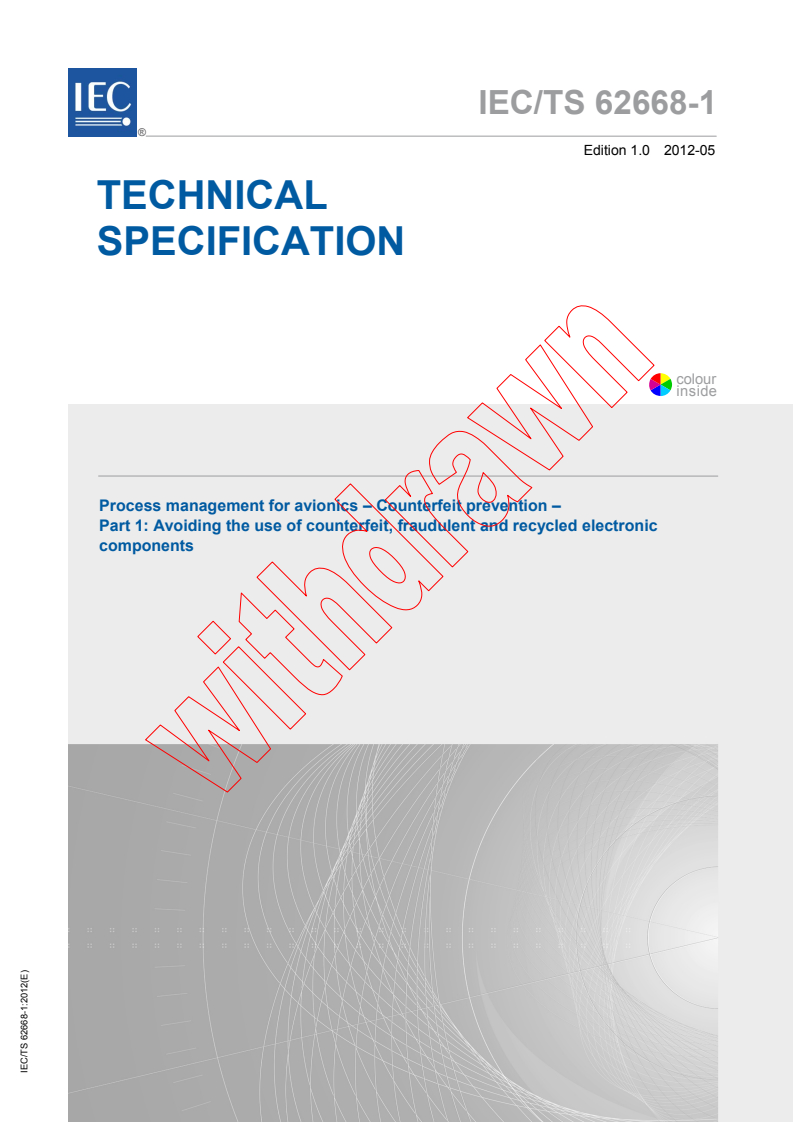
TECHNICAL
SPECIFICATION
colour
inside
Process management for avionics – Counterfeit prevention –
Part 1: Avoiding the use of counterfeit, fraudulent and recycled electronic
components
IEC/TS 62668-1:2012(E)
All rights reserved. Unless otherwise specified, no part of this publication may be reproduced or utilized in any form
or by any means, electronic or mechanical, including photocopying and microfilm, without permission in writing from
either IEC or IEC's member National Committee in the country of the requester.
If you have any questions about IEC copyright or have an enquiry about obtaining additional rights to this publication,
please contact the address below or your local IEC member National Committee for further information.
IEC Central Office Tel.: +41 22 919 02 11
3, rue de Varembé Fax: +41 22 919 03 00
CH-1211 Geneva 20 info@iec.ch
Switzerland www.iec.ch
About the IEC
The International Electrotechnical Commission (IEC) is the leading global organization that prepares and publishes
International Standards for all electrical, electronic and related technologies.
About IEC publications
The technical content of IEC publications is kept under constant review by the IEC. Please make sure that you have the
latest edition, a corrigenda or an amendment might have been published.
Useful links:
IEC publications search - www.iec.ch/searchpub Electropedia - www.electropedia.org
The advanced search enables you to find IEC publications The world's leading online dictionary of electronic and
by a variety of criteria (reference number, text, technical electrical terms containing more than 30 000 terms and
committee,…). definitions in English and French, with equivalent terms in
It also gives information on projects, replaced and additional languages. Also known as the International
withdrawn publications. Electrotechnical Vocabulary (IEV) on-line.
IEC Just Published - webstore.iec.ch/justpublished Customer Service Centre - webstore.iec.ch/csc
Stay up to date on all new IEC publications. Just Published If you wish to give us your feedback on this publication
details all new publications released. Available on-line and or need further assistance, please contact the
also once a month by email. Customer Service Centre: csc@iec.ch.
IEC/TS 62668-1 ®
Edition 1.0 2012-05
TECHNICAL
SPECIFICATION
colour
inside
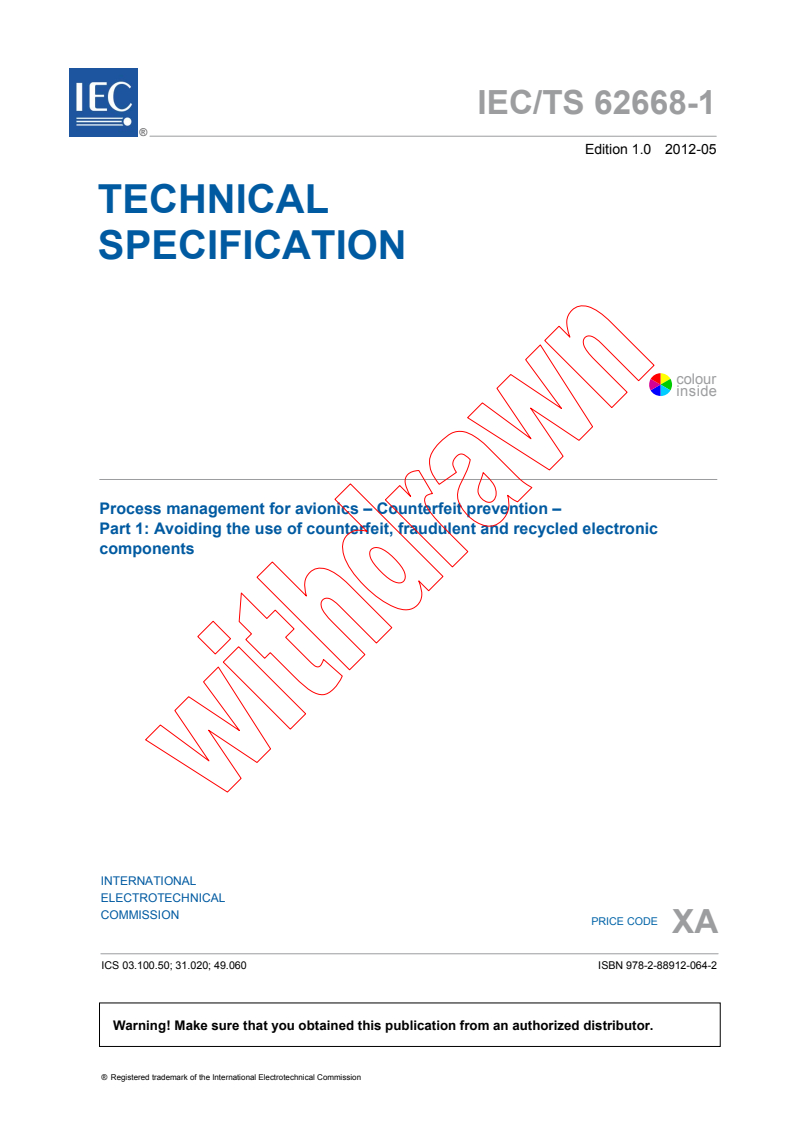
Process management for avionics – Counterfeit prevention –
Part 1: Avoiding the use of counterfeit, fraudulent and recycled electronic
components
INTERNATIONAL
ELECTROTECHNICAL
COMMISSION
PRICE CODE
XA
ICS 03.100.50; 31.020; 49.060 ISBN 978-2-88912-064-2
– 2 – TS 62668-1 IEC:2012(E)
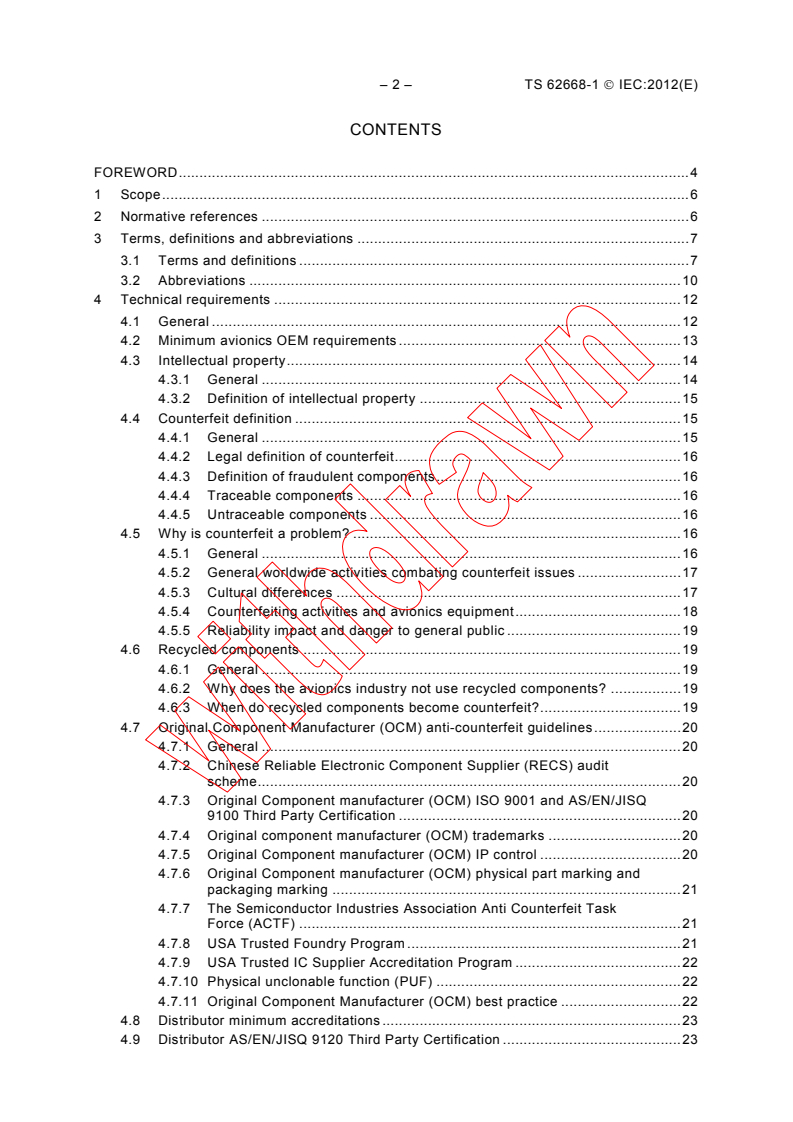
CONTENTS
FOREWORD . 4
1 Scope . 6
2 Normative references . 6
3 Terms, definitions and abbreviations . 7
3.1 Terms and definitions . 7
3.2 Abbreviations . 10
4 Technical requirements . 12
4.1 General . 12
4.2 Minimum avionics OEM requirements . 13
4.3 Intellectual property . 14
4.3.1 General . 14
4.3.2 Definition of intellectual property . 15
4.4 Counterfeit definition . 15
4.4.1 General . 15
4.4.2 Legal definition of counterfeit . 16
4.4.3 Definition of fraudulent components . 16
4.4.4 Traceable components . 16
4.4.5 Untraceable components . 16
4.5 Why is counterfeit a problem? . 16
4.5.1 General . 16
4.5.2 General worldwide activities combating counterfeit issues . 17
4.5.3 Cultural differences . 17
4.5.4 Counterfeiting activities and avionics equipment . 18
4.5.5 Reliability impact and danger to general public . 19
4.6 Recycled components . 19
4.6.1 General . 19
4.6.2 Why does the avionics industry not use recycled components? . 19
4.6.3 When do recycled components become counterfeit? . 19
4.7 Original Component Manufacturer (OCM) anti-counterfeit guidelines . 20
4.7.1 General . 20
4.7.2 Chinese Reliable Electronic Component Supplier (RECS) audit
scheme . 20
4.7.3 Original Component manufacturer (OCM) ISO 9001 and AS/EN/JISQ
9100 Third Party Certification . 20
4.7.4 Original component manufacturer (OCM) trademarks . 20
4.7.5 Original Component manufacturer (OCM) IP control . 20
4.7.6 Original Component manufacturer (OCM) physical part marking and
packaging marking . 21
4.7.7 The Semiconductor Industries Association Anti Counterfeit Task
Force (ACTF) . 21
4.7.8 USA Trusted Foundry Program . 21
4.7.9 USA Trusted IC Supplier Accreditation Program . 22
4.7.10 Physical unclonable function (PUF) . 22
4.7.11 Original Component Manufacturer (OCM) best practice . 22
4.8 Distributor minimum accreditations . 23
4.9 Distributor AS/EN/JISQ 9120 Third Party Certification . 23
TS 62668-1 IEC:2012(E) – 3 –
4.10 Franchised distributor network . 23
4.10.1 General . 23
4.10.2 Control stock through tracking schemes . 24
4.10.3 Control scrap . 24
4.10.4 RECS . 24
4.10.5 SAE AS6081 . 24
4.11 Non- franchised distributor anti-counterfeit guidelines . 24
4.11.1 General . 24
4.11.2 OEM managed non-franchised distributors . 25
4.11.3 Brokers . 25
4.12 Avionics OEM anti-counterfeit guidelines when procuring components . 25
4.12.1 General . 25
4.12.2 Buy from approved sources . 25
4.12.3 Traceable components . 26
4.12.4 Certificates of conformance . 26
4.12.5 Plan and buy sufficient quantities . 26
4.12.6 Use of non- franchised distributors . 27
4.12.7 Brokers . 27
4.12.8 Contact the original manufacturer . 27
4.12.9 Obsolete components and Franchised Aftermarket sources . 27
4.12.10 IEC TS 62239 approved alternatives . 27
4.12.11 Product redesign . 28
4.12.12 Non traceable components . 28
4.12.13 OEM anti-counterfeit plans including SAE AS5553 and SAE AS6174 . 28
4.13 OEM anti-counterfeit guidelines for their products . 28
4.13.1 IP control . 28
4.13.2 Tamper-proofing the OEM Design . 29
4.13.3 Tamper Proof Labels . 29
4.13.4 Use of ASICS and FPGAs with IP protection features . 29
4.13.5 Control the final OEM product marking . 29
4.13.6 Control OEM scrap . 30
4.13.7 OEM Trademarks and logos . 30
4.13.8 Control delivery of OEM products and spares and their useful life . 30
4.13.9 Repairs to OEM products . 30
4.14 Counterfeit, fraud and component recycling reporting . 31
4.14.1 General . 31
4.14.2 USA FAA suspected unapproved parts (SUP) program . 31
4.14.3 UK counterfeit reporting . 31
4.14.4 EU counterfeit reporting . 31
4.14.5 UKEA anti-counterfeiting forum. 31
Annex A (informative) Useful contacts . 32
Annex B (informative) Examples of aftermarket sources . 55
Annex C (informative) Typical example of a RECS certificate . 56
Annex D (informative) Flowchart of IEC/TS 62668-1 requirements . 57
Bibliography . 59
– 4 – TS 62668-1 IEC:2012(E)
INTERNATIONAL ELECTROTECHNICAL COMMISSION
____________
PROCESS MANAGEMENT FOR AVIONICS –
COUNTERFEIT PREVENTION –
Part 1: Avoiding the use of counterfeit, fraudulent
and recycled electronic components
FOREWORD
1) The International Electrotechnical Commission (IEC) is a worldwide organization for standardization comprising
all national electrotechnical committees (IEC National Committees). The object of IEC is to promote
international co-operation on all questions concerning standardization in the electrical and electronic fields. To
this end and in addition to other activities, IEC publishes International Standards, Technical Specifications,
Technical Reports, Publicly Available Specifications (PAS) and Guides (hereafter referred to as “IEC
Publication(s)”). Their preparation is entrusted to technical committees; any IEC National Committee interested
in the subject dealt with may participate in this preparatory work. International, governmental and non-
governmental organizations liaising with the IEC also participate in this preparation. IEC collaborates closely
with the International Organization for Standardization (ISO) in accordance with conditions determined by
agreement between the two organizations.
2) The formal decisions or agreements of IEC on technical matters express, as nearly as possible, an international
consensus of opinion on the relevant subjects since each technical committee has representation from all
interested IEC National Committees.
3) IEC Publications have the form of recommendations for international use and are accepted by IEC National
Committees in that sense. While all reasonable efforts are made to ensure that the technical content of IEC
Publications is accurate, IEC cannot be held responsible for the way in which they are used or for any
misinterpretation by any end user.
4) In order to promote international uniformity, IEC National Committees undertake to apply IEC Publications
transparently to the maximum extent possible in their national and regional publications. Any divergence
between any IEC Publication and the corresponding national or regional publication shall be clearly indicated in
the latter.
5) IEC itself does not provide any attestation of conformity. Independent certification bodies provide conformity
assessment services and, in some areas, access to IEC marks of conformity. IEC is not responsible for any
services carried out by independent certification bodies.
6) All users should ensure that they have the latest edition of this publication.
7) No liability shall attach to IEC or its directors, employees, servants or agents including individual experts and
members of its technical committees and IEC National Committees for any personal injury, property damage or
other damage of any nature whatsoever, whether direct or indirect, or for costs (including legal fees) and
expenses arising out of the publication, use of, or reliance upon, this IEC Publication or any other IEC
Publications.
8) Attention is drawn to the Normative references cited in this publication. Use of the referenced publications is
indispensable for the correct application of this publication.
9) Attention is drawn to the possibility that some of the elements of this IEC Publication may be the subject of
patent rights. IEC shall not be held responsible for identifying any or all such patent rights.
The main task of IEC technical committees is to prepare International Standards. In
exceptional circumstances, a technical committee may propose the publication of a technical
specification when
• the required support cannot be obtained for the publication of an International Standard,
despite repeated efforts, or
• the subject is still under technical development or where, for any other reason, there is the
future but no immediate possibility of an agreement on an International Standard.
Technical specifications are subject to review within three years of publication to decide
whether they can be transformed into International Standards.
IEC/TS 62668-1, which is a technical specification, has been prepared by IEC technical
committee 107: Process management for avionics.
TS 62668-1 IEC:2012(E) – 5 –
The text of this technical specification is based on the following documents:
Enquiry draft Report on voting
107/165/DTS 107/177/RVC
Full information on the voting for the approval of this technical specification can be found in
the report on voting indicated in the above table.
This publication has been drafted in accordance with the ISO/IEC Directives, Part 2.
A list of all the parts in the IEC 62668 series, published under the general title Process
management for avionics – Counterfeit prevention, can be found on the IEC website.
The committee has decided that the contents of this publication will remain unchanged until
the stability date indicated on the IEC web site under "http://webstore.iec.ch" in the data
related to the specific publication. At this date, the publication will be
• transformed into an International standard,
• reconfirmed,
• withdrawn,
• replaced by a revised edition, or
• amended.
A bilingual version of this publication may be issued at a later date.
IMPORTANT – The 'colour inside' logo on the cover page of this publication indicates
that it contains colours which are considered to be useful for the correct
understanding of its contents. Users should therefore print this document using a
colour printer.
– 6 – TS 62668-1 IEC:2012(E)
PROCESS MANAGEMENT FOR AVIONICS –
COUNTERFEIT PREVENTION –
Part 1: Avoiding the use of counterfeit, fraudulent
and recycled electronic components
1 Scope
This Technical Specification defines requirements for avoiding the use of counterfeit, recycled
and fraudulent components used in the aerospace, defence and high performance (ADHP)
industries. It also defines requirements for ADHP industries to maintain their intellectual
property (IP) for all of their products and services. The risks associated with purchasing
components outside of franchised distributor networks will be considered in IEC/TS 62668-2
which is to be published in the near future. Although developed for the avionics industry, this
specification may be applied by other high performance and high reliability industries at their
discretion.
2 Normative references
The following documents, in whole or in part, are normatively referenced in this document and
are indispensable for its application. For dated references, only the edition cited applies. For
undated references, the latest edition of the referenced document (including any
amendments) applies.
IEC/TS 62239, Process management for avionics – Preparation of an electronic components
management plan
IEC/PAS 62435, Electronic components – Long-duration storage of electronic components –
Guidance for implementation
ISO 9001, Quality management systems – Requirements
AS/EN/JISQ 9100, Quality Management Systems – Requirements for Aviation, Space and
Defense Organizations
AS/EN/JISQ 9110, Quality Maintenance Systems – Aerospace- Requirements for
Maintenance Organizations
AS/EN/JISQ 9120, Quality Management Systems – Requirements for Aviation, Space and
Defense Distributors
GEIA-STD-0016, Standard for Preparing a DMSMS Management Plan
IDEA-STD-1010B, Acceptability of electronic components distributed in the open market
___________
Under consideration.
This Technical Specification will be superseded by IEC/TS 62239-1, Process management for avionics –
Management plan – Part 1: Preparation and maintenance of an electronic components management plan, which
is currently under study.
TS 62668-1 IEC:2012(E) – 7 –
SAE AS5553 , Counterfeit Electronic Parts; Avoidance, Detection, Mitigation and Disposition
SEMI T20, Specification for authentication of semiconductors and related products
SEMI T20.1, Specification for object labelling to authenticate semiconductors and related
Products in an open market
SEMI T20.2, Guide for qualifications of authentication service bodies for detecting and
preventing counterfeiting of semiconductors and related products
3 Terms, definitions and abbreviations
3.1 Terms and definitions
For the purposes of this document, the following terms and definitions apply.
3.1.1
after-market source
reseller who may or may not be under contract with the original component manufacturer
(OCM), or is sometimes a component “re-manufacturer”, under contract with the OCM
Note 1 to entry: The reseller accumulates inventories of encapsulated or non-encapsulated (wafer) components
whose end of life date has been published by the OCM. These components are then resold at a profit to fill a need
within the market for components that have become obsolete.
3.1.2
counterfeit
action to simulate, reproduce or modify a material good or its packaging without authorization
Note 1 to entry: It is the practice of producing products which are imitations or are fake goods or services. This
activity infringes the Intellectual Property rights of the original manufacturer and is an illegal act. Counterfeiting
generally relates to wilful trade mark infringement.
3.1.3
counterfeited component
material good imitating or copying an authentic material good which may be covered by the
protection of one or more registered or confidential intellectual property rights
Note 1 to entry: It is one whose identity or pedigree has been altered or misrepresented by its supplier
Identity = Original manufacturer, part number, date code, lot number, testing, inspection, documentation or
warranty etc.
Pedigree = Origin, ownership history, storage, handling, physical condition, previous use etc.
3.1.4
COTS
commercial off-the-shelf products
one or more pieces, mechanical or electrical, developed for multiple commercial consumers,
whose design and/or configuration is controlled by the supplier’s specification or industry
standard
Note 1 to entry: They can include electronic components, subassemblies, or top level assemblies. COTS
subassemblies include circuit card assemblies, power supplies, hard drives, and memory modules. Top-level COTS
assemblies includes a fully integrated rack of equipment such as raid arrays, file servers to individual switches,
routers, personal computers, or similar equipment.
___________
This standard will be superseded by SAE AS5553A, Counterfeit Electronic Parts; Avoidance, Detection,
Mitigation and Disposition, which is currently under study.
– 8 – TS 62668-1 IEC:2012(E)
3.1.5
customer, user
original equipment manufacturer (OEM) who purchases electronic components, including
integrated circuits and/or semiconductor devices compliant to this technical specification, and
uses them to design, produce, and maintain systems
3.1.6
data sheet
document prepared by the manufacturer that describes the electrical, mechanical, and
environmental characteristics of the component
3.1.7
broker
individual or corporate organization that serves as an intermediary between buyer and seller.
Note 1 to entry: In the electronic component sector a broker specifically seeks to supply obsolete or hard to find
components in order to turn a profit. To do so it may accumulate an inventory of components considered to be of
strategic value or may rely on inventories accumulated by another. The broker operates within a worldwide
component exchange network.
3.1.8
customer device specification
device specification written by a user and agreed by the supplier
3.1.9
fraudulent component
electronic component produced or distributed in violation of the law
Note 1 to entry: This includes stolen component, component scrapped by the original component manufacturer
(OCM) or by any user, disassembled component salvaged and resold as new component, counterfeit component,
copy, imitation, full or partial substitute of brands, designs, models , patents, software or copyright, for example:
component whose production and distribution are not controlled by the original manufacturer, unlicensed copies of
a design, disguised component (remarking of original manufacturer name, reference date/code or other identifiers
etc.), component without internal silicon die or with substituted silicon die which are not the original manufacturer’s
silicon die.
3.1.10
franchised distributor or agent
individual or corporate organisation that is legally independent from the franchiser (in this
case the electronic component manufacturer or OCM) and who agrees under contract to
distribute products using the franchiser’s name and sales network
Note 1 to entry: Distribution activities are carried out in accordance with standards set and controlled by the
franchiser. Shipments against orders placed can be despatched either direct from the OCM or the franchised
distributor or agent. In other words, the franchised distributor enters into contractual agreements with one or more
electronic component manufacturers to distribute and sell said components. Distribution agreements may be
stipulated according to the following criteria: geographical area, type of clientele (avionics for example), maximum
manufacturing lot size. Components sourced through this route are protected by the OCM’s warranty and supplied
with full traceability
3.1.11
non-franchised distributor
non-franchised or independent electronic component distributors are companies who do not
fall under one of the above mentioned categories (i.e. franchised distributor)
Note 1 to entry: These distributors may purchase components from component manufacturers, franchised
distributors, or through other supply channels (open markets). These distributors cannot always provide the
guarantees and support provided by the franchised distributor network; components sourced through this source
are usually protected by the source’s warranty only. However, some of them are able to purchase traceable
components and/or to provide traceability paperwork and/or are able to return stock for investigation to the OCM.
TS 62668-1 IEC:2012(E) – 9 –
3.1.12
purchasing agency
organization who groups the quantities of electronic components required by a series of
companies in order to constitute significant buying power and thereby obtain the best possible
supplier conditions for purchasing ( especially as regards pricing and purchasing conditions)
as well as for assistance with management, documentation , financing etc.
3.1.13
reseller
general supplier who offers a selection of electronic components to order from a catalog
3.1.14
microcircuit, component, device
electrical or electronic device that is not subject to disassembly without destruction or
impairment of design use and is a small circuit having a high equivalent circuit element
density which is considered as a single part composed of interconnected elements on or
within a single substrate to perform an electronic circuit function
Note 1 to entry: This excludes printed wiring boards / printed circuit boards, circuit card assemblies and modules
composed exclusively of discrete electronic components.
3.1.15
original equipment manufacturer (OEM)
manufacturer who defines the electronic sub assembly that includes the electronic
components or defines the components used in an assembly and/or test specification
3.1.16
original component manufacturer (OCM)
company specifying and manufacturing the electronic component
3.1.17
piracy
willful copyright infringement
3.1.18
sourcing channel
various sourcing system available to the electronic equipment manufacturer and its
subcontractors for example: purchase of electronic components directly from the original
manufacturer or its representative, purchase through a franchised or non-franchised
distributor, broker or other source
3.1.19
semiconductor
electronic component in which the characteristic distinguishing electronic conduction takes
place within a semiconductor
Note 1 to entry: This includes:
(1) semiconductor diodes which are semiconductor devices having two terminals and exhibiting a nonlinear
voltage-current characteristic and
(2) transistors which are active semiconductor devices capable of providing power amplification and having
three or more terminals.
3.1.20
subcontractor for manufacturing electronic subassemblies
supplier manufacturing items in compliance with customer design data pack and drawings and
under the authority of the OEM
Note 1 to entry: This supplier can potentially procure all or part of the electronic components required to produce a
sub assembly and is often referred to as the contract electronic manufacturer (CEM) or electronics manufacturing
services (EMS).
– 10 – TS 62668-1 IEC:2012(E)
3.1.21
supplier
company which provides to another an electronic component which is identified by the logo or
name marked on the device
Note 1 to entry: A supplier can be an OCM, franchised distributor or agent, non-franchised distributor, broker,
reseller, OEM, CEM, and EMS etc.
3.1.22
traceability
ability to have for an electronic component its full trace back to the original component
manufacturer
Note 1 to entry: This traceability means that every supplier in the supply chain is prepared to legally declare in
writing that they know and can identify their source of supply, which goes back to the original manufacturer and
can confirm that the electronic components are brand new and were handled with appropriate ESD and MSL
handling precautions. This authenticates that the electronic components being supplied are unused, brand new
components with no ESD, MSL or other damage. This ensures that the electronic components are protected by any
manufacturer’s warranties, have all of their useful life remaining and function according to the manufacturer’s
published datasheet, exhibiting the expected component life in the application for the OEM’s reliability predictions
and product warranty.
3.1.23
untraceable
property of electronic components which have lost their traceability (see definition in 3.1.22)
3.2 Abbreviations
AAIPT Alliance Against IP Theft
ACTA Anti-Counterfeit Trade Agreement
ACTF Semiconductor Industries Association Anti Counterfeit Task Force
ADHP aerospace, defence and high performance
ASIC application specific integrated circuit
ATP acceptance test procedure
CATA China Anti-counterfeit Technology Association
CB Certifying Bodies (Third Party)
COTS Commercial off-the-shelf
CEM contract electronic manufacturer
CEPA Chinese Electronic Purchasing Association
CQAE China Quality Management Association for Electronics Industry
CMOS complementary metal oxide semiconductor
DOD Department of Defence (US)
DMEA Defense MicroElectronics Activity
DMSMS diminishing manufacturing sources and material shortages
DSCC Defence Supply Centre Columbus
DLA Defense Logistics Agency (former DSCC)
EASA European Aviation Safety Agency
ECIA Electronic Components Industry Association
ECMP electronic component management plan
ECSN electronic component supplier network
EMS electronic manufacturing service
ERAI Electronic Reseller Association International (see http://www.erai.com)
ESD electrostatic discharge
TS 62668-1 IEC:2012(E) – 11 –
EOS electrical overstress
EU European Union
FAA Federal Aviation Administration
FAR Federal Avionic Regulations
FFF form, fit and function
FIT failures in time
FPGA field-programmable gate array
G-19 SAE Counterfeit Electronic Parts Committee
GAMS Government/Authorities meeting on Semiconductors
GIFAS French Aerospace Association
HAST highly accelerated stress test
HIS Hardware Intrinsic Security
HTOL high temperature operating life
ID independent distributors
IDEA Independent Distributors of Electronics Association
ISP internet service provider
ITAR International Traffic in Arms Regulations
JIT just in time
JPO Japanese Patent Office
LTB last time buy
LDC lot date code
MBTF mean time between failures
MTTF mean time to failure
MSL moisture sensitivity level
NEDA National Electronics Distributors Association
NOVRAM non-volatile random access memory
OCM original component manufacturer
OEM original equipment manufacturer
OHIM Office for Harmonisation in the Internal Market (EU)
PCB printed circuit board
PCN product change notice
PRC People’s Republic of China
RECS Reliable Electronic Component Suppler
PUF physical unclonable function
RFID radio frequency identity detection
RAM random access memory
ROM read only memory
SEE single event effect
SEU single event upset
SER soft error rate
SIA Semiconductor Industry Association
SRAM static random access memory
TAPO Trusted Access Program Office
– 12 – TS 62668-1 IEC:2012(E)
TSO Trading Standards Officers
UK United Kingdom
UKEA UK Electronics Alliance
UNG unique number generator
USA United States of America
WIPO World Intellectual Property Organization
WSC World Semiconductor Council
4 Technical requirements
4.1 General
This Technical Specification minimises counterfeiting, recycling and fraudulent activities by
maintaining intellectual property and purchasing traceable components.
Minimum avionics OEM requirements are defined in 4.2.
Subclauses 4.3 to 4.14.5 provide supporting information to 4.2.
Informative annexes are provided at the end of this specification and their content is subject
to change. Users of this specification are encouraged to review the latest data available
whenever referencing the content of these annexes.
• Annex A provides further cross-reference information for all the institutions and
organisations discussed in Clause 4;
• Annex B provides examples of after-market sources which shall be considered in
obsolescence situations (see 4.12.9);
• Annex C provides an example of a typical Chinese RECS certificate (see 4.7.2 and
A.9.3);
• Annex D provides a flowchart of IEC/TS 62668-1 requirements and their relationship to
external standards.
The key elements to control and understand are:
a) the definition of intellectual property (see 4.3);
b) the limitations of the term counterfeit (see 4.4);
c) the better term fraudulent (see 4.4.3);
d) what recycling is and why the avionics industry minimises recycling to in-house activities
only (see 4.6);
e) the use of original component manufacturers (OCMs) who protect their intellectual
property (see 4.7);
f) the use of approved franchised distributors or sources (see 4.10);
g) the use of risk management and component test processes when buying suspect
untraceable components from non-franchised distributors in accordance with
IEC/TS 62668-2 (see 4.12.12);
h) the protection of OEM intellectual property, throughout their product lifecycles including
management of all spares;
i) the reporting of violations of intellectual property through local law enforcement (see 4.14,
A.7.2, A.8 for useful contacts).
___________
Under consideration.
TS 62668-1 IEC:2012(E) – 13 –
4.2 Minimum avionics OEM requirements
The avionics OEM shall:
a) Protect their intellectual property rights (see 4.3, 4.4, 4.5, 4.12 and 4.13);
b) Select components from original component manufacturers (OCMs) who control their
intellectual property rights (see 4.3, 4.7) and which includes unique configuration
controlled part numbers and physical part markings (see 4.7.6);
c) Have an anti-counterfeit, fraudulent and recycled component process, in compliance with
the requirements herein, which may include an anti-counterfeit management plan in
accordance with this specification or specifications such as SAE-AS5553A or others
similar (see 4.12.13) and shall flow this requirement down to lower level suppliers (see
4.12.13.3);
d) Have an AS/EN/JISQ 9100 process (see 4.12) to audit all sources of supply of
components, which shall have an anti-counterfeit, fraudulent and recycled component
process in compliance with this specification;
e) Have a process only allowing the purchase of traceable components (see 4.12.3) using
the AS/EN/JISQ 9100 procedures, from:
1) Reliable Electronic Component Supplier (RECS) approved original component
manufacturers (OCM) (see 4.7.2) and franchised distributors (see 4.10) where the
RECS scheme operates, e.g. China and the Far East (see 4.6.2). See Annex C for a
typical RECS certificate.
2) Where the RECS scheme does not operate, purchase traceable components:
i) Direct from the original component manufacturer (OCM) (see 4.7) with any
appropriate traceability measures such as the use of Semiconductor Industries
Association Anti Counterfeit Task Force (ACTF) measures (see 4.7.7) or physical
unclonable function (PUF) features (see 4.7.10), as considered necessary;
ii) Direct from USA Trusted Foundry Program (see 4.7.8) and/or from the USA
Trusted IC Supplier Accreditation Program (see 4.7.9) where required by customer
contract or considered appropriate;
iii) In situations where the component is obsolete, purchase direct from the franchised
aftermarket manufacturer (see 4.12.9 and Annex B);
iv) From franchised distributors ( see 4.10)
1) Who are preferably AS/EN/JISQ 9120 approved (see 4.9);
2) Who are also ISO9001 approved as a minimum requirement (see 4.8);
v) From non-franchised distributors (see 4.11 and IEC/TS 62668-2 which will be
published at a later date)
1) Who are preferably AS/EN/JISQ 9120 approved (see 4.9);
2) Who are also ISO 9001 approved as a minimum requirement (see 4.8);
3) Have additional procedures to ensure counterfeit, recycled or fraudulent
components do not enter the supply chain, e.g. use IDEA-STD-1010B (see
4.11).
f) Have an AS/EN/JISQ 9100 process which avoids the use of unapproved brokers (see
4.11.3);
g) In the rare event an avionics OEM considers it is necessary to purchase untraceable
components, the avionics OEM shall:
___________
Under consideration.
Under consideration.
– 14 – TS 62668-1 IEC:2012(E)
1) conduct an exhaustive search for traceable alternatives, including the review of
possible design changes to accommodate traceable alternatives and aftermarket
sources (see 4.12, in particular 4.12.10, 4.12.11, and Annex B);
2) use a risk management process, to assess the additional requirements needed to
determine that the components are not counterfeited, recycled or fraudulent
components , with the results documented in the OEM’s AS/EN/JISQ 9100 non-
conformance procedures, using the requirements of IEC/TS 62668-2 Under
consideration which, will include conformity, quality, reliability and maintenance
performances aspects.
h) Have a process for repair and rework operations (see 4.13.9) which shall include
AS/EN/JISQ 9110 certification for all maintenance operation;
i) Report incidents of counterfeit and fraudulent activities in accordance with local law (see
4.14).
4.3 Intellectual property
4.3.1 General
Anti-counterfeit activities start with the definition and knowledge of what is intellectual
property (IP). Counterfeit occurs when the original manufacturer’s IP is fraudulently infringed.
Therefore anti-counterfeit activities are concerned about the maintenance of intellectual
property.
The World Intellectual Property Organization (WIPO) is a specialized agency of the United
Nations. It is dedicated to developing a balanced and accessible international IP system,
which rewards creativity, stimulates innovation and contributes to economic development
while safeguarding the public interest.
WIPO was established by the WIPO Convention in 1967 with a mandate from its Member
States to promote the protection of IP throughout the world through cooperation among states
and in collaboration with other international organizations. Its headquarters are in Geneva,
Switzerland. For further information about WIPO see A.1. The following are regional
Intellectual Property offices:
a) USA: The United States Patent and Trademark Office (see A.8.1).
b) UK: The Intellectual Property Office (see A.6.1), which provides further information and
details of the on-line IP Healthcheck diagnostic tool.
c) Europe: The Europa webpage contains summaries of EU legislation for Intellectual
Property (see A.7.1).
d) China: the State Intellectual Property office of the P.R.C (see A.9.1).
The following are additional resources for intellectual property information:
a) WIPO webpage (see A.1.3) has links to the treaties administered by WIPO, with details of
legislations from a wide range of countries and other related information (see A.1.4) and
includes the present members of the Global Network on Intellectual Property (IP)
Academies
b) International Intellectual Property Alliance is a private sector coalition, formed in 1984 of
trade associations representing the US copyright based industries in bilateral and
multilateral efforts working to improve international protection and enforcement of
copyrighted materials and open up foreign markets closed by piracy and other market
access barriers (see A.8.4).
___________
Under consideration.
TS 62668-1 IEC:2012(E) – 15 –
c) The International Trade Administration, U.S. Department of Commerce Stopfakes
webpage http://www.stopfakes.gov/sf_how.asp (see A.8.2) has links to Intellectual
Property Toolkits for other countries.
d) The USA Embassy in China webpage (see A.8.3) has very useful data for IP control when
importing goods into China.
4.3.2 Definition of intellectual property
4.3.2.1 General
Intellectual property (IP) refers to creations of the mind: inventions, literary and artistic works,
and symbols, names, images, and designs used in commerce. This is property created
through intellectual or creative activity. It includes patents, trademarks, copyright and designs.
It can be owned, rented out, licensed, sold or given away.
4.3.2.2 Patents
Patents are territorial rights. Therefore, they apply in one country, in the European Union (EU)
or through the patent Co-operation Treaty. A granted patent becomes property and can be
sold or licensed out. A patent can last up to 20 years. For further information see:
(a) WIPO (see A.1.3); or
(b) the European patent Office (see A.7.3.);
(c) the Chinese Patent and Trademark Office (see A.9.2);
(d)
...