

IEC 60045-1:2020
(Main)Steam turbines - Part 1: Specifications
General Information
- Abstract
IEC 60045-1:2020 is applicable primarily to land-based horizontal steam turbines driving generators for electrical power services. Some of its provisions are relevant to turbines for other applications. Generator, gear box and other auxiliaries which are considered as a part of the system are also mentioned in this document. Detailed specifications for this equipment are not included in this document.
The purpose of this document is to make an intending purchaser aware of options and alternatives which it may wish to consider, and to enable it to state its technical requirements clearly to potential suppliers. Consequently, final technical requirements will be in accordance with an agreement between the purchaser and the supplier in the contract.
This second edition cancels and replaces the first edition published in 1991. This edition constitutes a technical revision.
This edition includes the following significant technical changes with respect to the previous edition:
a) Scope clarification and boundaries of applicability;
b) general update to state-of-the-art technology;
c) integration of product safety: Clause 5;
d) integration of automation, incorporating the former annex on electronic governors: Clause 11;
e) Informative Annex A on welding added.
- Status
- Published
- Publication Date
- 12-May-2020
- Technical Committee
- TC 5 - Steam turbines
- Drafting Committee
- MT 12 - TC 5/MT 12
- Current Stage
- PPUB - Publication issued
- Start Date
- 13-May-2020
- Completion Date
- 12-Jun-2020
Overview
IEC 60045-1:2020 is the international standard specifying technical requirements for land-based horizontal steam turbines primarily used for driving generators in electrical power services. This standard, issued by the International Electrotechnical Commission (IEC), serves as a comprehensive guideline to inform purchasers about relevant options and alternatives, enabling clear communication of technical requirements to suppliers.
As a second edition replacing the 1991 version, IEC 60045-1:2020 incorporates technical revisions reflecting the latest advancements in steam turbine technology and operational safety, including updated clauses on product safety and automation. The scope also covers connections with related auxiliaries such as generators and gearboxes, though detailed specifications of these auxiliaries are not included.
Key Topics
IEC 60045-1:2020 provides essential guidelines across various areas critical to steam turbine operation and procurement:
Scope and Application
Clear boundaries for applicability, with an emphasis on turbines for power generation and references to turbines for other applications.Terms and Definitions
Precise definitions for turbine types, steam admission methods, operational speeds, steam flow rates, heat rates, and operational regimes to standardize terminology.Performance Guarantees
Specifications surrounding thermal performance, including turbine efficiency, output, steam flow capacity, and permissible tolerances.Product Safety
Integration of risk assessment and risk reduction processes specifically tailored to steam turbines, including hazard identification and safety documentation.Operation and Maintenance
Guidelines on normal and abnormal operation procedures, installation conditions (indoor/outdoor, seismic considerations), and maintenance requirements to ensure reliability and longevity.Component Specifications
Detailed considerations on materials, design, stressed and unstressed parts, rotor balancing, overspeed protection, valve functions, bearings, thermal insulation, and welding.Exhausts and Steam Extraction
Design and operational parameters for steam outlets, extraction lines, protection devices to prevent backflow, and boundary conditions for performance guarantees.Auxiliary Systems
Lubricating oil systems, control fluids, sealing mechanisms, drains, vents, turning gears, and piping specifications critical to turbine auxiliary operations.Automation and Control
Updated clauses on integration of automation, including environmental requirements, electromagnetic compatibility, hardware and software design, control system functions, speed and load adjustments, and valve testing.
Applications
IEC 60045-1:2020 is essential for a broad range of stakeholders involved in steam turbine procurement, installation, and operation, including:
Power Generation Companies
Ensuring turbines meet required electrical power output, efficiency, and operational safety standards.Manufacturers and Suppliers
Designing and delivering turbines in compliance with up-to-date international specifications.Engineering and Design Firms
Incorporating standardized technical criteria into plant design and turbine selection processes.Maintenance and Operations Teams
Following recommended procedures to optimize turbine longevity and safe operation.Safety and Compliance Officers
Applying structured risk management and safety documentation for turbine systems.
By adhering to IEC 60045-1:2020, organizations can achieve improved operational reliability, safety, and performance efficiency of steam turbines employed in electric power generation and related applications.
Related Standards
To complement the specifications outlined in IEC 60045-1:2020, users are encouraged to consult related IEC standards that cover:
Steam Turbine Parts and Testing
Standards focusing on detailed design and performance testing methodologies.Generator and Auxiliary Equipment
Specifications for generators, gearboxes, and associated electrical equipment connected to steam turbines.Safety and Electrotechnical Practices
IEC standards addressing risk assessment, electromagnetic compatibility, and environmental testing protocols.Automation and Control Systems
Guidelines on software, hardware, and functional safety for electromechanical control systems integrated with steam turbines.
Utilizing IEC 60045-1:2020 in conjunction with these related standards ensures comprehensive compliance, operational excellence, and enhanced safety in steam turbine applications.
Keywords: IEC 60045-1:2020, steam turbines standard, land-based steam turbines, turbine specifications, electrical power generation, turbine safety, turbine automation, steam turbine maintenance, turbine operational guidelines, steam turbine performance guarantees.
Get Certified
Connect with accredited certification bodies for this standard

DNV
DNV is an independent assurance and risk management provider.

Lloyd's Register
Lloyd's Register is a global professional services organisation specialising in engineering and technology.
DNV Energy Systems
Energy and renewable energy certification.
Sponsored listings
Frequently Asked Questions
IEC 60045-1:2020 is a standard published by the International Electrotechnical Commission (IEC). Its full title is "Steam turbines - Part 1: Specifications". This standard covers: IEC 60045-1:2020 is applicable primarily to land-based horizontal steam turbines driving generators for electrical power services. Some of its provisions are relevant to turbines for other applications. Generator, gear box and other auxiliaries which are considered as a part of the system are also mentioned in this document. Detailed specifications for this equipment are not included in this document. The purpose of this document is to make an intending purchaser aware of options and alternatives which it may wish to consider, and to enable it to state its technical requirements clearly to potential suppliers. Consequently, final technical requirements will be in accordance with an agreement between the purchaser and the supplier in the contract. This second edition cancels and replaces the first edition published in 1991. This edition constitutes a technical revision. This edition includes the following significant technical changes with respect to the previous edition: a) Scope clarification and boundaries of applicability; b) general update to state-of-the-art technology; c) integration of product safety: Clause 5; d) integration of automation, incorporating the former annex on electronic governors: Clause 11; e) Informative Annex A on welding added.
IEC 60045-1:2020 is applicable primarily to land-based horizontal steam turbines driving generators for electrical power services. Some of its provisions are relevant to turbines for other applications. Generator, gear box and other auxiliaries which are considered as a part of the system are also mentioned in this document. Detailed specifications for this equipment are not included in this document. The purpose of this document is to make an intending purchaser aware of options and alternatives which it may wish to consider, and to enable it to state its technical requirements clearly to potential suppliers. Consequently, final technical requirements will be in accordance with an agreement between the purchaser and the supplier in the contract. This second edition cancels and replaces the first edition published in 1991. This edition constitutes a technical revision. This edition includes the following significant technical changes with respect to the previous edition: a) Scope clarification and boundaries of applicability; b) general update to state-of-the-art technology; c) integration of product safety: Clause 5; d) integration of automation, incorporating the former annex on electronic governors: Clause 11; e) Informative Annex A on welding added.
IEC 60045-1:2020 is classified under the following ICS (International Classification for Standards) categories: 23.060.40 - Pressure regulators; 25.040.40 - Industrial process measurement and control; 27.040 - Gas and steam turbines. Steam engines. The ICS classification helps identify the subject area and facilitates finding related standards.
IEC 60045-1:2020 is available in PDF format for immediate download after purchase. The document can be added to your cart and obtained through the secure checkout process. Digital delivery ensures instant access to the complete standard document.
Standards Content (Sample)
IEC 60045-1 ®
Edition 2.0 2020-05
INTERNATIONAL
STANDARD
NORME
INTERNATIONALE
Steam turbines –
Part 1: Specifications
Turbines à vapeur –
Partie 1: Spécifications
All rights reserved. Unless otherwise specified, no part of this publication may be reproduced or utilized in any form
or by any means, electronic or mechanical, including photocopying and microfilm, without permission in writing from
either IEC or IEC's member National Committee in the country of the requester. If you have any questions about IEC
copyright or have an enquiry about obtaining additional rights to this publication, please contact the address below or
your local IEC member National Committee for further information.
Droits de reproduction réservés. Sauf indication contraire, aucune partie de cette publication ne peut être reproduite
ni utilisée sous quelque forme que ce soit et par aucun procédé, électronique ou mécanique, y compris la photocopie
et les microfilms, sans l'accord écrit de l'IEC ou du Comité national de l'IEC du pays du demandeur. Si vous avez des
questions sur le copyright de l'IEC ou si vous désirez obtenir des droits supplémentaires sur cette publication, utilisez
les coordonnées ci-après ou contactez le Comité national de l'IEC de votre pays de résidence.
IEC Central Office Tel.: +41 22 919 02 11
3, rue de Varembé info@iec.ch
CH-1211 Geneva 20 www.iec.ch
Switzerland
About the IEC
The International Electrotechnical Commission (IEC) is the leading global organization that prepares and publishes
International Standards for all electrical, electronic and related technologies.
About IEC publications
The technical content of IEC publications is kept under constant review by the IEC. Please make sure that you have the
latest edition, a corrigendum or an amendment might have been published.
IEC publications search - webstore.iec.ch/advsearchform Electropedia - www.electropedia.org
The advanced search enables to find IEC publications by a The world's leading online dictionary on electrotechnology,
variety of criteria (reference number, text, technical containing more than 22 000 terminological entries in English
committee,…). It also gives information on projects, replaced and French, with equivalent terms in 16 additional languages.
and withdrawn publications. Also known as the International Electrotechnical Vocabulary
(IEV) online.
IEC Just Published - webstore.iec.ch/justpublished
Stay up to date on all new IEC publications. Just Published IEC Glossary - std.iec.ch/glossary
details all new publications released. Available online and 67 000 electrotechnical terminology entries in English and
once a month by email. French extracted from the Terms and Definitions clause of
IEC publications issued since 2002. Some entries have been
IEC Customer Service Centre - webstore.iec.ch/csc collected from earlier publications of IEC TC 37, 77, 86 and
If you wish to give us your feedback on this publication or CISPR.
need further assistance, please contact the Customer Service
Centre: sales@iec.ch.
A propos de l'IEC
La Commission Electrotechnique Internationale (IEC) est la première organisation mondiale qui élabore et publie des
Normes internationales pour tout ce qui a trait à l'électricité, à l'électronique et aux technologies apparentées.
A propos des publications IEC
Le contenu technique des publications IEC est constamment revu. Veuillez vous assurer que vous possédez l’édition la
plus récente, un corrigendum ou amendement peut avoir été publié.
Recherche de publications IEC - Electropedia - www.electropedia.org
webstore.iec.ch/advsearchform Le premier dictionnaire d'électrotechnologie en ligne au
La recherche avancée permet de trouver des publications IEC monde, avec plus de 22 000 articles terminologiques en
en utilisant différents critères (numéro de référence, texte, anglais et en français, ainsi que les termes équivalents dans
comité d’études,…). Elle donne aussi des informations sur les 16 langues additionnelles. Egalement appelé Vocabulaire
projets et les publications remplacées ou retirées. Electrotechnique International (IEV) en ligne.
IEC Just Published - webstore.iec.ch/justpublished Glossaire IEC - std.iec.ch/glossary
Restez informé sur les nouvelles publications IEC. Just 67 000 entrées terminologiques électrotechniques, en anglais
Published détaille les nouvelles publications parues. et en français, extraites des articles Termes et Définitions des
Disponible en ligne et une fois par mois par email. publications IEC parues depuis 2002. Plus certaines entrées
antérieures extraites des publications des CE 37, 77, 86 et
Service Clients - webstore.iec.ch/csc CISPR de l'IEC.
Si vous désirez nous donner des commentaires sur cette
publication ou si vous avez des questions contactez-nous:
sales@iec.ch.
IEC 60045-1 ®
Edition 2.0 2020-05
INTERNATIONAL
STANDARD
NORME
INTERNATIONALE
Steam turbines –
Part 1: Specifications
Turbines à vapeur –
Partie 1: Spécifications
INTERNATIONAL
ELECTROTECHNICAL
COMMISSION
COMMISSION
ELECTROTECHNIQUE
INTERNATIONALE
ICS 27.040 ISBN 978-2-8322-8313-4
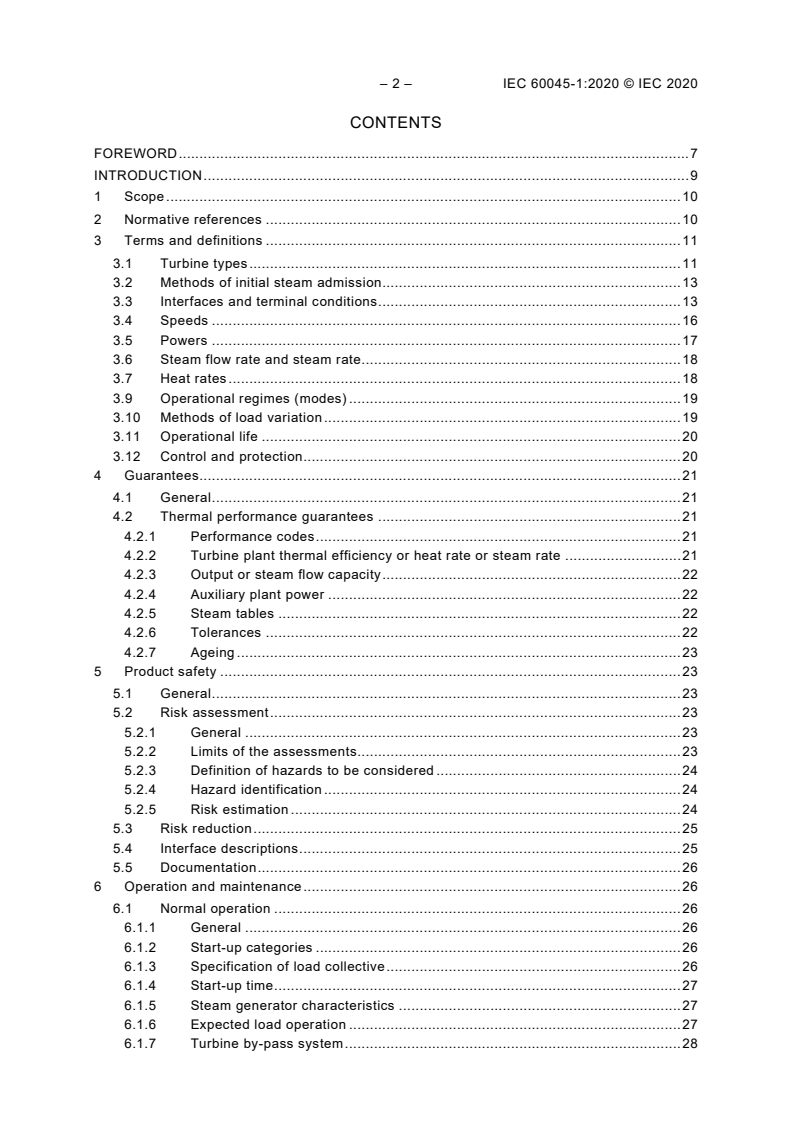
– 2 – IEC 60045-1:2020 © IEC 2020
CONTENTS
FOREWORD . 7
INTRODUCTION . 9
1 Scope . 10
2 Normative references . 10
3 Terms and definitions . 11
3.1 Turbine types . 11
3.2 Methods of initial steam admission . 13
3.3 Interfaces and terminal conditions . 13
3.4 Speeds . 16
3.5 Powers . 17
3.6 Steam flow rate and steam rate. 18
3.7 Heat rates . 18
3.9 Operational regimes (modes) . 19
3.10 Methods of load variation . 19
3.11 Operational life . 20
3.12 Control and protection . 20
4 Guarantees. 21
4.1 General . 21
4.2 Thermal performance guarantees . 21
4.2.1 Performance codes . 21
4.2.2 Turbine plant thermal efficiency or heat rate or steam rate . 21
4.2.3 Output or steam flow capacity . 22
4.2.4 Auxiliary plant power . 22
4.2.5 Steam tables . 22
4.2.6 Tolerances . 22
4.2.7 Ageing . 23
5 Product safety . 23
5.1 General . 23
5.2 Risk assessment . 23
5.2.1 General . 23
5.2.2 Limits of the assessments . 23
5.2.3 Definition of hazards to be considered . 24
5.2.4 Hazard identification . 24
5.2.5 Risk estimation . 24
5.3 Risk reduction . 25
5.4 Interface descriptions . 25
5.5 Documentation . 26
6 Operation and maintenance . 26
6.1 Normal operation . 26
6.1.1 General . 26
6.1.2 Start-up categories . 26
6.1.3 Specification of load collective . 26
6.1.4 Start-up time . 27
6.1.5 Steam generator characteristics . 27
6.1.6 Expected load operation . 27
6.1.7 Turbine by-pass system . 28
6.1.8 Auxiliary steam . 28
6.2 Limits of variation of parameters from rated conditions . 28
6.2.1 General . 28
6.2.2 Initial pressure . 29
6.2.3 Initial and, where applicable, reheat temperature . 29
6.2.4 Turbine exhaust pressure/temperature. 31
6.2.5 Speed . 32
6.3 Abnormal operation . 32
6.3.1 Cases . 32
6.3.2 Limitations from abnormal turbine operation . 32
6.3.3 Boundary conditions at abnormal turbine operation . 32
6.4 Installation conditions . 33
6.4.1 Indoor/outdoor . 33
6.4.2 Seismic condition. 33
6.5 Maintenance . 33
6.6 Operating instructions . 33
7 Components . 34
7.1 Materials, construction and design . 34
7.2 Parts subject to high temperatures . 34
7.2.1 Unstressed parts . 34
7.2.2 Stressed parts . 34
7.3 Casings and pedestals . 34
7.4 Rotors . 34
7.4.1 Balancing . 34
7.4.2 Critical speeds . 34
7.4.3 Overspeed . 35
7.4.4 Short-circuit and other abnormal torque loads . 35
7.4.5 Shaft train . 35
7.5 Valves. 36
7.6 Main bearings and housings . 36
7.7 Cylinder and interstage glands . 36
7.8 Thermal insulation . 36
7.9 Welding . 36
8 Foundations and buildings . 37
9 Extractions, bleeds and exhausts . 37
9.1 General . 37
9.2 Requirements on steam parameters and volume flow . 38
9.3 Design of steam outlets . 38
9.4 Limits of supply . 38
9.5 Boundary conditions for guarantees . 39
9.6 Protection devices against backflow of water and steam . 39
9.6.1 Water ingress from the feedwater heating system or other condensation
systems . 39
9.6.2 Preventing steam backflow to steam turbine to avoid overspeed . 40
9.6.3 Unwanted steam from cold reheat system . 40
10 Turbine auxiliary systems . 41
10.1 General . 41
10.2 Lubricating oil . 41
10.3 Control fluid . 42
– 4 – IEC 60045-1:2020 © IEC 2020
10.4 Sealing system for rotor and valve glands . 42
10.5 Drains . 42
10.6 Vents . 42
10.7 Turning gear . 43
10.8 Piping . 43
11 Automation . 43
11.1 General . 43
11.2 General requirements in relation to the steam turbine automation system . 43
11.2.1 Environmental conditions . 43
11.2.2 Electromagnetic compatibility . 44
11.2.3 Requirements as to hardware and software design . 44
11.2.4 Tests of the steam turbine automation system . 45
11.3 Turbine Control System (TCS) . 46
11.3.1 General . 46
11.3.2 Functional requirements as to governing system. 46
11.3.3 Speed and load adjustments . 47
11.3.4 Controller characteristics . 47
11.3.5 Performance characteristics . 47
11.3.6 Valve testing control . 48
11.3.7 Facilities . 48
11.3.8 Control functions for auxiliary systems . 48
11.3.9 Monitoring functions and/or informative messages . 49
11.4 Steam turbine protection . 49
11.4.1 Functional requirements for protection . 49
11.4.2 Requirements as to the design of the protection system . 51
11.5 Instrumentation . 52
11.5.1 General . 52
11.5.2 Standard instruments . 52
11.5.3 Turbine supervisory instrumentation (TSI) . 52
11.5.4 Additional instruments . 53
11.5.5 Test measuring points . 53
12 Other devices for protection of the turbine and of interfacing systems . 54
12.1 Low-pressure casing and condenser pressurization . 54
12.2 Valve casing pressurization . 54
13 Vibration . 54
13.1 General . 54
13.2 Vibration measured at the bearing housing . 54
13.3 Vibration measured at the shaft . 54
14 Noise . 54
14.1 General . 54
14.2 Noise emitted by the steam turbine . 55
14.3 Noise level in the vicinity of the turbine unit . 55
15 Tests . 55
15.1 General . 55
15.2 Testing of pressurized components . 55
15.3 Performance tests . 55
15.4 Test results and data . 56
16 Delivery and installation. 56
16.1 Transport to site and temporary protection . 56
16.2 Erection and commissioning . 56
17 Design information to be supplied by the purchaser . 56
17.1 General . 56
17.2 Characteristics of the turbine and its accessories . 56
17.3 Steam and water conditions . 57
17.4 Conditions for condensers and coolers (where this equipment is within the
supplier's scope of supply) . 58
17.5 Information on regenerative feedwater heating . 58
17.6 Applications: installation and mode of operation . 59
17.7 Foundations . 60
17.8 Terminal points . 60
17.9 Delivery site conditions . 60
17.10 Tests . 61
17.11 Automation system . 61
17.12 Documentation . 61
17.13 Quality measures . 61
17.14 Participation in risk assessment . 61
18 Design information to be provided by the supplier . 61
18.1 General . 61
18.2 Piping . 62
18.3 Thermal expansion . 62
18.4 Information on regenerative feedwater heating . 62
18.5 Pipe connections . 62
18.6 Time schedule . 62
18.7 Auxiliary media and electrical supply . 62
18.8 Turbine foundations . 62
18.9 Instrumentation and control . 63
18.10 Heat emissions . 63
Annex A (informative) Welding of stationary components of steam turbines . 64
A.1 General . 64
A.2 Principles for design, qualification and execution of welding . 64
A.3 Welding supervision, welding personnel . 66
A.4 Testing . 67
A.5 Documentation . 67
Bibliography . 68
Figure 1 – Condensing steam turbine interfaces . 14
Figure 2 – Extraction steam turbine interfaces . 14
Figure 3 – Single shaft combined cycle with multi casing steam turbine interfaces . 15
Table 1 – Permissible variations for rated pressure . 29
Table 2 – Permissible temperature variations for rated temperature up to 566 °C . 30
Table 3 – Permissible temperature variations for rated temperature higher than 566 °C
up to 630 °C . 31
Table 4 – Environment classes . 43
Table 5 – Controller droop and dead band characteristics . 47
– 6 – IEC 60045-1:2020 © IEC 2020
Table 6 – Maximum load non-linearity and load stability . 48
Table A.1 – Correlation between function and foreseeable risk potential and
manufacturer's quality requirements according to ISO 3834 . 65
Table A.2 – Correlation of structural integrity and quality levels . 65
Table A.3 – Qualification of welding procedures (WPQR) for processes 111, 14, 12, 13,
15, 51 (electron beam welding), 52 (laser welding) . 66
INTERNATIONAL ELECTROTECHNICAL COMMISSION
____________
STEAM TURBINES –
Part 1: Specifications
FOREWORD
1) The International Electrotechnical Commission (IEC) is a worldwide organization for standardization comprising
all national electrotechnical committees (IEC National Committees). The object of IEC is to promote
international co-operation on all questions concerning standardization in the electrical and electronic fields. To
this end and in addition to other activities, IEC publishes International Standards, Technical Specifications,
Technical Reports, Publicly Available Specifications (PAS) and Guides (hereafter referred to as “IEC
Publication(s)”). Their preparation is entrusted to technical committees; any IEC National Committee interested
in the subject dealt with may participate in this preparatory work. International, governmental and non-
governmental organizations liaising with the IEC also participate in this preparation. IEC collaborates closely
with the International Organization for Standardization (ISO) in accordance with conditions determined by
agreement between the two organizations.
2) The formal decisions or agreements of IEC on technical matters express, as nearly as possible, an international
consensus of opinion on the relevant subjects since each technical committee has representation from all
interested IEC National Committees.
3) IEC Publications have the form of recommendations for international use and are accepted by IEC National
Committees in that sense. While all reasonable efforts are made to ensure that the technical content of IEC
Publications is accurate, IEC cannot be held responsible for the way in which they are used or for any
misinterpretation by any end user.
4) In order to promote international uniformity, IEC National Committees undertake to apply IEC Publications
transparently to the maximum extent possible in their national and regional publications. Any divergence
between any IEC Publication and the corresponding national or regional publication shall be clearly indicated in
the latter.
5) IEC itself does not provide any attestation of conformity. Independent certification bodies provide conformity
assessment services and, in some areas, access to IEC marks of conformity. IEC is not responsible for any
services carried out by independent certification bodies.
6) All users should ensure that they have the latest edition of this publication.
7) No liability shall attach to IEC or its directors, employees, servants or agents including individual experts and
members of its technical committees and IEC National Committees for any personal injury, property damage or
other damage of any nature whatsoever, whether direct or indirect, or for costs (including legal fees) and
expenses arising out of the publication, use of, or reliance upon, this IEC Publication or any other IEC
Publications.
8) Attention is drawn to the Normative references cited in this publication. Use of the referenced publications is
indispensable for the correct application of this publication.
9) Attention is drawn to the possibility that some of the elements of this IEC Publication may be the subject of
patent rights. IEC shall not be held responsible for identifying any or all such patent rights.
International Standard IEC 60045-1 has been prepared by IEC technical committee 5: Steam
turbines.
This second edition cancels and replaces the first edition published in 1991. This edition
constitutes a technical revision.
This edition includes the following significant technical changes with respect to the previous
edition:
a) Scope clarification and boundaries of applicability;
b) general update to state-of-the-art technology;
c) integration of product safety: Clause 5;
d) integration of automation, incorporating the former annex on electronic governors:
Clause 11;
e) Informative Annex A on welding added.
– 8 – IEC 60045-1:2020 © IEC 2020
The text of this International Standard is based on the following documents:
FDIS Report on voting
5/231/FDIS 5/232/RVD
Full information on the voting for the approval of this International Standard can be found in
the report on voting indicated in the above table.
This document has been drafted in accordance with the ISO/IEC Directives, Part 2.
A list of all parts in the IEC 60045 series, published under the general title Steam turbines,
can be found on the IEC website.
The committee has decided that the contents of this document will remain unchanged until the
stability date indicated on the IEC website under "http://webstore.iec.ch" in the data related to
the specific document. At this date, the document will be
• reconfirmed,
• withdrawn,
• replaced by a revised edition, or
• amended.
INTRODUCTION
The first edition of IEC 60045 was issued in 1931. Subsequent revisions were made, the last
being in 1991. In daily practice this document has added tremendous value throughout the
years giving guidance in the tendering processes for steam turbines worldwide. Intensive
development has resulted in new specific application requirements, the availability of more
highly rated turbines, and tremendous advances in automation and control. The new revision
of this document was consequently driven by the motivation to close the gap to available
technology and a wish to provide a single standard valid for a wide range of industrial and
utility steam turbine applications.
st
Specifically, in the beginning of the 21 century renewable energy sources are rapidly taking
shares on the electricity market and steam turbines play an important role in the shift of
energy systems:
– They are key components for new power plant concepts as for concentrated solar power
(CSP), for geothermal power or in combined heat and power applications;
– They are requested to provide flexible thermal backup power generation with high
efficiency (combined cycle) to compensate the increased volatility of the electrical grids;
– Higher steam parameters are technically viable and contribute to more efficient utilisation
of energy sources and investments.
In the area of automation and controls the integration of relevant safety standards was
necessary and a complete new Clause 5 is dedicated to this. Also, automation itself has
formed its own Clause 11 integrating the former aspects of governing, controls,
instrumentation and protection paving the way towards digitalization of power plants.
The overall structure of the document is intentionally kept close to the former revision to
promote seamless application of the document.
Wherever practicable, this document takes into account the scope for applying to smaller
turbines developments originally intended for larger machines, without implying that such
applications would always be necessary or advantageous.
– 10 – IEC 60045-1:2020 © IEC 2020
STEAM TURBINES –
Part 1: Specifications
1 Scope
This part of IEC 60045 is applicable primarily to land-based horizontal steam turbines driving
generators for electrical power services. Some of its provisions are relevant to turbines for
other applications. Generator, gear box and other auxiliaries which are considered as a part
of the system are also mentioned in this document. Detailed specifications for this equipment
are not included in this document.
The purpose of this document is to make an intending purchaser aware of options and
alternatives which it may wish to consider, and to enable it to state its technical requirements
clearly to potential suppliers. Consequently, final technical requirements will be in accordance
with an agreement between the purchaser and the supplier in the contract.
2 Normative references
The following documents are referred to in the text in such a way that some or all of their
content constitutes requirements of this document. For dated references, only the edition
cited applies. For undated references, the latest edition of the referenced document (including
any amendments) applies.
IEC 60034-3, Rotating electrical machines – Part 3: Specific requirements for synchronous
generators driven by steam turbines or combustion gas turbines
IEC 60079 (all parts), Explosive atmospheres
IEC 60204-1, Safety of machinery – Electrical equipment of machines – Part 1: General
requirements
IEC 60953 (all parts), Rules for steam turbine thermal acceptance tests
IEC 61000-6-2, Electromagnetic compatibility (EMC) – Part 6-2: Generic standards –
Immunity standard for industrial environments
IEC 61000-6-4, Electromagnetic compatibility (EMC) – Part 6-4: Generic standards –
Emission standard for industrial environments
IEC 61064, Acceptance tests for steam turbine speed control systems
ISO 1940, Mechanical vibration – Balance quality requirements for rotors in a constant (rigid)
state
ISO 7919-3, Mechanical vibration – Evaluation of mechanical vibration by measurements on
rotating shafts – Part 3: Coupled industrial machines
ISO 10494, Turbines and turbine sets – Measurement of emitted airborne noise –
Engineering/survey method
ISO 11342, Mechanical vibration – Methods and criteria for the mechanical balancing of
flexible rotors
ISO 10816-3, Mechanical vibration – Evaluation of machine vibration by measurements on
non-rotating parts – Part 3: Industrial machines with nominal power above 15 kW and nominal
speeds between 120 r/min and 15 000 r/min when measured in situ
ISO 12100:2010, Safety of machinery – General principles for design – Risk assessment and
risk reduction
ISO 13850, Safety of machinery – Emergency stop – Principles for design
ISO 20816-1, Mechanical vibration – Measurement and evaluation of machine vibration –
Part 1: General guidelines
ISO 20816-2, Mechanical vibration – Measurement and evaluation of machine vibration –
Part 2: Land-based gas turbines, steam turbines and generators in excess of 40 MW, with
fluid-film bearings and rated speeds of 1 500 r/min, 1 800 r/min, 3 000 r/min and 3 600 r/min
ISO 21940-31, Mechanical vibration – Rotor balancing – Part 31: Susceptibility and sensitivity
of machines to unbalance
3 Terms and definitions
For the purposes of this document, the following terms and definitions apply.
ISO and IEC maintain terminological databases for use in standardization at the following
addresses:
• IEC Electropedia: available at http://www.electropedia.org/
• ISO Online browsing platform: available at http://www.iso.org/obp
3.1 Turbine types
3.1.1
high-pressure turbine
HP turbine
turbine as classified by manufacturers with high pressure level of steam admission
3.1.2
intermediate-pressure turbine
IP turbine
turbine as classified by manufacturers with intermediate pressure level of steam admission
3.1.3
low-pressure turbine
LP turbine
turbine as classified by manufacturers with low pressure level of steam admission
3.1.4
superheat turbine
turbine whose initial steam is significantly superheated
3.1.5
wet-steam turbine
saturated-steam turbine
turbine whose initial steam is saturated or nearly so
– 12 – IEC 60045-1:2020 © IEC 2020
3.1.6
supercritical turbine
turbine whose initial steam pressure is higher than the critical pressure of water
Note 1 to entry: For turbines with higher steam inlet parameters non-standardized naming as ultra supercritical
turbine is in use.
3.1.7
reheat turbine
turbine from which the steam is extracted part-way through the expansion, reheated (one or
more times) and readmitted to the turbine
3.1.8
mixed-pressure turbine
turbine provided with separate inlets for steam supplied at two or more pressures
3.1.9
back-pressure turbine
turbine whose exhaust heat typically will be used to provide process heat (eg. industrial
process, district heating, post combustion carbon capture system and desalination), and
whose exhaust is not directly connected to a condenser
Note 1 to entry: The exhaust pressure will normally be above atmospheric pressure.
3.1.10
condensing turbine
turbine whose exhaust is directly connected to a condenser
Note 1 to entry: The exhaust pressure will normally be below atmospheric pressure.
3.1.11
heating turbine
turbine which delivers heat to an external process, where its exhaust steam is connected to a
heat exchanger / steam condenser whose pressure varies from vacuum to overpressure
EXAMPLE District heating, industrial process heating and air conditioning.
3.1.12
regenerative-cycle turbine
turbine from which some of the steam is extracted part-way through the expansion in order to
heat feedwater
3.1.13
extraction turbine
turbine in which some of the steam is extracted part-way through the expansion using internal
pressure control means for the extracted steam
Note 1 to entry: The control means are located inside the turbine flow path or in a cross-over line between turbine
sections. The target is to provide process steam.
EXAMPLE Plant regenerative cycle use, industrial process, district heating, post-combustion carbon capture
system and desalination.
Note 2 to entry: Control of extraction pressure can be internal, external or combined internal/external. For
externally controlled extractions the control means are located in the extraction steam line. The aim is to control
steam parameters downstream of the control means, i.e. on the process side. In this case the turbine is not called
an extraction turbine.
Note 3 to entry: If no means for controlling the pressure are used, this steam line is called a bleed, and the
turbine is not called an extraction turbine.
3.1.14
combined-cycle turbine
combination of boiler, steam turbine and gas turbine, in which the gas turbine exhaust
normally contributes to the heat input to the steam cycle
3.1.15
single-shaft combined-cycle turbine
combined-cycle plant in which the steam turbine and gas turbine both drive the same generator
3.1.16
multi-shaft combined-cycle turbine
combined-cycle plant in which the steam turbine and gas turbine each drive their own
independent generator
3.2 Methods of initial steam admission
3.2.1
full-arc steam admission
steam admission whereby all of the control valves supply steam uniformly to the admission
inlet belt of the first stage
3.2.2
partial-arc steam admission
steam admission whereby the inlet belt to the first stage is divided into discrete arcs of
admission, steam being supplied separately to each arc through, normally, one governing
valve; governing valves operate wholly or partially in sequence
3.3 Interfaces and terminal conditions
3.3.1
interface
location at which information needs to be exchanged in order to specify the steam turbine
Note 1 to entry: This document defines minimum requirements on data exchange at these locations and they shall
be described at terminal conditions. This document does not provide
...