

IEC 62328-2:2005
(Main)Multimedia home server systems - Interchangeable volume/file structure adaptation for broadcasting receivers - Part 2: General recording structure
General Information
- Abstract
Defines the volume and file structure required for interchanging multimedia data of a home server/broadcasting receiver, which consists of an AV stream with multiple associated objects.
- Status
- Published
- Publication Date
- 25-Jul-2005
- Technical Committee
- TA 18 - Multimedia home systems and applications for end-user networks
- Current Stage
- PPUB - Publication issued
- Start Date
- 26-Jul-2005
- Completion Date
- 15-Nov-2005
Overview
IEC 62328-2:2005 - "Multimedia home server systems – Interchangeable volume/file structure adaptation for broadcasting receivers – Part 2: General recording structure" - defines the required volume and file structure to interchange recorded multimedia between home servers and broadcasting receivers. The standard covers how an AV stream and its associated objects (metadata, thumbnails, timestamps, pointer tables and mark entries) are organized on storage volumes so different devices can read, navigate and manage recorded content reliably.
Key topics and technical requirements
- File and directory composition: formalizes directory layouts (e.g., RT_TVRS) and file naming/placement rules for program and stream-related files to ensure consistent interchange.
- Timestamp and duration formats: generic timestamps (GTS), stream timestamps (TSAVS) and duration fields used for accurate playback, seeking and time-based navigation.
- Pointer and mark formats: pointer position formats, thumbnail pointers and mark-entry specifications that allow random access, chaptering and bookmark functionality across devices.
- Metadata and program management: structures such as PROG_SET.MGR and EXT_PS.MGR for organizing programme information, component details and searchable metadata.
- Thumbnail and auxiliary files: rules for embedded or external thumbnails and compression-type interpretation to support preview and UI displays.
- Access and allocation rules: stream file allocation and aligned recording packet structures (detailed in annexes) to support playback alignment and transfer.
- Search and time-search information: tables and structures enabling time-based search and module-level access units for reliable seek behavior.
- Rights and encryption hooks: placeholders and formats for license/rights management and cipher identifiers to support content protection workflows.
Applications and practical value
- Ensures interoperability between home media servers, NAS devices and broadcasting receivers (set-top boxes, PVRs).
- Enables consistent recording, playback and migration of AV programs across devices from different manufacturers.
- Facilitates robust UI features (thumbnails, time search, marks/bookmarks) and reliable random access to recorded streams.
- Supports product development for consumer electronics, digital video recording firmware, media-server software and broadcast receiver manufacturers.
Who should use this standard
- Device manufacturers (set‑top boxes, PVRs, multimedia home servers)
- Firmware and embedded systems engineers implementing recording/storage stacks
- Software developers building media management or playback applications
- Systems integrators and QA teams validating interchange and interoperability
- Standards and compliance engineers defining product conformance
Related standards
- Other parts of the IEC 62328 series (interchange structure family)
- Common broadcast and multimedia ecosystem specifications (used alongside MPEG/DVB-based workflows)
Keywords: IEC 62328-2:2005, multimedia home server systems, interchangeable volume/file structure, broadcasting receivers, AV stream, recording structure, RT_TVRS, PROG_SET.MGR, timestamps, metadata, interoperability.
Get Certified
Connect with accredited certification bodies for this standard

BSI Group
BSI (British Standards Institution) is the business standards company that helps organizations make excellence a habit.

NYCE
Mexican standards and certification body.

ANCE
Mexican certification and testing association.
Sponsored listings
Frequently Asked Questions
IEC 62328-2:2005 is a standard published by the International Electrotechnical Commission (IEC). Its full title is "Multimedia home server systems - Interchangeable volume/file structure adaptation for broadcasting receivers - Part 2: General recording structure". This standard covers: Defines the volume and file structure required for interchanging multimedia data of a home server/broadcasting receiver, which consists of an AV stream with multiple associated objects.
Defines the volume and file structure required for interchanging multimedia data of a home server/broadcasting receiver, which consists of an AV stream with multiple associated objects.
IEC 62328-2:2005 is classified under the following ICS (International Classification for Standards) categories: 33.160.60 - Multimedia systems and teleconferencing equipment; 35.040.40 - Coding of audio, video, multimedia and hypermedia information. The ICS classification helps identify the subject area and facilitates finding related standards.
IEC 62328-2:2005 is available in PDF format for immediate download after purchase. The document can be added to your cart and obtained through the secure checkout process. Digital delivery ensures instant access to the complete standard document.
Standards Content (Sample)
INTERNATIONAL IEC
STANDARD 62328-2
First edition
2005-07
Multimedia home server systems –
Interchangeable volume/file structure
adaptation for broadcasting receivers –
Part 2:
General recording structure
Reference number
Publication numbering
As from 1 January 1997 all IEC publications are issued with a designation in the
60000 series. For example, IEC 34-1 is now referred to as IEC 60034-1.
Consolidated editions
The IEC is now publishing consolidated versions of its publications. For example,
edition numbers 1.0, 1.1 and 1.2 refer, respectively, to the base publication, the
base publication incorporating amendment 1 and the base publication incorporating
amendments 1 and 2.
Further information on IEC publications
The technical content of IEC publications is kept under constant review by the IEC,
thus ensuring that the content reflects current technology. Information relating to
this publication, including its validity, is available in the IEC Catalogue of
publications (see below) in addition to new editions, amendments and corrigenda.
Information on the subjects under consideration and work in progress undertaken
by the technical committee which has prepared this publication, as well as the list
of publications issued, is also available from the following:
• IEC Web Site (www.iec.ch)
• Catalogue of IEC publications
The on-line catalogue on the IEC web site (www.iec.ch/searchpub) enables you to
search by a variety of criteria including text searches, technical committees
and date of publication. On-line information is also available on recently issued
publications, withdrawn and replaced publications, as well as corrigenda.
• IEC Just Published
This summary of recently issued publications (www.iec.ch/online_news/ justpub)
is also available by email. Please contact the Customer Service Centre (see
below) for further information.
• Customer Service Centre
If you have any questions regarding this publication or need further assistance,
please contact the Customer Service Centre:
Email: custserv@iec.ch
Tel: +41 22 919 02 11
Fax: +41 22 919 03 00
INTERNATIONAL IEC
STANDARD 62328-2
First edition
2005-07
Multimedia home server systems –
Interchangeable volume/file structure
adaptation for broadcasting receivers –
Part 2:
General recording structure
IEC 2005 Copyright - all rights reserved
No part of this publication may be reproduced or utilized in any form or by any means, electronic or
mechanical, including photocopying and microfilm, without permission in writing from the publisher.
International Electrotechnical Commission, 3, rue de Varembé, PO Box 131, CH-1211 Geneva 20, Switzerland
Telephone: +41 22 919 02 11 Telefax: +41 22 919 03 00 E-mail: inmail@iec.ch Web: www.iec.ch
PRICE CODE
Commission Electrotechnique Internationale XC
International Electrotechnical Commission
МеждународнаяЭлектротехническаяКомиссия
For price, see current catalogue
– 2 – 62328-2 IEC:2005(E)
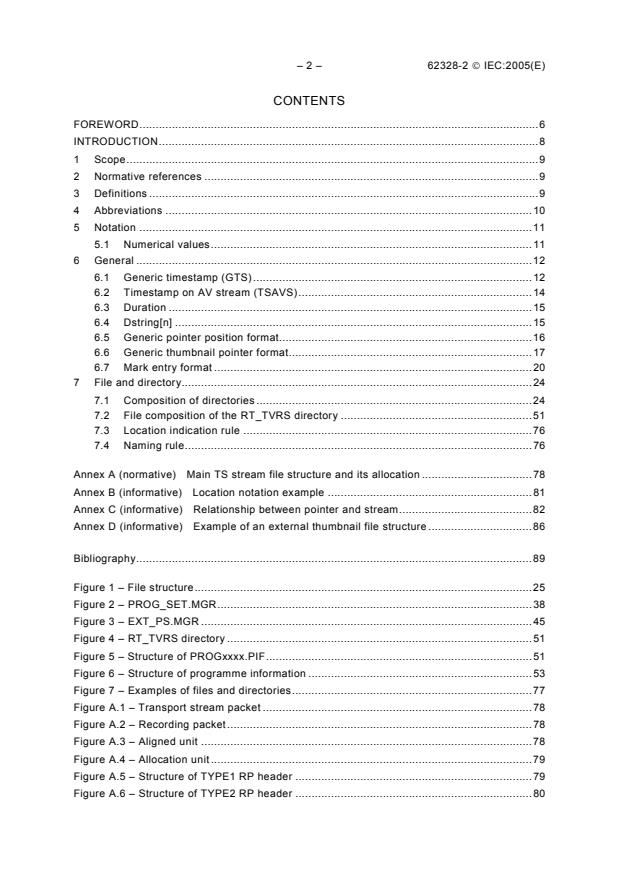
CONTENTS
FOREWORD.6
INTRODUCTION.8
1 Scope.9
2 Normative references .9
3 Definitions .9
4 Abbreviations .10
5 Notation .11
5.1 Numerical values.11
6 General .12
6.1 Generic timestamp (GTS).12
6.2 Timestamp on AV stream (TSAVS).14
6.3 Duration .15
6.4 Dstring[n] .15
6.5 Generic pointer position format.16
6.6 Generic thumbnail pointer format.17
6.7 Mark entry format .20
7 File and directory.24
7.1 Composition of directories .24
7.2 File composition of the RT_TVRS directory .51
7.3 Location indication rule .76
7.4 Naming rule.76
Annex A (normative) Main TS stream file structure and its allocation .78
Annex B (informative) Location notation example .81
Annex C (informative) Relationship between pointer and stream.82
Annex D (informative) Example of an external thumbnail file structure .86
Bibliography.89
Figure 1 – File structure.25
Figure 2 – PROG_SET.MGR.38
Figure 3 – EXT_PS.MGR .45
Figure 4 – RT_TVRS directory .51
Figure 5 – Structure of PROGxxxx.PIF.51
Figure 6 – Structure of programme information .53
Figure 7 – Examples of files and directories.77
Figure A.1 – Transport stream packet .78
Figure A.2 – Recording packet.78
Figure A.3 – Aligned unit .78
Figure A.4 – Allocation unit .79
Figure A.5 – Structure of TYPE1 RP header .79
Figure A.6 – Structure of TYPE2 RP header .80
62328-2 IEC:2005(E) – 3 –
Figure C.1 – Access unit point of video ES .82
Figure C.2 – Access unit point of recording packet .83
Figure C.3 – Module access unit point .83
Figure C.4 – Recording data packet access unit point.84
Figure C.5 – Relationship between mark point and AV stream .85
Figure D.1 – External thumbnail file structure .86
Table 1 – Structure of GTS .12
Table 2 – Structure of TTZ.12
Table 3 – Structure of EI.13
Table 4 – Day-of-week interpretation .13
Table 5 – Structure of TSAVS .14
Table 6 – Structure of AVTS .14
Table 7 – Frame rate interpretation.14
Table 8 – Structure duration .15
Table 9 – Structure of Dstring[n] .15
Table 10 – Interpretation of character set .16
Table 11 – Structure of GPPF .16
Table 12 – Structure of BASEP.16
Table 13 – Block_Length interpretation.17
Table 14 – Structure of LGTPF .17
Table 15 – Structure of TTYPE .18
Table 16 – Thumbnail compression type interpretation.18
Table 17 – Structure of SGTPF.19
Table 18 – Structure of LMEF .20
Table 19 – Mark type interpretation.21
Table 20 – Structure of FLMEF .21
Table 21 – Structure of PIDPLUS.22
Table 22 – PID_Type interpretation.23
Table 23 – Structure of SMEF.23
Table 24 – Structure of PGR.25
Table 25 – Structure of VER .26
Table 26 – Structure of PGRTYPE .26
Table 27 – Structure of PGRSA .29
Table 28 – PGR specific area TYPE interpretation .29
Table 29 – Structure of TYPE1 PGRSA.30
Table 30 – Structure of FL1 .30
Table 31 – Structure of TYPE 2 PGRSA.31
Table 32 – Structure of FL2 .32
Table 33 – TSI type interpretation.32
Table 34 – Structure of TYPE3 PGRSA.34
Table 35 – Structure of PGRG .34
Table 36 – Structure of VER .35
– 4 – 62328-2 IEC:2005(E)
Table 37 – Structure of PGRGTYPE .35
Table 38 – Structure of RMETYPE.37
Table 39 – Structure of PGRGSA.37
Table 40 – PGRG specific area TYPE interpretation .37
Table 41 – Structure of TYPE1 PGRGSA .38
Table 42 – Structure of PROG_SET.MGR.39
Table 43 – Structure of user interface entry information .39
Table 44 – PGR general information .40
Table 45 – Structure of PGRGIF .40
Table 46 – PGRG general information.41
Table 47 – Structure of PGRGGIF.41
Table 48 – Structure of PGReferences.43
Table 49 – Structure of PGRGroups.43
Table 50 – Structure of PGRG_xxxxxxxx stream file .44
Table 51 – Structure of FLPGRG .44
Table 52 – Structure of EXT_PS.MGR .45
Table 53 – Structure EI.46
Table 54 – File type of structure EI .47
Table 55 – Structure of FLEI .47
Table 56 – Structure of EISA .48
Table 57 – Extended info TYPE interpretation.48
Table 58 – Structure of TYPE1 EISA.48
Table 59 – Structure of MetaDataTable.49
Table 60 – Structure of MDE.49
Table 61 – MDE TYPE interpretation .49
Table 62 – Structure of MarkTable .50
Table 63 – Structure of programme management header .52
Table 64 – Structure of programme general information.53
Table 65 – Programme identification type interpretation.53
Table 66 – Recorded stream type interpretation.54
Table 67 – Service type interpretation.54
Table 68 – Structure of FLPGI .54
Table 69 – Structure of broadcasting TV programme information .55
Table 70 – BTVPI TYPE interpretation .55
Table 71 – Structure of recording information .56
Table 72 – Structure of component information .56
Table 73 – COMPI TYPE interpretation.56
Table 74 – Structure of time search information .57
Table 75 – Structure of TSIF.57
Table 76 – Structure of ACUIE.58
Table 77 – Structure of FLACUIE.59
Table 78 – Structure of PIDPLUS2.59
62328-2 IEC:2005(E) – 5 –
Table 79 – PID_Type Interpretation .59
Table 80 – Structure of ALUIE .60
Table 81 – Structure of TUIE .60
Table 82 – Structure of license information .61
Table 83 – Structure of LIF .61
Table 84 – Rights management specification identifier interpretation .62
Table 85 – Cipher algorithm interpretation .62
Table 86 – Structure of CASTYPE .62
Table 87 – Key length interpretation .63
Table 88 – TYPE 1 interpretation .63
Table 89 – Encrypted area on AV stream interpretation .63
Table 90 – CBC type interpretation .64
Table 91 – Structure of other information .65
Table 92 – Structure of OIF .65
Table 93 – Structure of AccessUnitInfo stream file.66
Table 94 – Structure of ACUE.66
Table 95 – Structure of ACUTP.67
Table 96 – PTYPE interpretation.67
Table 97 – Structure of AllocationUnitInfo stream file.68
Table 98 – Structure of ALUE .68
Table 99 – Structure of TimeUnitInfo stream file .68
Table 100 – Structure of TUE .69
Table 101 – Structure of CipherInfo stream file .69
Table 102 – Structure of CIF.69
Table 103 – LETYPE interpretation.70
Table 104 – Structure of LERE .70
Table 105 – Structure of LFLAG .71
Table 106 – Structure of IndexInfo stream file.72
Table 107 – Structure of IERE .73
Table 108 – Structure of DataInfo stream file .73
Table 109 – Structure DCE .74
Table 110 – Structure of *UDF_LICENSE stream file .74
Table 111 – Structure LR .75
Table D.1 – Structure of header .86
Table D.2 – Structure of ETFL .87
Table D.3 – Structure of thumbnail.87
Table D.4 – Structure of FMT.87
Table D.5 – DataType interpretation .88
– 6 – 62328-2 IEC:2005(E)
INTERNATIONAL ELECTROTECHNICAL COMMISSION
___________
MULTIMEDIA HOME SERVER SYSTEMS –
INTERCHANGEABLE VOLUME/FILE STRUCTURE ADAPTATION
FOR BROADCASTING RECEIVERS –
Part 2: General recording structure
FOREWORD
1) The International Electrotechnical Commission (IEC) is a worldwide organization for standardization comprising
all national electrotechnical committees (IEC National Committees). The object of IEC is to promote
international co-operation on all questions concerning standardization in the electrical and electronic fields. To
this end and in addition to other activities, IEC publishes International Standards, Technical Specifications,
Technical Reports, Publicly Available Specifications (PAS) and Guides (hereafter referred to as “IEC
Publication(s)”). Their preparation is entrusted to technical committees; any IEC National Committee interested
in the subject dealt with may participate in this preparatory work. International, governmental and non-
governmental organizations liaising with the IEC also participate in this preparation. IEC collaborates closely
with the International Organization for Standardization (ISO) in accordance with conditions determined by
agreement between the two organizations.
2) The formal decisions or agreements of IEC on technical matters express, as nearly as possible, an international
consensus of opinion on the relevant subjects since each technical committee has representation from all
interested IEC National Committees.
3) IEC Publications have the form of recommendations for international use and are accepted by IEC National
Committees in that sense. While all reasonable efforts are made to ensure that the technical content of IEC
Publications is accurate, IEC cannot be held responsible for the way in which they are used or for any
misinterpretation by any end user.
4) In order to promote international uniformity, IEC National Committees undertake to apply IEC Publications
transparently to the maximum extent possible in their national and regional publications. Any divergence
between any IEC Publication and the corresponding national or regional publication shall be clearly indicated in
the latter.
5) IEC provides no marking procedure to indicate its approval and cannot be rendered responsible for any
equipment declared to be in conformity with an IEC Publication.
6) All users should ensure that they have the latest edition of this publication.
7) No liability shall attach to IEC or its directors, employees, servants or agents including individual experts and
members of its technical committees and IEC National Committees for any personal injury, property damage or
other damage of any nature whatsoever, whether direct or indirect, or for costs (including legal fees) and
expenses arising out of the publication, use of, or reliance upon, this IEC Publication or any other IEC
Publications.
8) Attention is drawn to the Normative references cited in this publication. Use of the referenced publications is
indispensable for the correct application of this publication.
9) Attention is drawn to the possibility that some of the elements of this IEC Publication may be the subject of
patent rights. IEC shall not be held responsible for identifying any or all such patent rights.
International Standard IEC 62328-2 has been prepared by IEC technical committee 100:
Audio, video and multimedia systems and equipment.
The text of this standard is based on the following documents:
FDIS Report on voting
100/964A/FDIS 100/988/RVD
Full information on the voting for the approval of this standard can be found in the report on
voting indicated in the above table.
This publication has been drafted in accordance with the ISO/IEC Directives, Part 2.
62328-2 IEC:2005(E) – 7 –
IEC 62328 consists of the following parts, under the general title Multimedia home server
systems – Interchangeable volume/file structure adaptation for broadcasting receivers:
Part 1: General description and architecture
Part 2: General recording structure
Part 3: Broadcasting system specific recording structure - ISDB
The committee has decided that the contents of this publication will remain unchanged until
the maintenance result date indicated on the IEC web site under "http://webstore.iec.ch" in
the data related to the specific publication. At this date, the publication will be
• reconfirmed;
• withdrawn;
• replaced by a revised edition, or
• amended.
A bilingual version of this publication may be issued at a later date.
– 8 – 62328-2 IEC:2005(E)
INTRODUCTION
Broadcast data in a transport stream can contain multiple associated objects. When that data
is distributed on interchangeable storage media, for example, optical disks, the associated
objects should be synchronized. Open distribution of the media requires that the data be
adapted to a standardized volume and file structure, which should conform to the existing
basic volume and file structure.
62328-2 IEC:2005(E) – 9 –
MULTIMEDIA HOME SERVER SYSTEMS –
INTERCHANGEABLE VOLUME/FILE STRUCTURE ADAPTATION
FOR BROADCASTING RECEIVERS –
Part 2: General recording structure
1 Scope
This part of IEC 62328 defines the volume and file structure required for interchanging
multimedia data of a home server/broadcasting receiver, which consists of an AV stream with
multiple associated objects.
2 Normative references
The following referenced documents are indispensable for the application of this document.
For dated references, only the edition cited applies. For undated references, the latest edition
of the referenced document (including any amendments) applies.
IEC 62328-1: Multimedia home service systems – Interchangeable volume/file structure
adaptation for broadcasting receivers – Part 1: General description and architecture
IEC 62328-3: Multimedia home service systems – Interchangeable volume/file structure
adaptation for broadcasting receivers – Part 3: Broadcasting system specific recording
structure – ISDB
ISO/IEC 646:1991, Information technology – ISO 7-bit coded character set for information
interchange
ISO/IEC 10918-1:1994, Information technology – Digital compression and coding of
continuous-tone still images: Requirements and guidelines
ISO/IEC 13818-2:2000, Information technology – Generic coding of moving pictures and
associated audio information: Video
3 Definitions
For the purposes of this document, the following terms and definitions apply.
3.1
action
duration from start to end defined by a user or equipment
3.2
AV stream
recorded data in the MainTS stream file of PROGxxxx.PIF in this specification or the general
meaning as multiplexed digital audio and video
3.3
AV stream sequence
sequence of AV stream(s) pointed by the orderly set of pointers to the part of a MainTS
stream file
– 10 – 62328-2 IEC:2005(E)
3.4
component
elementary stream contained in a TV programme
3.5
event
set of video and/or audio stream data and/or related objects, which together form a
broadcasting service in the duration defined by a broadcaster
3.6
partial TS
TS derived from broadcasting TS by modifying PSI/SI and/or removing one or more
elementary streams
3.7
programme
recorded TV programme compliant with this specification
3.8
programme reference(PGR)
pointer which references all or a part of AV stream in a programme
3.9
programme reference group(PGRG)
set of programme references or a set of programme reference groups
3.10
transport stream(TS)
system stream for broadcasting defined in ISO/IEC13818-1
3.11
TV programme
logical unit of TV broadcasting (event in digital TV service)
3.12
TVRS partial TS
partial TS recording format which complies with this specification
4 Abbreviations
For the purposes of this document, the following abbreviations apply.
ACU Access unit
ALU Allocation unit
AES Advanced encryption standard
ATSC Advanced television systems committee
BP Byte position within a file starting with zero
CBC Cipher block chaining
CCI Copy control information
CD Compact disc
DVD Digital versatile disc
DES Data encryption standard
DSM-CC Digital storage media command and control
62328-2 IEC:2005(E) – 11 –
DVB Digital video broadcasting
ES Elementary stream
GOP Group of pictures
HDD Hard disk drive
IRV International reference version
ISDB Integrated services digital broadcasting
MO Magneto-optical disk
MPEG Moving picture experts group
PES Packetized elementary stream
PGR Programme reference
PGRG Programme reference group
PID Packet identifier
PSI Programme-specific information
RBP Relative byte position within a file starting with zero
RP Recording packet
SI Service information
STB Set top box
TS Transport stream
TU Time unit
TVRS TV recording format specific
UDF Universal disk format
5 Notation
5.1 Numerical values
5.1.1 Decimal notation
A decimal number is represented as decimal digits 0 to 9.
5.1.2 Hexadecimal notation
A hexadecimal number is represented as hexadecimal digits 0 to 9 and A to F prefixed by the
symbol “0x”.
5.1.3 Binary notation
A binary number is represented as binary digits 0 to 1 suffixed by the symbol “b”.
5.1.4 Bit string
A bslbf shall be recorded as bit string, left bit first.
5.1.5 Unsigned numerical value
A uimsbf shall be unsigned integer, most significant bit first.
– 12 – 62328-2 IEC:2005(E)
6 General
6.1 Generic timestamp (GTS)
The structure of GTS is described in Table 1.
Table 1 – Structure of GTS
RBP Length
Field name Contents
in bytes
0 1 TYPE and time zone TTZ
1 1 Extended information EI
2 1 Year (from 1900) uimsbf
3 1 Month uimsbf
4 1 Day uimsbf
5 1 Hour uimsbf
6 1 Minutes uimsbf
7 1 Seconds uimsbf
6.1.1 Type and time zone (RBP0)
The structure of TTZ is described in Table 2.
Table 2 – Structure of TTZ
bit7 bit6 bit5 bit4 bit3 bit2 bit1 bit0
L/G TZ P/M TZ Offset[3.0] HF DSTF
6.1.1.1 L/G (bit7) [bslbf]
If the local time is applied, the L/G bit shall be set to 1b. If the coordinated universal time
(global time) is applied, the L/G bit shall be 0b.
6.1.1.2 TZ P/M (bit6) [bslbf]
If the local time is ahead of the coordinated universal time, the TZ P/M bit shall be set to 1b. If
the local time is behind the coordinated universal time, the TZ P/M bit shall be 0b. If the L/G
bit is 0b, this means that the coordinated universal time is applied – this bit shall be ignored.
6.1.1.3 TZ offset [3.0] (bit5-2) [uimsbf]
This 4-bit value specifies the offset, in hours, of the date and time of the day from the
coordinated universal time. This offset is an absolute value.
6.1.1.4 HF (bit1) [bslbf]
If this HF bit is set to 1b, the TZ offset has a half-hour additional time. If this HF bit is set to
0b, the TZ offset has no additional time.
62328-2 IEC:2005(E) – 13 –
6.1.1.5 DSTF (bit0) [bslbf]
If this DSTF bit is set to 1b, the daylight saving time is applied by the time zone. If this DSTF
bit is set to 0b, the standard time is applied by the time zone.
6.1.2 Extended information (RBP1)
The structure of EI is described in Table 3.
Table 3 – Structure of EI
bit7 bit6 bit5 bit4 bit3 bit2 bit1 bit0
Day of week[2.0] Reserved
6.1.2.1 Day of week [2.0] (bit7-5) [uimsbf]
The day of the week is stored. The 3-bit interpretation is described in Table 4.
Table 4 – Day-of-week interpretation
Value Interpretation
0x0 The day of week is not specified in this field
0x1 Sunday
0x2 Monday
0x3 Tuesday
0x4 Wednesday
0x5 Thursday
0x6 Friday
0x7 Saturday
6.1.2.2 Reserved (bit4-0) [bslbf]
These bits are reserved for future standardization and all bits shall be set to 0b.
6.1.3 Year (RBP2)
This field shall specify the year as an offset value from 1900.
6.1.4 Month (RBP3)
This field shall specify the month of the year as a number in the range 1 to 12.
6.1.5 Day (RBP4)
This field shall specify the day of the month as a number in the range 1 to 31.
6.1.6 Hour (RBP5)
This field shall specify the hour of the day as a number in the range 0 to 23.
6.1.7 Minute (RBP6)
This field shall specify the minute of the hour as a number in the range 0 to 59.
– 14 – 62328-2 IEC:2005(E)
6.1.8 Second (RBP7)
This field shall specify the second of the minute as a number in the range 0 to 59.
6.2 Timestamp on AV stream (TSAVS)
The structure of TSAVS is described in Table 5.
Table 5 – Structure of TSAVS
RBP Length
Field name Contents
in bytes
0 4 AV stream timestamp AVTS
6.2.1 AV stream timestamp (RBP0)
The structure of AVTS is described in Table 6.
Table 6 – Structure of AVTS
bit31 bit30 bit29 bit28 bit27 bit26 bit25 bit24
Frame_Rate[3.0] Number of frames[27.24]
bit23 bit22 bit21 bit20 bit19 bit18 bit17 bit16
Number of frames[23.16]
bit15 bit14 bit13 bit12 bit11 bit10 bit9 bit8
Number of frames[15.8]
bit7 bit6 bit5 bit4 bit3 bit2 bit1 bit0
Number of frames[7.0]
6.2.1.1 Frame rate[3.0] (bit31-28) [uimsbf]
The frame rate of the pointed AV stream is stored. The 4-bit interpretation is described in
Table 7.
Table 7 – Frame rate interpretation
Value Interpretation
0x0 Frame rate is NOT specified in this field
0x1 24/1,001 (23,976)Hz
0x2 24 Hz
0x3 25 Hz
0x4 30/1,001 (29,97)Hz
0x5 30
0x6 50
0x7 60/1,001 (59,94)Hz
0x8 60
0x9 - 0xF Reserved
62328-2 IEC:2005(E) – 15 –
6.2.1.2 Number of frames [27.0] (bit27-0) [uimsbf]
This 27-bit value specifies the number of frames from the beginning of pointed AV stream.
6.3 Duration
The structure duration is described in Table 8.
Table 8 – Structure duration
RBP Length
Field name Contents
in bytes
0 1 Day uimsbf
1 1 Hour uimsbf
2 1 Minutes uimsbf
3 1 Seconds uimsbf
6.3.1 Day (RBP0)
This field shall specify the day as a number in the range 0 to 255.
6.3.2 Hour (RBP1)
This field shall specify the hour of the day as a number in the range 0 to 23.
6.3.3 Minute (RBP2)
This field shall specify the minute of the hour as a number in the range 0 to 59.
6.3.4 Second (RBP3)
This field shall specify the second of the minute as a number in the range 0 to 59.
6.4 Dstring[n]
A Dstring[n] is a field where a string can be recorded. “n” in Dstring[n] is the unsigned integer
and shall be the same as the value of character string field size. The character string field
size shall be equal to n. The character set of the string is defined in the character set field.
The structure of Dstring[n] is described in Table 9.
Table 9 – Structure of Dstring[n]
RBP Length
Field name Contents
in bytes
0 1 Character set uimsbf
1 3 Reserved bslbf
4 2 Character string field size uimsbf
6 2 Length of character string uimsbf
8 n Character strings bslbf
– 16 – 62328-2 IEC:2005(E)
6.4.1 Character set
The format of the character set is described in Table 10.
Table 10 – Interpretation of character set
Value Character set
0x00-0xFF The interpretation is specified in IEC
62328-3
6.4.2 Reserved
This field shall be reserved for future standardization and all bytes shall be set to 0× 00.
6.4.3 Character string field size
Character string field size in bytes shall be stored in this field.
6.4.4 Length of character string
The length of character string in bytes shall be stored in this field.
6.4.5 Character strings
Character strings coded by the character set defined in character set field are stored.
6.5 Generic pointer position format
The structure of GPPF is described in Table 11.
Table 11 – Structure of GPPF
RBP Length
Field name Contents
in bytes
0 4 Base position BASEP
4 2 Offset positionuimsbf
6.5.1.1 Base position
The structure of BASEP is described in Table 12.
Table 12 – Structure of BASEP
bit31 bit30 bit29 bit28 bit27 bit26 bit25 bit24
Block_Length[2.0] Number of blocks[28.24]
bit23 bit22 bit21 bit20 bit19 bit18 bit17 bit16
Number of blocks[23.16]
bit15 bit14 bit13 bit12 bit11 bit10 bit9 bit8
Number of blocks[15.8]
bit7 bit6 bit5 bit4 bit3 bit2 bit1 bit0
Number of blocks[7.0]
62328-2 IEC:2005(E) – 17 –
6.5.1.1.1 Block_Length [2.0] (bit31-29) [uimsbf]
The length of the block is stored. The 3-bit interpretation is described in Table 13.
Table 13 – Block_Length interpretation
Value Interpretation
0x0 The block length is 1 byte
0x1 The block length is 192 bytes (size of RP packet)
0x2 The block length is 512 bytes (size of sector)
0x3 The block length is 2048 bytes (size of sector)
0x4 The block length is 6144 bytes (size of aligned
unit)
0x5-0x7 Reserved
6.5.1.1.2 Num_of_Blocks [28.0] (bit28-0) [uimsbf]
The base position based on the block defined in the Block_Length field shall be stored. The
base position in bytes equals the block length defined in the Block_Length field multiplied by
the value of the Num_of_Blocks field.
6.5.1.2 Offset position
Offset bytes from the base position shall be stored.
6.6 Generic thumbnail pointer format
6.6.1 Long generic thumbnail pointer format
The structure of LGTPF is defined in Table 14.
Table 14 – Structure of LGTPF
RBP Length
Field Name Contents
in bytes
0 1 Thumbnail type TTYPE
1 1 Thumbnail compression type uimsbf
2 2 Thumbnail horizontal size uimsbf
4 2 Thumbnail vertical size uimsbf
6 136 Thumbnail pointer location Dstring[128]
142 6 Thumbnail pointer position GPPF
148 4 Thumbnail pointer size uimsbf
152 136 Thumbnail file location Dstring[128]
288 8 File offset of target thumbnail uimsbf
296 4 Length of target thumbnail uimsbf
6.6.1.1 Thumbnail type (TTYPE)
The structure of TTYPE is described in Table 15.
– 18 – 62328-2 IEC:2005(E)
Table 15 – Structure of TTYPE
Bit7 bit6 bit5 bit4 bit3 bit2 bit1 bit0
V NC L/S P/EF Reserved
6.6.1.1.1 V (bit7) [bslbf]
If the thumbnail is defined by either the pointer to an AV stream file or an external file, the V
bit shall be set to 1b. If the thumbnail is not indicated, the V bit shall be set to 0b.
6.6.1.1.2 NC (bit6) [bslbf]
If a change of the thumbnail is prohibited by a user or the equipment, the NC bit shall be set
to 1b. Otherwise, the NC bit shall be 0b.
6.6.1.1.3 L/S (bit5) [bslbf]
If the thumbnail format is the long generic thumbnail pointer format, this bit shall be set to 1b.
If the thumbnail format is the short generic thumbnail pointer format, this bit shall be set to 0b.
6.6.1.1.4 P/EF (bit 4) [bslbf]
If the thumbnail is defined by the pointer to an AV stream file, the P/EF bit shall be set to 1b.
If the thumbnail is stored by the part of an external file, the P/EF bit shall be set to 0b.
6.6.1.1.5 Reserved (bit 3-0) [bslbf]
These bits are reserved for future use and shall be 0b.
6.6.1.2 Thumbnail compression type
The interpretation of the thumbnail compression type is described in Table 16. This field is
valid only when the thumbnail is indicated by an external file.
Table 16 – Thumbnail compression type interpretation
Thumbnail
compression Interpretation
type
0x0 The thumbnail compression type is not specified in
this field
0x1 ISO/IEC 10918-1(JPEG)
0x2 MPEG2-I (video ES prefixed by a sequence header)
0x3 - 0xFF Reserved
6.6.1.3 Thumbnail horizontal size
The number of the horizontal pixels of the thumbnail shall be stored. This is not a display size
but a size of the stored thumbnail.
6.6.1.4 Thumbnail vertical size
The number of the vertical pixels of the thumbnail shall be stored. This is not a display size
but a size of the stored thumbnail.
62328-2 IEC:2005(E) – 19 –
6.6.1.5 Thumbnail pointer location
If the thumbnail is defined by the pointer to an AV stream file, the location of an AV stream file
shall be stored in this field. The location identification rule described in 7.3 shall be applied. If
the P/EF bit in the thumbnail type field is 0b, this field shall be ignored.
6.6.1.6 Thumbnail pointer position
If the thumbnail is defined by the pointer to an AV stream file, the start position of an AV
stream file shall be stored in this field. The start point of an AV stream described in Annex C
should be referred. If the P/EF bit in the thumbnail type field is 0b, this field shall be ignored.
6.6.1.7 Thumbnail pointer size
If the thumbnail is defined by the pointer to an AV stream file, the size in bytes shall be stored
in this field. The size of an AV stream described in Annex C should be referred. If the P/EF bit
in the thumbnail type field is 0b, this field shall be ignored.
6.6.1.8 Thumbnail file location
If the thumbnail is stored in an external file, the location of an external file shall be stored in
this field. The location identification rule described in 7.3 shall be applied. If the P/EF bit in
the thumbnail type field is 1b, this field shall be ignored. The example of an ext
...