

IEC 60851-4:1996/AMD1:1997
(Amendment)Amendment 1 - Methods of test for winding wires - Part 4: Chemical properties
General Information
- Abstract
- Status
- Published
- Publication Date
- 04-Sep-1997
- Technical Committee
- TC 55 - Winding wires
- Drafting Committee
- WG 1 - TC 55/WG 1
- Current Stage
- DELPUB - Deleted Publication
- Start Date
- 06-Jul-2016
- Completion Date
- 28-Aug-2026
Overview
IEC 60851-4:1996/AMD1:1997 is the first amendment to the international standard that specifies test methods for chemical properties of winding wires, particularly focusing on enamelled wires used in electrical applications. Published by the International Electrotechnical Commission (IEC), this amendment enhances the testing procedures to assess the resistance of winding wires to hydrolysis and transformer oil exposure under specific conditions. The standard ensures that winding wires maintain chemical stability, mechanical integrity, and electrical insulation properties when subjected to demanding operating environments.
Key Topics
Resistance to Hydrolysis
Hydrolysis resistance is evaluated by examining the appearance and adherence of wire specimens after exposure to transformer oil containing water under pressure at elevated temperatures. This simulates real-world conditions where moisture and oil impact winding wire coatings.Resistance to Transformer Oil
The standard assesses the wire’s durability by measuring the breakdown voltage and flexibility after prolonged exposure to transformer oil under pressure and high temperature, ensuring the enamel coating withstands chemical degradation without losing electrical performance.Specimen Preparation and Types
Testing includes various specimen forms for both round and rectangular conductor wires: straight pieces, twisted pairs, U-shaped specimens, and mandrel wound specimens based on IEC 60851 methods. These ensure comprehensive evaluation of coating performance under different mechanical stresses.Testing Equipment and Conditions
The testing setup mandates the use of sealable glass tubes, stainless steel pressure vessels with controlled heating systems, and standard transformer oil per IEC 60296. Parameters include- Temperature: 150 °C ± 3 °C
- Duration: 24 hours for hydrolysis testing, 1000 hours for oil resistance
- Pressure: Specified high-pressure conditions to mimic operational environments
Preconditioning of Materials
Papers used in testing must be dried at controlled pressures and temperatures to standardize conditions prior to oil exposure tests, ensuring repeatability.
Applications
This amendment to IEC 60851-4 is critical for manufacturers and quality assurance teams involved in:
- Manufacture of enamelled winding wires for electric motors, transformers, coils, and other electromagnetic devices.
- Reliability testing and certification of electrical insulation materials under chemical stress conditions.
- Research and development of new enamel coatings aimed at improving resistance to moisture and transformer oils.
- Ensuring long-term performance and durability of electric components in power generation and distribution systems, industrial machinery, and household appliances.
By adhering to this standard, producers can ensure their winding wires meet stringent chemical resistance criteria, reducing failures due to insulation degradation and extending the service life of electrical equipment.
Related Standards
- IEC 60851-3: Methods for testing the mechanical properties of winding wires, including mandrel bending tests referenced in specimen preparation.
- IEC 60851-5: Defines preparations and electrical testing methods for twisted pairs and U-shaped specimens used in breakdown voltage evaluations.
- IEC 60296: Specifies the characteristics and quality requirements of transformer oil, the fluid used during chemical resistance testing.
- IEC 60554-1: Defines test papers used for electrical insulation testing, ensuring consistency in sample preparation.
This amendment complements and refines the comprehensive framework for electrical winding wire testing, ensuring stakeholders can verify chemical stability and electrical insulation performance as crucial factors for high-quality, durable winding wires.
By applying IEC 60851-4 Amendment 1 protocols, electrical wire manufacturers and users strengthen product reliability and safety, supporting innovation in electric insulation technologies.
Relations
- Effective Date
- 05-Sep-2023
- Effective Date
- 05-Sep-2023
Get Certified
Connect with accredited certification bodies for this standard

IMQ S.p.A. (Certification)
Italian electrical product certification.

SLG Prüf- und Zertifizierungs GmbH
German testing and certification body.

UL Solutions
Global safety science company with testing, inspection and certification.
Sponsored listings
Frequently Asked Questions
IEC 60851-4:1996/AMD1:1997 is a standard published by the International Electrotechnical Commission (IEC). Its full title is "Amendment 1 - Methods of test for winding wires - Part 4: Chemical properties". This standard covers: Amendment 1 - Methods of test for winding wires - Part 4: Chemical properties
Amendment 1 - Methods of test for winding wires - Part 4: Chemical properties
IEC 60851-4:1996/AMD1:1997 is classified under the following ICS (International Classification for Standards) categories: 29.060.10 - Wires. The ICS classification helps identify the subject area and facilitates finding related standards.
IEC 60851-4:1996/AMD1:1997 has the following relationships with other standards: It is inter standard links to IEC 60851-4:1996, IEC 60851-4:2016. Understanding these relationships helps ensure you are using the most current and applicable version of the standard.
IEC 60851-4:1996/AMD1:1997 is available in PDF format for immediate download after purchase. The document can be added to your cart and obtained through the secure checkout process. Digital delivery ensures instant access to the complete standard document.
Standards Content (Sample)
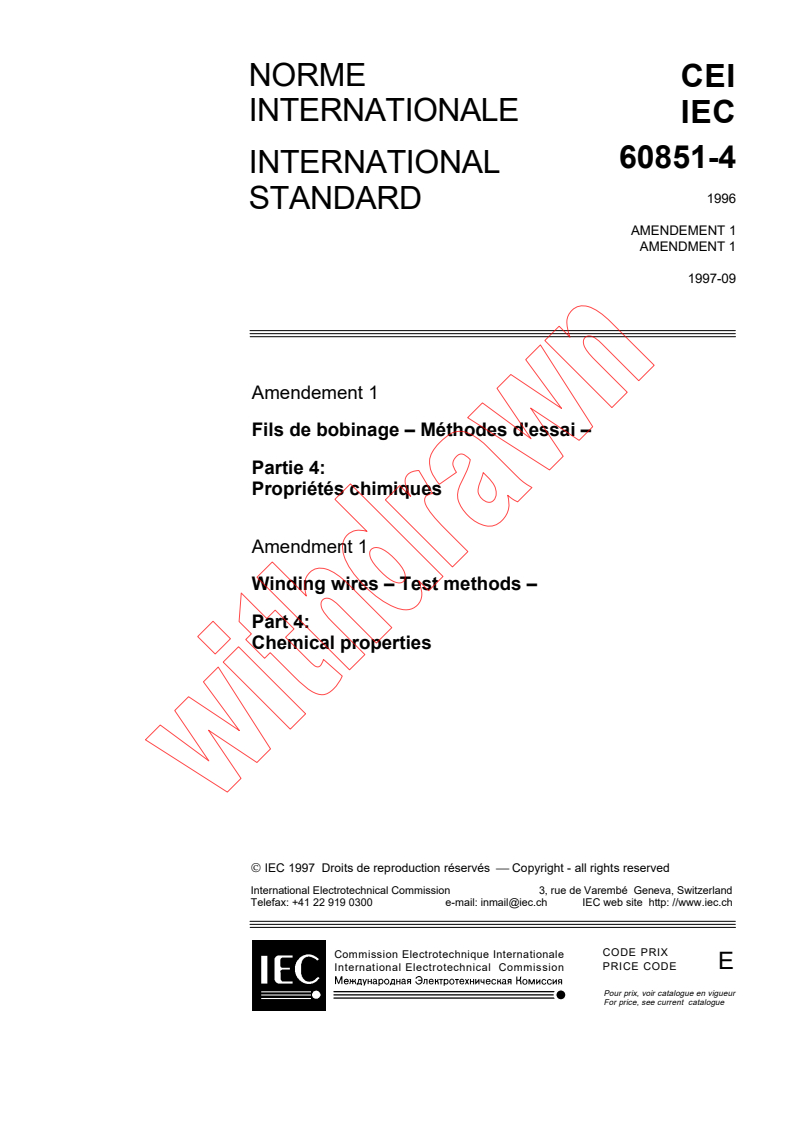
NORME
CEI
INTERNATIONALE
IEC
60851-4
INTERNATIONAL
STANDARD
AMENDEMENT 1
AMENDMENT 1
1997-09
Amendement 1
Fils de bobinage – Méthodes d'essai –
Partie 4:
Propriétés chimiques
Amendment 1
Winding wires – Test methods –
Part 4:
Chemical properties
IEC 1997 Droits de reproduction réservés Copyright - all rights reserved
International Electrotechnical Commission 3, rue de Varembé Geneva, Switzerland
Telefax: +41 22 919 0300 e-mail: inmail@iec.ch IEC web site http: //www.iec.ch
CODE PRIX
Commission Electrotechnique Internationale
PRICE CODE E
International Electrotechnical Commission
Pour prix, voir catalogue en vigueur
For price, see current catalogue
– 2 – 60851-4 amend. 1 © CEI:1997
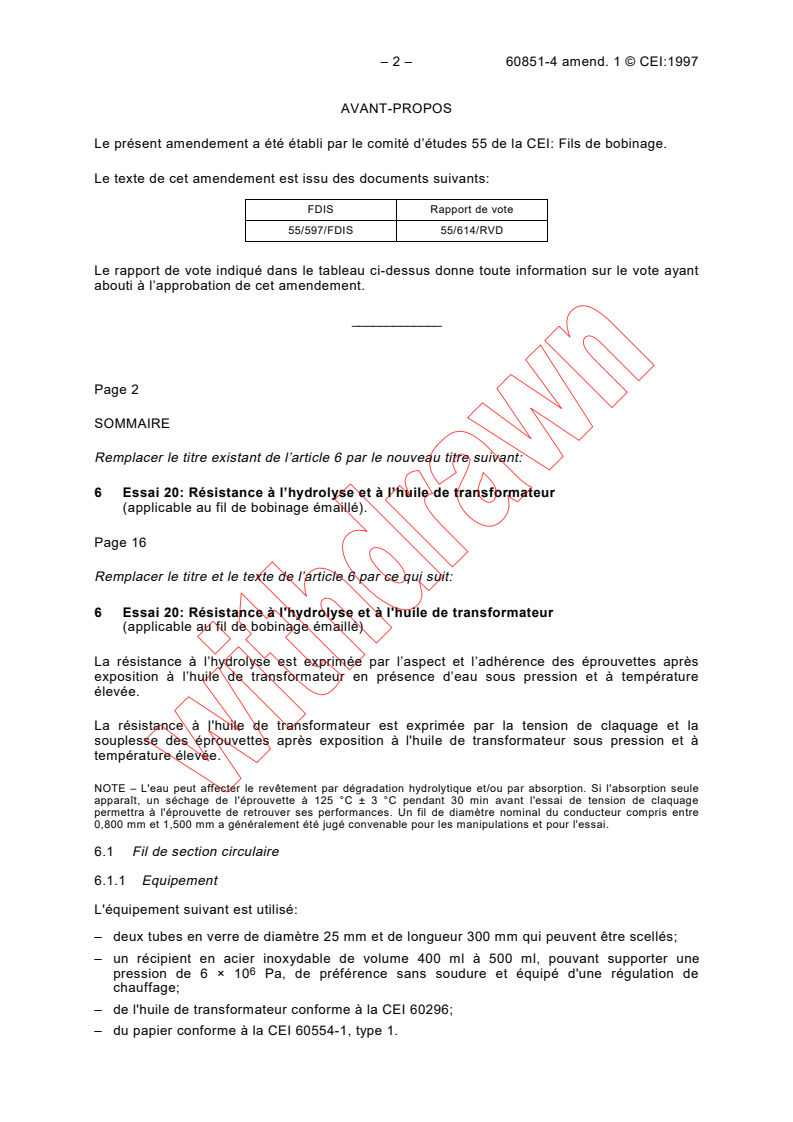
AVANT-PROPOS
Le présent amendement a été établi par le comité d’études 55 de la CEI: Fils de bobinage.
Le texte de cet amendement est issu des documents suivants:
FDIS Rapport de vote
55/597/FDIS 55/614/RVD
Le rapport de vote indiqué dans le tableau ci-dessus donne toute information sur le vote ayant
abouti à l’approbation de cet amendement.
_____________
Page 2
SOMMAIRE
Remplacer le titre existant de l’article 6 par le nouveau titre suivant:
6 Essai 20: Résistance à l’hydrolyse et à l’huile de transformateur
(applicable au fil de bobinage émaillé).
Page 16
Remplacer le titre et le texte de l’article 6 par ce qui suit:
6 Essai 20: Résistance à l'hydrolyse et à l'huile de transformateur
(applicable au fil de bobinage émaillé)
La résistance à l’hydrolyse est exprimée par l’aspect et l’adhérence des éprouvettes après
exposition à l’huile de transformateur en présence d’eau sous pression et à température
élevée.
La résistance à l'huile de transformateur est exprimée par la tension de claquage et la
souplesse des éprouvettes après exposition à l'huile de transformateur sous pression et à
température élevée.
NOTE – L'eau peut affecter le revêtement par dégradation hydrolytique et/ou par absorption. Si l'absorption seule
apparaît, un séchage de l'éprouvette à 125 °C ± 3 °C pendant 30 min avant l'essai de tension de claquage
permettra à l'éprouvette de retrouver ses performances. Un fil de diamètre nominal du conducteur compris entre
0,800 mm et 1,500 mm a généralement été jugé convenable pour les manipulations et pour l'essai.
6.1 Fil de section circulaire
6.1.1 Equipement
L'équipement suivant est utilisé:
– deux tubes en verre de diamètre 25 mm et de longueur 300 mm qui peuvent être scellés;
– un récipient en acier inoxydable de volume 400 ml à 500 ml, pouvant supporter une
pression de 6 × 10 Pa, de préférence sans soudure et équipé d'une régulation de
chauffage;
– de l'huile de transformateur conforme à la CEI 60296;
– du papier conforme à la CEI 60554-1, type 1.
60851-4 Amend. 1 © IEC:1997 – 3 –
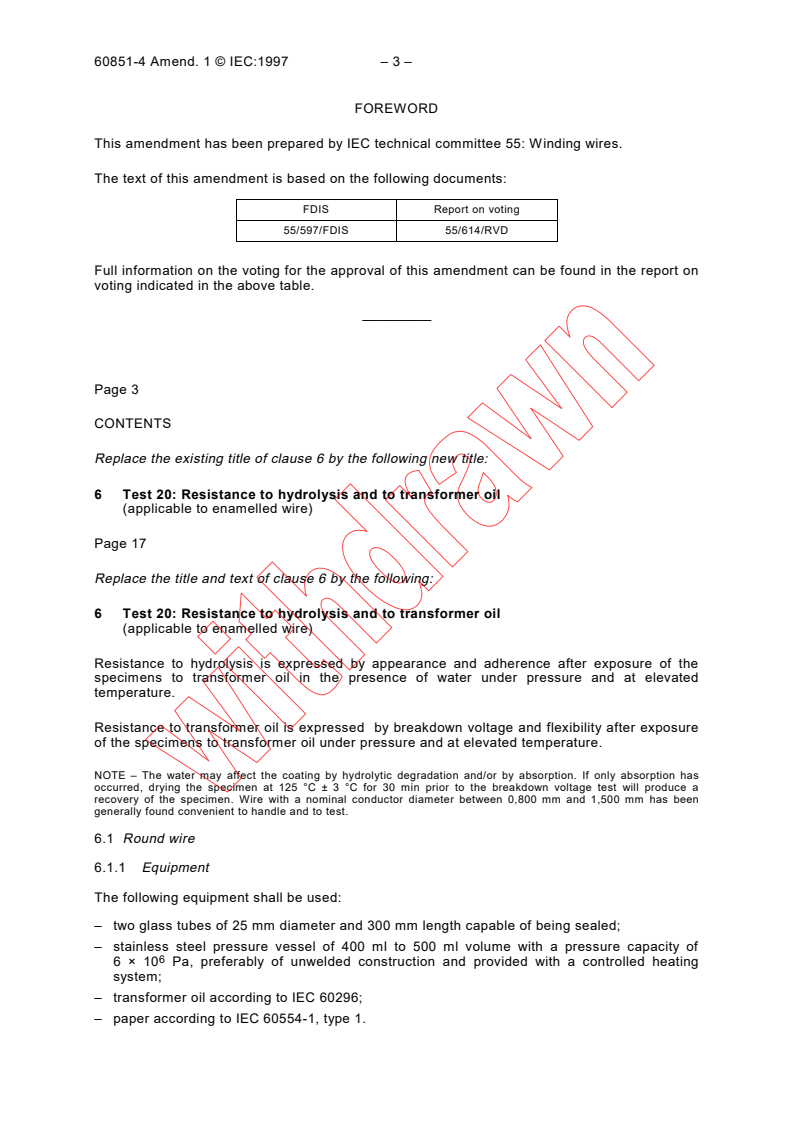
FOREWORD
This amendment has been prepared by IEC technical committee 55: Winding wires.
The text of this amendment is based on the following documents:
FDIS Report on voting
55/597/FDIS 55/614/RVD
Full information on the voting for the approval of this amendment can be found in the report on
voting indicated in the above table.
––––––––––
Page 3
CONTENTS
Replace the existing title of clause 6 by the following new title:
6 Test 20: Resistance to hydrolysis and to transformer oil
(applicable to enamelled wire)
Page 17
Replace the title and text of clause 6 by the following:
6 Test 20: Resistance to hydrolysis and to transformer oil
(applicable to enamelled wire)
Resistance to hydrolysis is expressed by appearance and adherence after exposure of the
specimens to transformer oil in the presence of water under pressure and at elevated
temperature.
Resistance to transformer oil is expressed by breakdown voltage and flexibility after exposure
of the specimens to transformer oil under pressure and at elevated temperature.
NOTE – The water may affect the coating by hydrolytic degradation and/or by absorption. If only absorption has
occurred, drying the specimen at 125 °C ± 3 °C for 30 min prior to the breakdown voltage test will produce a
recovery of the specimen. Wire with a nominal conductor diameter between 0,800 mm and 1,500 mm has been
generally found convenient to handle and to test.
6.1 Round wire
6.1.1 Equipment
The following equipment shall be used:
– two glass tubes of 25 mm diameter and 300 mm length capable of being sealed;
– stainless steel pressure vessel of 400 ml to 500 ml volume with a pressure capacity of
6 × 10 Pa, preferably of unwelded construction and provided with a controlled heating
system;
– transformer oil according to IEC 60296;
– paper according to IEC 60554-1, type 1.
– 4 – 60851-4 amend. 1 © CEI:1997
6.1.2 Eprouvettes
Les éprouvettes suivantes sont préparées:
– 12 longueurs droites de fil d'environ 200 mm de long;
– 10 éprouvettes torsadées préparées conformément à 4.4.1 de la CEI 60851-5;
– trois éprouvettes enroulées sur mandrin préparées conformément à 5.1.1 de la CEI 60851-3.
6.1.3 Procédure
6.1.3.1 Résistance à l'hydrolyse
Chacun des tubes est chargé avec six longueurs droites de fil conformes à 6.1.2 et avec 80 ml
d'huile de transformateur séchée et désaérée. Dans l'un des tubes on ajoute 0,24 ml ± 0,01 ml
d'eau distillée. Les deux tubes sont scellés et placés dans une étuve pendant 24 h à 150 °C ± 3 °C.
Les tubes sont alors retirés de l'étuve et laissés refroidir à température ambiante puis ouverts.
Les éprouvettes sont examinées en vision normale.
Un seul essai est effectué. Les changements d'aspect et d'adhérence sont notés.
6.1.3.2 Résistance à l'huile de transformateur
Le récipient supportant la pression sera chargé avec les éléments indiqués au tableau 1, sauf
autres conditions conformes à l'accord préalable entre utilisateur et fournisseur.
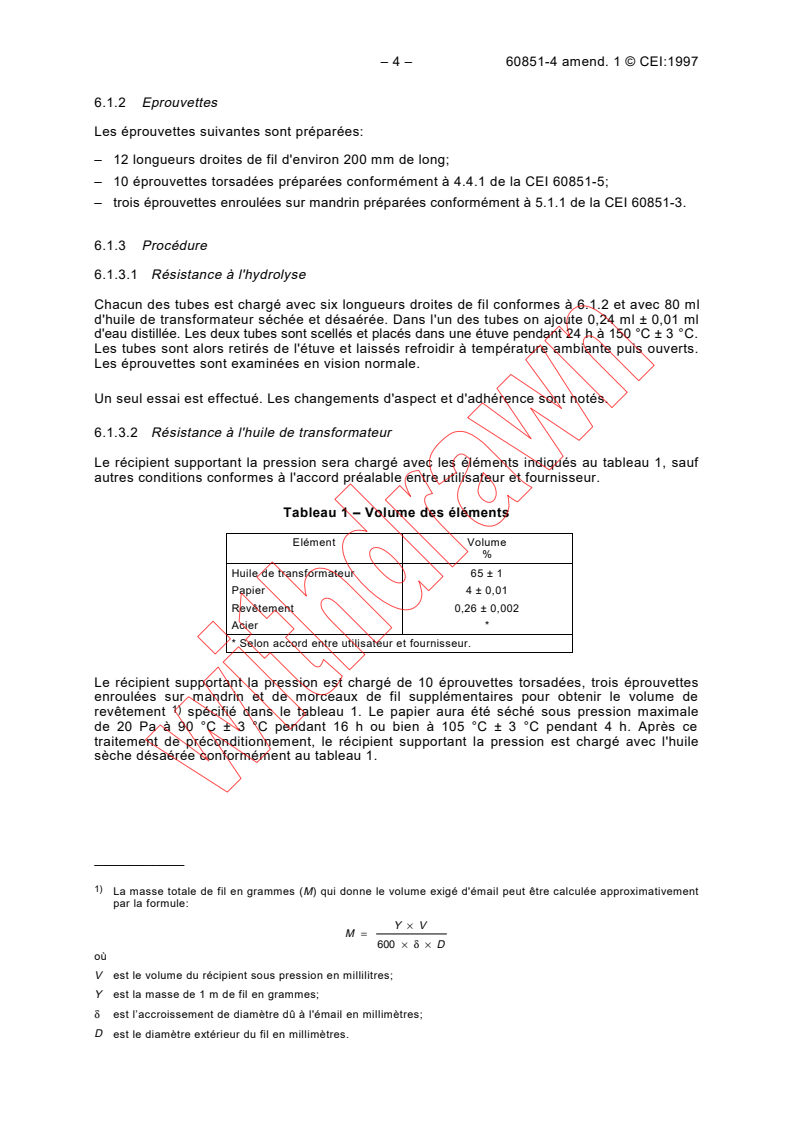
Tableau 1 – Volume des éléments
Elément Volume
%
Huile de transformateur 65 ± 1
Papier 4 ± 0,01
Revêtement 0,26 ± 0,002
Acier *
* Selon accord entre utilisateur et fournisseur.
Le récipient supportant la pression est chargé de 10 éprouvettes torsadées, trois éprouvettes
enroulées sur mandrin et de morceaux de fil supplémentaires pour obtenir le volume de
1)
revêtement spécifié dans le tableau 1. Le papier aura été séché sous pression maximale
de 20 Pa à 90 °C ± 3 °C pendant 16 h ou bien à 105 °C ± 3 °C pendant 4 h. Après ce
traitement de préconditionnement, le récipient supportant la pression est chargé avec l'huile
sèche désaérée conformément au tableau 1.
–––––––––––––
1)
La masse totale de fil en grammes (M) qui donne le volume exigé d'émail peut être calculée approximativement
par la formule:
Y V
×
M =
600 ××δ D
où
V est le volume du récipient sous pression en millilitres;
Y est la masse de 1 m de fil en grammes;
δ est l’accroissement de diamètre dû à l'émail en millimètres;
D est le diamètre extérieur du fil en millimètres.
60851-4 Amend. 1 © IEC:1997 – 5 –
6.1.2 Specimens
The following specimens shall be prepared:
– 12 straight pieces of wire about 200 mm in length;
– 10 twisted pair specimens prepared in accordance with 4.4.1 of IEC 60851-5;
– three mandrel wound specimens prepared in accordance with 5.1.1 of IEC 60851-3.
6.1.3 Procedure
6.1.3.1 Resistance to hydrolysis
Each of the tubes shall be charged with six straight pieces of wire according to 6.1.2 and 80 ml
de-aerated dry transformer oil. To one of the tubes, 0,24 ml ± 0,01 ml of distilled water shall be
added. The two tubes shall be sealed and placed in an oven for 24 h at 150 °C ± 3 °C. The
tubes shall then be removed from the oven, allowed to cool down to room temperature and
opened. The specimens shall be examined with normal vision.
One test shall be made. Any changes in appearance and adherence shall be reported.
6.1.3.2 Resistance to transformer oil
The pressure vessel shall be charged with components according to table 1 unless otherwise
agreed between purchaser and supplier.
Table 1 – Volume of components
Component Volume
%
Transformer oil 65 ± 1
Paper 4 ± 0,01
Coating 0,26 ± 0,002
Steel *
* By agreement between purchaser and supplier.
The pressure vessel shall contain 10 twisted pair specimens, three mandrel wound specimens
1)
and extra pieces of wire to arrive at the volume of coating specified in table 1. The paper
shall be dried at a pressure of maximum 20
...