


IEC 61839:2000
(Main)Nuclear power plants - Design of control rooms - Functional analysis and assignment
Nuclear power plants - Design of control rooms - Functional analysis and assignment
Specifies functional analysis and assignment procedures for the design of the control-room system for nuclear power plants and gives rules for developing criteria for the assignment of functions. Supplements IEC 60964. Is applicable to the design of new control-rooms or to backfits to existing control-rooms.
Centrales nucléaires de puissance - Conception des salles de commande - Analyse fonctionnelle et affectation des fonctions
Définit les procédures d'analyse fonctionnelle et d'affectation des fonctions applicables à la conception du système de salle de commande dans les centrales nucléaires et donne des règles pour établir des critères applicables à l'affectation des fonctions. Est un complément de la CEI 60964. S'applique à la conception de nouvelles salles de commande ou à des rénovations apportées à des salles de commande existantes.
General Information
- Status
- Published
- Publication Date
- 20-Jul-2000
- Current Stage
- PPUB - Publication issued
- Start Date
- 20-Jul-2000
- Completion Date
- 15-Aug-2000
Overview
IEC 61839:2000 is an international standard developed by the International Electrotechnical Commission (IEC) that addresses the design of control rooms for nuclear power plants. This standard focuses on the functional analysis and assignment of control-room systems, ensuring that control room design supports safe and efficient operation. It provides rigorous procedures and criteria for analyzing and assigning functions between human operators and control equipment during the design phase of new control rooms or upgrades (backfits) to existing ones.
As a supplement to IEC 60964, IEC 61839:2000 establishes a structured process that supports comprehensive and systematic design decisions critical in nuclear power plant operations. Ensuring the proper assignment of control functions helps optimize human-machine interaction, enhance operational safety, and comply with national and international laws and guidelines.
Key Topics
The standard covers several critical topics essential for the design and implementation of nuclear power plant control rooms:
Functional Analysis (FA): Breaking down overall control room functions into detailed sub-functions to thoroughly understand command and monitoring needs.
- Identification of individual control functions.
- Analysis of information requirements including timing and representative events.
Assignment of Functions (AF): Allocation of control and monitoring tasks between human operators and automated systems.
- Criteria development based on human capabilities and machine functionalities.
- Consideration of legal frameworks, operational policies, and vendor guidelines.
- Processes to ensure optimal function distribution for safety and effectiveness.
Team Involvement: Outlines the roles of the technical team responsible for conducting functional analysis and function assignments, emphasizing multidisciplinary collaboration.
Regulatory Compliance: Addresses national legislation and international standards to ensure legal and safety requirements are met.
Backfitting and New Designs: Applicable both to design of new control rooms and upgrades or modifications to existing control-room setups.
Applications
IEC 61839:2000 serves as a foundational reference for engineers, safety analysts, and control room designers involved in nuclear power plant projects. Practical applications include:
- Designing control rooms that enhance operator situational awareness and response capability.
- Developing control and monitoring systems that balance automation with manual controls.
- Informing safety cases and regulatory submissions by documenting systematic functional analyses.
- Supporting modernization efforts where control rooms are retrofitted with new technologies or organizational changes.
- Guiding vendor collaboration and specification compliance for control room hardware and software.
By using IEC 61839, nuclear facility operators can systematically allocate control functions that account for human factors and system reliability to promote safer and more effective plant operation.
Related Standards
IEC 61839:2000 is intended to be used in conjunction with and complements other important standards in nuclear instrumentation and control system design:
- IEC 60964 - Design of control rooms for nuclear power plants; provides general guidelines on control room design that IEC 61839 supplements with functional analysis and assignment procedures.
- IEC 60050 - International Electrotechnical Vocabulary; for consistent terminology related to electrical engineering.
- IEC 60027, 60417, 60617 - Standards relating to graphical and letter symbols used in control systems and documentation.
- Various national regulations and international guidelines on nuclear safety and human factors engineering.
Summary
IEC 61839:2000 sets out a structured framework for the functional analysis and assignment of control-room tasks in nuclear power plants. By defining clear processes for breaking down control functions and rigorously assigning them to human operators or automated systems, this standard helps ensure operational safety, regulatory compliance, and ergonomic optimization. Its integration with other IEC standards and legal requirements makes it a key document for engineers and safety professionals engaged in nuclear control room design and upgrades. Applying IEC 61839:2000 supports the creation of control-room environments that effectively optimize human-machine interaction in the highly critical context of nuclear power plant operations.
Keywords: IEC 61839, nuclear power plants, control room design, functional analysis, function assignment, human-machine interface, nuclear safety standards, control systems, nuclear instrumentation, IEC 60964, backfit, operator tasks allocation.
Get Certified
Connect with accredited certification bodies for this standard

DNV
DNV is an independent assurance and risk management provider.

Lloyd's Register
Lloyd's Register is a global professional services organisation specialising in engineering and technology.
DNV Energy Systems
Energy and renewable energy certification.
Sponsored listings
Frequently Asked Questions
IEC 61839:2000 is a standard published by the International Electrotechnical Commission (IEC). Its full title is "Nuclear power plants - Design of control rooms - Functional analysis and assignment". This standard covers: Specifies functional analysis and assignment procedures for the design of the control-room system for nuclear power plants and gives rules for developing criteria for the assignment of functions. Supplements IEC 60964. Is applicable to the design of new control-rooms or to backfits to existing control-rooms.
Specifies functional analysis and assignment procedures for the design of the control-room system for nuclear power plants and gives rules for developing criteria for the assignment of functions. Supplements IEC 60964. Is applicable to the design of new control-rooms or to backfits to existing control-rooms.
IEC 61839:2000 is classified under the following ICS (International Classification for Standards) categories: 27.120.20 - Nuclear power plants. Safety; 29.120.10 - Conduits for electrical purposes. The ICS classification helps identify the subject area and facilitates finding related standards.
IEC 61839:2000 is available in PDF format for immediate download after purchase. The document can be added to your cart and obtained through the secure checkout process. Digital delivery ensures instant access to the complete standard document.
Standards Content (Sample)
NORME CEI
INTERNATIONALE IEC
INTERNATIONAL
Première édition
STANDARD
First edition
2000-07
Centrales nucléaires de puissance –
Conception des salles de commande –
Analyse fonctionnelle et affectation des fonctions
Nuclear power plants –
Design of control rooms –
Functional analysis and assignment
Numéro de référence
Reference number
CEI/IEC 61839:2000
Numéros des publications Numbering
Depuis le 1er janvier 1997, les publications de la CEI As from 1 January 1997 all IEC publications are
sont numérotées à partir de 60000. issued with a designation in the 60000 series.
Publications consolidées Consolidated publications
Les versions consolidées de certaines publications de Consolidated versions of some IEC publications
la CEI incorporant les amendements sont disponibles. including amendments are available. For example,
Par exemple, les numéros d’édition 1.0, 1.1 et 1.2 edition numbers 1.0, 1.1 and 1.2 refer, respectively, to
indiquent respectivement la publication de base, la the base publication, the base publication incor-
publication de base incorporant l’amendement 1, et la porating amendment 1 and the base publication
publication de base incorporant les amendements 1 incorporating amendments 1 and 2.
et 2.
Validité de la présente publication Validity of this publication
Le contenu technique des publications de la CEI est The technical content of IEC publications is kept
constamment revu par la CEI afin qu'il reflète l'état under constant review by the IEC, thus ensuring that
actuel de la technique. the content reflects current technology.
Des renseignements relatifs à la date de reconfir- Information relating to the date of the reconfirmation
mation de la publication sont disponibles dans le of the publication is available in the IEC catalogue.
Catalogue de la CEI.
Les renseignements relatifs à des questions à l’étude et Information on the subjects under consideration and
des travaux en cours entrepris par le comité technique work in progress undertaken by the technical
qui a établi cette publication, ainsi que la liste des committee which has prepared this publication, as well
publications établies, se trouvent dans les documents ci- as the list of publications issued, is to be found at the
dessous: following IEC sources:
• «Site web» de la CEI* • IEC web site*
• Catalogue des publications de la CEI • Catalogue of IEC publications
Publié annuellement et mis à jour Published yearly with regular updates
régulièrement (On-line catalogue)*
(Catalogue en ligne)*
• Bulletin de la CEI
• IEC Bulletin
Disponible à la fois au «site web» de la CEI*
Available both at the IEC web site* and
et comme périodique imprimé
as a printed periodical
Terminologie, symboles graphiques
Terminology, graphical and letter
et littéraux
symbols
En ce qui concerne la terminologie générale, le lecteur
For general terminology, readers are referred to
se reportera à la CEI 60050: Vocabulaire Electro-
IEC 60050: International Electrotechnical Vocabulary
technique International (VEI).
(IEV).
Pour les symboles graphiques, les symboles littéraux
For graphical symbols, and letter symbols and signs
et les signes d'usage général approuvés par la CEI, le
approved by the IEC for general use, readers are
lecteur consultera la CEI 60027: Symboles littéraux à
referred to publications IEC 60027: Letter symbols to
utiliser en électrotechnique, la CEI 60417: Symboles
be used in electrical technology, IEC 60417: Graphical
graphiques utilisables sur le matériel. Index, relevé et
symbols for use on equipment. Index, survey and
compilation des feuilles individuelles, et la CEI 60617:
compilation of the single sheets and IEC 60617:
Symboles graphiques pour schémas.
Graphical symbols for diagrams.
* Voir adresse «site web» sur la page de titre.
* See web site address on title page.
NORME CEI
INTERNATIONALE IEC
INTERNATIONAL
Première édition
STANDARD
First edition
2000-07
Centrales nucléaires de puissance –
Conception des salles de commande –
Analyse fonctionnelle et affectation des fonctions
Nuclear power plants –
Design of control rooms –
Functional analysis and assignment
IEC 2000 Droits de reproduction réservés Copyright - all rights reserved
Aucune partie de cette publication ne peut être reproduite ni No part of this publication may be reproduced or utilized in
utilisée sous quelque forme que ce soit et par aucun procédé, any form or by any means, electronic or mechanical,
électronique ou mécanique, y compris la photocopie et les including photocopying and microfilm, without permission in
microfilms, sans l'accord écrit de l'éditeur. writing from the publisher.
International Electrotechnical Commission 3, rue de Varembé Geneva, Switzerland
Telefax: +41 22 919 0300 e-mail: inmail@iec.ch IEC web site http://www.iec.ch
CODE PRIX
Commission Electrotechnique Internationale
R
PRICE CODE
International Electrotechnical Commission
Pour prix, voir catalogue en vigueur
For price, see current catalogue
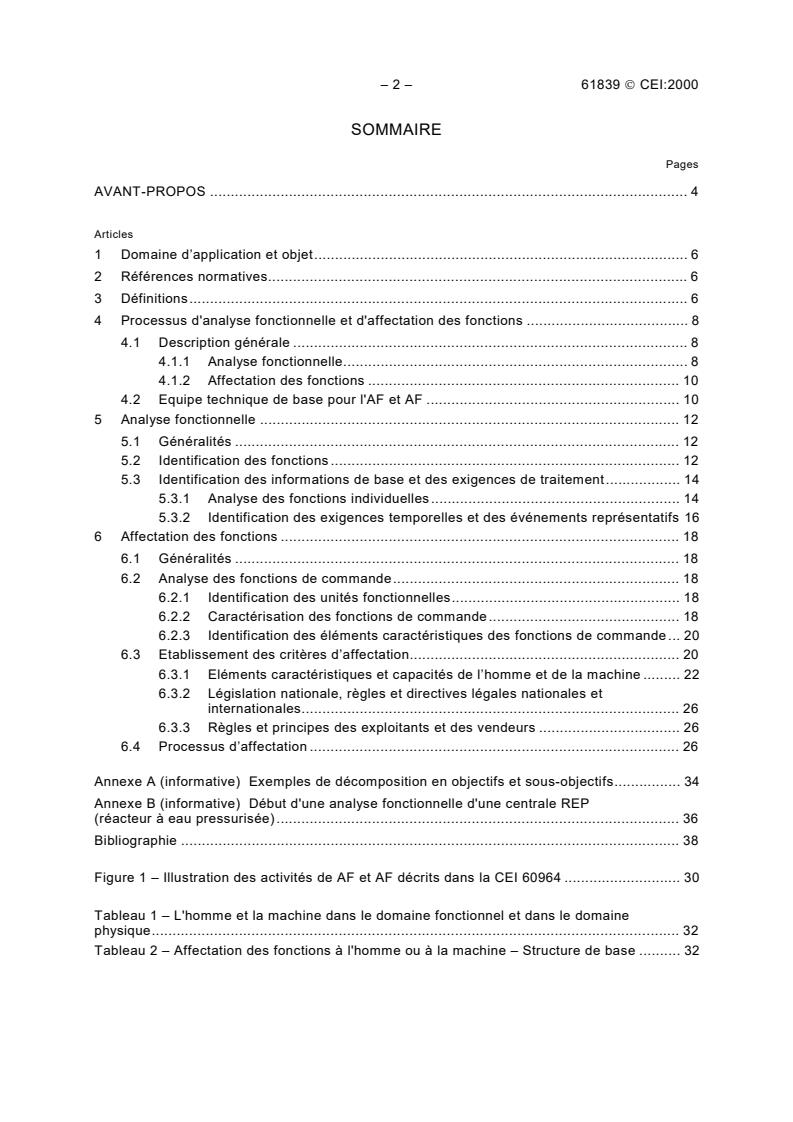
– 2 – 61839 CEI:2000
SOMMAIRE
Pages
AVANT-PROPOS . 4
Articles
1 Domaine d’application et objet. 6
2 Références normatives. 6
3 Définitions. 6
4 Processus d'analyse fonctionnelle et d'affectation des fonctions . 8
4.1 Description générale . 8
4.1.1 Analyse fonctionnelle. 8
4.1.2 Affectation des fonctions . 10
4.2 Equipe technique de base pour l'AF et AF . 10
5 Analyse fonctionnelle . 12
5.1 Généralités . 12
5.2 Identification des fonctions . 12
5.3 Identification des informations de base et des exigences de traitement. 14
5.3.1 Analyse des fonctions individuelles. 14
5.3.2 Identification des exigences temporelles et des événements représentatifs 16
6 Affectation des fonctions . 18
6.1 Généralités . 18
6.2 Analyse des fonctions de commande. 18
6.2.1 Identification des unités fonctionnelles. 18
6.2.2 Caractérisation des fonctions de commande. 18
6.2.3 Identification des éléments caractéristiques des fonctions de commande. 20
6.3 Etablissement des critères d’affectation. 20
6.3.1 Eléments caractéristiques et capacités de l’homme et de la machine . 22
6.3.2 Législation nationale, règles et directives légales nationales et
internationales. 26
6.3.3 Règles et principes des exploitants et des vendeurs . 26
6.4 Processus d’affectation . 26
Annexe A (informative) Exemples de décomposition en objectifs et sous-objectifs. 34
Annexe B (informative) Début d'une analyse fonctionnelle d'une centrale REP
(réacteur à eau pressurisée). 36
Bibliographie . 38
Figure 1 – Illustration des activités de AF et AF décrits dans la CEI 60964 . 30
Tableau 1 – L'homme et la machine dans le domaine fonctionnel et dans le domaine
physique. 32
Tableau 2 – Affectation des fonctions à l'homme ou à la machine – Structure de base . 32
61839 IEC:2000 – 3 –
CONTENTS
Page
FOREWORD . 5
Clause
1 Scope and object . 7
2 Normative references. 7
3 Definitions. 7
4 Process of functional analysis and assignment . 9
4.1 General description. 9
4.1.1 Functional analysis . 9
4.1.2 Assignment of functions . 11
4.2 Basic technical team for FA and A . 11
5 Functional analysis . 13
5.1 General. 13
5.2 Identification of functions . 13
5.3 Identification of basic information and processing requirements. 15
5.3.1 Individual function analysis . 15
5.3.2 Identification of time requirements and representative events . 17
6 Assignment of functions . 19
6.1 General. 19
6.2 Control function analysis. 19
6.2.1 Identifying functional units. 19
6.2.2 Characterising the control functions . 19
6.2.3 Identifying control function characteristics measurements . 21
6.3 Development of assignment criteria . 21
6.3.1 Characteristic measurement and man-machine capabilities. 23
6.3.2 National law, national and international legal rules and guides. 27
6.3.3 Utility and vendors' rules and policies . 27
6.4 Assignment process. 27
Annex A (informative) Examples of decomposition of goals and subgoals . 35
Annex B (informative) Beginning of PWR (pressurized water reactor) functional analysis . 37
Bibliography . 39
Figure 1 – Illustrated FA and A activities given in IEC 60964. 31
Table 1 – Humans and machines in the functional domain and in the physical domain . 33
Table 2 – Assignment of functions to humans and machines – Basic structure . 33
– 4 – 61839 CEI:2000
COMMISSION ÉLECTROTECHNIQUE INTERNATIONALE
–––––––––––
CENTRALES NUCLÉAIRES DE PUISSANCE –
CONCEPTION DES SALLES DE COMMANDE –
ANALYSE FONCTIONNELLE ET AFFECTATION DES FONCTIONS
AVANT-PROPOS
1) La CEI (Commission Electrotechnique Internationale) est une organisation mondiale de normalisation composée
de l'ensemble des comités électrotechniques nationaux (Comités nationaux de la CEI). La CEI a pour objet de
favoriser la coopération internationale pour toutes les questions de normalisation dans les domaines de
l'électricité et de l'électronique. A cet effet, la CEI, entre autres activités, publie des Normes internationales.
Leur élaboration est confiée à des comités d'études, aux travaux desquels tout Comité national intéressé par le
sujet traité peut participer. Les organisations internationales, gouvernementales et non gouvernementales, en
liaison avec la CEI, participent également aux travaux. La CEI collabore étroitement avec l'Organisation
Internationale de Normalisation (ISO), selon des conditions fixées par accord entre les deux organisations.
2) Les décisions ou accords officiels de la CEI concernant les questions techniques représentent, dans la mesure
du possible, un accord international sur les sujets étudiés, étant donné que les Comités nationaux intéressés
sont représentés dans chaque comité d’études.
3) Les documents produits se présentent sous la forme de recommandations internationales. Ils sont publiés
comme normes, spécifications techniques, rapports techniques ou guides et agréés comme tels par les Comités
nationaux.
4) Dans le but d'encourager l'unification internationale, les Comités nationaux de la CEI s'engagent à appliquer de
façon transparente, dans toute la mesure possible, les Normes internationales de la CEI dans leurs normes
nationales et régionales. Toute divergence entre la norme de la CEI et la norme nationale ou régionale
correspondante doit être indiquée en termes clairs dans cette dernière.
5) La CEI n’a fixé aucune procédure concernant le marquage comme indication d’approbation et sa responsabilité
n’est pas engagée quand un matériel est déclaré conforme à l’une de ses normes.
6) L’attention est attirée sur le fait que certains des éléments de la présente Norme internationale peuvent faire
l’objet de droits de propriété intellectuelle ou de droits analogues. La CEI ne saurait être tenue pour
responsable de ne pas avoir identifié de tels droits de propriété et de ne pas avoir signalé leur existence.
La Norme internationale CEI 61839 a été établie par le sous-comité 45A: Instrumentation des
réacteurs, du comité d'études 45 de la CEI: Instrumentation nucléaire.
Cette norme doit être lue conjointement avec la CEI 60964.
Le texte de cette norme est issu des documents suivants:
FDIS Rapport de vote
45A/382/FDIS 45A/389/RVD
Le rapport de vote indiqué dans le tableau ci-dessus donne toute information sur le vote ayant
abouti à l'approbation de cette norme.
Cette publication a été rédigée selon les Directives ISO/CEI, Partie 3.
Les annexes A et B sont données uniquement à titre d’information.
Le comité a décidé que le contenu de cette publication ne sera pas modifié avant 2006. A cette
date, la publication sera
• reconduite;
• supprimée;
• remplacée par une édition révisée, ou
• amendée.
61839 IEC:2000 – 5 –
INTERNATIONAL ELECTROTECHNICAL COMMISSION
___________
NUCLEAR POWER PLANTS –
DESIGN OF CONTROL ROOMS –
FUNCTIONAL ANALYSIS AND ASSIGNMENT
FOREWORD
1) The IEC (International Electrotechnical Commission) is a worldwide organization for standardization comprising
all national electrotechnical committees (IEC National Committees). The object of the IEC is to promote
international co-operation on all questions concerning standardization in the electrical and electronic fields. To
this end and in addition to other activities, the IEC publishes International Standards. Their preparation is
entrusted to technical committees; any IEC National Committee interested in the subject dealt with may
participate in this preparatory work. International, governmental and non-governmental organizations liaising
with the IEC also participate in this preparation. The IEC collaborates closely with the International
Organization for Standardization (ISO) in accordance with conditions determined by agreement between the
two organizations.
2) The formal decisions or agreements of the IEC on technical matters express, as nearly as possible, an
international consensus of opinion on the relevant subjects since each technical committee has representation
from all interested National Committees.
3) The documents produced have the form of recommendations for international use and are published in the form
of standards, technical specifications, technical reports or guides and they are accepted by the National
Committees in that sense.
4) In order to promote international unification, IEC National Committees undertake to apply IEC International
Standards transparently to the maximum extent possible in their national and regional standards. Any
divergence between the IEC Standard and the corresponding national or regional standard shall be clearly
indicated in the latter.
5) The IEC provides no marking procedure to indicate its approval and cannot be rendered responsible for any
equipment declared to be in conformity with one of its standards.
6) Attention is drawn to the possibility that some of the elements of this International Standard may be the subject
of patent rights. The IEC shall not be held responsible for identifying any or all such patent rights.
International Standard IEC 61839 has been prepared by subcommittee 45A: Reactor
instrumentation, of IEC technical committee 45: Nuclear instrumentation.
This standard shall be read in conjunction with IEC 60964.
The text of this standard is based on the following documents:
FDIS Report on voting
45A/382/FDIS 45A/389/RVD
Full information on the voting for the approval of this standard can be found in the report on
voting indicated in the above table.
This publication has been drafted in accordance with the ISO/IEC Directives, Part 3.
Annexes A and B are for information only.
The committee has decided that the contents of this publication will remain unchanged until
2006. At this date, the publication will be
• reconfirmed;
• withdrawn;
• replaced by a revised edition, or
• amended.
– 6 – 61839 CEI:2000
CENTRALES NUCLÉAIRES DE PUISSANCE –
CONCEPTION DES SALLES DE COMMANDE –
ANALYSE FONCTIONNELLE ET AFFECTATION DES FONCTIONS
1 Domaine d’application et objet
La présente Norme internationale définit les procédures d’analyse fonctionnelle et d’affectation
des fonctions (AF et AF, quelquefois appelées «allocation des fonctions ») applicables à la
conception du système de salle de commande dans les centrales nucléaires et donne des
règles pour établir des critères applicables à l’affectation des fonctions.
La présente norme est un complément de la CEI 60964, relative à la conception des salles de
commande des centrales nucléaires de puissance.
Le but de la présente norme est d’établir des exigences spécifiques pour effectuer l’analyse
fonctionnelle et l’affectation des fonctions requises en 3.1 et 3.2 de la CEI 60964, et de ce fait
se substitue aux directives données en A.3.1 et A.3.2 de la CEI 60964.
La présente norme s’applique à la conception de nouvelles salles de commande ou à des
rénovations (renouvellement ou modifications de la conception) apportées à des salles de
commande existantes. Dans ce dernier cas, il est nécessaire d’user de prudence dans
l’identification des zones affectées indirectement et directement par les modifications.
2 Références normatives
Les documents normatifs suivants contiennent des dispositions qui, par suite de la référence
qui y est faite, constituent des dispositions valables pour la présente Norme internationale.
Pour les références datées, les amendements ultérieurs ou les révisions de ces publications
ne s’appliquent pas. Toutefois, les parties prenantes aux accords fondés sur la présente
Norme internationale sont invitées à rechercher la possibilité d’appliquer les éditions les plus
récentes des documents normatifs indiqués ci-après. Pour les références non datées, la
dernière édition du document normatif en référence s’applique. Les membres de l’ISO et de la
CEI possèdent les registres des Normes internationales en vigueur.
CEI 60964:1989, Conception des salles de commande des centrales nucléaires de puissance
CEI 61771:1995, Centrales nucléaires de puissance – Salle de commande principale –
Vérification et validation de la conception
3 Définitions
Pour les besoins de la présente Norme internationale, les définitions données dans la
CEI 60964 et les suivantes s'appliquent:
3.1
conditions accidentelles
ensemble de conditions identifiées dans les rapports d'analyse de sûreté ou de transitoire et/ou
dans les procédures de conduite accidentelles
3.2
affectation des fonctions
répartition des fonctions parmi les constituants humains et automatisés d'un système
61839 IEC:2000 – 7 –
NUCLEAR POWER PLANTS –
DESIGN OF CONTROL ROOMS –
FUNCTIONAL ANALYSIS AND ASSIGNMENT
1 Scope and object
This International Standard specifies functional analysis and assignment procedures (FA
and A, sometimes called allocation of functions) for the design of the control-room system for
nuclear power plants and gives rules for developing criteria for the assignment of functions.
This standard supplements IEC 60964, which applies to the design of the control-room for
nuclear power plants.
The purpose of this standard is to provide specific requirements for carrying out the functional
analysis and assignment required in 3.1 and 3.2 of IEC 60964, and therefore supersedes the
guidance given in A.3.1 and A.3.2 of IEC 60964.
This standard is applicable to the design of new control-rooms or to backfits (design renewal
and design modifications) to existing control-rooms. In the latter case, particular caution is to
be exercised to identify areas indirectly affected as well as those directly affected.
2 Normative references
The following normative documents contain provisions which, through reference in this text,
constitute provisions of this International Standard. For dated references, subsequent
amendments to, or revisions of, any of these publications do not apply. However, parties to
agreements based on this International Standard are encouraged to investigate the possibility
of applying the most recent editions of the normative documents indicated below. For undated
references, the latest edition of the normative document referred to applies. Members of IEC
and ISO maintain registers of currently valid International Standards.
IEC 60964:1989, Design for control rooms of nuclear power plants
IEC 61771:1995, Nuclear power plants – Main control-room – Verification and validation of
design
3 Definitions
For the purpose of this International Standard, the definitions given in IEC 60964 and the
following definitions apply:
3.1
accident conditions
set of conditions identified in the safety or transient analysis reports and/or in the emergency
operating procedures
3.2
functional assignment
distribution of functions among the human and automated constituents of a system
– 8 – 61839 CEI:2000
3.3
interface homme/machine, IHM
interface entre l’équipe de conduite d’une part, les systèmes de contrôle-commande et les
calculateurs reliés à la centrale d’autre part. Elle inclut les afficheurs, les commandes et
l’interface «système support de l’opérateur» (voir «Interface homme/machine» dans la
CEI 60964)
3.4
évaluation probabiliste de sûreté (EPS)
approche méthodologique d'identification des séquences d'accident pouvant être issues d'un
large spectre d'événements initiateurs; elle inclut la détermination systématique et réaliste des
fréquences et des conséquences des accidents
3.5
fonction de commande
actions de commande exécutées par un homme ou une machine pour atteindre un objectif
1)
fonctionnel et comprenant l’acquisition et le traitement d’information associés
3.6
tâches
1)
actions de commande exécutées par l’homme pour atteindre un objectif fonctionnel
4 Processus d'analyse fonctionnelle et d'affectation des fonctions
4.1 Description générale
Le processus d'analyse fonctionnelle et d'affectation des fonctions est requis à l’article 3 de la
CEI 60964 comme première étape de conception d'une salle de commande (voir figure 1). Il a
pour objet, d'abord, d'identifier toutes les fonctions nécessaires pour exploiter la centrale, puis
d'affecter les fonctions à l'homme ou à la machine.
Deux étapes essentielles sont requises:
a) l’analyse fonctionnelle;
b) l’affectation des fonctions.
Elles sont respectivement définies aux articles 5 et 6 de la présente norme.
4.1.1 Analyse fonctionnelle
L'identification des fonctions (voir 5.2) est obtenue d'abord par une définition des objectifs
généraux ou fondamentaux de l’exploitation de la centrale, c'est-à-dire une production
d'électricité sûre et efficace, une protection du public contre les risques de rejets radioactifs,
puis par une décomposition des fonctions de haut niveau – permettant à ces objectifs d'être
atteints – en une hiérarchie de fonctions dont la base sera constituée des fonctions de
commande qui doivent être affectées à l'homme ou à la machine. L’analyse fonctionnelle
globale d’une centrale nucléaire est un moyen pour identifier toutes les fonctions accomplies
depuis la salle de commande.
La base de données statique des fonctions des différents niveaux obtenue lors de l'étape
précédente est complétée par la détermination du flux d'informations opérationnelles de base
et des exigences de traitement pour l’exploitation de la centrale (voir 5.3.1).
___________
1)
Cette définition s’écarte de celle donnée dans la CEI 60964, mais reflète l’usage actuel.
61839 IEC:2000 – 9 –
3.3
human machine interface, HMI
interface between operating staff and I and C system and computer systems linked with the
plant. The interface includes displays, controls, and the Operator Support System interface
(see man/machine interface in IEC 60964)
3.4
probabilistic risk assessment (PRA)
methodological approach to identify accident sequences that can follow from a broad range of
initiating events; it includes the systematic and realistic determination of accident frequencies
and consequences
3.5
control function
control actions performed by humans or machines for the accomplishment of a functional goal
1)
including the associated information acquisition and processing
3.6
tasks
1)
control actions performed by humans for the accomplishment of a functional goal
4 Process of functional analysis and assignment
4.1 General description
The process of functional analysis and assignment is required in clause 3 of IEC 60964 as a
first step for the design of a control-room (see figure 1). It aims initially to identify all of the
functions required to operate the plant, then to assign the functions to humans or to
machines.
Two basic steps are required:
a) functional analysis;
b) assignment of functions.
They are defined respectively in clauses 5 and 6 of this standard.
4.1.1 Functional analysis
The identification of the functions (see 5.2) is obtained initially by defining general or
fundamental objectives of the plant operation, i.e. safe and effective generation of electrical
power, protection of the public from radiological hazards, then by breaking down the top-level
functions, allowing those objectives to be fulfilled, into a hierarchy of functions where the
lowest set of functions are the control functions which must then be assigned to humans or to
machines. The general nuclear power plant functional analysis is a means to the identification
of all the functions achieved from the main control-room.
The static database of functions of different levels, obtained in the previous step, is completed
by the determination of the basic operational information flow and processing requirements for
plant operation (see 5.3.1).
___________
1)
This definition deviates from IEC 60964 but reflects current use.
– 10 – 61839 CEI:2000
L'étape suivante de l'analyse est l'introduction d'exigences temporelles par la prise en compte
d'un nombre suffisant d'événements de la base de conception et de situations d’exploitation de
la centrale (normales, anormales et accidentelles) (voir 5.3.2). De cette façon, tous les
éléments nécessaires à l'identification des fonctions associées à la salle de commande sont
identifiés.
4.1.2 Affectation des fonctions
L’affectation des fonctions est une répartition des fonctions parmi les constituants humains et
automatisés d’un système.
Tout d’abord, une caractérisation des fonctions identifiées est à conduire pour
a) regrouper méthodiquement, si nécessaire, les fonctions définies (voir 6.2.1);
b) identifier et définir en détail toutes les actions nécessaires à l’accomplissement des
fonctions (voir 6.2.2);
c) identifier les éléments caractéristiques types des fonctions (voir 6.2.3).
Ensuite, l'affectation des fonctions peut être assurée sur la base d'un ensemble prédéfini de
critères d'affectation (voir 6.3).
Affecter des fonctions à l'homme signifie les réaliser par des commandes manuelles, par une
démarche intellectuelle ou par leurs combinaisons. Affecter des fonctions à la machine signifie
les réaliser par voie d'automatismes. Par conséquent, dans le domaine fonctionnel, «machine»
désigne les automatismes, tandis que «homme» désigne l'équipe de la salle de commande.
Voir tableau 1.
Le terme «machine» couvre un ensemble de matériels qui incluent le système de contrôle-
commande et le système support de l'opérateur.
Il convient de noter que les systèmes manuels de réglage, les moyens de commandes et de
présentation d'informations, qui font partie du système de contrôle-commande, sont
nécessaires pour permettre à l'équipe de la salle de commande de remplir les fonctions qui lui
sont assignées.
La vérification et la validation (V et V) de l’affectation des fonctions sont hors du domaine
d’application de la présente norme et relèvent de la CEI 61771.
NOTE La conception de la centrale et l’analyse des fonctions et des tâches qui en résulte sont limitées aux
événements, scénarios prévus et aux combinaisons prévus d’événements et de défaillances. Des fonctions peuvent
s’avérer nécessaires pour le diagnostic et la gestion de situations d’exploitation imprévues; cela est évidemment du
ressort de l’équipe de conduite et est alors en dehors du domaine d’application de la présente norme.
4.2 Equipe technique de base pour l'AF et AF
En général, il convient que l'équipe technique de base pour l'analyse fonctionnelle et
l'affectation des fonctions inclue les domaines d'expertise suivants:
− ingénierie des systèmes nucléaires et non nucléaires;
− analyses des systèmes;
− conception des systèmes de contrôle et de commande (CC);
− conception des systèmes informatiques et d’information;
− ingénierie des facteurs humains;
− exploitation de centrale;
− élaboration des procédures de conduites normale et accidentelle.
Dans la suite, cette équipe technique est désignée par «le concepteur».
61839 IEC:2000 – 11 –
The next step of the analysis is the introduction of time requirements, taking into account a
sufficient number of basic design events and plant conditions (normal, abnormal and accident
conditions) (see 5.3.2). In this way, all of the elements needed for the identification of the
functions associated with the control-room are identified.
4.1.2 Assignment of functions
Functional assignment is a distribution of functions between the human and automated
constituents of a system.
As a first step, a characterisation of the identified functions is to be performed to
a) methodically group, if necessary, the defined functions (see 6.2.1);
b) identify and define in detail all the actions needed for the accomplishment of the functions
(see 6.2.2);
c) identify typical function characteristic measurements (see 6.2.3).
Then, the functional assignment can be provided on the basis of a pre-defined set of
assignment criteria (see 6.3).
Assigning functions to humans means achieving them by manual control, monitoring, high-
level mental processing, or their combinations. The assignment of functions to machines
means achieving them by automation. Therefore, machine in the functional domain signifies
automation, while human in the functional domain signifies the control-room staff. See table 1.
The term machine covers a number of hardware entities which include the I and C system and
the operator support system.
It should be noted that manual control systems, controls and displays which are part of the I
and C system are needed to enable the control-room staff to achieve functions assigned to
them.
The verification and validation (V and V) of the functional assignment is outside the scope of
this standard; refer to IEC 61771.
NOTE The design of a plant and the resulting analysis of functions and tasks are limited to the anticipated events,
scenarios and anticipated combinations of events and failures. There may be a need for functions for the diagnosis
and handling of unforeseen operating situations, which is obviously to be handled by the operating staff, which is
then outside the scope of this standard.
4.2 Basic technical team for FA and A
In general, a basic technical team for FA and A should include the following areas of
expertise:
– nuclear and non-nuclear systems engineering;
– systems analysis;
– instrumentation and control (I and C) systems design;
– information and computer systems design;
– human factor engineering;
– plant operation;
– development of normal operation and emergency procedures.
In the following, this technical team is called the “designer”.
– 12 – 61839 CEI:2000
5 Analyse fonctionnelle
5.1 Généralités
Le processus d'analyse fonctionnelle doit inclure les deux étapes suivantes:
− identification des fonctions;
− identification du flux d'informations et des exigences de traitement.
5.2 Identification des fonctions
Le but de l'identification des fonctions de commande est d'assurer que l'IHM affectée à ces
fonctions en sera un support correct. Par exemple, il faut que la conception de l'IHM en salle
de commande fasse en sorte que toutes les informations et commandes associées aux
fonctions de sûreté soient à la fois présentes et convenablement présentées à l'opérateur.
L'identification des fonctions de commande nécessaires doit être basée sur une décomposition
fonctionnelle générale de la centrale nucléaire. Dans la suite, les grandes lignes d’une
méthode strictement hiérarchique sont tracées. Cette décomposition doit être obtenue en
présentant les résultats des études de conception d’ensemble de la centrale de manière
hiérarchique en liaison avec les objectifs opérationnels de la centrale:
a) l’objectif de sûreté (limitation des rejets radioactifs dans l'environnement), et
b) l’objectif de disponibilité (production maîtrisée d'électricité).
Ces objectifs doivent être développés de façon plus approfondie en sous-objectifs pour
produire une structure d'objectifs hiérarchisés, c'est-à-dire un ensemble de relations entre des
objectifs et des sous-objectifs fonctionnels structurés hiérarchiquement.
En ce qui concerne la structure d'objectifs hiérarchisés mentionnés ci-dessus, toutes les
fonctions de la centrale nécessaires pour atteindre ces objectifs et sous-objectifs doivent être
identifiées. Il convient que l'identification des fonctions résulte directement de l'identification
des objectifs. En principe, les termes «objectif» et «fonction» sont interchangeables.
Cependant, aux niveaux supérieurs de la structure hiérarchique, la vision conceptuelle de la
centrale est appréhendée et mieux exprimée en termes d'«objectifs» alors qu'aux niveaux
inférieurs faire référence à une «fonction» en tant qu'activité ou rôle rempli par l'homme ou par
des systèmes automatiques (définition de la CEI 60964) est plus approprié.
Le concepteur doit tour à tour subdiviser chacune de ces fonctions et élaborer un ensemble de
règles afin d’identifier le moment où l'analyse hiérarchique a abouti à un niveau suffisant de
détail. La décomposition d’une fonction peut être typiquement stoppée quand
a) la fonction ne comprend plus de fonction de commande, par exemple une fonction
purement mécanique;
b) le niveau de maîtrise de fonctions individuelles, de paramètres ou d’actionneurs est atteint.
Les règles définies doivent assurer que les fonctions de bas niveau forment un ensemble
complet, sont individualisées et décrites en termes fonctionnels, ou que le processus peut être
arrêté quand les fonctions détaillées ont été obtenues et que les constituants importants de la
structure ont été identifiés.
Dans tous les cas, le niveau final de décomposition doit permettre la mise à disposition de
l'information nécessaire à l'étape suivante de conception (voir paragraphes suivants). Il se peut
que quelques itérations soient nécessaires pour atteindre ce niveau final.
Au sommet, la structure hiérarchique obtenue aura les objectifs fonctionnels, au milieu, des
fonctions de type système, et à la base, des fonctions de commande détaillées devant être
affectées à l'homme ou à la machine.
61839 IEC:2000 – 13 –
5 Functional analysis
5.1
General
The functional analysis process shall include the following two steps:
– identification of functions;
– identification of information flow and processing requirements.
5.2 Identification of functions
The purpose of identifying control functions is to assure that the HMI allocated to these
functions will support them correctly. As an example, the control-room HMI design must
ensure that all signals and controls associated with safety functions are both present and
clearly displayed to the operator.
The identification of control functions needed shall be based on a general nuclear power plant
functional decomposition. In the following, a strictly hierarchical method is outlined. This
decomposition shall be obtained by presenting the results of the overall plant design in a
hierarchical manner, with the plant operational goals:
a) safety goal (prevent activity release to the environment); and
b) availability goal (controlled generation of electricity).
These goals shall be developed further as subgoals, producing a hierarchical goal structure,
i.e. a relationship between functional goals and subgoals structured in a hierarchical order.
With regard to the hierarchical goal structure above, all plant functions to achieve these goals
and subgoals shall be identified. The function identification should follow immediately from
goal identification. In principle, the terms "goal" and "function" are interchangeable. However,
at higher levels of the hierarchy, the plant design concept is considered and better expressed
in terms of goals, when at lower levels it is more appropriate to refer to a function as an
activity or role performed by a human or automated systems (definition in IEC 60964).
The designer shall subdivide each of these functions successively and develop a set of rules
to identify when the hierarchical analysis is completed to a sufficient level of detail. The
decomposition of a function can be typically stopped when
a) the function does not contain a control function any more, for example purely mechanical;
b) the level of controlling individual functions, parameters or actuators is reached.
The defined rules shall ensure that the bottom-level functions form a complete set, itemised
and stated in functional terms, or the process can be stopped where detailed functions are
obtained and the important constituents of the structure have been identified.
In any case, the final level of decomposition shall allow the provision of the information
needed for the next design step (see following paragraphs). Some iteration could be
necessary to reach this final level.
The resultant hierarchy will have the functional goals at the top, system-level functions in the
middle and detailed control functions at the bottom level, to be assigned to humans or
machines.
– 14 – 61839 CEI:2000
Il peut être noté que, même si sûreté et disponibilité forment des points d'entrée séparés dans
la décomposition fonctionnelle, ils convergent souvent sur des fonctions communes (sauf pour
des objectifs spécifiques tels que l'intégrité du confinement). En conséquence, il est admis,
pour cette analyse spécifique seulement, que les objectifs de sûreté et de disponibilité soient
pris en compte ensemble.
Dans le cas d'une nouvelle conception de centrale, ce processus «du haut vers le bas»
est conduit collectivement pour tous les systèmes de la centrale (c'est-à-dire systèmes
mécaniques, systèmes électriques, etc.). Il convient alors que cette décomposition d'objectifs
généraux en fonctions destinées à être affectées à l'homme ou à la machine fasse partie du
processus d'ensemble de conception de la centrale et ne soit pas exclusivement réalisée pour
la conception de la salle de commande. Cela devrait permettre une prise en compte de la
conception de la salle de commande à un stade précoce de la conception de la centrale et
éviter des itérations.
Les principes et critères utilisés lors de l'analyse doivent être documentés.
Il convient de remarquer qu'une décomposition strictement hiérarchique des fonctions n'est
pas la seule voie d'organisation et de représentation d'une centrale. Selon les objectifs de
conception, il est admis que d'autres représentations fonctionnelles soient mieux adaptées.
Des exemples de décomposition fonctionnelle sont donnés aux annexes A et B.
5.3 Identification des informations de base et des exigences de traitement
L'étape suivante de l'analyse fonctionnelle est l'identification des informations de base et des
exigences de traitement nécessaires à la réalisation des fonctions de commande définies à
l'étape précédente.
Tout d'abord, chaque fonction est analysée individuellement, puis les fonctions sont prises en
compte collectivement, selon les besoins de réponse à des événements spécifiques de la
centrale, pour identifier des exigences temporelles.
5.3.1 Analyse des fonctions individuelles
Pour chaque fonction de commande, le concepteur doit identifier
− les paramètres observables indiquant l'état de la centrale et/ou agissant comme données
d'entrée de la fonction;
− les actions réalisées par la fonction et les équipements impliqués;
− les valeurs de référence requises pour vérifier l'exécution de la fonction;
− l'importance pour la sûreté (c'est-à-dire la classification de sûreté).
Le concepteur doit aussi identifier
− comment déterminer le fonctionnement correct de la fonction;
− quelles solutions de remplacement sont disponibles lorsque l'on perd le fonctionnement
correct, et comment on peut choisir parmi elles. Ici les solutions de remplacement se
réfèrent à des fonctions qui peuvent venir en appui d'une fonction d'un niveau fonctionnel
plus élevé à la place de la fonction analysée. Par exemple, on peut choisir parmi plusieurs
circuits redondants d'évacuation de la chaleur selon les conditions de la centrale;
− les modes de fonctionnement de la centrale quand la fonction est requise (par exemple de
l'arrêt jusqu'au fonctionnement à pleine puissance);
− les états de la centrale lorsque la fonction est requise (par exemple fonctionnement
normal, fonctionnement anormal, accidents);
− les fonctions support (par exemple alimentation en air ou en électricité).
61839 IEC:2000 – 15 –
It should be noted that, e
...
Questions, Comments and Discussion
Ask us and Technical Secretary will try to provide an answer. You can facilitate discussion about the standard in here.
Loading comments...