

IEC 61935-2:2010
(Main)Specification for the testing of balanced and coaxial information technology cabling - Part 2: Cords as specified in ISO/IEC 11801 and related standards
General Information
- Abstract
IEC 61935-2:2010 provides methods to ensure compatibility of balanced cords to be used in cabling according to ISO/IEC 11801 and provides test methods and associated requirements to demonstrate the performance and reliability of these balanced cords during their operational lifetime. This International Standard may also be used for providing test methods for assessing the behaviour of other balanced cords. This third edition cancels and replaces the second edition published in 2005. It differs from the second edition in that it covers category 6A to category 7A cords as defined in ISO/IEC 11801.
- Status
- Published
- Publication Date
- 11-Jul-2010
- Technical Committee
- TC 46 - Cables, wires, waveguides, RF connectors, RF and microwave passive components and accessories
- Drafting Committee
- MT 61935-2 - TC 46/MT 61935-2
- Current Stage
- DELPUB - Deleted Publication
- Start Date
- 08-Feb-2022
- Completion Date
- 28-Aug-2026
Buy Documents


IEC 61935-2:2010 - Specification for the testing of balanced and coaxial information technology cabling - Part 2: Cords as specified in ISO/IEC 11801 and related standards Released:7/12/2010
Overview
IEC 61935-2:2010 is an international standard developed by the International Electrotechnical Commission (IEC) that specifies testing methods for balanced cords used in information technology cabling systems. Covering cords as specified in ISO/IEC 11801 and related standards, this third edition updates the testing framework to include balanced cords from Category 6A to Category 7A. The standard ensures the compatibility, performance, and reliability of these cords during their operational lifetime.
Balanced cords play a critical role in connecting IT equipment through free connectors defined by IEC 60603-7 series and related connector standards. Given that connecting hardware performance is influenced by cord terminations and manufacturing quality, IEC 61935-2:2010 provides comprehensive test procedures that help manufacturers and network deployers guarantee the quality and functionality of these essential components in structured cabling systems.
Key Topics
Test Scope and Configuration
The standard covers balanced cords incorporating twisted pairs terminated with free connectors. It includes test setups, cable and connector design criteria, and details on test equipment configurations essential for consistent measurements.Performance Tests
Key electrical property evaluations include:- Insertion loss
- Return loss
- Near End Crosstalk (NEXT)
- Propagation delay and delay skew
Acceptance and Periodic Testing
The document sets requirements for:- Visual inspection and wire map verification to detect physical defects and wiring accuracy
- Mechanical tests including tensile strength, flexure, bending, twisting, and crushing to verify durability under normal usage
- Environmental tests such as dust exposure and climatic sequences to assess cord robustness in different conditions
Test Head Requirements
The standard details minimum specifications for test heads used in the evaluation process, ensuring precise loss centering, return loss measurement, and crosstalk properties.Cord Categories Supported
IEC 61935-2:2010 extends testing methodology to support advanced cabling categories conforming to ISO/IEC 11801 standards, spanning Category 6A through Category 7A cords.
Applications
Structured Cabling Systems
Designed for use in enterprise networks, data centers, and telecommunications facilities, the standard helps maintain the performance integrity of balanced cords within structured cabling infrastructures.Manufacturing Quality Control
Cable manufacturers use these test methods during production to validate cord assemblies and ensure they meet stringent performance criteria for high-speed data transmission.Network Equipment Compatibility
Ensures balanced cords seamlessly connect IT equipment according to international interoperability standards, preventing signal degradation or failures due to poor cable assembly or component mismatch.Reliability Assurance Across Cord Lifespan
The mechanical and environmental test methods help predict and verify cord durability, ensuring dependable network operation under varying installation and operational conditions.
Related Standards
ISO/IEC 11801 – International standard defining generic cabling for customer premises, specifying cabling system architectures including balanced cords.
IEC 60603-7 Series – Standard series covering connectors for balanced copper cabling, critical for physical interface specifications.
IEC 61076-3-104 and IEC 61076-3-110 – Standards focusing on specific free connector types used in balanced cords.
IEC 61935-1 – Part 1 of the series specifying testing of balanced and coaxial cabling, dealing primarily with permanent links.
By applying IEC 61935-2:2010, stakeholders can ensure balanced cords meet internationally recognized technical and quality benchmarks, supporting high-performance and robust IT infrastructure cabling deployments worldwide.
Relations
- Effective Date
- 05-Sep-2023
- Effective Date
- 05-Sep-2023
Buy Documents
IEC 61935-2:2010 - Specification for the testing of balanced and coaxial information technology cabling - Part 2: Cords as specified in ISO/IEC 11801 and related standards Released:7/12/2010
Get Certified
Connect with accredited certification bodies for this standard

ANCE
Mexican certification and testing association.

Intertek Slovenia
Intertek testing, inspection, and certification services in Slovenia.

LNE (Laboratoire National de Métrologie et d'Essais)
French national laboratory for metrology and testing.
Sponsored listings
Frequently Asked Questions
IEC 61935-2:2010 is a standard published by the International Electrotechnical Commission (IEC). Its full title is "Specification for the testing of balanced and coaxial information technology cabling - Part 2: Cords as specified in ISO/IEC 11801 and related standards". This standard covers: IEC 61935-2:2010 provides methods to ensure compatibility of balanced cords to be used in cabling according to ISO/IEC 11801 and provides test methods and associated requirements to demonstrate the performance and reliability of these balanced cords during their operational lifetime. This International Standard may also be used for providing test methods for assessing the behaviour of other balanced cords. This third edition cancels and replaces the second edition published in 2005. It differs from the second edition in that it covers category 6A to category 7A cords as defined in ISO/IEC 11801.
IEC 61935-2:2010 provides methods to ensure compatibility of balanced cords to be used in cabling according to ISO/IEC 11801 and provides test methods and associated requirements to demonstrate the performance and reliability of these balanced cords during their operational lifetime. This International Standard may also be used for providing test methods for assessing the behaviour of other balanced cords. This third edition cancels and replaces the second edition published in 2005. It differs from the second edition in that it covers category 6A to category 7A cords as defined in ISO/IEC 11801.
IEC 61935-2:2010 is classified under the following ICS (International Classification for Standards) categories: 33.040.20 - Transmission systems; 33.120.20 - Wires and symmetrical cables. The ICS classification helps identify the subject area and facilitates finding related standards.
IEC 61935-2:2010 has the following relationships with other standards: It is inter standard links to IEC 61935-2:2022, IEC 61935-2:2005. Understanding these relationships helps ensure you are using the most current and applicable version of the standard.
IEC 61935-2:2010 is available in PDF format for immediate download after purchase. The document can be added to your cart and obtained through the secure checkout process. Digital delivery ensures instant access to the complete standard document.
Standards Content (Sample)
IEC 61935-2 ®
Edition 3.0 2010-07
INTERNATIONAL
STANDARD
NORME
INTERNATIONALE
colour
inside
Specification for the testing of balanced and coaxial information technology
cabling –
Part 2: Cords as specified in ISO/IEC 11801 and related standards
Spécification relative aux essais des câblages symétriques et coaxiaux des
technologies de l’information –
Partie 2: Cordons tels que spécifiés dans l’ISO/CEI 11801
et normes associées
All rights reserved. Unless otherwise specified, no part of this publication may be reproduced or utilized in any form or by
any means, electronic or mechanical, including photocopying and microfilm, without permission in writing from either IEC or
IEC's member National Committee in the country of the requester.
If you have any questions about IEC copyright or have an enquiry about obtaining additional rights to this publication,
please contact the address below or your local IEC member National Committee for further information.
Droits de reproduction réservés. Sauf indication contraire, aucune partie de cette publication ne peut être reproduite
ni utilisée sous quelque forme que ce soit et par aucun procédé, électronique ou mécanique, y compris la photocopie
et les microfilms, sans l'accord écrit de la CEI ou du Comité national de la CEI du pays du demandeur.
Si vous avez des questions sur le copyright de la CEI ou si vous désirez obtenir des droits supplémentaires sur cette
publication, utilisez les coordonnées ci-après ou contactez le Comité national de la CEI de votre pays de résidence.
IEC Central Office
3, rue de Varembé
CH-1211 Geneva 20
Switzerland
Email: inmail@iec.ch
Web: www.iec.ch
About the IEC
The International Electrotechnical Commission (IEC) is the leading global organization that prepares and publishes
International Standards for all electrical, electronic and related technologies.
About IEC publications
The technical content of IEC publications is kept under constant review by the IEC. Please make sure that you have the
latest edition, a corrigenda or an amendment might have been published.
ƒ Catalogue of IEC publications: www.iec.ch/searchpub
The IEC on-line Catalogue enables you to search by a variety of criteria (reference number, text, technical committee,…).
It also gives information on projects, withdrawn and replaced publications.
ƒ IEC Just Published: www.iec.ch/online_news/justpub
Stay up to date on all new IEC publications. Just Published details twice a month all new publications released. Available
on-line and also by email.
ƒ Electropedia: www.electropedia.org
The world's leading online dictionary of electronic and electrical terms containing more than 20 000 terms and definitions
in English and French, with equivalent terms in additional languages. Also known as the International Electrotechnical
Vocabulary online.
ƒ Customer Service Centre: www.iec.ch/webstore/custserv
If you wish to give us your feedback on this publication or need further assistance, please visit the Customer Service
Centre FAQ or contact us:
Email: csc@iec.ch
Tel.: +41 22 919 02 11
Fax: +41 22 919 03 00
A propos de la CEI
La Commission Electrotechnique Internationale (CEI) est la première organisation mondiale qui élabore et publie des
normes internationales pour tout ce qui a trait à l'électricité, à l'électronique et aux technologies apparentées.
A propos des publications CEI
Le contenu technique des publications de la CEI est constamment revu. Veuillez vous assurer que vous possédez
l’édition la plus récente, un corrigendum ou amendement peut avoir été publié.
ƒ Catalogue des publications de la CEI: www.iec.ch/searchpub/cur_fut-f.htm
Le Catalogue en-ligne de la CEI vous permet d’effectuer des recherches en utilisant différents critères (numéro de référence,
texte, comité d’études,…). Il donne aussi des informations sur les projets et les publications retirées ou remplacées.
ƒ Just Published CEI: www.iec.ch/online_news/justpub
Restez informé sur les nouvelles publications de la CEI. Just Published détaille deux fois par mois les nouvelles
publications parues. Disponible en-ligne et aussi par email.
ƒ Electropedia: www.electropedia.org
Le premier dictionnaire en ligne au monde de termes électroniques et électriques. Il contient plus de 20 000 termes et
définitions en anglais et en français, ainsi que les termes équivalents dans les langues additionnelles. Egalement appelé
Vocabulaire Electrotechnique International en ligne.
ƒ Service Clients: www.iec.ch/webstore/custserv/custserv_entry-f.htm
Si vous désirez nous donner des commentaires sur cette publication ou si vous avez des questions, visitez le FAQ du
Service clients ou contactez-nous:
Email: csc@iec.ch
Tél.: +41 22 919 02 11
Fax: +41 22 919 03 00
IEC 61935-2 ®
Edition 3.0 2010-07
INTERNATIONAL
STANDARD
NORME
INTERNATIONALE
colour
inside
Specification for the testing of balanced and coaxial information technology
cabling –
Part 2: Cords as specified in ISO/IEC 11801 and related standards
Spécification relative aux essais des câblages symétriques et coaxiaux des
technologies de l’information –
Partie 2: Cordons tels que spécifiés dans l’ISO/CEI 11801
et normes associées
INTERNATIONAL
ELECTROTECHNICAL
COMMISSION
COMMISSION
ELECTROTECHNIQUE
PRICE CODE
INTERNATIONALE
U
CODE PRIX
ICS 33.040.20; 33.120.20 ISBN 978-2-88912-001-7
– 2 – 61935-2 © IEC:2010
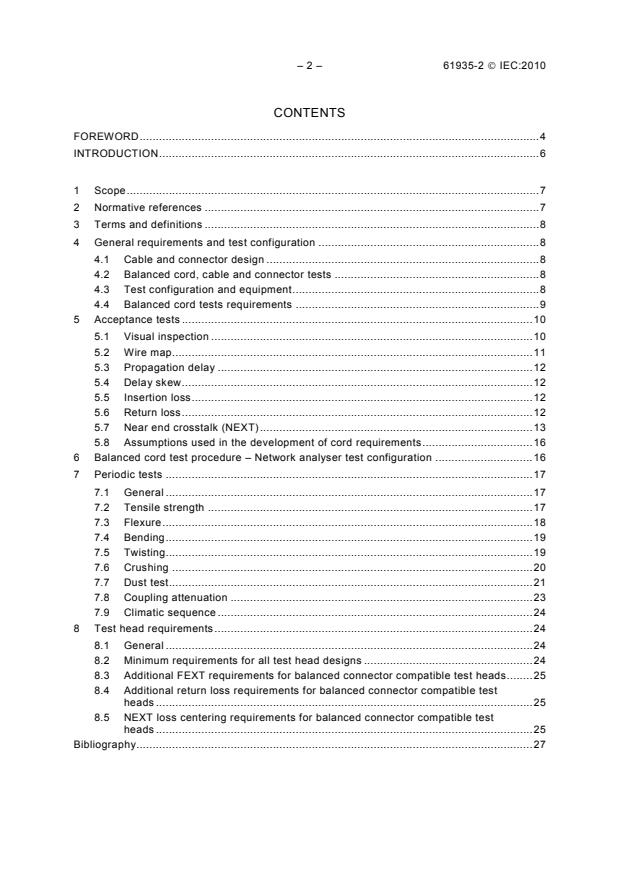
CONTENTS
FOREWORD.4
INTRODUCTION.6
1 Scope.7
2 Normative references .7
3 Terms and definitions .8
4 General requirements and test configuration .8
4.1 Cable and connector design .8
4.2 Balanced cord, cable and connector tests .8
4.3 Test configuration and equipment.8
4.4 Balanced cord tests requirements .9
5 Acceptance tests .10
5.1 Visual inspection .10
5.2 Wire map.11
5.3 Propagation delay .12
5.4 Delay skew.12
5.5 Insertion loss.12
5.6 Return loss.12
5.7 Near end crosstalk (NEXT).13
5.8 Assumptions used in the development of cord requirements.16
6 Balanced cord test procedure – Network analyser test configuration .16
7 Periodic tests .17
7.1 General .17
7.2 Tensile strength .17
7.3 Flexure.18
7.4 Bending.19
7.5 Twisting.19
7.6 Crushing .20
7.7 Dust test.21
7.8 Coupling attenuation .23
7.9 Climatic sequence .24
8 Test head requirements.24
8.1 General .24
8.2 Minimum requirements for all test head designs .24
8.3 Additional FEXT requirements for balanced connector compatible test heads.25
8.4 Additional return loss requirements for balanced connector compatible test
heads .25
8.5 NEXT loss centering requirements for balanced connector compatible test
heads .25
Bibliography.27
61935-2 © IEC:2010 – 3 –
Figure 1 – Test configuration for balanced cord for NEXT and return loss
measurements .9
Figure 2 – Correct pairing .11
Figure 3 – Incorrect pairing .11
Figure 4 – Initial marking of the cable sheath.17
Figure 5 – Final visual inspection.17
Figure 6 – Fixture for balanced cord flexure test .18
Figure 7 – Bending test: assembly in U shape .19
Figure 8 – Twisting test: assembly in U shape .20
Figure 9 – Fixture for cable crushing test .21
Figure 10 – Measuring device .23
Figure 11 – Centering of NEXT properties of the balanced connector test head .26
Table 1 – Return loss requirements .13
Table 2 – Balanced cord return loss requirements at key frequencies .13
Table 3 – Category 5 balanced cord NEXT requirements at key frequencies.15
Table 4 – Category 6 balanced cord NEXT requirements at key frequencies.15
Table 5 – Category 6 balanced cord NEXT requirements at key frequencies .15
A
Table 6 – Category 7 balanced cord NEXT requirements at key frequencies.15
Table 7 – Category 7 balanced cord NEXT requirements at key frequencies .15
A
Table 8 – Assumptions for cabling components used in the development of NEXT and
return loss requirements .16
Table 9 – Coupling attenuation limits .23
– 4 – 61935-2 © IEC:2010
INTERNATIONAL ELECTROTECHNICAL COMMISSION
____________
SPECIFICATION FOR THE TESTING OF BALANCED AND
COAXIAL INFORMATION TECHNOLOGY CABLING –
Part 2: Cords as specified in ISO/IEC 11801 and related standards
FOREWORD
1) The International Electrotechnical Commission (IEC) is a worldwide organization for standardization comprising
all national electrotechnical committees (IEC National Committees). The object of IEC is to promote
international co-operation on all questions concerning standardization in the electrical and electronic fields. To
this end and in addition to other activities, IEC publishes International Standards, Technical Specifications,
Technical Reports, Publicly Available Specifications (PAS) and Guides (hereafter referred to as “IEC
Publication(s)”). Their preparation is entrusted to technical committees; any IEC National Committee interested
in the subject dealt with may participate in this preparatory work. International, governmental and non-
governmental organizations liaising with the IEC also participate in this preparation. IEC collaborates closely
with the International Organization for Standardization (ISO) in accordance with conditions determined by
agreement between the two organizations.
2) The formal decisions or agreements of IEC on technical matters express, as nearly as possible, an international
consensus of opinion on the relevant subjects since each technical committee has representation from all
interested IEC National Committees.
3) IEC Publications have the form of recommendations for international use and are accepted by IEC National
Committees in that sense. While all reasonable efforts are made to ensure that the technical content of IEC
Publications is accurate, IEC cannot be held responsible for the way in which they are used or for any
misinterpretation by any end user.
4) In order to promote international uniformity, IEC National Committees undertake to apply IEC Publications
transparently to the maximum extent possible in their national and regional publications. Any divergence
between any IEC Publication and the corresponding national or regional publication shall be clearly indicated in
the latter.
5) IEC itself does not provide any attestation of conformity. Independent certification bodies provide conformity
assessment services and, in some areas, access to IEC marks of conformity. IEC is not responsible for any
services carried out by independent certification bodies.
6) All users should ensure that they have the latest edition of this publication.
7) No liability shall attach to IEC or its directors, employees, servants or agents including individual experts and
members of its technical committees and IEC National Committees for any personal injury, property damage or
other damage of any nature whatsoever, whether direct or indirect, or for costs (including legal fees) and
expenses arising out of the publication, use of, or reliance upon, this IEC Publication or any other IEC
Publications.
8) Attention is drawn to the Normative references cited in this publication. Use of the referenced publications is
indispensable for the correct application of this publication.
9) Attention is drawn to the possibility that some of the elements of this IEC Publication may be the subject of
patent rights. IEC shall not be held responsible for identifying any or all such patent rights.
International Standard IEC 61935-2 has been prepared by IEC technical committee 46:
Cables, wires, waveguides, R.F. connectors, R.F. and microwave passive components and
accessories.
This third edition cancels and replaces the second edition published in 2005.
This third edition of IEC 61935-2 differs from the second edition in that it covers category 6
A
to category 7 cords as defined in ISO/IEC 11801.
A
61935-2 © IEC:2010 – 5 –
The text of this standard is based on the following documents:
FDIS Report on voting
46/351/FDIS 46/364/RVD
Full information on the voting for the approval of this standard can be found in the report on
voting indicated in the above table.
The French version of this standard has not been voted upon.
This publication has been drafted in accordance with the ISO/IEC Directives, Part 2.
A list of all parts of the IEC 61935 series, under the general title: Specification for the testing
of balanced and coaxial information technology cabling, can be found on the IEC website.
The committee has decided that the contents of this publication will remain unchanged until
the stability indicated on the IEC web site under "http://webstore.iec.ch" in the data related to
the specific publication. At this date, the publication will be
• reconfirmed,
• withdrawn,
• replaced by a revised edition, or
• amended.
A bilingual version of this publication may be issued at a later date.
IMPORTANT – The 'colour inside' logo on the cover page of this publication indicates
that it contains colours which are considered to be useful for the correct
understanding of its contents. Users should therefore print this document using a
colour printer.
– 6 – 61935-2 © IEC:2010
INTRODUCTION
Balanced cords are constructed for connecting equipment using free connectors according to
IEC 60603-7 series, IEC 61076-3-104 and IEC 61076-3-110. It is known that connecting
hardware performance is subject to influence by the properties of the free connector
termination and therefore balanced cords should be tested to determine the quality of the
assembly. Moreover, the performance of balanced cords may differ due to the performances
of the involved separate components depending upon the efficiency of the manufacturing
procedure. Manufacturing procedures also impact upon the reliability of these balanced cords.
Therefore, the primary object of this standard is to provide test methods to ensure
compatibility of balanced cords to be used in cabling according to ISO/IEC 11801. Another
object is to provide test methods and associated requirements to demonstrate the
performance and reliability of these balanced cords during their operational lifetime.
The test methods described in this standard may also be used for any balanced cords that
include twisted pairs terminated at each end.
61935-2 © IEC:2010 – 7 –
SPECIFICATION FOR THE TESTING OF BALANCED AND
COAXIAL INFORMATION TECHNOLOGY CABLING –
Part 2: Cords as specified in ISO/IEC 11801 and related standards
1 Scope
This International Standard provides methods to ensure compatibility of balanced cords to be
used in cabling according to ISO/IEC 11801 and provides test methods and associated
requirements to demonstrate the performance and reliability of these balanced cords during
their operational lifetime. This International Standard may also be used for providing test
methods for assessing the behaviour of other balanced cords.
2 Normative references
The following referenced documents are indispensable for the application of this document.
For dated references, only the edition cited applies. For undated references, the latest edition
of the referenced document (including any amendments) applies.
IEC 60068-2-61, Environmental testing – Part 2: Test methods – Test Z/AMB: Climatic
sequence
IEC 60603-7 (all parts), Connectors for electronic equipment – Part 7: Detail specifications
IEC 60603-7:2008, Connectors for electronic equipment – Part 7: Detail specification for 8-
way, unshielded, free and fixed connectors
IEC 60603-7-51, Connectors for electronic equipment – Part 7-51: Detail specification for 8-
way, shielded, free and fixed connectors, for data transmission with frequencies up to 500
MHz
IEC 61076-3-104, Connectors for electronic equipment – Product requirements – Part 3-104:
Detail specification for 8-way, shielded free and fixed connectors for data transmissions with
frequencies up to 1000 MHz
IEC 61076-3-110, Connectors for electronic equipment – Product requirements – Part 3-110:
Rectangular connectors – Detail specification for shielded, free and fixed connectors for data
transmission with frequencies up to 1000 MHz
IEC 61156 (all parts), Multicore and symmetrical pair/quad cables for digital communications
IEC 61156-1, Multicore and symmetrical pair/quad cables for digital communications – Part 1:
Generic specification
IEC 61156-6, Multicore and symmetrical pair/quad cables for digital communications – Part 6:
Symmetrical pair/quad cables with transmission characteristics up to 1 000 MHz – Work area
wiring – Sectional specification
IEC 61935-1:2009, Specification for the testing of balanced and coaxial information
technology cabling – Part 1: Installed balanced cabling as specified in ISO/IEC 11801 and
related standards
– 8 – 61935-2 © IEC:2010
IEC 612153-4-11, Metallic communication cable test methods – Part 4-11: Electromagnetic
compatibility (EMC) – Coupling attenuation or screening attenuation of patch cords, coaxial
cable assemblies, pre-connectorized cables – Absorbing clamp method
ISO/IEC 11801, Information technology – Generic cabling for customer premises
3 Terms and definitions
For the purposes of this document, the terms and definitions given in IEC 61935-1 and the
following apply.
3.1
cord
a cable assembly as defined in IEC 61935-1 whatever its targeted use
NOTE In this document, the usage of balanced cord covers, amongst others, work area cord, patch cord and
equipment cord. The terminology “modular plug cord” is an alternative expression.
4 General requirements and test configuration
4.1 Cable and connector design
When compliance with ISO/IEC 11801 is required, the design of the cables and connectors
should conform to the applicable parts of IEC 61156 and IEC 60603-7, IEC 61076-3-110 and
IEC 61076-3-104 respectively.
4.2 Balanced cord, cable and connector tests
For balanced cords complying with ISO/IEC 11801, cables and connectors used in cable
assemblies should be assessed separately in accordance with IEC 61156-1 and IEC 60603-7,
IEC 61076-3-104 or IEC 61076-3-110 respectively. These component tests do not need to be
repeated on the balanced cord, but the terminated contact height should be assessed (e.g.
dimension K2 of Table 1 of IEC 60603-7).
For other cords, the cables and connectors shall be assessed separately according to their
respective standard unless there are no component standards. In this case, all tests will be
performed on the cords, including interface tests. The acceptance tests described in this
document shall be performed on a balanced cord on a lot-by-lot basis.
The periodic tests described in this document are type tests that have to be performed
according to the quality system of the manufacturer.
4.3 Test configuration and equipment
The reference measurement procedures that are described in this standard require the use of
a network analyser, coaxial interface cables, r.f. transformers (baluns), twisted pair test leads
and impedance matching terminations. Refer to IEC 61935-1 for requirements of test
equipment, including baluns (see 4.2.6 of IEC 61935-1). The nominal impedance for the test
set-up and the terminations is 100 Ω. The same tests may be used for 120 Ω and 150 Ω
cords, but the measurement methods have not been evaluated for these nominal impedance
values.
61935-2 © IEC:2010 – 9 –
The test configuration includes termination test heads at each end of the cord. For NEXT and
return loss, the test configuration is as shown in Figure 1. The terminals on the test heads
interface with the test equipment. Refer to IEC 61935-1 for detailed connection diagrams. All
pairs shall be terminated with differential plus common mode terminations per IEC 61935-1.
Resistive type terminations are preferred.
4 5
IEC 1351/10
Key
1 test interface 5 cord under test
2 network analyser (receiver, in –50 Ω) 6 ground plane
3 near end test head 7 far end test head
4 balun
Figure 1 – Test configuration for balanced cord for NEXT and return loss measurements
4.4 Balanced cord tests requirements
The test methods described in this specification characterise balanced cords according to
ISO/IEC 11801. They may be also used for other cords. For certification purposes, the test
schedule refers to these tests.
The cord test requirements include tests that can be performed on each cord or
representative samples produced, and tests that are only performed on representative
samples of cords. The sampling only tests (known as periodic tests) include:
• tensile strength;
• flexure;
• bending/twisting;
• crushing;
• dust test;
– 10 – 61935-2 © IEC:2010
• climatic sequence;
• coupling attenuation.
The periodic tests are described in detail in Clause 7.
The acceptance tests that can be performed on each cord include:
• visual inspection;
• wire map;
• return loss;
• pair-to-pair NEXT.
If all components used to assemble the cord are not assured to be compliant to their
respective component standards, the following additional tests should be performed:
• insertion loss (attenuation);
• propagation delay;
• delay skew;
• d.c. resistance;
• d.c. resistance unbalance.
The requirements to be verified on each cord are described in detail in Clause 5.
Balanced cords shall meet the transmission requirements of its designated category and, with
appropriate test heads, the transmission requirements of all lower categories, e.g. a category
7 balanced cord shall meet the:
A
• category 7 requirements when tested with a category 7 test head;
A A
• category 7 requirements when tested with a category 7 test head;
• category 6 requirements when tested with a category 6 test head;
A A
• category 6 requirements when tested with a category 6 test head;
• category 5 requirements when tested with a category 5 test head.
5 Acceptance tests
5.1 Visual inspection
Visual inspection of balanced cords shall be performed by visual inspection with normal or
corrected vision without any additional magnification:
• the condition, workmanship and finish are satisfactory;
• the marking, when specified in the relevant specification, is legible;
• mechanical damage is absent and there is no undesired movement or displacement of
parts;
• flaking of materials or finishes is absent;
• the length as specified.
61935-2 © IEC:2010 – 11 –
5.2 Wire map
A conductor map test is intended to verify correct pin termination at each end and to check for
installation connectivity errors. For each of the conductors in the cable, and the screen(s), if
any, the conductor map indicates
• continuity to the remote end;
• shorts between any two or more conductors/screen(s);
• transposed pairs;
• reversed pairs;
• split pairs;
• any other connection errors.
Correct connectivity of telecommunications outlet/connectors is defined in ISO/IEC 11801 (or
Figure 2 (for four pair cables).
equivalent), and is illustrated in
1 1
2 2
3 3
6 6
5 5
4 4
7 7
8 8
Screen Screen
IEC 1229/09
Figure 2 – Correct pairing
A reversed pair occurs when the polarity of one pair is reversed at one end of the balanced
cord (also called a tip/ring reversal). See Figure 3a for an illustration of a reversed pair.
A transposed pair occurs when the two conductors in a pair are connected to the position for
a different pair at the remote connection. See Figure 3b for an illustration of transposed pairs.
NOTE Transposed pairs are sometimes referred to as crossed pairs.
Split pairs occur when pin to pin continuity is maintained but physical pairs are separated.
See Figure 3c for an illustration of split pairs.
1 1 1 1 1 1
2 2 2 2 2 2
3 3 3 3 3
6 6 6 6 6
5 5 5 5 5 5
4 4 4 4 4 4
7 7 7 7 7 7
8 8 8 8 8 8
Screen Screen Screen Screen Screen Screen
IEC 1230/09 IEC 1231/09 IEC 1232/09
Figure 3a – Reversed pair
Figure 3b – Transposed pairs
Figure 3c – Split pairs
Figure 3 – Incorrect pairing
– 12 – 61935-2 © IEC:2010
If the balanced cord wire map test is conformant, then a “pass” shall be reported.
5.3 Propagation delay
Propagation delay is assumed to be met by design when using cables and connectors that
comply with IEC 61156-6, IEC 60603-7, IEC 61076-3-104 or IEC 61076-3-110 respectively.
Propagation delay shall be measured in accordance with 4.6 of IEC 61935-1.
5.4 Delay skew
Delay skew is assumed to be met by design when using cables and connectors that comply
with IEC 61156-6, IEC 60603-7, IEC 61076-3-104 or IEC 61076-3-110 respectively. Delay
skew shall be calculated in accordance with 4.6 of IEC 61935-1.
5.5 Insertion loss
Insertion loss is assumed to be met by design when using cables and connectors that comply
with IEC 61156-6, IEC 60603-7, IEC 61076-3-104 or IEC 61076-3-110 respectively. Insertion
loss shall be measured in accordance with 4.5 of IEC 61935-1.
5.6 Return loss
5.6.1 Object
The object of this test is to measure the return loss of a balanced cord.
5.6.2 Test method
Return loss is derived from the measured value of the scattering parameter, S and S , of
11 22
the balanced cord.
5.6.3 Test set-up and measurement
The test set-up is described in 4.3. The test set-up consists of a network analyser, four baluns
and two test heads (each containing a fixed connector). Calibration is performed according to
4.11.4.1 of IEC 61935-1.
The balanced cord shall be connected to the test equipment by connecting to appropriate (by
category) test heads, as shown in Figure 1.
5.6.4 Test report
The measured results shall be reported in graphical or table format with the limits specified in
the standard distinctly shown on the graphs or in the table at the same frequencies as
specified in the relevant detail specification. Results for all pairs shall be reported. It shall be
explicitly noted if the measured results exceed the test limits.
5.6.5 Requirements
The requirements for the return loss for each category are shown in Table 1. The assumptions
that were used to develop these requirements are shown in Table 8.
61935-2 © IEC:2010 – 13 –
Table 1 – Return loss requirements
Category 5 6 6 7 7
A A
Frequency range (MHz) 4 to 100 4 to 250 4 to 500 4 to 600 4 to 1 000
1 to 25 19,8+3·log(f) dB
25 to 250 38–10·log(f) dB
250 to 500 Not applicable 14–15·log(f/250) dB 38–10·log(f) dB
500 to 600 Not applicable 38–10·log(f) dB
a
600 to 1 000 Not applicable 38–10·log(f) dB
NOTE The frequency f is in MHz.
a
Calculated values below 10 dB revert to 10 dB.
The requirements at key frequencies are shown in Table 2.
Table 2 – Balanced cord return loss requirements at key frequencies
Return loss requirements at key frequencies in dB
Category 5 6 6 7 7
A A
4 MHz 21,6 21,6 21,6 21,6 21,6
100 MHz 18,0 18,0 18,0 18,0 18,0
250 MHz na 14,0 14,0 14,0 14,0
500 MHz na na 9,5 11,0 11,0
600 MHz na na na 10,2 10,2
1 000 MHz na na na na 10,0
na = not applicable
5.7 Near end crosstalk (NEXT)
5.7.1 Object
The object of this test is to measure the NEXT of a balanced cord.
5.7.2 Test method
NEXT is derived from the measured value of the scattering parameter of the balanced cord,
S and S as applicable.
21 12
5.7.3 Test set-up and measurement
The test set-up is described in 4.3.
The balanced cord shall be connected to the test equipment by connecting to appropriate (by
category) test heads, as shown in Figure 1. NEXT shall be measured in accordance with 4.7
of IEC 61935-1.
5.7.4 Test report
The measured results shall be reported in graphical or table format with the limits specified in
the standard distinctly shown on the graphs or in the table at the same frequencies as
specified in the relevant detail specification. Results for all pair combinations shall be
reported. It shall be explicitly noted if the measured results exceed the test limits.
– 14 – 61935-2 © IEC:2010
5.7.5 Requirements
When compliance with ISO/IEC 11801 is required, the NEXT requirements at key frequencies
are shown in Table 3 (category 5), Table 4 (category 6), Table 5 (category 6 ), Table 6
A
(category 7) and Table 7 (category 7 ) based upon the assumptions in Table 8. These values
A
are based on cord cables that are consistent with IEC 61156-6 and connectors that are
consistent with IEC 60603-7 series, IEC 61076-3-104 or IEC 61076-3-110.
The balanced cords shall meet the appropriate requirements of Equation (1), calculated
according to Equations (2), (3) and (4).
⎛ − (NEXT + 2⋅IL )⎞
−NEXT cable connector
⎜ ⎟
connectors
⎜ ⎟
(1)
NEXT = − 10⋅log⎜10 + 10 ⎟ − RFEXT
cord
⎜ ⎟
⎜ ⎟
⎜ ⎟
⎝ ⎠
where
NEXT is the NEXT of the entire cord in dB;
cord, dB
NEXT is the NEXT of the connectors in dB;
connector, dB
NEXT is the NEXT of the cable itself in dB;
cable, dB
IL is the insertion loss of one connector in dB;
connector, dB
RFEXT is the allowance for reflected FEXT in dB;
and
⎛ ⎛ ⎛ ⎞⎞⎞
− NEXT + 2⋅⎜ IL + IL ⎟
⎜ ⎜ ⎟⎟
− NEXT
remote cable connector
local
⎝ ⎠
⎝ ⎠
⎜ ⎟
(2)
⎜ 20 20 ⎟
NEXT = − 20⋅log 10 +10
connectors
⎜ ⎟
⎜ ⎟
⎜ ⎟
⎝ ⎠
The NEXT of the cord cable and connecting hardware is as specified in applicable standards.
The properties of the local and remote connectors are assumed to be identical.
L
(3)
IL ≈ α ⋅
cable,dB cable, 100m, dB
where
NEXT is the NEXT of the connector at the local end of the cord in dB;
local, dB
NEXT is the NEXT of the connector at the remote end of the cord in dB;
remote, dB
IL is the attenuation of the cable in dB;
cable, dB
IL is the attenuation of the connector in dB;
connector, dB
α is the attenuation of 100 m of the cable used for the cord;
cable, 100 m, dB
L is the length of the cable in the cord.
61935-2 © IEC:2010 – 15 –
The length corrected near-end crosstalk of the cable of the balanced cord is given by:
α
L
cable,100m,dB
⋅
100 5
1 − 10
(4)
NEXT = NEXT − 10 ⋅log
cable,L,dB cable, 100 m,dB
α
cable,100m,dB
1 − 10
Calculations yielding NEXT limits in excess of 65 dB shall revert to a limit of 65 dB.
Table 3 – Category 5 balanced cord NEXT requirements at key frequencies
Length 1 m 2 m 5 m 10 m
4 MHz 65,0 65,0 63,7 61,6 dB
100 MHz 39,9 39,0 37,4 36,4 dB
Table 4 – Category 6 balanced cord NEXT requirements at key frequencies
Length 1 m 2 m 5 m 10 m
4 MHz 65,0 65,0 65,0 65,0 dB
100 MHz 46,8 46,2 45,1 44,2 dB
250 MHz 39,1 38,7 38,0 37,6 dB
Table 5 – Category 6 balanced cord NEXT requirements
A
at key frequencies
Length 1 m 2 m 5 m 10 m
4 MHz 65,0 65,0 65,0 65,0 dB
100 MHz 46,8 46,2 45,1 44,2 dB
250 MHz 39,2 38,7 38,0 37,6 dB
500 MHz 31,0 31,0 31,3 31,7 dB
Table 6 – Category 7 balanced cord NEXT requirements at key frequencies
Length 1 m 2 m 5 m 10 m
4 MHz 65,0 65,0 65,0 65,0 dB
100 MHz 65,0 65,0 65,0 65,0 dB
250 MHz 60,4 60,7 61,2 61,9 dB
500 MHz 56,2 56,5 57,2 58,0 dB
600 MHz 55,0 55,4 56,2 57,0 dB
Table 7 – Category 7 balanced cord NEXT requirements
A
at key frequencies
Length 1 m 2 m 5 m 10 m
4 MHz 65,0 65,0 65,0 65,0 dB
100 MHz 65,0 65,0 65,0 65,0 dB
250 MHz 62,5 62,6 63,3 64,1 dB
500 MHz 56,7 57,1 58,0 59,1 dB
600 MHz 55,3 55,6 56,7 57,8 dB
1 000 MHz 46,7 47,4 48,9 50,2 dB
– 16 – 61935-2 © IEC:2010
5.8 Assumptions used in the development of cord requirements
In accordance with ISO/IEC 11801, the assumptions that were used in the development of
cord NEXT and return loss requirements are shown in Table 8.
Table 8 – Assumptions for cabling components used in the development of NEXT
and return loss requirements
Category 5 6 6 7 7
A A
Frequency range 4 to 100 4 to 250 4 to 500 4 to 600 4 to 1 000 MHz
Insertion loss for 1,9108·√f+ 1,82·√f+ 1,82·√f+ 1,8·√f+ 1,8·√f+ dB
horizontal cable,
0,0222·f+ 0,017·f+ 0,0091·f+ 0,01·f+ 0,005·f+
100 m
0,2/√f 0,25/√f 0,25/√f 0,2/√f 0,25/√f
Insertion loss derating 50 %
for cord cable
Return loss cord cable, 20+ 5·log(f), 4 MHz to 10 MHz 20+ 5·log(f), 4 MHz to 10 MHz dB
100 m
25, 10 MHz to 25 MHz 25, 10 MHz to 25 MHz
25 – 8,6·log(f), ≥ 25 MHz 25 – 8,6·log(f), ≥ 25 MHz,
15,6 dB minimum
NEXT cord cable, 65,3–15·log(f) 74,3– 74–15·log(f) 102,4– 108,4–15·log(f) dB
100 m 15·log(f) 15·log(f)
Cable asymptotic 100 ± 5 Ω
characteristic
impedance
Test head mated 0,04·√f 0,02·√f dB
insertion loss
Test head mated 69–20·log(f) dB
return loss
Test head mated 0,04 m
electrical length
Test head mated FEXT 88,1–20·log(f) dB
Test head mated 87 – 20·log(f) 94 – 20·log(f) 94 – 20·log(f) 102,4 – 116,3 – 20·log(f) dB
NEXT 15·log(f)
f ≤ 250 MHz f ≤ 600 MHz
46,04 – 60,73 –
30·log(f/250) 40·log(f/600)
f > 250 MHz f > 600 MHz
Reflected FEXT 0 0,5 dB
allowance
NOTE The frequency f is in MHz.
6 Balanced cord test procedure – Network analyser test configuration
The test configuration is described in 4. 3 .
The frequency step size shall be no greater than 1 MHz up to 1 000 MHz. Pass/fail
qualification shall be determined by comparing the resulting sweeps to the pass/fail limits for
the applicable frequency range. The pass/fail margin and the frequency at which it occurs
shall be reported for each pair combination.
61935-2 © IEC:2010 – 17 –
7 Periodic tests
7.1 General
Where specified in this clause, the transmission performance requirements of Clause 5 shall
be met before and after conditioning tests.
7.2 Tensile strength
7.2.1 Object
To determine the mechanical strength and, when required, electrical stability of the balanced
cord when subjected to an axial force.
7.2.2 Procedure
A tensile force as specified in the relevant detail specification shall be applied to the two
connectors along the common axis of the cable and connectors.
Preparation shall be made after initial visual inspection (before all the subsequent tests).
Mark the outer cable sheath at the end of the connector boot at both ends of the balanced
cord as indicated in Figure 4. The marks are required to identify movement of the cable
sheath caused by the mechanical stresses during subsequent tests.
IEC 1352/10
Figure 4 – Initial marking of the cable sheath
If the connector has a shrink-tube as part of the boot, the mark shall be made on the outer
cable sheath right at the end of the shrink-tube.
7.2.3 Requirements
The movement of the cable relative to the connector, during and after any test, shall be
limited to 1 mm maximum (see Figure 5). This visual inspection shall be applied to ensure that
the captivation or attachment of a cable sheath to a connector will withstand all climatic and
mechanical tests required in this specification. After the test, NEXT and return loss shall be as
specified in the detail specification.
Final visual inspection shall be made after all tests have been finished. The outer sheath
movement is visible through the movements of the marks at the outer cable sheath.
Max. 1 mm
IEC 1353/10
Figure 5 – Final visual inspection
– 18 – 61935-2 © IEC:2010
7.2.4 Detail specification
Requirements to be given in the detail specification:
a) value of the force (normally 50 N for balanced cords);
b) duration and method of application of the force;
c) NEXT;
d) return loss;
e) the allowed movement of the outer cable sheath relative to the connector boots.
7.3 Flexure
7.3.1 Object
To determine the ability of the balanced cord to withstand bending at the junction of the cable
and connector.
7.3.2 Procedure
The test shall be performed using a fixture shown in Figure 6.
±90°
Pivot
Adaptor secured – both
connectors latched
220 mm to 280 mm
F = 2 N
IEC 1354/10
Figure 6 – Fixture for balanced cord flexure test
A flexure is a rotation of the fixture of 180°. The rate of flexure shall be 20 per minute or as
specified in the relevant detail specification.
7.3.3 Requirements
After the test, the balanced cord interface dimensions shall be within the specified limits.
Electrical test requirements stated in the relevant detail specification shall be complied with.
61935-2 © IEC:2010 – 19 –
7.3.4 Information to be given in the detail specification
Information to be given in the detail specification:
a) number of flexures, normally 500;
b) NEXT;
c) return loss;
d) whether or not electrical tests shall be applied with the balanced cord still on the
fixture.
7.4 Bending
7.4.1 Object
To determine the ability of the balanced cord to withstand bending of the cable by checking
return loss and NEXT compliance after bending.
7.4.2 Procedures
A balanced cord, which is a "U" shape, has to be connected to a suitable network analyser
(Figure 7a). During recording of the return loss or the NEXT, the cable is wound around a
mandrel for 180° (Figure 7b), unwound to the starting position, wound counter-clockwise for
180° around the mandrel (Figure 7c) and again unwound to its starting position. The initial
position of the mandrel shall be chosen that only the straight parts of the "U" will be bent
during the test. Unless otherwise specified, the radius of the mandrel shall be 120 mm.
DUT
Figure 7a – Starting position
IEC 1355/10
Figure 7b – Clockwise
rotation
DUT
IEC 1356/10
DUT
Figure 7c – Counter
clockwise rotation
IEC 1357/10
Key
1 NWA test ports
Figure 7 – Bending test: assembly in U shape
7.5 Twisting
7.5.1 Object
To determine the ability of the balanced cord to withstand twisting of the cable by checking
return loss and NEXT compliance after twisting.
– 20 – 61935-2 © IEC:2010
7.5.2 Procedures
A balanced cord, which is in a "U" shape, has to be connected to a suitable network analyser
(Figure 8a). During the recording of the return loss and the NEXT, the mandrel in the middle
of the cable is first twisted in a clockwise direction for 180° (Figure 8b) then released to the
starting position, twisted counter-clockwise for 180° (Figure 8c) and again released to its
starting position.
NOTE Depending on the torsional rigidity and the maximum permissible torque at the cable connector's interface,
the maximum twist angle may have to be reduced.
DUT
Figure 8a – Starting position
IEC 1358/10
DUT
Figure 8b – Clockwise twist
IEC 1359/10
DUT
Figure 8c – Counter
clockwise twist
IEC 1360/10
Unless otherwise specified, the radius of mandrel shall be 120 mm.
Key
1 NWA test ports
Figure 8 – Twisting test: assembly in U shape
7.5.3 Requirements
The return loss and NEXT shall not exceed the limits specified in the relevant detail
specification.
7.6 Crushing
7.6.1 Object
To determine the ability of a balanced cord to withstand a transverse load (or a force) applied
to any part of the cable.
This test is normally performed on the cable before assembly. Where the cable was not tested
for crushing, the balance
...